

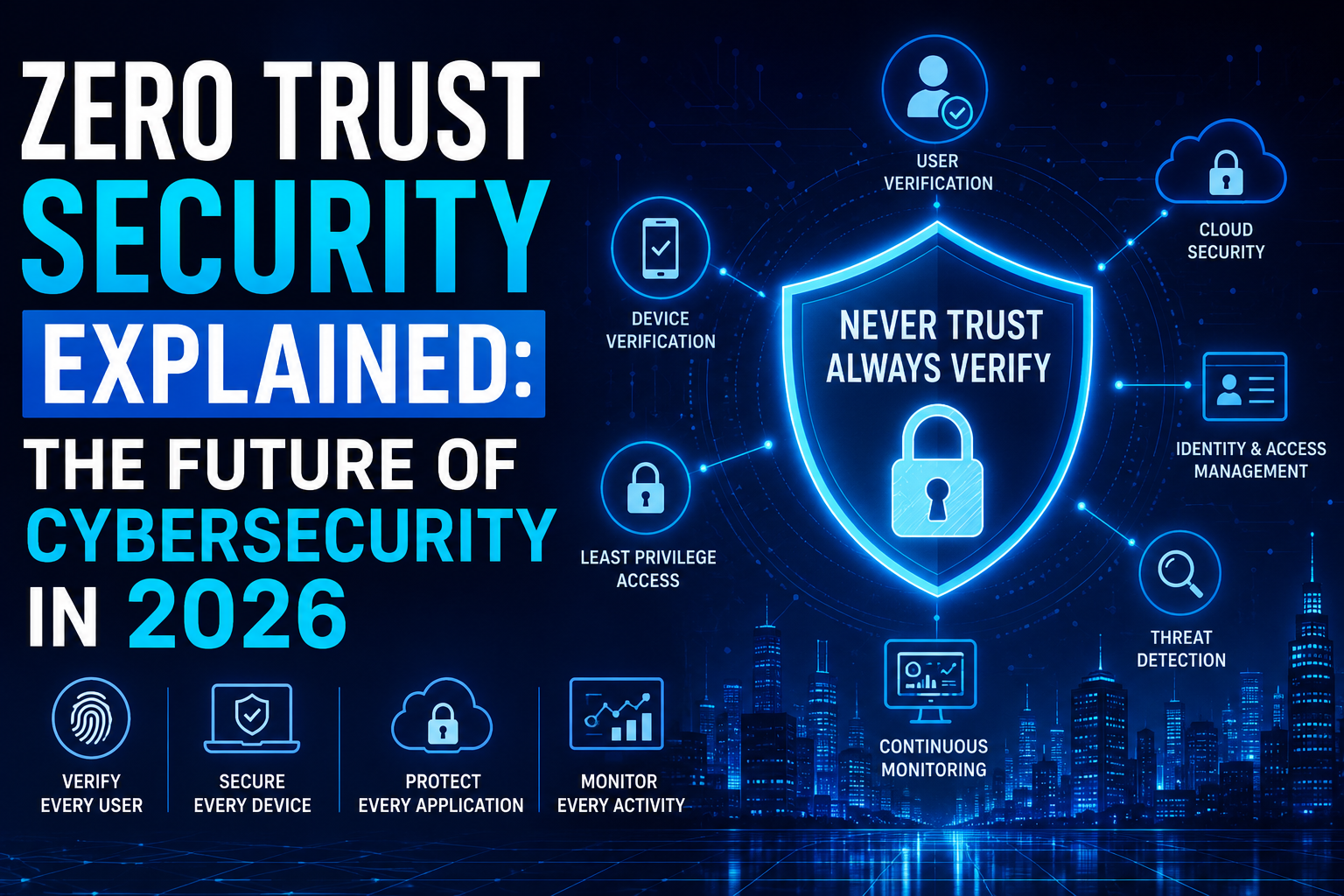
Cybersecurity is changing faster than ever. Businesses no longer protect only office computers. They now manage cloud platforms, mobile devices, remote employees, and smart technologies every day. This rapid growth has also increased Advanced Cyber Threats. Hackers no longer attack only company networks. They steal identities, target cloud accounts, and exploit human mistakes. That is why many organizations have started replacing the Traditional Security Model with smarter and more flexible protection methods.
Today, companies need security that protects every user, device, and application. A single password is no longer enough. One stolen account can expose valuable information within minutes. Zero Trust Security has become one of the most trusted approaches because it checks every request before granting access. Instead of assuming everything inside a network is safe, it continuously verifies users and devices. This strategy improves Business Data Security, strengthens Cyber Attack Prevention, and creates a Secure Digital Environment for organizations of every size.
Introduction: Why Traditional Security Models Are No Longer Enough
For many years, businesses relied on Network Perimeter Security. The idea was simple. Build a strong firewall around the company network and trust everyone inside it. That method worked well when employees used office computers and company servers. However, the workplace looks very different today. Employees work from home, connect through personal laptops, and use Cloud-Based Applications every day. Companies also depend on digital services that operate across different locations. These changes have made the old security approach far less effective.
Cybercriminals have adapted quickly. They no longer wait outside the network. Instead, they steal login credentials through phishing emails, malware, or weak passwords. Once attackers enter the system, they often move freely because the network already trusts them. This creates serious risks for Digital Transformation projects and modern businesses. Organizations now require Modern Cybersecurity Solutions that verify every request before allowing access. This shift supports Online Security Protection, improves Data Breach Prevention, and helps organizations build a safer Modern IT Infrastructure for the future.
What Is Zero Trust Security?
Zero Trust Security is a cybersecurity strategy that assumes no user, device, or application should receive automatic trust. Every access request must pass several security checks before entering company resources. This approach follows the simple idea of Never Trust Always Verify. Instead of trusting users because they are inside the company network, the system confirms their identity, device health, and security status every time they request access.
The foundation of Zero Trust Security is the Zero Trust Security Model. This model combines Identity Verification, User Authentication, Access Control, and Continuous Monitoring into one complete security process. It protects sensitive information whether users work from the office, home, or another country. Businesses using this approach reduce security risks while improving Cloud Security, Data Protection, and Enterprise Security. As digital environments continue expanding, this model has become one of the strongest examples of a Modern Security Approach.
How Does the Zero Trust Security Model Work?
The Zero Trust Security Model does not depend on location. Instead, it evaluates every request before granting permission. Whenever someone tries to access files, applications, or company systems, the platform checks user identity, device condition, location, behavior, and risk level. If something appears unusual, the system requests additional verification or blocks access completely. This process protects organizations even when attackers steal passwords or compromise user accounts.
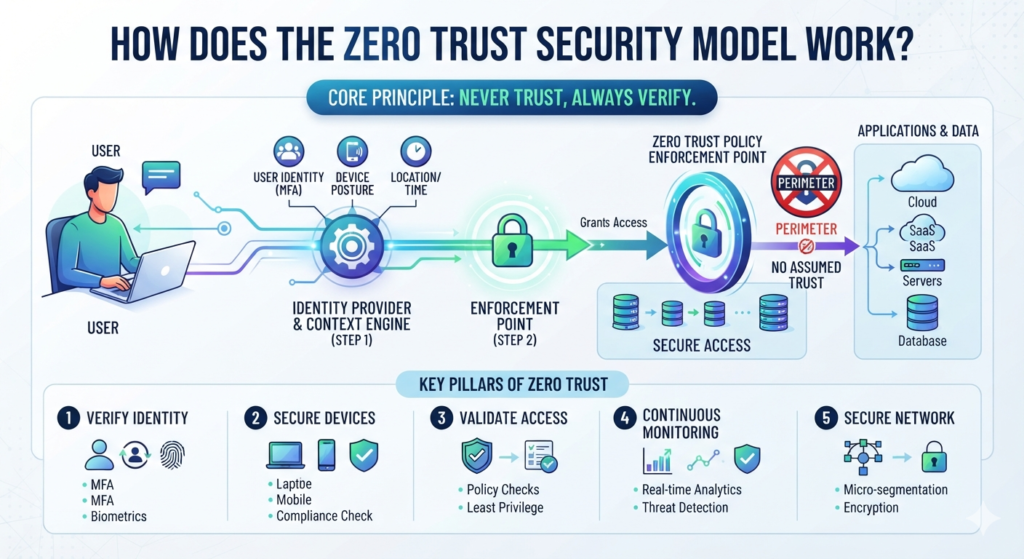
Every security decision follows the principles of the Zero Trust Architecture. The system performs Device Verification, evaluates Risk-Based Access, applies Security Policies, and continues Security Monitoring after access is granted. If user behavior suddenly changes, the platform immediately reacts. This ongoing process strengthens Threat Detection, improves Cyber Threat Intelligence, and supports Security Automation across modern business environments.
| Security Stage | Purpose | Business Benefit |
| Identity Verification | Confirms the user’s identity | Prevents unauthorized access |
| Device Verification | Checks device security status | Reduces infected device risks |
| Risk-Based Access | Evaluates login risk | Protects sensitive systems |
| Continuous Monitoring | Watches user activity | Detects suspicious behavior quickly |
| Incident Response | Responds to threats | Limits security damage |
1. Never Trust, Always Verify
The principle of Never Trust Always Verify sits at the center of Zero Trust Security. Every employee, contractor, customer, and administrator must verify their identity before accessing company resources. The system does not assume anyone is safe simply because they logged in earlier. Instead, every new request receives fresh security checks. This method creates stronger Identity-Based Security while reducing opportunities for attackers to move across company systems.
Imagine an employee working from home. They sign in using company credentials from a new laptop. Instead of allowing immediate access, the system performs Identity and Access Management, requests Multi-Factor Authentication, checks Digital Identity, confirms Endpoint Security, and reviews device health. If everything appears safe, access continues. If unusual behavior appears later, Continuous Authentication activates another verification process. This strategy improves Remote Work Security, supports Secure Access Management, strengthens Security Controls, and protects valuable business information without interrupting normal work.
2. Least Privilege Access
Many companies make one common mistake. They give employees more access than they actually need. This creates unnecessary security risks. The principle of Least Privilege Access solves this problem by allowing users to access only the files, systems, and applications required for their specific job. If an attacker steals an employee’s account, the damage stays limited because the account cannot reach every business resource. This simple rule plays a major role in successful Zero Trust Implementation and strengthens overall Security Architecture.
For example, an HR manager does not need access to financial databases. Likewise, a marketing employee should not control server settings. Modern organizations use Privileged Access Management to separate sensitive accounts from regular user accounts. These controls improve Enterprise Risk Management, reduce Attack Surface Reduction, and increase Business Continuity during security incidents. By limiting permissions, businesses also improve Security Best Practices while protecting confidential customer and company information.
3. Continuous Monitoring and Authentication
Security should never stop after login. Attackers often wait until they enter a network before changing their behavior. That is why Continuous Monitoring has become one of the strongest features of Zero Trust Security. Every user session stays under observation. The system watches login locations, device changes, unusual downloads, and unexpected activities. This process helps security teams identify threats before they become serious attacks.
Modern security platforms combine Continuous Authentication, User Behavior Analytics, AI-Powered Security, and Machine Learning Security to recognize suspicious actions in real time. For example, if an employee usually logs in from Texas during business hours but suddenly signs in from another country late at night, the system immediately increases security checks. These intelligent decisions improve Automated Threat Detection, strengthen Real-Time Security Monitoring, and support faster Incident Response whenever unusual behavior appears.
Why Zero Trust Security Is Important in 2026
The cybersecurity landscape looks very different today than it did only a few years ago. Businesses now rely on cloud platforms, connected devices, artificial intelligence, and remote employees. At the same time, cybercriminals continue developing more advanced attack methods. Password theft, ransomware, phishing campaigns, and identity attacks have become daily challenges for organizations across the United States. These changes make Zero Trust Security more important than ever because it focuses on verifying every user instead of trusting every connection.
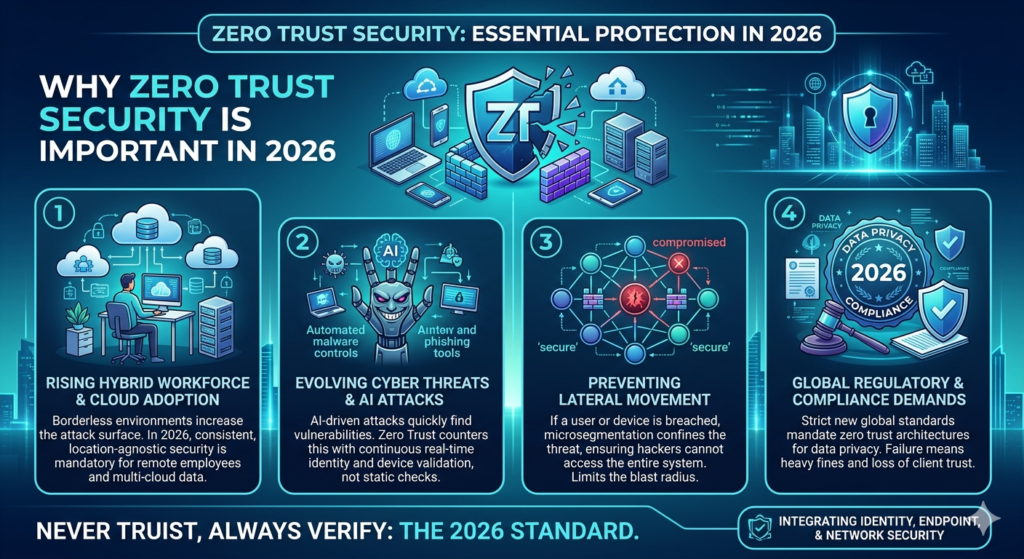
Government agencies, healthcare providers, banks, technology companies, and online retailers now invest heavily in Cybersecurity Strategy because digital assets have become their most valuable resources. Modern regulations also introduce stronger Compliance Requirements for protecting customer information. Organizations adopting Zero Trust Security improve Ransomware Protection, strengthen Phishing Prevention, increase Data Privacy, and build a Secure Cloud Environment that supports long-term business growth.
Cybersecurity Trends Driving Zero Trust Adoption
| Trend | Why It Matters |
| Remote employees | More users connect outside company offices. |
| Cloud services | Business data now lives across multiple cloud platforms. |
| AI-powered attacks | Hackers automate attacks using artificial intelligence. |
| Identity theft | Stolen credentials remain one of the biggest attack methods. |
| Compliance laws | Companies must better protect customer information. |
| Digital transformation | Businesses need stronger security for new technologies. |
Key Principles of Zero Trust Architecture
Every successful Zero Trust Architecture follows several core principles. First, every request requires verification regardless of where it comes from. Second, organizations assume attackers may already exist inside the network. Third, access remains limited according to business needs. Finally, systems monitor users continuously instead of checking them only during login. Together, these principles create stronger protection against modern cyber risks.
This security approach also depends on strong Security Infrastructure and intelligent decision-making. Businesses combine Security Monitoring, Cyber Threat Intelligence, Network Protection, and Security Controls to protect every digital resource. Instead of building a single wall around the company, organizations secure every user, application, and device individually. This flexible design supports long-term growth while improving Digital Asset Protection across every business environment.
Identity Verification
Strong security begins with knowing exactly who requests access. Identity Verification confirms users before allowing them to reach company systems. Modern organizations no longer depend only on passwords because passwords alone can be stolen. Instead, businesses combine identity checks with additional security methods to reduce unauthorized access.
Companies strengthen verification through Identity and Access Management, Multi-Factor Authentication, and secure User Authentication systems. These technologies verify employees through passwords, mobile devices, biometrics, or security keys. Together, they improve Digital Identity protection while creating safer access for both office workers and the growing Remote Workforce.
Device Security Checks
A trusted employee can still use an unsafe device. That is why Device Verification plays an essential role in Zero Trust Security. Before allowing access, the system checks whether laptops, smartphones, or tablets meet company security standards. Devices with outdated software or known vulnerabilities receive limited access until security issues are fixed.
Organizations also combine Endpoint Security, Application Security, and Vulnerability Management to protect every connected device. This approach prevents malware from entering business systems and strengthens Malware Defense across the organization. Healthy devices reduce cyber risks while supporting a safer digital workplace for employees everywhere.
Network Segmentation
Traditional networks often allow attackers to move freely after gaining access. Network Segmentation solves this problem by dividing the network into smaller protected areas. Even if hackers compromise one section, they cannot easily reach other sensitive systems or confidential business data.
Advanced organizations also implement Micro Segmentation for even stronger protection. Every application, server, and workload receives its own security rules. This strategy limits attacker movement while improving Network Protection, reducing business risks, and supporting more effective Cyber Attack Prevention throughout the organization.
Real-Time Threat Detection
Modern cyber attacks move quickly. Some attacks take only a few minutes to steal valuable information. Businesses cannot wait for manual investigations because delays often increase damage. Real-Time Security Monitoring allows organizations to identify suspicious behavior immediately. Security platforms watch every login, file transfer, device connection, and network request. If unusual activity appears, the system reacts before attackers can spread across the environment.
Today’s security tools combine Threat Detection, AI-Powered Security, Machine Learning Security, and Cyber Threat Intelligence to analyze millions of events every day. They learn normal user behavior and quickly recognize suspicious patterns. When an employee suddenly downloads thousands of confidential files or logs in from an unusual country, the platform automatically launches Incident Response procedures. This intelligent process improves Automated Threat Detection, reduces response time, and strengthens the entire Cybersecurity Framework.
Zero Trust Security vs Traditional Network Security
The biggest difference between Zero Trust Security and the Traditional Security Model is trust. Older security systems assume users inside the company network are safe. Once employees log in, they often receive broad access without additional verification. That approach worked years ago when businesses operated only from physical offices. Today, cloud services, remote work, and mobile devices have completely changed how organizations operate. Trust based only on location no longer provides enough protection.
Zero Trust Security verifies every request regardless of where it comes from. It checks user identity, device condition, application risk, and current behavior before granting access. This process improves Cloud Security, strengthens Enterprise Security, and creates a more resilient Modern Security Approach. Instead of protecting only the network edge, organizations protect every user, application, and digital resource individually.
| Feature | Traditional Security Model | Zero Trust Security |
| Trust Level | Trusted after login | Verify every request |
| Security Focus | Network boundary | Identity and data |
| User Access | Broad permissions | Least Privilege Access |
| Authentication | One-time login | Continuous Authentication |
| Monitoring | Limited | Continuous Monitoring |
| Threat Response | Mostly reactive | Proactive and automated |
| Cloud Protection | Limited | Strong Hybrid Cloud Security |
| Insider Risk | Higher | Lower through verification |
Benefits of Implementing Zero Trust Security
Organizations adopting Zero Trust Security experience stronger protection across every department. Employees access only the information required for their work. Security teams gain better visibility into user activity. Cloud applications become safer because every connection passes through multiple verification steps. This approach also supports Secure Access Management, improves Data Protection, and reduces the chances of expensive cyber incidents.
Businesses also benefit from improved Business Data Security, stronger Data Breach Prevention, and better Online Security Protection. Security teams spend less time responding to preventable incidents because automated systems identify problems earlier. Companies improve customer trust while meeting important Compliance Requirements. As digital operations continue growing, Zero Trust Security helps organizations build a safer and more reliable future.
Benefits of Zero Trust Security
| Business Benefit | Business Impact |
| Better identity protection | Fewer unauthorized logins |
| Reduced ransomware risk | Lower financial losses |
| Stronger cloud security | Safer cloud operations |
| Better compliance | Easier regulatory audits |
| Faster threat detection | Reduced incident response time |
| Limited attacker movement | Better Digital Asset Protection |
| Secure remote work | Improved employee productivity |
Challenges of Zero Trust Adoption
Although Zero Trust Security offers many advantages, implementation requires careful planning. Many organizations still operate older systems that were never designed for modern identity-based security. Upgrading these systems requires investment, skilled professionals, and a clear migration strategy. Employees also need training because new verification methods may initially seem unfamiliar.
Another challenge involves balancing strong protection with user experience. Security should never become so complicated that employees struggle to complete daily tasks. Successful organizations solve this problem by gradually introducing Security Policies, improving Security Controls, and investing in Security Automation. Over time, users become comfortable with stronger authentication while businesses continue improving overall protection.
How Businesses Can Implement a Zero Trust Strategy
Every successful Zero Trust Implementation begins with understanding existing security risks. Organizations should first identify valuable business assets, sensitive customer information, critical applications, and connected devices. Once these resources are clearly documented, security teams can design policies that protect each asset according to its importance. This structured approach reduces unnecessary complexity while strengthening the organization’s Cybersecurity Strategy.
Implementation should happen gradually instead of changing every system at once. Businesses usually improve identity management first, strengthen authentication, secure devices, and then expand continuous monitoring across the organization. This phased approach supports Business Continuity, improves Security Best Practices, and helps organizations build a stronger Secure Cloud Environment without disrupting daily operations.
Step 1: Identify Users and Devices
The first step is knowing exactly who accesses company resources. Security teams create a complete inventory of employees, contractors, vendors, applications, servers, laptops, and mobile devices. Unknown users or unmanaged devices create unnecessary security risks because they operate outside normal security controls.
Organizations also classify resources according to business importance. Critical financial systems receive stronger protection than public information. This process improves Access Control, strengthens Device Verification, and supports better Enterprise Risk Management by reducing unknown security gaps.
Step 2: Improve Identity Management
Strong identity management forms the foundation of Zero Trust Security. Every employee should receive a unique identity that follows strict verification rules. Shared accounts should disappear because they make investigations difficult after security incidents.
Modern businesses deploy Identity and Access Management, Privileged Access Management, and advanced User Authentication systems to protect every login. These technologies reduce identity theft while strengthening Identity-Based Security across cloud services, business applications, and internal systems.
Step 3: Apply Multi-Factor Authentication
Passwords alone no longer provide enough protection. Many cybercriminals steal passwords through phishing emails, malware, or previous data breaches. Even strong passwords can eventually become compromised if users unknowingly expose them.
Multi-Factor Authentication adds another layer of security by requiring users to verify their identity using additional methods such as authentication apps, fingerprints, security keys, or one-time verification codes. This extra step dramatically improves Ransomware Protection, supports Phishing Prevention, and strengthens overall account security.
Step 4: Monitor Network Activity
Security does not end after users receive access. Organizations must continuously observe system activity to identify unusual behavior before it becomes a serious incident. Security teams review login history, application usage, data transfers, and network traffic every day.
Modern monitoring platforms combine Security Monitoring, User Behavior Analytics, Automated Threat Detection, and Cyber Threat Intelligence to identify suspicious actions immediately. These systems support faster Incident Response, improve Attack Surface Reduction, and help businesses maintain long-term cybersecurity resilience.
Role of AI in Zero Trust Security
Artificial intelligence is changing the way organizations defend their systems. Modern attacks happen within seconds. Human teams alone cannot analyze millions of security events every day. That is why Zero Trust Security now works closely with AI-Powered Security to detect unusual behavior faster and make better security decisions. AI studies login patterns, user activity, device health, and application usage. When something looks suspicious, it reacts immediately before the threat grows.
For example, an employee normally signs in from New York during office hours. Suddenly, the same account attempts to log in from another country late at night. AI compares this activity with previous behavior and identifies it as unusual. It can request additional verification, block the session, or notify the security team. This intelligent process uses Machine Learning Security, Threat Detection, Continuous Monitoring, and User Behavior Analytics to strengthen Cyber Attack Prevention while reducing false alarms that often waste valuable time.
Zero Trust Security for Small Businesses
Many small business owners believe advanced cybersecurity is only for large corporations. That assumption is no longer true. Small businesses have become attractive targets because attackers know they often have fewer security resources. A single ransomware attack or stolen employee account can interrupt daily operations and cause significant financial losses. Zero Trust Security gives small organizations an affordable way to strengthen protection without building expensive security systems.
Small businesses can begin with simple improvements. They should enable Multi-Factor Authentication, strengthen Identity Verification, secure laptops with Endpoint Security, and protect important cloud accounts using Cloud Security tools. Business owners should also review Security Policies, educate employees about phishing attacks, and monitor account activity regularly. These practical steps improve Business Data Security, support Data Privacy, and create a stronger Secure Digital Environment for customers and employees.
Simple Zero Trust Checklist for Small Businesses
| Security Practice | Why It Matters |
| Enable Multi-Factor Authentication | Prevents unauthorized account access |
| Use strong Identity and Access Management | Controls who accesses business systems |
| Secure company devices | Reduces malware infections |
| Apply Least Privilege Access | Limits insider risks |
| Monitor user activity | Detects unusual behavior quickly |
| Update software regularly | Fixes known vulnerabilities |
| Train employees | Improves phishing awareness |
Future of Zero Trust Cybersecurity in 2026 and Beyond
Cybersecurity will continue evolving because technology never stands still. Artificial intelligence, cloud computing, smart devices, and digital services are expanding every year. At the same time, attackers continue creating more sophisticated methods to steal information. Organizations can no longer depend on outdated security strategies. Zero Trust Security will remain one of the most effective approaches because it protects users, devices, applications, and data through constant verification instead of blind trust.
Industry experts expect Zero Trust Architecture to become a standard part of every Cybersecurity Framework. Future platforms will rely more heavily on Security Automation, intelligent analytics, and Real-Time Security Monitoring to make security decisions within seconds. Businesses investing today will build stronger resilience tomorrow. They will improve Digital Asset Protection, strengthen Business Continuity, and create a safer Modern IT Infrastructure that supports innovation without sacrificing security.
“Trust is no longer a security strategy. Continuous verification is the foundation of modern cybersecurity.”
Frequently Asked Questions (FAQ)
What is Zero Trust Security?
Zero Trust Security is a cybersecurity approach that never automatically trusts users, devices, or applications. Every request must pass verification before access is granted.
Why is Zero Trust Security important in 2026?
Businesses now depend on cloud platforms, remote employees, and digital services. Modern cyber threats target identities instead of only networks. Zero Trust Security reduces these risks through continuous verification.
How does Zero Trust Architecture work?
Zero Trust Architecture checks user identity, device health, application risk, and activity before granting access. It continues monitoring users even after they successfully log in.
Is Zero Trust Security only for large businesses?
No. Small businesses can also implement Zero Trust Security by using Multi-Factor Authentication, protecting devices, limiting user permissions, and monitoring account activity.
What are the main principles of Zero Trust Security?
The main principles include Never Trust Always Verify, Least Privilege Access, Continuous Authentication, Continuous Monitoring, and strong Identity Verification for every user and device.
How does AI improve Zero Trust Security?
Artificial intelligence analyzes user behavior, identifies unusual activities, improves Threat Detection, and supports faster Incident Response through intelligent automation.
What is the difference between Zero Trust Security and traditional security?
Traditional security trusts users after login. Zero Trust Security verifies every request continuously, regardless of where the user connects from.
How can a company start implementing Zero Trust?
Organizations should identify users and devices, improve identity management, enable Multi-Factor Authentication, monitor activity continuously, and gradually expand Zero Trust Implementation across all systems.
Conclusion
Cybersecurity has entered a new era where trust alone no longer provides protection. Businesses operate across cloud platforms, remote locations, and connected devices that constantly exchange sensitive information. Every new connection creates another opportunity for attackers. Zero Trust Security addresses these challenges by verifying every user, every device, and every request before granting access. This approach reduces cyber risks while improving visibility across the entire organization.
Whether you manage a global enterprise or a growing small business, adopting Zero Trust Security is an investment in long-term resilience. Combined with strong identity management, AI-driven monitoring, and continuous verification, it creates a safer digital environment prepared for today’s threats and tomorrow’s challenges. Organizations that embrace this modern security strategy today will be better equipped to protect their people, data, and reputation in 2026 and beyond.
Meta Description:
Learn Zero Trust Security in 2026. Discover how Zero Trust Architecture, AI, MFA, and continuous verification protect businesses from modern cyber threats and data breaches.
15 Comments