

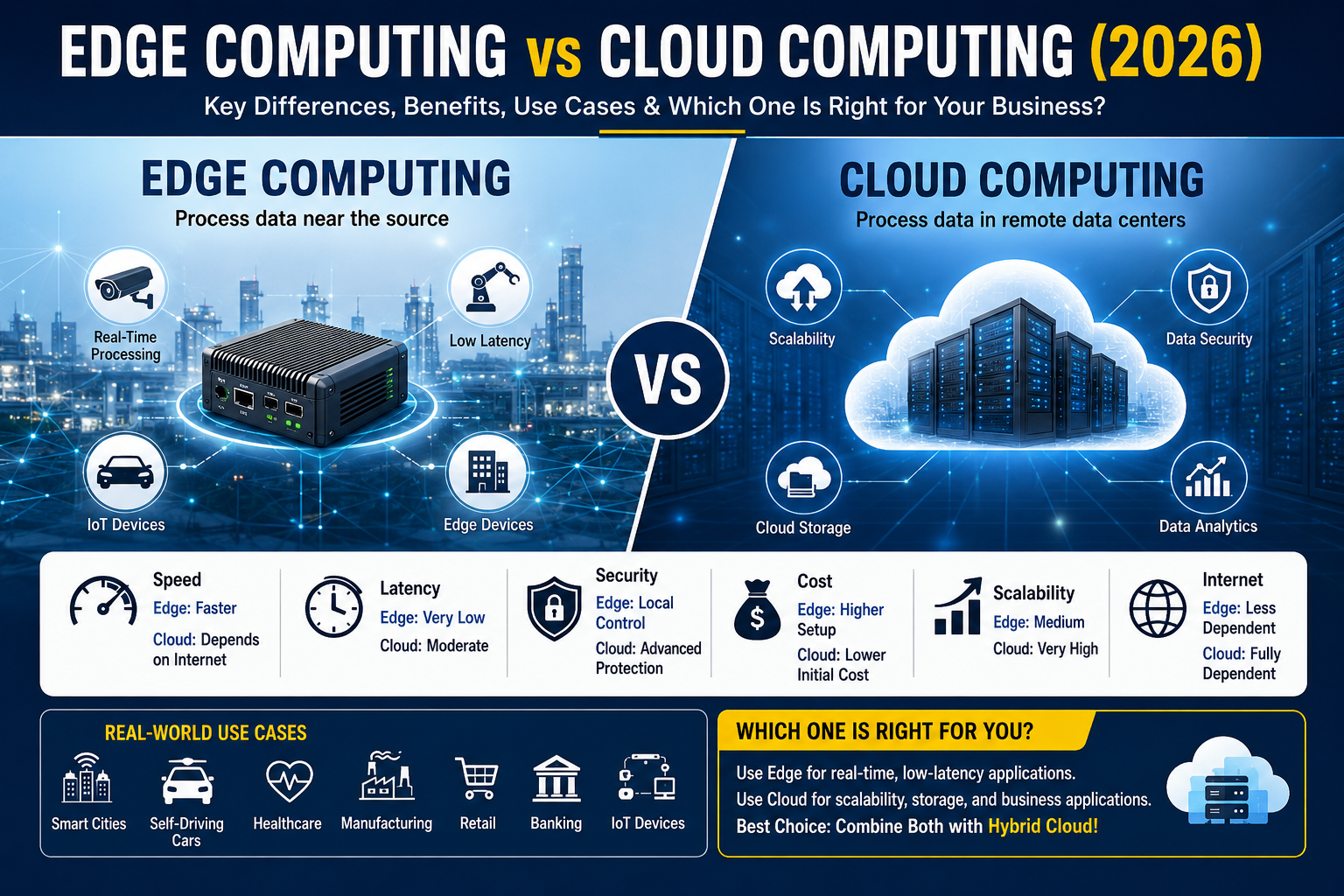
Technology is changing faster than ever. Businesses now collect huge amounts of data from websites, mobile apps, factories, hospitals, smart homes, and connected devices. Processing that data quickly has become just as important as collecting it. This is where Edge Computing vs Cloud Computing becomes an important discussion. Both technologies help organizations store, process, and analyze information, but they solve different business challenges.
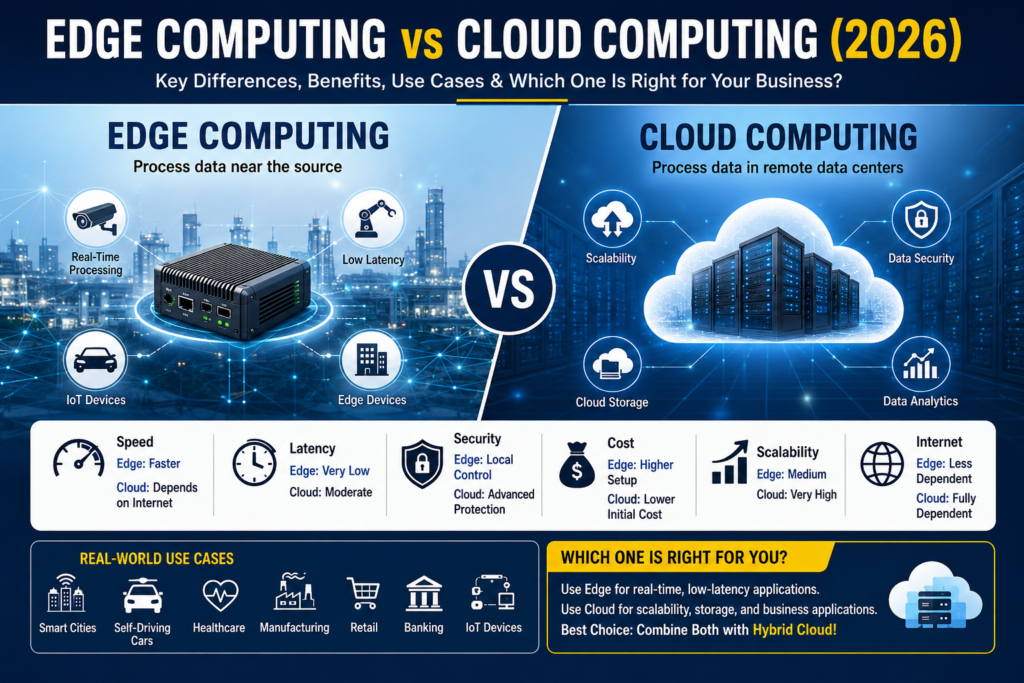
If you’re planning a digital transformation, understanding the difference between Edge Computing and Cloud Computing will help you choose the right solution. In this guide, you’ll learn how both technologies work, their advantages, limitations, real-world applications, and which one best fits your business goals. Whether you run a startup, a growing company, or a large enterprise, this article will help you make a smarter technology decision.
What Is Edge Computing?
Edge Computing Explained refers to processing data close to where it is created instead of sending every piece of information to distant cloud servers. This approach reduces delays, improves response times, and allows devices to make quick decisions without waiting for information to travel across the internet. As businesses rely more on Real-Time Data Processing, Internet of Things (IoT) devices, and Artificial Intelligence (AI), edge technology continues to become more valuable.
Instead of depending entirely on remote systems, Edge Computing brings computing power closer to users and devices. Factories, hospitals, autonomous vehicles, retail stores, and smart cities all use this technology to improve speed, reliability, and efficiency. By reducing Network Latency, organizations can deliver faster services while improving customer experiences.
Definition of Edge Computing
Edge Computing is a distributed computing model that processes information near its source using Edge Devices, gateways, or Edge Servers. Instead of sending all information to distant Cloud Data Centers, local systems analyze data first, reducing delays while improving performance for applications that require instant responses.
Why Edge Computing Matters in 2026
The growth of 5G Networks, Machine Learning, connected factories, and smart healthcare systems has made IoT Edge Computing one of the fastest-growing technologies. Businesses increasingly depend on instant processing because even a one-second delay can affect manufacturing, emergency services, financial transactions, and customer satisfaction.
What Is Cloud Computing?
Cloud Computing Explained is the delivery of computing resources through the internet. Instead of purchasing expensive physical servers, businesses rent processing power, storage, software, and networking services from cloud providers whenever they need them. This flexible approach helps companies reduce costs while scaling their operations more efficiently.
Today, Cloud Computing supports millions of businesses worldwide. From small startups to global enterprises, organizations rely on Cloud Infrastructure to host websites, store files, run applications, manage databases, and support remote teams. Its flexibility has made cloud technology one of the foundations of modern business.
Definition of Cloud Computing
Cloud Computing provides on-demand access to Cloud Services, Cloud Storage, computing resources, databases, and software through internet-connected Cloud Data Centers. Companies pay only for the resources they use instead of maintaining expensive local hardware.
Why Cloud Computing Is Still Growing
Organizations continue adopting Cloud Computing because it supports Cloud Scalability, reduces infrastructure costs, and enables employees to work from anywhere. Popular providers such as Amazon Web Services (AWS), Microsoft Azure, and Google Cloud Platform (GCP) continue expanding their services to meet growing business demands.
Edge Computing vs Cloud Computing: Key Differences
Although both technologies support modern applications, they serve different purposes. Edge Computing vs Cloud Computing is not about choosing a winner. Instead, it’s about understanding where each technology performs best. Edge focuses on speed and local processing, while cloud platforms focus on scalability, centralized management, and global accessibility.
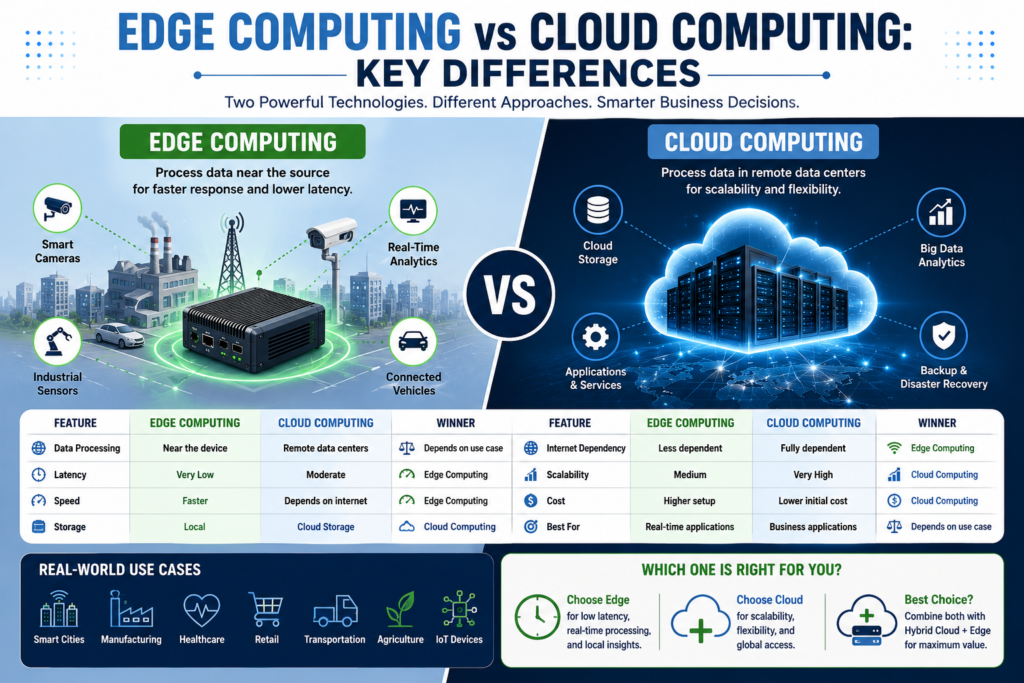
Many organizations now combine both approaches. Local devices handle urgent tasks using Edge Data Processing, while the cloud stores historical information, performs Cloud Analytics, and manages enterprise workloads. This combination creates a balanced technology strategy that improves efficiency, reliability, and business growth.
Processing Location
Edge Computing processes information close to users through Edge Devices and local gateways. Cloud Computing sends information to centralized Cloud Data Centers where powerful servers perform large-scale processing.
Speed and Latency
Because data travels a much shorter distance, Edge Computing delivers Low Latency and near-instant responses. Cloud platforms depend on internet connections, making response times slightly longer for applications requiring immediate action.
Data Storage
Most Edge Computing systems temporarily store information locally before sending selected data to the cloud. Cloud Computing relies heavily on centralized Cloud Storage, making it easier to manage large volumes of information across multiple locations.
Internet Dependency
Edge technology can continue operating even when internet connectivity becomes unstable because much of the processing happens locally. Cloud platforms require stable internet connections since applications communicate directly with remote servers.
Security
Both technologies prioritize Cloud Security and Edge Security, but each introduces different challenges. Edge environments protect sensitive local information while cloud providers invest heavily in Cybersecurity, Encryption, Identity and Access Management (IAM), and Multi-Factor Authentication (MFA) to secure enterprise systems.
Cost
Edge solutions usually require higher upfront investments because organizations install local hardware and intelligent devices. Cloud platforms typically reduce initial costs through subscription pricing, allowing businesses to expand resources only when necessary.
Scalability
Cloud environments offer almost unlimited Cloud Scalability, making them ideal for growing businesses. Edge systems also scale successfully, although expanding them often requires installing additional hardware across multiple locations.
Performance Comparison
Applications needing Real-Time Decision Making, autonomous operations, and industrial automation perform better with edge technology. Business software, collaboration platforms, large databases, and global applications benefit more from centralized cloud environments.
Edge Computing vs Cloud Computing Comparison Table
| Feature | Edge Computing | Cloud Computing |
| Data Processing | Near the device | Remote data centers |
| Latency | Very Low | Moderate |
| Speed | Faster | Depends on internet |
| Storage | Local | Cloud |
| Internet Dependency | Less dependent | Fully dependent |
| Scalability | Medium | Very High |
| Initial Cost | Higher setup | Lower initial cost |
| Best For | Real-time applications | Business applications |
| Security Focus | Local processing | Centralized protection |
| Typical Users | Manufacturing, IoT, Healthcare | Startups, Enterprises, SaaS Companies |
Expert Insight: The future isn’t about choosing only one technology. Most successful organizations combine Edge Computing and Cloud Computing to achieve better speed, stronger security, improved scalability, and smarter business operations.
How Does Edge Computing Work?
Modern businesses need instant responses. Edge Computing works by processing information close to where it is created instead of sending everything to a distant cloud server. This approach reduces delays, improves Real-Time Data Processing, and supports applications that cannot afford even a few seconds of waiting. Industries such as healthcare, manufacturing, transportation, and retail rely on this model because quick decisions improve efficiency and customer satisfaction.
Instead of replacing the cloud, Edge Computing complements it. Local devices handle urgent tasks while important information is later synchronized with the cloud for storage, reporting, and Data Analytics. This combination improves reliability, reduces network traffic, and creates a smarter technology environment for businesses.
Edge Devices
Edge Devices are the first point where information is collected and processed. These devices include smart cameras, industrial sensors, medical equipment, retail scanners, and Internet of Things (IoT) products. They analyze data immediately, allowing businesses to react much faster than traditional cloud-only systems.
Local Data Processing
With Edge Data Processing, information is analyzed directly on the local device or nearby gateway. This reduces Network Latency, saves internet bandwidth, and supports applications that require immediate responses, such as factory automation and autonomous vehicles.
Edge Servers
Edge Servers provide additional computing power near users or connected devices. They process larger workloads before sending selected information to the cloud. This improves application performance while reducing unnecessary traffic between local devices and remote data centers.
How Does Cloud Computing Work?
Unlike edge technology, Cloud Computing processes information inside powerful Cloud Data Centers connected through the internet. Businesses access computing resources whenever they need them without purchasing expensive hardware. This flexible model allows organizations to grow quickly while reducing infrastructure costs.
Cloud providers manage hardware, networking, software updates, and security. Businesses simply access the services they need through an internet connection. This makes Cloud Computing ideal for companies that require flexibility, remote collaboration, and scalable infrastructure.
Cloud Data Centers
Large Cloud Data Centers contain thousands of servers that work together to provide computing power, storage, databases, and networking services. These facilities are designed for high availability, allowing businesses to access applications from almost anywhere in the world.
Virtualization
Virtualization divides physical hardware into multiple Virtual Machines, allowing several applications to share the same server efficiently. This technology improves resource utilization while supporting Containerization, Containers, and modern Cloud Native Applications.
Internet-Based Services
Businesses use internet-based Cloud Services to host websites, store files, manage databases, and run business software. Popular service models include Infrastructure as a Service (IaaS), Platform as a Service (PaaS), and Software as a Service (SaaS), giving organizations flexibility for different workloads.
Benefits of Edge Computing
One of the biggest strengths of Edge Computing is its ability to deliver fast performance without relying entirely on remote servers. Local processing reduces delays, improves system reliability, and helps businesses make decisions instantly. This makes edge technology especially valuable for industries where every second matters.
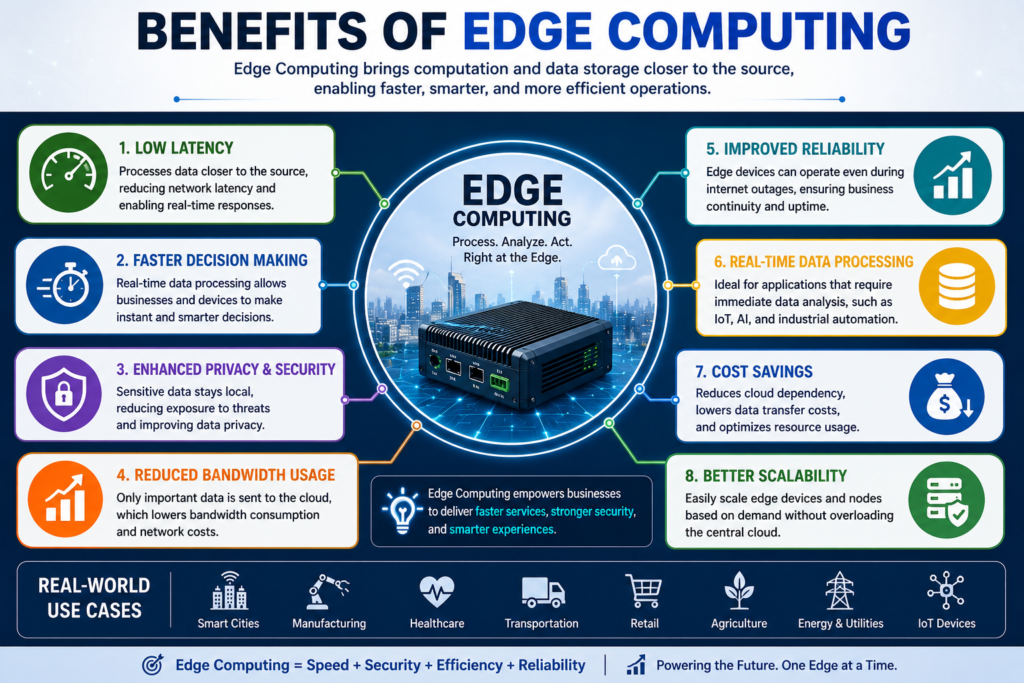
Another major advantage is efficiency. By processing information locally, businesses reduce bandwidth costs, improve privacy, and continue operating even when internet connections become unstable. As more organizations embrace Digital Transformation, edge technology continues to play an increasingly important role.
Lower Latency
Because information travels only a short distance, Low Latency allows systems to respond almost instantly. This is essential for smart factories, healthcare monitoring, robotics, and emergency response systems.
Faster Decision Making
Real-time analysis supports Artificial Intelligence (AI) and Machine Learning applications that depend on immediate decisions. Fast processing improves safety, productivity, and customer experiences.
Better Privacy
Sensitive information often remains on local devices instead of being transmitted across public networks. This strengthens Data Privacy, supports regulatory compliance, and reduces exposure to cyber threats.
Reduced Bandwidth Usage
Only important information is transmitted to cloud servers. This reduces internet traffic, lowers operating costs, and improves Bandwidth Optimization for organizations handling large volumes of data.
Reliable Offline Performance
Many edge systems continue functioning during temporary internet outages because processing happens locally. This improves Business Continuity and keeps essential services available when connectivity is interrupted.
| Edge Computing Benefit | Business Value |
| Low Latency | Faster response times |
| Local Processing | Better performance |
| Better Privacy | Stronger data protection |
| Lower Bandwidth Usage | Reduced operating costs |
| Offline Capability | Improved reliability |
| Real-Time Processing | Better customer experience |
Benefits of Cloud Computing
Businesses continue investing in Cloud Computing because it provides flexibility without requiring large hardware investments. Companies can increase or decrease computing resources within minutes, making cloud technology ideal for organizations experiencing rapid growth or changing workloads.
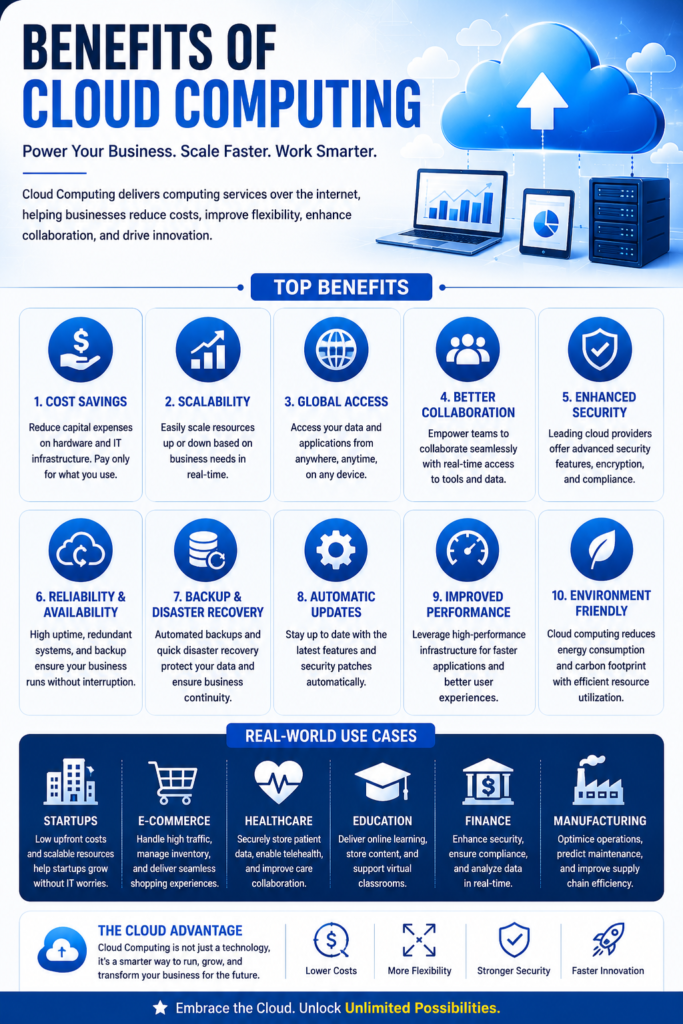
Cloud platforms also simplify collaboration. Employees can securely access files, applications, and business systems from almost anywhere. Combined with strong Cloud Backup, Disaster Recovery, and advanced Cloud Security, cloud technology helps organizations improve productivity while protecting valuable business information.
Cost Savings
Cloud platforms reduce capital expenses because businesses pay only for the resources they use. This makes technology investments more affordable for startups and growing companies.
Unlimited Scalability
One of the biggest advantages of Cloud Scalability is the ability to quickly increase storage, processing power, and networking resources without purchasing new hardware.
Remote Access
Employees can securely connect to business applications from home, the office, or while traveling. This flexibility supports hybrid work environments and improves collaboration.
Easy Backup
Automatic Cloud Backup protects important files against accidental deletion, hardware failures, and unexpected disasters. Businesses can restore information quickly whenever needed.
Disaster Recovery
Modern cloud providers build multiple backup systems across different regions. These Disaster Recovery solutions help organizations recover quickly from outages while maintaining business operations.
| Cloud Computing Benefit | Business Value |
| Lower Costs | Reduced hardware investment |
| Unlimited Scalability | Supports business growth |
| Remote Access | Work from anywhere |
| Automatic Backup | Better data protection |
| Disaster Recovery | Faster recovery from failures |
| Global Availability | Access services worldwide |
Expert Insight: Businesses don’t always need to choose between Edge Computing and Cloud Computing. Many organizations achieve the best results by combining both technologies—using edge for fast local processing and the cloud for storage, analytics, and long-term scalability.
Real-World Use Cases of Edge Computing vs Cloud Computing
Technology becomes more valuable when it solves real business problems. Understanding Edge Computing vs Cloud Computing is easier when you see how different industries use both technologies every day. Some organizations need instant local processing, while others need massive computing power from the cloud. Choosing the right model depends on business goals, application requirements, and customer expectations.
Many companies now combine Edge Computing with Cloud Computing to build faster, smarter, and more reliable systems. Local devices process urgent information while cloud platforms handle long-term storage, Data Analytics, and enterprise applications. This hybrid approach delivers better performance and supports continuous Digital Transformation.
Smart Cities
Smart cities use Edge Computing to control traffic lights, monitor air quality, and improve public safety. Thousands of sensors collect information every second. Local processing helps city systems respond immediately while cloud platforms analyze historical trends for future planning.
Self-Driving Cars
Autonomous vehicles depend on Low Latency because they must react within milliseconds. Cameras and sensors process information through Edge Devices, while cloud platforms store driving data and improve future driving models using Machine Learning.
Healthcare
Hospitals use Edge Computing to monitor patient health in real time. Medical devices process critical information instantly while Cloud Computing securely stores medical records and supports collaboration between healthcare professionals.
Manufacturing
Modern factories rely on Edge AI to monitor equipment, detect faults, and improve production quality. Cloud platforms collect long-term manufacturing data for reporting, predictive maintenance, and business planning.
Retail
Retail stores analyze customer traffic, manage inventory, and operate self-checkout systems using edge technology. At the same time, cloud platforms manage online stores, customer databases, and sales reports.
Banking
Banks use edge technology for ATM operations and branch services that require fast responses. Cloud Security platforms manage customer accounts, fraud detection, backups, and regulatory compliance.
Video Streaming
Streaming companies use Content Delivery Network (CDN) servers near users to reduce buffering. Meanwhile, Cloud Data Centers store video libraries, user accounts, and recommendation systems.
IoT Devices
Millions of Connected Devices generate continuous information every second. IoT Edge Computing processes urgent events locally while cloud platforms perform large-scale Cloud Analytics and long-term storage.
Industry Comparison Table
| Industry | Edge Computing | Cloud Computing |
| Smart Cities | Real-time traffic control | Data analysis and reporting |
| Healthcare | Patient monitoring | Medical record storage |
| Manufacturing | Equipment monitoring | Production analytics |
| Retail | Smart checkout | Inventory management |
| Banking | ATM processing | Core banking systems |
| Video Streaming | Fast content delivery | Video storage |
| IoT | Local device control | Large-scale analytics |
Challenges of Edge Computing and Cloud Computing
Every technology has strengths and limitations. Although Edge Computing and Cloud Computing offer significant advantages, businesses should also understand their challenges before making investment decisions. Careful planning helps reduce risks and ensures long-term success.
Organizations often evaluate performance, cost, security, maintenance, and scalability before selecting the right solution. Understanding these challenges allows businesses to build stronger IT strategies and avoid expensive mistakes in the future.
Edge Computing Challenges
Managing thousands of Edge Devices across different locations can become difficult. Hardware maintenance, software updates, and physical security require ongoing attention. Organizations also need skilled IT teams to monitor distributed systems effectively.
Cloud Computing Challenges
Although cloud platforms offer excellent flexibility, they depend heavily on reliable internet connections. Service outages, vendor lock-in, and data transfer costs may affect some organizations, especially those handling mission-critical workloads.
Security Risks
Both technologies face evolving Cybersecurity threats. Businesses must invest in Encryption, Identity and Access Management (IAM), Multi-Factor Authentication (MFA), and Zero Trust Security to protect sensitive information and reduce security risks.
Management Complexity
Companies using both edge and cloud technologies must manage multiple environments simultaneously. Monitoring applications, synchronizing data, and maintaining consistent security policies require careful planning and effective management tools.
| Challenge | Edge Computing | Cloud Computing |
| Hardware Management | High | Low |
| Internet Dependency | Low | High |
| Initial Investment | Higher | Lower |
| Scalability | Moderate | Excellent |
| Security Management | Distributed | Centralized |
| Maintenance | More complex | Provider-managed |
Which One Should You Choose?
Choosing between Edge Computing vs Cloud Computing depends on your business goals rather than the popularity of one technology. Some organizations need instant processing close to users, while others benefit more from centralized cloud platforms. Evaluating your workload, budget, and future growth plans will help you make the right decision.
For many businesses, the best solution is not choosing one over the other. Combining edge and cloud technologies allows organizations to enjoy fast local processing while taking advantage of cloud storage, scalability, and advanced analytics. This balanced approach supports innovation and prepares businesses for future growth.
When to Choose Edge Computing
Choose Edge Computing if your applications require Real-Time Decision Making, low latency, local processing, and reliable performance during temporary internet disruptions. Manufacturing, healthcare, transportation, and smart city projects benefit greatly from this approach.
When to Choose Cloud Computing
Choose Cloud Computing when your business needs flexible infrastructure, global access, unlimited storage, and simplified IT management. It works well for business applications, websites, collaboration tools, and enterprise software.
When to Use Both Together
Many organizations combine Hybrid Cloud solutions with Edge Computing. Edge handles immediate processing close to users, while the cloud provides long-term storage, Cloud Backup, reporting, and enterprise-level computing resources. This strategy delivers better performance, stronger resilience, and improved business efficiency.
Expert Insight: The future of business technology isn’t Edge or Cloud. It’s Edge and Cloud working together to create faster, smarter, and more secure digital experiences.
Future of Edge Computing and Cloud Computing (2026 & Beyond)
Technology continues to evolve every year. Edge Computing and Cloud Computing will work even more closely together as businesses demand faster performance, stronger security, and smarter automation. Instead of replacing one another, both technologies will become part of one intelligent ecosystem that supports every industry.
Over the next few years, businesses will invest more in Digital Transformation, Cloud Infrastructure, Edge AI, and Cloud Scalability. Companies that build flexible systems today will be better prepared for future innovations and changing customer expectations.
Artificial Intelligence Integration
Artificial Intelligence (AI) and Machine Learning are making both edge and cloud environments smarter. AI can analyze millions of events, predict failures, detect unusual activity, and improve business decisions without constant human involvement.
5G Networks
The expansion of 5G Networks will reduce delays even further. Combined with Edge Computing, businesses will process data almost instantly, making smart factories, autonomous vehicles, and connected healthcare systems more reliable.
Edge AI
Edge AI allows intelligent devices to process information locally instead of sending everything to remote servers. This improves privacy, reduces bandwidth usage, and delivers faster responses for real-time applications.
Hybrid Cloud + Edge
Many organizations are moving toward Hybrid Cloud environments that combine cloud platforms with edge infrastructure. This model offers better flexibility, stronger resilience, and improved business performance.
IoT Expansion
The number of Internet of Things (IoT) devices continues to grow rapidly. Smart homes, factories, hospitals, and cities will depend on Connected Devices that work together using both edge and cloud technologies.
Frequently Asked Questions (FAQs)
What is the difference between Edge Computing and Cloud Computing?
Edge Computing processes data close to where it is created, while Cloud Computing processes data inside remote cloud data centers through the internet.
Which is faster, Edge or Cloud Computing?
Edge Computing is usually faster because data travels a much shorter distance, resulting in Low Latency and quicker responses.
Is Edge Computing replacing Cloud Computing?
No. Edge is not replacing the cloud. Most organizations now combine both technologies to achieve better speed, scalability, and reliability.
Can Edge Computing work without the cloud?
Yes. Many edge systems continue working even if the internet connection is temporarily unavailable. However, cloud platforms remain valuable for storage, analytics, and long-term management.
Which is better for small businesses?
Most small businesses benefit more from Cloud Computing because it offers lower startup costs, easy scalability, and simplified management.
Expert Tips for Choosing the Right Computing Model
Every business has different technology needs. Before investing in new infrastructure, evaluate your current workloads, future growth plans, and security requirements. A well-planned strategy will save money while improving long-term performance.
Remember that technology decisions should support your business goals. Choosing the right combination of edge and cloud services today will make future expansion much easier.
Analyze Your Business Needs
Identify which applications require instant processing and which workloads can safely run in the cloud. This helps you build an efficient and cost-effective infrastructure.
Consider Security Requirements
Protect sensitive information using Multi-Factor Authentication (MFA), Zero Trust Security, regular monitoring, and strong Cloud Security policies.
Evaluate Budget
Compare hardware investments, cloud subscription costs, maintenance expenses, and long-term operational savings before making a decision.
Plan for Future Growth
Choose technologies that support Cloud Scalability, business expansion, and future digital innovation without requiring major infrastructure changes.
Conclusion – Edge Computing vs Cloud Computing: Choose the Right Technology for Your Future
Edge Computing vs Cloud Computing is not about deciding which technology is better. It is about understanding which solution best fits your business needs. Edge delivers speed, low latency, and real-time processing, while cloud platforms provide scalability, flexibility, and centralized management.
For many organizations, the smartest strategy is combining both technologies. Edge handles immediate processing close to users, while the cloud stores data, powers analytics, and supports long-term business growth. By adopting the right balance, you can improve performance, strengthen security, reduce costs, and prepare your business for the future.
Quick Comparison Summary
| Feature | Edge Computing | Cloud Computing |
| Speed | ⭐⭐⭐⭐⭐ | ⭐⭐⭐⭐ |
| Latency | Very Low | Moderate |
| Scalability | Medium | Very High |
| Storage | Local | Centralized |
| Cost | Higher Setup | Lower Startup |
| Internet Dependency | Low | High |
| Best For | Real-Time Apps | Business Applications |
| Future Potential | Excellent | Excellent |
Continue Reading on DailyTecho
If you found this guide helpful, continue exploring our Cloud Computing series.
| Related Guide | Why Read It? |
| What Is Cloud Computing? The Ultimate Beginner’s Guide (2026) | Learn cloud fundamentals from the ground up. |
| Public Cloud vs Private Cloud vs Hybrid Cloud (2026) | Compare cloud deployment models in detail. |
| Cloud Service Models Explained: IaaS, PaaS & SaaS | Understand the three main cloud service models. |
| Cloud Deployment Models Explained (2026) | Learn when to use public, private, hybrid, and multi-cloud. |
| Cloud Storage Explained (2026) | Discover how cloud storage works and compare top providers. |
| Cloud Migration Explained (2026): The Complete Guide to Successfully Moving Your Business to the Cloud | Learn how to migrate applications and data with confidence. |
| Cloud Security Explained (2026) | Protect your cloud environment using modern security best practices. |
→ Explore More Technology Guides
Continue exploring Cybersecurity, Cloud Computing, Artificial Intelligence, networking, software, and emerging technologies on DailyTecho to stay ahead in the digital world.
Meta Description
Learn the difference between Edge Computing vs Cloud Computing in this complete 2026 guide. Compare benefits, speed, security, costs, real-world use cases, and discover which technology is best for your business.
2 Comments