

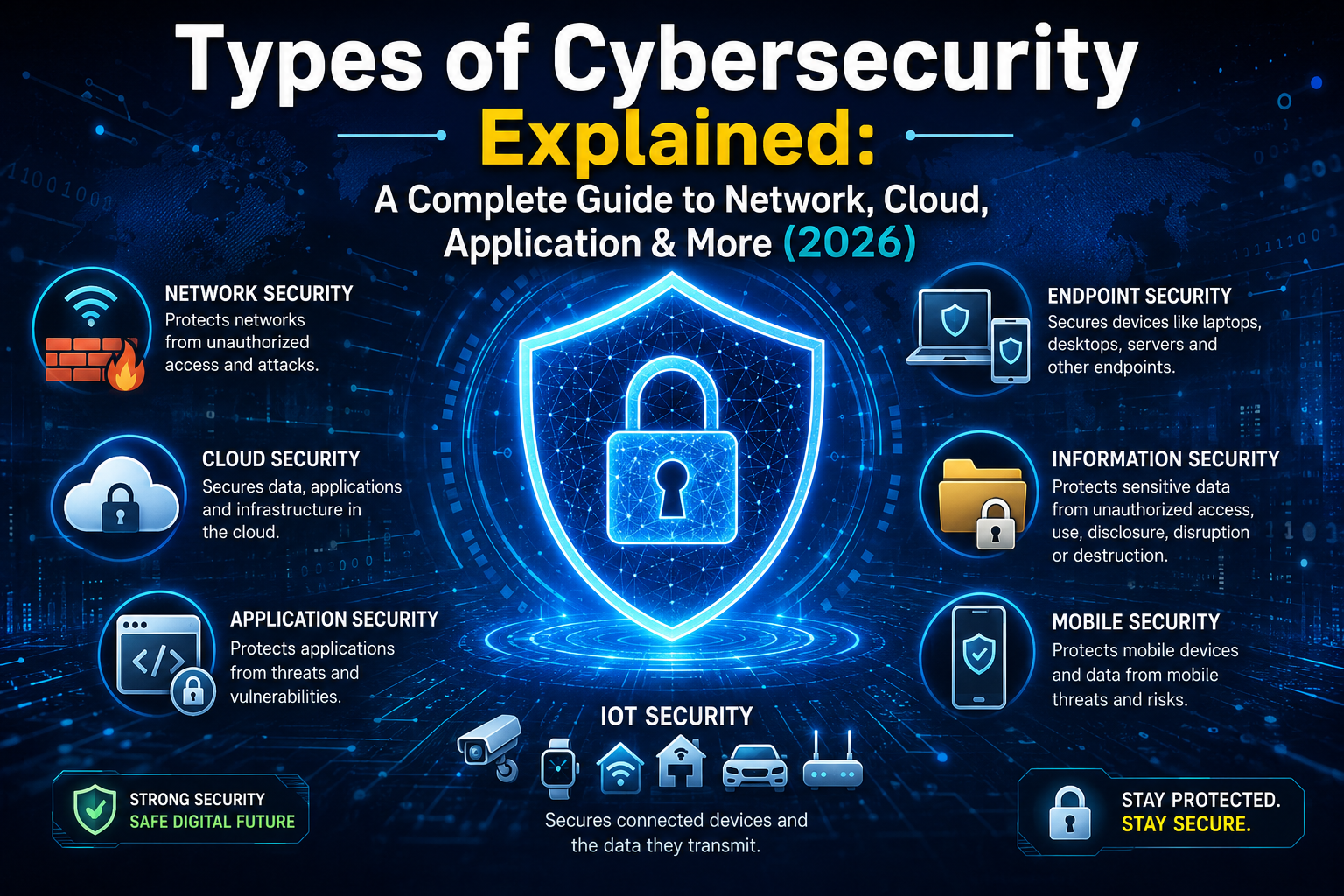
Technology makes life easier. You can shop online, manage your bank account, work from home, and store important files in the cloud. However, every connected device also creates new security risks. Cybercriminals constantly search for weaknesses to steal money, personal information, or business data. That is why understanding the Types of Cybersecurity has become more important than ever.
Whether you are a student, business owner, remote worker, or everyday internet user, learning the Different Types of Cybersecurity helps you stay protected. Each security layer serves a unique purpose. Some protect networks while others secure applications, cloud platforms, or mobile devices. Together, these Cybersecurity Categories create a complete defense against modern Cyber Threats and Cyber Attacks.
What Are the Different Types of Cybersecurity?
What Does “Types of Cybersecurity” Mean?
The Types of Cybersecurity describe different security practices that protect computers, networks, software, cloud services, mobile devices, and sensitive information. Every digital system faces unique risks. A company website needs different protection than a smartphone or cloud storage account. That is why cybersecurity professionals build several security layers instead of relying on a single solution. This approach strengthens Digital Security, improves Data Protection, and reduces the chance of successful attacks.
Why Modern Cybersecurity Requires Multiple Protection Layers
Modern organizations cannot depend on antivirus software alone. Attackers use advanced methods to bypass traditional defenses. One attack may target an employee through Phishing, while another may exploit a software bug using a Zero-Day Attack. Businesses now combine Network Security, Cloud Security, Application Security, Endpoint Security, and Information Security to protect every part of their environment. Each layer blocks different attack methods and creates stronger overall protection.
How Different Cybersecurity Types Work Together
Think of cybersecurity like protecting a modern house. A strong front door helps, yet you also need secure windows, cameras, alarms, and smart locks. The same idea applies to digital systems. A Firewall protects the network, Encryption secures valuable information, Identity and Access Management controls who enters the system, and Threat Detection tools monitor suspicious behavior. When these technologies work together, organizations become much harder targets for cybercriminals.
Main Types of Cybersecurity
| Type | Primary Purpose | Common Example |
| Network Security | Protect computer networks | Firewalls and IDS |
| Cloud Security | Secure cloud platforms | AWS Security |
| Application Security | Protect software | Secure coding |
| Endpoint Security | Protect user devices | EDR solutions |
| Information Security | Protect sensitive data | Encryption |
| Mobile Security | Secure smartphones | Mobile device management |
| IoT Security | Protect smart devices | Smart home security |
Why Are Different Types of Cybersecurity Important?
Protecting Personal Information from Modern Cyber Threats
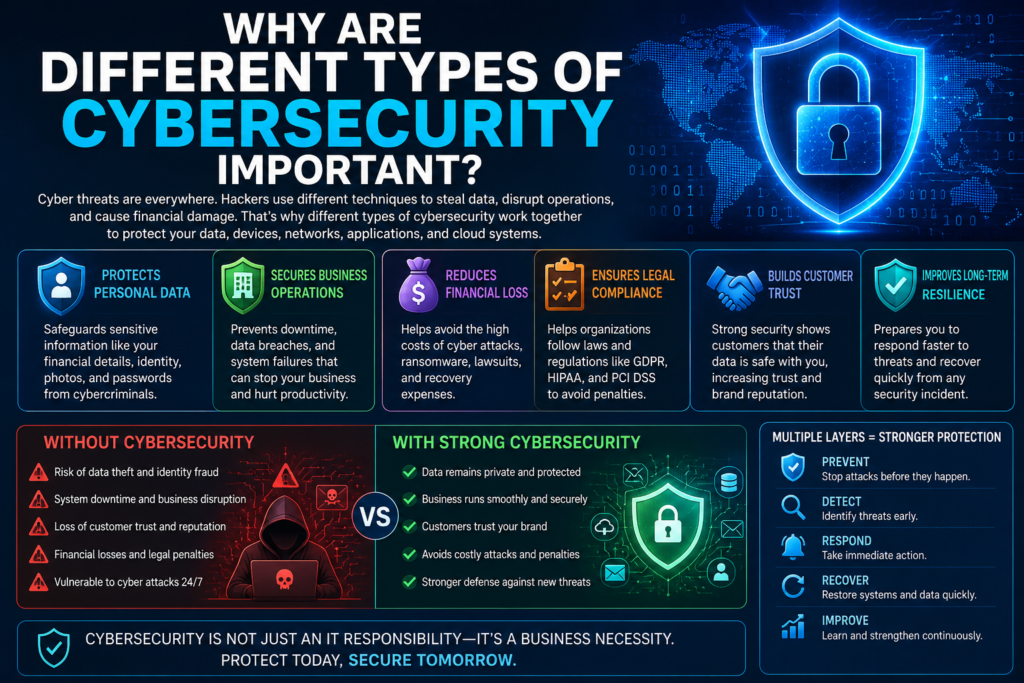
Every day, people share passwords, financial details, medical records, and personal photos online. Without proper protection, criminals can steal this information through Malware, Spyware, Identity Theft, or Ransomware attacks. Different cybersecurity layers protect different kinds of data. For example, Mobile Security safeguards smartphones, while Information Security protects confidential files stored inside business systems. Together, these defenses help reduce the growing risks of online crime.
Safeguarding Business Operations and Critical Data
Businesses face much greater challenges because they manage customer records, payment systems, employee information, and confidential projects. A single successful attack can stop operations for days or even weeks. Modern companies use Cloud Computing Security, Access Control, Cyber Risk Management, and Security Awareness training to reduce these risks. They also invest in Business Continuity planning and Disaster Recovery strategies so they can recover quickly after an attack.
Reducing Financial Losses and Compliance Risks
Cybercrime costs organizations billions of dollars every year. Beyond direct financial losses, companies may also face legal penalties, damaged reputations, and lost customer trust. Strong Compliance programs help businesses follow privacy regulations while protecting sensitive information. Technologies such as Multi-Factor Authentication (MFA), Virtual Private Network (VPN) connections, and Encryption reduce unauthorized access and strengthen overall security across the organization.
Fact: According to IBM’s annual Cost of a Data Breach research, the average cost of a major data breach reaches millions of dollars for many organizations, making cybersecurity one of the smartest long-term investments.
Why Multiple Security Layers Matter
| Security Layer | Protects Against |
| Firewall | Unauthorized network traffic |
| Encryption | Data theft |
| Multi-Factor Authentication (MFA) | Stolen passwords |
| Endpoint Detection and Response (EDR) | Device attacks |
| Extended Detection and Response (XDR) | Multi-stage cyber attacks |
| Threat Intelligence | Emerging cyber threats |
| Incident Response | Security incidents |
| Security Operations Center (SOC) | Continuous monitoring |
Modern cybersecurity is no longer optional. Every connected device, cloud service, application, and network creates new opportunities for attackers. Understanding the Types of Cybersecurity helps individuals and businesses build stronger defenses before problems appear instead of reacting after valuable data has already been compromised.
Types of Cybersecurity Explained: A Complete Guide to Network, Cloud, Application & More (2026)
Technology makes life easier. You can shop online, manage your bank account, work from home, and store important files in the cloud. However, every connected device also creates new security risks. Cybercriminals constantly search for weaknesses to steal money, personal information, or business data. That is why understanding the Types of Cybersecurity has become more important than ever.
Whether you are a student, business owner, remote worker, or everyday internet user, learning the Different Types of Cybersecurity helps you stay protected. Each security layer serves a unique purpose. Some protect networks while others secure applications, cloud platforms, or mobile devices. Together, these Cybersecurity Categories create a complete defense against modern Cyber Threats and Cyber Attacks.
What Are the Different Types of Cybersecurity?
What Does “Types of Cybersecurity” Mean?
The Types of Cybersecurity describe different security practices that protect computers, networks, software, cloud services, mobile devices, and sensitive information. Every digital system faces unique risks. A company website needs different protection than a smartphone or cloud storage account. That is why cybersecurity professionals build several security layers instead of relying on a single solution. This approach strengthens Digital Security, improves Data Protection, and reduces the chance of successful attacks.
Why Modern Cybersecurity Requires Multiple Protection Layers
Modern organizations cannot depend on antivirus software alone. Attackers use advanced methods to bypass traditional defenses. One attack may target an employee through Phishing, while another may exploit a software bug using a Zero-Day Attack. Businesses now combine Network Security, Cloud Security, Application Security, Endpoint Security, and Information Security to protect every part of their environment. Each layer blocks different attack methods and creates stronger overall protection.
How Different Cybersecurity Types Work Together
Think of cybersecurity like protecting a modern house. A strong front door helps, yet you also need secure windows, cameras, alarms, and smart locks. The same idea applies to digital systems. A Firewall protects the network, Encryption secures valuable information, Identity and Access Management controls who enters the system, and Threat Detection tools monitor suspicious behavior. When these technologies work together, organizations become much harder targets for cybercriminals.
Main Types of Cybersecurity
| Type | Primary Purpose | Common Example |
| Network Security | Protect computer networks | Firewalls and IDS |
| Cloud Security | Secure cloud platforms | AWS Security |
| Application Security | Protect software | Secure coding |
| Endpoint Security | Protect user devices | EDR solutions |
| Information Security | Protect sensitive data | Encryption |
| Mobile Security | Secure smartphones | Mobile device management |
| IoT Security | Protect smart devices | Smart home security |
Why Are Different Types of Cybersecurity Important?
Protecting Personal Information from Modern Cyber Threats
Every day, people share passwords, financial details, medical records, and personal photos online. Without proper protection, criminals can steal this information through Malware, Spyware, Identity Theft, or Ransomware attacks. Different cybersecurity layers protect different kinds of data. For example, Mobile Security safeguards smartphones, while Information Security protects confidential files stored inside business systems. Together, these defenses help reduce the growing risks of online crime.
Safeguarding Business Operations and Critical Data
Businesses face much greater challenges because they manage customer records, payment systems, employee information, and confidential projects. A single successful attack can stop operations for days or even weeks. Modern companies use Cloud Computing Security, Access Control, Cyber Risk Management, and Security Awareness training to reduce these risks. They also invest in Business Continuity planning and Disaster Recovery strategies so they can recover quickly after an attack.
Reducing Financial Losses and Compliance Risks
Cybercrime costs organizations billions of dollars every year. Beyond direct financial losses, companies may also face legal penalties, damaged reputations, and lost customer trust. Strong Compliance programs help businesses follow privacy regulations while protecting sensitive information. Technologies such as Multi-Factor Authentication (MFA), Virtual Private Network (VPN) connections, and Encryption reduce unauthorized access and strengthen overall security across the organization.
Fact: According to IBM’s annual Cost of a Data Breach research, the average cost of a major data breach reaches millions of dollars for many organizations, making cybersecurity one of the smartest long-term investments.
Why Multiple Security Layers Matter
| Security Layer | Protects Against |
| Firewall | Unauthorized network traffic |
| Encryption | Data theft |
| Multi-Factor Authentication (MFA) | Stolen passwords |
| Endpoint Detection and Response (EDR) | Device attacks |
| Extended Detection and Response (XDR) | Multi-stage cyber attacks |
| Threat Intelligence | Emerging cyber threats |
| Incident Response | Security incidents |
| Security Operations Center (SOC) | Continuous monitoring |
Modern cybersecurity is no longer optional. Every connected device, cloud service, application, and network creates new opportunities for attackers. Understanding the Types of Cybersecurity helps individuals and businesses build stronger defenses before problems appear instead of reacting after valuable data has already been compromised.
Application Security: Protecting Software from Cyber Attacks
What Is Application Security?
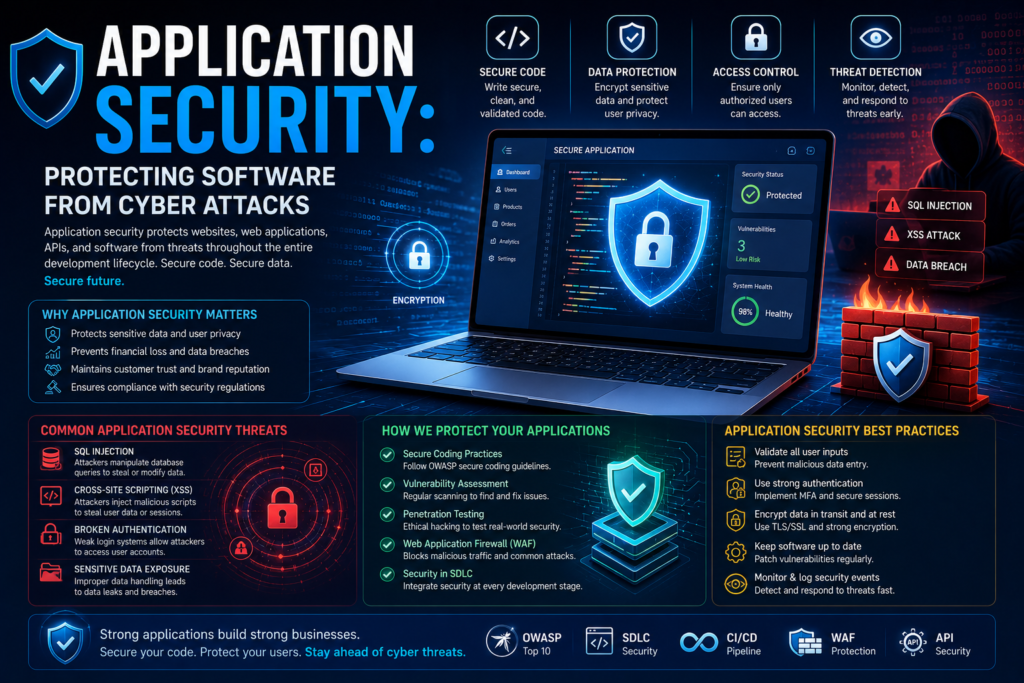
Application Security protects software, websites, and mobile apps from cybercriminals throughout their entire lifecycle. Security should begin during the planning stage instead of after the application is released. Developers build protection into the code so attackers cannot easily exploit weaknesses. Strong Application Security, Data Protection, Access Control, Threat Detection, and Cyber Resilience work together to keep applications secure.
Modern applications handle sensitive customer information every second. Online banking, healthcare portals, shopping websites, and business platforms all process valuable data. If developers ignore security, attackers may steal information, change records, or interrupt services. That is why secure application development has become one of the most important parts of modern cybersecurity.
Secure Coding and Secure Software Development
Secure coding means writing software that prevents common security mistakes. Developers carefully validate user input, protect sensitive data, and remove unnecessary system permissions. They also review code regularly because even a small programming error can create a serious vulnerability.
Many organizations now follow Secure Software Development Life Cycle (SSDLC) practices. Security teams participate from the beginning instead of reviewing applications only after completion. This approach reduces development costs because fixing security problems early is much easier than repairing them after deployment.
Vulnerability Assessments and Penetration Testing
Security professionals regularly perform Vulnerability Assessment to discover weaknesses before attackers find them. Automated scanning tools inspect applications for outdated software, configuration errors, and insecure programming practices. Every discovered weakness receives a priority level so teams can fix the most dangerous problems first.
After scanning, ethical hackers perform Penetration Testing by simulating real cyber attacks. They attempt to bypass security controls just like criminals would. These controlled tests reveal hidden weaknesses that automated scanners sometimes miss. Businesses improve their security by fixing every issue before releasing new software.
Web Application Firewalls and Runtime Protection
A Web Application Firewall (WAF) filters malicious traffic before it reaches a website. It blocks common attacks such as SQL Injection, Cross-Site Scripting (XSS), and automated bot activity. Many organizations use WAFs because they provide continuous protection without affecting the user experience.
Modern runtime protection tools also monitor applications while they are running. They analyze user behavior, detect suspicious requests, and stop attacks immediately. Combined with Threat Intelligence, Artificial Intelligence, Incident Response, and continuous monitoring, these tools create a powerful defense against evolving cyber threats.
Common Application Security Risks
| Security Risk | Recommended Protection |
| SQL Injection | Secure coding and input validation |
| Cross-Site Scripting (XSS) | Output encoding and Web Application Firewall |
| Weak Authentication | Multi-Factor Authentication (MFA) |
| Broken Access Control | Strong Access Control policies |
| Software Vulnerabilities | Regular updates and Vulnerability Assessment |
| Session Hijacking | Secure session management and Encryption |
Case Study: An online shopping company discovered a serious SQL Injection vulnerability during routine Penetration Testing. Developers fixed the issue before launching a new feature. This simple security review protected thousands of customer payment records from possible theft.
Endpoint Security: Securing Computers, Smartphones, and Other Devices
What Is Endpoint Security?
Endpoint Security protects laptops, desktop computers, smartphones, tablets, servers, and other connected devices. Every device connected to a company network creates a possible entry point for attackers. Criminals often target individual devices because they usually have weaker security than central servers. Strong Endpoint Security, Digital Security, Identity and Access Management, Data Protection, and Cyber Risk Management reduce these risks.
Remote work has made endpoint protection even more important. Employees now connect from homes, hotels, airports, and public Wi-Fi networks. Without proper protection, attackers may compromise a single device and then attempt to access the entire corporate network. Every endpoint must receive the same level of protection regardless of its location.
Antivirus, EDR, and XDR Solutions
Traditional antivirus software detects known threats such as Computer Virus, Trojan Horse, Spyware, and Malware. Although antivirus remains useful, today’s cyber attacks have become far more sophisticated. Criminals constantly develop new techniques that can bypass signature-based detection.
Modern organizations therefore use Endpoint Detection and Response (EDR) and Extended Detection and Response (XDR) platforms. These advanced systems monitor user behavior, identify suspicious activity, and automatically isolate infected devices. Security teams receive detailed alerts that help them investigate incidents before attackers spread across the network.
Protecting Remote Workers and BYOD Devices
Many employees now use personal laptops and smartphones for work. This Bring Your Own Device (BYOD) approach increases flexibility, yet it also introduces new security challenges. Organizations must ensure that every device meets company security standards before granting access to business resources.
Companies achieve this by enforcing strong passwords, device encryption, automatic updates, and secure authentication. They also require employees to connect through a Virtual Private Network (VPN) whenever they access company systems remotely. These simple practices greatly reduce the risk of unauthorized access and data theft.
Endpoint Security Best Practices
Effective endpoint protection combines technology with user education. Organizations should install reliable security software, monitor device activity continuously, apply updates quickly, and remove unnecessary applications. Continuous Security Awareness training teaches employees how to recognize suspicious emails and avoid dangerous downloads before they create security incidents.
Security teams should also prepare for unexpected attacks by developing clear recovery procedures. Fast Incident Response, reliable backups, regular monitoring, and continuous Threat Detection help businesses recover quickly while minimizing downtime and financial losses.
Endpoint Security Comparison
| Endpoint Threat | Security Solution |
| Malware | Antivirus and Endpoint Detection and Response (EDR) |
| Spyware | Anti-spyware protection and monitoring |
| Trojan Horse | Application control and antivirus |
| Lost Devices | Device encryption and remote wipe |
| Public Wi-Fi Risks | Virtual Private Network (VPN) |
| Unauthorized Access | Identity and Access Management with Multi-Factor Authentication (MFA) |
Example: A remote employee accidentally clicked a fake email attachment containing Ransomware. The company’s Endpoint Detection and Response (EDR) system immediately isolated the infected laptop before the malware reached shared business files. Because of fast Incident Response, the company avoided a costly ransomware outbreak.
Information Security: Protecting Sensitive Data from Unauthorized Access
Understanding the CIA Triad
Information Security focuses on protecting valuable information from unauthorized access, misuse, alteration, or destruction. Unlike Network Security or Application Security, this security type protects the information itself regardless of where it is stored. Organizations rely on Information Security, Data Protection, Encryption, Data Privacy, and Access Control to ensure sensitive data remains accurate, confidential, and available only to authorized users.
The foundation of Information Security is the CIA Triad, which stands for Confidentiality, Integrity, and Availability. Confidentiality ensures only approved users can access information. Integrity guarantees that data remains accurate and unchanged. Availability means authorized users can access important information whenever they need it. Together, these three principles support secure business operations and protect customer trust.
Encryption and Data Protection Strategies
Encryption converts readable information into coded text that unauthorized users cannot understand. Even if attackers steal encrypted files, they cannot read the contents without the proper decryption key. Businesses use encryption to protect financial records, healthcare information, customer databases, and confidential communications across digital platforms.
Organizations also implement multiple Data Protection strategies beyond encryption. Regular backups, secure storage, automatic monitoring, and controlled sharing reduce the risk of accidental data loss or theft. These practices protect information throughout its entire lifecycle, from creation to permanent deletion.
Identity and Access Management
Identity and Access Management ensures that only authorized people can access specific systems and information. Every employee receives permissions based on their responsibilities. For example, a customer service representative should not have access to financial records that belong to the accounting department.
Modern organizations strengthen identity verification by combining strong passwords with Multi-Factor Authentication (MFA). Many companies also use biometric authentication such as fingerprints or facial recognition. These additional verification methods make unauthorized access much more difficult, even when passwords become compromised.
Compliance, Privacy, and Data Governance
Businesses must follow various privacy laws and industry regulations to protect customer information. Strong Compliance programs help organizations meet legal requirements while maintaining customer confidence. Security teams regularly review company policies to ensure sensitive information remains protected throughout every business process.
Good data governance also improves decision-making by organizing information properly. Companies classify sensitive records, define storage rules, monitor user activity, and securely remove outdated information. These practices improve Cyber Resilience while reducing the likelihood of costly security incidents.
CIA Triad Explained
| Principle | Purpose | Example |
| Confidentiality | Protect sensitive information | Encryption and Access Control |
| Integrity | Keep information accurate | File validation and audit logs |
| Availability | Ensure systems remain accessible | Backups and disaster recovery |
Case Study: A healthcare provider encrypted every patient record before storing it in its database. When attackers gained temporary access to one server, they could not read any patient information because every file remained protected through strong Encryption and strict Identity and Access Management controls.
Mobile Security: Protecting Smartphones and Tablets
Common Mobile Security Threats
Mobile Security protects smartphones, tablets, and other portable devices from cyber attacks. Millions of people use mobile devices for banking, shopping, email, and business communication every day. These devices store passwords, financial details, personal photos, and business documents. Without proper security, attackers can easily target valuable personal information.
Mobile devices face many modern threats including Malware, Spyware, fake applications, and Phishing messages. Criminals often create fraudulent apps that appear legitimate. Once installed, these apps quietly steal passwords, banking details, and personal information without the user’s knowledge. Public Wi-Fi networks also increase security risks because attackers may intercept unprotected communications.
Mobile Device Management (MDM)
Many businesses use Mobile Device Management (MDM) platforms to secure employee smartphones and tablets. MDM allows administrators to enforce company security policies, install updates remotely, monitor device activity, and remove company information if a device becomes lost or stolen.
This centralized management system improves Digital Security while reducing administrative effort. Security teams can quickly identify outdated devices, block risky applications, and ensure every employee follows company security standards regardless of where they work.
Secure Mobile Apps and Device Encryption
Installing applications only from trusted stores greatly reduces security risks. Official app stores regularly scan software for malicious code before publication. However, users should still review permissions carefully because some applications request unnecessary access to contacts, cameras, microphones, or location services.
Businesses also require full-device Encryption to protect sensitive information. Even if someone steals a smartphone, encrypted files remain unreadable without proper authentication. Combined with Virtual Private Network (VPN) connections and Multi-Factor Authentication (MFA), encryption creates multiple security layers that protect valuable business information.
Tips for Keeping Mobile Devices Safe
Keeping mobile devices secure requires consistent habits instead of complicated technology. Users should install updates promptly, avoid suspicious links, enable automatic backups, and lock devices using strong authentication methods. Small daily actions significantly reduce the chances of successful cyber attacks.
Employee education also plays an important role. Regular Security Awareness, continuous Threat Detection, responsible app usage, and careful browsing habits help users recognize threats before they become serious problems. Good security begins with informed decisions made every single day.
Mobile Security Best Practices
| Best Practice | Benefit |
| Enable Multi-Factor Authentication (MFA) | Protects user accounts |
| Use Encryption | Secures stored information |
| Install apps from trusted stores | Reduces malware infections |
| Update software regularly | Fixes security vulnerabilities |
| Use a Virtual Private Network (VPN) | Protects public Wi-Fi connections |
| Enable remote device wipe | Protects lost or stolen devices |
Example: A sales manager accidentally left a company smartphone inside an airport lounge. Because the device used full Encryption, Multi-Factor Authentication (MFA), and remote wipe capabilities, the company’s confidential information remained protected even though the phone was never recovered.
Internet of Things (IoT) Security: Securing Smart Devices
What Is IoT Security?
IoT Security protects internet-connected devices such as smart home systems, security cameras, medical equipment, industrial sensors, and wearable technology. These devices communicate with each other and exchange information automatically. While they improve convenience and efficiency, they also create new opportunities for hackers. Strong IoT Security, Network Security, Data Protection, Threat Detection, and Cyber Risk Management help reduce these risks.
The number of connected devices continues to grow every year. Homes, hospitals, factories, and cities now depend on smart technology. Unfortunately, many IoT devices have weak passwords or outdated software. Attackers often target these weaknesses because they are easier to exploit than well-protected computers and servers.
Security Challenges in Smart Homes
Smart homes include connected door locks, lights, thermostats, speakers, televisions, and security cameras. These devices improve daily life, yet they also collect personal information. If criminals compromise one smart device, they may gain access to other devices connected to the same network.
Homeowners can reduce these risks by changing default passwords, enabling Multi-Factor Authentication (MFA) whenever available, installing software updates, and separating smart devices from personal computers through Network Security practices. These simple steps create stronger protection without making devices difficult to use.
Healthcare, Manufacturing, and Industrial IoT Security
Healthcare organizations rely on connected medical devices to monitor patients and improve treatment. Manufacturing companies use industrial sensors to automate production lines. These connected systems improve productivity, but they also become attractive targets for cybercriminals because they support critical operations.
Organizations protect these environments by applying strict Access Control, continuous Threat Intelligence, regular software updates, and advanced monitoring. Security teams also isolate industrial devices from public networks, reducing the chances of attackers reaching critical infrastructure.
Best Practices for Securing Connected Devices
Strong IoT security begins before devices are connected to the internet. Organizations should purchase equipment from trusted manufacturers that regularly provide security updates. Every device should receive a unique password instead of using factory default credentials.
Continuous monitoring also plays an important role. Businesses regularly inspect connected devices, remove inactive equipment, apply firmware updates, and perform Vulnerability Assessment to identify weaknesses before attackers can exploit them. These proactive measures strengthen long-term Cyber Resilience.
Common IoT Security Risks
| IoT Risk | Recommended Protection |
| Default Passwords | Strong unique passwords |
| Unpatched Firmware | Regular software updates |
| Device Hijacking | Access Control and monitoring |
| Weak Authentication | Multi-Factor Authentication (MFA) |
| Data Theft | Encryption |
| Network Exposure | Device segmentation and Firewall protection |
Case Study: A manufacturing company connected hundreds of smart sensors to monitor production equipment. Before deployment, the IT team changed every default password, separated IoT devices from the corporate network, enabled Encryption, and scheduled monthly firmware updates. When attackers later scanned the company’s network, they failed to access the protected industrial devices.
Common Cyber Threats That Target Every Type of Cybersecurity
Malware and Ransomware
Every organization faces a growing number of Cyber Threats every day. One of the most common threats is Malware, which includes harmful software designed to damage systems or steal information. Different forms of malware include Computer Virus, Trojan Horse, Spyware, and Ransomware. Each one attacks systems in a different way, making layered security extremely important.
Ransomware remains one of the most damaging cyber threats today. Attackers encrypt company files and demand payment before restoring access. Even if organizations pay the ransom, there is no guarantee they will recover their information. Regular backups, strong Incident Response, and continuous monitoring help reduce the impact of ransomware attacks.
Phishing and Social Engineering
Not every cyber attack targets technology directly. Many criminals focus on people instead. Phishing emails trick users into revealing passwords, banking details, or confidential company information. These fake messages often appear to come from trusted organizations, making them difficult to recognize.
Social engineering attacks rely on psychology instead of technical skills. Criminals create urgency, fear, or excitement to convince victims to click dangerous links or download infected files. Regular Security Awareness training teaches employees how to identify suspicious messages before they become security incidents.
Zero-Day Vulnerabilities
A Zero-Day Attack occurs when attackers exploit a software weakness before developers release a security patch. Because no official fix exists, organizations have little time to respond. These attacks often target widely used software, allowing criminals to compromise thousands of systems quickly.
Businesses reduce these risks by applying security updates immediately after release, monitoring network activity continuously, and using advanced Threat Detection systems. Security teams also subscribe to Threat Intelligence services that warn organizations about newly discovered vulnerabilities.
Insider Threats and Supply Chain Attacks
Not every security incident begins outside the organization. Insider threats involve employees, contractors, or business partners who accidentally or intentionally expose sensitive information. Weak permissions, poor password management, and human error often contribute to these incidents.
Supply chain attacks target trusted software providers instead of attacking businesses directly. Criminals compromise a vendor’s software update and distribute malicious code to thousands of customers. Strong Compliance, vendor security reviews, and continuous monitoring help organizations reduce these risks.
AI-Powered Cyber Threats
Modern attackers increasingly use Artificial Intelligence to automate cyber attacks. AI helps criminals create convincing phishing emails, identify vulnerable systems, and analyze stolen information much faster than before. As AI technology improves, cyber attacks become more sophisticated and harder to detect.
Fortunately, security professionals also use Artificial Intelligence to strengthen defenses. AI-powered security platforms identify unusual behavior, detect hidden attack patterns, and support faster Incident Response. The future of cybersecurity will depend on how effectively organizations use AI to stay ahead of evolving threats.
Common Cyber Threats Comparison
| Cyber Threat | Main Target | Best Defense |
| Malware | Devices and systems | Antivirus and updates |
| Ransomware | Business data | Backups and Incident Response |
| Phishing | People | Security Awareness and MFA |
| Spyware | Personal information | Anti-malware software |
| Trojan Horse | Computer systems | Application control |
| Zero-Day Attack | Software vulnerabilities | Fast patching and monitoring |
| Distributed Denial-of-Service (DDoS) | Websites and servers | DDoS protection services |
| Man-in-the-Middle Attack | Network communications | Encryption and Virtual Private Network (VPN) |
Quote: “Cybersecurity is not just about technology. It is about people, processes, and continuous improvement.”
Best Cybersecurity Practices for Individuals and Businesses
Create Strong Passwords and Enable Multi-Factor Authentication
Good cybersecurity begins with strong habits. Weak passwords remain one of the biggest reasons attackers successfully break into online accounts. Every account should use a unique password that combines letters, numbers, and symbols. A trusted password manager also helps users create and store secure passwords without remembering every combination. Combining strong passwords with Multi-Factor Authentication (MFA), Identity and Access Management, Data Protection, Access Control, and Digital Security creates a much stronger defense against unauthorized access.
Even if hackers steal your password, Multi-Factor Authentication (MFA) adds another security layer before granting access. Most services send a verification code to your phone or authentication app. This extra step only takes a few seconds but prevents many common cyber attacks. Today, banks, healthcare providers, government agencies, and businesses recommend MFA as a basic security requirement instead of an optional feature.
Keep Systems Updated and Patched
Software updates do much more than add new features. They also repair security weaknesses that attackers actively search for every day. Delaying updates gives cybercriminals more time to exploit known vulnerabilities. Organizations should update operating systems, web browsers, business software, and connected devices as soon as trusted updates become available.
Automatic patch management helps businesses maintain consistent security across hundreds or even thousands of devices. Combined with Threat Detection, Cyber Risk Management, Compliance, Cyber Resilience, and regular monitoring, timely updates greatly reduce the chances of successful cyber attacks while improving overall system stability.
Back Up Important Data Regularly
No security system can guarantee complete protection. That is why reliable backups remain one of the smartest cybersecurity investments. Regular backups allow individuals and businesses to restore important information after hardware failures, ransomware attacks, accidental deletion, or natural disasters. Backups should always remain separate from the primary network whenever possible.
Security professionals recommend following the 3-2-1 backup strategy. Keep three copies of important information, store them on two different types of media, and keep one copy offline or in a secure cloud environment. This simple strategy supports Business Continuity, Disaster Recovery, Data Protection, Encryption, and fast Incident Response after unexpected events.
Train Employees to Recognize Cyber Threats
Technology alone cannot stop every cyber attack. Human mistakes continue to cause many security incidents around the world. Employees often receive fake emails, fraudulent phone calls, or suspicious text messages designed to steal passwords or install malicious software. Regular Security Awareness training teaches employees how to recognize these warning signs before damage occurs.
Training should include realistic examples instead of complicated technical language. Employees learn how to identify Phishing emails, suspicious attachments, fake websites, and social engineering techniques. Continuous education helps create a security-first culture where everyone actively protects company information instead of relying only on the IT department.
Build a Strong Cybersecurity Culture
Strong organizations make cybersecurity part of everyday work instead of treating it as a yearly requirement. Leaders encourage employees to report suspicious activity immediately without worrying about blame or punishment. Open communication helps security teams respond faster before small problems become major incidents.
Successful companies also review security policies regularly, perform Vulnerability Assessment, conduct Penetration Testing, monitor systems continuously, and improve Threat Intelligence capabilities. Cybersecurity becomes much stronger when technology, people, and business processes work together toward the same goal.
Cybersecurity Best Practices Checklist
| Best Practice | Why It Matters |
| Use strong passwords | Reduces unauthorized access |
| Enable Multi-Factor Authentication (MFA) | Adds another security layer |
| Update software regularly | Fixes security vulnerabilities |
| Back up important data | Supports recovery after attacks |
| Train employees | Improves Security Awareness |
| Use Virtual Private Network (VPN) | Secures remote connections |
| Perform Penetration Testing | Finds hidden weaknesses |
| Monitor systems continuously | Improves Threat Detection |
Case Study: A small accounting firm introduced mandatory Multi-Factor Authentication (MFA), monthly employee training, encrypted backups, and regular software updates. Six months later, employees received a convincing Phishing email pretending to be from Microsoft. Because of their recent training, they reported the email instead of clicking the link. The attempted attack failed before causing any damage.
How Artificial Intelligence Is Transforming Modern Cybersecurity
AI-Based Threat Detection
Modern organizations generate millions of security events every day. Security teams cannot manually investigate every alert because the volume is simply too large. Artificial Intelligence solves this challenge by analyzing huge amounts of information within seconds. AI systems recognize unusual behavior, identify suspicious patterns, and alert security teams before attacks become serious incidents. Combined with Threat Detection, Threat Intelligence, Security Operations Center (SOC), Endpoint Detection and Response (EDR), and Extended Detection and Response (XDR), AI significantly improves cybersecurity operations.
Unlike traditional security software, AI continuously learns from new information. It recognizes changing attack techniques and adapts to evolving cyber threats without requiring constant manual updates. This learning ability helps organizations detect advanced attacks that older security systems might completely miss.
Security Automation and Incident Response
Cyber attacks often happen within minutes, leaving very little time for human decision-making. AI-powered automation responds immediately by isolating infected devices, blocking malicious connections, and notifying security teams. These automatic actions reduce damage while allowing experts to investigate the incident more effectively.
Fast Incident Response also minimizes business disruption. Instead of spending hours manually reviewing thousands of alerts, analysts can focus on the most serious threats. Automation improves efficiency while helping organizations recover more quickly after security incidents.
Predictive Analytics and Threat Intelligence
One of AI’s greatest strengths is its ability to predict future risks. Instead of reacting after an attack occurs, AI analyzes historical information, user behavior, and global attack trends to identify potential threats before they become active. This proactive approach allows organizations to strengthen defenses early.
Modern Threat Intelligence platforms combine global security research with AI analysis to discover emerging attack techniques. Businesses receive early warnings about new malware families, software vulnerabilities, and criminal activities. This information helps security teams prioritize updates and improve their overall security strategy.
Benefits and Challenges of AI in Cybersecurity
Although AI offers powerful advantages, it also introduces new challenges. Criminals increasingly use AI to create more convincing phishing emails, automate password attacks, and search for vulnerable systems. As a result, cybersecurity professionals must continue improving their defenses while understanding how attackers use emerging technologies.
The future will depend on balancing innovation with responsibility. Organizations that combine skilled professionals, strong security policies, continuous learning, and Artificial Intelligence will be better prepared for tomorrow’s cyber threats than those relying only on traditional security tools.
AI in Cybersecurity Comparison
| AI Capability | Business Benefit |
| Threat Detection | Finds attacks faster |
| Security Automation | Reduces manual work |
| Predictive Analytics | Prevents future attacks |
| Threat Intelligence | Identifies emerging risks |
| Incident Response | Speeds up recovery |
| Behavioral Analysis | Detects unusual activity |
| AI Risk Analysis | Improves decision-making |
Expert Insight: Artificial Intelligence does not replace cybersecurity professionals. Instead, it gives them faster insights, better visibility, and stronger tools to defend against increasingly sophisticated cyber threats.
Future Trends in Cybersecurity for 2026 and Beyond
Zero Trust Security Architecture
Cybersecurity continues to change every year because attackers constantly develop new techniques. One of the biggest trends is Zero Trust Security, which follows the rule of “never trust, always verify.” Every user, device, and application must prove its identity before accessing company resources. This approach strengthens Identity and Access Management, Access Control, Data Protection, Cyber Risk Management, and overall Digital Security across modern organizations.
Unlike traditional security models, Zero Trust Security assumes that threats may already exist inside the network. Every login request is verified, every device is monitored, and every permission is carefully controlled. This strategy limits attacker movement and reduces the damage caused by compromised accounts.
Quantum-Resistant Encryption
Quantum computing promises incredible processing power, but it also introduces new cybersecurity challenges. Future quantum computers could eventually break many of today’s encryption methods. Security researchers are already developing quantum-resistant algorithms to prepare for this technological shift.
Governments, financial institutions, and technology companies are investing heavily in next-generation Encryption, Information Security, Compliance, Data Privacy, and advanced cryptographic research. Preparing early helps organizations stay protected as computing technology continues to evolve.
Cloud-Native Security Platforms
As businesses continue moving applications to cloud environments, security platforms are becoming cloud-native as well. Instead of protecting only office networks, modern security solutions monitor users, applications, cloud services, and remote devices from one centralized dashboard.
Cloud-native platforms combine Cloud Security, Threat Detection, Incident Response, Cyber Resilience, and automated monitoring into one system. This unified approach improves visibility while reducing the complexity of managing multiple security products.
AI-Powered Cyber Defense
The future of cybersecurity will rely heavily on Artificial Intelligence. AI systems will analyze billions of security events every day, identify unknown attack patterns, and respond automatically within seconds. Human experts will continue making strategic decisions while AI handles repetitive security tasks.
Organizations that successfully combine skilled professionals with intelligent automation will detect threats faster and recover more efficiently. AI will not replace cybersecurity experts. Instead, it will become one of their most valuable tools.
The Growing Demand for Cybersecurity Professionals
Cybersecurity careers continue to grow because organizations need skilled professionals to protect their digital assets. Businesses require security analysts, penetration testers, cloud security engineers, incident responders, and compliance specialists to defend against increasingly advanced cyber threats.
Learning the Types of Cybersecurity today creates valuable opportunities for students, IT professionals, and career changers. As technology expands, cybersecurity knowledge will become one of the most valuable digital skills in every industry.
Future Cybersecurity Trends
| Trend | Why It Matters |
| Zero Trust Security | Verifies every user and device |
| AI Security Automation | Faster threat detection |
| Quantum-Resistant Encryption | Protects future data |
| Cloud-Native Security | Secures hybrid environments |
| Predictive Threat Intelligence | Prevents attacks earlier |
| Security Automation | Improves efficiency |
| Continuous Monitoring | Detects threats 24/7 |
Expert Quote: “Cybersecurity is no longer just an IT responsibility. It has become a business priority that protects customers, reputation, and long-term growth.”
Frequently Asked Questions About Types of Cybersecurity
What are the main Types of Cybersecurity?
The main Types of Cybersecurity include Network Security, Cloud Security, Application Security, Endpoint Security, Information Security, Mobile Security, and IoT Security. Each one protects a different part of a digital environment and works together to provide complete security.
Which type of cybersecurity is the most important?
There is no single most important type. Businesses need multiple security layers because cybercriminals use different attack methods. Combining several cybersecurity solutions creates stronger protection than relying on only one technology.
What is the difference between Network Security and Cloud Security?
Network Security protects communication between devices and prevents unauthorized access to networks. Cloud Security focuses on securing cloud applications, cloud storage, virtual servers, and online services hosted by providers like AWS, Microsoft Azure, and Google Cloud.
Why is Application Security important?
Applications process customer information every day. Application Security prevents attackers from exploiting software vulnerabilities such as SQL Injection and Cross-Site Scripting (XSS) while protecting sensitive business data.
What is Endpoint Security used for?
Endpoint Security protects laptops, desktops, smartphones, servers, and tablets from malware, ransomware, and unauthorized access. Modern businesses use Endpoint Detection and Response (EDR) and Extended Detection and Response (XDR) to monitor endpoint activity continuously.
How does Artificial Intelligence improve cybersecurity?
Artificial Intelligence analyzes large amounts of security information, identifies suspicious activity, predicts future attacks, and supports faster Incident Response. AI helps organizations detect threats that traditional security tools may overlook.
Why is Multi-Factor Authentication (MFA) important?
Multi-Factor Authentication (MFA) requires users to verify their identity using more than one authentication method. Even if attackers steal a password, they cannot easily access the account without completing the second verification step.
How can beginners improve their cybersecurity?
Beginners should use strong passwords, enable MFA, update software regularly, install trusted antivirus software, avoid suspicious emails, back up important files, and continue learning about modern cybersecurity threats.
Conclusion
Understanding the Types of Cybersecurity is no longer optional in today’s connected world. Every website, smartphone, cloud platform, and business network faces evolving cyber threats every day. A single security tool cannot stop every attack. Instead, organizations build multiple layers of protection through Network Security, Cloud Security, Application Security, Endpoint Security, Information Security, Mobile Security, and IoT Security.
Whether you protect your personal information or manage a large business, investing in cybersecurity reduces risks, strengthens customer trust, and improves long-term resilience. As technologies like Artificial Intelligence, Zero Trust Security, and cloud computing continue to evolve, staying informed will remain one of the strongest defenses against future cyber attacks.
Meta Description
Learn the Types of Cybersecurity in this complete 2026 guide. Explore Network Security, Cloud Security, Application Security, Endpoint Security, Information Security, and more to protect your digital life.
7 Comments