

Data is one of the most valuable assets inside a modern organization. A single company may handle customer records, employee files, financial documents, product designs, passwords, contracts, emails, source code, and thousands of other files every day. Not all of that information carries the same level of risk. Treating every file equally can waste security resources while leaving truly sensitive information exposed.
That is why data classification matters. It gives organizations a structured way to understand what information they own, how sensitive it is, who should access it, and what protection it needs. In practical terms, classification connects information with security decisions. A public brochure does not need the same controls as a database containing customer financial information. A confidential product design should not be handled like an ordinary internal memo.
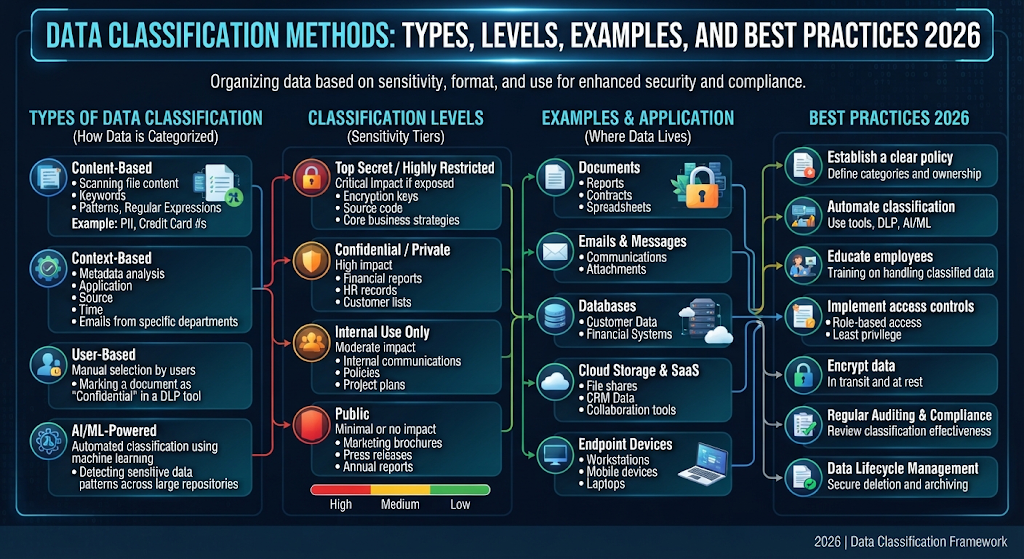
For cybersecurity teams, classification is becoming even more important as businesses move information across cloud platforms, SaaS applications, remote devices, email systems, data warehouses, and AI-powered services. Modern security therefore needs to understand the information itself instead of protecting only the network around it. NIST describes data classification as an important part of data-centric security because organizations need to identify and characterize information before they can apply suitable protections.
Trusted Sources
| Trusted Source | Best For | Explore Now |
|---|---|---|
| NIST — Data Classification Practices | Data discovery, identification, labeling, sensitive and unstructured data | NIST Data Classification Practices |
| NIST — Data Classification Concepts | Data classification, data protection, cybersecurity, privacy, Zero Trust | NIST Data Classification Concepts |
| NIST — Data-Centric Security Management | Data classification, data labeling, handling rules, Zero Trust | NIST Data-Centric Security Management |
What Is Data Classification in Cybersecurity?
Data classification in cybersecurity is the process of examining information and assigning it to a defined category according to factors such as sensitivity, business value, privacy impact, regulatory requirements, or potential damage from unauthorized access. The classification tells an organization how that information should be handled. It can influence access control, encryption, sharing, storage, monitoring, retention, and disposal.
Think of classification like a security rating attached to information. A company might classify a public product page as Public, an employee handbook as Internal, a financial forecast as Confidential, and privileged administrator credentials as Restricted. These labels don’t protect the information by themselves. Instead, they provide the decision-making layer that tells other security controls what protection should apply.
How Data Classification Differs From Simply Organizing Files
Ordinary file organization focuses on convenience. You might create folders called “Finance,” “HR,” or “Marketing” to find documents faster. Classification goes further because it considers the security risk associated with information. A finance folder could contain both public annual reports and highly confidential payroll records.
A mature data classification system therefore considers more than the subject of a document. It can examine data sensitivity, ownership, business purpose, legal obligations, access requirements, storage location, and potential consequences of exposure. This distinction becomes critical when organizations manage enormous repositories containing both low-risk and high-risk information.
Why Is Data Classification Important for Data Security?
The biggest reason classification matters is simple: not all data deserves identical protection. If a company applies maximum security controls to every piece of information, the environment becomes expensive and difficult to manage. If it applies weak controls everywhere, sensitive information becomes an easy target. Classification helps security teams concentrate stronger protection where the consequences are greater.
Consider a company that stores ten million documents. Perhaps only a small percentage contains customer financial records, credentials, intellectual property, or regulated information. Without classification, security teams may struggle to distinguish those files from ordinary business documents. With a practical data security classification model, they can identify high-value information and connect it with appropriate data protection, monitoring, access restrictions, and information security controls.
Classification Creates a Connection Between Data and Security Controls
A useful classification program does more than attach labels. It creates a chain between information and the actions required to protect it. When a document receives a Confidential label, the organization can define exactly what that label means. Employees may need authorization before accessing it. External sharing may require approval. Encryption may become mandatory. DLP rules may monitor attempts to transfer it.
This is where data protection controls become more meaningful. Instead of asking security teams to protect “everything,” classification helps answer a more precise question: What needs protection, how much protection does it need, and why?
| Classification decision | Security question it helps answer |
| Sensitivity | How serious would exposure be? |
| Ownership | Who is responsible for the information? |
| Access | Who should be allowed to use it? |
| Storage | Where can it safely reside? |
| Sharing | Can it be sent outside the organization? |
| Retention | How long should it be kept? |
| Disposal | How should it be securely destroyed? |
| Monitoring | What activity should trigger attention? |
This approach also supports information governance because classification gives business and security teams a common vocabulary. Instead of debating every individual file, organizations can establish consistent data classification guidelines that employees, applications, and security technologies can follow.
How Do Data Classification Methods Work?
Understanding how data classification methods work starts with visibility. An organization first needs to discover where its information exists. That may include databases, cloud storage, email, employee devices, file servers, collaboration platforms, SaaS applications, backups, and data warehouses. This discovery stage can reveal information that employees may have forgotten about or stored in unexpected locations.
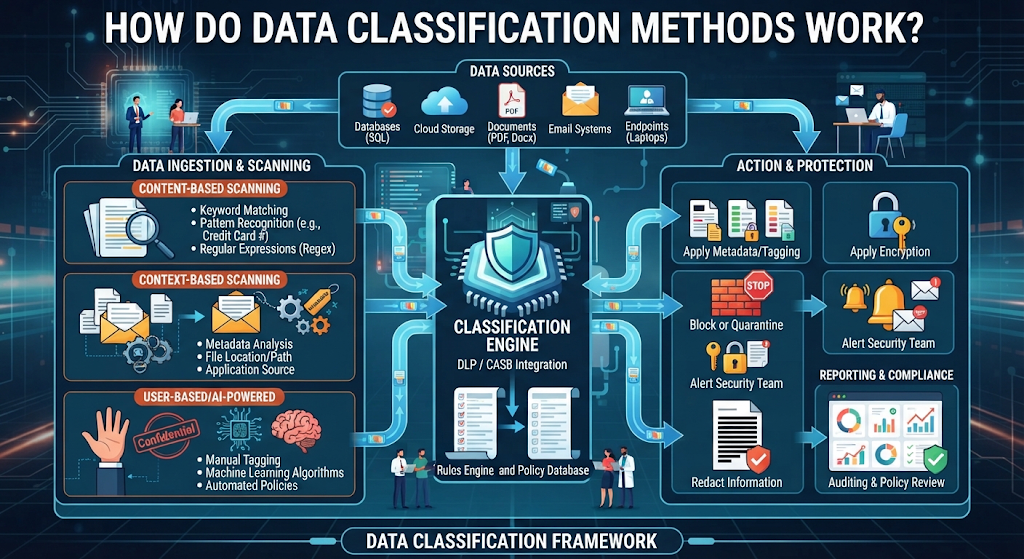
After discovery, the organization examines the information and determines its characteristics. The system or employee may inspect the actual content, metadata, file location, owner, user permissions, business purpose, or surrounding context. The organization then applies its data classification criteria and assigns an appropriate classification. That classification can become a persistent label that security technologies use later.
A Practical Data Classification Workflow
A mature data classification process normally moves through several connected stages rather than treating classification as a one-time labeling exercise.
| Stage | Purpose | Example |
| Data discovery | Find information | Scan cloud storage |
| Data identification | Understand what exists | Detect customer records |
| Risk assessment | Determine potential impact | Evaluate disclosure risk |
| Classification | Assign a category | Mark as Confidential |
| Data labeling | Communicate the decision | Add a sensitivity label |
| Policy enforcement | Apply protection | Restrict external sharing |
| Monitoring | Watch for misuse | Detect unusual transfers |
| Review | Confirm accuracy | Reclassify changed data |
The difficult part isn’t simply identifying a sensitive word. Context matters. A document containing the word “account” could be an ordinary marketing article. Another document containing the same word could contain bank account information. Strong data classification methodology therefore combines multiple signals instead of relying on one detection technique.
Why Context Matters During Classification
Imagine a spreadsheet named Customers.xlsx. The filename tells you almost nothing. The spreadsheet could contain a list of publicly announced business customers. It could also contain names, addresses, payment details, account numbers, and other sensitive information.
A classification engine may therefore inspect the content itself, examine data tags, check the document owner, review its storage location, and compare it against defined data classification rules. Human review can then resolve unusual cases. This layered data classification approach is much stronger than relying on filenames alone.
What Happens After Data Is Classified?
Classification becomes valuable when the organization uses it to make decisions. Once information receives a classification, policies can determine who may access it and how it can be shared. A Confidential document might require stronger authentication and restricted authorization. A Restricted database may require privileged access, encryption, detailed monitoring, and strict retention rules.
This creates a practical relationship between classification and technologies such as identity and access management, DLP, encryption, and Zero Trust. NIST has highlighted the role of data-centric security in protecting information according to its characteristics and requirements rather than relying solely on network location.
The process should also remain flexible. Data can become more sensitive or less sensitive over time. A product design might begin as highly restricted during development and later become public after launch. An employee record may need strict protection throughout its lifecycle. Good data classification management therefore includes periodic reviews and reclassification rather than assuming the original decision will always remain correct.
Data Classification Methods: The Main Classification Approaches
The right classification technique depends heavily on the information being examined. A small company with a few thousand documents can rely on trained employees and simple rules. A global enterprise may need automated discovery, pattern detection, machine learning, and human validation across millions of records. Choosing the right method is therefore less about finding one perfect solution and more about building a reliable classification workflow.
Modern information classification methods often work together. One method may discover potentially sensitive files. Another may inspect their content. A third may examine business context before assigning the final label. This layered approach can improve accuracy because different techniques compensate for each other’s weaknesses.
What Are the Main Data Classification Methods?
The major data classification types and methods include manual classification, automated classification, rule-based classification, machine learning-based classification, content-based classification, and context-based classification. Each method answers the same basic question: What is this information and how should the organization protect it?
However, they reach that answer in different ways. Manual classification depends on human judgment. Automated systems focus on scale. Rules provide predictable decisions. Machine learning can identify complex patterns. Content analysis examines the information itself. Context-based methods consider the environment surrounding the information.
| Classification method | Primary signal | Main advantage | Main limitation |
| Manual | Human judgment | Understands business context | Slow at large scale |
| Automated | Software analysis | Handles huge data volumes | Can produce errors |
| Rule-based | Defined conditions | Predictable results | Rules need maintenance |
| Machine learning-based | Learned patterns | Handles complex patterns | Requires validation |
| Content-based | Actual content | Strong direct evidence | May miss context |
| Context-based | Surrounding environment | Adds business meaning | Context can change |
A strong data classification framework doesn’t necessarily choose one method. It can combine several. For example, automated discovery might find a document, content analysis might detect personal information, a rule might identify a regulatory requirement, and a human owner might make the final decision.
Manual Data Classification
Manual data classification places the responsibility on people. Employees, data owners, security teams, or other authorized users examine information and choose the appropriate classification. The approach is straightforward. A document owner understands the purpose of a file and selects a label such as Public, Internal, Confidential, or Restricted.
Human judgment becomes especially valuable when the sensitivity of information depends on business context. An engineer may recognize that an ordinary-looking technical document contains unreleased intellectual property. A legal professional may understand that a contract contains information requiring special handling even when automated tools cannot confidently determine its importance.
When Manual Classification Works Best
Manual classification can work well for small repositories, highly specialized documents, or information that requires expert judgment. It is also useful when an organization is establishing its initial data classification strategy because employees can help identify realistic categories and handling requirements.
The weakness becomes obvious at scale. Asking employees to inspect millions of files is unrealistic. Human decisions can also vary between departments. One employee may mark a document Confidential while another may select Internal for similar information. For that reason, organizations using manual classification need clear data classification guidelines, training, ownership rules, and periodic quality checks.
Automated Data Classification
Automated data classification uses software to inspect information and apply classifications according to configured policies, patterns, metadata, machine learning models, or other signals. Its greatest advantage is scale. A system can examine repositories continuously without requiring an employee to open every document.
Automated systems can support data discovery, data scanning, sensitive-data detection, and automated labeling across cloud storage, databases, email, endpoints, and file repositories. This makes automation particularly useful for large organizations where information changes constantly. NIST’s recent work on sensitive unstructured information demonstrates how automated technologies can support discovery, identification, and labeling across complex environments.
Why Automation Still Needs Human Oversight
Automation isn’t automatically accurate. A classification engine can produce false positives when it sees a pattern that looks sensitive but isn’t. It can also produce false negatives when sensitive information appears in an unexpected format.
A practical data classification system should therefore allow organizations to review uncertain results. High-confidence classifications can be automated. Low-confidence decisions can be sent to a data owner or security professional. This creates a hybrid model where machines provide scale while humans provide judgment.
Rule-Based Data Classification
Rule-based classification uses predefined conditions to determine how information should be categorized. These rules can examine keywords, patterns, file properties, metadata, locations, users, or other attributes. The organization decides what conditions trigger a classification.
For example, a company could create a rule that identifies a specific format associated with a Social Security number. Another rule might identify credit card patterns. A third could classify documents stored inside a highly restricted legal repository as Confidential by default.
How Rule-Based Classification Identifies Data
Rules often use keyword matching, regular expressions, file names, metadata, and predefined dictionaries. A rule might search for terms such as “routing number,” “salary,” or “patient record.” A regular expression could identify a structured number pattern.
The major strength is transparency. Security teams can understand why a rule classified information in a particular way. That makes auditing easier. The weakness is maintenance. Business terminology changes. Data formats evolve. Attackers may also manipulate content to avoid simple patterns. Effective data classification rules therefore need regular testing and refinement.
Machine Learning-Based Data Classification
Machine learning classification takes a different approach. Instead of depending entirely on manually written rules, a model can learn patterns from examples or analyze complex relationships within information. This can help identify documents that don’t contain an obvious keyword yet share characteristics with known sensitive material.
Modern machine learning models can examine language, document structure, metadata, and other signals. Artificial intelligence and natural language processing can also help analyze documents where meaning depends on surrounding language. For example, the difference between a public article about banking and an internal banking report may not be obvious from one keyword.
Why Machine Learning Can Improve Classification
Machine learning can handle patterns that are difficult to describe through simple rules. It may recognize that a document contains a collection of characteristics associated with financial information even when the exact wording changes from one document to another.
However, machine learning introduces a new challenge: trust. Organizations need to understand model accuracy, false positives, false negatives, training data, and decision thresholds. High-risk classifications should not automatically trigger severe actions without appropriate validation. Intelligent data classification works best when organizations measure performance and maintain human oversight where the consequences of an incorrect decision are significant.
Content-Based Data Classification
Content-based classification examines what information actually appears inside a file, record, message, or document. The content itself becomes the primary evidence for determining sensitivity. This approach can be particularly useful for identifying personal data, financial information, credentials, health information, and other sensitive material.
For example, a document might contain a customer’s name, address, account number, and payment details. Content inspection can detect those characteristics even if the file name is simply report.xlsx. This makes content analysis much more useful than relying on filenames or folder structures alone.
How Content Analysis Detects Sensitive Information
A content-based system may use content analysis, pattern matching, dictionaries, regular expressions, document recognition, or machine learning. It can inspect text inside PDFs, spreadsheets, emails, presentations, and other unstructured files.
The method has an important limitation. Content doesn’t always reveal the complete risk. A document may contain ordinary information but still be highly sensitive because it belongs to a confidential project. That is why content-based classification often works best when combined with contextual signals and organizational policies.
Context-Based Data Classification
Context-based classification considers the environment around information. Instead of asking only “What does this file contain?” it also asks “Where is it stored?”, “Who owns it?”, “Who is using it?”, “Which application created it?”, and “What business process does it support?”
This approach can produce a more realistic classification decision. A spreadsheet containing sales information might be Internal when used for ordinary reporting. The same type of spreadsheet could become Restricted if it contains unreleased acquisition data. Context gives the classification engine information that content alone may not reveal.
Why Context Makes Classification More Accurate
Useful context can include the data owner, department, storage location, user role, access history, application, project, metadata, and business process. Contextual analysis can therefore complement content-based detection and improve classification accuracy.
However, context can change quickly. A document may move from one repository to another. An employee may change departments. A project may become public after a product launch. A reliable data classification approach must therefore monitor important changes instead of assuming that context remains permanent.
How These Data Classification Methods Work Together
The strongest enterprise environments often combine methods rather than choosing only one. Imagine a company scanning its cloud storage. Automated discovery first identifies thousands of files. Content analysis finds possible personal information. Rule-based detection confirms known sensitive patterns. Machine learning evaluates more complicated documents. Context analysis considers ownership and location. A human reviews unusual or high-risk cases.
This layered model creates stronger sensitive data classification because each technique contributes a different signal. Automation provides scale. Rules provide predictability. machine learning provides pattern recognition. Content analysis provides direct evidence. Context provides business meaning. Human review handles ambiguity.
| Layer | Contribution |
| Discovery | Finds where information exists |
| Content analysis | Examines actual information |
| Rules | Applies known classification criteria |
| Machine learning | Detects complex patterns |
| Context | Adds business and environmental meaning |
| Human review | Resolves uncertain decisions |
| Labeling | Communicates the final classification |
The important lesson is that data classification methodology should match the organization’s risk rather than follow technology trends. A sophisticated AI model isn’t automatically better for every organization. Sometimes a clear rule is more reliable. Sometimes expert review is essential. The best data classification model uses the right level of automation for each type of information.
Choosing the Right Classification Method
The decision should start with four questions: how much data exists, how sensitive it is, how often it changes, and how costly an incorrect classification would be. A small legal archive may benefit from expert review. A massive cloud environment needs automation. A highly regulated organization may require several layers of validation.
| Situation | Suitable approach |
| Small document collection | Manual classification |
| Millions of files | Automated classification |
| Known sensitive patterns | Rule-based classification |
| Complex document meaning | Machine learning |
| Personal or financial information | Content-based detection |
| Business-sensitive context | Context-based analysis |
| High-risk information | Hybrid approach |
There is no universal data classification methodology that fits every company. A practical program begins with clear classification criteria and grows as the organization understands its data environment. The objective isn’t to make classification complicated. The objective is to make protection more accurate.
Data Classification Levels, Types, and Real-World Examples
Understanding classification methods is only half the job. An organization also needs a clear system for deciding how sensitive each piece of information actually is. This is where classification levels become important. Without defined levels, employees may recognize sensitive information but still disagree about how strongly it should be protected.
A practical classification model should be simple enough for everyday employees yet detailed enough for security teams. The goal isn’t to create dozens of confusing labels. It is to establish meaningful boundaries between information that can be shared freely, information that should stay inside the organization, information that requires stronger protection, and information that could cause serious harm if exposed.
What Are the Different Levels of Data Classification?
Most organizations use a small number of data classification levels to make security decisions easier. A four-level model commonly separates information into Public, Internal, Confidential, and Restricted or Highly Confidential categories. The exact names can change between organizations. What matters is that every level has a clear definition and practical handling requirements.
A useful data classification scheme should explain what qualifies for each level, who can access it, how it can be shared, where it can be stored, and what happens when the information reaches the end of its data lifecycle. The classification should also consider business impact, privacy concerns, contractual obligations, and security requirements.
| Classification level | General sensitivity | Typical access | Example |
| Public | Low | Anyone | Published website content |
| Internal | Moderate | Authorized workforce | Internal procedures |
| Confidential | High | Approved users | Business financial records |
| Restricted | Very high | Strictly authorized users | Credentials or highly sensitive records |
These levels are not a universal legal standard. Organizations should define their own data classification criteria according to their risk profile and applicable obligations. A healthcare provider may need more detailed controls for medical information. A technology company may place greater emphasis on source code and intellectual property.
Public Data
Public data is information an organization intentionally makes available to people outside the company. It can include public webpages, press releases, product documentation, published reports, approved marketing material, job advertisements, and publicly released research.
The word “public” doesn’t mean the information has no security value. An attacker could still modify a public website or replace an official document with false information. The confidentiality requirement may be low, but information protection and integrity remain important.
Public Data Examples
A company’s homepage is usually public. Its published product pricing may also be public. A press release approved for distribution belongs in the same general category. Once information has been intentionally released through an official channel, restricting ordinary access to it usually provides little security benefit.
However, organizations should avoid classifying information as public simply because it isn’t obviously confidential. A draft press release, unreleased product announcement, or internal marketing strategy may still require stronger protection until the business officially approves publication.
Internal Data
Internal data is information intended for employees, contractors, or other authorized members of an organization. It doesn’t normally require public access. Yet unauthorized disclosure may still create operational, competitive, or security risks.
Examples can include internal procedures, employee communications, non-public meeting notes, routine operational documents, internal training materials, and certain system documentation. Internal information usually requires authentication and appropriate access permissions, even when it doesn’t contain highly sensitive personal or financial information.
Internal Data Examples
Consider an internal IT document explaining how employees connect to company systems. The document may not contain passwords or secret keys. Still, exposing detailed infrastructure information could help an attacker understand the organization’s environment. Classification therefore provides a useful middle ground between “public” and “highly restricted.”
Organizations should also define whether employees may send Internal information to personal accounts, external partners, or consumer cloud services. Clear data handling rules reduce accidental disclosure because employees don’t have to guess what “internal” actually means.
Confidential Data
Confidential data requires stronger protection because unauthorized access, disclosure, alteration, or loss could cause meaningful harm. This category often includes financial information, customer records, contracts, strategic plans, proprietary research, unreleased product information, and certain employee records.
Confidential information usually needs more restrictive access control, stronger sharing rules, encryption where appropriate, and additional monitoring. The organization should also define which departments can access it and whether external parties require formal authorization or contractual safeguards.
Confidential Data Examples
Imagine a software company developing a new product. Its public website may reveal the existing product line, while an internal roadmap explains what the company plans to release next year. The roadmap could contain valuable competitive information. Even though it isn’t personal data, its business value can justify a Confidential classification.
This illustrates an important principle in data sensitivity classification: sensitivity isn’t limited to privacy. Information can be sensitive because of its commercial value, strategic importance, legal status, security implications, or potential impact on customers and employees.
Restricted or Highly Confidential Data
Restricted information represents the highest-risk category in many organizational classification schemes. Exposure could create severe financial, legal, operational, privacy, or security consequences. Examples may include authentication secrets, highly sensitive personal information, privileged legal material, critical intellectual property, security keys, and certain regulated records.
Access should normally follow least privilege, meaning users receive only the permissions required for their responsibilities. Strong authentication, authorization, encryption, privileged access controls, and detailed security monitoring may also be appropriate depending on the information and risk.
Restricted Data Examples
Consider administrator credentials for a production environment. The credentials may consist of only a few characters, yet their value can be enormous. If stolen, they could allow unauthorized access to databases, applications, customer information, or cloud infrastructure.
The same principle applies to highly sensitive customer or employee records. A classification label should therefore trigger meaningful protection. Calling information “Restricted” without enforcing stronger controls creates a false sense of security.
What Are the Types of Data Classification?
Data classification types can be understood from several perspectives. Some organizations classify data mainly by confidentiality. Others also consider integrity, availability, privacy, business value, regulatory obligations, or operational importance.
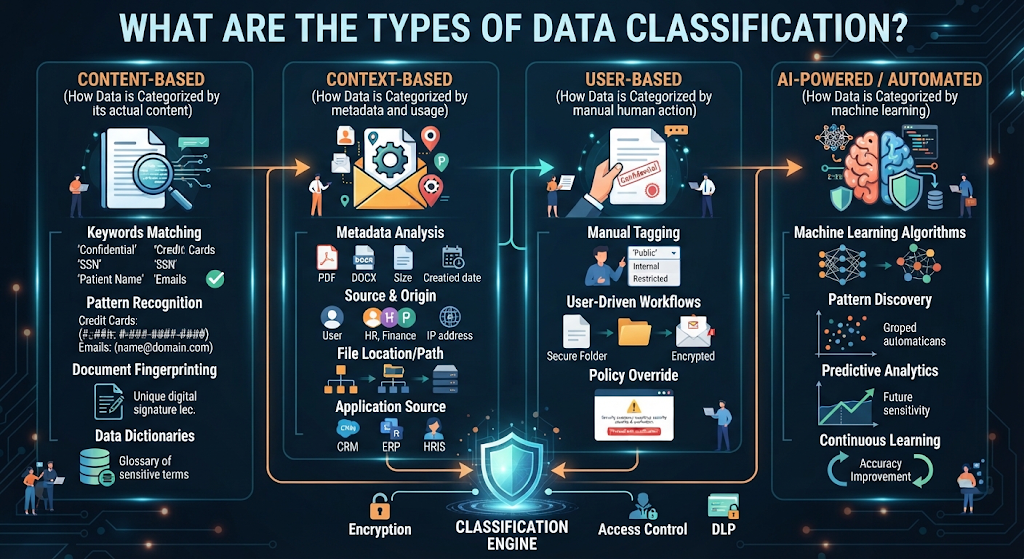
A mature data classification framework can combine these factors. For example, customer information might be classified as Confidential because unauthorized disclosure could harm customers. The same information might also carry a privacy designation because it contains personally identifiable information. Another dataset might be classified as Restricted because it supports a critical production system.
| Classification dimension | What it measures | Example |
| Confidentiality | Risk from unauthorized disclosure | Customer records |
| Integrity | Risk from unauthorized changes | Financial transactions |
| Availability | Impact if unavailable | Critical systems data |
| Privacy | Risk to individuals | Personal information |
| Business value | Commercial importance | Product designs |
| Regulatory status | Legal handling requirements | Protected health data |
This broader view makes organizational data classification more useful because it recognizes that information can be risky for different reasons. A public system status page may have low confidentiality requirements but high integrity requirements. A private database may require strong protection across all three security dimensions.
Sensitivity-Based Data Classification
Sensitivity-based classification asks a simple question: What could happen if this information reached the wrong person? The greater the potential harm, the stronger the classification generally becomes.
For example, a public product description may have minimal confidentiality risk. An internal business plan may have moderate risk. A customer database could create substantial privacy and financial risks. Production credentials could create severe security consequences. This makes sensitivity a practical foundation for many data classification standards.
However, sensitivity should not be evaluated in isolation. A document’s importance can change over time. A confidential product announcement may become public after its official release. A temporary project document might become obsolete and require secure disposal. Classification should therefore follow the information throughout its lifecycle.
Content-Based Data Classification Types
Content-based classification focuses on what information actually appears inside a file or record. This approach is particularly useful when organizations need to identify sensitive data that may be hidden inside large collections of unstructured information.
A document containing a Social Security number, payment card number, medical information, or authentication credential can potentially be detected through patterns or other content signals. This supports sensitive data detection and helps organizations identify information that employees may not have labeled correctly.
The approach becomes more powerful when combined with data discovery, content analysis, and contextual information. A file containing a common word shouldn’t automatically become Restricted. Classification engines need enough evidence to distinguish genuinely sensitive information from ordinary content.
Context-Based Data Classification Types
Context-based classification considers information surrounding the data. This can include its owner, department, storage location, application, project, user, access history, or business process.
Imagine two spreadsheets containing similar sales information. One belongs to a public marketing campaign. The other belongs to an executive acquisition project. Their content might look similar, yet the second document could be significantly more sensitive because of its business context.
This is why a strong data classification model shouldn’t depend exclusively on keywords. Context can provide the missing information that content analysis cannot see. It can also help security teams create more accurate classifications across complex enterprise environments.
Business-Based Data Classification Types
Business-based classification considers the value of information to the organization. Some data may not contain personal information or regulated content yet still represent significant intellectual or competitive value.
For example, proprietary algorithms, product designs, source code, pricing strategies, acquisition plans, and research results may contain intellectual property that competitors could exploit. These assets may therefore require Confidential or Restricted handling.
This approach strengthens enterprise data classification because it recognizes that cybersecurity isn’t only about protecting personal information. Companies also need to protect information that gives them commercial, technological, or strategic advantages.
Regulatory-Based Data Classification Types
Regulatory classification focuses on information that falls under specific legal, contractual, or industry requirements. A healthcare organization may need to identify protected health information. A financial institution may need to identify sensitive customer information. An educational institution may need to protect student records.
For U.S. organizations, examples can include HIPAA, PCI DSS, GLBA, and FERPA, depending on the organization’s role and applicable obligations. Classification can help identify relevant information, but it doesn’t automatically create compliance. The organization still needs to implement the controls required by the applicable framework or law.
Data Classification Levels vs Data Classification Types
These two concepts are often confused. Data classification levels describe degrees of sensitivity, such as Public, Internal, Confidential, and Restricted. Data classification types describe the reason or dimension used to classify information, such as sensitivity, privacy, business value, or regulatory status.
That distinction can make a classification program much clearer. A customer record could have a Confidential sensitivity level and a privacy designation because it contains PII. A product design could have a Confidential level because of its business value. Both are sensitive, but the reason for protection differs.
| Concept | Main purpose |
| Classification level | Shows degree of protection |
| Classification type | Explains classification dimension |
| Classification label | Communicates the decision |
| Classification rule | Helps make the decision |
| Classification policy | Defines organizational requirements |
This structure can form the foundation of a scalable data classification system. It also prevents organizations from trying to force every security concern into a single label.
Data Classification Examples in Real-World Organizations
Real-world data classification examples show why organizations need flexible models. A hospital, bank, software company, university, and retailer can all use the same basic classification principles while protecting very different information.
A hospital may classify a patient’s medical record as highly restricted. A software company may apply similar protection to unreleased source code. A bank may treat account information as highly sensitive. A university may protect student records while keeping its public course catalog freely available.
| Organization | Example information | Possible level | Main concern |
| Hospital | Patient medical record | Restricted | Privacy |
| Bank | Customer financial record | Restricted | Financial and privacy risk |
| Software company | Unreleased source code | Confidential | Intellectual property |
| University | Student record | Restricted | Privacy and regulation |
| Retailer | Customer purchase history | Confidential | Personal information |
| Manufacturer | Product design | Confidential | Competitive advantage |
These examples demonstrate why there is no single universal data classification scheme. The correct decision depends on the information, its context, its business value, and the consequences of unauthorized access.
A useful program also recognizes that classification can change. A confidential product design may become public after launch. An internal report may become confidential when it begins containing sensitive financial forecasts. A dataset may require stronger protection when new personal information is added. Effective data classification management must therefore support change rather than treating classification as permanent.
Building a Practical Classification Model
A practical organization should avoid creating too many levels. Employees need to make classification decisions quickly and consistently. If the system contains ten or fifteen confusing categories, employees may choose labels incorrectly or ignore them altogether.
A simple model can provide a strong foundation. Public information can remain openly accessible. Internal information can stay within the organization. Confidential information can receive stronger controls. Restricted information can receive the highest level of protection. Additional tags can then identify privacy, regulatory, or business-specific characteristics without creating unnecessary classification levels.
The best data classification strategy is therefore not the most complicated one. It is the one employees understand, security tools can enforce, data owners can maintain, and leadership can audit. Clear definitions matter more than an impressive list of labels.
Data Classification in Cybersecurity, Sensitive Data, and Enterprise Information
Data classification becomes much more valuable when it moves beyond labels and connects directly with cybersecurity operations. Modern organizations don’t store information in one location. Data moves between cloud platforms, databases, employee devices, email accounts, collaboration tools, applications, and backup systems. Every movement creates another opportunity for sensitive information to be exposed.
A strong data classification in cybersecurity program gives security teams a clearer view of what they need to protect. It can help distinguish ordinary business information from sensitive data, personal data, financial records, intellectual property, credentials, and other high-value information. That distinction allows organizations to apply protection according to risk instead of treating every file identically.
Data Classification in Cybersecurity
Cybersecurity traditionally focused heavily on networks, endpoints, applications, and identities. Those controls remain important. However, attackers ultimately want something valuable, such as customer information, credentials, financial records, intellectual property, or business-critical information. Classification helps security teams understand where that valuable information exists.
This makes data classification for cybersecurity a foundation for data-centric protection. Once information has a meaningful classification, organizations can connect it with access control, encryption, DLP, monitoring, retention, and incident response. The label becomes a bridge between the information and the security controls designed to protect it.
Classification Supports Risk-Based Security
Security teams rarely have unlimited resources. They need to prioritize the information whose compromise could create the greatest consequences. A Restricted database containing credentials deserves stronger controls than a public marketing brochure.
This is where security data classification becomes practical. It helps teams prioritize protection based on confidentiality, business value, privacy impact, regulatory obligations, and operational importance. Classification doesn’t eliminate risk. It helps organizations make better decisions about where to spend security effort.
How Data Classification Supports Access Control
Classification and access control work closely together. Classification describes the sensitivity of information. Access control determines who can interact with it. When these two systems work together, organizations can create more precise authorization decisions.
For example, Internal information might be available to authenticated employees. Confidential information could require membership in a specific department. Restricted information might require role-based access control, additional authentication, or privileged approval. This follows the principle of least privilege, where users receive only the access necessary for their responsibilities.
Classification and Identity Management
An organization can connect classification labels with identity and access management policies. A user’s role, department, location, device security, and authentication status can influence whether access is permitted.
This approach becomes especially useful in cloud environments. A user might legitimately access a Confidential document from a managed corporate device while the same request from an unmanaged personal device could require additional verification or be blocked. Classification provides the data-side signal needed for that decision.
Data Classification for Sensitive and Personal Data
Personal information deserves particular attention because exposure can affect real people. Organizations may collect names, addresses, phone numbers, email addresses, government identifiers, account details, employment information, medical records, and other forms of personally identifiable information.
Sensitive data classification helps organizations identify this information and apply appropriate controls. However, not every piece of personal information carries the same risk. A public business email address may present little risk. A combination of identity information and financial details can create far greater consequences.
Identifying Personally Identifiable Information
PII can appear in databases, spreadsheets, emails, PDFs, forms, applications, logs, and employee documents. Some information is structured into clearly defined database fields. Other information appears inside free-form text where detection becomes harder.
Effective classification can use data identification, pattern recognition, dictionaries, metadata, content inspection, and contextual signals. This helps organizations discover personal information even when employees haven’t manually labeled the document.
Financial Data Classification
Financial information often requires strong protection because unauthorized access can create fraud, privacy, regulatory, and reputational risks. Examples include bank account information, transaction records, payment details, tax information, financial statements, and certain customer records.
A data security classification program can identify these assets and connect them with appropriate controls. Payment information may require additional safeguards under relevant industry requirements. Financial records may also need retention and access rules based on the organization’s legal and operational obligations.
For example, a company’s published annual report may be Public. An internal financial forecast may be Confidential. Payment card information could require much stronger restrictions. The subject is “finance” in all three cases. Their security requirements are completely different.
Healthcare Data Classification
Healthcare organizations handle information that can reveal highly personal details about individuals. Medical histories, diagnoses, treatment information, prescriptions, insurance information, and other patient-related records may require strong protection.
Protected health information is an important classification concern for organizations subject to HIPAA. Classification can help identify relevant information and connect it with appropriate handling policies. However, classification itself isn’t a substitute for HIPAA compliance. Organizations must still implement the administrative, physical, and technical safeguards required by applicable rules.
PHI and Classification Decisions
PHI can appear in electronic health records, laboratory reports, medical documents, billing records, emails, and other systems. A classification program should consider both structured and unstructured sources.
This is particularly important because sensitive healthcare information can hide inside ordinary-looking documents. A PDF containing a patient’s name and treatment information may need stronger protection even if its filename doesn’t indicate medical content.
Employee Data Classification
Organizations also hold significant amounts of employee data. Human resources systems may contain payroll records, employment documents, tax information, performance information, identification details, and other private records.
These records shouldn’t automatically receive the same classification. A public job advertisement is very different from an employee’s private payroll information. A mature data classification policy should define these distinctions clearly so HR teams know how different types of employee information must be handled.
Classification also supports internal privacy. Employees don’t need unrestricted access to every HR record simply because they work for the same company. Proper classification can help enforce departmental boundaries and reduce unnecessary exposure.
Customer Data Classification
Customer information can exist across sales platforms, support systems, CRM applications, email, databases, analytics tools, and marketing platforms. This creates a broad data discovery challenge.
A customer database may contain contact information, purchase history, support conversations, preferences, payment details, and account information. Each element can carry different levels of sensitivity. Organizations should therefore consider the complete context rather than applying one generic label to every customer-related file.
This is particularly important when customer data moves into third-party SaaS applications or cloud environments. Classification can help organizations determine which information may be shared and what safeguards should accompany that transfer.
Data Classification for Structured and Unstructured Data
Organizations commonly divide information into structured data, unstructured data, and semi-structured data. Each format creates different classification challenges.
Structured data usually follows a defined schema. Databases and spreadsheets are common examples. Fields may clearly identify names, account numbers, transaction values, or dates. This structure can make automated discovery easier because classification systems know where to look.
Unstructured data is less predictable. Emails, presentations, PDFs, images, contracts, documents, and chat messages can contain sensitive information without consistent fields. Semi-structured data sits between these categories and may contain tags or organizational elements without following a rigid database structure.
| Data format | Examples | Classification challenge |
| Structured | Databases, spreadsheets | Large volumes and many fields |
| Unstructured | PDFs, emails, documents | Meaning and context vary |
| Semi-structured | JSON, XML, logs | Mixed structure and content |
Classifying Structured Data
Structured data often provides useful clues through field names, schemas, database metadata, and predictable formats. A security system can search specific columns for patterns associated with personal or financial information.
For example, a database may have fields named customer_name, account_number, and payment_status. These signals can support automatic data discovery and classification. Yet field names aren’t enough on their own. Organizations should validate what the fields actually contain.
A column called “ID” could contain a harmless internal reference number. It could also contain a government identifier. The classification system needs sufficient context to distinguish between them.
Classifying Unstructured Data
Unstructured information creates a more difficult problem. A contract may contain sensitive terms without any structured field identifying them. An email may contain customer information inside an ordinary conversation. A presentation may include confidential product details within a single slide.
This is where content-based classification, natural language processing, and contextual analysis can become valuable. Systems can inspect language, patterns, document properties, and surrounding information to estimate sensitivity.
However, organizations should be cautious with automated decisions. A model may misunderstand ambiguous language. High-risk classifications may therefore benefit from human review before strict controls are applied.
Data Classification in Cloud Environments
Cloud computing has changed where organizational information lives. Data may exist across SaaS applications, cloud databases, object storage, collaboration platforms, virtual machines, and backup systems. Employees can also access information from many locations and devices.
This makes cloud security closely connected with classification. Security teams need to know which cloud data is sensitive before they can decide how strongly to protect it. A Confidential file stored in an approved corporate repository may require different controls from the same file copied into an unmanaged personal account.
Classification can also support cloud access policies, monitoring, encryption, and DLP rules. When sensitive information moves somewhere it shouldn’t, security systems can use its classification to identify the event and trigger an appropriate response.
Data Classification and Data Loss Prevention
Data loss prevention systems use information about sensitive content to identify and control risky data movement. Classification can make those decisions more precise.
For example, an organization could allow Public information to leave the corporate environment freely while restricting external transmission of Restricted information. A DLP system can inspect email attachments, cloud uploads, endpoint activity, or other data transfers and respond according to classification policies.
Classification Makes DLP More Context-Aware
DLP without good classification can become noisy. If every document receives the same treatment, employees may encounter unnecessary warnings while genuinely dangerous transfers become harder to identify.
When DLP understands classification labels, it can prioritize higher-risk events. An attempt to upload a public brochure is fundamentally different from an attempt to upload a database containing customer records. Classification gives the DLP system the information needed to tell the difference.
Data Classification and Data Labeling
Classification and labeling are closely related but aren’t identical. Classification is the decision about how information should be treated. Data labeling communicates that decision through a visible or machine-readable label.
A document might receive a “Confidential” classification and then display a Confidential security label. That label can help employees understand handling requirements while security tools use the same signal for enforcement.
Why Labels Matter
Labels provide a common language between people and technology. An employee can see that a document is Restricted. A security platform can read the same sensitivity label and apply sharing restrictions.
Effective labeling therefore turns an abstract classification decision into something practical. It can also support automated enforcement when integrated with access control, DLP, encryption, and other security technologies.
Data Classification and Data Governance
Classification is also a major component of data governance. Governance establishes how an organization manages information throughout its lifecycle. Classification helps governance teams understand what information exists and which rules apply to it.
A governance program may connect classification with data ownership, retention, privacy, access, quality, and disposal. This creates a more complete data classification management process instead of treating classification as a one-time security project.
For example, an organization might identify a dataset as Confidential, assign a business owner, define approved users, establish a retention period, and specify how the dataset must be destroyed. The classification becomes part of the information’s lifecycle rather than a label that simply sits on a document.
A Practical Enterprise Classification Scenario
Consider a U.S. technology company preparing to launch a new product. Its website contains Public information about existing products. Internal project documentation contains operational details. The new product’s source code is Confidential. The company’s acquisition strategy is Restricted.
Now imagine the company stores these assets across Git repositories, cloud storage, email, project-management software, and employee laptops. A simple folder-based system would struggle to maintain consistent protection.
An enterprise data classification strategy could identify the information, apply appropriate labels, connect classifications with access permissions, monitor sensitive transfers, and periodically review the classifications as the project changes. When the product launches, selected information could be reclassified as Public without manually redesigning the entire security environment.
Why Classification Must Follow the Data Lifecycle
Information doesn’t remain static. It is created, modified, copied, shared, archived, and eventually deleted. A classification assigned at creation may become inaccurate later.
This is why data lifecycle management should be part of classification. Organizations should consider classification during creation, storage, use, sharing, archival, and disposal. A classification review can also occur when ownership changes, a project ends, a regulation changes, or new sensitive information is added.
The strongest programs treat classification as an ongoing process. They don’t simply label information once and forget about it. Continuous discovery, monitoring, review, and data handling keep classifications useful as the organization’s environment evolves.
Data Classification Process: Step-by-Step Implementation Guide
A strong classification program needs more than categories and labels. Organizations need a repeatable process that employees, security teams, and automated systems can follow consistently. Without a defined process, one department may classify information carefully while another uses completely different standards.
The data classification process should begin with visibility and end with continuous review. Organizations need to discover their information, understand its purpose, identify its owner, evaluate sensitivity, assign a classification, apply handling rules, and monitor whether those decisions remain accurate. This turns classification from a simple labeling exercise into an operational security practice.
Data Classification Process: Step-by-Step
The first step is to understand what information the organization actually owns. This sounds simple, yet large organizations often have information scattered across databases, laptops, email systems, cloud storage, collaboration applications, archives, backups, and third-party platforms.
After creating visibility, the organization can determine what each dataset contains, who owns it, why it exists, how sensitive it is, and which requirements apply. The classification decision should then trigger appropriate protection. Finally, the organization needs a review mechanism because information and business conditions change.
| Step | Main activity | Key outcome |
| 1 | Discover data | Visibility |
| 2 | Build inventory | Data map |
| 3 | Assign ownership | Accountability |
| 4 | Define criteria | Consistent decisions |
| 5 | Analyze information | Sensitivity assessment |
| 6 | Assign classification | Security label |
| 7 | Apply handling rules | Protection |
| 8 | Enforce controls | Risk reduction |
| 9 | Monitor usage | Ongoing visibility |
| 10 | Review classifications | Continued accuracy |
Step 1: Discover Organizational Data
Start by finding where information exists. A company may have structured databases alongside thousands of documents, emails, spreadsheets, images, logs, and cloud files.
Data discovery tools can scan repositories and identify potentially sensitive information. Manual discovery can also help during the early stages of a program. The objective is to establish a realistic picture of the organization’s information environment rather than assuming that all important data lives in official systems.
Step 2: Create a Data Inventory
Once information has been discovered, organize it into a data inventory. The inventory should identify important datasets, their locations, owners, business purpose, format, sensitivity, and relevant requirements.
A useful inventory doesn’t need to record every insignificant file individually. Organizations can group similar information when appropriate. For example, an HR system may be recorded as a major information asset while its individual employee records remain managed inside that system.
Step 3: Assign Data Ownership
Every important information asset should have a responsible owner. Data ownership creates accountability for classification decisions and handling requirements.
The owner doesn’t necessarily need to manage the technical infrastructure. Instead, the owner should understand the business value of the information and help determine how it should be handled. Security teams can provide technical guidance while business owners provide operational context.
Step 4: Define Classification Criteria
Before employees begin classifying information, establish clear data classification criteria. The criteria should explain what makes information Public, Internal, Confidential, or Restricted.
Organizations should consider confidentiality, privacy, business impact, regulatory obligations, contractual requirements, and potential damage from unauthorized access. Clear criteria reduce subjective decisions and make classification more consistent across departments.
Step 5: Analyze Data Sensitivity
The next stage evaluates the actual information. This can involve manual review, automated scanning, keyword matching, pattern recognition, metadata analysis, or machine learning.
The organization should ask practical questions. Does the information contain PII? Does it reveal financial information? Does it contain proprietary technology? Could exposure create legal or regulatory problems? Would alteration affect critical operations?
Step 6: Assign a Classification
After analysis, the organization assigns the appropriate classification. This may be performed by a person, an automated system, or a combination of both.
High-confidence cases can often be automated. Ambiguous or high-impact cases may require human approval. This hybrid data classification approach can improve scalability without removing human judgment from important decisions.
Step 7: Apply Data Handling Rules
Classification only becomes useful when it changes how information is handled. A Confidential document may require restricted sharing. A Restricted record may require encryption and privileged access.
The organization’s data handling rules should explain where information can be stored, who can access it, whether external sharing is allowed, how it can be transmitted, and how it should be disposed of.
Step 8: Enforce Security Controls
Technical controls should support the classification policy. These can include access control, encryption, DLP, authentication, monitoring, endpoint security, and cloud security controls.
For example, a Restricted classification could trigger stronger access restrictions while Public information remains broadly accessible. The exact controls should reflect the organization’s risk and operational needs.
Step 9: Monitor Classification Activity
Classification shouldn’t end after the label is assigned. Organizations should monitor whether sensitive information is being accessed, copied, shared, or moved in unexpected ways.
Security monitoring can help identify unusual behavior. A sudden attempt to download thousands of Confidential documents may deserve investigation. Classification gives security teams additional context when analyzing such events.
Step 10: Review and Reclassify Data
Information changes. Business projects end. New regulations appear. Employees change roles. Documents become public. New information gets added to existing datasets.
For that reason, organizations need periodic data classification review. A classification that was correct six months ago may no longer be appropriate today. Reclassification keeps security policies aligned with the actual risk.
How to Create a Data Classification Policy
A data classification policy converts the organization’s classification strategy into formal requirements. It should explain what the classification system means and how employees and technology must use it.
The policy should be understandable to ordinary employees. If the document is written entirely in technical language, people may struggle to apply it during daily work. Good policies provide clear definitions, examples, responsibilities, handling requirements, exceptions, and review procedures.
Define the Purpose and Scope
Start by explaining why classification exists. The purpose could include protecting sensitive information, reducing security risks, supporting compliance, improving data governance, and establishing consistent handling practices.
Then define the scope. The policy might cover employees, contractors, systems, cloud services, endpoints, databases, documents, email, applications, and third-party environments. Clear scope prevents uncertainty about which information is covered.
Define Classification Levels
The policy should provide precise definitions for each level. Public should explain what information can be openly shared. Internal should describe information intended for authorized workforce use. Confidential should define information requiring stronger protection. Restricted should explain the highest-risk category.
Avoid vague wording such as “important information.” Employees need practical examples. A policy becomes easier to follow when users can quickly compare their document with realistic scenarios.
| Level | Typical handling requirement |
| Public | Approved for external distribution |
| Internal | Authorized organizational use |
| Confidential | Restricted access and controlled sharing |
| Restricted | Strict access and enhanced protection |
Define Data Classification Responsibilities
A policy should identify who makes classification decisions. Responsibilities may be divided among data owners, employees, IT teams, security teams, privacy teams, compliance personnel, and senior management.
For example, employees may be responsible for handling information correctly. Data owners may determine sensitivity. Security teams may implement technical controls. Compliance teams may advise on regulatory requirements. This division creates clear accountability.
Define Classification Rules
The policy should establish data classification rules that help employees make consistent decisions. Rules can cover personal information, financial information, intellectual property, authentication data, customer records, employee records, and regulated information.
Rules should also explain what happens when an employee isn’t sure. A clear escalation process is better than forcing users to guess. Uncertain cases can be reviewed by the data owner or an appropriate security team.
Define Data Labeling Requirements
The organization should explain how users and systems communicate classifications. This may involve visible labels, metadata, document properties, digital tags, or automated sensitivity labels.
Effective data labeling should be easy enough that employees actually use it. If adding a classification requires several complicated steps, users may avoid doing it. Automation can reduce this friction where appropriate.
Connect the Policy With Access Control
The classification policy should explain how classification affects access. A Confidential label should have a meaningful relationship with access permissions.
For example, employees may access Internal information after authentication. Confidential information may require departmental authorization. Restricted information may require additional approval or privileged access. The exact design depends on organizational risk.
Connect Classification With DLP
A mature policy should also explain how classification interacts with data loss prevention. DLP systems can monitor sensitive information leaving approved environments.
For instance, the organization could allow Public documents to be shared externally while blocking unauthorized transfers of Restricted information. This makes classification a practical enforcement signal rather than a decorative label.
Data Classification Policy Requirements
A complete policy should address several core areas without becoming unnecessarily complicated. The following table shows the major policy components an organization should consider.
| Policy area | What it should define |
| Purpose | Why classification exists |
| Scope | Which data and users are covered |
| Definitions | Meaning of each classification |
| Ownership | Who is accountable |
| Classification criteria | How decisions are made |
| Labeling | How classifications are communicated |
| Handling | How information must be used |
| Access | Who may access each level |
| Sharing | Rules for internal and external transfer |
| Storage | Approved locations |
| Retention | How long information remains |
| Disposal | Secure destruction requirements |
| Exceptions | How unusual situations are approved |
| Review | When classifications are reassessed |
| Enforcement | What happens after policy violations |
How to Implement a Data Classification Framework
Implementation should happen gradually. Trying to classify an entire enterprise overnight can overwhelm security teams and employees. A better approach is to start with high-value information and expand the program based on lessons learned.
Begin with important repositories such as customer databases, financial systems, HR platforms, source-code repositories, cloud storage, and business-critical applications. Once the process works reliably, extend it to less critical information.
This creates a scalable data classification framework instead of a massive project that becomes impossible to maintain. Organizations can also measure accuracy, employee adoption, false positives, false negatives, and policy exceptions during each stage.
Data Classification Implementation Challenges
One of the biggest challenges is incomplete visibility. Organizations may discover information stored in forgotten folders, personal cloud accounts, old databases, backup systems, or collaboration platforms.
Another challenge is employee behavior. People may copy sensitive information into new documents, send it through email, or store it in applications that weren’t considered during the original classification project.
Technology can help with discovery and enforcement. Yet technology cannot replace governance. Organizations still need clear ownership, practical data classification guidelines, employee training, and management support.
A Practical Classification Policy Example
Imagine a U.S. software company that stores customer information, source code, financial forecasts, employee records, and public marketing content.
The company could define four levels. Public information can be distributed externally. Internal information remains within the workforce. Confidential information receives restricted access and controlled sharing. Restricted information receives the strongest safeguards and requires tightly controlled access.
The company could then connect these classifications with technical controls. DLP monitors sensitive transfers. Identity systems enforce access permissions. Encryption protects high-risk information. Security monitoring watches important activity. Periodic reviews ensure classifications remain accurate.
This example shows why a data classification procedure should connect policy with technology. A label without enforcement provides limited value. A policy without employee adoption creates friction. A technical system without clear definitions can make incorrect decisions.
Measuring Data Classification Success
Organizations should measure whether classification actually improves their security program. Useful indicators can include the percentage of important repositories discovered, classification accuracy, the number of sensitive records identified, policy violations, unresolved classification exceptions, and the time required to correct incorrect labels.
Metrics shouldn’t become a vanity exercise. Their purpose is to reveal weaknesses. If thousands of sensitive files remain unclassified, the organization has a discovery problem. If employees frequently override classifications, the policy may be too restrictive or confusing. If automated detection creates excessive false positives, the classification rules may need refinement.
A mature data classification management program uses these findings to improve continuously. Classification should become more accurate, easier to use, and better connected with security operations over time.
The Role of Data Classification in Data Governance
Classification works best when it becomes part of broader information governance rather than remaining isolated inside the security department. Data owners, privacy teams, legal teams, compliance professionals, IT staff, and business leaders may all depend on classification decisions.
This shared responsibility creates a more complete view of information. Security teams focus on protection. Privacy teams consider personal information. Legal teams evaluate obligations. Business owners understand commercial value. Governance teams coordinate the overall lifecycle.
The result is a data classification strategy that supports security, privacy, compliance, and operational decision-making at the same time.
Data Classification Best Practices, Access Control, and DLP
A classification program can look excellent on paper and still fail in daily operations. The real test comes when employees create documents, share files, upload information to cloud services, send emails, and access business systems. If classification doesn’t fit those workflows, users may ignore labels or create workarounds.
Strong data classification best practices focus on simplicity, accuracy, automation, ownership, and continuous improvement. The objective isn’t to classify every byte of information perfectly. It is to identify important information reliably and connect its classification with controls that reduce real security risks.
Data Classification Best Practices
A successful program starts with clear definitions. Employees should understand what each classification means without needing a security degree. Public, Internal, Confidential, and Restricted should have practical examples and straightforward handling requirements.
The organization should also align classification with business risk. A document shouldn’t become Restricted merely because it contains an important word. Classification should consider sensitivity, business value, privacy, regulatory obligations, ownership, and potential impact. This creates more useful data classification guidelines and reduces unnecessary restrictions.
Keep Classification Levels Simple
Too many categories can create confusion. If employees have to choose between twelve similar labels, classification becomes a guessing exercise.
A small number of meaningful levels usually works better. Additional attributes can identify privacy, regulatory, or business requirements without creating a huge classification hierarchy. Simplicity improves adoption and makes security controls easier to automate.
Make Data Owners Accountable
Security teams shouldn’t be expected to understand the business value of every dataset. Data owners are often better positioned to determine why information matters and what could happen if it were exposed.
Assigning clear data ownership also prevents classification decisions from becoming nobody’s responsibility. Owners should review classifications when information changes significantly, while security and IT teams can provide technical support.
Classify High-Risk Data First
Organizations don’t need to begin with every file. Start with information that could cause serious harm if compromised.
Customer records, payment information, credentials, healthcare information, sensitive employee records, proprietary source code, intellectual property, and critical business information often deserve early attention. This risk-based approach can make data classification implementation more manageable.
Automate Where Scale Requires It
Manual classification remains useful, but humans cannot realistically inspect millions of documents. Automated data classification can discover information, identify patterns, suggest classifications, and apply labels at scale.
Automation should still be monitored. Organizations need to test accuracy and investigate false positives and false negatives. High-impact decisions may require human validation. A hybrid model often provides a better balance between speed and judgment.
Review Classifications Regularly
Classification isn’t permanent. Business information changes as projects develop, products launch, employees move between roles, and information becomes obsolete.
Organizations should establish review triggers rather than relying only on annual reviews. Ownership changes, major business events, regulatory changes, new data sources, and changes in sensitivity can all justify reclassification.
Use Classification Throughout the Data Lifecycle
Information should remain classified throughout its lifecycle. Classification can influence how information is created, stored, accessed, shared, archived, and destroyed.
For example, a Restricted record should remain protected when copied into a backup environment. A Confidential document shouldn’t lose its classification merely because someone emails it. Lifecycle-aware classification helps maintain data protection even when information moves.
Train Employees With Real Examples
Employees are more likely to understand classification when training uses realistic situations. Instead of presenting abstract definitions, organizations can show examples involving emails, spreadsheets, customer records, contracts, screenshots, and cloud files.
Training should also explain what employees should do when uncertain. A clear escalation process prevents users from choosing classifications randomly. Regular refreshers can reinforce the organization’s data classification policy.
Test Classification Accuracy
A classification program needs quality control. Security teams should periodically sample classified information and compare the assigned label with the actual sensitivity.
Testing can reveal incorrect classifications, outdated rules, excessive restrictions, and missed sensitive information. Organizations can then adjust their data classification criteria and improve detection methods.
Common Data Classification Mistakes to Avoid
Many classification programs fail because organizations treat classification as a labeling project instead of a security process. They create labels, publish a policy, and assume the problem is solved.
Another common mistake is creating overly complicated categories. Employees may not understand the difference between several nearly identical sensitivity levels. Confusing terminology leads to inconsistent decisions and poor adoption.
Mistake: Classifying Everything as Confidential
Some organizations take an overly cautious approach and classify almost everything as Confidential. That may seem safe, but it weakens the usefulness of the classification system.
If every document requires restrictive handling, employees may stop paying attention to labels. Security teams also lose the ability to identify truly high-risk information. Effective data sensitivity classification should create meaningful distinctions.
Mistake: Relying Only on Keywords
Keywords are useful, but they’re not enough. A document containing the word “customer” doesn’t automatically contain sensitive customer information.
Organizations should combine content, metadata, location, ownership, business context, and other signals. Context-based classification can reduce mistakes that simple keyword matching creates.
Mistake: Ignoring Unstructured Data
Databases are often easier to classify because their fields are clearly defined. Yet sensitive information can hide inside emails, PDFs, presentations, spreadsheets, chat messages, and documents.
Ignoring unstructured data creates a major visibility gap. Organizations should include these sources in their data classification system whenever they contain information relevant to security, privacy, or compliance.
Mistake: Forgetting Cloud and SaaS Data
Modern businesses use many cloud services. Employees may store sensitive information in collaboration platforms, SaaS applications, cloud drives, and external services.
A classification program that only covers internal file servers leaves important information outside its protection boundary. Cloud repositories should be included in data discovery and classification where appropriate.
Mistake: Treating Classification as Permanent
Information can become more or less sensitive over time. A confidential product plan may become public after launch. An ordinary dataset may become sensitive after new personal information is added.
Organizations should support reclassification and establish clear review triggers. This makes the data classification process responsive to changing business conditions.
Data Classification and Access Control
Classification becomes particularly powerful when connected to access control. The classification tells the organization how sensitive information is. Access control determines who can use it.
A Public document may require little restriction. Internal information may require employee authentication. Confidential information can require department-based authorization. Restricted information may require tightly controlled access, stronger authentication, and privileged approval.
| Classification | Example access approach |
| Public | Broad access |
| Internal | Authenticated workforce |
| Confidential | Authorized personnel |
| Restricted | Strictly approved users |
This relationship supports role-based access control and RBAC. Access policies can use classification labels alongside user roles, device status, location, authentication strength, and other signals.
Data Classification and Least Privilege
The principle of least privilege says users should receive only the access they need to perform their work. Classification can provide an important data-side signal for applying that principle.
Suppose an employee needs access to ordinary project documentation but doesn’t need access to restricted payroll information. A classification-aware access model can separate those resources even when both exist in the same cloud environment.
This reduces unnecessary exposure. It also helps limit the damage that could occur if an account becomes compromised.
Data Classification and Privileged Access
Some information requires access by administrators or highly trusted personnel. Privileged access should receive additional scrutiny because privileged accounts can often reach large amounts of sensitive information.
Classification can help identify which resources require privileged access and stronger controls. Organizations may combine classification with multifactor authentication, session monitoring, approval workflows, and privileged access management.
The goal is not simply to restrict administrators. It is to make sure elevated access is justified and monitored when sensitive information is involved.
Data Classification and Data Loss Prevention
Data loss prevention uses classification and other detection signals to identify potentially risky movement of information. DLP can monitor email, endpoints, cloud applications, file transfers, and other channels depending on the organization’s technology.
Classification gives DLP additional context. Instead of treating every document equally, the system can apply stronger policies to Confidential or Restricted information.
How DLP Uses Classification Labels
Imagine an employee tries to email a Restricted financial document to an external address. A DLP system can recognize the document’s classification and apply the organization’s policy. It might block the transfer, require justification, notify security personnel, or apply another approved response.
A public brochure wouldn’t normally trigger the same response. This difference is exactly why classification can make DLP more useful.
Classification Before DLP
DLP works best when organizations understand what information matters. Without reliable classification, DLP systems may depend heavily on generic detection rules.
Classification can provide a durable security signal. A document labeled Restricted remains identifiable even when its filename changes. This can improve enforcement across different systems that understand the organization’s labels.
However, DLP and classification should complement each other. Classification can identify intended sensitivity. DLP can monitor behavior and detect policy violations. Neither technology should be treated as a complete security solution by itself.
Data Classification and Zero Trust
Zero Trust assumes that access should be continuously evaluated rather than automatically trusted because a user is inside a network. Classification can strengthen this approach by providing information about the sensitivity of the requested resource.
For example, accessing a public document may require minimal friction. Accessing a Restricted dataset can require stronger identity verification, device checks, authorization, and additional monitoring.
This creates a more context-aware security model. User identity matters. Device posture matters. Location can matter. Most importantly, data sensitivity matters.
Data Classification and Encryption
Encryption protects information by making it difficult for unauthorized parties to understand. Classification can help determine which information requires stronger encryption requirements.
An organization may decide that Restricted data must be encrypted at rest and during transmission. Confidential information may have similar requirements depending on risk. Public information may not require the same confidentiality protection.
Classification therefore helps prioritize encryption resources. The exact controls should be determined through risk assessment and applicable security requirements.
Data Classification and Incident Response
Classification can also improve incident response. Security teams need to understand the potential impact of an incident quickly.
Suppose an attacker accesses a server containing thousands of files. Classification can help investigators determine whether those files contain Public information, Internal documents, Confidential business data, or Restricted personal records.
That information can influence investigation priority, containment decisions, notification analysis, and recovery planning. Classification doesn’t replace incident response procedures. It provides valuable context during an incident.
Common Data Classification Mistakes in Access Control
A frequent mistake is creating classification labels without connecting them to permissions. Employees see “Confidential” on a document while everyone in the organization can still open it.
Another problem occurs when access remains unchanged after a document’s classification increases. If an Internal file becomes Confidential, the associated permissions may also need review.
Classification should therefore be integrated with identity and access management, authorization processes, and periodic access reviews. The label should have practical consequences.
Building a Classification-Aware Security Architecture
A mature organization can connect classification with several security layers. Data discovery identifies information. Classification determines sensitivity. Labels communicate the decision. Access control limits users. DLP monitors movement. Encryption protects stored or transmitted information. Monitoring detects suspicious activity.
This creates a connected data classification framework rather than a standalone labeling program.
| Security layer | Role of classification |
| Discovery | Find potentially sensitive information |
| Classification | Determine sensitivity |
| Labeling | Communicate sensitivity |
| IAM | Control access |
| DLP | Monitor data movement |
| Encryption | Protect sensitive information |
| Monitoring | Detect suspicious activity |
| Incident response | Prioritize affected information |
The important point is integration. Classification becomes substantially more useful when other security systems understand its meaning and respond consistently.
Best Practice: Make Classification Useful, Not Decorative
The strongest classification programs don’t ask employees to label documents simply because policy says they should. They make labels useful.
A user should understand what a label means. Security systems should know how to respond to it. Data owners should know who is responsible for it. Auditors should be able to determine whether the policy is being followed.
When classification changes actual security behavior, adoption becomes easier to justify. The organization can see why the process exists instead of treating it as another administrative task.
Data Classification, Compliance, Tools, and Cybersecurity
Data classification becomes even more valuable when organizations use it to support compliance and security decisions. Modern companies may need to manage personal information, financial records, healthcare information, student records, intellectual property, and other sensitive assets across multiple environments.
However, classification should not be confused with compliance itself. A label doesn’t make information compliant. Instead, classification helps organizations identify information that may be subject to specific regulatory requirements, apply appropriate controls, and demonstrate a more organized approach to data governance and protection.
Data Classification and Compliance
Compliance requirements often depend on the type of information an organization collects, processes, stores, or shares. Classification can help identify those information types and connect them with relevant handling requirements.
For U.S. organizations, examples may include HIPAA, PCI DSS, GLBA, and FERPA, depending on the organization’s activities and legal obligations. State privacy laws can also introduce additional requirements. Organizations should therefore map their classification framework to the laws, regulations, contracts, and standards that actually apply to them.
Data Classification for HIPAA
Healthcare organizations and other covered entities may handle protected health information that requires careful protection. Classification can help identify PHI across electronic health records, documents, billing systems, email, and other repositories.
A classification system can then support access restrictions, monitoring, retention, and other safeguards. However, classification alone doesn’t satisfy HIPAA. Organizations still need to implement appropriate administrative, physical, and technical safeguards.
Data Classification for PCI DSS
Organizations handling payment card information face specific security requirements. Payment card data can exist in transaction systems, databases, logs, support environments, and other locations.
Classification can help organizations identify where sensitive payment information exists. That visibility can support segmentation, access control, monitoring, encryption, retention decisions, and other relevant controls.
Data Classification for GLBA
Financial institutions may handle sensitive customer information covered by GLBA and related requirements. Classification can help identify financial information and distinguish it from ordinary public or internal business content.
The classification process can then support risk assessments and appropriate security controls. Organizations should always map their actual obligations to the specific regulatory requirements applicable to their business.
Data Classification for FERPA
Educational institutions may maintain student records containing personal and academic information. Classification can help identify these records and establish appropriate access boundaries.
For example, a public university webpage can remain Public while student education records require stronger restrictions. This distinction helps institutions avoid applying identical controls to information with very different sensitivity levels.
Data Classification and Privacy Regulations
Privacy programs need visibility into personal information. Organizations cannot effectively manage information they don’t know exists.
Classification can support privacy compliance by helping teams identify personal data, sensitive information, data owners, storage locations, and handling requirements. It can also support data mapping and retention processes.
State privacy laws can differ in scope and terminology. Organizations operating across multiple U.S. states should therefore avoid assuming that one classification rule automatically satisfies every jurisdiction.
Data Classification and Data Retention
Classification can also influence data retention. Not every piece of information needs to remain stored indefinitely.
Sensitive information that no longer serves a legitimate business or legal purpose can increase risk if retained unnecessarily. Classification can help organizations identify information requiring specific retention schedules or disposal procedures.
Retention decisions should consider legal requirements, contracts, business needs, and applicable regulations. Secure disposal is particularly important for sensitive records because simply deleting a visible file may not remove every copy.
Data Classification and Records Management
Records management focuses on controlling information throughout its required lifecycle. Classification can provide an additional signal for determining how records should be handled.
A business record may require a defined retention period. A Restricted record may also require tighter access and secure disposal. Combining classification with records management helps organizations manage both the sensitivity and lifecycle of information.
How Data Classification Improves Cybersecurity
Classification improves cybersecurity by helping organizations prioritize protection around information that matters most. Instead of treating every file as equally important, security teams can identify where stronger controls are justified.
This supports a risk-based cybersecurity strategy. Sensitive information can receive stronger access restrictions. High-value data can receive additional monitoring. Restricted information can receive enhanced protection. Public information doesn’t need the same level of confidentiality controls.
Classification Reduces the Attack Surface
Attackers benefit when organizations don’t know where sensitive information exists. A large collection of poorly organized data creates unnecessary exposure.
Data classification helps reduce this uncertainty. Once important information is identified, organizations can remove unnecessary copies, restrict access, improve storage practices, and monitor high-risk repositories.
Classification Supports Threat Detection
Security systems can use classification as a signal during threat detection. An unusual download involving thousands of Public files may have limited confidentiality impact. The same activity involving Restricted customer records deserves immediate attention.
Classification therefore helps security teams prioritize alerts based on potential data impact rather than treating every event equally.
Classification Improves Incident Response
During an incident, investigators need to determine what was accessed, modified, or stolen. Classification can accelerate this process by showing which affected resources contain sensitive information.
This can help security teams prioritize containment and investigation. It can also provide useful context when organizations evaluate potential notification and regulatory obligations.
Data Classification Tools and Technologies
Modern classification programs can use a combination of manual processes and specialized technologies. The right approach depends on data volume, infrastructure, risk, budget, and organizational maturity.
Common capabilities include data discovery, content inspection, pattern matching, metadata analysis, machine learning, automated labeling, DLP integration, cloud scanning, and policy enforcement.
| Technology | Main purpose |
| Data discovery | Locate information |
| Content scanning | Inspect file contents |
| Pattern matching | Identify recognizable data formats |
| Metadata analysis | Use file and system context |
| Machine learning | Identify complex patterns |
| Automated labeling | Apply classifications |
| DLP | Monitor sensitive data movement |
| IAM integration | Enforce access |
| Cloud scanning | Discover cloud data |
| Encryption integration | Protect classified information |
Manual Data Classification Tools
Manual classification can involve document properties, sensitivity labels, metadata fields, or internal systems that allow employees to select a classification.
This method provides human judgment. Employees understand context that automated systems may miss. However, manual classification becomes difficult at enterprise scale because people may forget labels or interpret rules differently.
Manual classification works best when supported by clear data classification guidelines, training, and automation for repetitive tasks.
Automated Data Classification Tools
Automated data classification uses software to inspect information and assign or recommend classifications. These systems can scan large repositories much faster than human teams.
Automation may use keywords, regular expressions, dictionaries, file metadata, patterns, machine learning models, and contextual signals. It can also continuously scan newly created or modified information.
The main challenge is accuracy. Automated systems can produce false positives and false negatives. Organizations should therefore test classification logic before using it for high-impact enforcement.
Machine Learning Classification
Machine learning classification can identify complex patterns that traditional rules may struggle to recognize. Models can examine language, document structure, context, and other signals.
For example, a document may contain sensitive information without using an obvious keyword. Machine learning can potentially identify the meaning and context rather than relying on exact phrase matching.
However, machine learning isn’t automatically correct. Organizations should validate models, monitor performance, and establish human review for uncertain or high-risk classifications.
Artificial Intelligence and Data Classification
Artificial intelligence can support classification through natural language processing, semantic analysis, anomaly detection, and automated recommendations.
AI-based classification can be especially useful for unstructured information because documents often contain meaning that simple pattern matching cannot capture. An AI system may recognize that a document describes a confidential acquisition even if it contains no obvious “confidential” keyword.
Still, organizations should carefully evaluate accuracy, privacy, model behavior, data processing locations, and governance requirements before deploying AI classification at scale.
Rule-Based Data Classification
Rule-based systems use predefined data classification rules. A rule might identify a particular pattern associated with a government identifier, payment card number, or other sensitive information.
Rules are transparent and easy to audit. Security teams can understand why a classification decision occurred. However, rule-based systems can struggle with context and unusual formats.
The strongest environments often combine rules with other classification techniques. Rules can handle predictable patterns while more advanced systems analyze context and meaning.
Content-Based Classification Technology
Content-based classification examines the actual information inside a file. It can search for sensitive terms, patterns, identifiers, financial information, healthcare information, and other signals.
This method works particularly well when content itself provides strong evidence of sensitivity. Yet it may struggle when identical words appear in different business contexts.
Combining content with metadata and contextual signals can produce a more accurate classification methodology.
Context-Based Classification Technology
Context-based systems consider information surrounding the data. This might include the file owner, department, repository, application, project, user, access history, or business process.
Context helps answer questions that content alone cannot. Why does this file exist? Who owns it? Where is it stored? Which application created it? Who normally accesses it?
This broader perspective can improve intelligent data classification, especially in large enterprise environments.
Data Classification vs Data Categorization
Data classification determines how information should be protected based on defined criteria. Data categorization generally groups information according to its subject, purpose, type, or business function.
For example, an organization might categorize information as HR, Finance, Sales, Marketing, or Engineering. Classification then determines how sensitive each piece of information within those categories is.
| Concept | Main question |
| Data categorization | What kind of information is this? |
| Data classification | How should this information be protected? |
| Data labeling | How do we communicate its classification? |
The distinction matters because categorization doesn’t automatically indicate sensitivity. A Finance document could be Public, Internal, Confidential, or Restricted depending on its contents and purpose.
Data Classification vs Data Labeling
Classification and labeling are connected but different. Classification is the underlying decision. Labeling is the mechanism used to communicate that decision.
For example, a company may determine that an acquisition document is Restricted. It can then apply a visible classification label such as “Restricted” to the document. Security platforms can use the same label to apply appropriate controls.
This relationship creates a useful chain:
Data → Classification Decision → Security Label → Security Control
The classification establishes the meaning. The label communicates the meaning. The security control acts on the meaning.
Data Classification vs Information Classification
The terms data classification and information classification are often used interchangeably. In practice, information classification can emphasize the broader meaning and context surrounding data.
A database record is data. A business report containing that data is information. Both may need classification. The important principle is not the terminology but whether the organization has a consistent method for determining sensitivity and applying protection.
Data Classification vs Data Sensitivity
Data sensitivity describes how harmful unauthorized access or disclosure could be. Classification converts that assessment into an organizational category and handling requirement.
For example, a customer database may have high sensitivity because it contains personal information. The organization might therefore assign it a Confidential or Restricted classification depending on its policy.
Sensitivity is the underlying risk consideration. Classification is the structured decision.
Choosing the Right Data Classification Method
There isn’t one perfect method for every organization. Smaller companies with limited data volumes may rely more heavily on manual classification. Large enterprises may need automated discovery, machine learning, rule-based detection, and continuous monitoring.
A practical data classification methodology often combines several approaches. Content-based detection identifies what the information contains. Context-based detection considers where it exists and who owns it. Rules provide predictable decisions. Human review handles ambiguous cases.
The strongest approach depends on the organization’s data environment rather than the popularity of a particular technology.
Building a Mature Data Classification System
A mature data classification system connects people, processes, and technology. Employees understand classification rules. Data owners maintain accountability. Security teams enforce controls. Automated systems discover and label information. Governance teams monitor policy and compliance requirements.
Over time, the organization can improve classification accuracy by analyzing exceptions, reviewing false positives, updating rules, and responding to changes in the business environment.
The end goal isn’t simply to create more labels. It’s to create better visibility and stronger protection around information that matters.
Frequently Asked Questions About Data Classification
What Is Data Classification?
Data classification is the process of organizing information according to its sensitivity, value, privacy requirements, regulatory obligations, or security risk. Organizations use classifications to determine how information should be accessed, stored, shared, monitored, retained, and protected.
Why Is Data Classification Important?
Why data classification is important comes down to risk reduction. Organizations hold enormous amounts of information. Classification helps identify which information needs stronger protection and allows security teams to prioritize controls around higher-risk assets.
How Does Data Classification Work?
How data classification works depends on the organization’s methodology. Information is discovered, analyzed, evaluated against classification criteria, assigned a classification, labeled, protected, monitored, and periodically reviewed.
How Do You Classify Sensitive Data?
To understand how to classify sensitive data, examine its content, context, ownership, business value, privacy impact, and regulatory requirements. Then assign the appropriate classification according to the organization’s policy and apply the required handling controls.
What Are the Main Data Classification Methods?
Common methods for classifying data include manual classification, automated classification, rule-based classification, machine learning, content-based classification, and context-based classification. Organizations often combine several methods for better accuracy and scalability.
What Are the Common Data Classification Levels?
Many organizations use four broad data classification levels: Public, Internal, Confidential, and Restricted. The exact names and definitions can vary. Organizations should establish levels that match their risk and business requirements.
What Is Data Classification in Information Security?
Data classification in information security helps organizations identify sensitive information and determine how strongly it should be protected. It can connect information sensitivity with access control, encryption, monitoring, DLP, and other security controls.
What Is the Difference Between Data Classification and Data Labeling?
Classification determines the appropriate security treatment. Data labeling communicates that decision through labels, metadata, tags, or sensitivity markers. The two work together but serve different purposes.
Does Data Classification Help With Compliance?
Yes. Classification can help organizations identify information relevant to compliance requirements and apply appropriate controls. However, classification alone doesn’t make an organization compliant with a specific law or regulation.
Can Data Classification Be Automated?
Yes. Automated classification of sensitive data can use pattern recognition, rules, machine learning, content analysis, metadata, and contextual signals. Human review may still be useful for ambiguous or high-risk cases.
What Is the Best Data Classification Strategy?
The best strategy is practical rather than unnecessarily complicated. Organizations should define clear levels, assign data ownership, classify high-risk information first, automate repetitive discovery, connect classifications with security controls, train employees, and review classifications regularly.
Final Thoughts on Data Classification Methods
A strong data classification program gives organizations something they often lack: a clear understanding of what information matters most and why. Instead of applying identical security controls everywhere, teams can protect information according to its sensitivity, business value, privacy impact, and regulatory requirements.
The most effective data classification best practices combine people, policy, and technology. Employees need simple rules. Data owners need accountability. Security teams need reliable visibility. Automated tools need accurate classification criteria. Access control and DLP need meaningful labels they can act upon.
Most importantly, classification should remain connected to the real world. Information changes. Businesses change. Threats change. Regulations change. A useful data classification strategy must therefore evolve as well.
When classification becomes part of data governance, cybersecurity, access control, DLP, compliance, and the data lifecycle, it stops being a simple labeling exercise. It becomes a practical security layer that helps organizations protect sensitive information more intelligently and respond faster when risks emerge.
Meta Description
Learn data classification methods, types, levels, examples, and best practices. Discover how classification improves data security, cybersecurity, compliance, access control, and DLP.
Related source To Explore now
| Related source | See Now |
|---|---|
| AI Cybersecurity Threats | Explore now↗️ |
| AI-Powered Cybersecurity | Explore now↗️ |
| Identity and Access Management (IAM) | Explore now↗️ |
| Zero Trust Security | Explore now↗️ |
| AI Scams | Explore now↗️ |
| Prompt Injection Attacks | Explore now↗️ |
| Network Firewall vs Host-Based Firewall | Explore now↗️ |
| Firewall Security | Explore now↗️ |
| Cloud Computing | Explore now↗️ |
| Cloud Backup vs Cloud Storage | Explore now↗️ |