

A voice can sound exactly like someone you know. A message can look like it came from your bank. A video can show a familiar face. Yet none of those things prove that the person behind them is real.
That’s what makes modern AI scams so unsettling. Criminals can combine artificial intelligence, stolen personal details, fake websites, cloned voices, and social engineering to create convincing stories. In the U.S., impersonation scams alone caused consumers to report $3.5 billion in losses during 2025, according to the Federal Trade Commission.
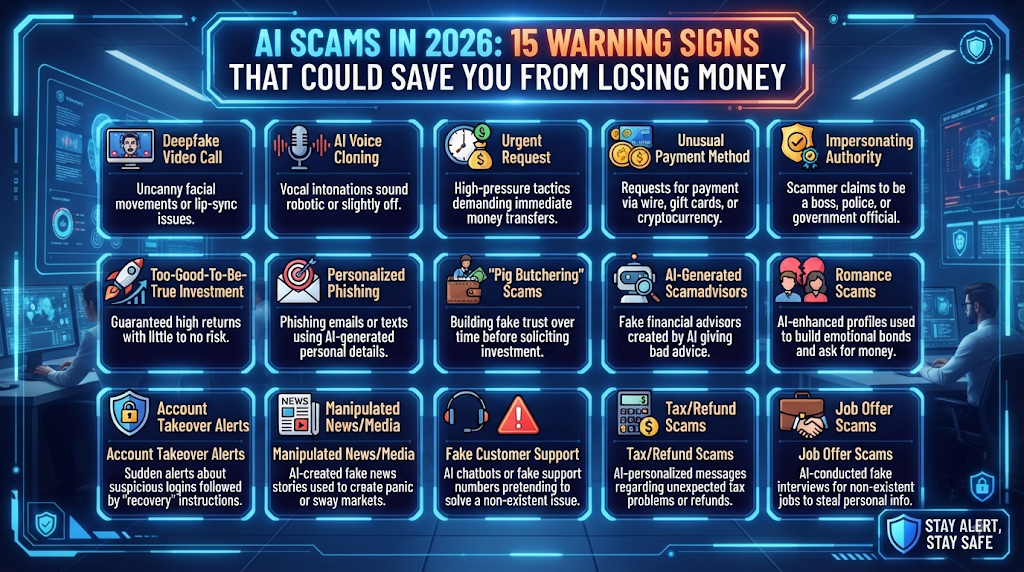
The technology itself isn’t the villain. The problem starts when criminals use AI technology to make old fraud methods faster, cheaper, and more believable. A scammer no longer needs perfect writing skills or advanced video-editing experience. With the right tools, they can create convincing material in minutes.
This guide explains how to spot AI scams, what warning signs deserve your attention, and what you should do before sending money or sharing sensitive information. You’ll also learn how voice cloning, deepfakes, phishing, fake websites, and impersonation fit into the bigger picture.
Important: A realistic voice, image, video, or message should never be treated as proof of identity. Verify the person through a separate trusted channel before taking action.
What Are AI Scams and How Do They Work?
At their core, AI scams are ordinary fraud schemes enhanced with generative AI or other automated technology. The criminal may use AI to write messages, create images, imitate voices, build fake profiles, translate conversations, or personalize a story around the victim. The goal remains simple: gain trust and then obtain money, credentials, or personal information.
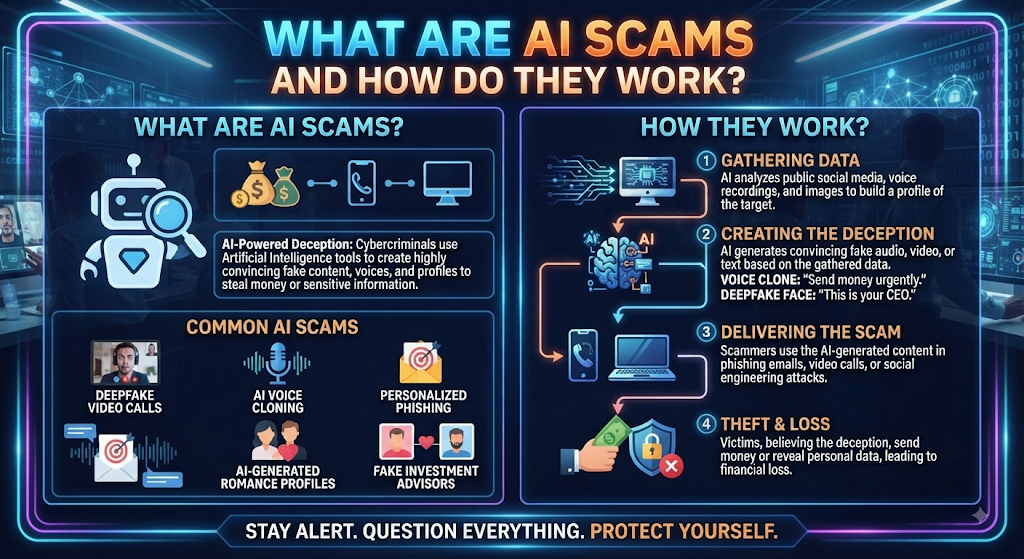
For example, imagine receiving a text that appears to come from your bank. It warns about a suspicious transaction and asks you to sign in through a link. The wording looks professional and the message feels urgent. You might assume it is genuine. In reality, the link could lead to a fake website designed to collect your login details.
The technology changes the presentation, not the underlying objective. Scammers still rely heavily on social engineering, pressure, deception, and emotional manipulation.
How Artificial Intelligence Helps Scammers
The biggest advantage for criminals is speed. Modern AI tools can generate polished emails, realistic images, fake profiles, and personalized conversations without requiring advanced technical skills. A scammer can also rewrite the same message for different victims, languages, age groups, or situations.
Voice cloning creates another problem. The FTC has warned that criminals can use AI voice cloning to impersonate relatives, friends, and business executives. The agency has specifically studied ways to reduce fraud involving cloned voices because the technology can make familiar voices easier to imitate.
Why AI Scams Are Harder to Recognize
Older internet users may remember obvious scam emails filled with strange grammar and spelling mistakes. That clue has become less reliable. AI-generated messages can sound polished, friendly, and specific to your situation.
However, perfect grammar doesn’t make a message legitimate. A scammer can still use online fraud techniques while presenting them in professional language. The better question is not “Does this message look real?” Instead, ask, “Can I independently verify who sent it and why they contacted me?”
What Information Do AI Scammers Want?
Money is only one target. Criminals may want passwords, verification codes, banking details, credit card numbers, Social Security numbers, copies of identification, or information that helps them impersonate you later.
That makes AI identity theft especially concerning. A single conversation might reveal your name, workplace, birthday, phone number, or other details. When combined with information already available online, those pieces can become useful tools for a much more convincing scam.
Why Are AI Scams Becoming More Common in 2026?
There’s a simple reason this problem deserves attention now: scammers can reach huge audiences while making their messages feel personal. The FTC reported that nearly 30% of people who reported losing money to a scam in 2025 said the scam started on social media, with reported losses reaching $2.1 billion.
At the same time, criminals can combine social media information with AI-powered scams to create targeted stories. They may know your employer, interests, relatives, or recent purchases before contacting you. That personal touch can make a fake request feel surprisingly believable.
Generative AI Makes Scams Easier to Create
Generative AI can produce text, images, audio, and other material quickly. This lowers the effort required to create convincing fraudulent content. A criminal can test different messages and keep changing the wording until one gets a response.
That matters because scammers don’t need every victim to believe them. They only need a small percentage of people to respond. Automation lets them send far more attempts while spending less time creating each one.
AI Makes Fake Messages More Convincing
A polished message can remove clues that once made scams easier to spot. AI phishing scams may use natural language, specific details, and familiar branding to create a stronger sense of legitimacy.
Text scams were already causing major losses before AI became widespread. The FTC reported that consumers lost $470 million to scams that started through text messages in 2024. Common examples included fake package problems, fraudulent bank alerts, unpaid toll messages, and fake job offers.
Voice and Video Cloning Are Changing Online Fraud
Now consider what happens when a scam includes a familiar voice or realistic video. Your brain naturally treats those signals as evidence that someone is genuine. Criminals can exploit that instinct through AI voice scams and synthetic media.
The FBI warned in July 2026 about an ongoing impersonation scheme involving fake IC3 communications. The scheme included AI-generated videos and spoofed websites designed to make victims believe they were dealing with legitimate government personnel.
How Do AI Scammers Target People Online?
The internet gives scammers many doors to knock on. They can reach you through email, text messages, social platforms, phone calls, advertisements, search results, or fake websites. The FTC says impersonation scams have appeared across text, phone, email, social media, search results, and other channels.
The important lesson is simple: don’t judge a message by the platform it arrives on. A scam can look professional anywhere. Instead, focus on the request, the sender’s identity, the payment method, and whether you can verify the claim independently.
Email and Messaging Apps
Email remains useful for scammers because people expect important notices to arrive there. A fake delivery notice, security alert, invoice, job offer, or account warning can push you toward a malicious link.
Modern AI-generated phishing can make these messages more natural. Still, the basic danger hasn’t changed. If an unexpected message asks you to log in, pay, download something, or reveal a code, stop and verify it first.
Social Media
Social platforms provide scammers with something extremely valuable: context. Public posts can reveal where you work, what you buy, who your friends are, and what interests you. Criminals can use those details to create believable AI impersonation scams.
Fake profiles can also copy photographs, names, job titles, and writing styles. A message from a familiar-looking account may therefore feel trustworthy even when the account itself is fraudulent.
Phone Calls
Phone calls create pressure because conversations happen in real time. You don’t get much time to think when someone claims your bank account has been attacked or your family member needs emergency money.
With voice cloning scams, hearing a familiar voice isn’t enough. The FTC specifically recommends independent verification for unexpected requests and warns consumers not to move money simply because someone claims it will “protect” their funds.
Fake Websites and Online Ads
A fake website can copy logos, colors, menus, product photos, and even customer reviews. Some criminals also use online advertising or manipulated search results to bring people to fraudulent pages.
The FBI warned in June 2026 about criminals using techniques that can redirect visitors toward fake login pages and other fraudulent websites. These pages can be used for phishing, financial fraud, or malware delivery.
15 Warning Signs of an AI Scam
The most useful AI scam warning signs aren’t always technical. Many involve human behavior: urgency, fear, secrecy, authority, and pressure. If several signs appear together, slow the conversation down.
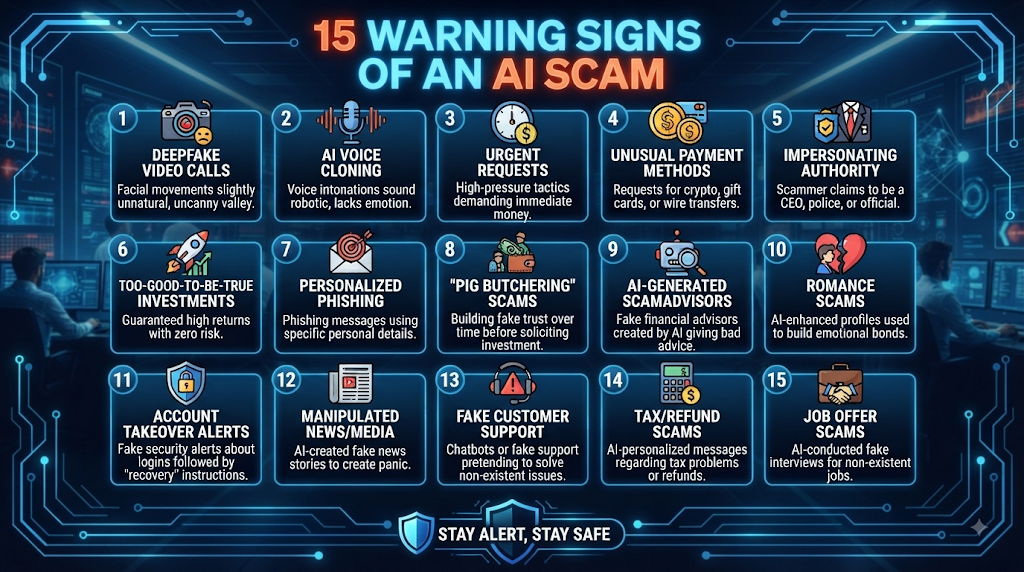
Remember this simple rule: a legitimate request can usually survive verification. A scam usually depends on preventing it.
The Message Creates Urgency
“Act now.” “Your account will close.” “You have ten minutes.” These phrases are designed to make you react before thinking.
Urgency is one of the oldest social engineering scams tactics. AI simply makes the story easier to personalize. If a message demands immediate action, pause and verify it through an official channel.
Someone Suddenly Asks for Money
An unexpected request for money should immediately raise your guard. It might come from someone pretending to be a relative, friend, employer, bank employee, or government official.
Don’t let familiarity override common sense. The FTC advises consumers to stop and verify unexpected requests rather than transferring money because someone claims an emergency exists.
The Person Wants a Gift Card or Cryptocurrency
Gift cards, cryptocurrency, wire transfers, and other difficult-to-reverse payment methods deserve extra caution.
A scammer may explain that the payment is required for taxes, account protection, fees, or an emergency. The story can vary. The unusual payment demand is the important clue.
The Voice Sounds Familiar but Something Feels Wrong
You may hear your child’s voice, your boss’s voice, or a relative’s voice. Yet something about the conversation feels strange.
Don’t rely on your ears alone. AI voice scams can exploit familiar voices, which is why independent verification matters more than ever. Call the person through a number you already trust.
The Video Looks Real but Cannot Be Verified
A realistic face doesn’t prove that a person is actually speaking to you. AI deepfake scams can use synthetic or manipulated video to support impersonation and fraudulent claims.
If someone appears on video and asks for money, confidential information, or unusual action, verify the request separately. A second communication channel can break the illusion.
The Message Contains a Suspicious Link
Unexpected links deserve caution even when the message looks professional. Look closely at the domain instead of trusting the logo or display name.
Scammers can create fake websites that imitate banks, retailers, government agencies, or technology companies. Open the official website yourself rather than using an unexpected link.
Someone Asks for a Verification Code
A one-time code can help a criminal prove they control an account. If someone unexpectedly asks you to read that code aloud, stop.
This is an important part of account takeover protection. Legitimate support staff should not need you to hand over a security code simply because they contacted you.
The Sender Wants Personal Information
Be careful when an unexpected caller or message asks for your Social Security number, date of birth, password, address, bank information, or identification documents.
Scammers may collect small details first. Later, those details can support identity theft protection attacks, account recovery attempts, or convincing impersonation.
The Offer Looks Too Good to Be True
Huge profits, guaranteed income, unbelievable discounts, surprise prizes, and effortless jobs should make you skeptical.
AI can make AI fraud scams look more polished. It cannot turn an unrealistic promise into a legitimate opportunity. Verify the company, offer, payment terms, and independent reputation before committing anything.
The Website Has Strange Details
Look beyond the logo. Check the domain name, contact information, return policy, payment methods, and wording.
A fraudulent site may look professional at first glance. Yet small inconsistencies can expose it. Online scam protection starts with slowing down before entering credentials or payment details.
Someone Tells You to Keep the Conversation Secret
Secrecy is powerful because it cuts off outside advice. A scammer may say your family won’t understand or that telling anyone will cause problems.
That pressure should make you step back. Genuine emergencies may require privacy in some situations. Financial requests, however, should still survive independent verification.
A “Company” Requests Immediate Payment
A fake employee might claim your subscription expired. Another may say your account has a security problem. Someone else might send an urgent invoice.
The FTC reported that business impersonation scams caused substantial losses in the U.S. during 2025. When a company contacts you unexpectedly, verify it using contact details you find independently.
The Person Refuses Independent Verification
This is a major warning sign. A legitimate person should generally understand why you want to verify an unusual request.
If someone says you cannot call the company directly, speak to your family, or check the account yourself, stop. AI scam protection often begins with one simple action: create distance between the claim and your decision.
The Story Keeps Changing
Scammers often improvise. Names change. Payment methods change. The emergency becomes more complicated. New explanations appear whenever you ask questions.
One inconsistency doesn’t automatically prove fraud. Several inconsistencies combined with urgency, secrecy, and money requests should make you step away and verify everything.
You Are Being Pressured Not to Think
The final warning sign is often the strongest one. If someone is trying to stop you from checking, asking questions, or getting another opinion, that’s a problem.
Real trust doesn’t require panic. Good cybersecurity tips often sound boring because they work: pause, verify, protect your information, and never let pressure make the decision for you.
AI Voice Scams: How Voice Cloning Tricks Victims
Hearing a familiar voice can trigger an instant emotional response. That reaction is exactly what criminals exploit with AI voice scams. Modern voice cloning can imitate speech closely enough to make a short emergency call sound believable. The scammer then adds urgency, fear, or authority to push you toward a quick decision.
The trick isn’t necessarily perfect imitation. It’s the combination of a familiar voice and a convincing story. A caller might claim they lost their phone, need emergency money, or have been arrested. AI scam protection starts when you remember that a familiar voice is no longer reliable proof of identity.
How AI Voice Cloning Works
Voice cloning systems can analyze recordings and generate speech that resembles the original speaker. Criminals may obtain audio from social media videos, public interviews, podcasts, or other online material. They can then combine the synthetic voice with a prepared script.
The technology doesn’t need a long conversation to become dangerous. A short recording can sometimes provide useful material for imitation. That’s why limiting unnecessary public audio and using strong verification habits can support online identity protection.
How Family Emergency Voice Scams Work
Imagine receiving a call from your son. His voice sounds normal. He says he had an accident and needs money immediately. He asks you not to tell anyone because he’s embarrassed.
That emotional setup can make people act before thinking. Instead, hang up and contact your family member through a number you already have. A simple family verification phrase can also help expose voice cloning scams when emotions run high.
How to Verify a Suspicious Voice Call
Never treat the voice itself as authentication. Ask a personal question only the real person should know, then verify through another channel. Better still, call the person back using a trusted number.
If money or account access is involved, take another step. Contact the relevant bank, employer, or organization independently. Financial fraud protection works best when you separate verification from the communication that created the pressure.
AI Phishing Scams: How Fake Messages Look Real
Phishing has existed for years. AI makes the presentation more convincing. AI phishing scams can use natural language, personal details, realistic branding, and carefully timed messages to create a believable reason for you to click.
The goal remains familiar. A criminal wants you to reveal credentials, install malware, send money, or provide information. Phishing protection therefore still depends on verification, even when the message looks polished and professional.
AI-Generated Phishing Emails
A scammer can use generative AI to create an email that sounds like a real company. The message might mention a recent purchase, account problem, invoice, or security alert.
That personalization can make the email feel authentic. However, don’t judge an email by grammar alone. Check the sender address, destination domain, request, and context before clicking anything.
Fake Bank and Payment Messages
Fake bank messages often use fear. They may claim someone attempted a purchase or that your account needs immediate verification.
Don’t follow the supplied link. Open your banking app or type the bank’s official website into your browser yourself. This simple habit reduces exposure to fake bank scams that rely on fraudulent login pages.
Fake Account Security Alerts
A fake security alert may claim that your password changed, your account was hacked, or a suspicious login occurred.
The message may even include a convincing logo and professional wording. Instead of clicking, access the account directly through its official app or website. Check recent activity there. Account security should never depend on an unexpected link.
How to Check a Suspicious Link
Look at the actual domain before opening it. A familiar company name inside a long URL doesn’t automatically make the website legitimate.
When you’re unsure, don’t click. Visit the company’s official website independently and find its support page. This approach is one of the simplest online safety tips you can use against phishing.
AI Deepfake Scams and Fake Videos
A convincing video can feel like strong evidence. Unfortunately, synthetic media has changed that assumption. AI deepfake scams can manipulate faces, voices, expressions, or entire scenes to support false claims.
Deepfakes can appear in social posts, advertisements, video calls, investment promotions, and impersonation attempts. The important lesson is straightforward: seeing someone on screen doesn’t remove the need for verification. Deepfake technology can make false information look remarkably authentic.
What Is a Deepfake?
A deepfake is synthetic or manipulated media created with technology that can alter or generate a person’s appearance or voice.
Some deepfakes are obvious. Others can look surprisingly convincing. The quality also varies between tools and situations. That’s why readers shouldn’t rely on one visual clue when deciding whether a video is genuine.
Deepfake Celebrity Scams
Celebrity images and videos can attract attention quickly. A scammer may create a fake celebrity endorsement for an investment, product, giveaway, or cryptocurrency opportunity.
The FTC has repeatedly warned consumers about deceptive endorsements and impersonation schemes. If a famous person appears to promise guaranteed profits, verify the claim through trusted sources before sending money.
Fake Video Calls and Impersonation
Video calls create another layer of trust. A criminal may attempt to imitate a manager, relative, business partner, or public figure during a conversation.
Don’t make important financial decisions simply because you can see a face. Confirm the request separately. AI impersonation scams become much harder to pull off when victims use independent verification.
How to Verify a Suspicious Video
Start with the claim rather than the video quality. Ask whether the person actually made the statement through a trusted official channel.
Search for independent confirmation from the person’s verified website or account. If the video asks for money, passwords, or sensitive information, treat the request as suspicious until you verify it.
AI Impersonation Scams: When Someone Pretends to Be a Person You Know
Impersonation works because trust already exists. The criminal doesn’t need to build a relationship from scratch. They simply pretend to be someone you already trust and then use that identity to make a request.
AI makes this approach more flexible. A scammer can combine AI-generated content, stolen photographs, public information, cloned voices, and personalized messages. The result can feel far more convincing than a random scam message.
Family Member Impersonation
A fake relative may claim they lost their phone or encountered an emergency. They might ask for money through a payment app or another fast transfer method.
Don’t let panic make the decision. Contact the relative directly using a known number. If they don’t answer, contact another family member. Social engineering becomes less effective when you introduce a second person into the verification process.
Friend and Social Media Impersonation
Scammers can create duplicate accounts using a friend’s name and photograph. They may then send messages asking for money, links, votes, codes, or other information.
Before responding, check the account carefully. Look at its history, username, followers, creation details, and previous interactions. A familiar photograph doesn’t guarantee a genuine account.
Boss or Executive Impersonation
Business employees may receive messages that appear to come from a manager or executive. The request might involve an urgent payment, gift cards, confidential documents, or a transfer.
This is especially risky because employees may feel pressure to obey authority. Companies should create independent payment verification rules. AI cyber attacks don’t always need sophisticated hacking when social manipulation can achieve the same result.
Customer Support Impersonation
Fake support agents may contact you after you post about a problem online. They might claim they can fix your account and then request remote access, passwords, verification codes, or payment.
Don’t trust unsolicited support messages. Find the company’s official support page yourself. Fake customer support scams often succeed because the victim already has a genuine problem when the scammer arrives.
AI Romance Scams and Fake Online Relationships
Romance scams are built around emotional trust rather than technical tricks. AI can make the relationship feel more active because criminals can generate messages quickly and maintain long conversations.
That doesn’t mean every online relationship is suspicious. The concern rises when someone avoids reasonable verification, repeatedly invents emergencies, or begins requesting money. AI romance scams often depend on patience, emotional pressure, and gradual manipulation.
How AI Makes Romance Scams More Convincing
A scammer can use AI to help maintain conversations, translate messages, generate photos, or create a consistent personality.
The victim may receive thoughtful replies throughout the day. That constant attention can create emotional attachment. However, frequent communication doesn’t prove someone’s identity. AI-generated images and carefully written messages can support a completely fictional persona.
Warning Signs of an AI Romance Scam
Watch for rapid emotional attachment, excuses for avoiding video verification, repeated travel problems, financial emergencies, and requests to move money.
Another warning sign is a relationship that always remains online. If the person constantly avoids reasonable identity checks while asking for financial help, step back. Online fraud often becomes harder to stop once emotional trust takes over.
Why Scammers Ask for Money
The reason may change over time. A person might claim they need medical treatment, travel expenses, legal fees, business funding, or help accessing an account.
The story matters less than the pattern. If a romantic contact repeatedly asks you to send money or cryptocurrency, stop sending funds and seek independent advice before continuing.
AI Investment and Cryptocurrency Scams
Investment scams can be especially damaging because they target people’s desire to grow their savings. AI adds a modern layer by making fake platforms, promotional material, testimonials, and conversations look sophisticated.
A polished dashboard doesn’t prove that money is being invested. Neither does a video of someone claiming to have earned huge returns. AI investment scams can create an impressive appearance while hiding a simple fraud scheme.
Fake Investment Opportunities
A scammer may promise access to an exclusive investment before everyone else. They might show fake profits inside an online dashboard.
The displayed balance may not represent real money. Before investing, verify the company, registration, contact information, withdrawal process, and independent reputation. Never rely solely on screenshots or testimonials.
AI Trading Scam Claims
Some scams use the popularity of AI as a sales pitch. They may claim an automated system can predict markets perfectly or generate guaranteed profits.
Real financial markets involve uncertainty. No legitimate technology can remove investment risk completely. AI fraud often becomes easier to recognize when you question unrealistic claims rather than focusing on impressive technology.
Fake Cryptocurrency Platforms
A fraudulent crypto platform may allow deposits but create obstacles when you try to withdraw money. The scammer may then demand another payment for taxes, verification, or release fees.
Don’t send additional money simply because a website shows a balance. Verify the platform independently before depositing anything. Fake investment websites can be designed to look remarkably professional.
Why Guaranteed Returns Are a Red Flag
Investment returns always involve risk. A promise of guaranteed profits should therefore trigger serious skepticism.
The FTC warns consumers about investment scams that use promises of easy or guaranteed money. Before investing, independently research the opportunity and understand where your money actually goes. (ftc.gov)
AI Job Scams: Fake Recruiters and Employment Offers
Job scams can be particularly effective because they arrive when people are actively looking for opportunities. A professional-looking job description can create excitement before the victim notices the warning signs.
The FTC has reported significant consumer losses from job and employment scams. Some schemes involve fake employers, fake recruiters, unexpected checks, equipment purchases, or requests for personal information. AI job scams can make those approaches look more polished.
Fake Job Advertisements
A fake listing may promise unusually high pay, remote work, minimal experience requirements, and immediate hiring.
Check whether the position appears on the company’s official careers page. Compare the employer’s website, domain name, job description, and contact information. A legitimate-looking listing can still lead to a fraudulent operation.
Fake Recruiter Messages
A scammer may contact you through email or social media and claim to represent a recognizable company.
Don’t assume the recruiter is genuine because the profile looks professional. Verify the person’s role through the company’s official website. Never let excitement about a job replace basic security awareness.
Requests for Money or Personal Documents
Be extremely cautious if someone asks you to pay for training, equipment, certification, background checks, or guaranteed employment.
Personal documents also deserve protection. Don’t send sensitive identification until you’ve verified the employer and understood why the information is genuinely required.
How to Verify a Job Offer
Search for the company independently. Visit its official website and locate the position yourself. Contact the company using details published there.
If the recruiter says you must pay money to receive the job, stop. Legitimate employment shouldn’t depend on sending money to a stranger through an unusual payment method.
AI Shopping Scams and Fake Online Stores
Online shopping scams can look surprisingly polished because creating convincing product pages is easier than ever. A fake store may use attractive photographs, professional descriptions, countdown timers, and fabricated customer reviews.
Before buying, look beyond appearance. AI shopping scams often use urgency and unusually low prices to push people toward fast purchases. Take a minute to check the business independently before entering payment information.
AI-Generated Product Listings
AI can help scammers create detailed descriptions for products that may not exist. Stolen photographs can make the listing look even more credible.
Check whether the same images appear on unrelated websites. Search for independent information about the retailer. AI-generated content can make a fraudulent listing look professional without proving that the seller is legitimate.
Fake Reviews and Testimonials
A page filled with five-star reviews doesn’t automatically mean a store is trustworthy. Reviews can be copied, fabricated, or manipulated.
Look for feedback across independent platforms. Pay attention to repeated phrases, vague experiences, unusual review timing, and missing criticism. A trustworthy store should have a reputation beyond its own website.
Fake Discounts and Limited-Time Offers
A countdown timer can make you feel that waiting means losing money. That’s exactly the reaction scammers want.
Take a breath and compare prices elsewhere. If the discount exists only because a timer is running, you can usually afford to investigate before paying.
How to Check an Online Store
Check the domain, contact details, return policy, payment methods, company information, and independent reviews. Look for a real business presence beyond the store itself.
If a site demands unusual payment methods or hides basic company details, walk away. Strong personal data protection starts before you enter your card number.
How AI Scams Can Lead to Identity Theft
An AI scam doesn’t always end with a stolen payment. Sometimes the real target is your identity. A criminal may collect enough information to impersonate you, access accounts, open fraudulent services, or convince another organization that they are you.
This is where identity theft protection becomes important. The safest approach is to treat personal information like a valuable asset rather than harmless background details. A phone number, birthday, address, or login can become useful when combined with other stolen data.
Personal Information Scammers Target
Scammers may seek your full name, address, date of birth, Social Security number, phone number, email address, workplace, or government identification.
One detail may seem harmless. Several together can create a much clearer picture of your identity. Limit what you share publicly and question unexpected requests for sensitive information.
Stolen Login Details
Passwords are valuable because people often reuse them across different services. If one password leaks, several accounts could become exposed.
Use strong passwords that are unique to each important account. A password manager can make this easier without forcing you to memorize dozens of different credentials.
Account Takeover
Once criminals obtain credentials or verification codes, they may attempt to take control of email, social media, financial, or shopping accounts.
Your email account deserves special attention because it can help reset other passwords. Turn on multi-factor authentication wherever possible and review account recovery settings regularly.
Financial Information
Bank accounts, credit cards, payment applications, and investment accounts can all become targets after a successful scam.
If you suspect that financial information has been exposed, contact the relevant institution through an official channel. Quick action can sometimes limit further damage. Financial fraud protection starts with recognizing the problem early.
AI Scams vs Traditional Scams: What’s Changed?
AI hasn’t invented every scam. Instead, it has given criminals new ways to improve familiar techniques. Phishing, impersonation, romance fraud, investment scams, and fake shopping sites all existed before today’s AI tools.
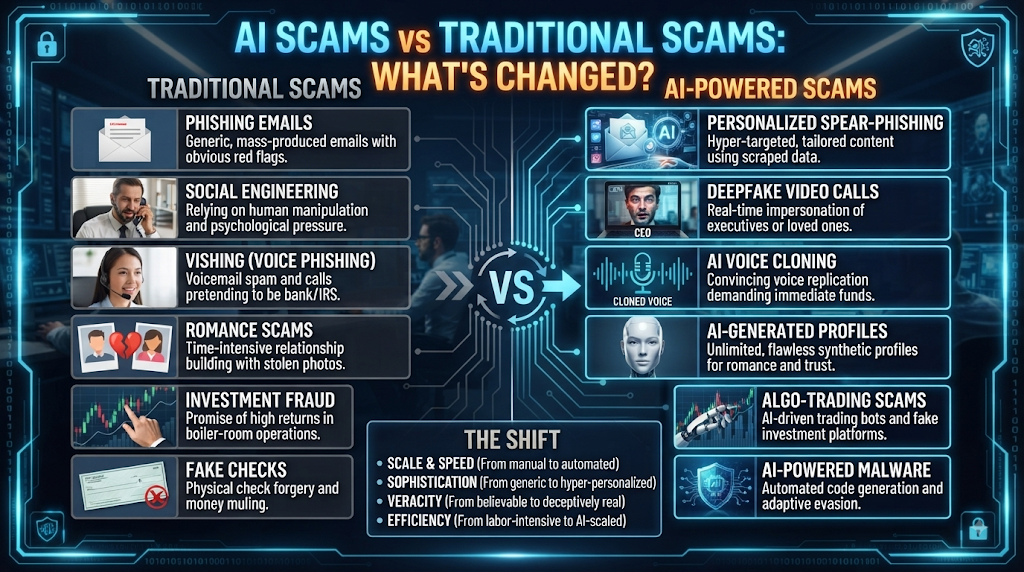
The major change is scale and personalization. AI-powered scams can potentially produce convincing material faster and adapt messages to individual targets. That makes old security habits even more important, not less.
| Feature | Traditional Scams | AI-Powered Scams |
| Fake messages | Possible | Easier to create |
| Personalization | Limited | More convincing |
| Voice impersonation | Difficult | Much easier |
| Fake images | Less common | Easier to generate |
| Fake videos | Difficult | More accessible |
| Phishing | Common | More personalized |
| Scale | Limited | Potentially much larger |
The table shows the broad difference rather than a strict rule. Traditional scams can still be sophisticated, while AI-assisted scams can sometimes be crude. The real risk comes from combining AI technology with stolen information, automation, and human manipulation.
How to Check If a Message, Call, Image, or Video Is an AI Scam
When something feels unusual, don’t try to prove whether it was created by AI. Instead, verify the person, company, and request independently. This works because even a perfect-looking AI-generated message becomes useless when you confirm the claim through a trusted channel.
The strongest defense is simple: slow down before you act. Scammers want quick decisions. You want evidence. That small difference can protect your money, accounts, and personal information.
Verify the Person Independently
If someone contacts you unexpectedly, don’t use the contact details they provide. Find the person’s known phone number, official email address, or verified social profile yourself.
For example, if a family member asks for emergency money, call them through your existing contacts. If your boss asks for a payment, confirm the request using your normal workplace process. This is one of the strongest scam prevention habits you can build.
Check the Original Source
A screenshot isn’t proof. Neither is a forwarded message, copied photograph, or video clip.
Look for the original source and compare the information with an official website or verified account. When dealing with news, financial claims, celebrity promotions, or government notices, independent confirmation matters more than how professional the content looks.
Avoid Clicking Under Pressure
Pressure changes how people make decisions. When someone tells you to click immediately, pause before doing anything.
Don’t open suspicious links simply because a message says your account is in danger. Open the official website yourself or use the company’s genuine application. This simple habit reduces exposure to AI phishing scams.
Contact the Company Directly
If a bank, retailer, employer, delivery company, or technology provider contacts you unexpectedly, find its official contact information yourself.
Don’t call the number in a suspicious message. Don’t trust a support number supplied by an unknown caller. Independent contact gives you a clean way to confirm whether the original communication was genuine.
Look for Multiple Warning Signs
One unusual detail doesn’t always mean fraud. However, several warning signs together should change your response.
Urgency combined with secrecy, unusual payment methods, suspicious links, and requests for verification codes is a serious combination. Think of these clues as a pattern rather than isolated evidence.
What Information Should You Never Give an AI Scammer?
Your information can be more valuable than a single payment. A criminal who gets your password, verification code, or identification document may use it later for identity theft, account takeover, or financial fraud.
The safest approach is to ask one question before sharing anything: “Why does this person need this information, and how did I independently verify who they are?” If you can’t answer both questions, stop.
Passwords
Never give your password to someone who contacts you unexpectedly. Legitimate companies don’t need your current password simply to prove that they are helping you.
Use a unique password for every important account. A password manager can help you create and store strong passwords without reusing the same login everywhere.
One-Time Verification Codes
A one-time code can help prove that you control an account. If a scammer asks you to read one back, they may be attempting to complete a login or account recovery process.
Treat verification codes like temporary keys. Never share them with an unexpected caller, even when the caller sounds convincing.
Bank Information
Your bank account number, debit card information, routing details, and online banking credentials can expose your finances.
A caller who claims to be from your bank should never become your reason for revealing sensitive details. End the call and contact the bank through its official website or mobile app.
Credit Card Details
Don’t provide card numbers, security codes, or PINs to unexpected contacts.
A legitimate purchase can require payment information. An unexpected person demanding it through a phone call, social message, or email deserves verification first. Financial information should never be handed over simply because someone creates urgency.
Social Security and Government ID Information
Your Social Security number and government identification documents can become powerful tools for identity fraud.
Only provide them when there is a genuine need and you’ve verified the organization requesting them. Be especially cautious with unexpected job offers, rental messages, government impersonation, and financial requests.
Private Photos and Sensitive Documents
A scammer may ask for passport images, driver’s licenses, private photographs, tax documents, or other files.
Don’t assume that a request is safe because the person already knows you. Once sensitive material leaves your control, you may not know where it goes next. Strong personal data protection starts with sharing less.
What to Do If You Already Responded to an AI Scam
Don’t panic if you’ve already replied. Acting quickly is more useful than blaming yourself. Many people respond to scams because the message looks convincing or arrives during a stressful moment.
Your next action depends on what you shared. The important thing is to stop communicating with the scammer, secure affected accounts, and contact the appropriate organization through a trusted channel.
If You Sent Money
Contact your bank, card company, payment provider, or money-transfer service immediately. Explain that the transaction involved suspected fraud and ask what recovery options are available.
Don’t send another payment because the scammer promises a refund. A second payment often becomes another part of the fraud. Save receipts, transaction details, usernames, phone numbers, emails, and messages as evidence.
If You Shared Your Password
Change the compromised password immediately. If you reused it anywhere else, change those accounts too.
Start with your email account because it may control password resets for other services. Then enable multi-factor authentication wherever available.
If You Shared a Verification Code
Contact the affected service immediately. Tell them that you may have accidentally provided a security code to someone else.
Check recent login activity and account recovery settings. If you still have access, change your password and remove unfamiliar devices or sessions.
If You Shared Personal Information
Think about exactly what information you provided. A name and email address require a different response from a Social Security number, banking details, or identification document.
For serious exposure, consider using official U.S. identity-theft resources and monitoring relevant accounts. The FTC’s IdentityTheft.gov service provides recovery guidance for people dealing with identity theft. IdentityTheft.gov
If Your Account Was Taken Over
Secure the account from a trusted device if possible. Change the password and sign out unfamiliar sessions.
Check whether the attacker changed recovery email addresses, phone numbers, forwarding rules, or authentication methods. Then warn your contacts if the account was used to send fake messages.
How to Protect Yourself From AI Scams in 2026
Good protection doesn’t require becoming a cybersecurity expert. You need a few reliable habits that work even when the scam looks sophisticated.
The goal isn’t to identify every piece of AI-generated content. That’s unrealistic. Instead, build layers of protection around your accounts, money, devices, and personal information.
Use Strong and Unique Passwords
Don’t use the same password for email, banking, shopping, and social media. One compromised account shouldn’t unlock everything else.
A password manager can create long and unique passwords for different services. This simple step strengthens online security without requiring you to remember every password.
Turn On Multi-Factor Authentication
Multi-factor authentication adds another verification step after your password.
It isn’t perfect protection. However, it can make stolen passwords less useful. Use MFA on email, financial accounts, social platforms, cloud storage, and other accounts containing valuable information.
Keep Software Updated
Updates aren’t only about new features. They can include security fixes for vulnerabilities criminals might exploit.
Keep your operating system, browser, mobile apps, antivirus software, and important applications updated. Cybersecurity works best when basic maintenance isn’t ignored.
Verify Unexpected Requests
Make independent verification your default response to unusual requests.
Someone asking for money, credentials, payment changes, confidential documents, or urgent account access should expect you to verify the request. A genuine person may be surprised, but a legitimate request shouldn’t depend on bypassing your security process.
Use Trusted Security Tools
Security software, spam filters, browser protections, password managers, and account alerts can reduce risk.
No tool catches every scam. Think of them as additional layers rather than magic shields. Your judgment remains an important part of AI fraud prevention.
Limit Public Personal Information
Public information can help scammers create believable stories. Review what your social accounts reveal about your workplace, family, location, birthday, phone number, and daily routines.
You don’t need to disappear from the internet. Simply avoid making sensitive information unnecessarily easy to collect. Good online identity protection begins with controlling what strangers can learn about you.
How Families Can Protect Older Adults From AI Scams
Older adults aren’t the only people targeted by scams. However, criminals may deliberately target people they believe have savings, retirement accounts, or less familiarity with newer digital threats.
The best response isn’t fear. It’s communication. Families can create simple rules that make suspicious requests easier to challenge before money or information leaves someone’s control.
Why Older Adults Can Be Targeted
Scammers often exploit authority and urgency. They may pretend to be a grandchild, bank employee, government worker, technician, or lawyer.
AI can strengthen that impersonation with convincing voice cloning and personalized messages. A family member who understands these tactics is less likely to trust a voice or video without verification.
Create a Family Verification Rule
Agree on one simple rule before an emergency happens: unexpected money requests must be verified through another channel.
Your family could also establish a private phrase for urgent situations. If someone claims to be a relative but cannot confirm the agreed information, stop the conversation and verify them independently.
Explain Voice and Video Cloning
Show family members how convincing synthetic media can become. Explain that a familiar voice doesn’t automatically prove identity.
This conversation matters because people often trust what they hear and see. Security awareness gives them permission to pause instead of feeling rude for questioning a familiar person.
Encourage a Second Opinion
Make asking for help normal. If a family member receives an alarming financial request, encourage them to call someone they trust before acting.
A second opinion can interrupt the emotional pressure that scammers depend on. Sometimes ten minutes of discussion can prevent thousands of dollars in losses.
How Businesses Can Protect Employees From AI Scams
Businesses face a different version of the problem. Criminals may impersonate executives, vendors, customers, recruiters, or technology providers.
The biggest mistake is assuming that technical security alone will solve the problem. AI cyber attacks can target people directly, so employee procedures need to account for social manipulation too.
Employee Security Training
Training should cover phishing, impersonation, fake support requests, deepfakes, voice cloning, and unusual payment requests.
Employees should learn what to do when something feels wrong. A clear reporting process is more useful than simply telling workers to “be careful.”
Payment Verification Procedures
A single message should never be enough to change bank details or authorize an unusual transfer.
Companies can require secondary verification for high-value payments, new vendors, changed banking information, and urgent executive requests. These controls can stop AI impersonation scams even when the message looks genuine.
Protecting Business Email Accounts
Business email accounts can become valuable targets because they contain conversations, contacts, documents, and password-reset opportunities.
Use MFA, unique passwords, security alerts, access controls, and regular account reviews. Protecting email strengthens both account security and wider business operations.
Executive Impersonation Prevention
Executives should understand that their public photographs, interviews, speeches, and videos can provide material for impersonation attempts.
Employees should never feel pressured to bypass company procedures because a request appears to come from a senior executive. Authority should not override verification.
Can AI Also Help Stop Scams?
AI isn’t only useful to criminals. Security companies, banks, email providers, and other organizations also use artificial intelligence to detect suspicious activity.
Systems can analyze patterns across enormous amounts of data. They may identify unusual transactions, suspicious messages, fake accounts, abnormal login behavior, or other signals that would be difficult for humans to review manually.
AI-Powered Threat Detection
Security systems can use machine learning to identify patterns associated with fraud and cyber threats.
For example, a financial institution might analyze transaction behavior and flag activity that doesn’t match normal account patterns. The technology can help investigators focus attention where risk appears higher.
AI Email Security
Modern email security systems can examine sender behavior, links, attachments, domains, and message patterns.
These systems can help detect phishing before it reaches an inbox. Still, no filter is perfect. Some malicious messages will get through, which is why phishing protection still requires human judgment.
Fraud Detection Systems
Banks and payment companies can analyze transactions for suspicious patterns. These systems may trigger additional verification or temporarily block unusual activity.
AI can improve the speed of detection, but false positives can happen. A legitimate transaction may sometimes look unusual. That’s why financial institutions combine automated systems with human review.
The Human Role in Cybersecurity
Technology can detect patterns. Humans provide context.
A security system may know that a message is unusual. You may know that your “boss” would never ask you to buy gift cards. That human context remains extremely valuable.
The strongest approach combines AI fraud prevention, technical controls, and good decision-making. AI may help fight scams, but people still need to verify important requests.
AI Scams FAQ
What is the most common AI scam?
There isn’t one single scam that dominates every situation. AI is being added to phishing, impersonation, investment, romance, job, shopping, and other fraud schemes.
The most important pattern is impersonation combined with urgency. A scammer wants you to trust a person or organization and then act before you verify the request.
How can I tell if a scammer is using AI?
You usually can’t know with certainty just by looking at a message, photograph, voice, or video.
Instead, focus on behavior. Unexpected urgency, requests for money, secrecy, suspicious links, unusual payment methods, and refusal to verify are stronger warning signs than small visual or grammatical clues.
Can AI clone someone’s voice?
Yes. AI voice cloning technology can generate speech that resembles a real person’s voice.
That doesn’t mean every familiar-sounding call is fake. It means voice alone should no longer be treated as reliable proof of identity when money or sensitive information is involved.
Can AI create fake videos?
Yes. Modern AI-generated videos can manipulate or synthesize visual and audio material.
Quality varies widely. Some examples are obvious while others can be convincing. Verify important claims through trusted sources rather than relying solely on what appears in a video.
Can scammers use AI to steal your identity?
Yes. AI can help criminals create convincing impersonation messages and organize information about a target.
The actual identity theft may involve stolen passwords, financial information, government identification, or other personal data. Strong identity theft protection therefore includes protecting both your information and your accounts.
Final Takeaway: Don’t Let Realistic AI Make the Decision for You
The biggest lesson from AI scams 2026 isn’t that you should distrust every email, call, photograph, or video. It’s that realistic digital content should no longer be treated as automatic proof.
A familiar voice can be cloned. A professional email can be generated. A photograph can be manipulated. A video can be fabricated. A social profile can be copied. None of those things remove the need for verification.
When money, passwords, verification codes, or sensitive information are involved, slow down.
Check the source. Contact the person independently. Open websites yourself. Use MFA. Protect your passwords. Ask someone you trust when you’re unsure.
Most importantly, don’t let a scammer control the speed of your decision.
If someone needs you to act immediately, verify them before you act.
That simple habit can become one of the most effective forms of online scam protection in 2026.
Meta Description
AI Scams in 2026: Learn 15 warning signs, spot AI voice, phishing, deepfake, investment and impersonation scams, and protect your money, identity and accounts.
Continue Reading
Expand your Artificial Intelligence knowledge with these related DailyTecho AI guides:
- AI-Powered Cybersecurity: How Artificial Intelligence Is Changing Online Security in 2026
- AI Prompt Engineering Guide (2026): Techniques, Best Practices, Examples & Real-World Use Cases
- AI Workflow Automation in 2026: How Smart AI Workflows Are Transforming Business Productivity
- AI-Native Companies in 2026: How Artificial Intelligence Is Building the Future of Business
- Generative AI in 2026: How Advanced AI Models Are Transforming Business, Creativity, and Everyday Life
- Best AI Automation Tools in 2026: Top AI Platforms for Business, Workflows, and Productivity
- Agentic AI in 2026: How Autonomous AI Systems Will Transform Business, Software, and Human Work
- AI Agents in 2026: What Are AI Agents and How They Will Change Work, Business, and Daily Life
- AI Tools for Content Creators in 2026: Best AI Apps for Writing, Video Creation & Design
- AI Tools for Students in 2026: Best AI Apps for Study and Learning
- What Is AI Automation? Complete Guide to AI Automation Tools and Future Benefits (2026)
- ChatGPT Search vs Perplexity AI: Which AI Search Engine Wins in 2026?
- Best AI Productivity Tools in 2026 (Complete Guide for Maximum Efficiency)
- Why 2026 Belongs to AI-Driven Social Media Managers: The Ultimate Game-Changing Guide
- Ultimate Guide to AI Regulations 2026: US, UK & EU Compliance Explained
- Powerful AI Search Optimization: How to Make Your Website Visible in AI Search Results in 2026
The more you understand Artificial Intelligence, the better you can use AI tools, automation, and intelligent technologies in your work, studies, and everyday life.
Ready to Explore Artificial Intelligence?
AI is changing how people work, learn, create, search for information, and run businesses. Continue exploring our expert guides to learn about Generative AI, AI Agents, AI Automation, Prompt Engineering, AI Productivity Tools, and other important AI technologies.
1 Comment