

Artificial intelligence is changing how people work, learn, create, and solve problems. Every day, millions of users interact with AI Prompt Engineering, yet many don’t realize that the quality of their results depends on the quality of their prompts. A simple change in wording can turn an average answer into an excellent one. That is why Prompt Engineering has become one of the most valuable skills in the world of Artificial Intelligence. Whether you use ChatGPT, Gemini, Claude, Microsoft Copilot, or another AI Assistant, learning how to communicate with AI can improve your productivity and help you achieve better results.
This AI Prompt Engineering Guide explains everything you need to know in simple English. You will learn how prompts work, why they matter, how different prompting methods improve AI Responses, and how professionals use them in real-world situations. You will also discover modern Prompt Engineering Techniques, practical Prompt Examples, advanced strategies, and industry use cases that help you unlock the full potential of Generative AI and Large Language Models.
“AI is only as smart as the instructions you give it. Better prompts create better results.”
| Quick Overview | Details |
| Topic | AI Prompt Engineering |
| Updated | 2026 |
| Difficulty | Beginner to Advanced |
| Best For | Students, Professionals, Businesses, Developers |
| Reading Time | 30–40 Minutes |
What Is AI Prompt Engineering?
Understanding AI Prompt Engineering is the first step toward using modern AI effectively. Many people think AI automatically knows exactly what they want. In reality, AI depends on clear instructions. Well-written prompts help AI understand your goal, produce accurate answers, and reduce mistakes. This process is known as Prompt Engineering, and it has become an essential skill for anyone working with AI Writing, AI Research, AI Content Creation, or AI Automation.
Good prompts don’t just ask questions. They provide purpose, context, expectations, and formatting instructions. This improves AI Communication, makes AI Conversations more natural, and increases the quality of AI Generated Content. As Large Language Models become more powerful, prompt quality becomes even more important.
What Is a Prompt?
A prompt is the information you give an AI before it generates an answer. It may be a question, a command, or a detailed instruction. Every prompt acts as AI User Input, guiding the model toward a specific result. Good Prompt Writing helps AI understand what you expect and reduces confusion. A clear prompt also improves Prompt Accuracy and produces more useful AI Outputs.
What Is Prompt Engineering?
Prompt Engineering is the process of creating, improving, and testing prompts so AI produces better results. Instead of asking random questions, you carefully design prompts using clear instructions, goals, and formatting. This process includes AI Prompt Design, Prompt Development, Prompt Optimization, and Prompt Refinement. These methods improve quality, save time, and help AI deliver more reliable responses.
Why Prompt Engineering Matters
Modern Large Language Models (LLMs) can perform thousands of tasks, but they depend on clear guidance. Without proper prompts, AI may misunderstand your request or generate incomplete information. Strong Prompt Engineering Best Practices improve AI Response Quality, reduce AI Hallucinations, and help users complete tasks faster. Whether you work in business, education, marketing, or software development, better prompts lead to better outcomes.
| Benefit | Why It Matters |
| Better Accuracy | Produces more relevant answers |
| Faster Results | Saves time and effort |
| Higher Productivity | Improves daily work |
| Better Decision Making | Supports informed choices |
| Better AI Interaction | Creates natural conversations |
How AI Prompt Engineering Works
To understand AI Prompt Engineering, you first need to know how AI processes information. Modern Transformer Models are trained on large collections of text. They analyze patterns instead of thinking like humans. When you type a prompt, the model predicts the most appropriate response based on its training and the information you provide. This prediction process powers many AI Assistants, including ChatGPT, Gemini, Claude, and Microsoft Copilot.
Prompt quality directly affects response quality. Clear instructions, useful background information, and realistic expectations help AI generate better answers. Poor prompts often produce incomplete or confusing results. Learning how AI interprets instructions allows you to communicate more effectively with advanced Foundation Models.
How AI Understands Prompts
AI reads your prompt as text rather than human intention. It looks for patterns, keywords, relationships, and context before generating an answer. Every User Prompt influences how the model interprets your request. The Context Window also determines how much information the AI can consider during a conversation. Better context usually leads to better responses.
Role of Context
Prompt Context gives AI the background information needed to understand your request correctly. For example, telling AI who your audience is, what tone you want, or what problem you are solving helps it produce more accurate content. Good AI Context Management reduces misunderstandings and creates more relevant results.
Role of Instructions
Clear AI Instructions tell the model exactly what to do. They may define the writing style, output length, audience, format, or objective. A well-structured System Prompt combined with clear user instructions improves Structured Output, supports JSON Output when needed, and increases overall response consistency.
| Prompt Element | Purpose |
| User Prompt | Main request |
| System Prompt | Sets AI behavior |
| Prompt Context | Provides background |
| Context Window | Defines usable conversation history |
| Output Formatting | Controls response structure |
Types of AI Prompts
Different situations require different prompting methods. There is no single prompt that works for every task. Choosing the correct prompting technique improves response quality and helps AI solve complex problems more effectively. As AI technology evolves, several prompting methods have become industry standards.
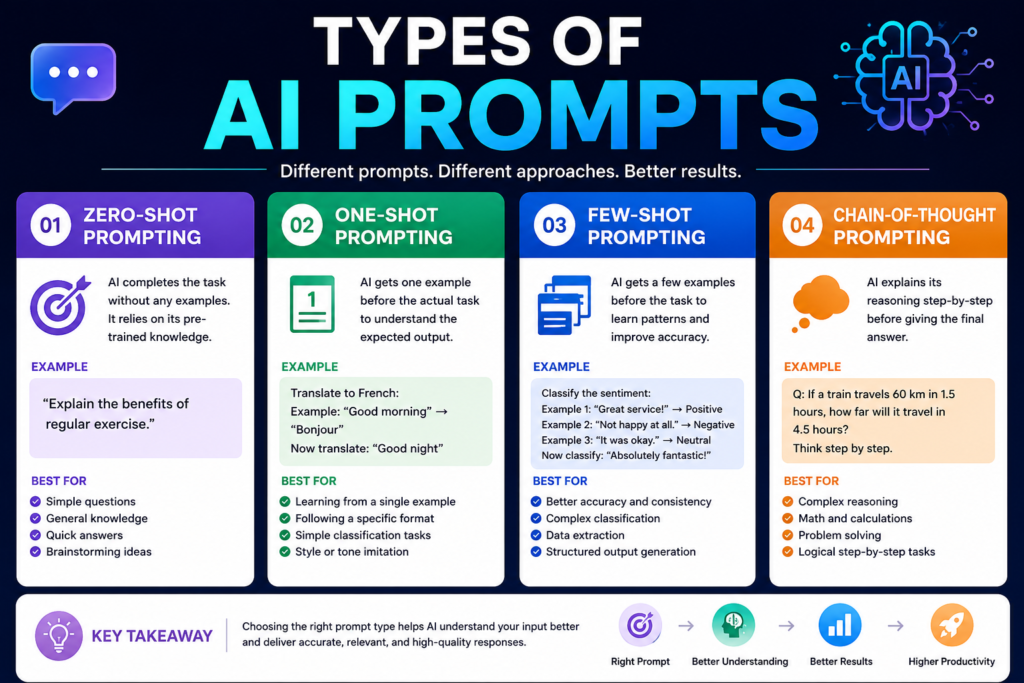
Each prompting method offers unique advantages. Some work best for beginners, while others help professionals solve complicated reasoning tasks. Understanding these approaches allows you to select the right technique for writing, coding, research, education, marketing, and business.
Zero-Shot Prompting
Zero-Shot Prompting asks AI to complete a task without giving examples. The model relies on its previous training to understand your request. This method works well for simple questions, quick summaries, translations, and general knowledge tasks.
One-Shot Prompting
One-Shot Prompting provides a single example before asking AI to complete a similar task. The example helps the model understand the expected format, tone, or style. This approach often improves consistency compared to zero-shot prompting.
Few-Shot Prompting
Few-Shot Prompting includes several examples before the final request. These examples teach AI the desired structure and improve reliability. Many professionals use this method for classification, customer support, content writing, and data organization.
Chain-of-Thought Prompting
Chain-of-Thought Prompting encourages AI to explain its reasoning step by step before giving a final answer. This approach often improves logical thinking and helps with complex calculations, analysis, planning, and decision-making. It is widely used when solving difficult reasoning tasks with advanced AI Reasoning Models.
| Prompt Type | Best Use Case |
| Zero-Shot Prompting | Simple requests |
| One-Shot Prompting | Learning from one example |
| Few-Shot Prompting | Consistent output |
| Chain-of-Thought Prompting | Complex reasoning |
Essential Prompt Engineering Techniques
Learning a few practical methods can improve your AI Prompt Engineering skills much faster than simply writing random prompts. Professional users rarely type one short question and hope for the best. Instead, they carefully plan their prompts to guide the AI toward the exact result they need. These methods increase Prompt Accuracy, improve AI Responses, and make AI Interaction more natural.
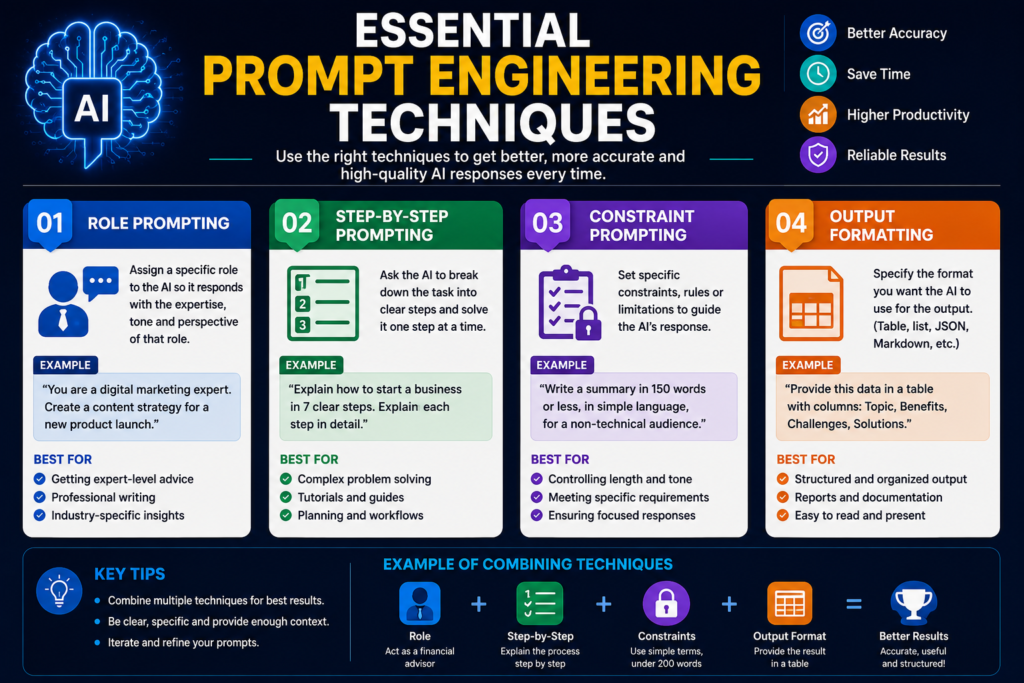
Every successful prompt follows a simple idea. Tell the AI who it should be, what task it should perform, what rules it must follow, and how the final answer should look. These small improvements create better AI Outputs, reduce errors, and make your overall AI Workflow more efficient.
Role Prompting
Role Prompting tells the AI to behave like a specific professional before answering your request. You can ask it to act as a doctor, lawyer, teacher, software engineer, financial advisor, or SEO expert. This simple technique improves response quality because the AI focuses on knowledge related to that profession. It also strengthens AI Decision Making and creates more relevant answers.
Step-by-Step Prompting
Step-by-step prompting asks AI to solve a task one stage at a time instead of producing everything at once. This approach makes complicated tasks easier to understand and reduces mistakes. It is especially useful for AI Research, programming, learning, business planning, and technical documentation.
Constraint Prompting
Constraint Prompting limits how the AI should answer. You can define word count, tone, audience, writing style, formatting rules, or specific restrictions. Clear limits improve Prompt Optimization Techniques, increase consistency, and help produce more accurate results for professional projects.
Output Formatting
Output Formatting controls the appearance of the final response. You can ask for tables, markdown, JSON, reports, emails, summaries, or comparison charts. Proper formatting improves readability and supports Structured Output, making AI content easier to use in real projects.
| Technique | Main Purpose | Best For |
| Role Prompting | Assign expertise | Professional advice |
| Step-by-Step Prompting | Break complex tasks | Learning and analysis |
| Constraint Prompting | Control responses | Content creation |
| Output Formatting | Organize results | Reports and documentation |
Prompt Engineering Best Practices
Great prompts are built with planning rather than guesswork. Following proven Prompt Engineering Best Practices helps AI understand your request faster and produce more reliable information. Whether you use AI for writing, coding, education, or business, small improvements in prompt quality often create much better results.
Professional prompt engineers rarely accept the first answer without reviewing it. They improve prompts through testing, editing, and Prompt Iteration until the response matches their expectations. This process saves time and improves long-term productivity.
Be Specific
Clear prompts always perform better than vague ones. Instead of asking AI to “write an article,” explain the audience, tone, length, purpose, and expected structure. Specific prompts improve Prompt Evaluation, reduce misunderstandings, and increase overall content quality.
Give Context
Adding useful background information allows AI to understand the situation before answering. Explain who the reader is, why the task matters, and what result you expect. Better context improves AI Context Management, reduces AI Hallucinations, and creates more accurate responses.
Define Goals
Always explain the objective before requesting content. Whether your goal is education, marketing, coding, research, or entertainment, a clearly defined objective helps AI stay focused. Strong goals improve Prompt Variables and support better decision-making throughout the conversation.
Request Examples
Examples teach AI exactly what you expect. A sample paragraph, sentence, or format gives the model a clear reference point. This approach strengthens Prompt Template usage and produces more consistent results across different tasks.
Expert Tip: “The best prompt is usually the one that leaves the fewest unanswered questions.”
| Best Practice | Why It Helps |
| Be Specific | Improves accuracy |
| Give Context | Creates relevant responses |
| Define Goals | Keeps AI focused |
| Request Examples | Increases consistency |
Common Prompt Engineering Mistakes
Even advanced AI users make prompting mistakes. Most problems happen because prompts are unclear, incomplete, or overloaded with conflicting instructions. Fortunately, these issues are easy to fix once you understand how AI processes information.
Improving prompts is an ongoing process. Professionals regularly perform Prompt Testing, review AI responses, and make small improvements before using the final result. This habit produces better content while reducing editing time.
Vague Prompts
General questions often produce general answers. A prompt such as “Tell me about AI” gives the model too much freedom. Instead, explain exactly what information you need, who the audience is, and how detailed the response should be. Better prompts improve AI Response Quality and reduce unnecessary information.
Missing Context
Without background information, AI must guess your intent. Missing details often lead to incomplete answers or incorrect assumptions. Adding context improves Prompt Context, strengthens AI Communication, and creates more relevant results.
Too Many Instructions
Giving too many instructions in one prompt can confuse the model. Long prompts with several unrelated objectives often reduce clarity. Divide complicated tasks into smaller requests or use Prompt Chaining to complete each step separately.
Conflicting Requests
Conflicting instructions create inconsistent responses. For example, asking AI to write a detailed 3,000-word guide while limiting it to 200 words creates confusion. Clear objectives improve Prompt Debugging, reduce errors, and help AI deliver reliable results.
| Common Mistake | Better Solution |
| Vague Prompt | Add details and goals |
| Missing Context | Explain the background |
| Too Many Instructions | Break tasks into smaller prompts |
| Conflicting Requests | Use one clear objective |
Real-World Case Study: A digital marketing agency asked AI to “write SEO content.” The results were average. After rewriting the prompt with audience details, search intent, word count, formatting rules, and target keywords, the content quality improved dramatically. The editing time also dropped because the AI understood the task more clearly.
Prompt Engineering Examples
The easiest way to understand AI Prompt Engineering is by looking at real examples. Different tasks require different prompts. A prompt that works well for writing may not produce the best results for coding or marketing. Learning from practical scenarios helps you improve Prompt Engineering Skills and create better AI Prompts for everyday work.
Professional users rarely depend on one version of a prompt. They compare responses, improve wording, and perform Prompt Refinement until the answer matches their goal. This process creates higher-quality AI Generated Content, improves efficiency, and reduces unnecessary editing.
Writing Example
Imagine you need a blog post for beginners. Instead of writing, “Write an AI article,” provide detailed AI Instructions. You can explain the audience, writing style, tone, word count, SEO requirements, and desired format. This simple improvement produces stronger AI Writing and better organized content.
Coding Example
Developers use AI to generate code, explain errors, and improve applications. A good prompt includes the programming language, project objective, expected output, and any limitations. This approach improves AI for Developers, reduces debugging time, and supports faster software development.
Marketing Example
Marketing professionals use AI to write advertisements, email campaigns, social media content, and product descriptions. Clear prompts that define the target audience, platform, brand voice, and campaign goals create stronger AI for Marketing and improve customer engagement.
SEO Example
SEO experts use AI to generate keyword ideas, article outlines, meta descriptions, and content strategies. Detailed prompts that include search intent, audience, heading structure, and optimization goals improve AI Content Strategy, support AI Content Creation, and produce more useful results.
| Industry | Example Prompt Goal |
| Writing | Blog articles and reports |
| Coding | Generate and explain code |
| Marketing | Ads and campaigns |
| SEO | Optimized content planning |
Prompt Engineering for ChatGPT
ChatGPT is one of the most widely used AI tools in the world. Millions of users rely on it for writing, learning, coding, research, brainstorming, and business tasks. While ChatGPT is highly capable, its performance depends heavily on the quality of your prompts. Strong AI Prompt Engineering helps users receive more detailed, accurate, and useful answers.
Instead of asking short questions, successful users provide context, clear objectives, formatting requirements, and audience details. This improves AI Conversations, produces better AI Outputs, and saves valuable time during editing.
Content Creation
Many writers use ChatGPT to generate articles, emails, product descriptions, and website content. Detailed prompts improve AI Content Creation, maintain a consistent tone, and help produce content that matches business goals.
Research
Researchers often use ChatGPT to summarize information, organize ideas, explain technical concepts, and generate outlines. Good prompts improve AI Research while helping users explore topics more efficiently before consulting reliable primary sources.
Business
Businesses use ChatGPT to improve customer support, prepare reports, write proposals, and automate repetitive tasks. Effective prompts increase AI Productivity, strengthen AI Workflow, and support better communication across teams.
Learning
Students and professionals use ChatGPT to understand difficult topics, practice languages, prepare for interviews, and develop new skills. Personalized prompts make learning more interactive while encouraging deeper understanding through Conversational AI.
Quote: “The quality of your prompt often determines the quality of your learning.”
| ChatGPT Use Case | Main Benefit |
| Content Creation | Faster writing |
| Research | Organized information |
| Business | Improved productivity |
| Learning | Better understanding |
Prompt Engineering for Other AI Models
ChatGPT is not the only powerful AI platform available today. Many organizations use different AI models depending on their goals, privacy requirements, and preferred features. Although each model has unique strengths, the same Prompt Engineering Techniques usually improve results across all major platforms.
Understanding how different systems respond to prompts helps users adapt their writing style and maximize performance. Good prompts remain valuable regardless of which AI platform you choose.
Gemini
Gemini is Google’s advanced AI model designed to work across text, images, and other information formats. It performs well with reasoning, productivity, and research tasks. Clear prompts with detailed Prompt Context help Gemini generate more relevant responses and improve overall accuracy.
Claude
Claude focuses on helpful, thoughtful, and natural conversations. It performs especially well with long documents, writing tasks, and analytical discussions. Users who provide detailed instructions usually receive more complete answers with fewer revisions.
Microsoft Copilot
AI Copilot integrates AI into Microsoft products such as Word, Excel, Outlook, and Teams. Business users often rely on it for reports, presentations, spreadsheets, and workplace communication. Structured prompts improve productivity and reduce manual work.
Perplexity AI
Perplexity AI combines conversational responses with web-based information. It is especially useful for research, fact-finding, and exploring new topics. Well-written prompts improve search quality and help users discover relevant information more efficiently.
| AI Model | Best For |
| Gemini | Research and productivity |
| Claude | Long-form writing |
| Microsoft Copilot | Business workflows |
| Perplexity AI | Research and information discovery |
Prompt Engineering for Different Industries
AI Prompt Engineering is no longer limited to technology companies. Today, schools, hospitals, marketing agencies, software firms, and many other industries use AI to improve daily work. Well-designed prompts help professionals save time, improve accuracy, and make better decisions. As Artificial Intelligence continues to evolve, organizations are integrating AI Workflow Automation into routine operations to increase efficiency and reduce repetitive work.
Every industry has unique goals. A teacher needs lesson plans while a doctor may need medical summaries. A marketer wants persuasive content whereas a developer focuses on writing clean code. Learning how to adapt prompts for different situations makes Prompt Engineering a practical skill that delivers real business value.
Education
Schools, colleges, and universities use AI to create lesson plans, explain difficult topics, generate quizzes, and personalize learning. Well-crafted prompts support AI for Education, improve classroom engagement, and help teachers prepare educational materials faster. Students also benefit from interactive explanations that simplify complex concepts.
Healthcare
Healthcare professionals use AI to organize clinical notes, summarize medical research, and assist with documentation. AI should always support professional judgment rather than replace it. Clear prompts improve accuracy, reduce administrative work, and strengthen Human-AI Collaboration in healthcare environments.
Marketing
Marketing teams rely on AI for campaign planning, audience research, content creation, and customer engagement. Detailed prompts produce stronger AI Content Strategy, improve AI Communication, and generate content that aligns with business goals across different platforms.
Software Development
Developers use AI to write code, explain programming concepts, generate documentation, and review software logic. High-quality prompts improve Prompt Engineering Skills, support debugging, and increase development speed while maintaining code quality.
| Industry | Common AI Applications |
| Education | Lesson planning and tutoring |
| Healthcare | Documentation and research |
| Marketing | Campaigns and content |
| Software Development | Coding and debugging |
Advanced Prompt Engineering Methods
After learning the basics, advanced techniques help users solve more complicated problems. These methods improve reasoning, reduce errors, and produce more reliable responses. Many AI professionals combine several prompting strategies to complete challenging projects involving planning, analysis, and automation.
Advanced prompting is not about writing longer prompts. Instead, it focuses on structuring requests more intelligently. These methods improve AI Model Behavior, increase Prompt Accuracy, and help modern Foundation Models solve tasks that require logical reasoning.
Prompt Chaining
Prompt Chaining divides one large task into several smaller prompts. Each response becomes the starting point for the next step. This technique improves organization, simplifies complex workflows, and reduces confusion during long projects.
Self-Consistency
Self-Consistency Prompting asks AI to generate several possible reasoning paths before selecting the most reliable answer. Comparing multiple solutions often improves accuracy and produces stronger final responses for analytical tasks.
Tree of Thoughts
Tree of Thoughts expands on traditional reasoning by encouraging AI to explore several possible solutions before making a decision. Instead of following one path, the model evaluates different possibilities. This method supports advanced planning, strategy development, and complex AI Decision Making.
ReAct Prompting
ReAct Prompting combines reasoning with actions. The AI explains its thinking while deciding what action to perform next. This technique works especially well for AI Agents, research assistants, and problem-solving systems that interact with external tools or information sources.
Expert Insight: Advanced prompting is less about asking smarter questions and more about guiding AI through a structured thinking process.
| Advanced Method | Primary Benefit |
| Prompt Chaining | Breaks complex tasks into steps |
| Self-Consistency Prompting | Improves reasoning reliability |
| Tree of Thoughts | Explores multiple solutions |
| ReAct Prompting | Combines reasoning with action |
AI Prompt Engineering Tools
Professional prompt engineers rarely rely on memory alone. They use specialized tools to organize prompts, test different versions, measure performance, and improve consistency. These tools make AI Prompt Engineering easier for individuals, teams, and large organizations.
Modern AI platforms continue to introduce features that simplify prompt management. Organized workflows help businesses reuse successful prompts, improve collaboration, and maintain consistent quality across multiple AI projects.
Prompt Libraries
Prompt Templates and prompt libraries store reusable prompts for common tasks such as writing, coding, research, marketing, and customer support. Instead of creating new prompts every time, users can quickly customize existing templates for faster results.
AI Prompt Managers
AI prompt managers help organize prompts into searchable collections. Teams can update prompts, track revisions, and maintain quality standards across projects. These tools support Prompt Development, improve collaboration, and simplify prompt management for growing organizations.
Testing Tools
Professional users rely on Prompt Testing tools to compare responses, identify weaknesses, and measure output quality. Regular testing improves Prompt Evaluation, supports Prompt Debugging, and helps refine prompts before they are used in production environments.
| Tool Type | Main Purpose |
| Prompt Libraries | Store reusable prompts |
| AI Prompt Managers | Organize and manage prompts |
| Prompt Testing Tools | Compare and improve outputs |
Case Study: A software company created a shared prompt library for customer support. Instead of writing new prompts every day, employees reused optimized templates. Response quality improved, training time decreased, and customer satisfaction increased because every team member followed the same prompting standards.
Future of Prompt Engineering
The future of AI Prompt Engineering looks exciting because AI systems continue to become more capable every year. Prompting is already an essential skill for writers, marketers, developers, educators, researchers, and business leaders. As Artificial Intelligence evolves, people will spend less time learning complicated software and more time learning how to communicate effectively with AI. Strong prompting skills will remain valuable because every intelligent system still depends on clear human guidance.
Future AI systems will understand text, images, audio, video, and real-world data together. This shift will make prompts more dynamic and interactive. Instead of writing simple instructions, users will build complete AI workflows that solve business problems, automate repetitive tasks, and improve daily productivity.
AI Agents
Modern AI Agents can complete tasks without constant human supervision. They can plan projects, perform research, schedule activities, analyze information, and interact with software tools. Good prompts help these intelligent systems make better decisions while improving AI Workflow Automation across different industries.
Multimodal AI
Multimodal AI processes text, images, videos, voice, and documents within the same conversation. Instead of uploading only text, users can combine multiple content types in one prompt. Better prompting helps AI understand relationships between different formats and deliver more useful answers.
Automation
Businesses increasingly depend on AI Automation to eliminate repetitive work. Prompt engineering makes automation more reliable because every workflow begins with clear instructions. Well-designed prompts improve consistency, reduce manual effort, and help organizations save valuable time.
Enterprise AI
Large organizations are adopting Enterprise AI to improve customer support, internal operations, analytics, content production, and decision-making. Companies also focus on Responsible AI, AI Ethics, AI Safety, AI Alignment, and AI Guardrails to ensure AI systems remain accurate, secure, and trustworthy.
| Future Trend | Expected Impact |
| AI Agents | More autonomous task execution |
| Multimodal AI | Better understanding across multiple content types |
| AI Automation | Faster business workflows |
| Enterprise AI | Smarter organizational operations |
Frequently Asked Questions About Prompt Engineering
People often have questions before learning AI Prompt Engineering. The answers below explain the most common concerns and help beginners understand how prompt engineering fits into today’s AI landscape.
Learning prompt engineering does not require years of technical experience. With regular practice and a willingness to experiment, almost anyone can develop this valuable skill and improve the quality of AI-generated results.
Is Prompt Engineering a Good Career?
Yes. Prompt Engineering Career opportunities continue to grow as businesses adopt AI across many industries. Professionals with strong Prompt Engineering Skills are valuable because they know how to communicate effectively with AI systems. While job titles and responsibilities vary, prompting knowledge complements roles in content creation, software, marketing, research, and business operations.
Do I Need Coding?
No. Most prompt engineering tasks do not require programming knowledge. Clear communication, logical thinking, and problem-solving skills are often more important than coding. However, developers may combine prompting with software development to build more advanced AI applications.
Can Beginners Learn Prompt Engineering?
Absolutely. Beginners can start by asking simple questions, improving prompts through practice, and learning from real examples. Free resources, tutorials, and Prompt Engineering Course materials make it easier than ever to understand modern AI tools. As experience grows, users can explore Prompt Engineering Training and advanced prompting methods.
Best Way to Practice
The best way to improve is through consistent experimentation. Write prompts, compare different responses, perform Prompt Evaluation, adjust your wording, and repeat the process. Over time, you will understand which techniques produce the most accurate and useful AI responses.
| Question | Short Answer |
| Is prompt engineering difficult? | No, it becomes easier with practice. |
| Is coding required? | No, but it can be helpful for advanced use cases. |
| Can beginners learn it? | Yes. |
| Is it useful for business? | Yes, across many industries. |
Expert Quote: “The best prompt engineers are not those who write the longest prompts. They are the ones who write the clearest prompts.”
Final Thoughts on AI Prompt Engineering Guide (2026)
AI Prompt Engineering has become one of the most practical skills in the age of Generative AI. Whether you create content, develop software, teach students, analyze data, or manage a business, the quality of your prompts directly influences the quality of your results. Learning how AI interprets instructions helps you work more efficiently while improving creativity, productivity, and decision-making.
Successful prompting is a continuous learning process. Every prompt teaches you something new about how AI responds to different instructions, context, and objectives. By applying proven techniques, testing your prompts, and refining them over time, you can consistently produce better outcomes regardless of which AI platform you use.
“Clear prompts create clear thinking. Clear thinking creates better AI results.”
Conclusion
This AI Prompt Engineering Guide has explained the essential concepts, practical techniques, advanced methods, and real-world applications needed to use AI more effectively. From understanding what a prompt is to exploring Zero-Shot Prompting, Few-Shot Prompting, Chain-of-Thought Prompting, Prompt Chaining, and ReAct Prompting, every section helps build a strong foundation for working with modern AI systems.
As Large Language Models, AI Agents, and Multimodal AI continue to evolve, prompt engineering will remain a valuable skill for individuals and organizations alike. By following best practices, avoiding common mistakes, and practicing regularly, you can create better prompts, improve AI performance, and unlock the full potential of today’s intelligent technologies.
Meta Description
Discover the AI Prompt Engineering Guide with advanced techniques, best practices, prompt examples, AI tools, and real-world use cases to master AI prompting in 2026.
3 Comments