

Cybersecurity has changed dramatically as businesses and everyday users move more activity online. Cyber threats now target cloud accounts, mobile devices, business applications, identities, and connected systems. Attackers can also automate parts of their work, which puts pressure on defenders to react faster. This is where AI in cybersecurity becomes increasingly important.
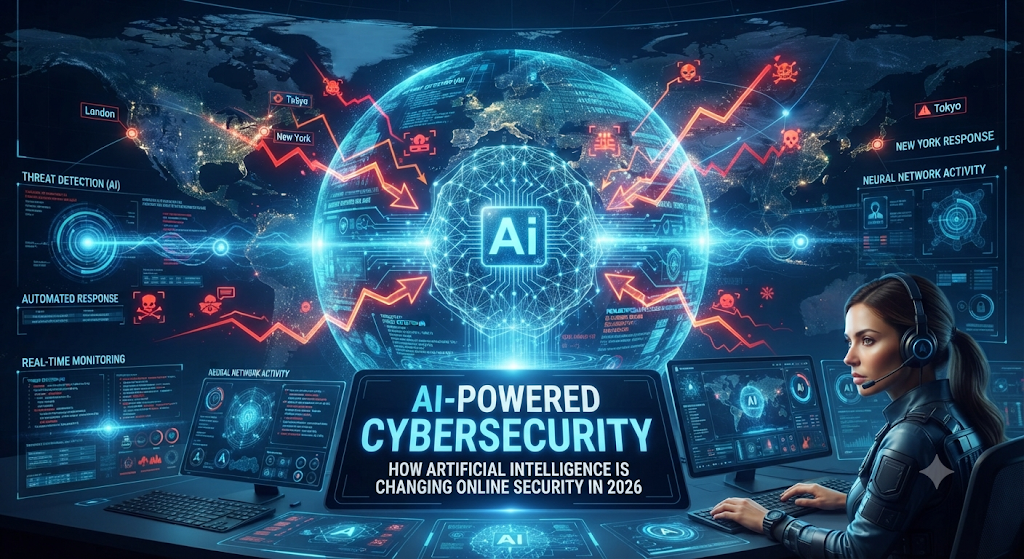
Artificial intelligence can examine huge amounts of security data, identify unusual behavior, and help security teams investigate potential attacks. It can support intelligent threat detection, behavioral analysis, and faster incident investigation. However, AI isn’t a magic shield. It can make mistakes and still needs human oversight. In this guide, you’ll learn how AI is changing online security in 2026 and why it matters for both individuals and businesses.
What Is AI-Powered Cybersecurity?
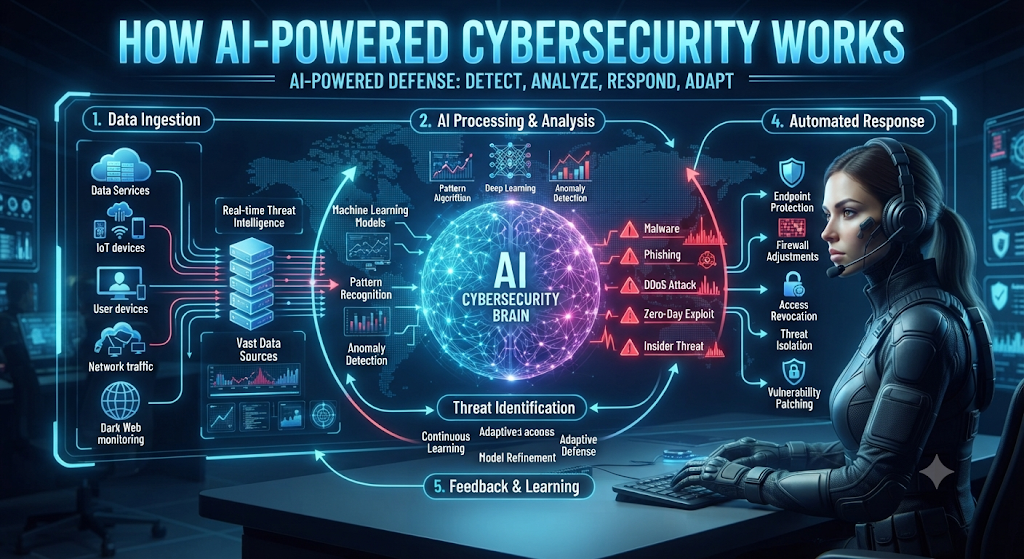
At its simplest, AI-powered cybersecurity means using artificial intelligence to help protect computers, networks, applications, accounts, and data from digital attacks. Traditional security tools often follow predefined rules. For example, an antivirus program may compare a file against known malicious signatures. A firewall may block traffic based on configured rules. These methods remain useful. However, modern attacks can change quickly, which creates a need for systems that can examine behavior rather than rely only on fixed instructions.
This is where artificial intelligence in cybersecurity adds another layer. AI systems can process large volumes of security events and search for relationships that would be difficult to identify manually. Machine learning cybersecurity tools can learn from relevant data and recognize patterns associated with suspicious activity. A system might notice that an employee normally logs in from one location during business hours. If that account suddenly signs in from an unusual location, accesses sensitive files, and starts communicating with unfamiliar services, the combined behavior may deserve investigation.
The important distinction is that AI does not simply “know” whether something is dangerous. It evaluates signals based on models, rules, training data, context, and confidence levels. A good system can identify a pattern that looks unusual, but a human analyst may still need to decide whether it represents a genuine attack. This is why AI-driven cybersecurity works best as part of a layered defense strategy rather than as a replacement for firewalls, authentication, backups, encryption, and trained professionals.
How AI-Powered Cybersecurity Works
| Security layer | How AI can help |
| Analyze suspicious messages and links | |
| Endpoint | Identify unusual processes and behavior |
| Network | Detect abnormal connections and traffic |
| Identity | Flag unusual login and access patterns |
| Cloud | Monitor account and application activity |
| Security operations | Correlate alerts and prioritize investigations |
The real strength of AI comes from connecting these layers. Imagine an employee receives a suspicious email, clicks a malicious link, signs into a fake page, and then an attacker uses the stolen credentials. Looking at each event separately may not reveal the full story. An AI system can potentially correlate the email, login, device behavior, and access attempt. That broader context can help analysts understand the attack faster.
Why Is Artificial Intelligence Important for Cybersecurity in 2026?
The cybersecurity environment in 2026 is difficult because organizations generate an enormous amount of security data. A modern company may use cloud platforms, remote-access systems, smartphones, laptops, SaaS applications, databases, collaboration tools, and connected devices. Every one of these systems can generate logs and security events. Human analysts cannot examine every event with the same level of attention. AI cybersecurity systems can help process that information and highlight activity that appears more important.
The problem becomes more serious when attackers combine different techniques. A campaign may begin with social engineering, move toward stolen credentials, and then attempt to access valuable business information. Defenders need to understand the sequence rather than simply identify one suspicious file. AI can support this process through AI-based threat detection, AI-based threat intelligence, and security analytics. These technologies can help connect events and prioritize potential incidents for further investigation.
Another important factor is speed. A security team may receive thousands of alerts during a busy period. If analysts spend too much time investigating harmless events, a serious incident could receive attention too late. AI-powered threat detection can help sort and group alerts based on available evidence. This doesn’t mean every AI-generated decision will be correct. It means analysts can spend more time on the events that deserve closer attention.
For businesses, this shift can be especially valuable. A large organization may have security operations running around the clock, while a small business may have only a few IT employees. Neither environment can afford to ignore important alerts. AI security solutions can provide scalable analysis that helps organizations handle more information without requiring every event to be reviewed manually.
Why AI Matters to Modern Security Teams
The value of AI isn’t simply that it can work quickly. Its bigger advantage is that it can examine relationships between many different signals. Threat intelligence, authentication activity, endpoint events, network traffic, and application behavior can provide pieces of the same security story. AI can help bring those pieces together.
For example, consider a U.S. business with employees working from several states. An employee’s account suddenly signs in from an unfamiliar location. Minutes later, the account downloads an unusual number of files. The same device then connects to a destination that the employee has never used before. A traditional system might create separate alerts. A more advanced system can correlate the events and assign greater importance to the combined pattern.
This is one reason adaptive security is becoming important. Security controls need to respond to changing circumstances rather than treating every event exactly the same way. AI can help adjust risk assessments based on behavior and context. However, organizations must carefully test these systems because incorrect assumptions can produce false alarms or block legitimate users.
The goal isn’t to make cybersecurity completely automatic. The goal is to create a stronger partnership between technology and people. Cybersecurity professionals still need to investigate unusual incidents, understand business impact, confirm threats, and make high-risk decisions. AI can handle much of the repetitive analysis, allowing human experts to focus on the problems where judgment matters most.
How Does AI Improve Online Security?
Modern security systems generate an enormous amount of information every minute. Login records, network connections, application activity, device events, and cloud activity all create signals that can help reveal an attack. AI can process these signals far faster than a person could review them manually. This makes security analytics and threat detection more efficient, especially when organizations have thousands of devices and accounts.
The real advantage appears when AI connects different events. Imagine an employee receives an unusual email, visits a suspicious website, downloads a new file, and then attempts to access sensitive company data. Each event might not look dangerous by itself. Together, however, they can form a recognizable pattern. AI can use machine learning, behavioral analysis, and contextual information to identify this relationship and send a higher-priority alert to the security team.
AI can also help establish a baseline of normal behavior. A system may learn that an employee usually accesses certain applications during working hours from familiar devices. If that pattern suddenly changes, the system can flag the difference. This doesn’t automatically prove an attack occurred. Instead, it gives analysts a useful starting point for investigation and helps reduce the time needed to find important events.
AI and Risk-Based Security Decisions
Modern AI systems can assign risk scores to events based on multiple signals. A login from a new device might have a low risk score by itself. A new device combined with an unusual location, repeated failed authentication, and access to sensitive resources could create a much higher score. This approach makes security alerts more meaningful because the system considers context rather than treating every event equally.
This process also supports AI security operations. Security analysts can investigate the highest-risk events first instead of working through alerts in a random order. In larger organizations, an AI-powered SOC can help correlate events across endpoints, identities, networks, and cloud services. The technology doesn’t replace analysts. It gives them a clearer picture of where attention may be needed.
How AI Detects Cyber Threats in Real Time
Real-time security matters because attackers don’t always wait for defenders to respond. Once an attacker gains access to an account or device, they may attempt to move quickly. AI can continuously analyze activity and compare current behavior with known patterns. This supports real-time monitoring and can shorten the time between suspicious activity and investigation.
One important technique is anomaly detection. Instead of looking only for known malware or attack signatures, an AI system can identify behavior that differs significantly from an established baseline. For example, a workstation that normally accesses a few business applications might suddenly connect to many unfamiliar destinations. That change doesn’t automatically mean the device is compromised. It does create a reason for closer examination.
Behavioral Detection in Real-Time
Behavioral threat detection becomes particularly useful when attackers use legitimate tools. An attacker who obtains valid credentials may not immediately trigger a traditional malware warning. However, the account might begin accessing resources it has never used before, downloading unusual amounts of data, or attempting privileged actions. AI can recognize these changes as part of a broader behavioral pattern.
This approach is also useful against previously unseen threats. A security team may not have a signature for a new attack. Yet the attack may still produce unusual behavior. AI can examine those behavioral signals and identify possible risk. The result is not perfect protection. Instead, it gives defenders another way to detect malicious behavior when traditional methods may have limited visibility.
AI-Powered Threat Detection and Response
Detection is only one part of cybersecurity. Once a possible threat appears, organizations need to decide what happens next. AI can help by collecting related evidence, ranking the incident, and suggesting appropriate actions. In carefully controlled environments, automated threat response can also perform predefined actions when certain conditions are met.
For example, an organization might configure its security platform to isolate a device when strong evidence indicates active malware. Another rule could temporarily block a suspicious connection while an analyst investigates. These actions can reduce response time. However, organizations should avoid giving AI unlimited authority. A mistaken decision could interrupt a legitimate employee or business application.
How Cybersecurity Automation Helps Security Teams
Cybersecurity automation is most useful when it removes repetitive tasks without removing human oversight. AI can group duplicate alerts, collect relevant logs, summarize an incident, and identify related accounts or devices. This can save analysts considerable time during an investigation.
A mature security operation may combine AI analysis with human approval. The system identifies a possible incident and gathers evidence. An analyst reviews the evidence and decides whether to contain the device, reset credentials, block access, or continue monitoring. This combination provides speed without treating AI output as unquestionable truth.
| Response stage | AI contribution | Human contribution |
| Detection | Finds unusual behavior | Validates the signal |
| Investigation | Connects related events | Understands context |
| Prioritization | Assigns risk indicators | Determines business impact |
| Containment | Suggests or performs approved actions | Approves critical actions |
| Recovery | Summarizes affected systems | Leads recovery decisions |
How AI Helps Prevent Phishing Attacks
Phishing remains effective because it attacks human behavior. A message may appear to come from a bank, employer, delivery company, coworker, or familiar service. Attackers often create urgency so the victim reacts before checking the details. AI can examine many characteristics of a message at once, including sender information, language, links, domains, attachments, and communication history.
Modern phishing detection can therefore go beyond simple keyword matching. A message might contain perfectly normal language but still use a suspicious domain. Another email might come from a legitimate account that has been compromised. AI can consider multiple signals and identify combinations that appear risky. This strengthens phishing prevention, especially when combined with email security controls and user awareness.
A Simple Phishing Example
Imagine an employee receives an email claiming that their Microsoft account will be suspended unless they verify it immediately. The link leads to a domain that looks similar to the real service but contains a subtle spelling difference. The email also arrives outside the employee’s normal communication pattern. AI can examine these signals and increase the risk score before the employee opens the link.
Still, technology isn’t enough. Users should remain cautious with unexpected login requests, payment changes, password resets, and urgent messages. Even advanced AI-powered security systems can make mistakes. The strongest defense combines automated detection with good human judgment.
AI and Malware Detection
Malware includes many types of harmful software, including trojans, spyware, worms, and other malicious programs. Traditional antivirus technology remains useful because known threats can often be identified through signatures. However, attackers can modify malware to avoid simple signature matching. This is where behavioral and machine-learning techniques can add another layer.
Machine learning algorithms can examine characteristics of files and programs and look for patterns associated with malicious behavior. A program that creates unexpected processes, changes protected system areas, accesses large numbers of files, and communicates with suspicious destinations may receive a higher risk score. This can support malware detection even when the exact file has not previously been classified.
Why Behavioral Malware Detection Matters
Signature-based protection asks a simple question: “Does this file match something known to be malicious?” Behavioral detection asks a different question: “What is this program doing?” Both approaches have value. A known threat can be blocked quickly through a signature, while unusual behavior can help reveal a new or modified threat.
This combination strengthens malware prevention. However, AI models can also produce false positives. Legitimate administrative software may perform powerful actions that resemble malicious behavior. Security teams therefore need context, testing, and appropriate confidence thresholds before taking disruptive action.
AI-Powered Ransomware Protection
Ransomware presents a particularly serious challenge because attackers can cause widespread disruption in a short period. Once ransomware begins encrypting files, organizations may lose access to critical documents and systems. AI can monitor for behavioral signals that may indicate an encryption event is underway.
For example, a normal workstation may modify a small number of documents throughout the day. Suddenly, a process begins changing thousands of files within minutes. That dramatic behavioral shift could trigger ransomware detection. A security platform may then investigate the process or apply an approved containment action.
Why AI Alone Isn’t Enough Against Ransomware
Strong ransomware protection requires several defensive layers. AI can help detect suspicious behavior, but organizations still need reliable backups, secure authentication, patch management, access restrictions, and recovery procedures. Backups should also be tested regularly because an untested backup isn’t a dependable recovery strategy.
The most important lesson is preparation. AI may help an organization recognize an attack earlier. Good recovery planning determines how well the organization can continue operating afterward. Detection and recovery therefore need to work together rather than being treated as separate cybersecurity problems.
How AI Protects Businesses From Cyberattacks
Businesses now depend on digital systems for almost every major operation. Customer records, payment platforms, employee accounts, cloud applications, internal databases, and communication tools all create possible entry points for attackers. Enterprise cybersecurity therefore needs visibility across many environments rather than protection for only one network. AI can help connect these different security signals and identify risks faster.
For example, imagine a U.S. company using Microsoft 365, cloud storage, remote laptops, customer databases, and several business applications. An attacker steals an employee’s password and signs in successfully. A traditional system may see a valid login. AI can examine the surrounding behavior and notice that the account is accessing unusual files, using a new device, and attempting actions outside its normal pattern. This type of intelligent threat detection can give analysts a much clearer picture.
AI can also support cyber risk management by helping businesses understand which events deserve immediate attention. Not every security alert represents the same level of danger. An employee opening a new business application may be normal. The same employee suddenly downloading thousands of customer records may require urgent investigation. AI can help prioritize these situations based on available context.
AI Across Business Security Layers
| Business area | AI security role |
| Employee accounts | Detect unusual authentication behavior |
| Laptops | Identify suspicious processes |
| Networks | Analyze unusual connections |
| Cloud platforms | Monitor account and application activity |
| Business applications | Identify abnormal usage |
| Company data | Detect unusual access or transfers |
The broader benefit is scalability. A small company may have limited IT resources while a large enterprise can generate millions of security events. AI doesn’t eliminate the need for skilled professionals. Instead, it can help organizations handle more information without requiring a person to manually inspect every event.
AI in Network Security
Networks are constantly changing. Employees connect from offices, homes, airports, hotels, and other locations. Applications communicate with cloud services while servers exchange information in the background. This creates a huge volume of network activity. AI can analyze these patterns and identify connections that differ from normal behavior.
Network threat detection becomes especially useful when an attacker has already gained access to a trusted device. The attacker may use legitimate credentials or tools rather than obvious malware. AI can still examine unusual communication patterns, unexpected destinations, abnormal data transfers, and changes in traffic behavior. This strengthens network security without relying entirely on known attack signatures.
How AI Finds Abnormal Network Behavior
Consider a company laptop that normally communicates with a limited number of business services. Suddenly, the device begins contacting unfamiliar servers and transferring a large amount of data late at night. Either event might have a legitimate explanation. When they occur together, however, the activity deserves closer investigation.
AI can compare this behavior with historical patterns and other security signals. If the same account recently experienced suspicious authentication activity, the risk becomes more significant. This type of correlation is one of the major strengths of AI-supported security analytics.
AI can also help identify patterns across many devices. One suspicious connection might be difficult to interpret. If hundreds of devices begin contacting the same unusual destination, the pattern becomes much more meaningful. Security analysts can then investigate whether the organization is facing a coordinated campaign or a legitimate software update.
AI and Identity and Access Security
Identity has become one of the most important parts of modern cybersecurity. Many businesses now use cloud applications and remote access, which means the traditional idea of protecting a single office network is no longer enough. Attackers increasingly target usernames, passwords, session tokens, and other credentials.
AI can help organizations examine how accounts normally behave. A system can consider login times, devices, locations, applications, authentication methods, and access patterns. If an account suddenly behaves differently, the system can raise its risk level. This strengthens identity security and identity threat detection.
AI-Based Identity Risk Example
Imagine an employee normally signs in from a company laptop during U.S. business hours. One morning, the account signs in from an unfamiliar device and immediately requests access to financial records. The password is correct, so a basic authentication system might allow the session.
An AI-supported identity system can look beyond the password. It can evaluate the new device, unusual access request, previous behavior, and other available signals. If the combined risk is high, the organization may require stronger verification or restrict access. This is where adaptive security becomes valuable.
AI can also help support access control by identifying accounts whose permissions no longer match their normal responsibilities. An employee who suddenly attempts to access resources unrelated to their role may deserve additional review. This doesn’t automatically mean the employee is malicious. The system simply identifies a change that security teams should understand.
AI-Powered Endpoint Security
Every laptop, desktop, smartphone, and workstation represents a potential endpoint. Attackers can use endpoints to steal credentials, install malware, move through a network, or access sensitive business information. Endpoint protection therefore needs to understand more than whether a particular file is known to be malicious.
AI-powered endpoint platforms can analyze processes, applications, file activity, system changes, and network connections. Endpoint threat detection can identify behavior that differs from an established baseline. For example, a workstation that suddenly launches an unfamiliar process and starts modifying large numbers of files could receive a high-risk score.
Why Endpoint Behavior Matters
Traditional antivirus may ask whether a file matches a known malicious signature. AI can examine what the program actually does. This distinction matters because attackers can modify malware to avoid simple signature detection.
A legitimate administrative tool can sometimes perform powerful actions too. Therefore, AI needs context. The same behavior may be normal on an IT administrator’s computer but suspicious on an employee’s workstation. Good endpoint security considers the user, device, application, and surrounding activity instead of treating every event identically.
AI can also help security teams investigate compromised devices faster. Instead of manually searching through thousands of events, analysts can receive a summarized timeline showing when suspicious behavior began and which processes or accounts were involved. That can make incident response more efficient.
How Cybercriminals Are Using AI
AI isn’t only changing defensive cybersecurity. Attackers can also use artificial intelligence to increase the speed and scale of certain activities. They may use AI-assisted systems to create more convincing social engineering messages, research targets, automate repetitive tasks, or adapt communications to different audiences.
This creates a difficult balance for defenders. A phishing message may contain natural language and appear highly personalized. An attacker can also combine stolen information with automated content generation to make a message look more believable. As a result, relying only on obvious spelling mistakes or generic warning signs is becoming less reliable.
The AI Security Arms Race
The growing use of AI creates something similar to an arms race. Defenders use AI to improve threat intelligence, behavioral detection, and automated analysis. Attackers can use AI to make some campaigns faster or more convincing. Both sides therefore have an incentive to improve their technology.
However, defensive AI still has an important advantage when it is connected to strong security controls. An organization can combine AI analysis with multifactor authentication, endpoint protection, backups, employee training, network controls, and identity monitoring. A single AI tool should never become the organization’s entire defense.
| Attacker capability | Defensive response |
| More convincing social engineering | Stronger phishing detection |
| Automated targeting | Better threat intelligence |
| Faster campaign creation | Faster security analysis |
| Credential abuse | Strong identity controls |
| Adaptive attack behavior | Behavioral threat detection |
The biggest lesson is that AI changes the speed of cybersecurity rather than removing the need for good security practices. Organizations that depend on one automated system may create a dangerous blind spot. Organizations that combine AI with layered controls can use the technology much more effectively.
AI vs. Traditional Cybersecurity: What Is the Difference?
Traditional cybersecurity relies heavily on predefined rules, signatures, policies, and known indicators. These controls remain extremely valuable. A firewall can block unauthorized traffic. Antivirus software can recognize known malware. Access policies can prevent users from reaching restricted resources. These basic protections form an important security foundation.
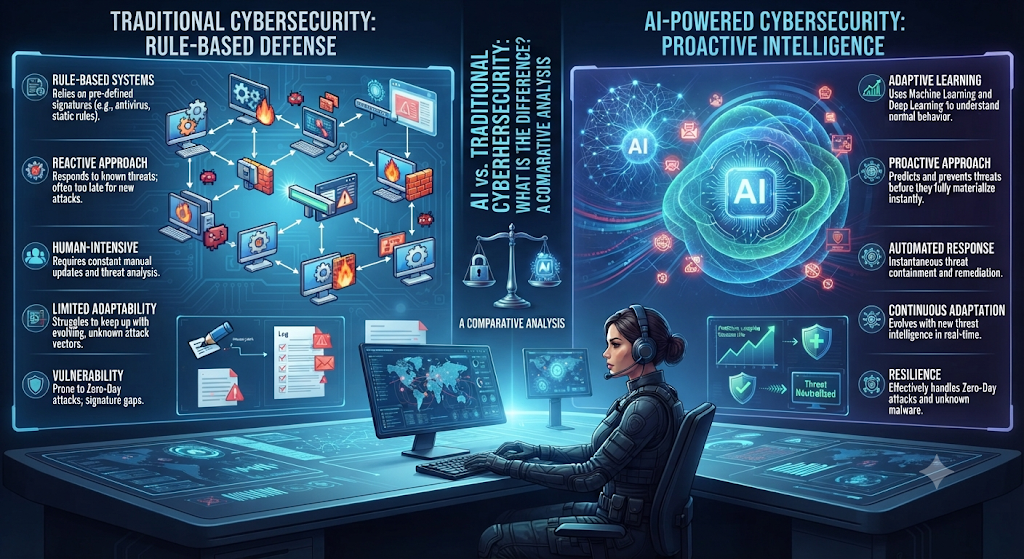
AI introduces a more dynamic approach. Instead of asking only whether an event matches a known rule, AI can examine behavior, context, and relationships between events. This can help identify previously unseen patterns. AI-powered security therefore complements traditional defenses rather than making them obsolete.
| Feature | Traditional cybersecurity | AI-assisted cybersecurity |
| Main approach | Rules and signatures | Patterns and behavior |
| Known threats | Very effective | Effective |
| Unknown behavior | More limited | Can identify anomalies |
| Data analysis | Often predefined | Large-scale analysis |
| Automation | Rule-based | Context-aware assistance |
| Human involvement | Essential | Still essential |
The strongest architecture combines both approaches. Traditional controls can handle predictable threats efficiently while AI adds another analytical layer. This combination creates stronger security systems because organizations don’t have to choose between proven defensive controls and newer AI capabilities.
Benefits of AI-Powered Cybersecurity
The biggest benefit of AI is speed. A security platform can examine huge volumes of events far faster than a human analyst. This matters when an organization has thousands of devices, accounts, applications, and network connections. AI threat detection can continuously compare activity, identify unusual patterns, and help security teams focus on events that appear most important.
AI also improves consistency. Human analysts can become overwhelmed by repetitive alerts, especially during a major incident. AI can group related events, remove duplicate signals, summarize technical information, and highlight possible attack patterns. This supports security analytics and helps analysts spend more time investigating genuine risks instead of manually sorting routine notifications.
Another major advantage is automation. With carefully defined policies, automated threat response can perform certain low-risk actions quickly. A suspicious endpoint might be isolated while an analyst investigates. A compromised account might require additional verification. These actions can reduce the gap between threat detection and incident response, which can be critical during fast-moving attacks.
Where AI Creates the Most Value
| Benefit | Why it matters |
| Faster detection | Reduces the time needed to identify suspicious activity |
| Large-scale analysis | Processes more security data than humans alone |
| Better prioritization | Helps analysts focus on higher-risk events |
| Automation | Handles repetitive security tasks |
| Behavioral analysis | Can identify unusual activity without a known signature |
| Scalability | Supports organizations with growing digital environments |
AI can also improve visibility across multiple environments. A modern organization may use cloud services, remote devices, business applications, and traditional infrastructure at the same time. An AI-powered SOC can correlate signals from these different areas and provide a more complete security picture.
However, speed should not be confused with accuracy. AI can make incorrect assumptions. A legitimate employee may suddenly travel, use a new device, or access a new application. If the system doesn’t understand that context, it could generate a false positive. Good cybersecurity therefore combines AI efficiency with human review and carefully designed policies.
Limitations and Risks of AI in Cybersecurity
AI has powerful capabilities, but it isn’t perfect. One major concern is false positives. A system may identify legitimate behavior as suspicious because it differs from an established pattern. If this happens too frequently, analysts can experience alert fatigue and start ignoring warnings. Good models and careful tuning are therefore essential.
Another problem is false negatives. AI can also miss an attack. A new technique may behave differently from anything represented in the data used to train or configure the system. Attackers can deliberately change their behavior to avoid detection. This means organizations should never assume that an AI system provides complete protection against all cyber threats.
Data quality is another major factor. AI systems depend heavily on the information they receive. Incomplete logs, incorrect data, outdated intelligence, or missing context can reduce the quality of a model’s decisions. An advanced system cannot magically produce reliable results from poor input.
Privacy and Sensitive Data
Privacy deserves special attention because cybersecurity AI may process large amounts of sensitive information. Security platforms can analyze usernames, device information, login records, emails, network activity, application usage, and other data. Organizations need clear rules about what information they collect and how long they keep it.
Strong data protection controls should therefore surround AI systems. Access should be limited to authorized personnel. Sensitive information should receive appropriate protection while stored and transmitted. Organizations should also understand how vendors process security data before deploying AI-powered products.
AI Can Become a Security Target
There is another important concern. The AI system itself can become a target. Attackers may attempt to manipulate the information used by a model, exploit connected applications, steal credentials, or abuse weaknesses in the surrounding infrastructure. AI doesn’t remove security vulnerabilities. It creates another technology layer that must also be secured.
This is why organizations need governance around AI deployment. Security teams should test models, monitor performance, review access permissions, and investigate unusual AI behavior. They should also maintain traditional controls so that a problem with one AI system doesn’t compromise the entire security architecture.
Can AI Replace Cybersecurity Professionals?
The short answer is no. AI can automate certain tasks and help analysts work faster, but cybersecurity requires judgment. A security professional may need to determine whether an unusual event is an attack, a business requirement, a technical mistake, or a legitimate change in user behavior.
Consider an employee who downloads a large number of files. AI might flag the activity because it differs from the employee’s normal behavior. A human analyst can investigate the reason. Perhaps the employee is preparing documents for an approved business project. Alternatively, an attacker may have compromised the account. The technology can identify the signal, but human context helps determine what it means.
This is why the future of cybersecurity is more likely to involve human-AI collaboration than complete replacement. AI can handle repetitive analysis while people focus on investigation, strategy, risk decisions, and communication.
How AI Supports Cybersecurity Professionals
| Security responsibility | AI assistance | Human responsibility |
| Alert review | Prioritizes signals | Validates important alerts |
| Threat hunting | Finds unusual patterns | Investigates their meaning |
| Incident analysis | Correlates evidence | Determines business impact |
| Response | Suggests actions | Approves critical decisions |
| Risk management | Identifies trends | Sets organizational priorities |
A skilled analyst can also challenge AI when its conclusion doesn’t make sense. This human oversight is important because security decisions can affect customers, employees, finances, and business operations.
How to Use AI Safely for Better Cybersecurity
Using AI safely starts with strong fundamentals. Individuals should still use unique passwords, enable multifactor authentication, update software, maintain backups, and be careful with unexpected messages. AI can provide additional protection, but basic security habits remain essential.
Businesses need a broader strategy. Before adopting an AI security solution, an organization should understand what systems it will monitor, what information it will process, and what actions it can take automatically. AI cybersecurity tools should have clearly defined permissions and response boundaries. High-impact actions should receive appropriate human oversight.
A Practical AI Security Strategy
| Security priority | Recommended approach |
| Identity | Use strong authentication and access controls |
| Devices | Maintain endpoint monitoring and updates |
| Data | Protect sensitive information and maintain backups |
| Network | Monitor unusual connections and traffic |
| AI systems | Review access, performance, and security |
| Response | Maintain a tested incident-response process |
Organizations should also measure whether AI actually improves their security program. Useful measurements can include how quickly analysts investigate alerts, how many alerts are false positives, how quickly incidents are contained, and whether important threats are being identified earlier.
The goal isn’t to purchase the most impressive AI product. The goal is to solve real security problems. A smaller organization may benefit more from a simple managed security service with useful automation than from an expensive platform containing features its team cannot manage effectively.
The Future of AI-Powered Cybersecurity
The future of AI-driven cybersecurity will likely involve more adaptive systems that can understand security events across multiple environments. Instead of treating email, identity, endpoint, and network security as completely separate areas, AI can increasingly help connect them.
This could strengthen predictive cybersecurity. By analyzing historical events and current behavior, systems may identify patterns that indicate increasing risk. For example, repeated failed logins, unusual application access, and suspicious network activity could collectively indicate that an account or device deserves closer attention.
Another important development is the growth of AI assistants inside security operations. Analysts may increasingly use AI to summarize incidents, search large datasets, explain suspicious activity, and suggest investigation paths. This can reduce the time required to understand complicated events.
AI Agents and Automated Security
AI agents could eventually perform more connected security tasks. Instead of simply generating an alert, an agent might gather relevant logs, examine the affected endpoint, check identity activity, compare threat intelligence, and prepare an investigation summary.
However, greater automation creates greater responsibility. An AI system that can take actions across multiple security controls needs strict permissions and monitoring. Organizations must know exactly what an automated system can change and when a human must approve an action.
The future should therefore focus on controlled automation, not unlimited autonomy. AI can become more capable while still operating within carefully defined security boundaries.
Frequently Asked Questions About AI-Powered Cybersecurity
What is AI-powered cybersecurity?
AI-powered cybersecurity uses artificial intelligence to help identify, analyze, investigate, and respond to security risks. It can process large amounts of security information and identify patterns that may indicate an attack.
How does AI detect cyber threats?
AI can examine behavior across systems and compare current activity with normal patterns. Anomaly detection, machine learning, threat intelligence, and behavioral analysis can help identify suspicious activity that deserves investigation.
Can AI stop every cyberattack?
No. AI can improve detection and response, but no technology can guarantee that every attack will be stopped. Strong authentication, software updates, backups, access controls, employee training, and layered defenses remain necessary.
Is AI better than traditional cybersecurity?
AI and traditional cybersecurity serve different purposes. Traditional tools remain effective against many known threats. AI adds behavioral analysis, automation, and large-scale data processing. Combining both approaches generally creates a stronger defense.
Can small businesses use AI cybersecurity?
Yes. Small businesses don’t necessarily need complex enterprise platforms. Managed security services, endpoint protection, identity monitoring, and security tools with useful AI features can provide practical protection when configured correctly.
Final Thoughts: Is AI the Future of Cybersecurity?
AI is becoming an important part of modern cybersecurity because the volume and complexity of digital activity continue to grow. It can analyze information quickly, recognize unusual behavior, prioritize security alerts, and support automated responses. These capabilities can help organizations react faster when genuine threats appear.
But the future isn’t about replacing cybersecurity professionals with machines. It is about combining advanced technology with human expertise. Strong AI security solutions, trained professionals, reliable backups, identity controls, network defenses, and good security policies all have a role to play.
The organizations that benefit most from AI will be those that use it carefully. They will test their systems, monitor performance, protect sensitive data, and keep humans involved in important decisions. In 2026 and beyond, responsible AI adoption can make cybersecurity faster, more adaptive, and more resilient against evolving digital threats.
Meta Description
AI-powered cybersecurity is transforming online security in 2026. Discover how AI detects cyber threats, stops attacks, protects data, and strengthens business security.
13 Comments