

Software is becoming more independent every year. Many programs can now observe what is happening, make decisions, and perform tasks with little human help. This is where software agents become important. They can work with users, systems, websites, databases, and other programs.
Understanding the types of software agents helps you understand modern automation. It also makes AI systems easier to understand. Not every agent works in the same way. Some follow fixed rules. Others learn from experience. More advanced systems can plan tasks and adapt to changing situations.
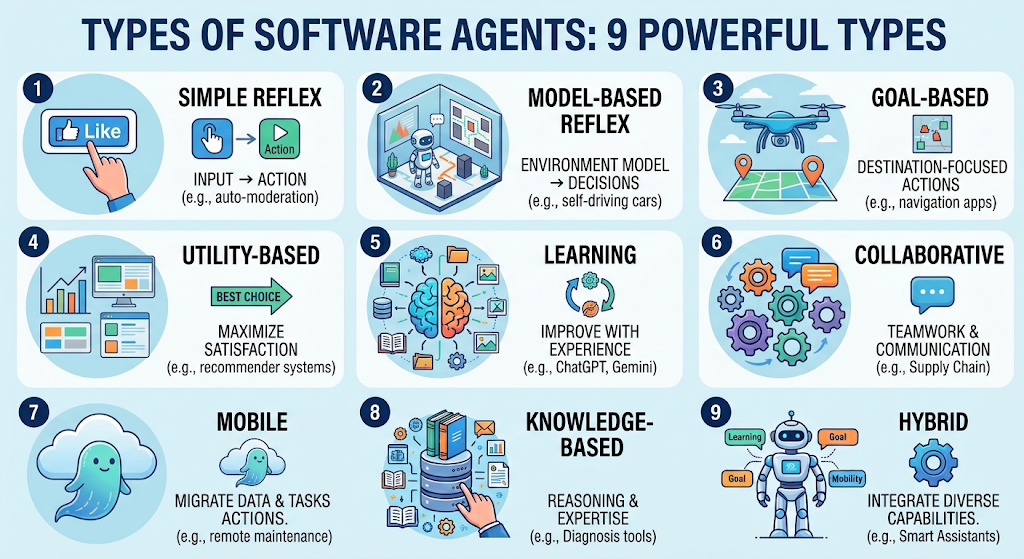
This guide explains the main software agent types in simple English. You will learn how they work, where they are used, and how they differ from AI agents and bots. You will also see real-world examples and a practical case study.
Trusted sources
| Source | Read More |
|---|---|
| Microsoft | Types of AI Agents and Their Use Cases |
| Microsoft | AI Agent FAQ: Definitions and Explanations |
| IBM | Types of AI Agents |
| IBM | What Are AI Agents? |
| Google Cloud | What Are AI Agents? Definition, Examples, and Types |
| NIST | AI Agent Standards Initiative |
| Microsoft Learn | Introduction to AI Agents |
| IBM Research | Large Language Models and AI Agents |
What Are Software Agents and How Do They Work?
A software agent is a program that can observe its surroundings and perform actions to reach a specific goal. It does not always need a person to control every step. The agent receives information, processes it, makes a decision, and performs an action. This basic cycle is the foundation of many agent-based systems.
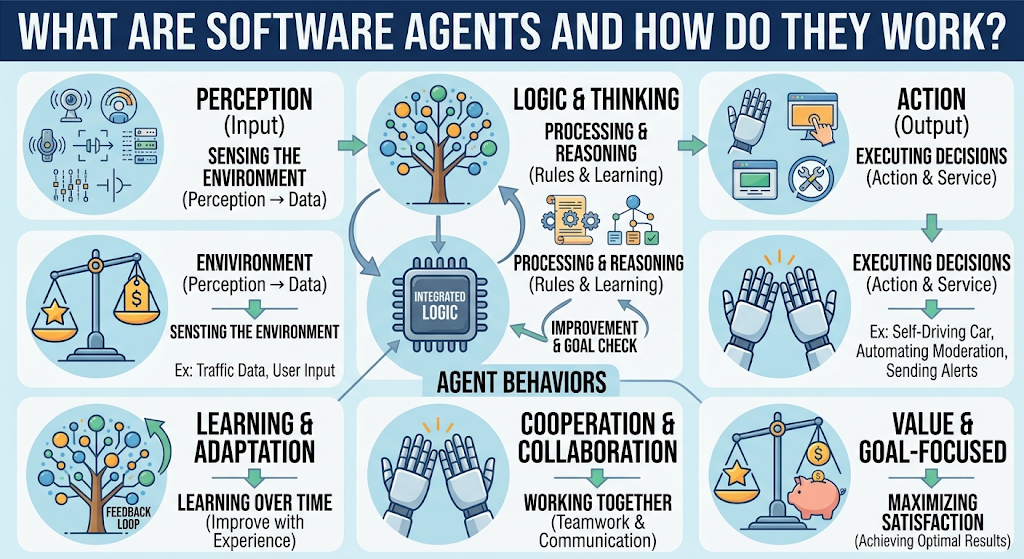
The process usually starts with agent perception. The agent collects information from its agent environment. It may read a file, receive a user request, monitor a network, or check a database. It then uses agent reasoning to decide what should happen next. Finally, it performs an agent action. This cycle can repeat many times as conditions change.
| Stage | What happens |
|---|---|
| Perception | The agent collects information |
| Analysis | It processes the available information |
| Reasoning | It evaluates possible actions |
| Planning | It decides what should happen next |
| Action | It performs the selected task |
| Feedback | It checks the result |
| Learning | Advanced agents improve from experience |
The intelligence of an agent depends on its design. A basic agent may only follow predefined rules. A modern agent can combine memory, reasoning, planning, external tools, and machine learning. This creates a wide range of intelligent software agents for different tasks.
Why Software Agents Matter in Modern Technology
Modern systems handle huge amounts of information. Humans cannot manually check every event, message, transaction, or security alert. Software agents can monitor these activities continuously. They can react much faster when a predefined condition appears.
Businesses also use agents to reduce repetitive work. An agent can process information, update records, monitor systems, or respond to common requests. This supports software automation, task automation, and intelligent automation. The result can be faster operations and fewer manual errors.
The value of an agent depends on the problem it solves. A simple monitoring agent may only need a few rules. A complex system may require memory, planning, learning, and communication. Therefore, choosing the right agent architecture is just as important as choosing the right technology.
9 Types of Software Agents You Should Know
The types of software agents differ mainly in how they perceive information and make decisions. Some agents react immediately to current conditions. Others maintain an internal model of their environment. More advanced agents can pursue goals, calculate useful outcomes, or learn from previous results.
The following table gives you a simple comparison before we examine each type in detail.
| Agent type | Main ability | Typical use |
|---|---|---|
| Simple reflex agent | Reacts to current input | Basic automation |
| Model-based reflex agent | Uses an internal model | Monitoring systems |
| Goal-based agent | Works toward a goal | Planning tasks |
| Utility-based agent | Chooses the best outcome | Complex decisions |
| Learning agent | Improves from experience | Adaptive systems |
| Rule-based agent | Follows predefined rules | Business processes |
| Autonomous agent | Works with limited human control | Automation |
| Multi-agent system | Coordinates multiple agents | Distributed tasks |
| AI-powered agent | Uses modern AI capabilities | Advanced automation |
These categories can sometimes overlap. For example, an autonomous agent can also be a learning agent. An AI-powered agent may use goal-based or utility-based decision-making. The exact design depends on the system’s purpose.
1. Simple Reflex Agents
Simple reflex agents are among the easiest agents to understand. They react to information available at the current moment. They normally use predefined condition-action rules. When a particular condition appears, the agent performs the related action.
For example, imagine a system that monitors a server. If CPU usage reaches a certain level, it can send an alert. The agent does not need to understand the entire history of the server. It simply observes the current condition and responds. These are classic reactive agents because their behavior depends heavily on immediate input.
2. Model-Based Reflex Agents
Model-based reflex agents are more advanced. They maintain some internal information about their environment. This helps them make decisions when the current input does not provide the complete picture.
Consider a network monitoring system. A single alert may not tell the whole story. The agent can remember previous events and combine them with the latest information. This creates a basic internal model. Such agents can work better in environments where conditions change over time.
3. Goal-Based Agents
Goal-based agents make decisions according to a desired result. Instead of simply reacting to an event, they consider what action can help achieve their agent goals.
Suppose an agent needs to schedule a meeting. It may check calendars, compare available times, and select a suitable option. The goal is not simply to react to a calendar update. The goal is to produce a successful schedule. This makes goal-based systems more flexible than basic reflex systems.
4. Utility-Based Agents
Utility-based agents go one step further. They consider different possible outcomes and select an option based on its usefulness. The system may have several choices that can achieve the same goal.
For example, a delivery system may need to choose between several routes. One route could be faster but more expensive. Another could be slower but cheaper. A utility-based agent can evaluate these trade-offs. This type of decision-making agent is useful when the best choice depends on several factors.
5. Learning Agents
Learning agents improve their behavior through experience. They can use previous results to make better decisions in future situations. This is one reason learning systems are important in modern AI.
A recommendation system provides a simple example. It can study which content a user interacts with. Over time, it can adjust its recommendations. Modern machine learning agents can use models, feedback, and historical data to improve performance. Their behavior does not always remain fixed after deployment.
6. Rule-Based Agents
Rule-based agents operate according to predefined instructions. These instructions usually follow an “if this happens, do that” structure. They are common in systems where decisions must remain predictable.
A customer support system could use rules to identify common requests. If a customer asks about a password reset, the system can provide the relevant instructions. Rule-based systems are easier to audit than some complex AI systems. However, they can struggle when situations fall outside their predefined rules.
7. Autonomous Software Agents
Autonomous software agents can perform tasks with limited human intervention. They can monitor conditions, make decisions, and execute actions without requiring a person to approve every step.
Autonomy does not mean unlimited freedom. A well-designed agent normally operates within permissions and predefined boundaries. For example, an automation agent may be allowed to create reports but not delete important records. Good agent architecture therefore includes controls, permissions, monitoring, and failure handling.
8. Multi-Agent Systems
Multi-agent systems contain multiple agents that interact with one another. Each agent may have a different responsibility. Together, they can solve a larger problem.
One agent could collect information. Another could analyze it. A third could coordinate the final action. This requires agent communication, agent coordination, and agent collaboration. Such systems can use distributed agent systems when their components operate across different machines or environments.
9. AI-Powered Agents
AI-powered agents combine agent behavior with modern artificial intelligence. They may use machine learning, natural language processing, reasoning, planning, or generative AI.
Modern generative AI agents can understand natural language requests and break larger tasks into smaller actions. Natural language processing agents can also interpret text and communicate with users. This makes advanced agents much more flexible than traditional rule-based programs.
How Different Types of Software Agents Make Decisions
Different software agent types use different decision-making methods. A reflex agent may only check the current condition. A goal-based agent considers its target. A utility-based agent compares possible outcomes. A learning agent can also use previous experience when selecting its next action.
The basic process can be understood as a loop: perception, reasoning, planning, action, and feedback. Advanced systems may maintain an agent knowledge base that stores useful information. They may also perform agent planning before taking action. The more complex the environment becomes, the more important these capabilities become.
| Decision approach | Main question |
|---|---|
| Reflex | “What should I do now?” |
| Model-based | “What is happening in my environment?” |
| Goal-based | “Which action helps reach my goal?” |
| Utility-based | “Which option gives the best outcome?” |
| Learning | “What can I learn from previous results?” |
| AI-powered | “How can I reason across complex information?” |
A useful example is an email management agent. A simple system may move messages based on fixed rules. A smarter agent can understand the sender, subject, context, and previous behavior. An advanced agent could classify the message, summarize it, create a task, and suggest a response.
Software Agents vs AI Agents: What Is the Difference?
The terms software agents and AI agents are often used together. However, they are not always identical. A software agent can work with simple rules and does not necessarily need artificial intelligence. An AI agent usually uses AI capabilities to understand information and make more flexible decisions.
For example, a traditional software agent can automatically back up a folder every evening. It follows a known schedule. An AI agent could examine files, identify important changes, prioritize them, and decide which information needs attention. Both are agents, but their capabilities can be very different.
| Feature | Software Agent | AI Agent |
|---|---|---|
| Rules | Often used | Can use rules |
| Machine learning | Optional | Common |
| Natural language | Optional | Often supported |
| Planning | Basic to advanced | Often advanced |
| Adaptation | Depends on design | Usually stronger |
| Reasoning | May be limited | Often more flexible |
The key difference is not the word “agent.” The important difference is how the system perceives, reasons, learns, and acts.
Software Agents vs Bots: Are They the Same?
A bot is usually designed to perform a specific automated task. A chatbot may answer questions. A web crawler may visit pages and collect information. These systems can be considered agents when they independently perceive input and perform actions.
However, not every bot has the same level of autonomy or intelligence. Some bots simply execute fixed commands. More advanced autonomous agents can maintain context, plan tasks, use tools, and adapt to new information. Therefore, the terms can overlap, but they do not always describe exactly the same system.
| Feature | Basic Bot | Software Agent |
|---|---|---|
| Automated actions | Yes | Yes |
| Fixed rules | Common | Optional |
| Goals | Limited | Common |
| Planning | Usually limited | Can be advanced |
| Learning | Rare | Possible |
| Autonomy | Often limited | Can be high |
The difference becomes clearer when you examine the system’s behavior. A basic bot may execute one instruction. A sophisticated agent can decide which steps are needed to complete a larger objective.
Real-World Examples of Software Agents
Software agent examples exist across everyday technology. Search crawlers collect information from websites. Recommendation systems analyze user behavior. Email filters classify incoming messages. Monitoring systems watch servers and networks. These systems may use very different software agent technology, but they share the idea of automated perception and action.
Modern applications are becoming more sophisticated. A travel agent could understand a request, compare options, organize information, and prepare an itinerary. A cybersecurity agent could monitor alerts and identify suspicious behavior. A business agent could process documents and update internal systems. These software agent applications show why agent-based technology has become important.
| Industry | Example agent application |
|---|---|
| Cybersecurity | Threat monitoring |
| Finance | Fraud detection |
| Healthcare | Data monitoring |
| E-commerce | Product recommendations |
| Customer service | Automated support |
| Business | Workflow automation |
| Software development | Testing and monitoring |
| Marketing | Data and campaign analysis |
The important point is that agents are not limited to futuristic systems. Many already operate quietly inside services you use every day.
How Software Agents Are Used in Cybersecurity
Cybersecurity is a strong use case for cybersecurity agents. Security teams receive huge volumes of alerts every day. Humans cannot investigate every event manually. Automated agents can monitor logs, examine events, identify suspicious patterns, and send important findings to analysts.
Security software agents can also run on endpoints and servers. They may watch processes, network connections, files, and system activity. When something unusual appears, the agent can collect evidence or trigger a predefined response. More advanced systems can combine multiple signals before deciding whether an event deserves attention.
A security environment can also use multiple agents. One agent can monitor endpoints. Another can examine network traffic. A third can analyze threat intelligence. Their agent communication can create a broader security picture. This approach can reduce manual workload while improving response speed.
However, security agents require strict controls. An incorrectly configured autonomous agent can create new problems. For this reason, permissions, logging, testing, human review, and rollback mechanisms remain important.
How Software Agents Are Used in Business and Automation
Businesses use agents to handle repetitive workflows. A finance agent can process invoices. A support agent can classify customer requests. A sales agent can organize leads. An operations agent can monitor internal systems.
These business automation agents can reduce repetitive manual work. They can also connect different software systems. For example, an agent could receive an order, check inventory, update a database, and notify another system. This is where agent automation becomes more useful than simple task scripts.
Modern AI automation can add another layer. An agent may understand unstructured information instead of waiting for perfectly formatted data. It can read a document, identify important fields, and decide which workflow should follow. The quality of the result still depends on the underlying data, rules, models, and system controls.
Benefits of Using Software Agents
The main advantage of agents is automation. They can perform tasks continuously without requiring a person to start every action. This can save time and help teams focus on work that requires human judgment.
Another benefit is consistency. An agent can follow the same process repeatedly. It does not become tired after thousands of routine checks. Advanced systems can also work around the clock. When agents are designed correctly, they can improve response speed and operational efficiency.
| Benefit | Practical value |
|---|---|
| Automation | Reduces repetitive manual work |
| Speed | Responds quickly to events |
| Consistency | Repeats processes reliably |
| Scalability | Handles larger workloads |
| Monitoring | Watches systems continuously |
| Adaptation | Some agents improve through learning |
| Coordination | Multiple agents can share tasks |
Still, automation should not be treated as a magic solution. A badly designed agent can automate the wrong process very efficiently. Good implementation starts with a clear goal and reliable data.
Limitations and Risks of Software Agents
Agents can make mistakes. A rule can be wrong. A model can misunderstand information. A learning system can produce unexpected results. The risk becomes higher when an agent has permission to perform important actions automatically.
Privacy is another concern. Agents may need access to emails, documents, databases, or business systems. Poor access controls can expose sensitive information. Organizations should therefore limit permissions and monitor agent activity.
Autonomous systems also create accountability questions. If an agent makes a harmful decision, someone must determine why it happened. Strong human-agent interaction can help keep people involved in important decisions.
The safest approach is controlled autonomy. Give the agent enough access to perform its job. Do not give it unnecessary authority. Monitor its actions and create clear recovery procedures.
How Software Agents Are Changing With Generative AI
Generative AI has changed what agents can understand and produce. Traditional agents often depend on structured inputs and predefined rules. Modern systems can process natural language, summarize information, generate content, and interact with tools.
This has created more capable generative AI agents. A user can describe a goal in normal language. The agent can interpret the request and create a sequence of actions. It may search information, analyze results, call software tools, and produce an answer.
The biggest change is the move from simple automation toward flexible task completion. Autonomous decision making can allow an agent to select the next step based on changing information. However, autonomy also increases risk. More capability requires stronger permissions, monitoring, testing, and human oversight.
How to Choose the Right Type of Software Agent
Choosing between the types of software agents starts with the task. First, determine whether the system only needs simple reactions or more advanced reasoning. A fixed workflow may work well with a rule-based agent. A changing environment may require a model-based or learning approach.
You should also consider data, risk, cost, autonomy, and integration requirements. If the agent can affect important systems, stronger controls become essential. The right software agent framework should support the capabilities your project actually needs rather than adding unnecessary complexity.
| Requirement | Suitable approach |
|---|---|
| Simple conditions | Rule-based or reflex agent |
| Known objective | Goal-based agent |
| Multiple trade-offs | Utility-based agent |
| Continuous improvement | Learning agent |
| Independent operation | Autonomous agent |
| Multiple specialized tasks | Multi-agent system |
| Complex language tasks | AI-powered agent |
The best agent is not always the most advanced one. A simple system can be more reliable when the task itself is simple.
Future of Software Agents: What to Expect Next
The future of software agents will likely focus on greater autonomy and stronger integration. Agents will increasingly connect with business software, databases, cloud services, security platforms, and productivity tools. Instead of only answering questions, they will increasingly help complete tasks.
We can also expect more collaboration between agents. A single system may contain specialized agents that share information and divide responsibilities. This will strengthen multi-agent systems, agent coordination, and agent collaboration.
At the same time, security will become more important. Organizations will need better identity controls, permission systems, audit logs, and monitoring. The future will not simply be about making agents more powerful. It will also be about making them reliable, controllable, and safe.
Common Software Agent Questions
What is a software agent?
A software agent is a program that observes information and performs actions toward a goal. Its capabilities depend on its design. Some agents follow simple rules, while others can learn, reason, and plan.
What are the main types of software agents?
The main categories include simple reflex agents, model-based reflex agents, goal-based agents, utility-based agents, and learning agents. Modern systems also include autonomous and AI-powered agents.
How does a software agent work?
An agent usually follows a perception, reasoning, and action cycle. It receives information from its environment. It processes that information and selects an action. Advanced agents can also plan and learn from feedback.
Are AI agents and software agents the same?
Not always. AI agents are a type of software system that uses artificial intelligence capabilities. A traditional software agent can work without machine learning or generative AI.
What is an autonomous software agent?
An autonomous software agent can perform tasks with limited human intervention. Its level of autonomy depends on its permissions, design, goals, and environment.
Where are software agents used?
Agents are used in cybersecurity, business automation, customer service, finance, e-commerce, software development, monitoring, and many other areas.
Are software agents safe?
They can be safe when properly designed and controlled. Strong permissions, monitoring, testing, logging, and human oversight are important for high-risk applications.
What is a multi-agent system?
A multi-agent system contains multiple agents that communicate and coordinate with each other. Each agent can handle a specific part of a larger task.
What is the difference between a bot and a software agent?
A bot usually performs a specific automated function. A software agent can have broader capabilities, including goals, reasoning, planning, memory, and autonomous actions.
Are software agents the future of automation?
Agents are becoming an important part of automation. Their ability to understand information and make decisions can support more flexible workflows. Their growth will depend on reliability, security, cost, and responsible deployment.
A Simple Case Study: Software Agents in a Security Operation
Imagine a company with hundreds of computers. Every day, its security platform produces thousands of events. A human team cannot manually investigate every event with equal attention.
The company introduces several specialized agents. A monitoring agent watches endpoint activity. A second agent analyzes suspicious files. Another agent checks threat intelligence. A coordination agent combines their findings.
When an unusual event appears, the agents share information. The system gives the event a risk score. A low-risk event can be logged automatically. A high-risk event can be sent to a human analyst for review.
This example shows how agent-based architecture can divide a complex problem into smaller responsibilities. It also shows why agent communication and agent coordination matter in real systems.
The company does not need to give every agent unlimited control. Instead, each agent receives only the permissions required for its task. This creates a safer balance between automation and human oversight.
Software Agent Types: A Quick Comparison
The following table summarizes the major software agent types discussed in this guide.
| Type | Decision style | Learning | Autonomy | Example |
|---|---|---|---|---|
| Simple reflex | Current condition | No | Low | Basic alert |
| Model-based | Current + internal state | Limited | Low to medium | System monitor |
| Goal-based | Goal focused | Optional | Medium | Scheduling system |
| Utility-based | Best outcome | Optional | Medium to high | Route selection |
| Learning | Experience based | Yes | Medium to high | Recommendation system |
| Rule-based | Predefined rules | Usually no | Low to medium | Business workflow |
| Autonomous | Independent operation | Optional | High | Automated task system |
| Multi-agent | Collaborative | Optional | High | Distributed platform |
| AI-powered | AI-driven reasoning | Often | High | AI task agent |
Final Thoughts on Types of Software Agents
Understanding the types of software agents gives you a clearer view of modern automation. These systems range from simple rule-based programs to advanced AI-powered systems. Each type solves a different kind of problem.
The most important idea is simple. An agent observes, decides, and acts. The difference comes from how it performs those steps. Some agents react instantly. Others use internal models, goals, utility calculations, learning, or AI reasoning.
As technology develops, agents will become more capable and more connected. Autonomous software agents, AI-powered agents, and multi-agent systems will likely become more common across business and cybersecurity.
But capability alone is not enough. Good agent design also requires security, clear goals, controlled permissions, reliable data, and human oversight. When these elements work together, software agents can turn complex workflows into faster and more manageable systems.
Continue Reading
- AI-Powered Cybersecurity: How Artificial Intelligence Is Changing Online Security in 2026
- AI Workflow Automation in 2026: How Smart AI Workflows Are Transforming Business Productivity
- Generative AI in 2026: How Advanced AI Models Are Transforming Business, Creativity, and Everyday Life
- Best AI Automation Tools in 2026: Top AI Platforms for Business, Workflows, and Productivity
- Agentic AI in 2026: How Autonomous AI Systems Will Transform Business, Software, and Human Work
- AI Agents in 2026: What Are AI Agents and How They Will Change Work, Business, and Daily Life
- What Is AI Automation? Complete Guide to AI Automation Tools and Future Benefits (2026)
- Why 2026 Belongs to AI-Driven Social Media Managers: The Ultimate Game-Changing Guide
- Ultimate Guide to AI Regulations 2026: US, UK & EU Compliance Explained
Meta Description
Types of Software Agents explained with 9 powerful types, how they work, real-world examples, AI agents, automation, cybersecurity, and future trends.
1 Comment