

Cyber attacks rarely begin with a loud warning. Many start with a strange login, an unusual connection, or a small change in network traffic. If nobody notices these signals, attackers can move deeper into a business environment.
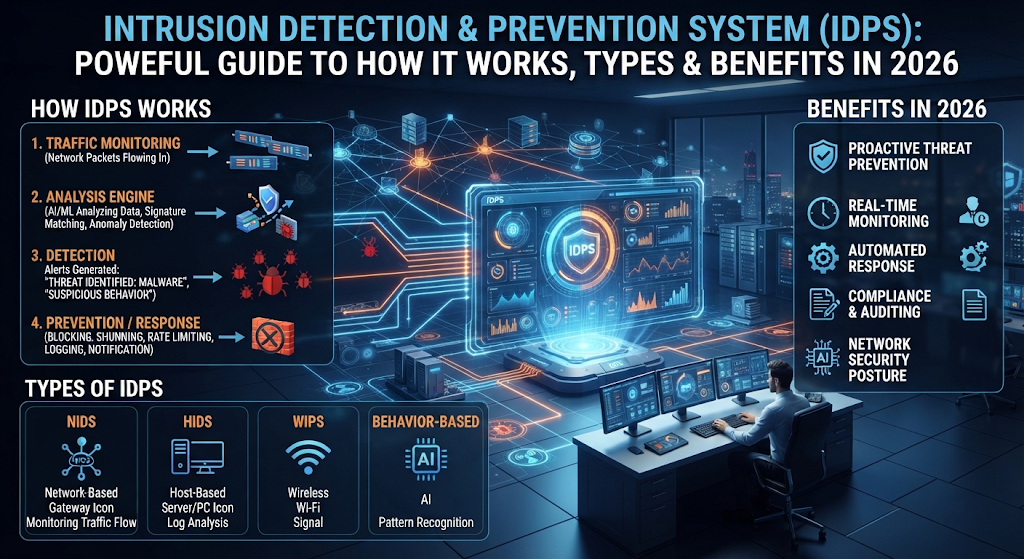
An Intrusion Detection and Prevention System (IDPS) helps security teams identify these warning signs. It monitors network or system activity, analyzes suspicious behavior, and can respond to certain threats automatically. This makes IDPS an important layer in modern cybersecurity and network security.
For organizations in the USA, the need is even greater as businesses rely on cloud services, remote workers, connected devices, web applications, and digital customer systems. A single exposed service can give attackers an entry point into a much larger environment.
This guide explains how IDPS works, how its different technologies operate, which attacks it can identify, where businesses use it, and how it compares with firewalls, antivirus software, and SIEM platforms.
Trusted External Sources
- NIST — Computer Security Resource Center: Intrusion Detection Systems
- NIST — Cybersecurity Framework: NIST Cybersecurity Framework
- CISA — Cybersecurity Resources: CISA Cybersecurity Resources
- IBM — Intrusion Detection and Prevention: IBM Security
What Is an Intrusion Detection and Prevention System (IDPS)?
An IDPS is a security solution that watches network or system activity for signs of attacks. It can identify suspicious network activity, generate security alerts, record important events, and sometimes block harmful connections before they reach their target.
The technology combines monitoring with analysis. Instead of simply checking whether a connection exists, an IDPS can examine communication patterns, packets, login behavior, protocols, and other signals. This helps organizations detect unauthorized access, malicious activity, and other security threats.
The “detection” part identifies activity that may represent an attack. The “prevention” part can take action when the system has enough confidence that activity violates a security rule or represents a known threat.
For example, imagine an employee’s account suddenly generates hundreds of login attempts against different internal systems. A properly configured IDPS may recognize that pattern as suspicious. It could alert the security team or trigger a predefined response.
How IDPS Differs From Basic Security Monitoring
Traditional security monitoring often involves collecting logs and reviewing them after something happens. An IDPS moves closer to real-time analysis by examining activity while communication or system events occur.
That distinction matters because speed can change the outcome of an attack. Detecting malicious traffic after a server has already been compromised isn’t as useful as identifying the attack while it’s unfolding.
| Security Function | Main Purpose |
| Network monitoring | Watches network activity |
| Intrusion detection | Identifies possible attacks |
| Intrusion prevention | Blocks or disrupts selected threats |
| Endpoint security | Protects individual devices |
| Firewall security | Controls permitted network connections |
| SIEM | Correlates security information from many sources |
An IDPS therefore shouldn’t be viewed as a replacement for every other security tool. It works best as part of layered cybersecurity protection.
How Does an IDPS Work?
An IDPS generally follows a cycle of collecting activity, inspecting it, analyzing the evidence, generating alerts, and responding when necessary. The exact architecture depends on the product and the environment where it operates.
A network deployment may observe traffic entering and leaving a network segment. A host-based deployment may instead monitor processes, files, system activity, and local connections on an individual server or computer.
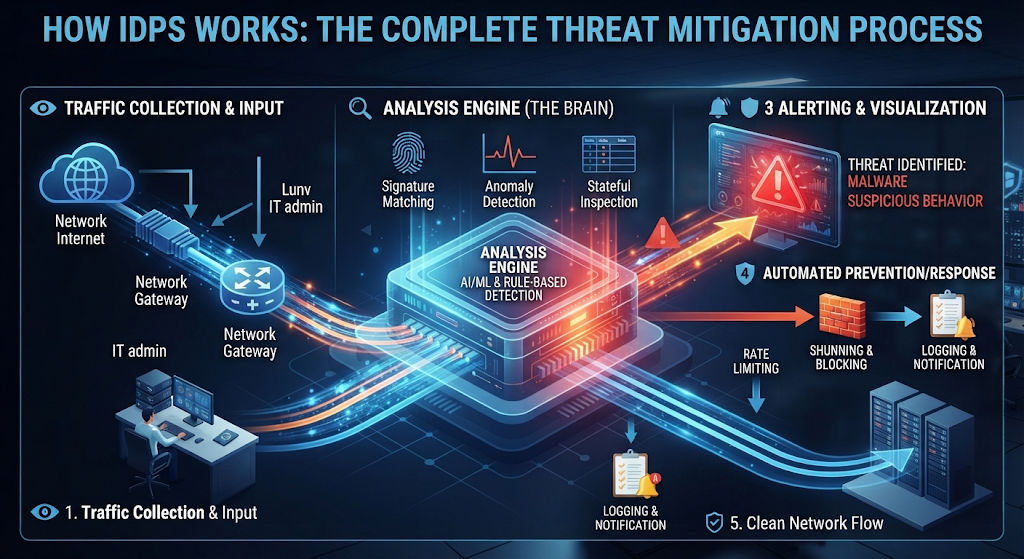
The first stage involves collecting useful information. The system may inspect packets, connections, protocols, addresses, ports, application behavior, authentication attempts, and other security events.
Next comes analysis. The IDPS compares observed activity against detection rules, known attack signatures, behavioral baselines, organizational policies, or intelligence about known malicious infrastructure.
If the activity appears suspicious, the system can create an alert. Depending on its configuration, it may also block traffic, terminate a connection, reset a session, quarantine an endpoint, or send information to another security platform.
A Simple IDPS Detection Flow
| Step | IDPS Activity | Example |
| 1 | Collect activity | Network packets enter a monitored segment |
| 2 | Inspect traffic | Ports, protocols, and packet contents are examined |
| 3 | Analyze behavior | Activity is compared with detection rules |
| 4 | Identify threat | Suspicious pattern matches an attack |
| 5 | Generate alert | Security team receives an alert |
| 6 | Respond | Traffic may be blocked or connection terminated |
| 7 | Record evidence | Security logs preserve investigation details |
The process becomes more powerful when the IDPS receives additional context from threat intelligence, endpoint tools, identity systems, and other security platforms.
What Is the Difference Between IDS and IPS?
The difference between IDS and IPS mainly comes down to what happens after suspicious activity is detected. An IDS focuses on identifying and reporting possible threats. An IPS can actively intervene to stop certain malicious activity.
An intrusion detection system usually works as a monitoring layer. It observes traffic and creates alerts when it identifies something suspicious. Security analysts can then investigate the event and decide what action to take.
An intrusion prevention system sits in a position where it can influence traffic. When its detection engine identifies a threat, it can apply a predefined response.
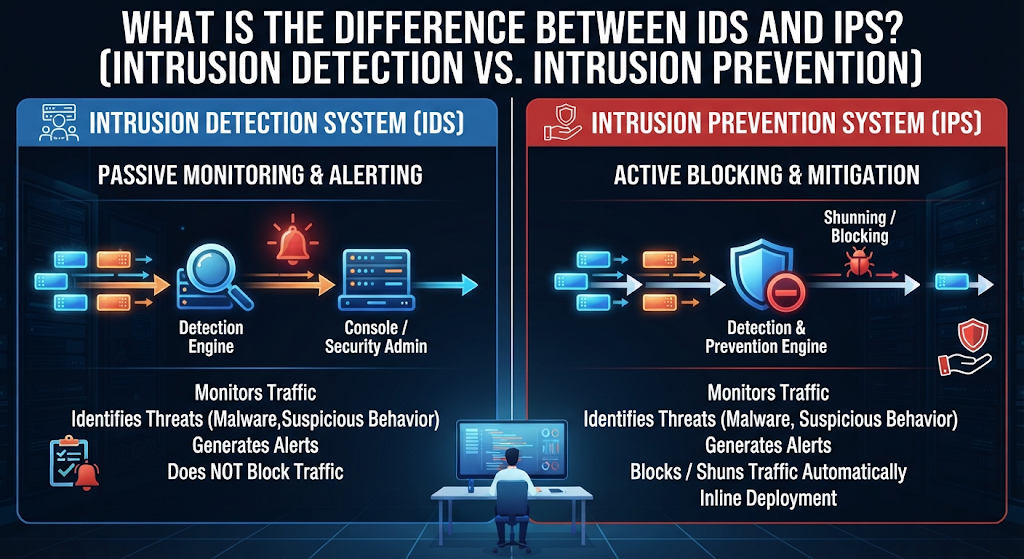
This creates an important distinction between IDS and IPS:
| Capability | IDS | IPS |
| Monitor traffic | Yes | Yes |
| Detect threats | Yes | Yes |
| Generate alerts | Yes | Yes |
| Block malicious traffic | Usually no | Yes |
| Terminate connections | Limited | Yes |
| Provide investigation data | Yes | Yes |
| Operate inline | Not normally required | Common |
Neither technology should automatically be considered superior. An IDS provides visibility with less risk of disrupting legitimate traffic. An IPS offers faster automated threat prevention, although poor configuration can sometimes block legitimate activity.
For many organizations, combining both capabilities provides a more balanced approach.
What Are the Main Types of IDPS?
IDPS technology isn’t one single product category. Different implementations monitor different parts of an environment. The four major approaches include network-based IDPS, host-based IDPS, wireless IDPS, and network behavior analysis.
Choosing the right type depends on what you need to protect. A company with sensitive servers may need host monitoring. A large enterprise may require network sensors across several locations.
Network-Based Intrusion Detection and Prevention Systems
A network-based IDPS monitors traffic moving across a network. It can inspect connections between users, servers, applications, and external services.
This technology is useful for identifying suspicious communication, scanning attempts, malicious payloads, and unusual traffic patterns. It can also support network intrusion detection and network intrusion prevention.
Network-based systems are often positioned at strategic points where they can observe important traffic flows without requiring software on every device.
Host-Based Intrusion Detection and Prevention Systems
A host-based IDPS operates directly on a computer, server, or other protected host. Instead of focusing mainly on network traffic, it examines activity happening inside the system.
It may monitor files, processes, system calls, configuration changes, login events, and local connections. This makes host-based monitoring useful for endpoint security and server protection.
For example, if an attacker modifies a sensitive system file after gaining access, a host-based system may detect the change even when network traffic looks normal.
Wireless Intrusion Detection and Prevention Systems
A wireless IDPS focuses on Wi-Fi environments. It can monitor wireless activity for unauthorized devices, rogue access points, suspicious connections, and unusual wireless behavior.
Wireless networks create security challenges that traditional wired monitoring may not fully cover. An attacker could attempt to create a fake access point that tricks users into connecting.
Wireless monitoring helps organizations discover these risks and improve overall network protection.
Network Behavior Analysis Systems
Network behavior analysis focuses on how systems communicate over time. Instead of relying only on known attack signatures, it looks for unusual relationships and traffic patterns.
For example, a workstation that suddenly begins communicating with many internal servers may deserve investigation. The behavior could indicate legitimate administration, software deployment, or potential lateral movement.
This approach can strengthen network traffic analysis and help identify threats that don’t closely match traditional signatures.
How Does IDPS Detect Cyber Threats?
An IDPS uses several techniques to decide whether activity looks dangerous. The strongest deployments don’t depend on a single detection method because attackers can change their tools, techniques, and traffic patterns.
The system may inspect network packets, compare traffic with known signatures, analyze behavioral changes, enforce security policies, and use external intelligence sources.
This process supports cyber threat detection by turning raw activity into meaningful security information. The system isn’t simply asking, “Is this packet allowed?” It can also ask, “Does this activity resemble an attack?”
Understanding Packet Inspection
Packet inspection examines information contained within network communication. Depending on the deployment and encryption, an IDPS may examine headers, protocols, addresses, ports, and sometimes payload information.
Packet inspection helps identify suspicious communication patterns. More advanced deep packet inspection can examine traffic at a deeper level when visibility and technical conditions allow it.
However, encrypted traffic creates an important challenge. If the IDPS cannot see useful content, it may need to rely more heavily on metadata, behavior, reputation, and other signals.
Why Traffic Context Matters
A single event rarely tells the complete story. A connection from an unfamiliar IP address might be harmless. Hundreds of connections combined with unusual authentication attempts create a different picture.
That’s why effective threat detection considers context. Time, frequency, destination, source, protocol, user identity, previous behavior, and threat intelligence can all affect the final assessment.
This contextual approach helps reduce unnecessary alerts while improving the chance of finding meaningful security incidents.
IDPS and Threat Intelligence
Threat intelligence can provide information about known malicious addresses, domains, files, attack techniques, and other indicators.
When an IDPS uses threat intelligence feeds, it gains additional context about activity occurring inside the environment. A connection that initially looks unusual may become much more concerning when its destination is associated with known malicious infrastructure.
However, intelligence isn’t perfect. Indicators can become outdated, attackers can change infrastructure, and legitimate services may sometimes be misclassified.
Intrusion Detection and Prevention System (IDPS): How It Works, Types & Benefits in 2026
What Is an Intrusion Detection and Prevention System (IDPS)?
An Intrusion Detection and Prevention System (IDPS) is a network security technology that watches network traffic, devices, and system activity for possible attacks. It combines an intrusion detection system with an intrusion prevention system. The goal is simple: identify dangerous activity quickly and stop it before it causes serious damage.
Unlike basic security monitoring tools, an IDPS can inspect traffic patterns and compare activity against known threats. Depending on its configuration, it can generate security alerts, block malicious connections, reset suspicious sessions, or notify a security team. This makes IDPS security an important layer of modern cybersecurity protection.
For example, imagine a company network as a building with hundreds of doors. A firewall controls which doors people can enter. An IDPS watches what happens after someone gets inside. If unusual behavior appears, it can raise an alarm or take action automatically.
How Does an IDPS Work?
An IDPS usually follows a continuous process involving traffic collection, inspection, detection, alerting, and prevention. Sensors collect network packets or host activity. The system then performs packet inspection, traffic analysis, and rule-based or behavioral analysis to identify potential security threats.
When the system discovers suspicious behavior, it creates an event or alert. A prevention-enabled system can then block traffic, terminate a connection, quarantine activity, or apply another configured response. This creates a complete cycle of threat detection and threat prevention.
Basic IDPS Workflow
| Stage | What Happens |
| Traffic collection | Network or host activity enters the monitoring system |
| Inspection | Packets and events are examined |
| Analysis | Detection engines compare activity with security rules |
| Identification | Possible attacks or abnormal behavior are identified |
| Alerting | Security teams receive relevant security alerts |
| Prevention | Malicious activity may be blocked automatically |
| Logging | Events are stored in security logs |
| Response | Analysts investigate and handle the incident |
The effectiveness of an IDPS depends heavily on configuration. Poor rules can create too many false positives. Weak detection coverage can create false negatives, allowing genuine attacks to pass unnoticed.
What Is the Difference Between IDS and IPS?
The biggest difference in IDS and IPS technology is how each system responds to detected threats. An IDS primarily monitors activity and alerts security teams. An IPS goes further by taking action against suspicious or malicious traffic.
This distinction matters when comparing IDS vs IPS for a business network. An IDS can provide valuable visibility without directly interfering with traffic. An IPS can provide automated threat prevention when rapid action matters.
| Feature | IDS | IPS |
| Monitoring | Yes | Yes |
| Threat detection | Yes | Yes |
| Security alerts | Yes | Yes |
| Automatic blocking | Usually no | Yes |
| Traffic inspection | Yes | Yes |
| Incident visibility | High | High |
| Main purpose | Detection | Detection and prevention |
In practice, many modern security platforms combine both capabilities. That is why organizations often use the broader term IDPS security when discussing detection and prevention together.
What Are the Main Types of IDPS?
Different environments require different monitoring approaches. A company protecting office networks may need a network-based IDPS, while a server-heavy environment may need a host-based IDPS.
Choosing the right architecture depends on where attacks are likely to appear. Network traffic, endpoints, wireless connections, cloud workloads, and unusual communication patterns can all require different forms of cyber threat detection.
Network-Based Intrusion Detection and Prevention Systems
A network-based IDPS monitors traffic moving across networks. It can inspect packets flowing between users, servers, applications, and external systems. This approach is useful for identifying network intrusion detection events before they spread across multiple systems.
Network-based systems commonly use traffic analysis and deep packet inspection to identify suspicious patterns. They can detect scanning, exploit attempts, unusual connections, and other forms of malicious traffic.
Host-Based Intrusion Detection and Prevention Systems
A host-based IDPS operates directly on individual computers, servers, or other endpoints. It monitors activities such as file changes, login attempts, processes, system calls, and configuration modifications.
This approach strengthens endpoint security because it can see events that network monitoring might miss. For example, an attacker could compromise a server through an encrypted connection. Host-level monitoring may still notice unusual file or process activity.
Wireless Intrusion Detection and Prevention Systems
A wireless IDPS focuses on Wi-Fi networks and wireless devices. It can identify unauthorized access points, suspicious wireless connections, rogue devices, and unusual radio activity.
This matters because wireless networks create a different attack surface. A properly configured wireless monitoring system can strengthen network visibility and reduce risks caused by unauthorized wireless infrastructure.
Network Behavior Analysis Systems
Network behavior analysis focuses on understanding how network activity normally behaves. Instead of looking only for known attack signatures, it can identify unusual communication patterns.
For example, a workstation that suddenly communicates with dozens of unfamiliar external servers may deserve investigation. This approach can be especially valuable when dealing with unfamiliar or emerging zero-day threats.
How Does IDPS Detect Cyber Threats?
Modern IDPS platforms use several detection techniques to recognize cyber threats. Some techniques look for known attack patterns. Others study normal behavior and identify activity that suddenly looks unusual.
A strong detection strategy usually combines multiple approaches. This gives organizations broader visibility across known malware, suspicious behavior, policy violations, and unusual network activity.
What Detection Methods Does an IDPS Use?
The detection engine determines how an IDPS decides whether activity deserves attention. Different methods have different strengths. Combining them can improve attack detection while reducing unnecessary alerts.
The four common approaches are signature-based detection, anomaly-based detection, policy-based detection, and behavior-based detection. Each method examines activity from a slightly different angle.
Signature-Based Detection
Signature-based detection compares network activity against known patterns linked to attacks. Security vendors regularly update these signatures as new threats become known.
This method works well against established attacks. However, it may struggle with new threats that don’t match an existing signature. That limitation makes additional detection methods important.
Anomaly-Based Detection
Anomaly-based detection establishes a baseline for normal activity. It then looks for significant deviations from that baseline.
For example, a user normally downloads small files during business hours. A sudden transfer of hundreds of gigabytes could trigger investigation. This approach can help identify previously unknown attack patterns.
Policy-Based Detection
Policy-based detection checks activity against predefined organizational rules. These rules can define what systems, users, applications, or connections are allowed to do.
For instance, a company may restrict administrative access to specific systems. If someone attempts to bypass that restriction, the IDPS can create a security event or trigger a response.
Behavioral Detection
Behavior-based detection examines patterns of activity rather than relying only on fixed signatures. It can evaluate how users, devices, applications, or connections behave over time.
This approach can support modern real-time threat detection, especially when attackers change tactics quickly. However, behavioral systems need careful tuning to avoid unnecessary alerts.
What Are the Benefits of Using an IDPS?
An IDPS gives organizations another defensive layer between normal activity and serious security incidents. It can improve security monitoring, identify suspicious behavior, and support faster incident response.
The biggest advantage is visibility. Without strong monitoring, an attack may continue quietly for hours or days. With an IDPS, suspicious activity can generate alerts that help security teams investigate earlier.
Another advantage is automated response. An IPS can block selected traffic based on configured rules. This reduces the time between detection and action, which can be crucial during fast-moving attacks.
IDPS vs Firewall: What’s the Difference?
The IDPS vs firewall comparison is important because both technologies protect networks but perform different jobs. A firewall primarily controls network access according to rules. An IDPS focuses more heavily on detecting suspicious activity and potential attacks.
Think of firewall security as controlling who can enter a building. An IDPS watches behavior inside and around that building. Using both technologies creates stronger network protection than relying on either one alone.
| Technology | Main Role | Typical Function |
| Firewall | Access control | Allows or blocks connections |
| IDS | Detection | Identifies suspicious activity |
| IPS | Prevention | Detects and blocks threats |
| IDPS | Detection + prevention | Monitors and responds to attacks |
A firewall can block traffic from a prohibited address. An IDPS may identify a more complex attack hidden inside otherwise permitted traffic.
IDPS vs Antivirus: How Are They Different?
The IDPS vs antivirus difference mainly comes down to where and how each technology monitors threats. Antivirus software primarily protects individual devices against malicious files, programs, and related threats.
An IDPS focuses more on network activity, host events, and attack patterns. Both can support malware detection, yet they address different parts of the security environment.
For strong cybersecurity, organizations shouldn’t treat these technologies as interchangeable. Antivirus strengthens endpoint defenses. IDPS strengthens intrusion monitoring and network-level visibility.
What Types of Attacks Can an IDPS Detect and Prevent?
An IDPS can identify many forms of suspicious activity. Its exact capabilities depend on the product, detection engines, configuration, traffic visibility, and available threat intelligence.
Modern systems can help with cyber attack detection, suspicious connections, exploit attempts, scanning activity, and other network threats. Prevention capabilities depend on the specific deployment.
Malware Attacks
An IDPS can detect network patterns associated with malware communication. This may include unusual outbound connections, command-and-control behavior, suspicious payloads, or known malicious signatures.
However, IDPS shouldn’t replace endpoint protection. Combining network monitoring with endpoint controls gives security teams stronger coverage.
Brute-Force Attacks
Brute-force attack detection identifies repeated login attempts that may indicate password guessing. An IDPS can monitor repeated authentication failures across visible network services.
For example, hundreds of login attempts against one account within a short period may indicate automated password attacks. Security teams can then investigate or block the source.
Port Scanning
Port scanning detection identifies attempts to discover open network services. Attackers often scan systems before launching more targeted attacks.
Early detection can provide useful warning. A security team may investigate the source before the attacker finds a vulnerable service.
Denial-of-Service Attacks
DoS attack detection looks for traffic patterns designed to overwhelm systems or services. Some IDPS platforms can also support broader DDoS protection strategies.
However, large-scale distributed attacks often require specialized DDoS mitigation services. An IDPS can still contribute valuable detection and response data.
Exploit Attempts
Exploit detection looks for traffic that appears designed to abuse software vulnerabilities. These attacks may target web applications, operating systems, databases, network services, or other technologies.
Strong vulnerability management should work alongside detection. An organization shouldn’t wait for an exploit attempt before fixing known weaknesses.
Suspicious Network Activity
Suspicious network activity can include unusual connections, unexpected data transfers, abnormal protocols, or communication with known malicious infrastructure.
This broader monitoring role makes IDPS useful for identifying activity that doesn’t fit ordinary network behavior.
Why Is IDPS Important for Network Security?
Modern networks are complicated ecosystems. Employees use laptops, smartphones, cloud applications, remote connections, and third-party services every day. That creates more opportunities for attackers to hide.
An IDPS provides another layer of network security by continuously examining activity. It can connect suspicious patterns with known security events and help teams prioritize potential incidents.
The value becomes even clearer when attackers move laterally after gaining access. Detecting unusual internal communication can help reveal activity that traditional perimeter defenses might overlook.
How Does IDPS Help Protect Businesses?
For businesses, an IDPS can strengthen enterprise network security by improving visibility across important systems. It can help security teams understand where suspicious traffic originates and which systems may be affected.
A practical example is a company with hundreds of employees. One compromised workstation begins communicating with an unfamiliar external server. Network monitoring may detect the unusual connection. Host monitoring may then reveal suspicious processes on that workstation.
“Visibility is the starting point for effective security.”
The system doesn’t eliminate every risk. Instead, it gives security teams better information and faster opportunities to respond.
Where Is an IDPS Used?
IDPS technology can operate across many environments. Its architecture changes depending on network size, traffic volume, regulatory requirements, and security objectives.
Modern organizations can deploy detection capabilities across office networks, endpoints, cloud workloads, and critical infrastructure. The right design depends on where valuable systems and sensitive information reside.
Small Businesses
Small businesses can use IDPS to improve protection without building a massive security operation. A managed security service can also help smaller teams handle alerts and monitoring.
This can be useful when a business has limited cybersecurity staff but still needs visibility into suspicious activity.
Enterprise Networks
Large organizations often have complex environments with thousands of users and devices. Enterprise deployments can combine multiple sensors with centralized security analytics.
This creates broader visibility across enterprise network security operations. It can also support SIEM integration for centralized investigation.
Cloud Environments
Cloud workloads introduce different monitoring challenges. Traditional network boundaries may not provide enough visibility into modern application traffic.
Cloud-focused IDPS capabilities can strengthen cloud security by monitoring workloads, connections, and suspicious behavior within cloud environments.
Data Centers
Data centers contain critical servers and applications. A strong monitoring architecture can help protect these systems from internal and external threats.
Data center security often combines IDPS technology with firewalls, access controls, endpoint protection, vulnerability management, and centralized logging.
What Are the Limitations of an IDPS?
Despite its advantages, an IDPS isn’t a magic shield. Poor configuration can create excessive false positives, while incomplete detection coverage can produce false negatives.
Encrypted traffic can also reduce visibility. If the system cannot inspect important traffic safely, some threats may remain hidden. High-volume networks can create another challenge because analyzing huge traffic streams requires substantial processing capacity.
Maintenance matters too. Detection rules, signatures, policies, and threat intelligence need regular updates. Without proper tuning, even a sophisticated system can become noisy or less useful.
How to Choose the Right IDPS Solution
Choosing an IDPS requires more than comparing product features. You should first understand your network architecture, critical assets, traffic patterns, cloud usage, compliance needs, and security team capabilities.
Integration is equally important. Look for support for security logs, threat intelligence, centralized monitoring, and security information and event management platforms.
| Selection Factor | Why It Matters |
| Detection accuracy | Reduces missed threats |
| False-positive control | Keeps alerts manageable |
| Traffic visibility | Improves detection coverage |
| Cloud support | Helps protect modern workloads |
| SIEM integration | Centralizes investigation |
| Scalability | Supports network growth |
| Automation | Speeds up response |
| Reporting | Helps security teams analyze events |
The best system isn’t necessarily the most expensive one. It should match the organization’s actual risk profile and operational capacity.
IDPS Best Practices for Better Cybersecurity
Effective IDPS deployment starts with sensible configuration. Security teams should define clear security policies, tune detection rules, update signatures, and review alerts regularly.
Placement also matters. Sensors should monitor areas where meaningful traffic passes. Organizations should combine IDPS with access control, endpoint protection, vulnerability management, and strong authentication.
Regular testing is another important practice. Security teams should verify that detection rules actually trigger when expected. Otherwise, a system may appear healthy while important threats remain invisible.
Can AI Improve Intrusion Detection and Prevention?
Artificial intelligence can improve threat detection by analyzing large volumes of network and security data. Machine learning models can identify patterns that traditional rules may overlook.
AI can also help prioritize alerts. Instead of treating every unusual event equally, intelligent systems can consider context, historical behavior, device risk, and other signals.
However, AI isn’t automatically accurate. Poor training data or weak configuration can produce misleading results. Human analysis remains important for high-impact security decisions.
What Is the Future of IDPS in 2026 and Beyond?
In 2026, IDPS technology is increasingly connected with broader security platforms. Organizations want detection systems that can understand network activity alongside endpoint events, identity signals, cloud activity, and threat intelligence.
The future will likely emphasize behavioral analytics, automation, encrypted-traffic visibility, AI-assisted detection, and deeper SIEM integration. Security teams also need faster response because attackers can automate their own operations.
A modern IDPS therefore shouldn’t operate as an isolated appliance. It works best as part of a larger security operations center where analysts can combine alerts, context, investigation, and response.
Frequently Asked Questions About IDPS
Is IDPS the same as IDS?
Not exactly. An IDS mainly focuses on detection and alerting. An IDPS combines detection with prevention capabilities, allowing the system to respond to certain threats automatically.
Is IPS better than IDS?
Neither is universally better. An IDS provides visibility without directly blocking traffic. An IPS adds prevention capabilities. The right choice depends on the organization’s risk, network architecture, and operational requirements.
Can IDPS replace a firewall?
No. An IDPS and firewall perform different security functions. A firewall controls network access while an IDPS focuses on detecting and preventing suspicious activity. Using both creates stronger layered protection.
Does IDPS protect against malware?
Yes, an IDPS can contribute to malware detection by identifying malicious traffic and known attack patterns. However, endpoint security and antivirus tools remain important for detecting malware directly on devices.
Is IDPS useful for small businesses?
Yes. Small businesses can use IDPS to improve network visibility and identify suspicious activity. Managed security services can also reduce the burden of monitoring and responding to alerts.
How does IDPS detect suspicious activity?
IDPS platforms can use signatures, behavioral analysis, anomaly detection, policies, traffic inspection, and threat intelligence. Combining several techniques can improve detection across different attack types.
What is the difference between IDPS and SIEM?
An IDPS detects and may prevent suspicious activity. A SIEM, or security information and event management platform, collects and analyzes security data from many sources.
How Does IDPS Work With Threat Intelligence?
Threat intelligence gives an intrusion prevention system more context about suspicious activity. Instead of examining traffic alone, an IDPS can compare IP addresses, domains, file patterns, and other indicators against trusted threat intelligence feeds. This helps improve cyber threat detection and identify known malicious infrastructure faster.
For example, if a device suddenly connects with an IP address associated with malware campaigns, the IDPS can raise a higher-priority security alert. When threat intelligence works alongside behavioral analysis, organizations can detect both known attacks and unusual activity.
Why Is Real-Time Monitoring Important?
Real-time monitoring matters because attackers rarely wait for convenient business hours. A compromised account can begin downloading sensitive data within minutes. Continuous security monitoring helps organizations notice suspicious changes while an incident is still developing.
Modern IDPS platforms can examine network flows, authentication events, connection attempts, and other signals. This creates a faster path from security incident detection to incident response. The sooner a threat becomes visible, the more options a security team has.
How Does Deep Packet Inspection Support IDPS?
Deep packet inspection allows security systems to examine packet contents and metadata more closely than basic traffic filtering. This can reveal patterns associated with exploits, malware communication, unauthorized protocols, and suspicious applications.
However, encrypted traffic creates a major visibility challenge. Organizations must design inspection carefully because decrypting traffic can introduce privacy, performance, and compliance considerations. Effective network traffic analysis therefore requires both technical capability and sensible security policies.
What Are False Positives and False Negatives in IDPS?
Detection accuracy is one of the biggest practical challenges in IDPS deployment. A false positive occurs when legitimate activity triggers an alert. A false negative occurs when genuine malicious activity goes undetected.
Too many false positives can overwhelm analysts. Too many false negatives can allow attacks to continue unnoticed. Good IDPS tuning aims for a useful balance by combining signatures, behavioral analysis, policies, threat intelligence, and environmental context.
| Detection Result | Meaning | Business Impact |
| True positive | Genuine threat detected | Requires investigation or response |
| False positive | Normal activity flagged | Creates unnecessary workload |
| True negative | Normal activity allowed | Desired normal behavior |
| False negative | Threat missed | Can create serious security risk |
How Does IDPS Support a Security Operations Center?
A security operations center needs reliable information to investigate threats efficiently. IDPS can provide network events, suspicious connections, attack indicators, and response actions that analysts can correlate with other security data.
With SOC security operations, analysts can combine IDPS alerts with endpoint events, identity activity, application logs, and cloud signals. This broader view helps determine whether an alert represents an isolated event or part of a larger attack.
How Does SIEM Integration Improve IDPS?
SIEM integration connects IDPS data with a centralized security platform. Instead of checking individual consoles, analysts can search and correlate events from multiple systems in one environment.
For example, an IDPS may detect unusual traffic from a workstation. The SIEM can correlate that event with a suspicious login and an endpoint alert. Together, these signals may reveal a compromised account or device that one tool alone couldn’t explain.
Can IDPS Detect Zero-Day Attacks?
Detecting zero-day threats is difficult because traditional signature-based systems may not have a known pattern to match. However, anomaly and behavioral techniques can identify activity that looks dangerous even without an existing signature.
This doesn’t guarantee zero-day protection. Instead, it adds another layer of defense. Strong vulnerability detection, network segmentation, endpoint security, access controls, and threat intelligence should work together.
IDPS and Network Segmentation
Network segmentation can limit how far an attacker moves after gaining access. An IDPS can monitor traffic between segmented environments and identify unexpected communication attempts.
Consider a company that separates finance systems from employee workstations. If an ordinary workstation suddenly attempts connections to restricted financial servers, the event may indicate unauthorized access or lateral movement. Detection becomes more valuable when network architecture already limits unnecessary communication.
IDPS for Remote Workers
Remote work has expanded the number of connections entering modern business environments. Employees may access company resources from home networks, public Wi-Fi, personal devices, and cloud services.
An IDPS can strengthen network protection by monitoring traffic that reaches protected infrastructure. However, remote environments require additional controls such as secure authentication, endpoint protection, encrypted connections, and appropriate access policies.
IDPS for Cloud Security
Cloud environments change how organizations think about network boundaries. Applications may communicate across virtual networks, containers, APIs, and managed services rather than traditional office infrastructure.
Cloud-aware IDPS technology can support cloud security by monitoring relevant workloads and traffic patterns. Visibility becomes especially important when applications scale dynamically and infrastructure changes frequently.
IDPS vs SIEM vs Firewall
These technologies often work together rather than compete. A firewall controls access. An IDPS detects and can prevent suspicious activity. A SIEM collects and correlates security information from many sources.
| Technology | Primary Purpose | Main Strength |
| Firewall | Access control | Controls permitted connections |
| IDPS | Detection and prevention | Identifies and blocks threats |
| SIEM | Security analysis | Correlates security events |
| Antivirus | Endpoint protection | Detects malicious software |
A layered approach provides stronger cybersecurity protection because each technology sees a different part of the environment.
Final Takeaway: Why IDPS Matters in Modern Cybersecurity
Modern attacks can move quickly across networks, endpoints, cloud workloads, and user accounts. An IDPS provides an important defensive layer by combining intrusion monitoring, detection, alerting, and automated response.
The strongest results come from integration rather than isolation. When IDPS works with firewalls, endpoint security, SIEM platforms, access control, vulnerability management, and threat intelligence, organizations gain a more complete view of security threats and can respond before a small intrusion becomes a major incident.
Meta Description
Intrusion Detection and Prevention System (IDPS) explained in simple terms. Learn how IDPS works, its types, detection methods, benefits, attacks, and future trends in 2026.
Strong Internal Information
| Related Article | Seen now |
|---|---|
| AI-Powered Cybersecurity | EXPLORE NOW↗️ |
| AI Cybersecurity Threats | EXPLORE NOW↗️ |
| Network Security | EXPLORE NOW↗️ |
| Firewall Security | EXPLORE NOW↗️ |
| Network Firewall vs Host-Based Firewall | EXPLORE NOW↗️ |
| Web Application Firewall | EXPLORE NOW↗️ |
| Hardware Firewall vs Software Firewall | EXPLORE NOW↗️ |
| Firewall vs Antivirus | EXPLORE NOW↗️ |
| Identity and Access Management | EXPLORE NOW↗️ |
| Zero Trust Security | EXPLORE NOW↗️ |
| Data Classification in Cybersecurity | EXPLORE NOW↗️ |
| Data Classification Methods | EXPLORE NOW↗️ |
| Data Encryption | EXPLORE NOW↗️ |
2 Comments