

Cloud technology has changed the way businesses build and run applications. Today, companies want faster development, lower costs, and better performance without spending time managing servers. That’s why Serverless Computing has become one of the fastest-growing cloud technologies in 2026. From startups to global enterprises, organizations now rely on Cloud Services that automatically manage infrastructure while developers focus on writing quality code.
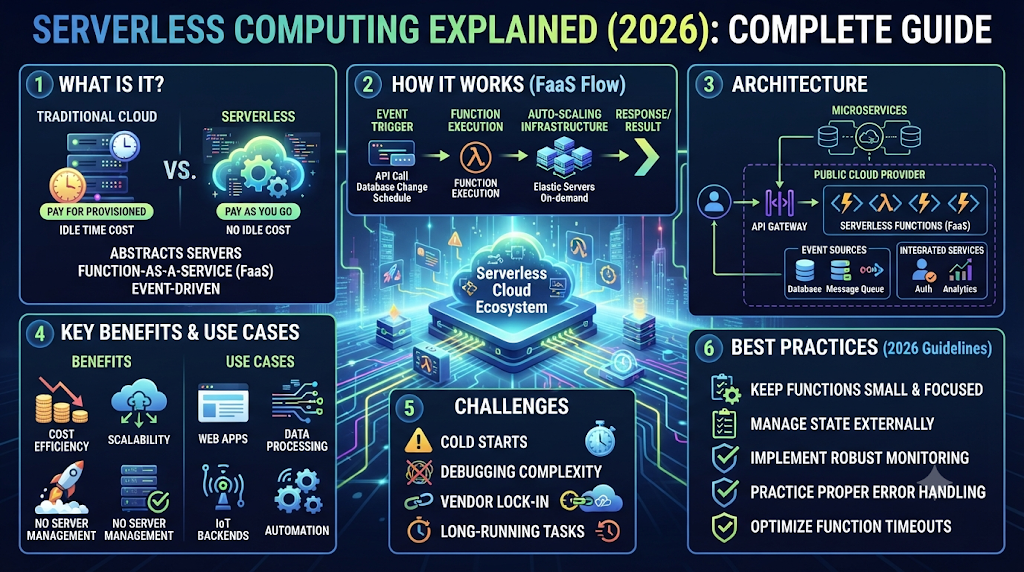
If you’ve ever wondered What is Serverless Computing, you’re in the right place. This guide explains everything in simple English. You’ll learn How Serverless Computing Works, why businesses prefer it, how it compares with traditional cloud solutions, and when you should use it. Whether you’re a beginner, developer, student, or business owner, this article will help you understand Serverless Computing from the ground up.
What Is Serverless Computing?
Simple Definition of Serverless Computing
Many people think Serverless Computing means there are no servers. That isn’t true. Servers still exist, yet you never have to manage them yourself. The cloud provider handles the hardware, operating system, updates, and maintenance. You simply upload your code, and the platform runs it whenever needed. This approach makes Serverless Development faster while reducing the need for Managed Infrastructure.
You only pay when your code runs. This pricing model makes Pay-As-You-Go Pricing attractive for businesses that want to reduce waste. Instead of keeping expensive servers running all day, applications consume Cloud Resources only when users trigger an action. As a result, companies improve efficiency while lowering operational costs.
Why Is It Called Serverless?
The word “serverless” often creates confusion because every application still runs on physical servers somewhere. The difference is simple. You don’t install, configure, patch, or monitor those servers. Your cloud provider performs every infrastructure task behind the scenes. This creates a highly automated Cloud Platform where developers focus entirely on building features instead of maintaining hardware.
Think about electricity in your home. You switch on a light without worrying about power stations or transmission lines. Serverless Computing works in a similar way. Developers use computing power whenever needed while the cloud provider manages the complex infrastructure automatically through advanced Cloud Infrastructure services.
Who Manages the Servers?
Major cloud providers such as AWS Lambda, Microsoft Azure Functions, and Google Cloud Functions manage servers for you. They automatically prepare computing resources, monitor system health, replace failed hardware, and install updates. This allows developers to spend more time creating valuable applications instead of handling routine maintenance.
The provider also improves Cloud Infrastructure Management by balancing workloads across multiple data centers. If demand suddenly increases, additional computing resources become available automatically. This intelligent resource allocation improves reliability and keeps applications running smoothly without manual intervention.
How Serverless Computing Differs from Traditional Hosting
Traditional hosting requires businesses to purchase virtual machines or dedicated servers before deploying applications. Teams must estimate future traffic, configure operating systems, install security updates, and monitor server performance continuously. These responsibilities consume valuable time and increase operational costs.
In contrast, Serverless Computing removes nearly all infrastructure management tasks. Applications automatically receive the resources they need through Automatic Scaling. Developers simply upload functions while the provider handles deployment, maintenance, scaling, and availability. This modern approach delivers greater flexibility with significantly less administrative work.
How Does Serverless Computing Work?
Event-Driven Execution
The foundation of Serverless Computing is Event-Driven Computing. Instead of running continuously, your application waits for an event before executing code. An event may occur when someone uploads a file, submits a form, clicks a button, or sends an API request. These actions instantly trigger Cloud Functions that perform the required task.
Because functions only execute after receiving an event, businesses avoid paying for idle computing time. This model improves efficiency and allows applications to respond quickly to changing workloads. Developers can build responsive systems without worrying about server capacity or infrastructure management.
Automatic Resource Allocation
One of the biggest strengths of Serverless Computing is automatic resource management. The platform detects workload changes in real time and allocates computing power whenever necessary. Developers never need to predict future traffic or manually increase server capacity during busy periods.
This intelligent Cloud Scalability helps businesses maintain excellent performance during unexpected traffic spikes. Whether ten users or ten million users access an application, the platform automatically provides sufficient computing resources. This level of Cloud Automation improves reliability while reducing operational complexity.
Function Execution Process
Every application contains small pieces of code called functions. These functions perform one specific task, such as sending an email, resizing an image, processing payments, or validating user information. This approach is known as Function as a Service, often shortened to FaaS.
Each Function Execution starts when an event activates it. The cloud platform prepares the environment, runs the code, returns the result, and then releases the resources. This efficient Cloud Execution model reduces costs because computing resources remain active only while the function is running.
Pay-Per-Use Billing Model
Unlike traditional hosting, Serverless Computing charges businesses only for actual usage. Companies pay based on the number of requests, execution time, and memory consumption. This pricing structure eliminates unnecessary spending on idle servers that remain active without processing useful work.
For startups and growing businesses, this flexible billing model supports better Cloud Cost Optimization. Organizations invest money only when applications generate value. As workloads grow, costs increase naturally alongside business demand, making financial planning much more predictable.
Why Is Serverless Computing Becoming So Popular?
Faster Application Development
Modern businesses compete by delivering new features quickly. Serverless Application Development allows developers to build and deploy applications much faster because they don’t spend time configuring servers or maintaining operating systems. This shorter development cycle helps companies respond to market changes with greater confidence.
Teams also benefit from reusable Microservices and modular application design. Instead of building one large application, developers create independent functions that work together. This approach improves collaboration, simplifies testing, and reduces deployment risks while accelerating innovation.
Reduced Infrastructure Management
Infrastructure management often consumes valuable engineering time. Teams must monitor servers, install updates, troubleshoot hardware failures, and plan future capacity. These repetitive tasks slow development and increase operational costs.
With Serverless Computing, providers handle Cloud Infrastructure, Cloud Deployment, monitoring, and maintenance automatically. Developers focus on solving business problems instead of managing servers. This shift increases productivity while allowing organizations to deliver better digital experiences faster.
Key Components of Serverless Computing
Function as a Service (FaaS)
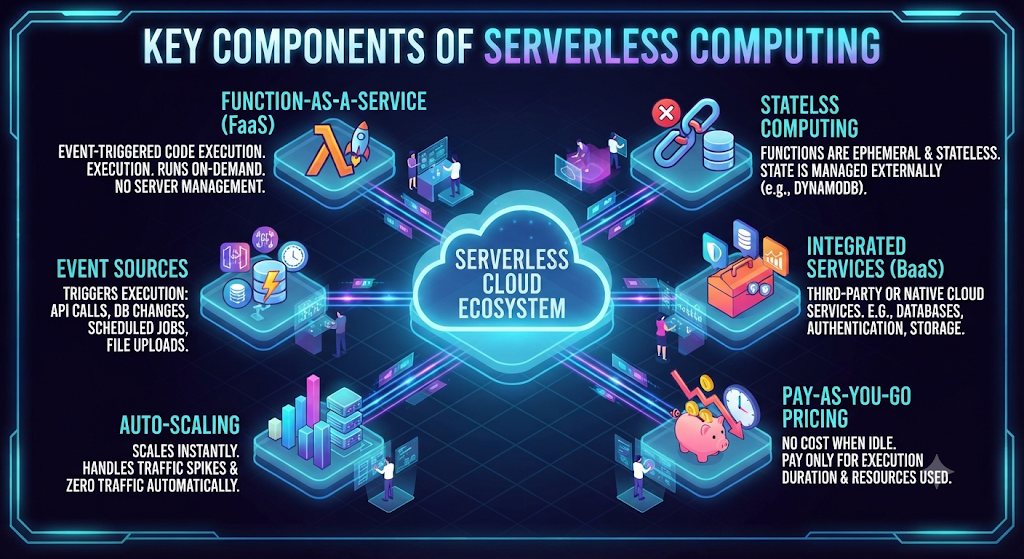
Function as a Service or FaaS is the foundation of Serverless Computing. It lets developers write small pieces of code that perform one task. Instead of running an entire application on a server, each function starts only when an event triggers it. This approach improves efficiency and supports modern Serverless Applications.
For example, an online store can use one function to process payments while another sends confirmation emails. Each function works independently. This design makes updates easier and reduces the risk of affecting the whole application. Many businesses use Cloud Functions to build reliable and scalable cloud solutions.
Backend as a Service (BaaS)
Backend as a Service (BaaS) provides ready-made backend features such as databases, user authentication, notifications, and cloud storage. Developers don’t need to build these services from scratch. Instead, they connect their applications to trusted cloud services that handle backend operations automatically.
This approach saves development time and improves productivity. It also supports faster Serverless Application Development because developers can focus on creating user-friendly features. Popular cloud providers combine Backend Services with serverless functions to build complete business applications.
API Gateway
An API Gateway acts as the main entrance for users and applications. It receives incoming requests and safely sends them to the correct serverless function. This process improves security, controls traffic, and ensures requests reach the right destination without unnecessary delays.
A modern Serverless API Gateway also handles authentication, request validation, and traffic management. Businesses can protect sensitive data while improving application performance. Because of these capabilities, the gateway plays an essential role in every Serverless Architecture.
Event Triggers
Every serverless function starts because of an event. These Event Triggers may include uploading a file, clicking a button, submitting an online form, making a payment, or receiving data from another application. Events activate functions only when they are required.
This model supports efficient Cloud Event Processing because computing resources remain inactive until work arrives. Instead of running continuously, applications react instantly to business events. As a result, companies reduce costs while improving response times.
Managed Cloud Services
Cloud providers supply databases, storage, monitoring, networking, and messaging services that work seamlessly with serverless applications. These Cloud Services remove the need to install or maintain supporting infrastructure. Everything operates through managed platforms.
Businesses also benefit from improved Cloud Resource Management because the provider automatically allocates computing resources when demand changes. This allows development teams to build complex applications without worrying about infrastructure maintenance.
Serverless Computing Architecture Explained
Client Applications
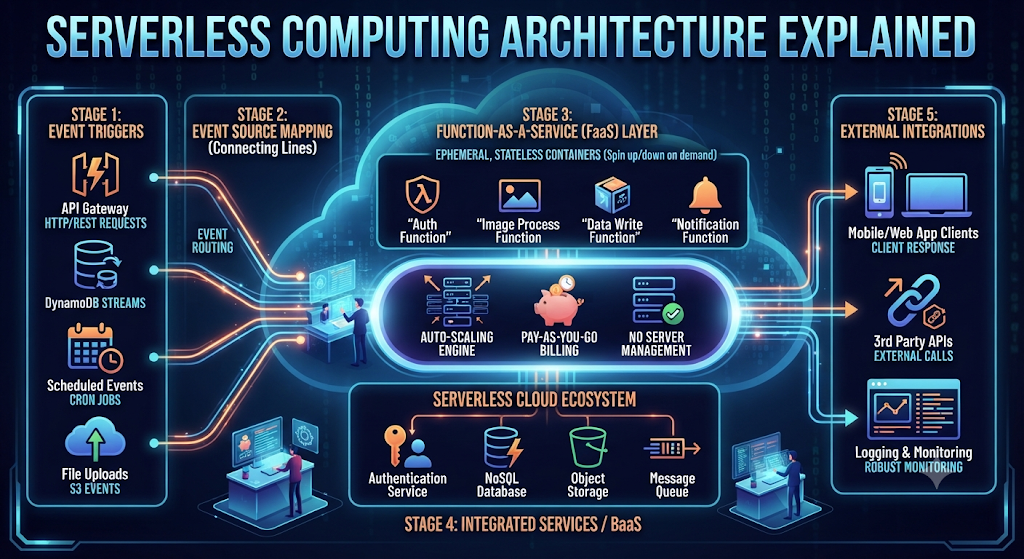
Every serverless application begins with a user. A customer may open a website, use a mobile app, or interact with an online service. These interfaces send requests to cloud services whenever users perform an action. The application remains responsive because only necessary resources are used.
Modern Cloud Applications often support millions of users simultaneously. Since Serverless Computing automatically manages infrastructure, businesses can deliver smooth experiences without investing in large server environments.
API Gateway Layer
The API Gateway receives every request before passing it to the correct function. It verifies permissions, routes traffic, and protects applications from unauthorized access. This gateway improves security while reducing unnecessary workloads on backend services.
Many organizations rely on a Serverless API because it simplifies communication between applications and cloud services. Developers can also monitor requests more efficiently through built-in logging and performance tools.
Cloud Functions
After passing through the gateway, the request activates one of the Cloud Functions. Each function performs a single task, completes the work, and then shuts down automatically. This process keeps applications lightweight and efficient.
Because each function remains independent, developers can update one feature without changing the rest of the application. This modular design improves Serverless Workflow while reducing maintenance complexity.
Event Sources
Events originate from many different systems. A database update, file upload, payment confirmation, IoT device, or scheduled timer can all trigger serverless functions automatically. These events keep applications responsive without requiring continuously running servers.
This Event-Based Computing model allows businesses to automate repetitive processes. Instead of checking systems repeatedly, applications respond immediately whenever new information becomes available.
Databases and Storage
Serverless applications often connect with cloud databases and storage services to save business information securely. Customer profiles, images, videos, documents, and transaction records remain available whenever functions need them.
These managed storage systems improve Cloud Performance because providers automatically replicate data, increase capacity, and maintain reliability. Businesses receive enterprise-level infrastructure without managing storage servers themselves.
Third-Party Integrations
Modern applications rarely work alone. They connect with payment gateways, email platforms, analytics tools, AI services, and customer relationship systems through secure APIs. Serverless functions make these integrations simple and highly scalable.
This flexibility helps organizations build advanced business solutions quickly. Developers spend less time creating integrations while improving overall Cloud Application Development and customer experience.
Main Benefits of Serverless Computing
Automatic Scaling
One of the biggest advantages of Serverless Computing is Auto Scaling. Applications automatically receive additional computing power whenever traffic increases. During quiet periods, unused resources disappear automatically. Businesses never need to estimate future demand manually.
This intelligent Automatic Scaling improves reliability while preventing unnecessary infrastructure expenses. Whether your application serves hundreds or millions of users, performance remains stable without manual intervention.
Cost Efficiency
Traditional hosting often requires businesses to pay for servers even when applications receive little traffic. Serverless platforms remove this problem by charging only for actual usage. Organizations spend money only when code executes successfully.
This flexible pricing model supports better Cloud Cost Optimization and improves budget planning. Small businesses especially benefit because they avoid large upfront investments in infrastructure.
Faster Deployment
Developers can publish new features much faster because they don’t configure operating systems or maintain virtual machines. They simply upload their functions, and the cloud platform handles deployment automatically.
This streamlined Serverless Development process shortens release cycles. Businesses respond more quickly to customer feedback while improving product quality through continuous updates.
Improved Developer Productivity
Without infrastructure responsibilities, developers spend more time writing valuable code. They concentrate on solving business challenges instead of installing software updates or replacing failed servers.
This increased productivity allows organizations to innovate faster. Teams can experiment with new ideas while maintaining reliable cloud applications that continue serving customers without interruption.
High Availability
Cloud providers distribute applications across multiple data centers. If one server experiences problems, another immediately handles incoming requests. This design improves uptime and reduces service interruptions.
Businesses gain dependable Cloud Platform reliability without purchasing backup hardware. Customers enjoy consistent access to services even during unexpected infrastructure failures.
Better Resource Utilization
Traditional servers often remain underused during normal business hours. Serverless platforms activate computing resources only when needed. This efficient allocation reduces waste and improves operational efficiency.
Better Cloud Resource Management also lowers energy consumption while helping organizations achieve sustainability goals. Companies receive excellent performance without maintaining unnecessary infrastructure.
Common Challenges of Serverless Computing
Cold Start Delays
A cold start happens when a serverless function hasn’t been used for some time. The cloud provider prepares the execution environment before running the function. This preparation may introduce a short delay for the first request.
Although providers continue improving startup speed, applications requiring instant responses should consider optimization techniques. Keeping functions lightweight helps reduce these delays significantly.
Vendor Lock-In
Many serverless applications rely heavily on services from a single cloud provider. Moving an application to another provider later may require code changes and additional testing.
Businesses should design applications carefully and use open standards whenever possible. This strategy reduces dependency while improving long-term flexibility.
Limited Execution Time
Every cloud provider defines a maximum execution time for serverless functions. Long-running tasks may stop automatically if they exceed these limits. Developers should divide complex workloads into smaller functions.
Breaking large processes into manageable steps improves reliability while supporting efficient Function Execution across multiple cloud services.
Monitoring and Debugging
Applications often contain hundreds of independent functions working together. Finding performance issues across many services can become challenging without proper monitoring tools.
Modern Cloud Monitoring platforms provide detailed logs, metrics, and alerts that help developers identify problems quickly. Continuous monitoring also improves application stability and customer satisfaction.
Security Considerations
Although providers secure the infrastructure, developers remain responsible for protecting application code, user data, and access permissions. Strong authentication and encryption remain essential for every cloud application.
Organizations should follow recognized Cloud Security best practices. Regular security reviews, identity management, and least-privilege access greatly reduce potential risks.
Serverless Computing vs Traditional Cloud Computing
Infrastructure Management
Traditional cloud environments require businesses to create virtual machines, install operating systems, configure networks, and monitor server health. These responsibilities demand skilled IT teams and ongoing maintenance. Even a small mistake can affect application performance and increase operational costs.
With Serverless Computing, the cloud provider manages the entire Cloud Infrastructure automatically. Developers simply upload code while the platform handles updates, scaling, security patches, and resource allocation. This modern approach reduces administrative work and allows teams to focus on innovation instead of Cloud Infrastructure Management.
Pricing Comparison
Traditional cloud hosting usually charges businesses for reserved servers regardless of actual usage. Even when traffic remains low, companies continue paying for running infrastructure. This model often leads to wasted resources and unnecessary expenses.
In contrast, Serverless Computing follows a Pay-As-You-Go Pricing model. You only pay when your functions execute. This flexible billing supports better Cloud Cost Optimization and helps startups, growing businesses, and enterprises control technology expenses more effectively.
Performance Differences
Traditional cloud servers stay active all the time, making them suitable for applications with constant workloads. However, businesses must manually increase server capacity whenever traffic grows. Incorrect planning can reduce performance during busy periods.
A Serverless Cloud Platform automatically adjusts computing resources based on incoming requests. This intelligent Cloud Scalability ensures applications continue performing well during traffic spikes without manual intervention. Businesses receive consistent performance while avoiding infrastructure bottlenecks.
Scalability Comparison
Scaling traditional servers often requires purchasing additional resources, configuring new virtual machines, and balancing workloads across multiple servers. These tasks consume valuable engineering time and may slow business growth.
Serverless platforms handle Automatic Scaling behind the scenes. Every request receives the resources it needs without manual configuration. This automation improves reliability while helping organizations serve thousands or even millions of users efficiently.
Best Use Cases
Traditional cloud computing works well for applications that require continuous processing, long-running workloads, or complete control over operating systems and networking. Large enterprise systems with specialized infrastructure requirements often benefit from this approach.
Serverless Computing performs best for APIs, web applications, automation tasks, image processing, background jobs, and event-driven services. Organizations looking for faster deployment and lower maintenance costs often choose serverless architecture.
Traditional Cloud vs Serverless Computing
| Feature | Traditional Cloud Computing | Serverless Computing |
| Server Management | Managed by developers | Managed by provider |
| Scaling | Manual or semi-automatic | Fully automatic |
| Pricing | Pay for reserved resources | Pay only when code runs |
| Maintenance | High | Very Low |
| Deployment Speed | Moderate | Very Fast |
| Infrastructure Setup | Required | Not Required |
| Best For | Long-running workloads | Event-driven applications |
Serverless Computing vs Containers
What Are Containers?
Containers package applications together with their libraries and dependencies so they run consistently across different environments. Popular technologies like Docker and Kubernetes make container deployment faster while improving software portability.
Containers give developers greater control over runtime environments. However, businesses still manage servers, networking, updates, and orchestration. These responsibilities increase operational complexity compared to Serverless Computing.
Key Differences
The biggest difference lies in infrastructure management. Container platforms require teams to manage clusters, operating systems, networking, and scaling policies. This provides flexibility but increases maintenance responsibilities.
A Serverless Architecture removes infrastructure management completely. Developers upload code while cloud providers manage execution environments, resource allocation, scaling, and availability automatically. This simplicity allows faster development and easier deployment.
Pros and Cons
Containers work well for applications requiring custom operating systems, long-running services, and consistent runtime environments. They provide greater flexibility and control, especially for enterprise software with complex requirements.
Serverless Computing excels when businesses need rapid deployment, automatic scaling, lower operational costs, and simplified maintenance. The trade-off includes execution limits and reduced control over underlying infrastructure.
Which Option Is Better?
Neither technology is universally better. The right choice depends on business goals, workload requirements, and development priorities. Many organizations even combine both approaches within the same cloud environment.
For modern web services, Cloud Native Applications, APIs, and automation tasks, Serverless Computing often delivers faster development with lower operational effort. Large enterprise systems may continue using containers for greater customization.
Serverless Computing vs Containers
| Feature | Serverless Computing | Containers |
| Infrastructure | Fully Managed | User Managed |
| Scaling | Automatic | Manual or Configured |
| Deployment | Very Fast | Fast |
| Maintenance | Minimal | Moderate |
| Startup Time | Possible Cold Start | Always Running |
| Best Choice | APIs, Automation, Events | Enterprise Applications |
Best Real-World Use Cases of Serverless Computing
Web Applications
Many modern websites use Serverless Computing to process contact forms, user registrations, product searches, and customer dashboards. Since functions execute only when users interact with the application, businesses reduce infrastructure costs while improving performance.
This approach also simplifies Serverless Hosting because developers no longer manage web servers. Cloud providers automatically allocate computing resources whenever website traffic increases.
Mobile Applications
Mobile apps constantly exchange information with cloud services. User authentication, profile updates, push notifications, and image uploads all benefit from serverless functions. These tasks execute quickly while requiring minimal infrastructure management.
Developers also improve Cloud Application Development by connecting mobile apps directly with cloud databases and authentication services. This reduces coding complexity while increasing development speed.
REST APIs
Businesses frequently build Serverless API solutions to support websites, mobile apps, and third-party integrations. Each API request activates a function that processes information before returning the correct response.
Because APIs experience changing traffic throughout the day, serverless platforms automatically adjust computing resources. This flexibility improves response times while reducing unnecessary infrastructure costs.
Chatbots
Modern AI chatbots depend on serverless functions to process conversations, retrieve customer information, and generate responses. Every message triggers cloud functions that complete individual tasks efficiently.
Businesses benefit from reduced infrastructure expenses because chatbot functions execute only when customers interact with them. This makes serverless technology ideal for customer support applications.
IoT Applications
Internet of Things devices continuously send temperature readings, sensor updates, and equipment information to cloud platforms. Event-Based Computing allows serverless functions to process this incoming data immediately after devices transmit it.
Factories, hospitals, transportation companies, and smart cities increasingly rely on this architecture to automate real-time monitoring while improving operational efficiency.
Image and Video Processing
Many businesses automatically resize images, convert video formats, generate thumbnails, and optimize media files using serverless functions. Each uploaded file immediately triggers processing without requiring permanently running servers.
This automated workflow improves customer experience while reducing hardware costs. It also supports efficient Cloud Function Execution across thousands of simultaneous uploads.
Data Processing Pipelines
Organizations process large volumes of business data every day. Serverless functions automatically validate records, transform information, and store results inside cloud databases without manual intervention.
This efficient Cloud Event Processing pipeline improves data accuracy while allowing businesses to analyze information much faster than traditional batch processing systems.
Real-Time Analytics
Companies increasingly depend on real-time dashboards to monitor website traffic, online sales, customer activity, and business performance. Serverless functions process events immediately after they occur.
Real-time analytics improve decision-making because managers receive updated information within seconds. This combination of Cloud Monitoring and serverless automation creates highly responsive business intelligence systems.
Top Serverless Platforms in 2026
AWS Lambda
AWS Lambda remains one of the world’s most widely adopted serverless platforms. It supports multiple programming languages, integrates with hundreds of AWS services, and automatically scales based on incoming requests.
Businesses choose AWS Lambda because of its reliability, security, global infrastructure, and mature developer ecosystem. It powers everything from simple automation tasks to enterprise-scale cloud applications.
Microsoft Azure Functions
Microsoft Azure Functions provides excellent integration with Microsoft services, including Azure Storage, SQL Database, Microsoft Entra ID, and Power Platform. Organizations already using Microsoft products often select Azure for seamless compatibility.
Its flexible pricing model, strong enterprise security, and advanced monitoring tools make Azure Functions a preferred choice for many large businesses.
Google Cloud Functions
Google Cloud Functions focuses on simplicity and event-driven application development. Developers deploy code quickly while integrating with Google’s AI, analytics, storage, and database services.
Businesses building data-driven applications appreciate Google’s strong machine learning ecosystem together with reliable global cloud infrastructure.
Cloudflare Workers
Cloudflare Workers execute code close to users through edge locations around the world. This reduces latency and improves website performance by processing requests before they reach centralized cloud servers.
Organizations use Cloudflare Workers to build fast APIs, website personalization, and security features that respond almost instantly to customer requests.
Vercel Functions
Vercel Functions are popular among frontend developers building modern React and Next.js applications. Deployment requires very little configuration while performance remains excellent for dynamic websites.
Startups especially value Vercel because developers can publish updates quickly without managing infrastructure or complicated deployment pipelines.
Netlify Functions
Netlify Functions simplify backend development for static websites and JAMstack applications. Developers create APIs, forms, and automation workflows without maintaining servers.
Its simple deployment process and developer-friendly tools make Netlify an attractive option for freelancers, agencies, and small businesses creating modern cloud applications.
Best Practices for Serverless Computing
Keep Functions Small
Successful Serverless Computing projects begin with small and focused functions. Every function should complete one task only. Smaller functions are easier to test, maintain, and update. They also reduce deployment risks because developers can improve one feature without changing the entire application.
This modular approach improves Serverless Workflow while making troubleshooting much easier. Businesses also benefit from better Cloud Performance because lightweight functions start faster and consume fewer computing resources.
Secure APIs Properly
Every Serverless API should include strong authentication and authorization. APIs often process sensitive business data, so protecting them from unauthorized access is essential. Developers should verify every request before allowing access to backend services.
Using encrypted connections, API keys, identity management, and role-based permissions strengthens Cloud Security. These security measures protect customer information while reducing the chances of cyberattacks.
Monitor Performance Continuously
Monitoring is an important part of every cloud application. Developers should track execution time, memory usage, request volume, and error rates to identify issues before users notice them. Continuous monitoring improves application reliability.
Modern Cloud Monitoring tools also generate alerts whenever unusual activity appears. This allows development teams to respond quickly and maintain excellent service quality without unnecessary downtime.
Optimize Function Execution
Efficient Function Execution reduces operating costs and improves user experience. Developers should remove unnecessary code, minimize dependencies, and keep execution time as short as possible. Faster functions also lower cloud expenses.
Optimized Cloud Function Execution improves response speed during busy periods. It also helps applications scale more efficiently when thousands of requests arrive at the same time.
Reduce Cold Starts
Cold starts are normal in serverless environments, but developers can reduce their impact. Keeping deployment packages small, using lightweight libraries, and avoiding unnecessary initialization help functions start much faster.
Some cloud providers also offer performance features that reduce startup delays. These improvements create smoother user experiences while increasing overall application responsiveness.
Use Least-Privilege Access
Every function should receive only the permissions required for its specific task. This principle reduces security risks because compromised functions cannot access unnecessary resources or sensitive information.
Applying least-privilege access strengthens Cloud Infrastructure Management while improving compliance with modern security standards. Organizations also reduce the potential impact of accidental configuration mistakes.
Test and Automate Deployments
Testing every update before deployment prevents many production issues. Automated testing helps developers detect bugs early while maintaining application quality across future releases.
Businesses should also automate deployments using a reliable Serverless Framework. Continuous integration and deployment reduce manual work and ensure updates reach users quickly and safely.
Is Serverless Computing Secure?
Built-In Cloud Security
Major cloud providers invest billions of dollars in infrastructure protection. They continuously monitor data centers, update operating systems, and defend against cyber threats. These investments provide a strong security foundation for every Serverless Computing environment.
Although providers secure the infrastructure, developers remain responsible for protecting application code, user accounts, and business data. Security works best when both responsibilities operate together.
Identity and Access Management
Identity management controls who can access cloud resources. Organizations should require strong authentication, multi-factor verification, and role-based permissions before granting access to serverless applications.
Proper identity management protects sensitive information while reducing insider threats. It also helps businesses maintain secure Cloud Deployment practices across development and production environments.
Data Encryption
Encryption protects information while it travels across networks and while it remains stored in cloud databases. Even if attackers intercept data, encrypted information stays unreadable without the correct encryption keys.
Businesses handling customer records, payment information, or healthcare data should always encrypt sensitive content. Strong encryption remains one of the most effective cloud security practices.
Security Best Practices
Developers should regularly update dependencies, scan application code, rotate access keys, and monitor system activity. Frequent security reviews identify vulnerabilities before attackers discover them.
Combining these practices with automated monitoring creates a stronger security posture. Organizations reduce cyber risks while maintaining customer trust and regulatory compliance.
Common Security Risks
Like every technology, Serverless Computing has potential risks. Poor access controls, insecure APIs, outdated libraries, and configuration mistakes remain common causes of security incidents.
Fortunately, these risks are manageable. Following established Cloud Security standards, performing regular audits, and educating development teams significantly reduce vulnerabilities across cloud environments.
Future of Serverless Computing
AI-Powered Serverless Applications
Artificial intelligence continues transforming cloud technology. Developers increasingly combine AI services with Serverless Computing to build smarter applications that analyze images, understand speech, translate languages, and generate business insights.
As AI becomes more accessible, businesses will create intelligent Cloud Applications without managing expensive infrastructure. This combination will accelerate innovation across many industries.
Edge Computing Integration
More applications now process information closer to users through edge networks. Combining Serverless Computing with edge computing reduces latency and improves response times for websites, gaming platforms, and IoT solutions.
This architecture delivers faster experiences because requests no longer travel long distances to centralized cloud data centers. Businesses improve customer satisfaction while supporting real-time services.
Multi-Cloud Serverless
Many organizations no longer rely on a single cloud provider. Instead, they distribute workloads across multiple cloud platforms to improve reliability, flexibility, and business continuity.
This multi-cloud strategy reduces vendor dependency while allowing businesses to choose the best services from different providers. Future serverless platforms will continue supporting this growing trend.
Kubernetes and Serverless
Kubernetes and serverless technologies increasingly complement one another instead of competing. Many organizations use Kubernetes for long-running workloads while choosing serverless functions for event-driven processes and automation.
This hybrid approach combines flexibility with operational efficiency. Businesses receive greater control over complex applications while reducing infrastructure management where possible.
Trends to Watch Beyond 2026
Experts expect Serverless Computing to become an even larger part of modern cloud strategies. Improved developer tools, stronger automation, faster execution, lower costs, and deeper AI integration will continue driving adoption worldwide.
Future platforms will also improve Cloud Automation, scalability, and developer productivity. Organizations embracing serverless technology today will be well prepared for tomorrow’s cloud innovations.
Frequently Asked Questions (FAQs)
What is Serverless Computing in simple words?
Serverless Computing is a cloud model where the provider manages servers, scaling, maintenance, and infrastructure. Developers simply upload code while paying only when it runs.
Is Serverless Computing really serverless?
No. Servers still exist. The difference is that developers never manage them because the cloud provider handles everything behind the scenes.
Is Serverless better than Traditional Cloud Computing?
It depends on your project. Serverless works best for APIs, automation, web applications, and event-driven workloads. Traditional cloud environments remain suitable for long-running applications.
What is the difference between Serverless and Containers?
Serverless removes infrastructure management completely. Containers provide greater flexibility but still require server management and orchestration.
Which industries use Serverless Computing?
Healthcare, finance, eCommerce, education, logistics, entertainment, SaaS companies, media platforms, and government organizations all use Serverless Computing.
Conclusion
Serverless Computing has transformed modern software development by removing the burden of server management. Businesses now build faster applications, reduce infrastructure costs, improve scalability, and accelerate innovation without maintaining complex hardware. Whether you run a startup or a global enterprise, serverless technology provides a flexible foundation for modern cloud solutions.
As cloud platforms continue evolving, serverless adoption will only grow stronger. Organizations that understand its architecture, strengths, limitations, and best practices will be better prepared to build reliable, secure, and high-performing applications. If you’re beginning your cloud journey, learning Serverless Computing today is an excellent investment for the future.
Key Comparison Table
| Feature | Serverless Computing | Traditional Cloud | Containers |
| Server Management | Cloud Provider | User | User |
| Infrastructure Setup | None | Required | Required |
| Auto Scaling | Yes | Partial | Manual/Configured |
| Pricing | Pay per execution | Pay for resources | Pay for resources |
| Maintenance | Very Low | High | Moderate |
| Deployment Speed | Very Fast | Moderate | Fast |
| Best Use Cases | APIs, Events, Automation | Long-running Apps | Enterprise Workloads |
| Operational Cost | Low | Medium to High | Medium |
| Developer Productivity | High | Medium | High |
| Flexibility | High | High | Very High |
Continue Reading on DailyTecho
To deepen your cloud computing knowledge, explore these related guides:
- What Is Cloud Computing? The Ultimate Beginner’s Guide (2026)
- Public Cloud vs Private Cloud vs Hybrid Cloud
- Cloud Service Models Explained: IaaS, PaaS & SaaS
- Cloud Deployment Models Explained
- Cloud Storage Explained
- Cloud Security Explained
- Cloud Migration Explained
- Edge Computing vs Cloud Computing
- Cloud Backup vs Cloud Storage
- Cloud Disaster Recovery Explained
Meta Description
Discover Serverless Computing in this complete 2026 guide. Learn how it works, its architecture, benefits, use cases, security, challenges, top platforms, and best practices.
1 Comment