

Cyberattacks rarely arrive with one obvious warning. Instead, they often leave small clues across many systems. A login may fail several times. A new device may appear. A privileged account may access an unusual server. Individually, these events can look harmless.
That’s where security information and event management becomes useful. A modern SIEM brings security data into one place. It helps teams collect, connect, search, and investigate events across an organization. NIST describes SIEM tools as applications that gather security data from information systems and present it as actionable information through a single interface.
This guide explains how the technology works in 2026. You’ll learn about SIEM software, architecture, threat detection, incident response, costs, comparisons, implementation, and practical business use.
| Related Cybersecurity Topic | Learn More |
|---|---|
| Endpoint Security | Learn more about Endpoint Security |
| Firewall Security | Learn more about Firewall Security |
| Cloud Security | Learn more about Cloud Security |
| Data Loss Prevention (DLP) | Learn more about Data Loss Prevention |
| Data Classification in Cybersecurity | Learn more about Data Classification in Cybersecurity |
| Data Classification Methods | Explore Data Classification Methods |
| Ransomware | Learn more about Ransomware |
| Intrusion Detection and Prevention System (IDPS) | Learn about IDPS |
| Cloud Computing Architecture | Explore Cloud Computing Architecture |
| Network Security | Explore Network Security |
What Is SIEM in Cybersecurity?
At its core, SIEM means Security Information and Event Management. It combines security information management with security event management. The technology collects security records from different systems and turns scattered events into useful security context.
A SIEM platform can bring together logs from networks, endpoints, identities, applications, and cloud services. It then applies analytics and correlation to identify meaningful patterns. NIST also describes SIEM as centralized logging across different log types.
How Does SIEM Work?
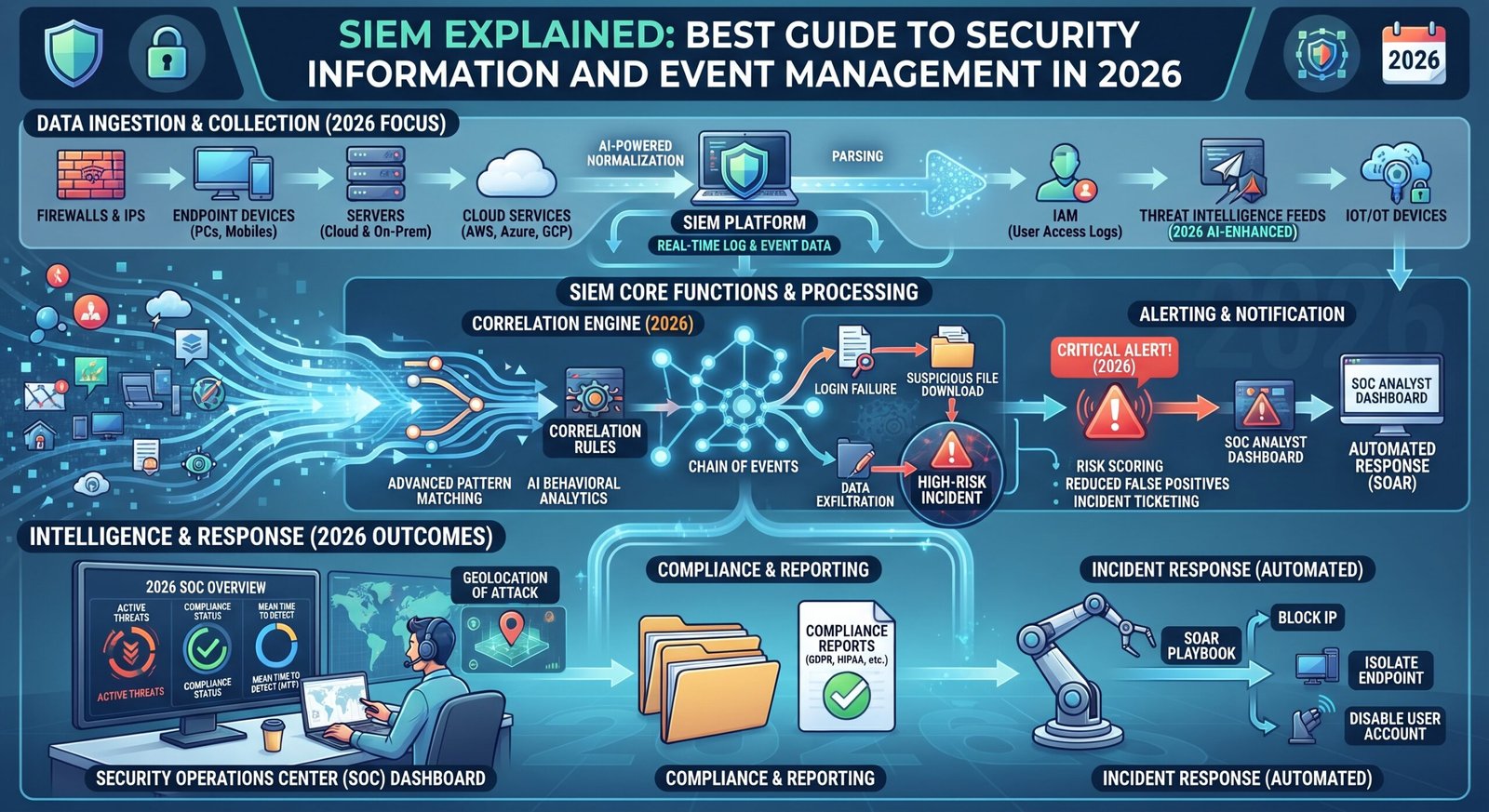
The basic process starts with security data collection. A platform receives information from many systems and performs log normalization so different formats become easier to analyze. It then uses correlation and detection logic to find suspicious patterns.
For example, five failed logins may mean nothing alone. Hundreds of failures followed by a successful login can look very different. Security event correlation connects those events and helps analysts investigate the larger story.
| Stage | What Happens |
|---|---|
| Collection | Security data enters the platform |
| Normalization | Different formats become consistent |
| Correlation | Related events are connected |
| Detection | Suspicious patterns are identified |
| Alerting | Analysts receive relevant warnings |
| Investigation | Teams examine evidence and timelines |
Why Is SIEM Important for Cybersecurity?
Modern organizations produce enormous amounts of security data. Without centralized security monitoring, important clues can remain buried inside separate systems. Analysts may need to search firewalls, endpoints, identity platforms, and cloud services independently.
A well-configured platform provides broader security visibility. It can support real-time security monitoring, investigation, and incident response. However, it doesn’t replace skilled security teams. Good results depend on useful data, accurate detection logic, and proper operational processes.
What Does a SIEM System Monitor?
A typical system can monitor security logs, system logs, and events from many technology layers. Common sources include firewalls, servers, endpoints, identity platforms, applications, VPNs, cloud services, and network devices.
The exact coverage depends on integrations. A strong deployment focuses on valuable SIEM data sources rather than blindly collecting everything. More data isn’t automatically better. Poorly selected data can increase storage costs and create unnecessary alerts.
SIEM Architecture: How the Main Components Work Together
A modern SIEM architecture usually contains several connected layers. Data collectors receive events from different systems. Processing components normalize the information. Analytics engines then correlate events and apply SIEM detection rules.
The final layer gives analysts searchable investigations, reports, and a SIEM dashboard. Modern cloud designs can distribute ingestion, storage, analytics, and search across scalable services.
Simple architecture:
Devices → Data Collection → Normalization → Storage → Correlation → Detection → Alerts → Investigation
What Is Security Log Management?
Security log management covers the collection, storage, protection, review, and retention of logs. Logs can show who accessed a resource, what happened, when it happened, and where the activity originated.
NIST notes that SIEM products can normalize, analyze, and correlate data from multiple sources. They can also support reporting and incident investigation. Good log retention therefore gives investigators historical evidence when an incident unfolds.
How SIEM Collects and Analyzes Security Events
Collection can happen through agents, APIs, connectors, syslog, cloud integrations, and other mechanisms. The platform receives firewall logs, authentication logs, endpoint logs, and application events.
It may also process Windows event logs, Linux logs, Active Directory logs, VPN logs, and DNS logs. After ingestion, log analysis and event correlation help analysts connect events that originate from different systems.
| Data Source | Useful Security Context |
|---|---|
| Firewall | Network connections and blocked traffic |
| Endpoint | Process and device activity |
| Identity | Login and access behavior |
| Application | User and application actions |
| Cloud | Cloud account and service activity |
| DNS | Domain lookup behavior |
SIEM Threat Detection and Real-Time Security Monitoring
Effective threat detection looks beyond isolated events. A platform can compare activity against detection rules, historical behavior, threat intelligence, and other context. This supports real-time threat detection when data arrives quickly enough.
Modern systems may also use behavioral analytics, anomaly detection, and user behavior analytics. These methods can highlight activity that differs from normal patterns. Analysts still need to validate alerts because unusual activity isn’t always malicious.
How SIEM Helps With Incident Response
When an incident occurs, analysts need evidence quickly. A SIEM can provide security incident detection, historical events, user activity, device information, and related alerts from one investigation environment.
This supports incident response by helping teams understand what happened and when. The platform can also work with automation and response tools. However, detection isn’t the same as containment. Other security controls may need to block accounts, isolate devices, or stop malicious processes.
SIEM vs SOC: What Is the Difference?
The difference between SIEM and SOC is simple. A SIEM is technology. A SOC is an operational function involving people, processes, and technology.
A SOC may use a SIEM for monitoring and investigation. Analysts review security alerts, investigate incidents, tune detections, and coordinate response actions. Think of the platform as a sophisticated instrument. The SOC is the team that knows how to play it.
| SIEM | SOC |
|---|---|
| Technology platform | Security operation |
| Collects and analyzes data | Uses people, processes, and tools |
| Generates alerts | Investigates and responds |
| Provides security visibility | Manages security operations |
SIEM vs XDR: What’s the Difference?
The difference between SIEM and XDR often comes down to design and scope. SIEM traditionally focuses on broad security data collection, correlation, search, analytics, and monitoring across many sources.
XDR emphasizes detection and response across connected security domains. In practice, modern platforms increasingly overlap. Your decision between SIEM or XDR should consider existing tools, data sources, response workflows, visibility requirements, and team skills.
SIEM vs EDR: Which Security Technology Does What?
SIEM vs EDR is another common comparison. EDR focuses heavily on endpoint activity. It can monitor devices, processes, files, connections, and other endpoint behavior.
A SIEM provides broader cross-system context. SIEM and EDR can therefore complement each other. An EDR may detect suspicious behavior on a laptop while the SIEM connects that activity with identity, network, and cloud events.
| Technology | Primary Focus |
|---|---|
| SIEM | Broad security visibility and analytics |
| EDR | Endpoint detection and response |
| XDR | Cross-domain detection and response |
| SOC | People, processes, and security operations |
SIEM vs Traditional Log Management
SIEM vs traditional log management becomes clearer when you examine purpose. Basic log management mainly focuses on collecting, storing, searching, and retrieving records.
SIEM adds security-focused correlation, analytics, alerting, and investigation capabilities. NIST notes that SIEM can provide stronger normalization, analysis, and correlation across multiple log sources than basic centralized syslog approaches.
Common SIEM Use Cases for Businesses
The most useful SIEM use cases revolve around finding suspicious activity across multiple systems. Organizations can use it for account compromise, malware investigations, ransomware detection, insider threat monitoring, privilege abuse, and unusual network behavior.
Other applications include suspicious login detection, brute force detection, cloud monitoring, compliance reporting, and investigation support. The value depends heavily on the quality of the data and detection logic.
| Use Case | Example |
|---|---|
| Account compromise | Strange login followed by privileged access |
| Malware detection | Suspicious process across endpoints |
| Ransomware detection | Abnormal file activity and endpoint alerts |
| Insider threat detection | Unusual access to sensitive systems |
| Data exfiltration detection | Unexpected large outbound transfer |
How SIEM Detects Cybersecurity Threats
Effective cybersecurity threat detection uses multiple techniques. Rule-based detection looks for known patterns. Threat detection rules can identify repeated authentication failures, impossible login patterns, or unusual administrative actions.
More advanced systems can support anomalous behavior detection and behavioral analytics. Threat intelligence integration can add information about known malicious indicators. These approaches improve context, yet false positives remain a practical challenge.
SIEM and Security Incident Investigation
During an investigation, analysts often start with one alert. They then search for related users, devices, addresses, applications, and events. This process creates a timeline around the suspicious activity.
Strong security incident investigation depends on searchable historical data. Analysts may examine malicious activity detection, unauthorized access detection, credential attack detection, and privilege changes. The goal isn’t simply to find an alert. It is to understand the complete sequence.
SIEM for Small Businesses: Is It Worth It?
SIEM for small business can make sense when the organization handles sensitive information, faces strict security requirements, or lacks visibility across growing infrastructure. Smaller teams may prefer managed SIEM services because they reduce operational workload.
However, a full deployment can become expensive or complex if the company has limited data and no security staff. Before buying, consider risk, staffing, data volume, compliance needs, and whether managed SIEM services offer a better fit.
SIEM for Large Enterprises and Security Teams
Large organizations often have thousands of devices, applications, identities, and cloud resources. An enterprise SIEM can help centralize this fragmented security information and support investigations across complex environments.
Enterprise teams also need scalability. Their SIEM capabilities may include advanced analytics, extensive integrations, long-term search, role-based access, automation, and detailed reporting. The platform should grow with the environment instead of becoming another bottleneck.
Cloud SIEM vs On-Premises SIEM
A cloud SIEM runs primarily through cloud infrastructure and can simplify scaling and infrastructure management. An on-premises SIEM gives organizations more direct control over their infrastructure and data location.
Neither model automatically wins. Your choice depends on architecture, regulatory requirements, data sensitivity, staffing, integrations, and operating preferences. Hybrid designs can also combine cloud services with local infrastructure.
| Factor | Cloud SIEM | On-Premises SIEM |
|---|---|---|
| Scaling | Usually easier | Requires infrastructure planning |
| Maintenance | Often lower | More internal responsibility |
| Data control | Depends on provider | Greater direct control |
| Deployment | Usually faster | Often more involved |
| Infrastructure | Provider-managed | Organization-managed |
What Are the Benefits of SIEM?
The main SIEM benefits come from bringing security information together. Analysts gain broader visibility and can investigate related events without jumping between many systems.
Other benefits include security monitoring, centralized investigation, alert management, compliance support, and stronger incident context. Still, the platform creates value only when teams configure it correctly. Good technology cannot compensate for weak security processes.
What Are the Limitations of SIEM?
Every security technology has trade-offs. Common SIEM limitations include data volume, storage requirements, false positives, complex configuration, integration work, and the need for skilled analysts.
NIST has also noted that SIEM can be more complicated and expensive to deploy than a basic centralized syslog approach. This matters for smaller organizations that may not need advanced correlation across hundreds of systems.
How Much Does SIEM Cost?
SIEM cost varies widely because vendors use different pricing models. Some focus on data ingestion. Others may consider users, devices, events, storage, features, or service levels.
SIEM pricing should include more than the software invoice. Organizations may also pay for implementation, integrations, retention, storage, tuning, training, and analysts. Always calculate the total operating cost before choosing a platform.
| Cost Factor | Why It Matters |
|---|---|
| Data ingestion | More data can increase pricing |
| Retention | Longer storage increases requirements |
| Integrations | Complex environments require more work |
| Staffing | Analysts need time and expertise |
| Implementation | Initial configuration can require specialists |
How to Choose the Best SIEM Solution
The best SIEM isn’t automatically the platform with the longest feature list. Start by defining what you need to monitor and which threats matter most to your organization.
When comparing best SIEM tools, examine integrations, search performance, detection quality, scalability, usability, automation, retention, support, and pricing. Also compare SIEM vendors carefully. A platform that fits your environment is usually more valuable than an impressive platform that doesn’t.
SIEM Implementation: How to Deploy It Successfully
Successful SIEM implementation starts with clear goals. Identify critical assets first. Then prioritize the most valuable SIEM integrations instead of connecting every system immediately.
A practical SIEM deployment can begin with identity, endpoints, firewalls, critical servers, and cloud infrastructure. Teams should then create useful detections, test alerts, tune false positives, and measure results. NIST guidance supports centralized collection and analysis as important parts of effective log management.
Common SIEM Implementation Mistakes
Poor planning can turn a powerful platform into an expensive alert generator. One common mistake is collecting huge amounts of low-value data without defining clear detection goals.
Another mistake is ignoring alert tuning. If analysts receive too many irrelevant warnings, important events can disappear inside the noise. Weak ownership, poor retention planning, incomplete integrations, and insufficient training can create similar problems.
SIEM Best Practices for Better Security Monitoring
Good SIEM best practices begin with visibility and priorities. Collect high-value data first. Protect administrative access. Synchronize system time. Build detections around realistic threats. Review alert quality regularly.
Teams should also test their detection logic. They need to know whether an alert actually appears when the expected behavior occurs. Regular tuning improves signal quality and reduces wasted analyst time.
How SIEM Supports Compliance and Security Audits
SIEM can support SIEM for compliance by centralizing audit records and helping organizations review security activity. It can make evidence easier to search and investigate.
However, using a SIEM doesn’t automatically make a company compliant. Requirements depend on the applicable framework and environment. For example, PCI DSS uses logging requirements to support records of who did what, where, when, and how.
The Future of SIEM in 2026 and Beyond
The future of SIEM technology is moving toward deeper automation, cloud-native architectures, broader analytics, and closer integration with other security platforms. AI can help analysts summarize events, identify patterns, prioritize alerts, and speed up investigations.
Yet automation isn’t a magic wand. Human judgment remains important when business context changes the meaning of an event. Modern security teams will likely use SIEM alongside XDR, EDR, SOAR, identity tools, threat intelligence, and other controls.
Frequently Asked Questions About SIEM
What does SIEM stand for?
SIEM stands for Security Information and Event Management. It describes technology that collects security information and events from different systems, then helps teams analyze and investigate that information.
Is SIEM a cybersecurity tool?
Yes. A SIEM is a cybersecurity platform used for security monitoring, event analysis, threat detection, investigation, and reporting.
What is SIEM used for?
SIEM is used for security event monitoring, threat detection, investigation, compliance support, and security operations. It helps teams understand activity across multiple systems.
Is SIEM the same as a SOC?
No. SIEM and SOC are different concepts. A SIEM is a technology platform. A SOC is the broader security operation involving people, processes, and technologies.
What is the difference between SIEM and XDR?
The SIEM vs XDR comparison depends on the platform. SIEM traditionally emphasizes broad data collection, analytics, correlation, and search. XDR focuses strongly on connected detection and response across security domains.
Does SIEM prevent cyberattacks?
Not by itself. SIEM primarily provides detection, visibility, analysis, and investigation. Other controls usually perform prevention and direct blocking.
Is SIEM useful for small businesses?
Yes, in the right situation. SIEM for small business can help organizations with sensitive data, complex infrastructure, or strong monitoring requirements. Managed services may reduce operational complexity.
How does SIEM detect threats?
SIEM detects threats through rules, correlation, behavioral analytics, anomaly detection, and threat intelligence. It can combine many small events into a larger security pattern.
What data does SIEM collect?
It can collect security events from endpoints, firewalls, servers, applications, identity systems, network devices, VPNs, and cloud services. The exact SIEM data sources depend on available integrations.
How much does SIEM cost?
There is no universal price. SIEM software cost depends on data volume, retention, features, users, devices, integrations, service level, and deployment model.
Final Verdict: Is SIEM Worth Using for Cybersecurity?
For organizations that need broad security visibility, SIEM can be extremely valuable. It brings scattered events together and helps analysts spot relationships that isolated tools may miss.
The real question isn’t simply “Do I need SIEM?” Ask whether your organization has enough risk, data, complexity, or compliance pressure to justify it. When the answer is yes, a properly planned SIEM can become a central part of effective cybersecurity operations and long-term security monitoring.
“A SIEM is most valuable when it turns security data into decisions.”
That principle matters in 2026. Don’t buy technology merely because it has more features. Choose a platform that fits your environment, tune it carefully, connect meaningful data sources, and give your security team a clear process for acting on what it discovers.
Sources and Further Reading
NIST — Security Information and Event Management Glossary
NIST — Security Information and Event Management Tool Glossary
NIST SP 800-92 — Guide to Computer Security Log Management
PCI Security Standards Council — Logging and Audit Records FAQ
Meta Description:
Learn SIEM in simple terms. Discover how Security Information and Event Management works, detects threats, supports incident response, and improves cybersecurity in 2026.