

Artificial intelligence is moving beyond simple chatbots. Today, AI can plan tasks, use tools, access data, write code, and complete multi-step work with less human help. This shift is creating a new class of autonomous AI agents that can act toward a goal instead of only generating an answer.
The idea sounds simple, but the technology is much deeper. These systems combine large language models, AI reasoning, memory, tools, planning, and controlled actions. They can also work across websites, software, APIs, files, and business systems. In 2026, companies are increasingly exploring these systems for productivity, software development, cybersecurity, research, and enterprise AI.
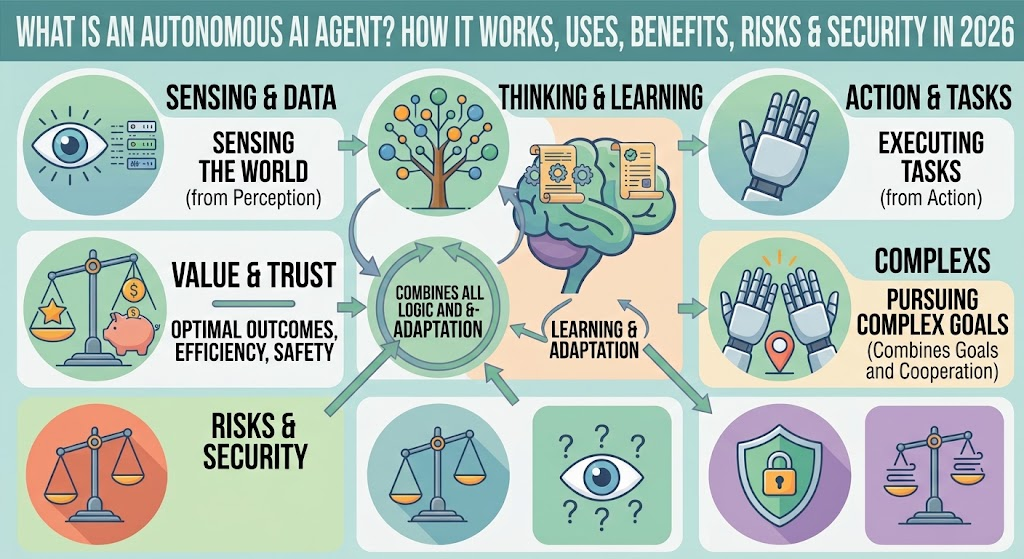
However, more autonomy also creates more risk. An agent that can take action can make a useful decision. It can also make a costly mistake if its permissions are too broad. That is why AI agent security has become a major part of modern AI development.
This guide explains what is an autonomous AI agent, how the technology works, what it can do, where companies use it, and why security matters.
Trusted source
| Resource | Why It Matters |
|---|---|
| OpenAI Agent Tools and Responses API | Agent tools, web search, file search, computer use, and orchestration |
| OpenAI Agents API | Current 2026 managed cloud agent infrastructure |
| Google Cloud AI Agent Architecture | Agent architecture, memory, tools, runtime, and orchestration |
| OWASP Excessive Agency | Major agent security risks and excessive permissions |
| Microsoft Agentic AI Security | 2026 security guidance for autonomous agents |
| Anthropic Claude Code Sandboxing | Practical sandboxing and network isolation for agents |
| Anthropic Trustworthy Agents | Current risks, governance, and agent safety |
| Microsoft Agentic AI in Cybersecurity | Security operations and autonomous threat response |
| IBM AI Agents Guide | Agent concepts, workflows, tools, memory, and use cases |
| OpenAI Agents SDK on GitHub | Current agent SDK concepts, tools, guardrails, sessions, and tracing |
What Is an Autonomous AI Agent?
An autonomous AI agent is an AI-powered system that can understand a goal, decide what steps are needed, use available tools, and perform actions with limited human intervention. Instead of simply answering a question, it can continue working until it reaches a defined result.
Modern agents often use large language models as their reasoning engine. They can combine natural language understanding with tool calling, memory, external data, and APIs. This allows them to perform tasks that would normally require several manual steps. IBM describes AI agents as systems that can design workflows and use available tools to perform tasks.
What Does “Autonomous” Mean?
The word autonomous means the system can make some decisions without asking a person at every step. The agent still operates within instructions, permissions, policies, and technical boundaries.
For example, a normal chatbot may tell you how to fix a website error. An autonomous system could inspect the relevant files, identify the problem, make a proposed change, run tests, and report the result. The important difference is independent actions.
Autonomous AI Agent vs Chatbot
A chatbot mainly responds to messages. An agent can manage a workflow. That difference becomes important when the task has several stages.
| Capability | Traditional Chatbot | Autonomous Agent |
|---|---|---|
| Answers questions | Yes | Yes |
| Understands context | Usually | Yes |
| Creates a plan | Limited | Yes |
| Uses external tools | Sometimes | Commonly |
| Calls APIs | Limited | Often |
| Performs actions | Limited | Yes |
| Maintains task state | Limited | Often |
| Works through multiple steps | Limited | Yes |
| Adapts during execution | Limited | Yes |
A chatbot may tell you what to do next. An agent can potentially do it for you.
Core Components of an Autonomous Agent
The basic architecture usually contains a model, instructions, memory, tools, an execution loop, and safety controls. Google Cloud describes agents through components such as models, grounding, tools, memory, orchestration, and runtime.
These components create agentic AI systems rather than ordinary question-and-answer software. The model provides machine reasoning, while tools provide the ability to interact with the outside world.
How Does an Autonomous AI Agent Work?
To understand how does an autonomous AI agent work, imagine a digital worker receiving a goal. It first understands the request. It then breaks the goal into smaller tasks, selects tools, performs actions, checks the results, and decides what should happen next.
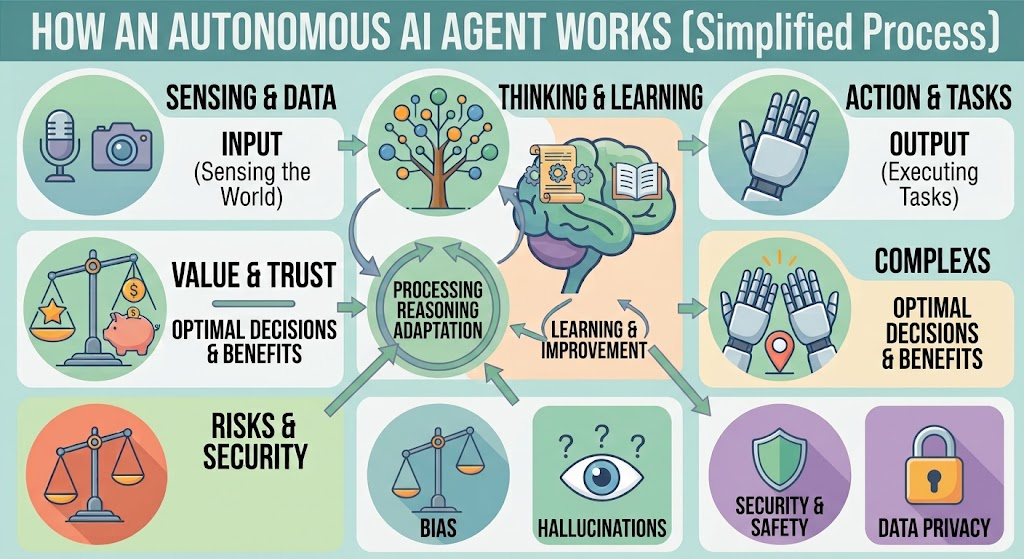
This creates a continuous loop of reasoning, planning, action, and feedback. Modern agent architectures can use short-term context and long-term memory. They can also connect to APIs, databases, websites, files, and other software.
Step 1: Understanding the Goal
The process begins with a goal. The goal may come from a user, another application, or an automated business process.
For example, a company might ask an agent to investigate a suspicious login. The agent must first understand the objective and identify what information it needs.
Step 2: AI Reasoning
Next, the system applies AI reasoning to determine a suitable approach. A modern LLM can compare information, interpret instructions, and decide which action may help.
This does not mean the system thinks exactly like a human. It means the model processes information and generates decisions based on its training, context, instructions, and available tools.
Step 3: AI Planning
Complex tasks often need several steps. The agent can create an internal task sequence before acting.
For example, a coding agent may inspect the repository first. It may then identify the relevant files, edit code, run tests, inspect errors, and try another approach.
Step 4: Tool Selection
Tools give agents practical abilities. These tools can include search systems, databases, calculators, APIs, browsers, code interpreters, file systems, or business applications.
This is where AI orchestration becomes important. The system must decide which tool should handle each part of the task.
Step 5: Action
The agent then performs the selected action. It may retrieve information, write a file, call an API, update a record, execute code, or communicate with another service.
The action layer is also where security becomes critical. A model with no external access has limited power. A model with broad credentials can have a much larger impact.
Step 6: Feedback
After taking an action, the agent receives a result. This result becomes part of its next decision.
This creates a feedback loop. If the action succeeds, the agent can continue. If it fails, the system may change its approach.
Step 7: Adaptation
The final stage is adaptation. The system uses new information to adjust its next action.
This behavior is sometimes described as adaptive AI. It allows agents to handle changing environments instead of following one rigid script.
The complete flow can be summarized as:
| Stage | Main Function |
|---|---|
| Goal | Understand the desired result |
| Reasoning | Interpret the problem |
| Planning | Create a task sequence |
| Tool use | Select external capabilities |
| Action | Execute a step |
| Feedback | Inspect the result |
| Adaptation | Adjust the next step |
What Makes an AI Agent Truly Autonomous?
An AI system becomes more autonomous when it can decide and execute multiple steps without constant human instructions. Autonomous decision making is therefore more important than simply having a powerful model.
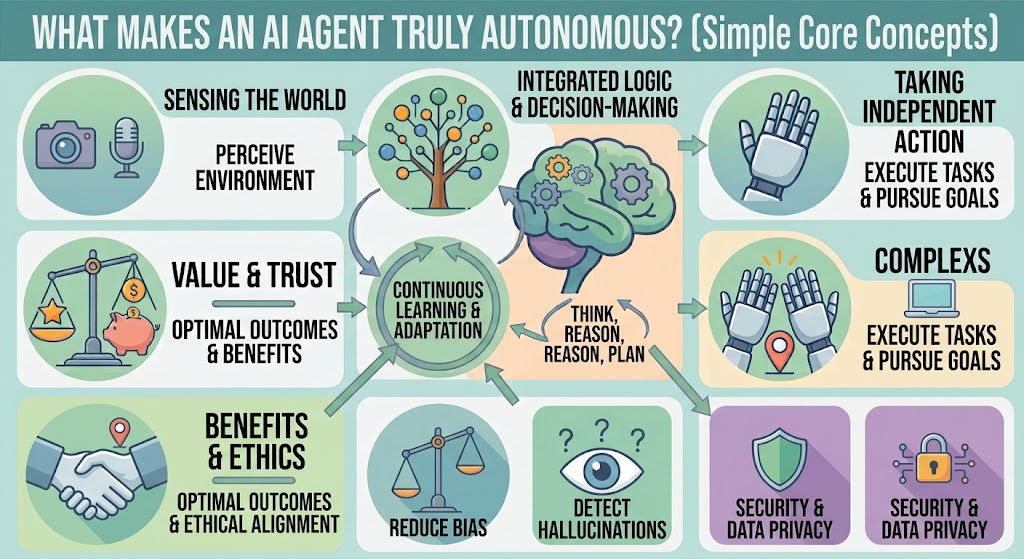
A useful agent normally combines memory, planning, tools, contextual understanding, and controlled execution. Without these components, a system may still be an AI assistant, but it may not behave like a fully autonomous workflow.
Goal-Directed Decision Making
An agent needs a clear objective. It must understand what result it should achieve and what actions are allowed.
This is the foundation of goal-oriented AI agents. The system does not simply generate random responses. It selects actions that appear useful for reaching the assigned goal.
Memory and Context
Memory allows an agent to retain useful information. Short-term memory can preserve the current task state. Long-term memory can store information that remains useful across sessions.
Google Cloud separates working memory from longer-term knowledge and persistent data.
Planning and Reasoning
Planning lets an agent handle multi-step work. AI planning can turn a broad request into smaller operations.
Reasoning helps the system choose between possible actions. The quality of these decisions depends on the model, available information, tools, instructions, and safety controls.
Tool Access
An agent becomes much more useful when it can interact with external systems. API access can connect the agent to databases, applications, search services, payment systems, monitoring platforms, or internal business tools.
However, every tool adds another security boundary.
Independent Execution
True autonomy requires some level of independent execution. The system must be able to continue through several steps without asking for permission after every small action.
That does not mean humans should disappear. Human oversight remains important for sensitive or high-impact operations.
Autonomous AI Agent vs Traditional AI: What’s the Difference?
Traditional AI often performs a defined function. It may classify an image, predict a value, detect spam, generate text, or answer a question.
An autonomous system goes further. It can combine multiple capabilities into a workflow. It may decide what information to retrieve, which tool to call, and what action to take next.
The biggest difference is agency. Traditional systems often wait for a request and return an output. Agentic systems can use that output as part of a larger process.
| Feature | Traditional AI | Autonomous AI |
|---|---|---|
| Main role | Generate or predict | Achieve a goal |
| Planning | Usually limited | Core capability |
| Tool use | Optional | Common |
| Memory | Often limited | Frequently included |
| Actions | Limited | More extensive |
| Workflow | Mostly predefined | Dynamic |
| Adaptation | Limited | More flexible |
| Human involvement | Usually direct | Can be supervisory |
This is why AI automation is evolving toward AI workflow automation. Instead of automating one isolated action, organizations can automate connected processes.
Autonomous AI Agent vs AI Agent: Are They the Same?
The terms AI agent and autonomous AI agent are often used almost interchangeably. In practice, an AI agent usually has some level of autonomy because it can reason, use tools, or perform tasks.
However, autonomy exists on a spectrum. One agent may only choose between two predefined actions. Another may plan and execute a long workflow with many tools.
Therefore, the phrase autonomous AI agent vs AI agent is mainly about degree. “AI agent” describes the broader category, while “autonomous” highlights independent decision-making and execution.
What Makes an Agent More Autonomous?
The more an agent can independently plan, select tools, execute actions, inspect results, and continue toward its goal, the more autonomous it becomes.
This distinction matters because autonomy increases both capability and responsibility. More freedom requires stronger controls.
Autonomous AI Agent vs Software Agent: What’s the Difference?
A software agent is a program that performs tasks on behalf of a user or another system. Software agents existed long before modern generative AI.
A modern agent may be a software agent powered by an LLM. It can use natural language processing, reasoning, memory, APIs, and external tools to perform more flexible tasks.
| Feature | Software Agent | Autonomous AI Agent |
|---|---|---|
| Core technology | Software logic | AI model plus software |
| Rules | Often predefined | Can be dynamic |
| Natural language | Optional | Common |
| Reasoning | May be limited | Usually central |
| Planning | Often predefined | Dynamic planning |
| Tool use | Yes | Yes |
| Adaptation | Varies | Often stronger |
| LLM required | No | Usually in modern systems |
The two categories overlap. An autonomous AI system can be considered a more advanced type of software agent.
For readers who want the broader concept, DailyTecho can also connect this topic with its existing coverage of AI agents and software agents.
What Are the Main Types of Autonomous AI Agents?
Different agents are designed for different goals. Some focus on one task. Others coordinate several specialized systems.
Modern intelligent agents can support coding, research, customer service, security operations, and business processes. Multi-agent systems can also divide complex work between specialized agents.
Goal-Oriented Agents
Goal-oriented agents focus on reaching a defined outcome. They can decide which steps are needed rather than following one fixed response pattern.
This approach is closely connected with goal-driven AI and task planning.
Task Automation Agents
Task-oriented agents are designed to automate repetitive or multi-step workflows. They may process documents, update records, schedule tasks, or move information between applications.
These systems support intelligent automation and autonomous automation.
Multi-Agent Systems
A multi-agent system contains multiple specialized agents. Each agent can handle a specific part of the workflow.
One agent might research information. Another could analyze it. A third could prepare the final result. This requires strong agent orchestration.
Autonomous Coding Agents
Coding agents can inspect software projects, modify files, run commands, and test changes. Modern developer tools increasingly support longer-running coding workflows.
For example, OpenAI’s current Agents SDK supports agents with tools, guardrails, handoffs, sessions, tracing, and sandbox environments.
Cybersecurity Agents
Security agents can help detect, investigate, and respond to threats. Microsoft describes agentic AI in cybersecurity as the use of autonomous agents for threat detection, investigation, and response with limited human intervention.
Research Agents
Research agents can search information, compare sources, organize findings, and create reports. Their usefulness depends heavily on source quality and verification.
Customer-Service Agents
Customer-service agents can understand requests, retrieve account information, follow business rules, and perform approved actions.
They can work as advanced virtual agents rather than simple scripted chatbots.
What Can Autonomous AI Agents Do?
The answer to what can autonomous AI agents do depends on their tools and permissions. An agent with only search access has limited capabilities. An agent with file, database, API, and execution access can perform much more complex work.
In practical systems, agents can research information, summarize documents, analyze data, write software, manage workflows, monitor systems, communicate with applications, and complete repetitive tasks.
Multi-Step Workflows
The major advantage is coordination. An agent can connect many individual operations into one workflow.
For example, a business agent could receive a customer request, retrieve account data, check company policy, draft a response, and prepare an approved action.
Software Development
Coding agents can inspect repositories and work through multiple development steps. OpenAI says its agent tooling can support long-running tasks involving files, commands, code editing, and sandboxed environments.
Data Processing
Agents can retrieve data, transform it, compare records, and prepare reports. This makes data processing a useful application for enterprise workflows.
Digital Tools
Agents can interact with browsers, APIs, databases, files, and other software. OpenAI’s Responses API, for example, introduced built-in web search, file search, and computer-use capabilities for developers building agents.
How Are Autonomous AI Agents Used in 2026?
In 2026, agent technology is moving from simple demonstrations toward practical workflows. Organizations are testing agents for cybersecurity, software development, business operations, research, customer support, IT, finance, healthcare, and marketing.
Google Cloud describes agentic workflows as AI-driven processes that combine reasoning, planning, and external tools to complete complex tasks with limited human intervention.
| Industry | Example Use |
|---|---|
| Cybersecurity | Threat investigation |
| Software | Code creation and testing |
| Business | Workflow automation |
| Research | Source discovery and analysis |
| Customer service | Ticket handling |
| IT operations | Incident investigation |
| Finance | Document and workflow analysis |
| Healthcare | Administrative support |
| Marketing | Research and content workflows |
Autonomous AI Agents in Cybersecurity
Security teams can use agents to investigate alerts, correlate information, and recommend or perform approved responses.
The value is speed. Security teams often face huge volumes of alerts. An agent can help investigate routine events while humans focus on complex decisions.
Autonomous AI Agents in Software Development
Software development is one of the clearest areas for agentic systems. Coding agents can inspect files, write code, run tests, and respond to errors.
OpenAI’s current agent tooling and Anthropic’s Claude Code architecture both show how modern agents are being designed for multi-step software work.
Autonomous AI Agents for Business Automation
Businesses can connect agents to CRM systems, help desks, databases, documents, and internal tools.
This creates AI-powered automation instead of isolated chatbot interactions. The agent becomes part of the workflow.
Research and Knowledge Work
Research agents can collect information from multiple sources and organize findings. They can also use real-time data when connected to appropriate tools.
However, humans should verify important claims. An agent can process information quickly without guaranteeing that every source is correct.
What Are the Benefits of Autonomous AI Agents?
The biggest advantage is the ability to combine reasoning with action. A normal AI model can produce useful content. An agent can potentially use that content to complete a larger workflow.
This can improve AI productivity, reduce repetitive work, and help teams operate at greater scale. IBM notes that agents can plan, make decisions, use tools, retain context, and complete multi-step tasks.
Higher Productivity
Agents can handle repetitive digital work. This gives employees more time for creative, strategic, and human-centered tasks.
Faster Decisions
An agent can gather information and process it quickly. This can support AI-powered decision making when humans remain responsible for high-impact decisions.
Continuous Operation
Software can operate outside normal working hours. An agent can monitor systems or process routine workflows continuously when properly designed.
Better Scalability
One automated workflow can potentially handle a much larger workload than a manual process.
Connected Workflows
Agents can connect tools that previously required separate manual steps. This is one reason autonomous workflows are becoming important in enterprise technology.
What Are the Risks of Autonomous AI Agents?
The biggest risk is simple: an agent can act. If the system misunderstands a request, follows malicious instructions, or receives excessive permissions, the consequences can be larger than a wrong chatbot answer.
OWASP identifies excessive functionality, excessive permissions, and excessive autonomy as major causes of excessive agency. It also notes that prompt injection and compromised extensions can trigger harmful actions.
| Risk | Possible Impact |
|---|---|
| Prompt injection | Agent follows malicious instructions |
| Data leakage | Sensitive information leaves the system |
| Excessive permissions | Agent changes systems unnecessarily |
| Tool abuse | Dangerous functions are misused |
| Credential theft | Attackers gain access to accounts |
| Incorrect decisions | Business or technical damage |
| Agent hijacking | Workflow is redirected |
| API compromise | External systems are abused |
Unauthorized Actions
An agent may take an action that technically fits its instructions but exceeds what the user intended.
This is especially dangerous when the agent can delete data, send messages, change infrastructure, or access sensitive systems.
Prompt Injection
Prompt injection occurs when malicious instructions influence the model’s behavior.
An attacker may place instructions inside a webpage, email, document, or tool response. The agent may treat that content as part of its task context.
Data Exposure
Agents often need access to information. If the system has weak boundaries, it may expose sensitive data through an answer, tool call, log, or external service.
Excessive Permissions
Giving an agent broad permissions increases its potential blast radius.
OWASP’s example shows how an email assistant with unnecessary sending permissions could be abused after an indirect prompt injection.
Agent Hijacking
Agent hijacking happens when an attacker redirects an agent away from its intended goal.
This can happen through malicious content, compromised tools, stolen credentials, or manipulated instructions.
Why Is Autonomous AI Agent Security So Important?
Traditional AI security focused heavily on model outputs. Agent security must also protect the actions performed after those outputs.
That changes the security model. An agent can read information, make decisions, call tools, modify systems, and communicate with other services. Microsoft says agentic systems introduce new security challenges because they operate autonomously, make decisions, and interact across multiple systems.
The Agent Has a Larger Attack Surface
Every tool can create another attack path. Every API connection can create another security dependency.
This makes autonomous AI agent security a system-wide problem. Developers must protect the model, tools, data, identity, runtime, and workflow.
Security Must Follow the Agent Loop
Security should exist before, during, and after an action.
Input validation can reduce malicious instructions. Tool restrictions can limit damage. Monitoring can identify suspicious behavior. Human approval can stop high-risk actions.
Anthropic’s current agent security work uses multiple layers, including prompt-injection detection, action evaluation, sandboxing, and network restrictions.
How Can Hackers Attack Autonomous AI Agents?
Attackers can target the model itself, the information it reads, the tools it uses, or the credentials behind those tools.
The most important AI agent threats are not limited to one attack technique. They form a chain. A malicious document can trigger prompt injection. The agent can then call a tool. That tool may have excessive permissions. The final result can become data theft or system damage.
Prompt Injection
A direct attack places malicious instructions into the user’s input. An indirect attack hides instructions inside content the agent retrieves.
Indirect prompt injection is especially important for agents because they often read external content.
OpenAI’s Operator research also identified prompt injection as a security concern for computer-using agents.
Malicious Tools
A compromised or poorly designed tool can return dangerous information or perform unintended operations.
The agent may trust the tool because it is part of its available environment.
Compromised APIs
Agents often depend on external APIs. If credentials are stolen or an API is compromised, attackers may use the agent’s access to reach other systems.
This makes API security a critical part of agent architecture.
Poisoned Data
Agents can consume documents, websites, messages, and databases. If those sources contain malicious or misleading instructions, they can influence the agent’s decisions.
Credential Theft
An agent may have access tokens, API keys, sessions, or service credentials. Poor credential management can turn one compromised agent into a gateway to other systems.
Excessive Agent Permissions
The more an agent can do, the more damage it can cause when something goes wrong.
That is why least privilege remains one of the most important security principles for agentic systems.
How to Secure an Autonomous AI Agent
The best way to protect an agent is to assume that something will eventually go wrong. A secure design limits what the system can access, what it can change, and how far an attack can spread.
Securing AI agents requires multiple controls. No single filter can solve every problem.
Least Privilege
Give the agent only the permissions it needs.
If an agent only needs to read invoices, do not give it permission to delete them. If it only needs to inspect an account, do not allow it to change account settings.
Sandboxing
Sandboxing places an agent inside a controlled environment. This can restrict filesystem access, network connections, commands, and other resources.
Anthropic reports using both filesystem and network isolation in Claude Code to limit the impact of prompt injection and unsafe actions.
Authentication and Access Control
Agents should have clear identities. Every tool call should be associated with the correct user, service, or workload.
Strong access control prevents an agent from becoming an unrestricted gateway.
Input and Output Validation
Systems should validate data before allowing it to influence sensitive actions.
Tool outputs should also be treated carefully. The fact that information came from a tool does not automatically make it trustworthy.
Human Approval
High-impact actions should require human-in-the-loop approval.
For example, an agent may prepare a financial transaction but require a human to approve the final submission.
Monitoring
Organizations need AI monitoring and agent activity monitoring to understand what agents are doing.
Logs should show tool calls, decisions, identity, timestamps, errors, and important actions.
Restrict Tools
Tools should be narrowly designed. A tool that combines read, write, and delete functions creates unnecessary risk.
OWASP recommends reducing excessive functionality and permissions to reduce excessive agency.
Security Testing
Organizations should test agents against prompt injection, malicious files, unexpected instructions, permission abuse, and tool manipulation.
Security testing should happen before deployment and continue after launch.
| Security Control | Main Purpose |
|---|---|
| Least privilege | Reduce agent power |
| Sandboxing | Contain damage |
| Authentication | Verify identity |
| Access control | Restrict resources |
| Input validation | Reduce malicious inputs |
| Tool restrictions | Limit actions |
| Human approval | Stop high-risk actions |
| Logging | Create accountability |
| Monitoring | Detect suspicious behavior |
| Testing | Find weaknesses |
Are Autonomous AI Agents Safe to Use?
The answer to are autonomous AI agents safe is not simply yes or no. Their safety depends on the model, tools, permissions, environment, monitoring, and human controls around them.
A restricted agent operating in a sandbox can have a small blast radius. An agent with unrestricted access to production systems can create serious risk.
Anthropic notes that autonomy introduces opportunities for agents to misread user intent and take unintended actions.
When Agents Are Safer
Agents are safer when they have limited permissions, isolated environments, strong authentication, clear instructions, monitoring, and approval gates for sensitive operations.
When Agents Become Dangerous
Risk increases when developers connect agents to sensitive systems without sufficient controls.
An agent should never receive broad access simply because the integration is convenient.
Human Oversight Still Matters
The goal is not to remove people from every workflow. The goal is to automate suitable work while keeping humans responsible for important decisions.
This creates a practical balance between autonomy and control.
Real-World Examples of Autonomous AI Agents
The autonomous AI agent examples available in 2026 show how quickly the technology is moving from experiments toward real workflows.
OpenAI has released tools for developers building agents, including web search, file search, computer use, the Responses API, and Agents SDK capabilities.
OpenAI Agent Systems
OpenAI’s current platform includes agent-building infrastructure for long-running tasks, tools, sandbox environments, and multi-agent workflows. In September 2026, OpenAI introduced its Agents API for managed cloud agents built around its Codex harness.
The development shows a clear trend toward agents that can operate for longer periods and use more tools.
Coding Agents
Coding agents are another major example. They can inspect repositories, edit files, run commands, and test their changes.
OpenAI describes agent workflows where coding systems scan codebases, make changes, execute tests, and repeat the loop when needed.
Anthropic has also developed Claude Code with sandboxing, filesystem controls, network isolation, and autonomous coding workflows.
Enterprise Workspace Agents
OpenAI introduced workspace agents in 2026 for teams using ChatGPT Business, Enterprise, and Edu. These agents can handle longer-running workflows while operating within organizational permissions and controls.
Cybersecurity Agents
Security vendors are developing agents that can investigate alerts and help respond to threats.
Microsoft describes agentic AI for cybersecurity as a way to detect, investigate, and respond to threats with minimal human intervention.
These examples show that autonomous technology is not limited to chat. It is becoming part of software, business, and security infrastructure.
What Is the Future of Autonomous AI Agents?
The future will likely involve more capable agents, better tool integration, stronger memory, and more sophisticated multi-agent systems.
The important shift is from generating answers to completing outcomes. Instead of asking AI to write one piece of code, you may ask it to investigate a bug, modify the project, test the change, and prepare the result.
OpenAI’s 2026 agent infrastructure and Google Cloud’s agent architecture work both show the industry moving toward longer-running, tool-using systems.
Software Development Will Change
Software development is likely to remain one of the biggest agent use cases.
Agents can already inspect code, modify files, execute commands, and test changes. Future systems may handle larger development workflows while developers focus more on architecture, review, and product decisions.
Multi-Agent Workflows Will Grow
A single agent may not be ideal for every task. One specialized agent can research. Another can code. Another can test. A coordinator can manage the workflow.
This creates more advanced agent orchestration.
Cybersecurity Will Become More Agentic
Security teams need speed. Attackers also use automation.
That creates a race between automated attacks and automated defense. Autonomous AI security could help defenders investigate alerts faster, but the agents themselves must be protected from manipulation.
Governance Will Become Essential
More autonomy means more responsibility.
Organizations will need policies for identity, permissions, data access, monitoring, approval, audit logs, and incident response.
The future of agentic technology is therefore not simply “more autonomy.” It is more useful autonomy with better boundaries.
Frequently Asked Questions About Autonomous AI Agents
What is an autonomous AI agent?
An autonomous AI agent is an AI-powered system that can understand a goal, plan actions, use tools, and perform multiple steps with limited human intervention.
How does an autonomous AI agent work?
It normally follows a loop involving goal understanding, reasoning, planning, tool use, action, feedback, and adaptation.
Are autonomous AI agents the same as AI agents?
They overlap heavily. An AI agent can have different levels of autonomy. The word autonomous emphasizes that the system can independently make decisions and execute actions.
What is the difference between an AI agent and a software agent?
A software agent is a broader software concept. An AI agent usually adds AI models, reasoning, natural language understanding, planning, and tool use to that software-agent architecture.
What are autonomous AI agents used for?
They are used for software development, cybersecurity, research, customer service, business automation, IT operations, data processing, and other multi-step workflows.
Are autonomous AI agents safe?
They can be safe when developers use strong access controls, least privilege, sandboxing, monitoring, testing, and human approval for sensitive actions.
Can autonomous AI agents be hacked?
Yes. Attackers can target them through prompt injection, malicious tools, compromised APIs, poisoned data, stolen credentials, and excessive permissions.
What are the biggest risks of autonomous AI agents?
The biggest risks include unauthorized actions, data leakage, prompt injection, excessive permissions, tool abuse, credential theft, incorrect decisions, and agent hijacking.
Final Thoughts
The rise of autonomous AI agents represents a major change in how people use artificial intelligence. Traditional AI mainly produces an answer. Agentic systems can use that answer as part of a larger workflow.
They can plan, reason, call tools, access information, execute tasks, inspect results, and continue working toward a goal. That makes them powerful for AI-powered automation, software development, cybersecurity, research, and enterprise workflows.
But capability always creates responsibility. An agent with more permissions has a larger blast radius when something goes wrong.
That is why AI agent cybersecurity, access control, least privilege, sandboxing, monitoring, and human approval must be designed from the beginning.
The most important lesson is simple. The future of AI is not just about making models smarter. It is about making agentic AI systems useful, controlled, observable, and secure.
Continue Reading
- AI Agents in 2026: What Are AI Agents and How They Will Change Work, Business, and Daily Life
- Agentic AI in 2026: How Autonomous AI Systems Will Transform Business, Software, and Human Work
- AI Agent vs Software Agent: Key Differences, Examples, and Use Cases Explained
- Types of Software Agents: A Complete Guide to Intelligent Software Agents
- AI-Powered Cybersecurity: How Artificial Intelligence Is Changing Online Security in 2026
- AI Workflow Automation in 2026: How Smart AI Workflows Are Transforming Business Productivity
- What Is AI Automation? Complete Guide to AI Automation Tools and Future Benefits (2026)
- Best AI Automation Tools in 2026: Top AI Platforms for Business, Workflows, and Productivity
- Generative AI in 2026: How Advanced AI Models Are Transforming Business, Creativity, and Everyday Life
- OpenAI AI Agent Warning: What You Need to Know About AI Agent Security
Meta Description:
Discover how an autonomous AI agent works in 2026, what it can do, real-world examples, hidden security risks, and how to safely use this powerful AI technology.