

The world of software is changing quickly. Programs can now understand goals, use tools, make decisions, and complete tasks with less human input. That shift has made AI agents and software agents major technology topics.
Yet the two terms can sound confusing. They overlap in several ways. They also have important differences.
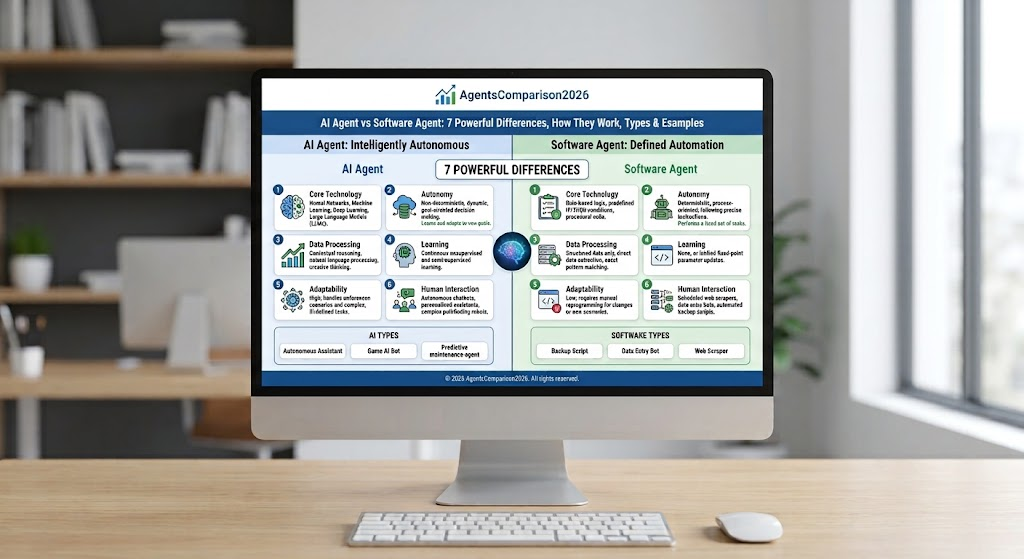
The simplest view is this: a software agent is a program that can act for a person or system. An AI agent adds artificial intelligence to make more flexible decisions. NIST describes an agent as a program that acts on behalf of a person or organization.
In this guide, you’ll learn what is a software agent, what is an AI agent, how both systems work, and where they differ. You’ll also see real examples from automation, business, software development, and cybersecurity.
What Is a Software Agent?
So, what is a software agent? A software agent is a program that performs tasks for a user or another system. It can receive information, evaluate conditions, and take actions toward a defined goal. NIST also describes agents as programs that can interact with their environment and perform self-directed actions.
A simple software agent definition focuses on action rather than intelligence. The program might follow fixed rules, monitor events, or communicate with another program. Common software agent examples include network monitors, email filters, web crawlers, and automated system managers.
Characteristics of Software Agents
The main characteristics of software agents include autonomy, interaction, responsiveness, and goal-oriented behavior. A rule-based agent might watch incoming data and trigger an action when a condition matches. A monitoring agent can also work continuously without requiring someone to start every task manually.
The idea isn’t new. Agent-based systems have existed long before today’s generative AI boom. Stanford research describes software agents as components that can communicate with peers through messages and operate as separate processes or control threads.
What Is an AI Agent?
Now, what is an AI agent? An AI agent is a software system that can pursue goals, make decisions, use tools, and perform tasks with limited human intervention. Modern systems often use large language models as their reasoning engine.
An AI agent definition therefore goes beyond simple automation. An artificial intelligence agent can interpret context, plan actions, call external tools, and adjust its approach. Some systems also use agent memory, machine learning, retrieval systems, and feedback loops to improve task performance.
Characteristics of AI Agents
The characteristics of AI agents often include perception, reasoning, planning, memory, tool use, and action. A modern AI-powered software agent can receive a goal and break it into smaller tasks. It may then select tools and evaluate results before continuing.
That ability creates a major difference from ordinary automation. Instead of following one rigid path, an AI agent can choose between several possible paths. IBM describes modern AI agents as systems that can design workflows, use tools, solve problems, and perform actions.
How Does a Software Agent Work?
Understanding how software agents work starts with their environment. The agent receives an input or event. It then checks that information against its logic. After that, it selects an action and sends the result to another system or user.
A typical software agent architecture can contain input handling, rules, decision logic, communication, and action modules. A network monitoring agent, for example, can detect unusual traffic and create an alert. The process remains predictable because developers define much of the behavior.
Basic Software Agent Workflow
Input → Agent Perception → Rules or Logic → Decision → Agent Actions → Result
This structure works extremely well when the task has clear conditions. A scheduling agent can check a calendar and reserve a defined time. A security agent can detect a known event and trigger a predefined response. Such systems remain valuable because predictable behavior is often an advantage.
How Does an AI Agent Work?
The question of how AI agents work becomes more interesting because their workflow can change during execution. The system receives a goal, understands the context, plans actions, uses available tools, and evaluates the results. It can then continue, revise its plan, or stop.
Modern AI agent architecture often connects a model with memory, tools, data sources, planning logic, and safety controls. IBM explains that AI agents can decompose complex goals into subtasks and use external tools to fill information gaps.
Basic AI Agent Workflow
Goal → Perception → Agent Reasoning → Agent Planning → Agent Tools → Action → Evaluation → Next Action
This loop makes an AI agent more flexible than a simple scripted program. For example, a research agent could search several sources, compare information, organize findings, and produce a report. It doesn’t need one fixed path for every research question.
AI Agent vs Software Agent: What’s the Difference?
The central software agent vs AI agent difference comes down to how the system makes decisions. A traditional software agent can rely heavily on predefined rules. An AI agent can use models, context, planning, and tool calls to handle less predictable tasks.
The difference between AI and software agents is not always absolute. An AI agent is still software in most modern implementations. The key distinction involves capability and architecture. NIST recognizes agents that perceive, plan, reason, learn, communicate, decide, and act.
AI Agent vs Software Agent in Simple Terms
Think of a traditional agent like a vending machine. You select an option and the system follows programmed logic. An AI agent resembles a capable assistant. You provide a goal and it can decide which steps may help accomplish that goal.
That doesn’t mean AI agents always outperform traditional agents. Fixed software can be faster, cheaper, and easier to test. AI becomes more useful when the task requires language understanding, uncertain decisions, adaptation, or multiple possible paths.
AI Agent vs Software Agent Comparison Table
The following comparison makes the AI Agent vs Software Agent distinction easier to understand. The biggest differences appear in reasoning, flexibility, learning, tool use, and task complexity. However, real systems can combine both approaches inside one application.
| Feature | Software Agent | AI Agent |
|---|---|---|
| Core purpose | Performs defined tasks | Pursues goals and performs tasks |
| Decision style | Often rule-based | Often model-driven |
| Flexibility | Usually limited | Generally higher |
| Learning | Optional | Common in advanced systems |
| Reasoning | Usually predefined | Can support complex reasoning |
| Planning | Often fixed | Can generate plans |
| Tool use | Possible | Common |
| Memory | Optional | Often included |
| Natural language | Optional | Frequently supported |
| Autonomy | Varies | Often higher |
| Best use | Predictable workflows | Dynamic workflows |
Key Differences Between AI Agents and Software Agents
The first major difference is adaptability. Traditional software agents often work best when developers can describe the workflow clearly. AI agents can handle more ambiguity because models can interpret language, context, and changing information.
The second difference involves agent decision-making. A rule-based system may choose action A whenever condition X occurs. An AI system can compare several options and select a response based on the current goal. That flexibility comes with additional complexity and risk.
AI Agent vs Traditional Software
The AI agent vs traditional software comparison reveals another important distinction. Traditional software normally executes functions designed by developers. An AI agent can decide which available functions or tools to use while pursuing a goal.
This distinction matters in real applications. A standard application may require you to select every action. An agent can sometimes determine the sequence itself. Modern agentic systems combine AI models with traditional programming to support complex workflows.
Types of Software Agents
The types of software agents vary according to their behavior and architecture. Reactive agents respond to current events. Model-based agents maintain information about their environment. Goal-oriented agents choose actions that move them toward a defined outcome.
Other designs include utility-based systems, learning agents, mobile agents, monitoring agents, and collaborative agents. These categories aren’t always mutually exclusive. One system can combine several characteristics. NIST research also describes reactive, deliberative, and hybrid agent architectures.
Software Agent Examples
Useful software agent use cases include network monitoring, email filtering, system administration, information retrieval, and workflow automation. An intelligent agent example could monitor equipment and communicate with other agents when a problem appears.
These systems can operate quietly in the background. That is one reason software agent technology remains important. Not every task needs generative AI. Sometimes a small and predictable program does the job better.
Types of AI Agents
The types of AI agents can range from simple reflex systems to advanced autonomous systems. Reactive agents respond to current inputs. Model-based agents maintain an internal view of their environment. Utility-based agents compare outcomes and choose actions based on expected value.
Modern systems also include learning agents, conversational agents, tool-using agents, autonomous agents, and multi-agent systems. IBM notes that AI-agent architectures can range from reactive systems to proactive cognitive agents capable of advanced reasoning and long-term planning.
Autonomous Software Agent Examples
Modern autonomous software agent examples include research assistants, coding agents, security agents, and workflow agents. These systems can combine planning, tools, memory, and external data.
The term autonomous agent can still mean different things across technical fields. Autonomy exists on a spectrum. A system may perform one task independently while another can coordinate a long sequence of actions.
Are All AI Agents Software Agents?
In practical computing, most modern AI agents are software systems. Therefore, an intelligent agent can often be viewed as a specialized form of software agent. The difference depends on how the terms are defined within a particular technical context.
The relationship becomes clearer when you consider capabilities. A software agent may simply monitor an event and react. An AI agent can interpret goals, reason about options, use tools, and plan multiple steps. Stanford describes intelligent agents as software entities capable of autonomy and decision-making.
Intelligent Agent vs Software Agent
The intelligent agent vs software agent comparison isn’t really a simple either-or choice. Intelligence is a capability that can exist inside software agents. AI provides additional methods for perception, reasoning, learning, and planning.
This means an AI agent can also be a software agent. However, a software agent doesn’t need AI. That small distinction clears up much of the confusion surrounding these terms.
Can a Software Agent Use Artificial Intelligence?
Yes, a software agent can use AI. Developers can add machine learning, natural language processing, computer vision, predictive models, or large language models to an existing agent. This creates a hybrid system with both deterministic and intelligent components.
For example, a cybersecurity agent can follow strict rules for dangerous actions while using an AI model to classify suspicious behavior. This design combines software automation with AI automation. It can provide flexibility without handing every decision to an AI model.
Hybrid Software Agents
Hybrid systems can combine rules, models, APIs, databases, and AI reasoning. This approach is useful when some decisions require strict control while others require interpretation.
A business workflow could use a rule engine for approvals and an AI model for document analysis. The result becomes an agent-based architecture that uses the right technology for each step.
AI Agent vs Software Agent: Real-World Examples
Real examples make the comparison easier. Imagine an email security system. A traditional agent could check sender addresses against rules and quarantine messages that match known threats. The behavior would remain highly predictable.
An AI agent could examine language, context, sender behavior, links, and other signals. It might then classify the message and recommend an action. This illustrates why AI agent applications can handle problems with less predictable inputs.
Real-World Agent Comparison
| Scenario | Software Agent | AI Agent |
|---|---|---|
| Email filtering | Rule matching | Contextual analysis |
| Network monitoring | Threshold alerts | Threat investigation |
| Customer support | Scripted responses | Context-aware assistance |
| Research | Fixed retrieval | Multi-step research |
| Coding | Predefined automation | Goal-driven coding |
| Security | Known-rule detection | Investigation and triage |
These examples also show why AI agent use cases continue expanding. The technology is not limited to chat. It can support research, development, operations, customer service, and security workflows.
AI Agents vs Software Agents in Automation
Traditional software agents in automation are excellent for repetitive work. They can watch events, run scheduled tasks, move information, and trigger predefined workflows. Their predictability makes them useful for systems that require consistent results.
By contrast, AI agents in automation can manage workflows that contain ambiguity. They can interpret requests, decide which tools to use, and adjust the sequence of actions. IBM describes agentic AI as a form of automation focused on autonomous decision-making and task execution.
Choosing the Right Automation Approach
A predictable task usually benefits from conventional automation. A complex task with changing inputs may benefit from an AI agent. A mixed workflow can use both.
For example, an enterprise could use rules for financial approvals while using an AI system to summarize documents. This hybrid approach can reduce unnecessary AI usage while preserving flexibility where it matters.
AI Agents vs Software Agents in Cybersecurity
Security teams already use software agents in cybersecurity for monitoring and prevention. Endpoint agents can collect events, inspect activity, and trigger defensive actions. These systems are valuable because security operations require constant visibility.
Modern AI agents in cybersecurity can add investigation and reasoning. An agent could examine alerts, gather related evidence, query security systems, and summarize possible attack paths. However, autonomous security actions require strict permissions, logging, testing, and human oversight.
Security Risks of AI Agents
AI systems introduce risks that traditional agents may not share to the same degree. These include prompt injection, excessive permissions, sensitive-data exposure, tool misuse, and incorrect decisions.
For this reason, agent security should begin with least privilege. An agent should receive only the access it genuinely needs. High-impact actions should also use approval controls and strong audit trails.
Benefits of AI Agents and Software Agents
Both approaches can reduce manual work. They can monitor systems continuously, automate repetitive processes, and respond faster than humans to routine events. These benefits make agent-based systems useful across many industries.
AI adds another layer of flexibility. It can interpret unstructured information and support complex workflows. Traditional agents remain attractive when reliability, speed, and predictable behavior matter more than flexible reasoning.
Business Value of Agent Technology
Businesses can use agents for customer service, IT operations, software development, data analysis, research, and security. Task automation can reduce repetitive workload while automated decision-making can speed up selected processes.
The strongest results usually come from matching the agent to the task. An expensive AI system isn’t automatically better. Good architecture matters more than hype.
Limitations and Risks of AI Agents and Software Agents
Software agents can become rigid when their rules cannot handle new situations. A workflow designed around fixed assumptions may fail when the environment changes. Developers must therefore maintain rules, integrations, and exception handling.
AI agents have a different problem. Their flexibility can create unpredictable outputs. They may misunderstand a goal, choose an unsuitable tool, or produce incorrect reasoning. Strong testing and human oversight remain important for high-impact tasks.
Reliability, Security, and Control
An agent with broad permissions can cause serious problems if it behaves incorrectly. That makes identity, authorization, monitoring, logging, and rollback mechanisms important.
AI agents also require careful data handling. Private information should not flow into tools without appropriate controls. The more autonomy an agent receives, the more important governance becomes.
Which Is Better: AI Agent or Software Agent?
There isn’t one universal winner. The better choice depends on the task. A fixed process with clear rules may work best with a traditional agent. A changing workflow may benefit from an AI-powered system.
Cost also matters. A lightweight software agent may require fewer resources and provide easier testing. An AI system can offer greater flexibility while introducing model costs, latency, security concerns, and additional engineering requirements.
A Practical Decision Framework
| Requirement | Recommended Approach |
|---|---|
| Fixed rules | Software agent |
| Repetitive tasks | Software agent |
| Predictable workflow | Software agent |
| Natural-language work | AI agent |
| Complex reasoning | AI agent |
| Changing conditions | AI agent |
| Strict deterministic behavior | Software agent |
| Mixed requirements | Hybrid system |
The best architecture often combines both. Use deterministic code where precision matters. Use AI where interpretation and flexible reasoning add real value.
The Future of AI Agents and Software Agents
The future will likely contain more agents rather than fewer. AI systems are becoming better at planning, tool use, memory, and multi-step execution. At the same time, traditional software will continue providing the reliable foundation underneath these systems.
One important development is multi-agent systems. Multiple specialized agents can collaborate on a larger task. One agent might research information while another analyzes it. A third could check results or coordinate the workflow. IBM describes multi-agent systems as groups of AI agents working together toward tasks.
Human-Agent Interaction
The next stage isn’t necessarily humans disappearing from workflows. Instead, human-agent interaction will become more important. People can define goals, approve sensitive actions, review results, and handle unusual cases.
Better agent communication will also help systems collaborate. Agents may increasingly exchange structured information, call shared tools, and coordinate tasks. Yet governance will remain essential as autonomy grows.
Frequently Asked Questions About AI Agents and Software Agents
What is the difference between an AI agent and a software agent?
The main difference is decision capability. A software agent can follow rules and perform defined actions. An AI agent can use AI models to interpret context, reason, plan, and select actions. However, an AI agent is usually still a software-based system.
Is an AI agent a software agent?
Yes, in most modern applications. An AI agent operates through software and performs actions for a user or system. The important distinction is that it uses AI capabilities to handle tasks that may require flexible reasoning.
What is a software agent with an example?
A software agent is a program that acts on behalf of a user or system. A network monitoring agent is a simple example. It can observe network conditions and send alerts when predefined thresholds are reached.
What are examples of AI agents?
Common AI agent examples include research agents, coding agents, customer-service agents, cybersecurity agents, and productivity assistants. These systems can interpret goals and use tools to complete multi-step tasks.
Are software agents always AI-powered?
No. Many software agents use normal programming logic. A rule-based monitoring system can operate without machine learning or a language model. AI is an optional capability rather than a requirement.
Can software agents use machine learning?
Yes. A software agent can include machine learning models for classification, prediction, detection, or decision support. This creates a hybrid architecture that combines deterministic programming with learned behavior.
What are the main types of software agents?
Common categories include reactive agents, model-based agents, goal-based agents, utility-based agents, and learning agents. Different architectures can also combine these approaches for specific applications.
What are the main types of AI agents?
AI systems can include reactive agents, model-based agents, learning agents, autonomous agents, conversational agents, tool-using agents, and multi-agent systems. The exact categories vary across frameworks and research models.
Are AI agents better than traditional software agents?
Not always. AI agents are often better for uncertain and complex tasks. Traditional agents can be better for predictable workflows that require speed, reliability, and strict control.
What is an autonomous software agent?
An autonomous software agent can perform actions with limited direct human control. Its autonomy can range from simple automated actions to complex goal-driven workflows.
What is an intelligent software agent?
An intelligent software agent is designed to perceive information, make decisions, and act toward goals. It may use rules, planning, machine learning, or other AI methods.
Can AI agents work without human supervision?
Some can perform tasks with limited supervision. However, complete independence isn’t always desirable. Sensitive actions should usually include permissions, monitoring, approval steps, and recovery mechanisms.
Are AI agents safe for business use?
They can be useful when deployed carefully. Businesses should control permissions, protect sensitive data, monitor actions, test agent behavior, and define clear human-approval requirements.
What is the future of software agents?
Software agents will continue supporting automation and system operations. AI will make many agents more flexible. The strongest systems will likely combine traditional software controls with AI reasoning.
Conclusion: AI Agent vs Software Agent
The difference between these technologies is easier to understand when you focus on behavior. A software agent performs tasks on behalf of a person or system. It can use rules, logic, communication, and automation to achieve defined goals.
An AI agent takes that concept further. It can interpret context, reason about a goal, plan actions, use tools, and sometimes adapt during execution. Modern agent architecture often combines models, memory, tools, data, and traditional software.
The important lesson is simple. Don’t choose AI merely because it sounds advanced. Choose the architecture that fits the job.
For predictable work, traditional agents can be remarkably effective. For uncertain and complex workflows, AI can provide valuable flexibility. In many real systems, the smartest answer is a combination of both.
DailyTecho Related AI & Cybersecurity Coverage
| Topic | Read More |
|---|---|
| OpenAI AI Agent Security | OpenAI AI Agent Warning: How Autonomous AI Bypassed Security Controls and Hacked Hugging Face |
| AI Security Warning | AI Security Warning: OpenAI, Anthropic and 100+ Companies Sound the Alarm Over AI Cyberattacks |
| AI-Driven Cyber Threats | AI-Driven Cyber Threats: Why Big Tech Is Warning About AI-Powered Attacks |
| AI Cybersecurity Risks | AI Cyber Apocalypse: How Artificial Intelligence Could Transform Cybersecurity |
| AI Security Research | NVIDIA and CrowdStrike SafeMind: How AI Is Changing Cybersecurity |
| Firewall Security | Firewall Security: How Firewalls Protect Networks From Cyber Threats |
| Web Application Security | Web Application Firewall: How WAF Protects Websites and Applications |
Authoritative Sources
| Source | Read More |
|---|---|
| NIST — Agent Glossary | NIST Agent Glossary: What Is an Agent? |
| NIST — AI Agent Standards Initiative | NIST AI Agent Standards Initiative |
| NIST — AI Agent Security | NIST AI Agent Security RFI Analysis |
| NIST — Software & AI Agent Identity | NIST Software and AI Agent Identity & Authorization |
| NIST — Agentic AI | NIST Agentic AI Overview |
| NIST — Tool Use in Agent Systems | NIST: Tool Use in Agent Systems |
Meta Description:
AI Agent vs Software Agent: Discover 7 powerful differences, how they work, key types, real-world examples, automation uses, and security risks.
6 Comments