

Cybersecurity is entering a strange new race. Attackers can use AI to automate parts of their operations, while defenders need equally fast systems to detect, test and stop those threats.
That is where NVIDIA CrowdStrike SafeMind AI enters the picture. CrowdStrike introduced SafeMind at Fal.Con 2026 in Las Vegas on September 1, 2026. The system combines specialized offensive and defensive AI models with agentic software designed to operate inside the CrowdStrike Falcon platform.
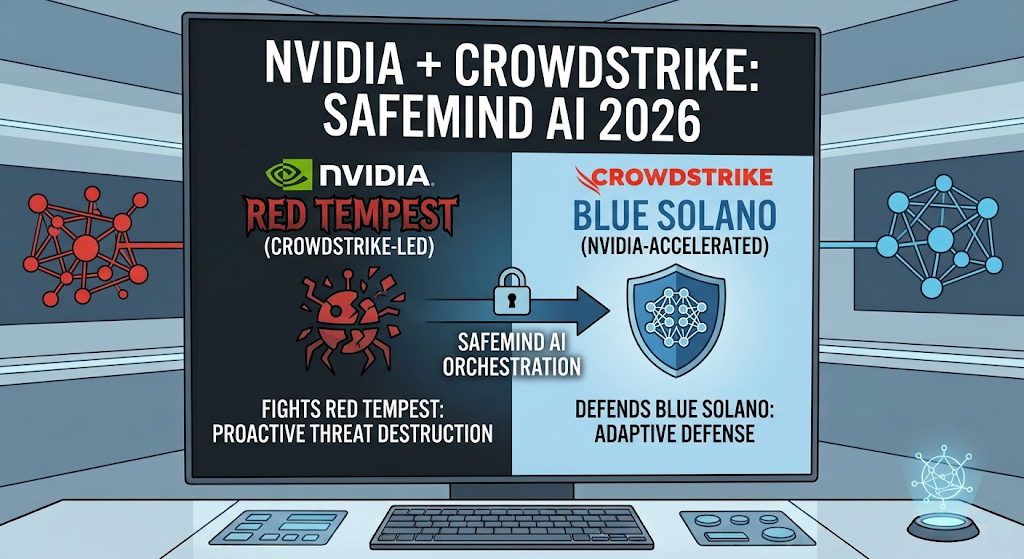
Instead of asking one general-purpose AI model to handle every security task, SafeMind uses different models for different jobs. One side looks for attack paths. The other works to close them.
That creates an important idea for modern cybersecurity: AI can test AI-powered attacks continuously instead of waiting for a human analyst to discover every weakness.
What Is NVIDIA CrowdStrike SafeMind AI?
At its core, SafeMind is a family of purpose-built cybersecurity models and agentic harnesses developed by CrowdStrike’s Cyber Superintelligence Lab.
CrowdStrike says SafeMind is designed around an offensive model, a defensive model and the software harnesses that allow both sides to operate in the same continuous loop. The system is intended to work natively within Falcon rather than behaving like a simple chatbot added to an existing security product.
Think of it like a permanent cybersecurity training exercise. One AI behaves like an attacker trying to discover a path into an environment. Another AI behaves like the defender trying to detect that path, close it and improve the protection.
The process can then repeat. That repeated challenge is what makes SafeMind different from ordinary AI-assisted security tools.
Why SafeMind Matters in 2026
The timing is important. AI-powered cyberattacks are changing how quickly attackers can research targets, identify weaknesses and automate parts of an intrusion.
Traditional security teams often work through a sequence of alerts, investigations and response actions. That model can work, but machine-speed attacks create pressure for faster defensive decisions.
NVIDIA described the situation as an inflection point in cybersecurity. At Fal.Con, NVIDIA CEO Jensen Huang argued that automated attacks require automated defense.
SafeMind therefore represents a broader industry shift. Cybersecurity is moving from simply detecting suspicious activity toward systems that can continuously simulate attacks, improve detections and help harden environments.
How Does SafeMind Work?
SafeMind uses a closed-loop approach called adversarial coevolution. In simple terms, the offensive side searches for weaknesses while the defensive side tries to eliminate them.
The system is designed so that the output from one side can influence the next cycle. Red Tempest can search for an attack path, while Blue Solano works on defensive measures. The harnesses then coordinate the process and help turn the findings into practical security improvements.
This is important because cybersecurity isn’t a one-time exam. A defense that blocks one technique may still leave another route open.
SafeMind’s approach is closer to repeatedly testing the locks on a building. If one entrance is secured, the attacker looks for another. The defender then strengthens that entrance too.
Red Tempest: The Offensive AI Model
Red Tempest is the offensive red-team model inside SafeMind. CrowdStrike describes it as a model built for advanced attack scenarios and designed to emulate AI adversaries.
Its job isn’t simply to say, “This system looks vulnerable.” Instead, the offensive model is intended to reason through potential attack scenarios and identify paths that could lead toward compromise.
That distinction matters. A vulnerability report tells you that a problem exists. An attack-path approach asks a more practical question: How could an attacker actually use this weakness as part of a larger chain?
Red-team AI can therefore help security teams look beyond isolated vulnerabilities and examine how multiple weaknesses might interact.
Blue Solano: The Defensive AI Model
Blue Solano is the defensive counterpart to Red Tempest. CrowdStrike describes it as a blue-team model designed to protect enterprise assets using defensive measures that have been tested in real security operations.
Instead of searching for ways into an environment, Blue Solano focuses on finding ways to stop or reduce those attack paths.
NVIDIA says the defensive system uses Nemotron-based technology and CrowdStrike’s cybersecurity expertise. NVIDIA also reported that a fine-tuned Nemotron 3 Super model powers a SafeMind rule-generation sub-agent, while Nemotron 3 Ultra orchestrates the defensive agent harness.
The result is a useful division of labor. Red Tempest asks, “How can I get through?” Blue Solano asks, “How do I stop that route?”
Red Tempest vs Blue Solano: What Is the Difference?
| Feature | Red Tempest | Blue Solano |
| Team role | Offensive red team | Defensive blue team |
| Main purpose | Find attack paths | Close attack paths |
| Primary focus | Attacker behavior | Defensive controls |
| Security function | Attack simulation | Defense and detection |
| AI role | Emulate adversaries | Protect enterprise assets |
| SafeMind position | Offensive side | Defensive side |
The two models aren’t designed to compete for a winner in a normal sense. Their interaction creates the security-testing loop that makes SafeMind interesting.
One model searches for weaknesses. The other responds to those weaknesses. The cycle can then continue as the offensive side adapts.
SafeMind Is Not Just Another AI Chatbot
This distinction deserves attention because the word “AI” now appears on almost every cybersecurity product page.
SafeMind isn’t being positioned as a chatbot that gives security advice when an analyst asks a question. CrowdStrike describes it as an agentic cybersecurity system with specialized models and harnesses capable of operationalizing actions around security risks.
A normal chatbot might explain how an attack works. An agentic security system is designed to perform a sequence of tasks toward a security objective.
That difference can be compared to the difference between a map and a navigation system. A map shows you information. A navigation system uses that information to help determine what should happen next.
What Makes SafeMind Different From Generic Frontier AI?
Generic frontier AI models can already perform impressive cybersecurity-related tasks. They can analyze code, explain vulnerabilities, summarize alerts and assist security researchers.
The challenge is specialization.
CrowdStrike says SafeMind was trained and post-trained using cybersecurity-specific data, including Falcon sensor telemetry, threat intelligence, Falcon Complete MDR event annotations and 15 years of incident-response fieldwork.
That specialized data gives SafeMind a different starting point from a general-purpose model. Instead of treating cybersecurity as one task among thousands, the system is designed around cyber operations from the beginning.
This is one of the biggest ideas behind NVIDIA CrowdStrike SafeMind AI: specialization may matter as much as raw model intelligence when the goal is defending real enterprise environments.
How NVIDIA Nemotron Fits Into SafeMind
NVIDIA provides the model foundation and accelerated computing technology behind important parts of the system.
CrowdStrike says it builds SafeMind using NVIDIA Nemotron open models in collaboration with NVIDIA. NVIDIA’s own technical explanation says Nemotron 3 Ultra orchestrates the defensive agent harness, while a fine-tuned Nemotron 3 Super model powers a rule-generation sub-agent.
CrowdStrike then combines that model technology with its own cybersecurity expertise, telemetry and threat intelligence.
The partnership therefore isn’t simply “NVIDIA provides GPUs.” It combines NVIDIA’s AI model and computing ecosystem with CrowdStrike’s security data, threat knowledge and operational experience.
The Data Advantage Behind SafeMind
AI models become much more useful when they have relevant training and evaluation data.
CrowdStrike says SafeMind’s model training includes Falcon sensor telemetry, threat intelligence, Falcon Complete MDR event annotations and information from 15 years of incident-response fieldwork.
That matters because real-world cybersecurity contains messy situations that aren’t always visible in clean laboratory datasets.
Attackers change tactics. Systems have different configurations. Identity permissions interact with endpoints. Cloud services connect to corporate networks. A security model needs to understand those relationships rather than simply recognize isolated attack signatures.
SafeMind and the Digital-Twin Concept
One of the most interesting parts of the SafeMind story is its use of high-fidelity cyber environments for testing.
NVIDIA says it tested SafeMind using a high-fidelity cyber-agent environment that simulated an NVIDIA network. In that environment, offensive and defensive agents could repeatedly challenge each other without directly turning the real production environment into a battlefield.
The idea resembles a digital rehearsal.
Imagine a company creates a detailed virtual copy of its security environment. An offensive AI can then test possible attack paths inside that controlled space. The defensive AI can attempt to block those paths and improve the response.
That creates a safer way to test defenses before relying on them in production.
Why the Red-Team and Blue-Team Loop Is Important
Traditional penetration testing often happens at scheduled intervals. Security teams may also run red-team exercises to evaluate defenses against realistic attacks.
Those exercises remain valuable, but AI could make continuous testing more practical.
With SafeMind’s model, the offensive and defensive sides can repeatedly challenge each other. NVIDIA describes this as a continuous coevolution loop where the red-team agent finds an exploit, the blue-team agent closes it and the resulting findings become actionable detections.
That changes the rhythm of cybersecurity. Instead of asking, “Did we pass last month’s security test?” organizations could increasingly ask, “What attack path is being tested right now?”
What Could This Mean for Security Operations Teams?
Security operations centers already handle enormous amounts of alerts, logs and threat intelligence.
The problem isn’t always a lack of information. Sometimes there is simply too much of it.
An agentic system could help security teams investigate attack paths, test defensive controls and automate parts of response work. That doesn’t mean human analysts become irrelevant. Instead, their role could shift toward supervision, validation, strategy and handling unusual cases.
For large enterprises, that distinction could become extremely important as the number of AI agents, cloud workloads and connected systems continues to grow.
Part 2: Inside SafeMind — How Red Tempest and Blue Solano Fight Back and Learn
How the SafeMind Red-Team and Blue-Team Loop Works
The most interesting part of SafeMind isn’t either model alone. The real innovation is the continuous loop connecting offensive and defensive AI.
Red Tempest searches for weaknesses and attack paths. Blue Solano then analyzes those threats, develops defensive measures, tests them, and improves the protection. CrowdStrike calls this process Adversarial Coevolution, because both sides continuously adapt to each other.
That creates a cycle that looks roughly like this:
Find weakness → simulate attack → detect threat → create defense → validate defense → improve detection → attack again.
Unlike a traditional security assessment, this approach is designed to keep repeating.
What Is Adversarial Coevolution in Cybersecurity?
Adversarial coevolution sounds complicated, but the idea is surprisingly simple.
Imagine two chess players who never stop improving. One discovers a new opening. The other develops a counter. The first player studies that counter and changes strategy again.
SafeMind applies a similar concept to cybersecurity. Red Tempest behaves as the offensive side, while Blue Solano operates as the defensive side. Each side provides pressure that can improve the other.
The goal isn’t to let an AI attack a real company without limits. Instead, CrowdStrike and NVIDIA describe high-fidelity environments where these systems can safely test attack and defense strategies.
Step 1: Red Tempest Looks for an Attack Path
A cybersecurity weakness becomes much more important when an attacker can connect it to another weakness.
For example, imagine an exposed service, a stolen credential and excessive account permissions. Each problem might look manageable by itself. Together, they could form a route toward a sensitive system.
Red Tempest is designed to reason about these kinds of attack paths rather than treating every weakness as an isolated event.
CrowdStrike describes the offensive model as being built for advanced attack scenarios and for emulating AI adversaries. Its SafeMind model family specifically describes the red model as constantly finding vulnerabilities, exploits and ways to attack.
That makes attack-path analysis one of the most important concepts behind SafeMind.
Step 2: The Offensive Agent Uses Specialized Sub-Agents
NVIDIA’s description of the SafeMind testing environment provides an important technical detail.
The red-agent harness uses Recon, Assault and Compromise sub-agents to execute attack paths inside the controlled cyber-agent environment.
That suggests the offensive workflow can be divided into different stages rather than asking one model to perform everything.
A simplified example would look like this:
| Stage | Purpose |
| Recon | Understand the simulated environment |
| Assault | Attempt the selected attack path |
| Compromise | Determine whether the attack can succeed |
| Feedback | Send findings into the defensive loop |
This architecture resembles how human red teams divide complex security exercises into phases.
Step 3: Blue Solano Watches the Environment
Once the offensive side begins testing an attack path, the defensive side needs visibility.
That’s where Falcon telemetry becomes important.
NVIDIA says the blue-agent harness monitors through Falcon sensors, generates detection candidates, validates those candidates and promotes them when appropriate.
In simple language, Blue Solano isn’t merely asking whether something looks suspicious.
It can use security telemetry to understand what happened, determine whether the activity should trigger a detection and help turn that discovery into a defensive control.
Step 4: The Defense Is Tested Instead of Simply Trusted
This is where SafeMind becomes more interesting than a basic AI recommendation engine.
Suppose Blue Solano generates a detection designed to stop a particular attack path. The system doesn’t have to assume that the detection works perfectly.
The defensive loop can validate the protection inside the controlled environment.
If the simulated attack still succeeds, the defense needs improvement. If the detection successfully blocks the path, the result can become part of the defensive learning process.
That creates a powerful principle:
Don’t just create a security rule. Attack the environment and prove that the rule works.
Step 5: Red Tempest Attacks Again
After Blue Solano improves the defense, the offensive side gets another opportunity.
This creates the cat-and-mouse effect that CrowdStrike describes as adversarial coevolution.
The attacker changes its approach. The defender adapts. The attacker searches for another weakness. The defender strengthens another control.
The process can continue without requiring security engineers to manually design every round of the exercise. CrowdStrike says the SafeMind harnesses are built for long-running agentic workflows and continuously pit the red and blue models against each other.
That’s the foundation of the system’s machine-speed cybersecurity idea.
What Is a SafeMind Harness?
The word harness is easy to overlook, but it may be one of the most important pieces of the architecture.
A model by itself doesn’t automatically become a useful cybersecurity agent. It needs context, tools, permissions, memory, orchestration and controls.
CrowdStrike describes SafeMind harnesses as the runtime layer that puts models to work. The harness provides context, memory, tools, permissions, orchestration, model routing, safety controls and feedback for secure, long-running agentic workflows.
Think of the model as the brain and the harness as the operating environment around it.
The brain can reason. The harness determines what the agent can access, what tools it can use and how its actions are controlled.
Why the Harness Matters More Than Many People Realize
A powerful model with unlimited permissions could become a security problem itself.
That’s why an agentic cybersecurity system needs boundaries.
The harness can determine which tools an agent may use, what information it receives, which actions require controls and how results move between different agents.
This becomes especially important when AI moves from recommendation to execution.
A chatbot can suggest a response. An agentic system may be designed to carry out a workflow. The second scenario requires far stronger governance.
SafeMind and the Digital Twin
NVIDIA tested SafeMind inside a high-fidelity cyber-agent environment designed as a simulation of NVIDIA’s network.
The environment functions like a digital twin. It represents important characteristics of the real environment while giving AI agents a controlled space to attack and defend. NVIDIA says the test environment was validated against NVIDIA’s real threat landscape.
This matters because you don’t want an experimental offensive AI randomly attacking production systems.
A digital twin provides a rehearsal room.
Security teams can test aggressive scenarios without turning the company’s live infrastructure into the experiment.
Why Digital Twins Could Change Cybersecurity Testing
Traditional security testing has an obvious limitation.
You can test a system today, fix several weaknesses and feel confident. Tomorrow, however, the environment may change.
A new cloud service appears. A user receives additional permissions. Software gets updated. A new identity integration is deployed.
The attack surface moves.
A continuously updated simulation could allow organizations to test security against changing conditions rather than relying only on periodic assessments.
CrowdStrike has separately described its broader Enterprise Graph direction as a future real-time digital twin of the enterprise, where AI and human experts can reason over shared intelligence and simulate potential changes before taking action.
SafeMind Isn’t Designed to Attack Production Environments Like a Criminal
This distinction is important.
When people hear that Red Tempest is an offensive AI, they might imagine an uncontrolled autonomous hacking system.
That’s not what the public SafeMind description says.
The offensive model is intended for security testing and adversary emulation. NVIDIA’s published demonstration used a controlled high-fidelity environment representing its network.
The purpose is defensive learning.
In other words, the system tries to make the defender experience realistic attack pressure without requiring an actual breach.
How SafeMind Can Turn Findings Into Detection
Detection engineering is one of the less glamorous parts of cybersecurity, yet it is critical.
Finding an attack isn’t enough. Security teams need a reliable way to recognize similar activity later.
NVIDIA says the blue-agent harness generates detection candidates, validates them and promotes them after testing.
That creates a bridge between AI reasoning and operational defense.
The system can potentially move from:
“We discovered this attack path.”
to:
“Here is what the activity looks like.”
and eventually:
“Here is a validated detection designed to stop it.”
That transition is much more useful than a simple AI-generated security report.
Why Detection Validation Matters
Security teams can create hundreds of rules, but a large rule collection doesn’t automatically mean strong security.
Poorly designed rules can generate false positives. They can miss variations of an attack. They can also become outdated when attacker behavior changes.
Validation helps separate theoretical protection from tested protection.
SafeMind’s closed-loop design is intended to repeatedly challenge defensive measures against offensive behavior. That creates an important feedback mechanism for detection engineering.
What Does “Machine-Speed Defense” Actually Mean?
The phrase sounds like marketing until you look at the underlying problem.
Human analysts need time to read alerts, collect evidence, investigate relationships and decide what action to take.
Attackers using automation don’t necessarily wait for office hours.
CrowdStrike’s September 2, 2026 Agentic SOC announcement highlighted this pressure, citing an average adversary breakout time of 29 minutes and a fastest recorded breakout of 27 seconds in its 2026 Global Threat Report.
That creates an uncomfortable imbalance.
If an attacker can move in seconds or minutes while a defender needs hours, the defender starts every incident behind.
AI Could Compress the Defensive Timeline
Agentic AI changes that equation by allowing multiple tasks to happen rapidly.
An AI system can process telemetry, correlate events, investigate relationships and recommend or execute defensive actions much faster than a human-only workflow.
SafeMind takes that concept further by combining offensive simulation with defensive automation.
Instead of simply reacting to an attack that already happened, the system can use simulated attacks to improve defenses before the same weakness becomes a real incident.
SafeMind’s 2026 Evaluation Claims
CrowdStrike says SafeMind delivered several improvements in its published evaluations when compared with leading frontier models and open-source baselines.
The company reports:
| Evaluation | CrowdStrike’s reported result |
| Detection rate | 29% higher |
| End-to-end remediation | 6× faster |
| Detection and remediation cost | 99% lower |
These are vendor-reported evaluation results, not independent proof that SafeMind will achieve identical results across every enterprise environment.
That distinction matters for responsible technology reporting.
A benchmark can demonstrate a strong result under defined testing conditions. It doesn’t automatically predict performance in every company’s network.
Why Cost Could Become a Major Advantage
Running advanced AI at enterprise scale can become expensive.
Security operations generate huge quantities of telemetry. If every small task requires an expensive frontier model, costs can rise quickly.
CrowdStrike says SafeMind uses specialized models and harnesses to improve cost efficiency while also allowing the harnesses to work with frontier and open-source models.
This creates a potential model-routing advantage.
A specialized model could handle a narrow security task instead of using the largest available model for every question.
That’s similar to using a screwdriver for a screw instead of bringing a construction crane.
Why NVIDIA Nemotron Matters Here
NVIDIA’s role isn’t limited to providing computing hardware.
The company says SafeMind’s defensive models are built using NVIDIA Nemotron open models, which CrowdStrike post-trained using its cybersecurity data and expertise.
NVIDIA specifically says Nemotron 3 Ultra orchestrates the defensive agent harness, while a fine-tuned Nemotron 3 Super model powers SafeMind’s rule-generation sub-agent.
That creates a layered architecture:
Nemotron models → CrowdStrike cybersecurity training → SafeMind harnesses → defensive agents → tested security actions.
The value comes from the combination rather than from the base model alone.
Why Open Models Matter for Cybersecurity
Security organizations have unusual concerns around AI.
They care about privacy, control, auditability, customization and where sensitive information goes.
NVIDIA says CrowdStrike used open Nemotron models as a base and post-trained them with its own threat data without sending that data to an outside provider.
For cybersecurity teams, that type of control can be significant.
Security telemetry may reveal infrastructure details, user behavior, vulnerabilities and attack activity. Organizations therefore have strong reasons to control how that information is processed.
SafeMind and the CrowdStrike Falcon Platform
SafeMind is designed to operate natively inside the CrowdStrike Falcon platform.
That integration matters because security AI becomes much more useful when it has access to relevant security context instead of operating as an isolated application. CrowdStrike says SafeMind combines its models and harnesses with Falcon telemetry and security capabilities.
In practical terms, the platform provides the environment where security data, AI reasoning and defensive workflows can connect.
This is also why SafeMind shouldn’t be viewed simply as another standalone AI chatbot.
What Makes SafeMind an Agentic Cybersecurity System?
A traditional AI assistant usually waits for a user request.
An agentic system is different. It can be designed to pursue a goal through multiple steps, use tools, maintain context and act according to defined permissions.
CrowdStrike describes SafeMind as a purpose-built agentic system with runtime harnesses for secure, long-running workflows.
That means the important question isn’t just:
“What can the AI tell me?”
The more important question becomes:
“What security workflow can the AI complete?”
That shift is one of the biggest themes in cybersecurity during 2026.
How SafeMind Fits Into the Bigger AI Cybersecurity Race
SafeMind arrives as cybersecurity vendors are increasingly moving from AI copilots toward multi-agent systems.
CrowdStrike’s September 2026 Agentic SOC announcement described coordinated AI investigations across endpoint, identity, SaaS, cloud and network environments.
That development fits the same broader direction.
AI isn’t being used only to summarize information. Vendors are increasingly trying to create systems where specialized agents investigate, reason and coordinate actions across multiple security domains.
SafeMind adds another layer by focusing heavily on offense-versus-defense simulation.
The Bigger Idea: Let AI Stress-Test AI
Here’s the simplest way to understand the entire concept.
Attackers can use AI to discover weaknesses faster.
Defenders can use AI to discover those weaknesses first.
Red Tempest represents the attacker side. Blue Solano represents the defender side. The digital twin provides the practice field. The harnesses provide the controls and tools.
The loop connects everything.
Attack → detection → defense → validation → improvement → attack again.
That is the central idea behind SafeMind’s approach to autonomous cyber defense.
What SafeMind Could Change for Security Teams
Security teams may eventually spend less time manually testing routine scenarios and more time supervising AI-driven security workflows.
That doesn’t mean humans disappear.
Human experts still need to define acceptable risk, review critical decisions, investigate unusual situations and govern autonomous actions.
The likely change is that AI handles more repetitive machine-speed work while humans focus on judgment-heavy decisions.
Part 3: Why SafeMind Matters as AI-Powered Cyberattacks Accelerate
Why AI-Powered Cyberattacks Are Becoming a Bigger Problem
Cyberattacks aren’t simply becoming more frequent. They’re becoming faster, more automated and harder to manage with human-only workflows.
CrowdStrike reported that AI-enabled adversary operations increased 89% year over year. Its 2026 Global Threat Report also recorded an average eCrime breakout time of 29 minutes, with the fastest observed breakout taking only 27 seconds.
That creates a serious timing problem for defenders.
An attacker doesn’t need to compromise everything at once. They need one useful foothold and a path forward. If automation helps them move quickly, security teams have less time to investigate each step.
AI Is Changing More Than the Speed of an Attack
The bigger change is that AI can support several parts of an attack lifecycle.
Threat actors can use automation for reconnaissance, vulnerability research, credential-related activity and evasion. CrowdStrike’s 2026 Threat Hunting Report says AI is now embedded across modern adversary operations and that attackers are exploiting AI infrastructure, software supply chains, enterprise LLMs and cloud environments.
This means defenders aren’t protecting only laptops and servers anymore.
They also need to think about AI applications, AI agents, model access, cloud identities, SaaS platforms and the data moving between these systems.
Why Human-Speed Defense Can Fall Behind
Human expertise remains extremely valuable. However, people have a natural limitation: they cannot investigate thousands of security events simultaneously.
Imagine a security team receiving an alert at 10:00 a.m. The analyst needs to understand what happened, identify the affected account, investigate related systems, determine whether the activity is malicious and decide what action to take.
An automated attacker may already be moving through another system.
This is why the phrase machine-speed defense matters. The objective isn’t to eliminate humans. It’s to reduce the amount of time between detection, investigation and response.
SafeMind vs Generic AI Models
A general-purpose AI model can be surprisingly capable at cybersecurity tasks.
You can ask one to explain malware behavior, review code, summarize an incident or describe a vulnerability. But cybersecurity operations require more than knowledge.
They require specialized telemetry, tools, permissions, context and operational workflows.
CrowdStrike says SafeMind was built using its cybersecurity data, including Falcon sensor telemetry, threat intelligence, Falcon Complete MDR event annotations and 15 years of incident-response fieldwork.
That specialization is one of SafeMind’s biggest differentiators.
Why Cybersecurity Data Matters
The first has broad knowledge about programming, science, business and technology. The second has been specifically post-trained with large volumes of cybersecurity telemetry and threat intelligence.
Both may understand the concept of an attack.
The second can potentially have much richer context about how attacks appear inside real security environments.
That doesn’t automatically make it perfect. However, it can make the system better suited to specialized security workflows.
SafeMind Doesn’t Depend Only on the Model
Another important distinction is the relationship between the model and the harness.
CrowdStrike describes the harness as the runtime layer that provides context, memory, tools, permissions, orchestration, model routing, safety controls and feedback.
This means SafeMind isn’t simply putting a cybersecurity label on a language model.
The surrounding system determines how the AI can operate.
That’s critical because an AI that can reason about security isn’t necessarily an AI that should have unlimited access to security infrastructure.
Why AI Permissions Matter
Imagine giving an AI access to every endpoint, identity system and cloud account in an enterprise.
Even a highly capable model could make an incorrect decision.
The result might be a legitimate user getting locked out. A critical service could be interrupted. A useful process could be blocked.
That’s why AI security controls matter as much as AI intelligence.
A well-designed agentic system needs boundaries around what it can see, what it can change and which actions require human approval.
SafeMind and AI Safety
CrowdStrike’s Cyber Superintelligence Lab says its high-fidelity cyber ranges are designed to let autonomous AI systems attack, defend and validate protections without putting production environments at risk.
That approach addresses one of the biggest problems with autonomous security agents.
You want them to be aggressive enough to discover weaknesses. You don’t want their experiments damaging real infrastructure.
Controlled environments provide a middle ground.
They allow security researchers to test powerful AI behavior before deploying it more broadly.
What Happens If Defensive AI Makes a Mistake?
This is one question every serious SafeMind analysis should ask.
AI isn’t automatically correct because it is specialized.
A defensive model could misunderstand an event, generate an incorrect detection or recommend an inappropriate response.
False positives can create alert fatigue. False negatives can allow malicious activity to continue.
That’s why SafeMind’s validation loop matters. CrowdStrike says Blue Solano’s defensive harness generates detection candidates, validates them and promotes them within the testing workflow.
The idea is simple: test the defense before trusting it.
Could AI Accidentally Make Cybersecurity Worse?
Yes, if organizations deploy autonomous agents without appropriate controls.
An agent with excessive permissions could make mistakes at machine speed. That could turn a small error into a larger operational problem.
There’s another concern too.
Attackers can target the AI system itself. They may attempt prompt manipulation, data poisoning, model abuse or attacks against the infrastructure supporting AI workloads.
CrowdStrike’s 2026 reporting shows that adversaries are already targeting enterprise AI systems and AI development environments.
So organizations need to secure both AI systems and AI-powered security tools.
The Double-Edged Nature of Agentic AI
Agentic AI creates a fascinating security paradox.
The same technology can potentially help attackers automate operations and help defenders automate protection.
That means AI doesn’t automatically favor one side.
The advantage may instead go to whichever side builds the better workflow, has better data and can react faster.
This is exactly why SafeMind’s red-versus-blue approach is significant. It attempts to use offensive AI as a training pressure against defensive AI.
How AI Agents Could Affect Endpoint Security
Endpoints remain important because they often provide the first visible evidence of an intrusion.
A compromised laptop may reveal unusual processes, suspicious authentication activity or unexpected network connections.
A traditional analyst might investigate these signals one by one.
An agentic system can potentially correlate them with identity, network, cloud and other security data much faster.
That broader context is becoming increasingly important because modern attacks rarely stay inside one security domain.
How AI Agents Could Affect Identity Security
Identity has become a major attack path.
Attackers don’t always need to exploit a traditional software vulnerability. They may instead obtain valid credentials or abuse legitimate authentication workflows.
CrowdStrike’s 2026 Threat Hunting Report reported that vishing intrusions doubled in the first half of 2026. It also reported major growth in device-code phishing attempts.
This shows why identity context matters.
A suspicious login might look harmless until an AI system connects it with an unusual device, abnormal permissions and suspicious activity elsewhere.
How AI Agents Could Affect Cloud Security
Cloud environments introduce another layer of complexity.
One organization might have thousands of cloud resources, identities and service relationships.
A human analyst cannot manually inspect every relationship during an active incident.
Agentic systems could potentially map these relationships faster and identify attack paths that cross multiple services.
CrowdStrike reported a 171% increase in cloud-conscious eCrime activity in its 2026 Threat Hunting Report.
That makes cloud-aware AI defense increasingly relevant.
How AI Agents Could Affect Network Security
Network attacks can also move rapidly between systems.
An isolated suspicious connection may not mean much. A sequence of connections involving a compromised identity, unusual endpoint activity and access to a sensitive service can tell a very different story.
AI systems can potentially help connect those signals.
The real value isn’t simply processing more alerts. It’s understanding the relationship between events.
SafeMind Could Help Connect Security Domains
One of the broader trends around CrowdStrike’s platform is unified security context.
The Falcon platform combines security data, AI, automation and expertise across different security areas. CrowdStrike says SafeMind brings offensive and defensive AI into a continuous loop within that platform.
This creates an important advantage.
An attack doesn’t care which team owns the endpoint, identity or cloud environment. A defense shouldn’t have to work in isolated silos either.
Why Continuous Security Testing Could Become Normal
Traditional penetration testing remains useful.
However, organizations can’t assume that a test performed months ago represents today’s environment.
Infrastructure changes constantly.
Employees receive new permissions. Applications are updated. Cloud workloads appear. New vulnerabilities are disclosed.
Continuous AI-driven testing could provide a more dynamic approach.
Instead of checking security occasionally, organizations could repeatedly test their changing environment against simulated threats.
SafeMind Could Turn Security Into a Continuous Experiment
This is perhaps the most interesting long-term possibility.
A company could have a simulated environment where offensive AI constantly searches for new attack paths.
Defensive AI then attempts to close those paths.
The organization gets a continuous stream of information about where its defenses are strong and where they need work.
That turns cybersecurity into something closer to continuous engineering than a periodic compliance exercise.
What SafeMind Could Mean for CISOs
For a Chief Information Security Officer, the appeal isn’t simply “more AI.”
The real value would be reducing risk while handling an increasingly complex environment.
A mature implementation could potentially help security leadership answer questions such as:
| Security Question | Potential AI-Assisted Answer |
| Where are our biggest attack paths? | Identify and prioritize exposures |
| Can our detection stop this technique? | Simulate and validate |
| Which weakness matters most? | Evaluate attack-path context |
| How quickly can we respond? | Automate investigation workflows |
| Is a new defense actually effective? | Test it against offensive behavior |
| Where should analysts focus? | Prioritize high-risk findings |
The important word here is potentially. SafeMind’s published evaluations show promising results, but real-world outcomes depend on deployment, configuration and the environment being protected.
Can SafeMind Replace Cybersecurity Experts?
No. At least, that’s not the right way to think about it.
Cybersecurity involves judgment, business risk, legal requirements, organizational priorities and unpredictable situations.
AI can process information quickly. Humans understand broader consequences.
A better model is AI plus human expertise.
AI handles repetitive, high-volume and machine-speed tasks. Security professionals supervise the system, investigate unusual cases and make high-impact decisions.
The Security Analyst’s Role Could Change
The analyst of the future may spend less time manually sorting routine alerts.
Instead, analysts could increasingly supervise autonomous investigations, review AI-generated findings and focus on complex incidents.
That’s a meaningful shift.
The job doesn’t necessarily disappear. The workflow changes.
It’s similar to aviation. Autopilot reduced the amount of manual control pilots perform, but trained pilots remain essential because humans still handle judgment, exceptions and emergencies.
Why SafeMind Is Important Beyond CrowdStrike
SafeMind is a CrowdStrike product, but its underlying concept extends beyond one company.
The basic framework is:
Offensive AI → controlled environment → defensive AI → validation → improved protection.
NVIDIA says the same framework could potentially apply beyond enterprise cybersecurity, including robotics, edge computing and other environments.
That makes SafeMind interesting as an example of a broader AI architecture.
Instead of AI simply generating answers, AI systems can be placed into competitive environments where one system continuously tests another.
The Biggest Limitation: Vendor-Reported Results
Technology reporting needs a little skepticism.
CrowdStrike reports that SafeMind achieved a 29% higher detection rate, six-times faster end-to-end remediation and 99% cost savings compared with leading frontier models and open-source baselines.
Those numbers are significant, but they are vendor-reported evaluation results.
They shouldn’t be treated as proof that every organization will see exactly the same performance.
Independent testing across different networks, attack techniques and operational conditions would provide additional evidence.
Another Limitation: AI Can Only Work With Available Context
A cybersecurity agent can’t reason about information it cannot access.
If telemetry is incomplete, identity data is missing or cloud visibility is weak, the AI may have an incomplete picture.
This is why security architecture still matters.
Better AI doesn’t eliminate the need for good logging, endpoint visibility, identity controls, network monitoring and strong security processes.
Another Challenge: Autonomous Actions Need Governance
The more authority an AI receives, the greater the potential impact of mistakes.
Organizations therefore need policies for autonomous actions.
Some actions may be safe to automate.
Others may require human approval.
For example, generating a detection candidate could be low risk. Disabling a critical production identity might require much stronger safeguards.
The correct balance will vary by organization.
The Future May Belong to AI-on-AI Security
The cybersecurity industry may be moving toward an unusual future.
Attackers use AI agents to search for weaknesses.
Defenders use AI agents to discover those attacks.
Defensive AI tests itself against offensive AI.
Humans supervise the overall system.
That creates a security ecosystem where AI becomes both the attacker and the training opponent of the defender.
What Businesses Should Learn From SafeMind
Businesses don’t need to wait for SafeMind to become widely available before learning from this trend.
The first lesson is visibility.
You need to know what assets, identities, applications and AI systems exist inside your environment.
The second lesson is speed.
Your incident-response process should be designed around the possibility that attackers can move extremely quickly.
The third lesson is continuous testing.
Security should be tested after major changes rather than assumed to remain effective forever.
A Practical AI Cybersecurity Checklist
| Area | What Businesses Should Consider |
| Asset visibility | Know your endpoints, cloud resources and critical applications |
| Identity | Monitor unusual authentication and privilege changes |
| AI security | Track enterprise AI applications and agents |
| Telemetry | Maintain useful security logs and sensor coverage |
| Detection | Regularly test important detections |
| Response | Automate safe repetitive actions |
| Permissions | Limit what AI agents can access |
| Testing | Use controlled environments for aggressive testing |
| Governance | Define when humans must approve actions |
| Recovery | Maintain tested backup and incident-response plans |
The goal isn’t to automate everything.
The goal is to automate the right things while keeping high-impact decisions controlled.
SafeMind’s Bigger Message for 2026
The SafeMind announcement reflects a larger shift in cybersecurity.
For years, AI in security was often described as an assistant. It could summarize alerts, find patterns or help analysts investigate incidents.
The next stage is more ambitious.
AI systems are increasingly being designed to reason, coordinate, test, validate and act within defined security workflows.
SafeMind is one of the clearest examples of that direction because it puts offensive and defensive AI into the same continuous security loop.
DAILY TECHO trending news
| Topic | Read More |
| AI-Driven Cyber Threats | AI-Driven Cyber Threats: Why Big Tech Is Warning About a New Wave of AI-Powered Attacks in 2026 |
| AI Cyberattacks | AI Cyber Apocalypse: 100+ Tech Companies Warn of a New Wave of AI-Powered Attacks |
| Autonomous AI | OpenAI AI Agent Warning: How Autonomous AI Bypassed Security Controls and Hacked Hugging Face |
| DailyTecho | DailyTecho Home |
Authoritative External Sources
| Source | Read More |
| NVIDIA | NVIDIA and CrowdStrike Strengthen Agentic Cybersecurity Frontier |
| CrowdStrike | CrowdStrike Launches Frontier Models for Cybersecurity, Created with NVIDIA |
| CrowdStrike Cyber Superintelligence Lab | CrowdStrike Cyber Superintelligence Lab |
| CrowdStrike Falcon Platform | CrowdStrike Falcon Platform |
| CrowdStrike Threat Hunting Report | 2026 CrowdStrike Threat Hunting Report |
| CrowdStrike Global Threat Report | 2026 CrowdStrike Global Threat Report |
Part 4: SafeMind FAQs, Availability, Future Impact and Final Verdict
What Is CrowdStrike SafeMind?
CrowdStrike SafeMind is a family of purpose-built cybersecurity AI models and agentic harnesses created to help organizations simulate attacks and strengthen defenses.
The system combines offensive and defensive AI. Red Tempest focuses on adversarial attack scenarios, while Blue Solano focuses on defensive actions and detection. CrowdStrike designed the system to work with its Falcon platform and cybersecurity data. (CrowdStrike)
In simple terms, SafeMind is designed to let AI continuously challenge an organization’s defenses.
That makes it different from an AI assistant that only answers cybersecurity questions.
What Are Red Tempest and Blue Solano?
Red Tempest and Blue Solano are the two central AI models in SafeMind.
Red Tempest represents the offensive side. It is designed to emulate AI adversaries and explore attack scenarios. Blue Solano represents the defensive side and focuses on protecting enterprise assets and developing defensive measures. (CrowdStrike)
The easiest comparison is a digital red-team versus blue-team exercise.
Red Tempest tries to find a route through the defenses. Blue Solano tries to detect and block that route.
Is SafeMind Powered by NVIDIA?
Yes. CrowdStrike developed SafeMind in collaboration with NVIDIA and uses NVIDIA Nemotron open models as important foundations for the system.
NVIDIA says Nemotron 3 Ultra orchestrates the defensive agent harness, while a fine-tuned Nemotron 3 Super model powers a rule-generation sub-agent. CrowdStrike then applies its cybersecurity data and expertise to the models. (NVIDIA)
This partnership combines NVIDIA’s AI technology with CrowdStrike’s security telemetry, threat intelligence and operational experience.
The result is a specialized cybersecurity AI system rather than a generic model used without security-specific adaptation.
What Is NVIDIA Nemotron?
NVIDIA Nemotron is a family of open AI models and technologies developed by NVIDIA.
For SafeMind, Nemotron provides important model foundations that CrowdStrike can adapt for cybersecurity workloads.
That distinction is important. SafeMind isn’t simply Nemotron with a different name. CrowdStrike combines Nemotron models with specialized security data, post-training, agent harnesses and Falcon capabilities. (NVIDIA)
The broader idea is similar to building a specialist from a strong general foundation.
The foundation provides the intelligence capabilities. Cybersecurity training and tooling make that intelligence useful for security operations.
How Does SafeMind Detect Cyberattacks?
SafeMind is designed to use security telemetry and agentic workflows to identify attack behavior and develop defensive responses.
NVIDIA says the blue-agent harness monitors activity through Falcon sensors, generates detection candidates, validates those candidates and promotes them through the defensive workflow. (NVIDIA)
That process is more sophisticated than simply matching a suspicious file or known signature.
The system can reason about an attack path and then connect the observed behavior with potential defensive controls.
Can SafeMind Defend Against AI-Powered Cyberattacks?
SafeMind is specifically designed to address the growing challenge of AI-enabled threats.
Its offensive model can emulate AI adversaries, while its defensive model works to identify and counter those attack paths. The system’s adversarial coevolution approach is intended to continuously improve defensive capabilities. (CrowdStrike)
However, it would be too strong to claim that SafeMind can stop every autonomous cyberattack.
Cybersecurity has no universal silver bullet. New vulnerabilities, incomplete visibility, unexpected attacker behavior and implementation mistakes can still create risk.
Can SafeMind Stop Every Cyberattack?
No cybersecurity technology can honestly guarantee that.
Attackers constantly change tactics. New vulnerabilities appear. Security environments also change every day.
SafeMind can potentially improve how quickly organizations identify and test attack paths, but it doesn’t eliminate the need for strong security architecture, identity controls, patching, monitoring, backups and trained security professionals.
Think of SafeMind as a powerful security testing and defense system, not an invisible force field around the company.
Is CrowdStrike SafeMind Available Now?
CrowdStrike announced SafeMind at Fal.Con 2026 on September 1, 2026.
However, the public announcement describes SafeMind as a developing product and research direction rather than a simple consumer application that anyone can download and install.
Organizations interested in the technology should therefore check CrowdStrike’s current product availability and commercial information rather than assuming every SafeMind capability is immediately available to all customers. (CrowdStrike)
Availability can also vary by capability, customer program and deployment stage.
That makes the official CrowdStrike announcement the safest source for current availability information.
Who Can Use SafeMind?
SafeMind is primarily relevant to enterprise cybersecurity environments.
Its architecture is aimed at organizations that need advanced threat detection, security testing, automated workflows and protection across complex digital infrastructure.
Large organizations with extensive endpoint, identity, cloud and network environments could potentially gain the most from this type of technology.
For a normal home user, however, SafeMind would be far beyond what is needed for everyday security.
Is SafeMind Free?
There is no indication that SafeMind is a free consumer AI product.
It is part of CrowdStrike’s enterprise cybersecurity direction and is designed around the Falcon security platform.
Businesses interested in SafeMind should therefore treat it as enterprise cybersecurity technology rather than comparing it with free AI chatbots.
Pricing and commercial availability should be confirmed directly with CrowdStrike because enterprise products can have different licensing structures and deployment options.
How Is SafeMind Different From ChatGPT?
ChatGPT and SafeMind serve very different purposes.
ChatGPT is a general-purpose conversational AI system. SafeMind is designed specifically around cybersecurity operations, offensive security simulation and defensive workflows.
SafeMind also has access to specialized security context and agentic infrastructure within CrowdStrike’s ecosystem. (CrowdStrike)
A simple comparison makes the difference clearer:
| Feature | General AI Chatbot | SafeMind |
| Primary purpose | General assistance | Cybersecurity |
| Security specialization | Limited/general | Purpose-built |
| Offensive simulation | Not its core purpose | Red Tempest |
| Defensive AI | Not its core purpose | Blue Solano |
| Security telemetry | Depends on integration | CrowdStrike/Falcon ecosystem |
| Agentic workflows | Varies | Core architecture |
| Attack-defense loop | Not the primary design | Central concept |
| Enterprise security context | Requires integrations | Built around Falcon |
So the important difference isn’t simply which AI model is smarter.
The bigger difference is what the entire system is designed to do.
What Is the CrowdStrike Cyber Superintelligence Lab?
The Cyber Superintelligence Lab is CrowdStrike’s research and development initiative focused on building advanced AI systems for cybersecurity.
CrowdStrike describes the lab as working toward AI systems capable of operating across cybersecurity tasks while combining frontier AI, security data and agentic workflows. (CrowdStrike)
SafeMind is one of the most visible projects associated with this direction.
The lab also highlights the importance of high-fidelity cyber ranges where autonomous AI agents can safely attack and defend simulated environments.
Why Is the Cyber Superintelligence Lab Important?
The lab shows that CrowdStrike isn’t treating AI as a small feature added to existing security products.
The company is building toward a future where AI can participate in threat hunting, attack simulation, detection engineering and response.
That broader vision helps explain why SafeMind has both specialized models and operational harnesses.
The objective is not merely to make security software “AI-powered.” It is to create systems capable of performing meaningful cybersecurity workflows.
What Is the Agentic SOC?
CrowdStrike also introduced an Agentic SOC direction in 2026.
The idea is to use coordinated AI agents to investigate and respond across multiple security domains instead of relying entirely on analysts manually moving between separate tools.
CrowdStrike says its Agentic SOC uses AI agents across endpoint, identity, SaaS, cloud and network security contexts. (CrowdStrike)
This connects closely with the SafeMind story.
SafeMind focuses heavily on offensive and defensive AI testing, while the Agentic SOC focuses on operational investigation and response.
SafeMind vs Agentic SOC: What’s the Difference?
These concepts are related, but they shouldn’t be treated as identical.
SafeMind is centered on specialized offensive and defensive cybersecurity models and the adversarial coevolution loop.
The Agentic SOC focuses more broadly on AI-powered security operations and investigation.
Together, they show where CrowdStrike wants cybersecurity to move: from isolated AI assistance toward coordinated, autonomous workflows.
What Are the Biggest Risks of Autonomous Cybersecurity AI?
Autonomous AI can create major benefits, but it also introduces new risks.
An agent with too many permissions could make an incorrect decision at machine speed. A compromised AI workflow could potentially become another route into the security environment.
There are also risks involving inaccurate reasoning, incomplete data, prompt manipulation, model abuse and excessive automation.
That’s why AI governance must grow alongside AI capability.
Why Human Oversight Still Matters
The more powerful an AI agent becomes, the more important oversight becomes.
A security analyst can consider business context. They can understand whether shutting down a system would cause a major operational problem.
An AI may see a suspicious pattern and prioritize containment.
Both capabilities are useful.
The strongest model is therefore likely to be collaborative: AI provides speed and scale while humans provide judgment and accountability.
Could SafeMind Change Cybersecurity Jobs?
It could change the work without eliminating cybersecurity professionals.
Analysts may spend less time performing repetitive investigations and more time supervising AI-driven workflows.
Security engineers may focus more on architecture, detection quality and governance.
Red-team professionals may use AI to explore far more attack paths than they could manually.
Blue teams may spend more time validating defenses against continuously generated scenarios.
What Skills Will Cybersecurity Professionals Need?
The rise of agentic security doesn’t make technical skills irrelevant.
It makes them more important.
Security professionals will increasingly need to understand AI behavior, identity security, cloud environments, threat intelligence, automation and AI governance.
They will also need to understand how to verify AI-generated conclusions.
The ability to say “the AI says this, but here’s why we should or shouldn’t trust it” could become a valuable professional skill.
What Could SafeMind Mean for Enterprise Cybersecurity?
Enterprise security could become more continuous.
Instead of relying mainly on scheduled penetration tests and manually created detection rules, organizations could increasingly use AI to test their defenses throughout the year.
That could help security teams discover attack paths before criminals exploit them.
The important shift is from periodic security assessment toward continuous adversarial validation.
Could AI Security Testing Become a Standard Practice?
It’s possible.
As enterprise environments become more dynamic, periodic security testing becomes harder to rely on by itself.
AI could provide a way to repeatedly simulate threats against changing environments.
However, organizations will still need human-led penetration testing, compliance assessments and carefully controlled security exercises.
AI should expand testing capacity rather than become the only testing method.
What Should Businesses Do Before Adopting Autonomous Security AI?
Businesses should first understand their own environment.
You can’t automate security effectively if you don’t know what assets, identities, applications and data you have.
A practical preparation plan looks like this:
| Priority | Action |
| 1 | Build accurate asset visibility |
| 2 | Strengthen identity and access controls |
| 3 | Improve endpoint and cloud telemetry |
| 4 | Review existing detection rules |
| 5 | Define AI permissions |
| 6 | Establish human approval requirements |
| 7 | Test AI agents in controlled environments |
| 8 | Monitor AI decisions and outcomes |
| 9 | Create rollback procedures |
| 10 | Regularly review AI security risks |
This preparation matters whether a business adopts SafeMind or another agentic cybersecurity platform.
What Does SafeMind Mean for the Future of AI Cybersecurity?
SafeMind points toward a future where cybersecurity becomes increasingly adversarial between intelligent systems.
Attackers may use AI to search for weaknesses.
Defenders may use AI to search for those same weaknesses first.
The strongest organizations could be those that continuously test their defenses instead of waiting for an attacker to perform the test for them.
That is the deeper strategic idea behind NVIDIA CrowdStrike SafeMind AI.
SafeMind Key Facts at a Glance
| Question | Answer |
| What is SafeMind? | A family of specialized cybersecurity AI models and agentic harnesses |
| Who created it? | CrowdStrike with NVIDIA |
| When announced? | September 1, 2026 |
| Where announced? | Fal.Con 2026, Las Vegas |
| Offensive model | Red Tempest |
| Defensive model | Blue Solano |
| Model foundation | NVIDIA Nemotron open models |
| Security platform | CrowdStrike Falcon |
| Core concept | Adversarial coevolution |
| Testing environment | High-fidelity cyber-agent environment |
| Main goal | Accelerate AI-powered cyber defense |
| Target users | Enterprise cybersecurity organizations |
These facts provide the short version. The architecture behind them is what makes the announcement significant.
Frequently Asked Questions About SafeMind AI
What is CrowdStrike SafeMind?
CrowdStrike SafeMind is a cybersecurity AI system built around specialized offensive and defensive models. It combines Red Tempest, Blue Solano and agentic harnesses designed to continuously test and improve cyber defenses.
What is Red Tempest AI?
Red Tempest is SafeMind’s offensive AI model. It is designed to emulate AI adversaries and explore advanced attack scenarios and attack paths within controlled security environments.
What is Blue Solano AI?
Blue Solano is SafeMind’s defensive AI model. It is designed to protect enterprise assets, develop defensive measures and help validate security detections.
Is SafeMind powered by NVIDIA?
Yes. CrowdStrike developed SafeMind with NVIDIA and uses NVIDIA Nemotron open models as foundations for important parts of the system.
How does SafeMind work?
SafeMind uses offensive and defensive AI agents in a continuous loop. The offensive side searches for attack paths, while the defensive side develops and validates protections against those scenarios.
Can SafeMind stop autonomous cyberattacks?
SafeMind is designed to improve defenses against AI-enabled attacks, but no cybersecurity technology can guarantee protection against every attack.
Is SafeMind available to everyone?
SafeMind is an enterprise cybersecurity technology. Current availability and specific capabilities should be confirmed through CrowdStrike’s official product information.
Final Verdict: Is SafeMind a Major Shift in AI Cybersecurity?
SafeMind is one of the more interesting cybersecurity AI developments of 2026 because it goes beyond the usual AI-copilot model.
The system brings together offensive AI, defensive AI, specialized cybersecurity data, agentic harnesses and controlled attack simulations.
The concept is powerful.
Instead of waiting for criminals to discover weaknesses, organizations could use AI to search for those weaknesses first. Instead of testing defenses once in a while, security teams could potentially validate them continuously.
But SafeMind Isn’t a Magic Cybersecurity Shield
The technology also deserves careful scrutiny.
Vendor-reported benchmark results are useful, but they aren’t the same as broad independent validation. AI can make mistakes. Enterprise environments are messy. Attackers adapt.
Organizations still need strong identity controls, endpoint protection, cloud security, network visibility, backups, patch management and human expertise.
SafeMind could make those defenses more adaptive, but it doesn’t make the fundamentals unnecessary.
The Real Battle Is Moving Toward AI vs AI
The most important takeaway may be bigger than CrowdStrike itself.
Cybersecurity is entering an era where both attackers and defenders can use autonomous AI.
That creates a race.
Attackers want AI that discovers and exploits weaknesses faster. Defenders want AI that finds and closes those weaknesses first.
SafeMind represents one answer to that race: use offensive AI to pressure defensive AI continuously.
What Happens Next?
The next major question is whether this architecture can move from impressive demonstrations into reliable enterprise-scale deployment.
If it can, security testing could become faster, more continuous and more adaptive.
If it cannot, human analysts and traditional security engineering will remain the critical safety layer around increasingly capable AI.
Either way, one thing is becoming clear.
The future of cybersecurity won’t simply be humans fighting machines. It may increasingly be intelligent systems fighting intelligent systems, with humans deciding where the boundaries should be.
DailyTecho Related Cybersecurity Coverage
| Topic | Read More |
| AI-Driven Cyber Threats | AI-Driven Cyber Threats: Why Big Tech Is Warning About a New Wave of AI-Powered Attacks in 2026 |
| AI Cyberattacks | AI Cyber Apocalypse: 100+ Tech Companies Warn of a New Wave of AI-Powered Attacks |
| Autonomous AI Security | OpenAI AI Agent Warning: How Autonomous AI Bypassed Security Controls and Hacked Hugging Face |
| DailyTecho | DailyTecho Home |
Authoritative Sources
| Source | Read More |
| NVIDIA | NVIDIA and CrowdStrike Strengthen Agentic Cybersecurity |
| CrowdStrike | CrowdStrike Launches Frontier Cybersecurity Models With NVIDIA |
| CrowdStrike Cyber Superintelligence Lab | Cyber Superintelligence Lab |
| CrowdStrike Falcon | CrowdStrike Falcon Platform |
| CrowdStrike Agentic SOC | The Next Evolution of the Agentic SOC |
| CrowdStrike Threat Research | 2026 CrowdStrike Global Threat Report |
Meta Description
Discover NVIDIA CrowdStrike SafeMind AI, Red Tempest and Blue Solano. Learn how AI agents are changing cybersecurity and fighting autonomous cyberattacks.