

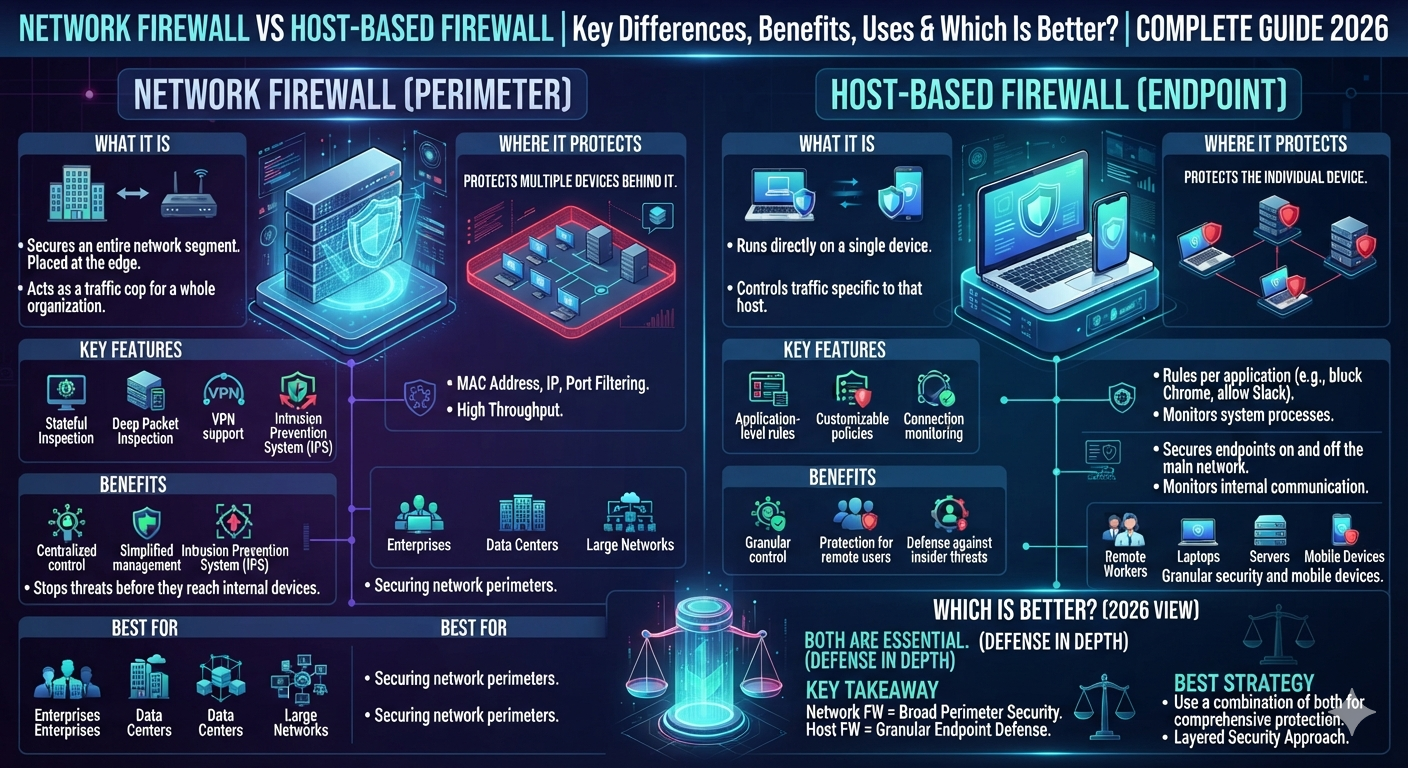
A firewall can quietly stop an unwanted connection before it becomes a bigger problem. Yet not every firewall protects the same place. A network firewall guards traffic between networks while a host-based firewall protects one computer or server. Understanding that difference helps you build smarter firewall security.
For a home user, the distinction may seem minor. For a business, it can shape the entire security architecture. A router can protect many devices at once. A laptop can leave the office network. A server can communicate directly with another internal system. This guide explains where each firewall fits and why using multiple layers can make sense.
What Is a Network Firewall vs Host-Based Firewall and How Does It Work?
The Network Firewall vs Host-Based Firewall comparison becomes much easier when you understand where each firewall works. A network firewall protects traffic moving between networks or security zones. A host-based firewall protects an individual computer, laptop, or server. Both control network connections, but they operate at different levels.
A network firewall usually sits at a network gateway and checks traffic before it reaches multiple devices. It can use firewall rules, ports, IP addresses, protocols, and connection states to allow or block traffic. A host-based firewall runs directly on an endpoint and controls incoming traffic and outgoing traffic for that specific device.
In simple terms, think of a company building. The network firewall is like the security gate at the entrance. The host-based firewall is like a lock on each office door. Using both creates stronger network protection because an unwanted connection may be stopped at the network boundary or again at the individual device. This is why the Network Firewall vs Host-Based Firewall choice isn’t always about selecting one over the other.
What Is a Network Firewall and How Does It Work?
A network firewall controls traffic crossing a network boundary. It can sit between your private network and the Internet or between separate internal segments. NIST defines firewalls as devices or programs that control network traffic between networks or hosts with different security postures.
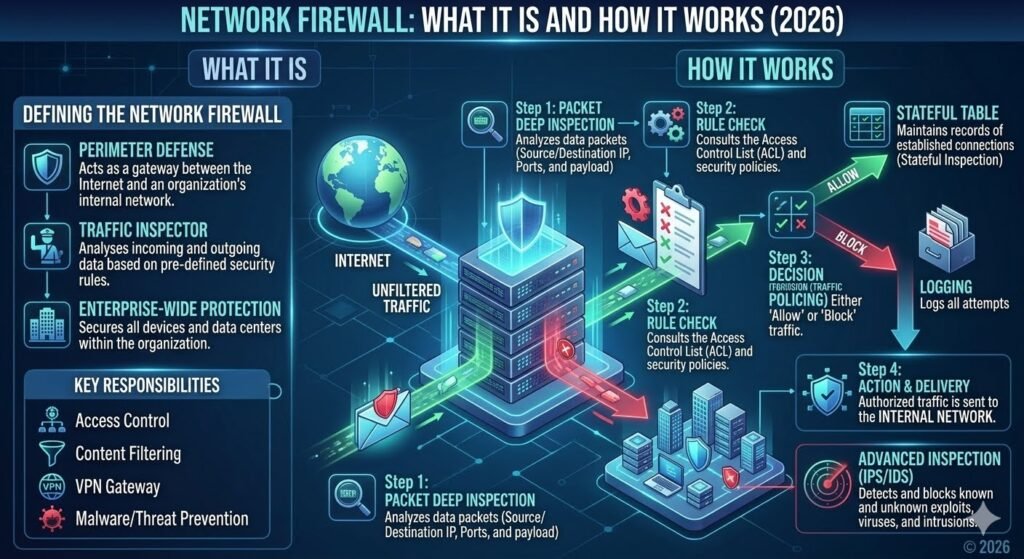
Think of it as a checkpoint. Every connection approaches the checkpoint with information such as its source, destination, port, and protocol. The firewall compares that traffic with configured firewall rules. It then permits or blocks the connection based on the security policy.
How a Network Firewall Filters Network Traffic
A network firewall can inspect incoming traffic and outgoing traffic. Basic systems may use packet filtering based on addresses and ports. More advanced systems can track connection states, inspect applications, and apply more detailed access control.
For example, a company might allow HTTPS traffic to its public web server while blocking unnecessary services. This reduces exposure without cutting off legitimate business traffic. NIST guidance covers packet filtering, stateful inspection, application gateways, and other firewall types.
Where Is a Network Firewall Installed?
A network firewall commonly operates at a network gateway, Internet edge, data center boundary, or between internal network segments. It can also protect separate security zones where systems have different access requirements.
CISA describes firewalls as gatekeepers between zones and recommends segmentation to limit communication between sensitive systems. This design can make it harder for an attacker to move across a network after compromising one device.
What Is a Host-Based Firewall and How Does It Work?
A host-based firewall runs directly on a computer or server. Instead of protecting an entire network boundary, it monitors and controls traffic involving that specific endpoint device. NIST describes it as software-based protection that controls incoming and outgoing traffic on an individual host.
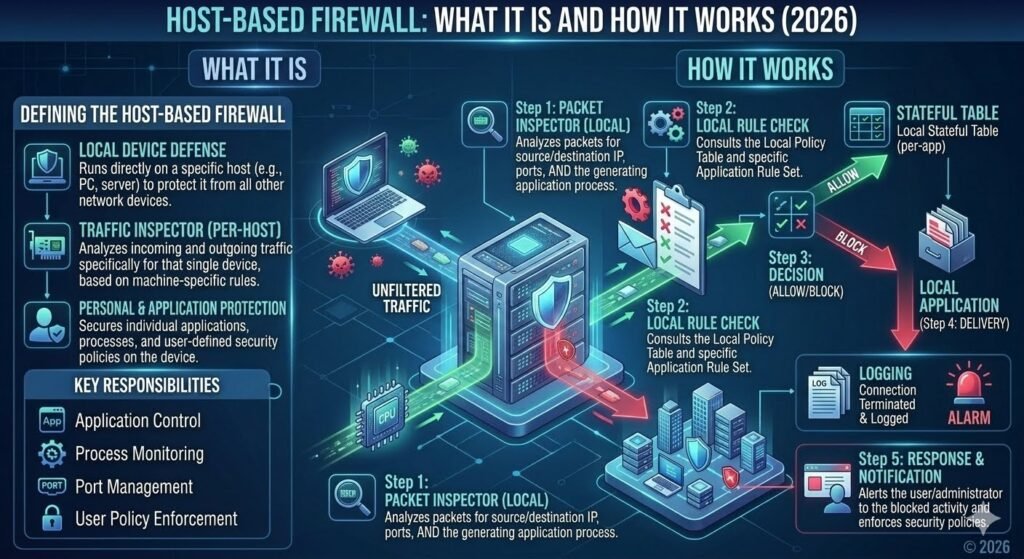
That local position gives it a useful advantage. A server can have its own rules even when another network firewall already protects the surrounding network. This creates another security layer and gives administrators more granular device protection.
How a Host-Based Firewall Protects Individual Devices
A host firewall can control inbound connections and outbound connections according to local rules. Depending on the operating system, rules can consider ports, applications, addresses, services, and network profiles.
Imagine an office with a locked main entrance. That’s your network firewall. Now imagine every important room also has its own lock. That’s closer to how a host firewall adds local endpoint protection.
Where Is a Host-Based Firewall Installed?
A host firewall is installed on the system it protects. Common host based firewall examples include firewall capabilities built into Windows, Linux, and other operating systems. Personal firewall software can also protect desktop and laptop computers.
This matters for mobile workers. A laptop doesn’t stop being an important endpoint security target when it leaves the office. NIST notes that host and personal firewalls can provide an additional protection layer for systems inside and outside perimeter firewalls.
Network Firewall vs Host-Based Firewall: What Is the Difference?
The simplest way to understand the difference between network firewall and host based firewall is to look at location. A network firewall protects traffic between networks or zones. A host firewall protects traffic involving one machine.
| Feature | Network Firewall | Host-Based Firewall |
|---|---|---|
| Protection | Network-level | Individual device |
| Main purpose | Controls network traffic | Controls device traffic |
| Coverage | Multiple devices | One device |
| Common use | Businesses and networks | PCs, laptops and servers |
| Location | Network gateway | Individual endpoint |
| Management | Often centralized | Device-specific |
| Best strength | Boundary control | Local control |
| Remote protection | Depends on network architecture | Travels with the device |
The network firewall and host based firewall can therefore complement each other. A network firewall may stop unwanted traffic before it reaches a group of systems. A host firewall can apply more precise rules once traffic reaches a particular computer or server.
Network Firewall vs Host-Based Firewall: Which One Provides Better Protection?
There is no universal winner in the network firewall vs host based firewall comparison. Each protects a different boundary. A network firewall offers broad coverage while a host firewall offers more granular control over individual systems.
NIST points out that perimeter firewalls cannot recognize every attack. Traffic moving directly between internal hosts may also bypass the perimeter completely. That’s one reason host-based protection can add useful depth to a security design.
Network Firewall vs Host-Based Firewall for Home Users
A typical home network may contain a router, laptops, phones, televisions, gaming systems, cameras, and smart appliances. A router can provide firewall protection at the network edge while computers can use their own host firewalls.
For many households, this layered setup is practical rather than excessive. Your laptop may connect through a coffee-shop Wi-Fi network tomorrow. Its local computer firewall can still protect the device when the home router is no longer involved.
Network Firewall vs Host-Based Firewall for Businesses
Businesses face a wider attack surface. Employees use laptops while servers, printers, cloud applications, and other systems communicate across different parts of the environment. A network firewall can create broad boundaries between those areas.
A host firewall adds another checkpoint around individual systems. This becomes especially useful for server security, remote employees, sensitive applications, and systems that require stricter access rules than ordinary workstations.
Hardware Firewall vs Software Firewall: What Is the Difference?
A hardware firewall usually refers to a dedicated appliance or network device that controls traffic for a network. A software firewall runs through an operating system or security application and commonly protects a particular host.
The hardware firewall vs software firewall comparison can become confusing because modern security products combine many functions. The better question is where the control operates and which traffic it can inspect.
Network Firewall vs Software Firewall: Are They the Same?
No. Network firewall vs software firewall describes two different ideas. “Network firewall” usually refers to the protection boundary while “software firewall” describes how the firewall is implemented.
A host firewall is often software-based. However, software can also participate in broader network security architectures. So don’t assume that every software firewall protects only one device or that every hardware appliance performs identical functions.
How Does a Network Firewall Protect Multiple Devices?
A network firewall can protect many systems from one strategic position. For example, an office gateway can inspect traffic between the Internet and dozens of employee computers.
The same concept works internally. Network segmentation can separate accounting systems, employee devices, servers, and guest networks. CISA explains that segmentation creates additional boundaries and can restrict access to devices, applications, and data.
How Does a Host-Based Firewall Protect a Computer or Server?
A host firewall sees traffic from the perspective of one machine. It can restrict unnecessary ports, services, applications, and connections that reach that specific system.
That local visibility matters when two devices communicate inside the same network. The traffic may never cross the perimeter network security firewall. A host firewall can still enforce local rules. NIST specifically highlights this granular protection.
Stateful vs Stateless Firewall: What Is the Difference?
A stateful firewall tracks the state of network connections. It can recognize whether a packet belongs to an established session and make decisions using that context.
A stateless firewall evaluates individual packets against predefined rules without maintaining the same connection history. Both approaches have legitimate uses. Modern products may combine multiple filtering techniques depending on the environment and security requirements.
Can a Host-Based Firewall Stop Malware?
A host firewall can restrict network communication from an infected machine. That can limit some unwanted connections and potentially reduce the spread of certain threats. However, a firewall isn’t a substitute for dedicated malware protection.
NIST notes that limiting outgoing traffic from a compromised host can help restrict malware from communicating or spreading. The firewall still works best alongside endpoint security, patching, secure configurations, and other controls.
Can a Network Firewall Protect Against Modern Cyber Attacks?
A network firewall can block unauthorized connections and reduce exposure to unnecessary services. It can also restrict communication between network segments. However, it can’t identify every phishing attempt, stolen credential, malicious document, or attack using legitimate traffic.
That’s why modern cybersecurity needs multiple controls. Firewalls work alongside identity protection, endpoint security, monitoring, patching, backups, and user awareness. CISA describes segmentation and multiple security layers as important parts of defense in depth.
Network Firewall vs Host-Based Firewall: Advantages and Limitations
Both approaches have clear strengths. A network firewall provides broad network protection while a host firewall provides tighter control over one device. Their limitations become more visible when an organization depends on only one layer.
| Area | Network Firewall | Host-Based Firewall |
|---|---|---|
| Coverage | Multiple systems | One system |
| Main strength | Boundary control | Device-level control |
| Internal traffic | May not see all traffic | Sees local host traffic |
| Remote devices | Depends on architecture | Protection follows device |
| Management | Often centralized | Endpoint-focused |
| Granularity | Network-level | Host-level |
| Typical role | Network boundary | Endpoint or server |
Do You Need Both a Network Firewall and a Host-Based Firewall?
For many organizations, using both creates defense in depth. The network firewall can restrict traffic between zones while host firewalls provide another layer around important computers and servers.
Consider a compromised employee laptop. The network firewall might restrict access to sensitive segments. The host firewall can impose additional restrictions on that laptop. NIST describes host-based firewalls as an additional security layer beyond perimeter protection.
Network Firewall vs Host-Based Firewall for Servers
Servers deserve careful attention because they often expose specific services. A web server may need HTTPS access while a database server might need connections only from approved application systems.
A local server firewall can restrict unnecessary open ports and services. Network segmentation can add another boundary around the server environment. Together, these controls can reduce the number of paths an attacker can use.
Network Firewall vs Host-Based Firewall for Remote Workers
Remote work changes where your security boundary sits. An employee may connect from a home network, hotel, airport, or public Wi-Fi. Your corporate network firewall may not sit between that laptop and the Internet.
A host firewall stays with the device. This makes it valuable for remote workers who frequently move between trusted and untrusted networks. NIST specifically discusses personal firewalls as an additional layer for mobile computers outside perimeter protection.
Common Firewall Configuration Mistakes to Avoid
A firewall doesn’t become effective simply because someone turns it on. Weak firewall rules, unnecessary open ports, outdated software, excessive permissions, and poor monitoring can create avoidable gaps.
CISA emphasizes that firewall rules should restrict traffic to what systems actually need. Broad “allow everything” policies can undermine the purpose of the control. Specific rules based on hosts, protocols, and ports provide tighter access control.
How to Choose the Right Firewall for Your Network
Start with your environment rather than the product price. Consider the number of devices, network architecture, traffic volume, applications, remote access, security requirements, management capacity, and budget.
For a home, straightforward firewall for home network protection may be enough. A growing company may need centralized management, segmentation, VPN capabilities, detailed logging, and endpoint controls. The best solution fits the actual risk.
Best Firewall Strategy for Small Businesses in 2026
A small company doesn’t automatically need the most expensive firewall security system. It needs sensible layers that work together. A secure gateway, endpoint firewalls, strong authentication, patching, backups, monitoring, and carefully managed permissions form a stronger foundation.
The idea is simple. Don’t make one control responsible for everything. CISA’s defense-in-depth guidance emphasizes multiple protective layers and segmentation rather than relying on a single barrier.
Network Firewall vs Host-Based Firewall: Complete Comparison
The central difference in host based firewall vs network firewall comes down to protection boundaries. One focuses on traffic between networks. The other focuses on traffic involving an individual system.
| Factor | Network Firewall | Host-Based Firewall |
|---|---|---|
| Security layer | Network | Endpoint |
| Coverage | Multiple devices | One device |
| Deployment | Gateway or network boundary | Individual host |
| Management | Often centralized | Endpoint-focused |
| Visibility | Network traffic | Local traffic |
| Best use | Network boundaries | Devices and servers |
| Remote protection | Architecture dependent | Travels with device |
| Granularity | Network-level | Device-level |
| Main limitation | May miss local traffic | Must protect each host |
Frequently Asked Questions About Network and Host-Based Firewalls
Is a Network Firewall Better Than a Host-Based Firewall?
Neither is automatically better. A network firewall provides broad boundary protection while a host firewall gives more granular control over an individual device. Businesses often use both because they protect different parts of the environment.
What Is the Difference Between a Network Firewall and a Host-Based Firewall?
The main difference is where protection occurs. A network firewall controls traffic between networks or zones. A host firewall controls traffic involving one computer or server. Their coverage and management models are therefore different.
Can a Host-Based Firewall Replace a Network Firewall?
Usually, no. A host firewall protects individual systems but doesn’t provide the same centralized boundary control across an entire network. Businesses generally need broader network controls when many devices and security zones are involved.
Do I Need Both Types of Firewalls?
Many businesses benefit from both. A network firewall controls traffic between network zones while host firewalls add local device protection. This layered design can reduce gaps that appear when only one firewall boundary exists.
Is Windows Firewall a Host-Based Firewall?
Yes. Windows includes built-in firewall functionality that controls traffic on individual Windows devices. It operates at the host level and can help regulate local network connections.
Is a Router Firewall a Network Firewall?
Often, yes. Many modern routers include firewall capabilities that control traffic between a local network and external networks. Features vary widely, though, so a consumer router isn’t equivalent to every dedicated enterprise firewall.
Which Firewall Is Better for a Small Business?
A small business usually benefits from a network gateway firewall plus properly configured host firewalls. The right setup depends on employee count, servers, remote access, cloud services, compliance needs, and network complexity.
Which Firewall Is Better for Servers?
A host firewall is valuable for servers because it can enforce rules specific to the services running on that machine. Network controls should still provide broader boundaries where appropriate.
Can a Firewall Stop Malware?
A firewall can restrict some malicious network communication. It can’t replace antivirus or endpoint security. Strong malware protection requires multiple controls that address different stages of an attack.
Can a Firewall Stop Hackers?
A firewall can block many unauthorized connections and reduce exposed attack paths. It can’t stop every attack. Stolen credentials, phishing, software vulnerabilities, and malicious insiders require additional security measures.
Final Verdict: Network Firewall vs Host-Based Firewall
So, network firewall vs host-based firewall isn’t really a battle between two competing products. They’re two different security layers. A network firewall protects boundaries between networks while a host firewall protects an individual computer or server.
For many homes and businesses, the smarter approach is layered protection. Combine a properly configured network firewall with host-based controls, endpoint security, strong authentication, updates, segmentation, monitoring, and reliable backups. That creates a much sturdier security architecture than expecting one firewall to carry the entire load.
Authoritative Sources
NIST’s firewall guidance covers firewall technologies, policies, deployment, configuration, and management. Its glossary also defines host-based and personal firewalls. CISA provides additional guidance on network segmentation, firewalls, and layered security.
NIST — Guidelines on Firewalls and Firewall Policy
NIST — Host-Based Firewall Glossary
CISA — Layering Network Security Through Segmentation
| RELATED ARTICLE | EXPLORE NOW |
|---|
| AI Cybersecurity Threats in 2026 | EXPLORE NOW |
| AI-Powered Cybersecurity | EXPLORE NOW |
| Identity and Access Management (IAM) | EXPLORE NOW |
| Zero Trust Security | EXPLORE NOW |
| AI Scams in 2026 | EXPLORE NOW |
📌 Explore More Topics
GET IN TOUCH – ARTIFICIAL INTELLIGENCE
Meta Description
Network Firewall vs Host-Based Firewall explained. Learn the key differences, benefits, uses, security layers, and which firewall is best for home and business.
1 Comment