

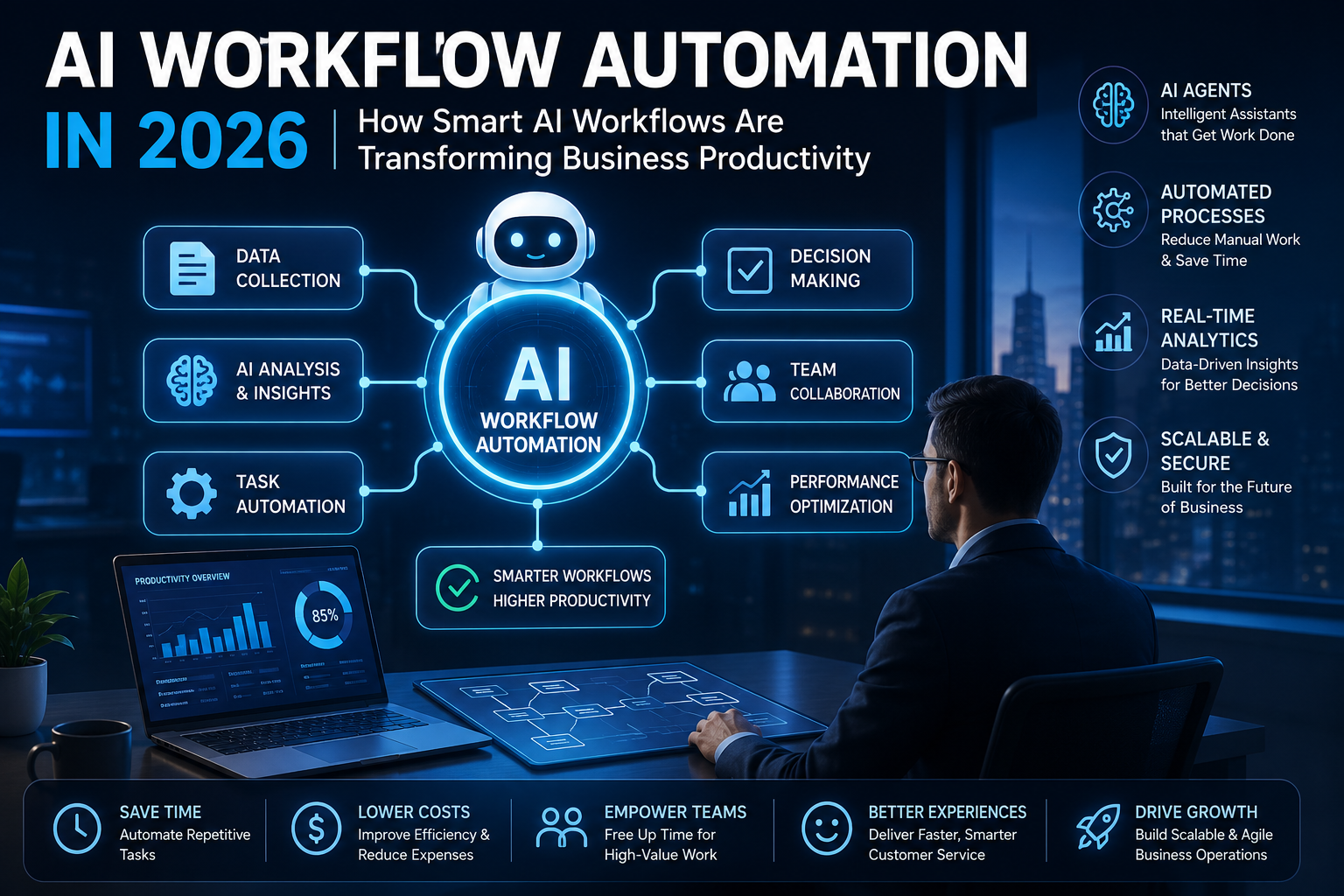
Modern businesses are changing faster than ever. Companies no longer want employees to spend hours on repetitive work that software can complete in minutes. This shift has made AI workflow automation one of the biggest technology trends in 2026. Organizations now use smart systems to improve speed, reduce costs, and deliver better customer experiences. Whether you run a small business or a global enterprise, intelligent workflows can help you work smarter instead of harder.
Powered by artificial intelligence, modern workflow systems can analyze information, make recommendations, automate routine tasks, and support faster decision-making. Instead of replacing people, these technologies remove repetitive work so employees can focus on creative thinking, customer relationships, and business growth. As companies continue investing in digital transformation, AI-powered workflows, and business innovation, AI workflow automation has become an essential strategy for improving long-term success.
Businesses across the United States now use intelligent automation in customer support, finance, healthcare, marketing, manufacturing, education, logistics, and software development. From processing invoices to answering customer questions, smart workflows are helping organizations improve business productivity while reducing human error. This guide explains everything you need to know about AI workflow automation, including how it works, its benefits, real-world applications, future trends, and practical strategies for successful implementation.
What Is AI Workflow Automation and Why Does It Matter in 2026?
AI workflow automation is the process of using artificial intelligence to automate business tasks, improve decisions, and manage work without constant human involvement. Unlike traditional workflow automation, AI can understand information, recognize patterns, learn from previous results, and recommend better actions. This makes intelligent workflow automation much more flexible than older systems that simply followed fixed rules. Companies now use AI to automate approvals, customer service, document management, scheduling, reporting, and many other daily activities.
The importance of AI workflow automation continues to grow because businesses need faster operations, better customer experiences, and improved business efficiency. Employees spend less time on repetitive work and more time solving problems that require creativity and critical thinking. Smart automation also improves workflow optimization by reducing delays, minimizing errors, and keeping projects moving smoothly across different departments. As more organizations embrace enterprise AI, intelligent workflows are becoming the foundation of modern business operations and the evolving digital workplace.
How AI Workflow Automation Works in Modern Businesses
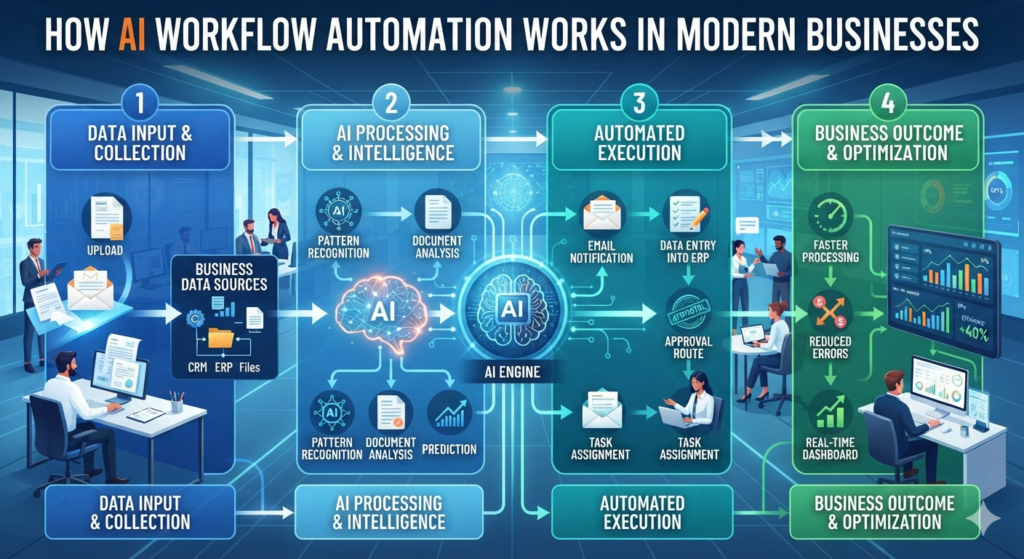
Modern AI workflows follow a simple but intelligent process. Information enters the system through emails, forms, databases, or connected applications. Using machine learning, natural language processing (NLP), and large language models (LLMs), the system understands the data, identifies priorities, and decides what should happen next. It can automatically assign tasks, generate reports, send notifications, or trigger approvals without waiting for manual input. Over time, these systems continue learning from business activities to improve speed and accuracy.
Instead of handling one task at a time, today’s intelligent platforms connect multiple business systems through API integration, cloud AI platforms, and advanced automation technology. This creates seamless business process automation across sales, marketing, finance, customer support, and human resources. Managers gain valuable insights through real-time analytics, while employees work alongside AI assistants that simplify daily responsibilities. The result is faster decisions, stronger collaboration, smarter workflow management, and highly efficient automated business workflows that support sustainable business growth.
How a Typical AI Workflow Operates
| Stage | What Happens |
|---|---|
| Data Collection | Information is gathered from business systems, emails, forms, and applications. |
| AI Analysis | Artificial intelligence analyzes data and identifies patterns. |
| Decision Making | The system uses AI decision making to determine the next action. |
| Task Execution | Work is completed through process automation and connected software. |
| Monitoring | Performance is tracked using business intelligence and real-time analytics. |
| Continuous Improvement | Machine learning improves future workflow accuracy and efficiency. |
How AI Workflow Automation Is Different From Traditional Business Automation
Traditional automation follows fixed rules. If a condition matches, the system performs a predefined task. It cannot think beyond its programming or adapt to unexpected situations. AI workflow automation, however, uses machine learning and AI automation to understand changing data, recognize patterns, and improve decisions over time. Instead of repeating the same action forever, intelligent systems become smarter as they process more information. This allows businesses to respond faster to customer needs and changing market conditions.
Another major difference is flexibility. Traditional tools usually automate one process at a time, while business workflow automation connects multiple departments into one intelligent system. Sales, finance, marketing, and customer support can share information instantly through workflow orchestration and AI-powered software. This creates smoother collaboration, stronger business operations, and better workflow management across the entire organization. Companies gain faster results because every process works together instead of operating in separate systems.
Traditional Automation vs AI Workflow Automation
| Feature | Traditional Automation | AI Workflow Automation |
|---|---|---|
| Decision Making | Rule-based | AI-driven and adaptive |
| Learning Ability | No learning | Learns through machine learning |
| Flexibility | Limited | Highly flexible |
| Data Analysis | Basic | Advanced predictive analytics |
| Business Value | Saves time | Improves productivity and decisions |
| Scalability | Moderate | Excellent for growing businesses |
Why Businesses Are Investing in AI Workflow Automation in 2026
Across the United States, organizations are investing heavily in AI workflow automation because they need faster growth without increasing operating costs. Customers expect quick responses, personalized experiences, and around-the-clock support. Businesses can no longer rely only on manual processes to meet these expectations. Smart AI workflows automate repetitive work, reduce delays, and help employees focus on strategic activities that create value. This improves AI productivity, strengthens customer satisfaction, and supports long-term business innovation.
Another reason for rapid adoption is the growing availability of cloud-based automation solutions. Modern companies can deploy workflow automation platform solutions without building expensive infrastructure from scratch. Thanks to cloud AI platforms, low-code automation, and no-code automation, even small businesses can automate complex processes with limited technical knowledge. Better data-driven decision making, improved business efficiency, and scalable enterprise automation allow companies to remain competitive in an increasingly digital economy.
Why Companies Are Adopting AI Workflow Automation
| Business Need | How AI Solves It |
|---|---|
| Faster customer service | Automates responses and support |
| Lower operating costs | Reduces repetitive manual work |
| Better productivity | Improves AI productivity across teams |
| Smarter decisions | Uses predictive analytics and AI insights |
| Business growth | Supports scalable enterprise AI solutions |
| Improved collaboration | Connects departments through AI-powered workflows |
Key Components of an AI Workflow Automation System
Every successful AI workflow automation system combines several technologies that work together. At the center is artificial intelligence, which analyzes information and recommends actions. Around it are workflow engines, automation tools, databases, cloud services, and communication platforms. Together, these components create intelligent systems that automate tasks while maintaining accuracy and reliability. Strong workflow optimization also depends on secure data management, continuous monitoring, and smooth integration between business applications.
Modern businesses also rely on advanced technologies to make workflows more intelligent. AI infrastructure, automation technology, and secure cloud environments allow organizations to process large amounts of information quickly. Connected systems improve business process automation, reduce manual errors, and create seamless digital experiences for employees and customers. As businesses continue their digital transformation, these technologies become the foundation of smarter and more efficient operations.
Artificial Intelligence, Machine Learning, AI Agents, and Data Integration
The true power of AI workflow automation comes from combining artificial intelligence, machine learning, AI agents, and seamless API integration. These technologies share information across different software platforms, automate decisions, and continuously improve workflow performance. Combined with deep learning, neural networks, and intelligent document processing, they transform ordinary business processes into adaptive systems that learn, improve, and deliver faster results with minimal human effort.
How AI Agents Are Powering Intelligent Workflow Automation
Modern businesses no longer rely only on fixed automation rules. Today, AI agents can complete tasks, make recommendations, and even coordinate work between different business systems. Within AI workflow automation, these intelligent assistants monitor activities, respond to changing conditions, and complete work with little human input. Unlike basic automation tools, they understand context, prioritize urgent requests, and support faster AI decision making. This makes daily operations smoother while improving overall business productivity across every department.
Many organizations now use agentic AI to manage customer support, employee onboarding, inventory tracking, scheduling, and internal approvals. These systems communicate with multiple applications using API integration and execute autonomous workflows without constant supervision. As more businesses adopt intelligent software, AI business automation becomes more accurate, scalable, and reliable. Employees spend less time managing repetitive work while focusing on innovation, customer relationships, and strategic planning that drives long-term success.
How AI Agents Improve Business Workflows
| Business Function | How AI Agents Help |
|---|---|
| Customer Support | Answer questions and resolve common requests |
| Human Resources | Automate onboarding and document processing |
| Finance | Process invoices and approve expenses |
| Marketing | Schedule campaigns and analyze performance |
| Sales | Qualify leads and update CRM systems |
| Operations | Coordinate tasks across multiple departments |
The Role of Generative AI in AI Workflow Automation
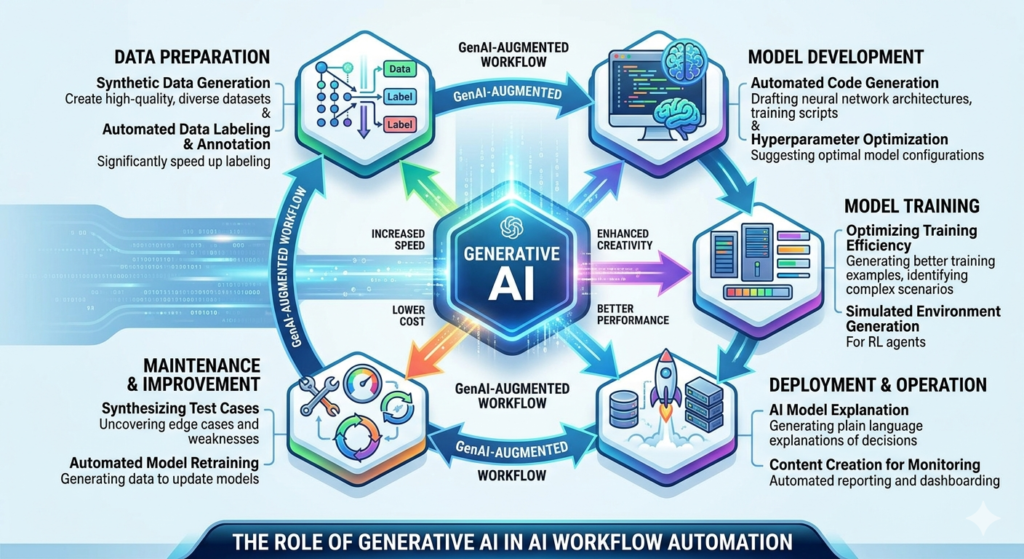
The rise of generative AI has changed the way organizations create content and complete daily work. Instead of writing reports, emails, product descriptions, or meeting summaries manually, businesses now use AI to produce high-quality drafts within seconds. Integrated into AI workflow automation, these systems reduce repetitive writing tasks and allow employees to review, improve, and publish content much faster. This approach saves valuable time while improving consistency across the organization.
Modern platforms powered by large language models (LLMs) also help businesses analyze documents, summarize conversations, generate code, and answer customer questions. Combined with natural language processing (NLP) and multimodal AI, these tools understand both written and visual information, making them useful across many industries. As organizations continue adopting AI-powered software, intelligent automation, and advanced workflow systems, generative AI is becoming a core technology behind smarter and more efficient business processes.
Common Business Tasks Powered by Generative AI
| Task | Business Benefit |
|---|---|
| Email Writing | Faster communication |
| Report Generation | Saves employee time |
| Content Creation | Improves marketing productivity |
| Code Assistance | Accelerates software development |
| Customer Responses | Provides faster support |
| Document Summaries | Simplifies information review |
Best AI Workflow Automation Tools and Platforms in 2026
The market for AI workflow tools has expanded rapidly as organizations search for better ways to automate complex business processes. Modern platforms combine workflow automation, analytics, and AI into one environment where businesses can manage projects, approvals, customer interactions, and internal operations. Some solutions focus on enterprise organizations, while others are designed for startups and growing businesses that need affordable automation. Choosing the right workflow automation platform depends on company size, technical requirements, security needs, and long-term business goals.
Today’s leading solutions integrate robotic process automation (RPA), business intelligence, cloud AI platforms, and real-time analytics into one connected system. These platforms help organizations improve task automation, reduce manual work, and strengthen workflow management across departments. As enterprise AI continues to evolve, businesses increasingly prefer flexible automation platforms that support future expansion without requiring major system changes.
Choosing the Right AI Workflow Platform for Your Business
Selecting the best platform starts with understanding your business needs rather than choosing the most popular software. Look for solutions that offer strong security, easy API integration, scalable AI infrastructure, and support for low-code automation or no-code automation. The ideal platform should simplify daily work, improve collaboration, and support future growth while delivering measurable improvements in business efficiency and overall workflow performance.
AI Workflow Automation Use Cases Across Different Industries
Every industry has repetitive tasks that slow down employees and reduce productivity. AI workflow automation helps organizations remove these bottlenecks by connecting people, software, and business data into one intelligent system. Companies use AI workflows to process documents, approve requests, manage customer interactions, and automate reporting without constant manual effort. This creates faster business operations, improves accuracy, and supports better customer experiences across different departments.
The adoption of intelligent workflow automation continues to grow because every sector has unique automation needs. Healthcare organizations automate patient records and appointment scheduling. Financial institutions speed up fraud detection and loan approvals. Retail businesses improve inventory management and customer support. Manufacturing companies optimize production lines, while educational institutions simplify admissions and student services. These real-world applications show how enterprise automation supports long-term business innovation and sustainable growth.
AI Workflow Automation Across Industries
| Industry | Common AI Workflow |
|---|---|
| Healthcare | Patient scheduling, medical records, billing |
| Finance | Fraud detection, invoice processing, loan approvals |
| Retail | Inventory management, order tracking, customer support |
| Manufacturing | Production planning, quality control, predictive maintenance |
| Marketing | Campaign automation, lead nurturing, content approval |
| Human Resources | Recruitment, onboarding, payroll workflows |
| Education | Student admissions, grading, communication |
| Logistics | Shipment tracking, warehouse management, route planning |
| Legal | Contract review, compliance monitoring |
| IT & Software | Ticket management, testing, deployment automation |
Benefits of AI Workflow Automation for Business Productivity
One of the greatest advantages of AI workflow automation is the ability to improve business productivity without increasing the workload on employees. Intelligent systems handle repetitive activities such as approvals, notifications, reporting, and document processing while people focus on creative work and strategic decisions. This improves workflow optimization, reduces delays, and creates a more efficient digital workplace. Organizations also experience fewer manual mistakes because AI follows consistent processes with high accuracy.
Beyond productivity, businesses gain stronger operational performance through smarter decision-making. Advanced systems use decision intelligence, real-time analytics, and predictive analytics to identify opportunities before problems become costly. Managers receive faster insights, employees complete work more efficiently, and customers enjoy quicker service. As companies continue their digital transformation, AI-powered workflows become a key driver of long-term business efficiency, stronger collaboration, and sustainable competitive advantage.
Key Business Benefits
| Benefit | Business Impact |
|---|---|
| Faster Task Completion | Less manual work and quicker results |
| Better AI productivity | Employees focus on high-value activities |
| Higher Accuracy | Fewer human errors |
| Lower Operating Costs | Reduced repetitive work |
| Improved Customer Experience | Faster response times |
| Smarter Decisions | Powered by data-driven decision making |
| Greater Scalability | Supports business growth |
| Stronger Collaboration | Connected teams and systems |
Case Study: AI Workflow Automation in Customer Support
A mid-sized software company in the United States struggled with thousands of customer requests every week. Support agents spent hours answering similar questions and routing tickets to different teams. After implementing AI workflow automation, the company introduced AI assistants that answered common questions instantly and directed complex issues to the right specialists. Managers also used business intelligence dashboards to monitor response times and customer satisfaction.
Within a few months, the company reduced average response times, improved customer satisfaction, and allowed support staff to focus on high-priority cases. The new workflow also improved task automation, streamlined internal communication, and created more consistent service quality. This example shows how intelligent automation delivers measurable business value without replacing human expertise.
Common Challenges and Risks of AI Workflow Automation
Although AI workflow automation offers significant benefits, every implementation requires careful planning. Many organizations expect immediate results without preparing their data, employees, or existing systems. Poor data quality often produces inaccurate outcomes because even the most advanced artificial intelligence depends on reliable information. Businesses should also review security policies before connecting multiple applications through API integration. A strong foundation reduces technical problems and helps intelligent systems deliver consistent results from the beginning.
Employee adoption is another important challenge. Some teams worry that automation will replace their jobs, while others hesitate because they are unfamiliar with new technology. Successful companies solve this problem through training, open communication, and gradual implementation. They introduce AI-powered software to support employees instead of replacing them. Regular monitoring, secure AI infrastructure, and continuous workflow improvements also help organizations reduce risks while building smarter business workflow automation that supports long-term growth.
Common Challenges and Practical Solutions
| Challenge | Recommended Solution |
|---|---|
| Poor Data Quality | Clean and organize business data before automation |
| Employee Resistance | Provide training and clear communication |
| Integration Problems | Use reliable API integration methods |
| Security Risks | Strengthen cybersecurity and access controls |
| High Initial Costs | Start with high-value workflows first |
| Compliance Requirements | Follow industry regulations and governance policies |
| Limited AI Skills | Train employees or work with experienced partners |
| Workflow Complexity | Automate simple processes before expanding |
How to Build an Effective AI Workflow Automation Strategy
A successful AI workflow automation strategy begins with understanding your current business processes. Start by identifying repetitive tasks that consume valuable employee time. Review existing workflows and measure how much time each activity requires. This helps businesses discover the best opportunities for process automation and improved workflow management. Clear goals also make it easier to measure success after implementation.
The next step is selecting the right technology and preparing employees for change. Businesses should choose scalable AI workflow tools that support future growth instead of focusing only on current needs. Good planning includes employee training, performance monitoring, and regular workflow reviews. Companies that continuously improve their AI workflows often achieve stronger business efficiency, better collaboration, and more consistent results. A long-term strategy transforms automation from a simple technology project into an important part of overall business success.
Building an AI Workflow Automation Strategy
| Step | Purpose |
|---|---|
| Analyze Existing Workflows | Identify repetitive tasks |
| Define Business Goals | Measure expected improvements |
| Select the Right Platform | Match business needs and budget |
| Prepare Business Data | Improve AI accuracy |
| Train Employees | Increase adoption and confidence |
| Launch Gradually | Reduce implementation risks |
| Monitor Performance | Measure productivity and efficiency |
| Improve Continuously | Optimize workflows over time |
Best Practices for Successful AI Workflow Implementation
Successful AI workflow automation starts with a clear plan instead of trying to automate everything at once. The best approach is to begin with one business process that delivers quick results. Once the first workflow performs well, businesses can gradually expand automation across other departments. This phased approach reduces risk, improves employee confidence, and creates a stronger foundation for long-term workflow optimization. Companies should also review workflow performance regularly to ensure every automated process continues supporting changing business needs.
Employee involvement is equally important. People should understand how AI workflow automation improves their daily work rather than replacing their jobs. Regular training helps employees use AI-powered software, interpret automation reports, and make smarter decisions using business intelligence. Organizations that encourage collaboration between employees and AI achieve stronger business productivity, faster innovation, and a more efficient digital workplace. Continuous improvement keeps workflows accurate as customer expectations and business requirements evolve.
Best Practices for Implementation
| Best Practice | Business Benefit |
|---|---|
| Start with one workflow | Lower implementation risk |
| Define clear business goals | Easier performance measurement |
| Train employees regularly | Higher user adoption |
| Monitor workflow performance | Continuous optimization |
| Protect business data | Better security and compliance |
| Update AI models | Improved long-term accuracy |
| Measure ROI | Better investment decisions |
| Expand gradually | Sustainable business growth |
Future Trends in AI Workflow Automation Beyond 2026
The next generation of AI workflow automation will become even more intelligent. Future systems will not only complete tasks but also predict business needs before problems appear. Powered by multimodal AI, deep learning, and advanced AI agents, these platforms will understand text, images, voice, and video within a single workflow. Businesses will rely more on autonomous workflows that manage routine operations with minimal human supervision while continuously learning from new information.
Another major trend is the growth of connected enterprise ecosystems. Future platforms will combine workflow orchestration, robotic process automation (RPA), and cloud AI platforms into unified business environments. Organizations will use decision intelligence and real-time analytics to optimize operations across every department. As enterprise AI continues to evolve, companies will create highly adaptive systems that improve customer experiences, strengthen operational resilience, and accelerate business innovation across the entire organization.
Future AI Workflow Trends
| Trend | Expected Business Impact |
|---|---|
| Multimodal AI | Smarter understanding of multiple data types |
| Autonomous workflows | Less manual supervision |
| Smarter AI agents | Better business decision support |
| Advanced workflow orchestration | Connected enterprise operations |
| Predictive automation | Faster problem prevention |
| Stronger enterprise AI | Scalable business growth |
How AI Workflow Automation Is Shaping the Future of Business
The future of modern business will depend on intelligent systems that work alongside people instead of replacing them. AI workflow automation enables organizations to complete routine work faster while employees focus on creativity, strategy, and customer relationships. Companies adopting AI business automation today are building flexible operations that adapt quickly to market changes and customer expectations. This combination of technology and human expertise creates stronger business operations and prepares organizations for the changing future of work.
Looking beyond 2026, businesses that invest in intelligent automation will be better positioned for long-term success. Continuous improvements in artificial intelligence, machine learning, and AI automation will make workflows more accurate, secure, and efficient. Organizations that embrace AI-powered workflows, support employee learning, and continuously optimize their processes will achieve higher productivity and stronger competitive advantages. The future belongs to businesses that treat automation not as a replacement for people, but as a powerful partner for smarter growth.
AI Workflow Automation at a Glance
| Area | Long-Term Value |
|---|---|
| Productivity | Faster task completion |
| Decision Making | Smarter business insights |
| Customer Experience | Quicker and more personalized service |
| Cost Efficiency | Lower operating expenses |
| Innovation | Continuous improvement |
| Business Growth | Scalable and future-ready operations |
Conclusion
AI workflow automation has become one of the most important technologies for modern organizations in 2026. It helps businesses automate repetitive work, improve decision-making, strengthen collaboration, and increase productivity without sacrificing quality. From small businesses to global enterprises, intelligent workflows are transforming the way people work by combining artificial intelligence, AI agents, and generative AI with everyday business processes.
As technology continues to evolve, organizations that invest in smart automation today will be better prepared for tomorrow’s challenges. Choosing the right strategy, implementing the right tools, and continuously improving workflows will help businesses achieve sustainable growth, higher efficiency, and stronger customer satisfaction. AI workflow automation is no longer just an emerging trend. It is becoming the foundation of the next generation of intelligent, competitive, and future-ready businesses.
Frequently Asked Questions (FAQs)
1. What is AI workflow automation?
AI workflow automation uses artificial intelligence to automate business processes, reduce manual work, and improve decision-making. Unlike traditional automation, AI can learn from data, adapt to changing conditions, and continuously improve workflow performance.
2. How is AI workflow automation different from traditional automation?
Traditional automation follows fixed rules and cannot learn from experience. AI workflow automation uses machine learning, AI agents, and predictive analytics to analyze information, make intelligent decisions, and optimize workflows over time.
3. Which industries benefit the most from AI workflow automation?
Almost every industry benefits from AI workflow automation. Healthcare, finance, retail, manufacturing, logistics, education, human resources, customer service, marketing, and software development all use intelligent workflows to improve efficiency and reduce repetitive tasks.
4. What are the biggest benefits of AI workflow automation?
The main benefits include improved business productivity, faster workflow management, lower operating costs, better customer experiences, stronger business efficiency, fewer manual errors, smarter decision-making, and scalable business growth.
5. What technologies power AI workflow automation?
Modern AI workflow automation combines artificial intelligence, machine learning, generative AI, AI agents, natural language processing (NLP), large language models (LLMs), robotic process automation (RPA), cloud AI platforms, and API integration to automate complex business processes.
6. Is AI workflow automation suitable for small businesses?
Yes. Many cloud-based AI workflow tools now offer affordable solutions for startups and small businesses. Low-code automation and no-code automation platforms allow companies to automate workflows without advanced programming skills.
7. What is the future of AI workflow automation?
The future includes smarter autonomous workflows, more capable AI assistants, advanced multimodal AI, better workflow orchestration, and stronger enterprise AI platforms. These technologies will continue improving business productivity and transforming the future of work.
Quote
“Businesses that automate repetitive work today create more time for innovation tomorrow. AI workflow automation is not replacing people. It is helping people perform their best work.”
Meta Description
Learn how AI Workflow Automation improves business productivity, automates workflows, reduces manual work, and transforms modern organizations. Discover tools, benefits, strategies, and future trends in this complete 2026 guide.
6 Comments