

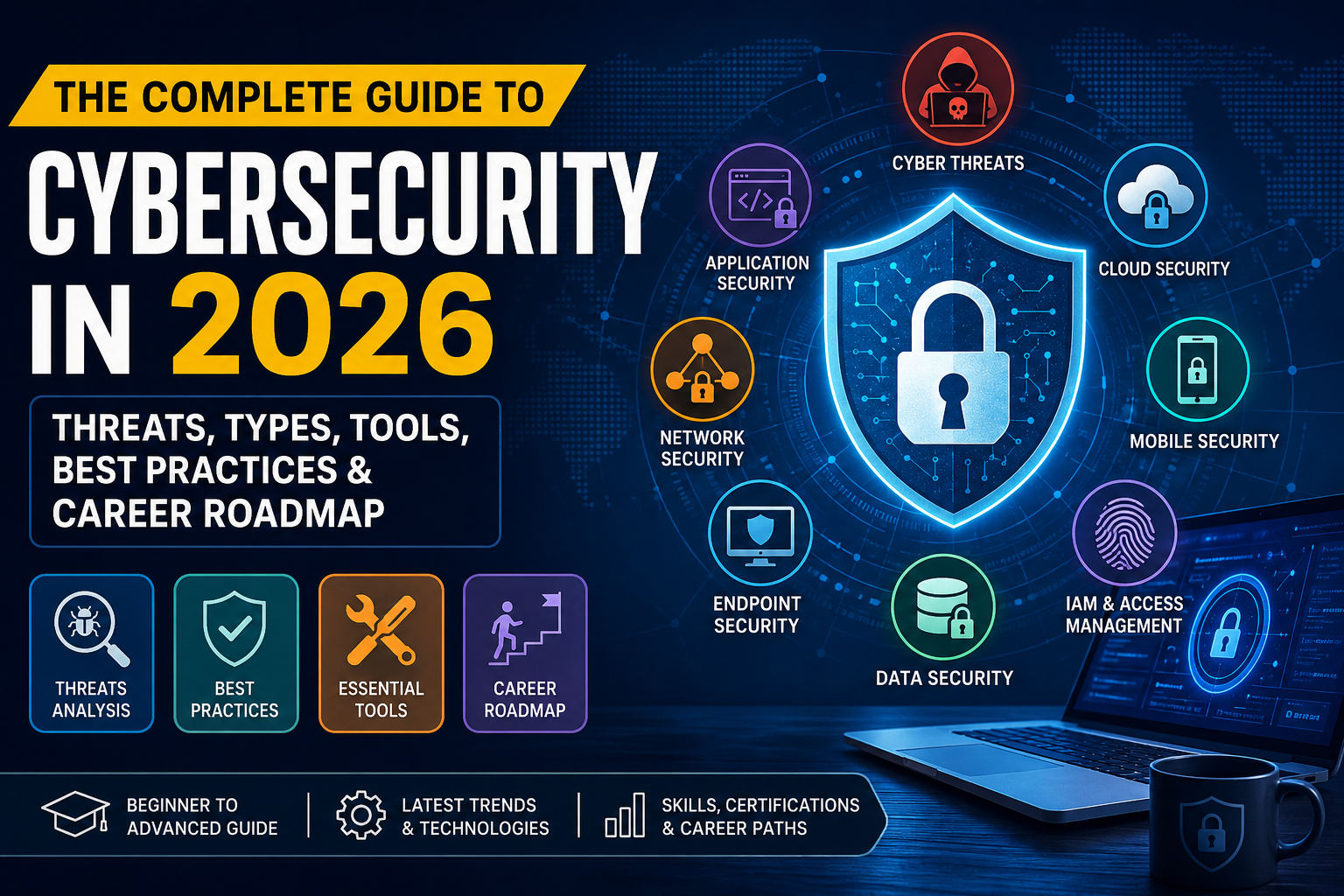
Introduction
The digital world is growing faster than ever. People use online banking, cloud platforms, mobile apps, smart devices, and remote work tools every day. However, this growth also creates new risks. Hackers are constantly developing new ways to steal information, damage systems, and attack organizations.
Cybersecurity has become a necessity for everyone. It protects personal information, business data, and digital systems from harmful activities. Whether you are a student, employee, small business owner, or technology professional, understanding cybersecurity in 2026 can help you stay safer online.
Modern cybersecurity solutions are no longer limited to large companies. Individuals and small businesses also need strong protection because attackers often target weak security points. A single stolen password or infected device can create serious problems.
This cybersecurity guide explains everything you need to know. You will learn about common threats, different security types, essential tools, best practices, and a complete career roadmap for entering this growing field.
What Cybersecurity Means
At its core, cybersecurity means protecting digital systems, networks, applications, and information from unauthorized access or damage. It combines technology, processes, and human awareness to prevent cyber attacks.
A simple way to understand it is to imagine your digital life as a house. Your passwords are the locks. Security software works like alarms. Firewalls act like gates. Together, these protections help keep unwanted visitors away.
The cybersecurity definition focuses on protecting confidentiality, integrity, and availability of digital information. These three principles are often called the foundation of modern security.
| Security Principle | Meaning |
| Confidentiality | Keeping information private |
| Integrity | Protecting data from unwanted changes |
| Availability | Making systems accessible when needed |
Today, digital security affects almost every part of life. From healthcare records to financial transactions, strong protection is required to prevent misuse.
Why Cybersecurity Is Important in 2026
The importance of cybersecurity has increased because our dependence on technology continues to grow. Businesses store valuable information online. Employees work remotely. Customers share personal details through digital platforms.
At the same time, cybersecurity threats are becoming more advanced. Attackers now use automation, artificial intelligence, and sophisticated methods to find weaknesses quickly.
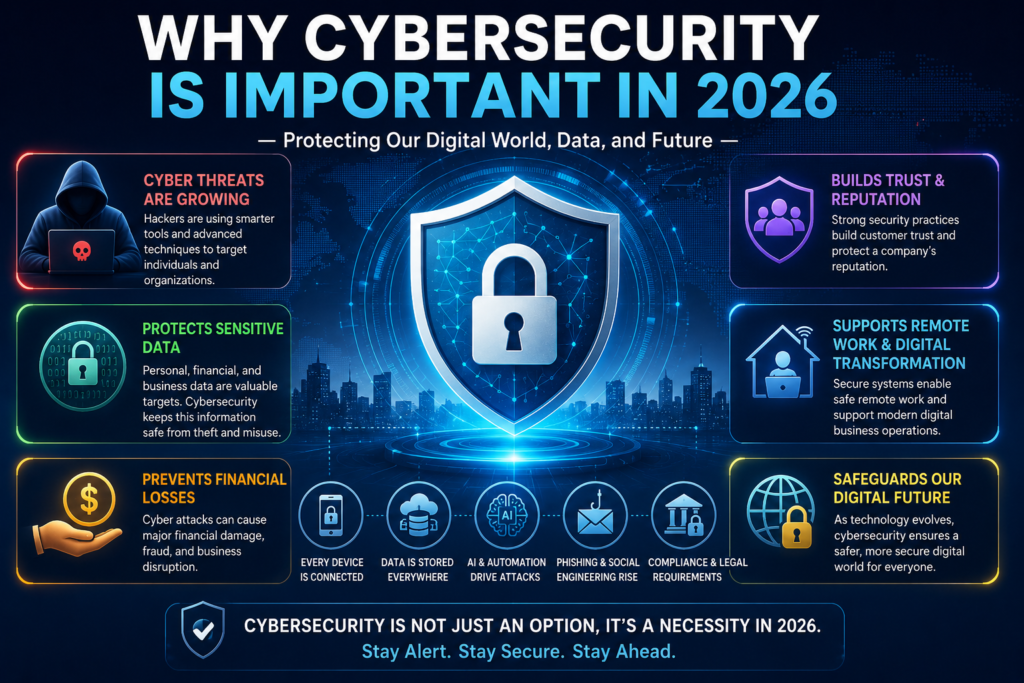
In 2026, organizations need strong cybersecurity protection because attacks are not only targeting large corporations. Small businesses, schools, healthcare providers, and individuals are also common targets.
For example, a small online store may lose customer information after a security breach. A person may experience financial loss after identity theft. These situations show why everyone needs basic security knowledge.
Growth of Digital Threats
The internet has created amazing opportunities. However, it has also created opportunities for cyber criminals. Attackers continuously improve their techniques to bypass traditional defenses.
Modern cyber threats include ransomware, phishing, malware, and data theft. Many attacks are now automated, allowing criminals to target thousands of users at once.
Some major reasons behind increasing threats include:
| Reason | Explanation |
| More online services | More digital systems create more targets |
| Remote work growth | Employees access company data from different locations |
| Cloud adoption | More valuable information is stored online |
| AI development | Attackers use smarter techniques |
The rise of AI cybersecurity is also changing the security industry. While attackers use artificial intelligence for harmful purposes, security teams use it for faster threat detection and improved protection.
How Individuals and Businesses Are Affected
Cyber attacks can affect anyone. Many people think hackers only target big companies, but personal devices and small organizations are also attractive targets.
Individuals may face:
- Financial fraud
- Stolen accounts
- Privacy problems
- Personal data exposure
Businesses face even greater risks because they manage large amounts of customer and company information.
A successful attack can cause:
| Impact | Business Effect |
| Data breaches | Loss of customer information |
| Ransomware attacks | Business downtime |
| Credential theft | Unauthorized account access |
| Reputation damage | Loss of customer trust |
For companies, investing in business cybersecurity solutions is becoming essential. Strong security practices protect operations and help maintain customer confidence.
Large organizations usually use enterprise security solutions, while smaller companies need practical small business cybersecurity strategies.
Importance of Learning Cybersecurity
Learning cybersecurity is valuable because digital skills are becoming important in almost every industry. Companies need professionals who can protect systems, analyze risks, and respond to attacks.
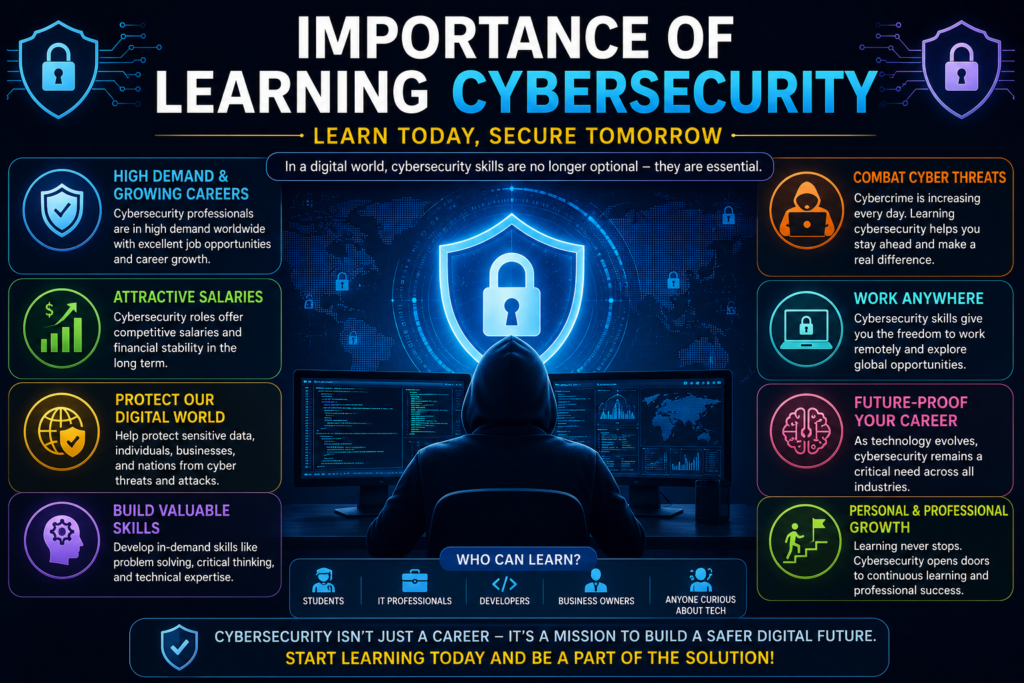
For beginners, cybersecurity education provides a clear path into technology. You do not need to become an expert immediately. Learning basic networking, operating systems, and security concepts is a strong starting point.
A beginner can follow a simple cybersecurity learning path:
| Learning Stage | Focus Area |
| Beginner | Networking and security basics |
| Intermediate | Security tools and testing |
| Advanced | Threat analysis and security architecture |
Understanding security also helps normal users. Basic cybersecurity awareness can prevent many common attacks.
Simple habits like using strong passwords, avoiding suspicious links, and updating software can greatly improve your protection.
What Is Cybersecurity?
Understanding Cybersecurity in Simple Words
Many people ask, “What is cybersecurity?” The answer is simple. It is the practice of protecting computers, networks, applications, and data from digital attacks.
Cybersecurity explained in everyday language means keeping your online world safe. It includes everything from protecting your smartphone to securing global company networks.
A complete security approach uses different areas such as network security, application security, cloud security, and data security.
Modern security teams combine technology and human decisions. Tools alone cannot stop every attack. Users must also understand risks and follow safe practices.
Protection of Systems, Networks, Applications, and Data
Every digital environment needs protection. Computers, servers, mobile devices, and applications can all become targets.
Information security focuses on protecting valuable information. Cybersecurity fundamentals focus on defending digital systems from online attacks.
Organizations use different layers of protection, including:
| Protection Area | Purpose |
| Systems | Protect computers and servers |
| Networks | Secure communication channels |
| Applications | Prevent software vulnerabilities |
| Data | Protect sensitive information |
Strong security systems create multiple defense layers. This approach is known as defense in depth.
Difference Between Cybersecurity and Information Security
Although people often use these terms together, they are slightly different.
Information security is a broader concept that protects information in every form, including digital and physical data.
Cybersecurity mainly focuses on protecting digital systems from online threats.
For example, protecting a printed document is information security. Protecting an online database from hackers is cybersecurity.
Both areas work together to create better data protection and stronger privacy protection.
Why Cybersecurity Matters Today
Technology has become a central part of modern life. People use digital platforms for communication, shopping, banking, education, and work. Because of this connection, protecting online activities has become more important than ever.
Strong cybersecurity awareness helps people understand common risks and make safer decisions. Without proper knowledge, even a small mistake like clicking a harmful link can create serious problems.
Increasing Cyber Attacks
Every year, attackers develop new methods to break into systems. Modern cyber attacks are becoming more targeted, faster, and harder to detect.
Hackers no longer depend only on basic tricks. They use advanced tools, automation, and stolen information to launch complex attacks.
Common examples include:
| Attack Type | How It Works |
| Malware attacks | Harmful software enters a device and causes damage |
| Phishing attacks | Fake messages trick users into sharing information |
| Ransomware attacks | Files are locked and criminals demand payment |
| Data breaches | Private information is exposed or stolen |
Organizations need strong cybersecurity strategy because attackers often search for weak points in systems. Proper planning, monitoring, and security controls reduce the chances of successful attacks.
Growing Online Dependency
The modern world depends heavily on internet services. Businesses use cloud platforms. Employees work remotely. Customers complete transactions online.
This digital growth creates convenience, but it also increases cybersecurity risks.
For example, a company that stores customer information online must protect that data from unauthorized access. A remote employee must secure their device before connecting to company systems.
Modern online security requires a combination of technology and responsible user behavior.
Important protection areas include:
| Area | Security Need |
| Online banking | Protect financial information |
| Cloud platforms | Secure stored data |
| Remote work | Protect company access |
| Mobile devices | Prevent unauthorized activity |
As more services move online, internet security becomes a daily requirement rather than an optional feature.
Protection of Personal and Business Data
Data is one of the most valuable assets in the digital world. Personal details, financial records, customer information, and business documents all require protection.
Strong data security helps prevent unauthorized access and reduces the damage caused by attacks.
Businesses collect large amounts of sensitive information. If attackers steal this data, companies may face legal issues, financial losses, and reputation problems.
In the United States, organizations also need to consider data protection laws USA requirements depending on their industry and the type of information they handle.
Good security practices help organizations maintain customer trust and protect their reputation.
Why Cybersecurity Is More Important Than Ever in 2026
The year 2026 represents a major shift in digital security. Technology is becoming smarter, but attackers are also becoming more creative.
Organizations now need advanced cybersecurity solutions that can detect problems quickly and respond effectively.
Traditional security methods alone are not enough. Modern businesses require continuous protection, monitoring, and improvement.
Growth of Cyber Threats
Cyber threats are increasing because attackers have access to better tools and larger attack opportunities.
A single vulnerability can expose thousands of users. This is why companies invest in security management, risk management, and advanced protection systems.
More Sophisticated Attacks
Modern attacks are not always obvious. Some attackers quietly enter systems and remain hidden for months.
These advanced campaigns are often known as advanced persistent threats. They usually target valuable information, government systems, financial organizations, and large companies.
Attackers may combine multiple techniques, including:
| Technique | Purpose |
| Social engineering | Manipulate people into giving access |
| Malware | Damage or control systems |
| Credential theft | Steal login information |
| Vulnerability exploitation | Use software weaknesses |
Security teams use security assessment and vulnerability management to discover weaknesses before attackers find them.
AI-Powered Attacks
Artificial intelligence is changing cybersecurity in both positive and negative ways.
Attackers use AI to create more convincing messages, automate attacks, and identify weaknesses faster.
For example, AI can help criminals create realistic phishing emails that look like they came from trusted companies.
At the same time, security professionals use AI cybersecurity tools to improve defense systems.
Security teams use AI for:
- Faster threat detection
- Automated analysis
- Suspicious activity identification
- Improved response time
This creates a continuous competition between attackers and defenders.
Automated Hacking Techniques
Automation allows attackers to perform tasks much faster than before.
Instead of manually searching for weak systems, criminals can use automated tools to scan thousands of devices.
These methods can include:
- Automated vulnerability scanning
- Password guessing attempts
- Botnet attacks
- Large-scale phishing campaigns
Security professionals respond with automated threat detection and advanced monitoring systems.
Digital Transformation and Security Risks
Digital transformation has changed how organizations operate. Businesses now depend on cloud platforms, remote teams, mobile devices, and online services.
While these technologies improve efficiency, they also introduce new security challenges.
A strong cybersecurity framework helps organizations manage these risks and create safer digital environments.
Cloud Computing
Cloud technology allows businesses to store data and run applications through internet-based services.
Companies benefit from flexibility and scalability, but they must also consider cloud security.
Common cloud risks include:
- Unauthorized access
- Misconfigured settings
- Data exposure
- Weak authentication
Modern cloud security solutions focus on protecting cloud environments through better access controls, monitoring, and encryption.
Remote Work
Remote work has become common across many industries. Employees now access company systems from homes, cafes, and different locations.
This creates challenges for remote work security.
Organizations must protect:
- Employee devices
- Company accounts
- Online communication
- Sensitive files
Using VPNs, strong authentication, and secure devices improves protection for remote workers.
IoT Devices
Internet-connected devices are becoming more popular. Smart watches, home devices, cameras, and industrial equipment all connect to networks.
However, many IoT devices create new risks because they may have weak security settings.
Strong device security is important because attackers can use vulnerable devices as entry points into larger networks.
Online Services
Online services make life easier, but they also store large amounts of personal information.
From shopping websites to financial applications, every platform needs proper protection.
Companies use secure communication, authentication systems, and encryption methods to protect users.
Customers should also practice safe habits, including checking website security, avoiding suspicious links, and protecting their accounts.
Common Cybersecurity Threats in 2026
The digital world creates many opportunities, but it also gives attackers more ways to target users and organizations. Understanding common threats is the first step toward better protection.
Modern cybersecurity threats are not limited to one type of attack. Criminals use different techniques depending on their goals. Some want money. Others want private information or access to valuable systems.
A strong security approach requires awareness, preparation, and the right tools. Learning about these threats helps individuals and businesses build better cybersecurity protection.
Malware Attacks
Malware is one of the most common forms of cyber threats. The word malware means malicious software designed to harm devices, steal information, or give attackers unauthorized access.
These attacks can affect personal computers, smartphones, company networks, and cloud systems.
Modern malware attacks can spread through emails, unsafe downloads, infected websites, and compromised applications.
Attackers often use malicious software because it can perform many harmful actions without the user noticing.
| Malware Type | Purpose |
| Viruses | Damage files and programs |
| Trojans | Hide inside legitimate software |
| Spyware | Monitor user activity |
| Worms | Spread automatically across networks |
Viruses
Computer viruses are programs that attach themselves to files or applications. When users open infected files, the virus can activate and spread.
Viruses may:
- Delete important files
- Slow down devices
- Damage operating systems
- Create security weaknesses
Although modern protection has improved, viruses remain a concern because attackers continue creating new versions.
Using updated antivirus software and practicing safe downloading habits can reduce infection risks.
Trojans
Trojans are dangerous because they often look like normal programs.
A user may download what appears to be useful software, but the hidden program gives attackers access to the device.
For example, a fake application may secretly install malware after installation.
Strong malware detection tools help identify suspicious activities before serious damage occurs.
Spyware
Spyware secretly monitors user activity and collects information without permission.
Attackers may use spyware to steal:
- Passwords
- Banking information
- Personal messages
- Browsing activity
This threat creates serious privacy problems.
Strong privacy protection practices and reliable security software help prevent spyware infections.
Worms
Unlike many malware types, worms can spread automatically without needing much user interaction.
They move through networks and search for vulnerable systems.
Large organizations can experience major problems if worms spread quickly across internal systems.
Proper network protection and regular updates reduce worm-related risks.
Ransomware Attacks
Ransomware is one of the most damaging cyber threats today. It locks files or systems and demands payment from victims.
During a ransomware attack, criminals usually encrypt important data. They then ask victims to pay money in exchange for restoring access.
Businesses are common targets because downtime can create major financial losses.
How Ransomware Works
A typical ransomware attack follows several stages:
| Stage | Explanation |
| Entry | Attackers gain access through phishing or vulnerabilities |
| Infection | Malware spreads through the system |
| Encryption | Files become inaccessible |
| Demand | Criminals request payment |
Many ransomware incidents begin with stolen login details or infected email attachments.
Strong data backups, security monitoring, and employee awareness can reduce the damage.
Business Impact
Ransomware can seriously affect organizations of all sizes.
A successful attack may cause:
- Business interruptions
- Lost customer information
- Financial expenses
- Reputation damage
For example, a healthcare organization may lose access to important systems during an attack. A small company may struggle to continue operations without customer files.
This is why companies invest in incident response and disaster recovery planning.
Prevention Methods
Preventing ransomware requires multiple security layers.
Important protection methods include:
| Method | Benefit |
| Data backups | Restore files after attacks |
| Security updates | Fix system weaknesses |
| Employee training | Reduce phishing risks |
| Access controls | Limit unauthorized activity |
Regular security awareness training helps employees recognize suspicious messages before they become dangerous.
Phishing Attacks
Phishing is one of the most successful attack methods because it targets human behavior.
Instead of directly breaking technology, attackers often trick people into giving away information.
Modern phishing attacks can appear very realistic. Criminals may copy trusted brands, companies, or government organizations.
Email Phishing
Email phishing uses fake emails to steal sensitive information.
A message may ask users to:
- Click a harmful link
- Download an infected file
- Confirm account details
- Share login information
Many phishing emails create urgency by saying an account will be closed or a payment is required.
Learning phishing prevention techniques helps users identify these messages.
Spear Phishing
Spear phishing is a more targeted version of phishing.
Instead of sending random messages, attackers research specific individuals or companies.
For example, a criminal may create a fake email that looks like it came from a manager requesting confidential information.
These attacks are harder to detect because they appear personalized.
Social Engineering
Social engineering attacks focus on manipulating human emotions.
Attackers may use:
- Fear
- Trust
- Urgency
- Curiosity
The goal is to convince people to make unsafe decisions.
Understanding social engineering attacks is important because technology alone cannot stop every threat.
Password Attacks
Passwords remain one of the most common security weaknesses.
Many users still create simple passwords or reuse the same password across multiple accounts.
Attackers take advantage of these mistakes through different methods.
Weak Passwords
Weak passwords are easy targets for criminals.
Examples include:
- Simple number combinations
- Common words
- Personal information
Using strong passwords improves account protection.
A good password should include:
| Feature | Example |
| Length | Longer than common passwords |
| Complexity | Mix of characters |
| Uniqueness | Different for every account |
Credential Theft
Credential theft happens when attackers steal usernames and passwords.
Criminals may obtain credentials through:
- Fake websites
- Malware
- Data leaks
- Social engineering
Stolen credentials can lead to account takeover and financial damage.
Strong password management and secure storage practices reduce this risk.
Brute Force Attacks
Brute force attacks use automated tools to guess passwords repeatedly.
Attackers test many possible combinations until they find the correct one.
Security systems prevent these attacks through:
- Login limits
- Multi factor authentication
- Account monitoring
Using two factor authentication adds an extra security layer.
Data Breaches
A data breach happens when unauthorized people gain access to private or sensitive information. These incidents can affect individuals, companies, healthcare organizations, and government agencies.
In today’s connected world, data breaches are becoming more common because businesses store huge amounts of valuable information online. Attackers often target customer records, financial details, employee information, and confidential documents.
Strong data security practices help organizations reduce the risk of unauthorized access. However, security requires continuous improvement because attackers constantly search for new weaknesses.
How Hackers Steal Data
Cyber criminals use different techniques to access private information. Sometimes they exploit technical weaknesses. Other times, they trick people into giving away access.
Common methods include:
| Method | How It Works |
| Phishing | Users are tricked into sharing login details |
| Malware | Harmful software steals information |
| Weak passwords | Attackers guess or reuse stolen passwords |
| Software vulnerabilities | Hackers exploit system weaknesses |
Many attacks happen because of poor security practices. Regular security assessment and vulnerability testing help organizations discover problems before attackers find them.
Companies also use encryption technology to protect sensitive information. Even if attackers access encrypted data, they cannot easily read it without the correct key.
Impact on Organizations
A successful data breach can create serious problems for any organization.
The impact may include:
- Financial losses
- Customer trust issues
- Legal consequences
- Operational disruption
For example, if an online company loses customer payment information, users may stop trusting the service. The company may also spend significant resources investigating and fixing the problem.
This is why businesses focus on risk management, strong security policies, and effective security controls.
A good security plan does not only prevent attacks. It also prepares organizations to respond quickly when problems occur.
Insider Threats
Not every security threat comes from outside attackers. Sometimes, risks come from people who already have access to company systems.
These situations are known as insider threats.
An insider threat can happen because of mistakes, poor security awareness, or intentional harmful actions.
Organizations must balance employee access with proper protection. Giving every user unlimited access creates unnecessary risks.
Employee Mistakes
Human mistakes are one of the most common security problems.
Employees may accidentally:
- Open harmful attachments
- Share confidential files
- Use weak passwords
- Misconfigure systems
Many incidents happen without bad intentions.
This is why companies invest in employee security training and regular awareness programs.
Good training helps employees recognize threats and follow safer digital habits.
Malicious Insiders
A malicious insider intentionally uses their access to harm an organization.
Examples include:
- Stealing confidential data
- Sharing company secrets
- Misusing account permissions
Organizations reduce these risks through:
- Access control
- Activity monitoring
- Employee verification
Modern identity access management systems help companies control who can access specific resources.
Types of Cybersecurity
Cybersecurity is not a single technology. It includes multiple areas that work together to protect digital environments.
Each security type focuses on a different part of technology. Together, they create a complete defense strategy.
Understanding different security areas helps individuals and businesses choose the right protection methods.
Network Security
Network security protects communication systems from unauthorized access, attacks, and misuse.
Every organization depends on networks to share information and operate daily. Without proper protection, attackers can enter systems and steal valuable data.
Network security focuses on creating safe connections between devices, servers, and users.
Protecting Networks
Organizations use different methods to protect their networks.
Important practices include:
- Monitoring network activity
- Blocking suspicious traffic
- Controlling user access
- Finding security weaknesses
A strong network environment uses secure network infrastructure to reduce attack opportunities.
Firewalls
Firewalls act as security barriers between trusted networks and dangerous traffic.
They analyze incoming and outgoing connections and block suspicious activity.
Modern firewall protection helps prevent unauthorized access and supports better network control.
Businesses often combine firewalls with other technologies such as:
- Intrusion detection system
- Intrusion prevention system
- Network monitoring
Monitoring Systems
Network monitoring helps security teams understand what is happening inside their systems.
It can detect unusual behavior, such as:
- Strange login activity
- Large data transfers
- Suspicious connections
Security teams use network security tools and network traffic analysis to identify possible attacks early.
Application Security
Applications are an important part of modern digital services. Websites, mobile apps, and business software all need protection.
Application security focuses on finding and fixing weaknesses inside software.
A vulnerable application can become an easy entry point for attackers.
Secure Software Development
Developers should consider security during every stage of software creation.
Secure development includes:
- Writing safer code
- Testing applications
- Fixing vulnerabilities
- Reviewing security risks
Security should not be added only after problems appear. It should be part of the development process from the beginning.
Vulnerability Testing
Vulnerability testing helps identify weaknesses before attackers exploit them.
Security teams use specialized tools to check applications for possible problems.
Common testing methods include:
| Testing Method | Purpose |
| Code review | Find security mistakes in software |
| Security testing | Identify weaknesses |
| Vulnerability scanning | Detect known issues |
Regular testing improves application reliability and reduces security risks.
Cloud Security
Cloud technology has changed how organizations store data and run applications.
Businesses now use cloud platforms for flexibility, scalability, and faster operations. However, cloud environments also create new security challenges.
Cloud security focuses on protecting cloud systems, applications, and stored information.
Protecting Cloud Data
Cloud data requires strong protection because unauthorized access can expose sensitive information.
Important protection methods include:
- Encryption
- Access control
- Activity monitoring
- Security policies
Modern cloud data protection helps organizations keep important information safe.
Cloud Access Management
Controlling who can access cloud resources is extremely important.
Organizations use cloud access management to decide:
- Who can view information
- Who can modify files
- Who can manage systems
Strong permissions reduce unnecessary access and improve overall security.
Cloud Security Practices
Good cloud security practices include:
| Practice | Benefit |
| Encryption | Protects stored information |
| Authentication | Confirms user identity |
| Monitoring | Detects unusual activity |
| Updates | Fixes security problems |
As cloud adoption grows, cloud security future will become an even bigger focus for businesses.
Endpoint Security
Every device connected to a network can become a possible entry point for attackers. Laptops, smartphones, tablets, and company computers all need protection.
Endpoint security focuses on securing individual devices that connect to business networks or personal accounts. As remote work continues to grow, protecting endpoints has become a major part of modern cybersecurity protection.
A single infected device can create problems across an entire organization. This is why companies use advanced tools and security policies to protect every connected device.
Device Protection
Modern organizations manage hundreds or thousands of devices. Each device needs proper security settings to reduce risks.
Effective device security includes:
| Protection Method | Purpose |
| Antivirus software | Detect and remove harmful programs |
| Regular updates | Fix security weaknesses |
| Access controls | Limit unauthorized users |
| Device monitoring | Identify suspicious activity |
Strong endpoint protection helps prevent malware infections and unauthorized access.
Antivirus Protection
Antivirus tools remain an important security layer. They scan devices, detect suspicious files, and remove harmful software.
Modern antivirus solutions use advanced detection methods instead of only searching for known threats.
They can identify:
- Suspicious files
- Dangerous applications
- Malware behavior
- Unusual activity
Businesses often combine antivirus protection with other technologies for stronger defense.
Endpoint Detection and Response (EDR)
Traditional antivirus is helpful, but modern threats require deeper monitoring.
Endpoint detection and response systems, also known as EDR solutions, continuously monitor devices for unusual behavior.
EDR tools can:
- Detect advanced attacks
- Investigate suspicious actions
- Respond quickly to threats
- Provide security insights
These solutions help security teams understand how an attack happened and prevent similar incidents.
Identity and Access Management (IAM)
Identity has become one of the most important parts of modern security. Many attacks begin when criminals gain access through stolen accounts.
Identity and access management helps organizations control who can access systems, applications, and data.
A strong identity strategy protects users and reduces unauthorized access risks.
User Authentication
Authentication confirms that a person is who they claim to be.
Common authentication methods include:
| Method | Example |
| Password | Traditional account login |
| Biometric | Fingerprint or facial recognition |
| Security key | Physical verification device |
| Verification code | Temporary login code |
Modern organizations use stronger authentication methods because passwords alone are often not enough.
Access Control
Access control decides what users can and cannot do after logging in.
For example, an employee may access customer records but may not have permission to change system settings.
Proper access control follows the principle of giving users only the permissions they need.
This reduces risks and supports better identity protection.
Multi-Factor Authentication
Multi factor authentication adds another security step beyond a password.
Instead of relying on one method, users verify their identity through multiple checks.
For example:
- Enter a password
- Confirm a mobile code
- Approve a login request
MFA is one of the easiest ways to improve account security.
Privileged Access Management
Some users have higher-level permissions, such as system administrators.
These accounts require extra protection because they can access sensitive areas.
Privileged access management helps organizations control and monitor powerful accounts.
It reduces the damage that can happen if an administrator account is compromised.
Data Security
Data is the foundation of modern businesses. Companies store customer details, financial records, research information, and private documents.
Data security focuses on protecting information from theft, damage, or unauthorized use.
Strong data protection helps organizations maintain trust and meet security requirements.
Encryption
Encryption changes readable information into a protected format.
Only authorized users with the correct key can access the original data.
Organizations use encryption tools to protect:
- Customer information
- Financial records
- Business documents
- Communication
Encryption is widely used in banking, healthcare, and online services.
Data Protection
Good data protection requires multiple security layers.
Important practices include:
| Practice | Purpose |
| Data backups | Recover information after incidents |
| Encryption | Protect stored information |
| Access control | Limit unnecessary access |
| Monitoring | Detect suspicious activity |
Companies also follow data protection laws USA requirements to protect customer information.
Mobile Security
Smartphones have become essential tools for communication, banking, shopping, and work.
However, mobile devices also create security risks.
Mobile security focuses on protecting smartphones, tablets, and mobile applications from threats.
Smartphone Protection
Users can improve mobile protection by following simple habits.
Important steps include:
- Installing apps from trusted sources
- Updating operating systems
- Using screen locks
- Avoiding unsafe networks
These practices improve mobile security and reduce common risks.
Mobile Threats
Mobile devices can face different threats, including:
- Malicious applications
- Fake updates
- Data theft
- Unsafe Wi-Fi connections
Attackers often target mobile users because smartphones contain valuable personal information.
Strong digital protection helps keep mobile data safer.
Essential Cybersecurity Tools in 2026
Security tools help individuals and organizations detect, prevent, and respond to digital threats.
However, tools alone cannot create complete protection. They work best when combined with proper strategies, user awareness, and security practices.
Modern security teams use different solutions based on their needs.
| Tool Category | Examples | Purpose |
| Antivirus | Malware detection tools | Remove threats |
| Firewall | Network protection tools | Block unauthorized access |
| VPN | Secure connection tools | Protect online privacy |
| Password Manager | Password security tools | Store passwords safely |
| SIEM | Security monitoring tools | Detect threats |
| Encryption Tools | Data protection | Secure information |
Antivirus Software
Antivirus software protects devices by detecting harmful files and suspicious behavior.
Modern solutions use advanced scanning methods to identify new threats.
They provide an important first layer of protection for individuals and businesses.
Firewall Software
Firewall software controls network traffic and blocks suspicious connections.
It helps prevent unauthorized access and protects sensitive systems.
Businesses often combine firewalls with monitoring tools for stronger security.
VPN Security
A VPN creates a protected connection between a device and the internet.
VPN security is especially useful for remote workers who access company systems from different locations.
VPNs help protect online activity by securing data during transmission.
Password Manager
Many users struggle to remember unique passwords for every account.
A password manager helps create and store strong passwords securely.
Benefits include:
- Better password management
- Reduced password reuse
- Stronger account protection
SIEM Tools
Security teams use SIEM tools to collect and analyze security information from different sources.
These tools help with:
- Threat detection
- Security monitoring
- Incident investigation
Large organizations often rely on SIEM platforms to manage complex security environments.
Cybersecurity Best Practices for Individuals and Businesses
Strong security does not depend on one tool alone. It requires daily habits, smart decisions, and proper planning. Whether you are an individual user or a business owner, following cybersecurity best practices can reduce many common risks.
Modern attackers often target human mistakes because people are easier to manipulate than advanced systems. Building good security habits creates a stronger defense against cyber threats.
A complete security approach combines technology, awareness, and responsible behavior.
Use Strong Passwords
Passwords are still one of the most important parts of digital security. Weak passwords can allow attackers to access accounts, steal information, and perform unauthorized actions.
Using strong passwords is a simple but powerful step toward better protection.
A strong password should be:
| Feature | Explanation |
| Long | Uses more characters for better protection |
| Unique | Different for every account |
| Complex | Includes different character types |
| Private | Not shared with others |
Password Management
Managing multiple passwords can become difficult. Many users solve this problem by using the same password everywhere, which creates serious risks.
Good password management helps users create and store secure passwords without remembering every detail.
A reliable password strategy includes:
- Using a password manager
- Avoiding password reuse
- Changing passwords after security incidents
- Keeping login information private
A password manager can generate stronger passwords and store them securely.
Unique Passwords
Using one password for many accounts creates a chain reaction risk.
For example, if attackers steal your password from one website, they may try the same password on banking, email, and social media accounts.
Unique passwords limit the damage because one compromised account does not expose everything.
Enable Multi-Factor Authentication
Passwords alone are no longer enough for modern security. Attackers can steal credentials through phishing, malware, and data leaks.
Two factor authentication and multi-step verification provide an additional security layer.
Multi-factor authentication requires users to prove their identity in more than one way.
Common verification methods include:
| Factor Type | Example |
| Something you know | Password |
| Something you have | Mobile device |
| Something you are | Fingerprint |
Extra Security Layer
Adding MFA creates an extra barrier for attackers.
Even if someone steals your password, they still need another verification step.
Many online services now support MFA because it significantly improves account protection.
Businesses also use MFA as part of their wider security controls and access policies.
Keep Software Updated
Software updates are not only about adding new features. They often include important security improvements.
Attackers frequently search for outdated software because old versions may contain known weaknesses.
Regular updates support better security patches and reduce exposure to vulnerabilities.
Security Patches
A security patch fixes a weakness discovered in software.
When companies release patches, users should install them quickly.
Delaying updates can leave devices open to attacks.
For example, a hacker may exploit an old operating system vulnerability to install malware or steal information.
Bug Fixes
Software developers constantly improve their products by fixing errors.
Some bugs may create security problems, while others affect performance.
Keeping applications updated improves:
- System stability
- Security protection
- Overall reliability
Regular updates are an important part of good cyber hygiene.
Regular Data Backup
Data loss can happen because of many reasons, including ransomware, hardware failure, accidental deletion, or cyber attacks.
Regular backups help users recover important information after unexpected events.
Strong data backups are one of the best defenses against ransomware.
Backup Strategies
A good backup plan should include multiple copies of important data.
The common approach is:
| Backup Type | Purpose |
| Local backup | Stored on personal devices |
| Cloud backup | Stored online securely |
| Offline backup | Protected from network attacks |
Organizations often create backup schedules to ensure important files remain available.
Ransomware Protection
Ransomware attacks can lock important files and stop business operations.
Reliable backups allow organizations to restore data without depending on attackers.
However, backups should also be protected because criminals may attempt to delete them during an attack.
Security Awareness Training
Technology alone cannot solve every security problem. Employees and users play a major role in preventing attacks.
Security awareness training teaches people how to identify risks and make safer decisions.
A well-trained team becomes an important security layer.
Employee Education
Employees should understand:
- How phishing works
- How to protect passwords
- How to report suspicious activity
- How to handle sensitive information
Regular training reduces mistakes and improves overall security.
Phishing Prevention
Phishing remains one of the most common attack methods because it targets human behavior.
Good phishing prevention includes:
- Checking email addresses carefully
- Avoiding unknown links
- Verifying unexpected requests
- Reporting suspicious messages
Security awareness helps users recognize threats before damage happens.
Cybersecurity Frameworks and Standards
Organizations need structured methods to manage security risks. A framework provides guidelines for protecting systems, identifying problems, and responding to incidents.
A strong cybersecurity framework helps businesses create organized security programs instead of using random security tools.
Frameworks are especially important for companies handling sensitive customer or financial information.
Zero Trust Security
Zero Trust is a modern security approach based on one simple idea:
“Never trust automatically. Always verify.”
Traditional security models often trusted users after they entered a network. Zero Trust assumes that every request could be risky.
Never Trust, Always Verify
Zero Trust requires continuous verification before allowing access.
It focuses on:
- User identity
- Device security
- Access permissions
- Network activity
This approach supports better access management and reduces unauthorized access risks.
Organizations use Zero Trust principles to protect remote workers, cloud systems, and sensitive applications.
NIST Cybersecurity Framework
The NIST Cybersecurity Framework is one of the most recognized security frameworks.
It helps organizations manage security through five core functions.
| Function | Purpose |
| Identify | Understand assets and risks |
| Protect | Apply security measures |
| Detect | Find security problems |
| Respond | Handle security incidents |
| Recover | Restore normal operations |
Identify
The first step is understanding what needs protection.
Organizations identify:
- Important data
- Critical systems
- Potential risks
- Security weaknesses
Without knowing assets, companies cannot protect them properly.
Protect
Protection involves applying security measures.
Examples include:
- Access controls
- Encryption
- Employee training
- Security policies
These actions reduce the chance of successful attacks.
Detect
Detection focuses on finding suspicious activity quickly.
Security teams use:
- Monitoring systems
- Alerts
- Security software
Fast detection can reduce the damage caused by attacks.
Respond
When an incident occurs, organizations need a clear response plan.
Incident response helps teams control the situation and reduce losses.
A quick response can prevent a small problem from becoming a major crisis.
Recover
Recovery focuses on restoring systems after an attack.
Organizations use:
- Data backups
- Recovery plans
- System restoration procedures
Good recovery planning improves business continuity.
Cybersecurity Career Roadmap in 2026
The cybersecurity field is growing rapidly because organizations need skilled professionals to protect their digital environments. As cyber attacks become more advanced, companies are searching for people who can identify risks, secure systems, and respond to incidents.
A career in cybersecurity can provide strong opportunities for beginners and experienced technology professionals. The field includes many roles, from security analysts to advanced threat researchers.
For anyone starting their journey, a clear cybersecurity career roadmap makes learning easier. You do not need to master everything at once. Building skills step by step creates a strong foundation.
Beginner Level
Starting a cybersecurity career begins with understanding basic technology concepts. Beginners should first learn how computers, networks, and operating systems work.
A strong foundation helps you understand how attacks happen and how security teams prevent them.
Learn Networking Basics
Networking knowledge is one of the most important cybersecurity skills.
Beginners should understand:
| Topic | Purpose |
| IP addresses | Identify devices on networks |
| TCP/IP | Understand internet communication |
| DNS | Understand website connections |
| Network protocols | Learn how systems communicate |
Without networking knowledge, it becomes difficult to understand attacks or build protection strategies.
Learning networking creates the foundation for advanced security topics like network security and threat analysis.
Operating Systems
Cybersecurity professionals work with different operating systems.
Learning both Windows and Linux helps beginners understand system behavior and security controls.
Important areas include:
- File permissions
- User accounts
- Command-line basics
- System settings
Linux knowledge is especially valuable because many security tools and servers use Linux environments.
Security Fundamentals
Beginners should learn basic security concepts before moving into advanced topics.
Important concepts include:
- Common cyber attacks
- Authentication
- Encryption
- Malware protection
- Security monitoring
A good beginner cybersecurity guide helps new learners understand these concepts without feeling overwhelmed.
Intermediate Level
After building basic knowledge, learners can move into practical security skills.
The intermediate stage focuses on hands-on experience, security tools, and real-world problem solving.
At this level, students start developing professional cybersecurity skills.
Ethical Hacking
Ethical hacking teaches professionals how to find weaknesses before criminals discover them.
Ethical hackers use the same techniques as attackers, but they work legally to improve security.
Common areas include:
- Network testing
- Web application testing
- Vulnerability discovery
- Security assessments
Learning ethical hacking helps students understand attacker behavior and improve defense strategies.
Security Tools
Cybersecurity professionals use many tools to monitor systems and identify threats.
Important categories include:
| Tool Category | Purpose |
| Vulnerability scanners | Find security weaknesses |
| SIEM platforms | Analyze security events |
| Packet analyzers | Study network activity |
| Penetration testing tools | Test system security |
Practical experience with security tools improves job readiness.
Vulnerability Assessment
Vulnerability assessment focuses on finding weaknesses before attackers exploit them.
Professionals analyze:
- Software problems
- Network weaknesses
- Configuration mistakes
- Security gaps
Companies use vulnerability assessments to improve their overall security posture.
Advanced Level
Advanced cybersecurity roles require deeper technical knowledge and real-world experience.
Professionals at this level design security systems, investigate complex attacks, and protect large organizations.
Penetration Testing
Penetration testing involves safely testing systems to discover vulnerabilities.
Security experts simulate attacks to understand how criminals could enter a system.
Professional penetration testers use specialized penetration testing tools to evaluate security.
This skill is valuable for organizations that need regular security testing.
Security Architecture
Security architects design secure technology environments.
They create plans for:
- Network protection
- Cloud security
- Identity management
- Data protection
A security architect focuses on building systems that remain secure as technology changes.
Threat Intelligence
Threat intelligence professionals study attackers, methods, and emerging risks.
They analyze:
- New malware campaigns
- Attack patterns
- Criminal techniques
- Security trends
A threat intelligence analyst helps organizations prepare before attacks happen.
Cybersecurity Certifications
Certifications help learners prove their knowledge and improve career opportunities.
While experience is important, certifications can provide structured learning and professional recognition.
The right certification depends on your current skill level.
| Certification | Level | Purpose |
| CompTIA Security+ | Beginner | Learn security fundamentals |
| Certified Ethical Hacker (CEH) | Intermediate | Learn ethical hacking concepts |
| CISSP certification | Advanced | Security leadership and management |
| OSCP certification | Advanced | Practical penetration testing |
CompTIA Security+
CompTIA Security+ is a popular starting certification for beginners.
It covers:
- Security basics
- Threat management
- Network protection
- Risk concepts
Many beginners use it as their first step into professional cybersecurity.
Certified Ethical Hacker (CEH)
The Certified Ethical Hacker certification focuses on ethical hacking techniques.
It teaches learners how attackers think and how security professionals identify weaknesses.
It is useful for people interested in penetration testing and security assessment roles.
CISSP Certification
The CISSP certification is designed for experienced professionals.
It focuses more on security leadership, architecture, and management.
Many security managers and senior professionals pursue this certification.
OSCP Certification
The OSCP certification is known for practical penetration testing skills.
It requires hands-on ability and focuses on real-world security testing.
It is popular among professionals who want advanced offensive security careers.
Cybersecurity Career Opportunities in the USA
The United States has a strong demand for cybersecurity professionals.
Organizations in healthcare, finance, technology, government, and retail need skilled security workers.
Popular roles include:
| Job Role | Main Responsibility |
| Security Analyst | Monitor and respond to threats |
| Security Engineer | Build security systems |
| Penetration Tester | Find vulnerabilities |
| Security Architect | Design secure environments |
| Threat Intelligence Analyst | Study cyber threats |
The demand for cybersecurity professionals continues to increase because businesses need stronger protection.
Many people choose this field because of strong cybersecurity career opportunities and long-term growth potential.
Future of Cybersecurity in 2026 and Beyond
The future of cybersecurity will be shaped by new technologies, changing threats, and increasing digital dependence.
As organizations adopt more advanced systems, security will become a core business requirement.
The future of cybersecurity will focus on faster detection, smarter protection, and stronger digital trust.
AI in Cybersecurity
Artificial intelligence is becoming a major part of modern security.
Artificial intelligence security solutions help organizations analyze large amounts of information quickly.
AI can support:
- Threat detection
- Security monitoring
- Attack prediction
- Automated responses
However, attackers also use AI to create more advanced threats.
This creates a continuous competition between attackers and defenders.
Automation
Automation helps security teams respond faster.
Modern organizations use automated systems to:
- Detect suspicious activity
- Analyze security events
- Block harmful actions
Automated threat detection reduces response time and helps security professionals focus on complex problems.
Cloud Security Growth
Cloud adoption will continue growing because businesses need flexible and scalable technology.
However, this growth also increases the need for stronger cloud protection.
The cloud security future will focus on:
- Better access control
- Stronger encryption
- Continuous monitoring
- Secure cloud environments
Companies will continue investing in cloud security because their important data depends on reliable protection.
Cybersecurity Job Demand
The need for cybersecurity experts is expected to remain strong.
Organizations need professionals who understand technology, risk, and digital protection.
The growing cybersecurity workforce demand creates opportunities for students, career changers, and technology workers.
Learning cybersecurity today can open doors to many professional paths.
FAQs About Cybersecurity in 2026
What is cybersecurity?
Cybersecurity is the practice of protecting computers, networks, applications, and digital information from unauthorized access, damage, or theft.
In simple words, what is cybersecurity means keeping your digital life safe from hackers and online dangers. It includes protecting personal accounts, business systems, websites, and connected devices.
Modern security uses different methods such as network security, encryption, authentication, and monitoring tools to prevent cyber attacks.
Why is cybersecurity important in 2026?
The importance of cybersecurity has increased because people and businesses depend heavily on digital technology.
In 2026, organizations store more information online than ever before. Cloud platforms, remote work systems, mobile devices, and online services create new security challenges.
Strong cybersecurity protection helps prevent:
- Data theft
- Financial fraud
- Privacy problems
- Business disruption
As cybersecurity trends 2026 continue changing, users and companies must improve their security awareness and protection methods.
What are the main types of cybersecurity?
There are several important areas of cybersecurity. Each one protects a different part of the digital environment.
The main types include:
| Type | Purpose |
| Network Security | Protects communication systems |
| Application Security | Secures software and applications |
| Cloud Security | Protects cloud-based data |
| Endpoint Security | Protects connected devices |
| Data Security | Protects sensitive information |
| Mobile Security | Protects smartphones and tablets |
| IAM Security | Controls user access |
These areas work together to create complete cybersecurity solutions for individuals and organizations.
How does cybersecurity work?
Many people ask, how does cybersecurity work?
Cybersecurity works through multiple layers of protection. Security teams identify risks, apply protective measures, monitor systems, and respond to incidents.
A typical security process includes:
| Step | Purpose |
| Identify | Find assets and possible risks |
| Protect | Apply security controls |
| Detect | Discover suspicious activity |
| Respond | Handle security incidents |
| Recover | Restore systems after problems |
This approach helps organizations build stronger cyber defense strategies.
What are cybersecurity threats?
Cybersecurity threats are dangers that can damage systems, steal information, or interrupt digital services.
Common threats include:
- Malware
- Ransomware
- Phishing
- Password attacks
- Data breaches
- Insider threats
Attackers use different methods depending on their goals. Some want financial rewards, while others want confidential information.
Understanding these threats is the first step toward better threat prevention.
How can I protect my data online?
You can improve your online safety by following simple security habits.
Important steps include:
| Security Habit | Benefit |
| Use strong passwords | Protects accounts |
| Enable MFA | Adds extra verification |
| Update software | Fixes security issues |
| Avoid suspicious links | Prevents phishing |
| Backup important files | Helps recover data |
Practicing safe browsing practices and improving your digital habits can greatly reduce security risks.
Is cybersecurity a good career?
Yes, cybersecurity is one of the fastest-growing technology fields.
Companies need skilled professionals who can protect systems, analyze threats, and respond to attacks.
A cybersecurity career can lead to roles such as:
- Security analyst
- Security engineer
- Ethical hacker
- Threat intelligence analyst
- Cybersecurity specialist
Many people choose this field because of strong job demand, professional growth, and attractive cybersecurity salary opportunities.
How can beginners learn cybersecurity?
Beginners should start with basic technology knowledge and gradually build advanced skills.
A simple learning path includes:
| Stage | Learn |
| Beginner | Networking, operating systems, security basics |
| Intermediate | Security tools, ethical hacking, vulnerability testing |
| Advanced | Penetration testing, threat analysis, security architecture |
New learners can explore cybersecurity courses, practice with labs, and study for certifications.
The most important thing is consistency. Cybersecurity is a large field, so learning step by step produces better results.
What skills are needed for cybersecurity?
Cybersecurity professionals need both technical and problem-solving skills.
Important skills include:
| Skill | Why It Matters |
| Networking | Understand communication systems |
| Linux knowledge | Work with security environments |
| Programming basics | Automate security tasks |
| Problem solving | Analyze complex issues |
| Communication | Explain security risks clearly |
Strong technical knowledge combined with curiosity helps professionals succeed in this industry.
Conclusion
The digital world will continue expanding, and security will become even more important. From individuals protecting personal accounts to companies securing large networks, everyone needs a better understanding of cybersecurity.
Modern cybersecurity solutions are not only about using security software. They require awareness, smart decisions, strong policies, and continuous improvement.
As threats become more advanced, organizations must focus on prevention, detection, and fast response. Learning about cybersecurity in 2026 helps people understand risks and build safer digital habits.
For businesses, investing in security creates trust and protects valuable information. For individuals, cybersecurity knowledge provides better online safety and opens exciting career opportunities.
The cybersecurity industry will continue growing because every connected device, application, and service needs protection.
Whether you are a beginner exploring technology or a professional building your career, now is a valuable time to learn cybersecurity.
Stay informed. Stay prepared. Build a safer digital future.
Meta Description :
Learn cybersecurity in 2026 with this complete guide covering cybersecurity threats, types, tools, best practices, and career roadmap. Discover how to protect data, systems, and online privacy while building essential security skills for the future.
Continue Learning Cybersecurity
Expand your cybersecurity knowledge with these related guides:
| Related Guide | Learn More About |
| What Is Cybersecurity? | Cybersecurity fundamentals and why they matter |
| Types of Cybersecurity | Different areas of cybersecurity protection |
| Common Cyber Threats | Modern online threats affecting individuals and businesses |
| Network Security | How networks are protected from cyberattacks |
| Firewall Explained | How firewalls filter and block malicious traffic |
| VPN Guide | Secure browsing and online privacy |
| Identity and Access Management (IAM) | Managing user identities and permissions |
| Endpoint Security | Protecting laptops, desktops, and mobile devices |
| What Is Malware? | Understanding malicious software and infections |
| What Is Ransomware? | How ransomware attacks work |
Ready to Improve Your Cybersecurity?
The best time to protect your devices is before an attack happens. Continue exploring our expert guides to learn about What Is Phishing? ,malware, firewalls, password managers, network security, and other essential cybersecurity topics.