

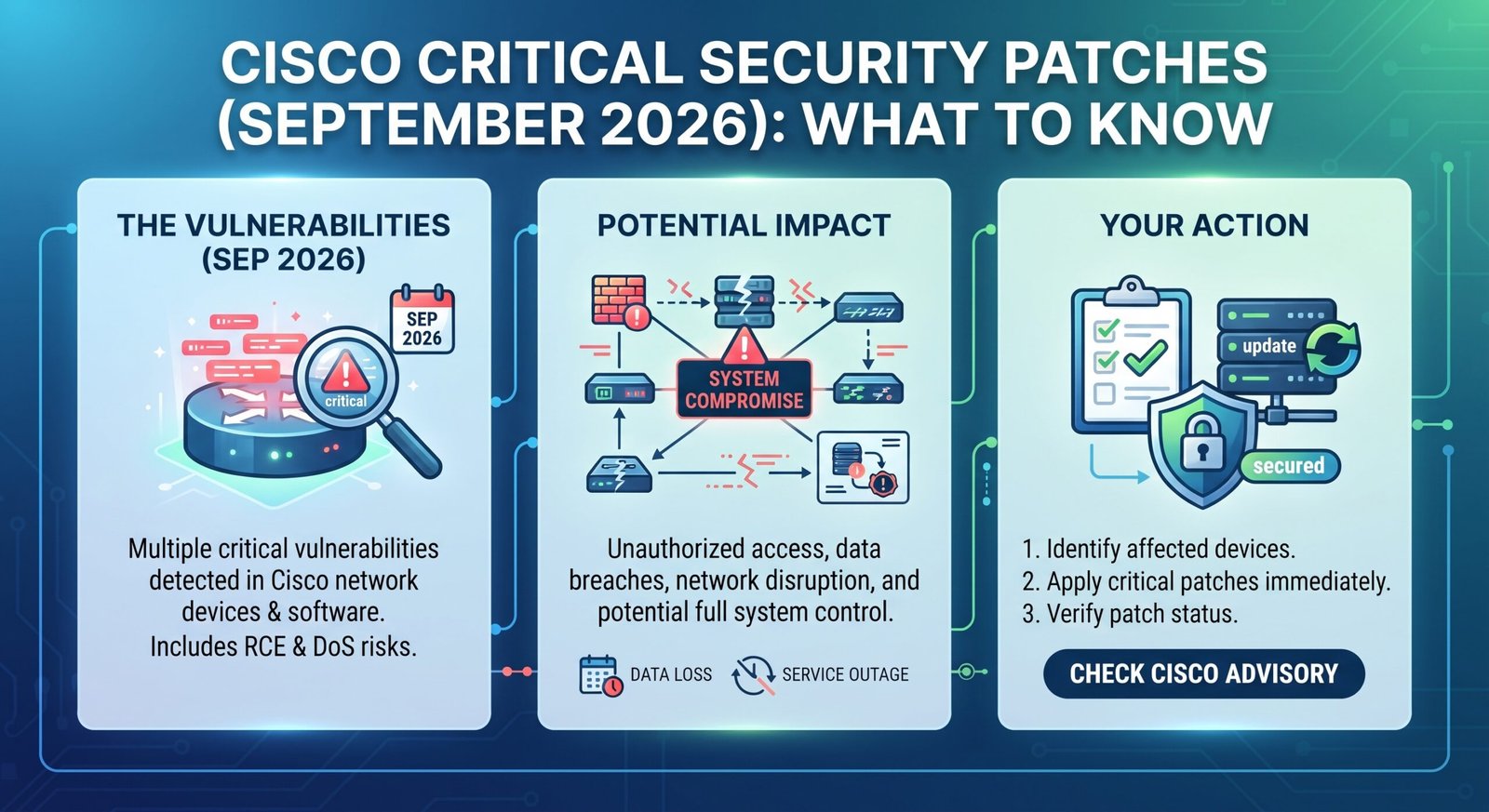
Cisco is preparing a major security disclosure for September 2, 2026. The release covers several important product families. Cisco has confirmed Cisco Releases Multiple Critical Security Patches 2026 for Desk Phone software, IOS XR, Nexus 9000 Silicon One switches, and Secure Email.
The timing matters for U.S. businesses. Network devices often sit quietly at the center of everything. They connect offices, servers, cloud systems, users, applications, and security tools. One overlooked weakness can therefore create a much bigger problem than expected.
Cisco’s advance notice does not confirm that every September 2 issue is critical. The individual advisories will provide the final CVE numbers, severity ratings, CVSS scores, affected releases, and fixed versions. That distinction matters. Good security reporting should separate confirmed facts from assumptions.
What Did Cisco Releases Multiple Critical Security Patches in Its September 2026 Security Update?
Cisco’s September release is broader than one ordinary firmware update. The company says its PSIRT team will publish vulnerability information and fixed software for four product areas. These include Desk Phone 9800, 7800, 8800 and 8875 software, IOS XR, Nexus 9000 Silicon One, and Secure Email.
That makes the Cisco security update September 2026 relevant to different types of organizations. A carrier may care about IOS XR. A data center may run Nexus switches. A company may use Secure Email. Another business may have hundreds of Cisco phones. Each environment needs a separate review.
| Product family | September release focus | What administrators should verify |
|---|---|---|
| Cisco Desk Phone software | Security advisories | Installed release and fixed release |
| Cisco IOS XR | Security hardening release | Running IOS XR version |
| Cisco Nexus 9000 Silicon One | Security advisory | Hardware and software combination |
| Cisco Secure Email | Security advisory | Appliance release and exposure |
Why Cisco’s Latest Security Patches Matter Right Now
Network infrastructure rarely gets the same attention as laptops. That creates a dangerous blind spot. Cisco network device security matters because routers and switches can control traffic between critical systems. If attackers compromise that layer, the problem can spread quickly.
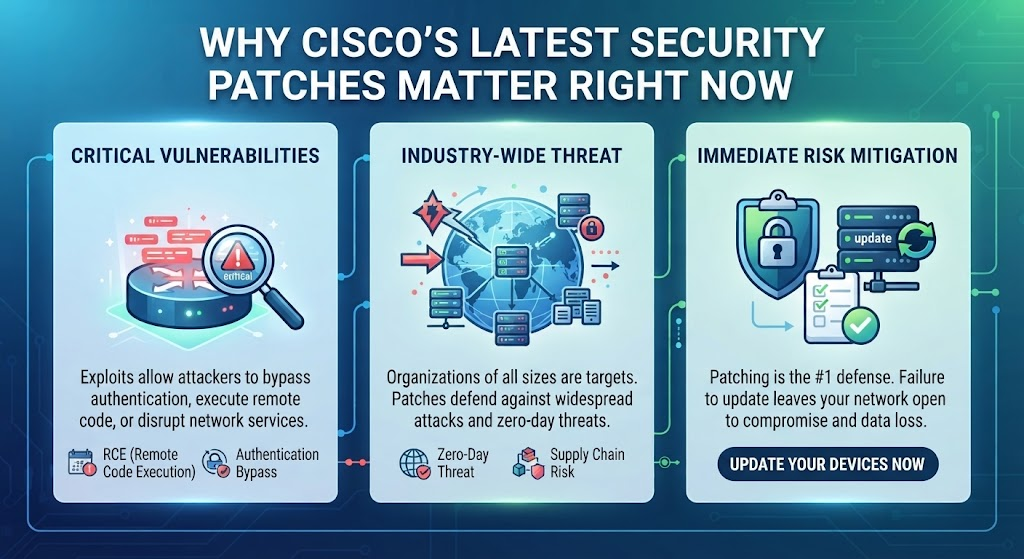
For U.S. organizations, Cisco enterprise security also connects with availability, compliance, and business continuity. A vulnerable device does not automatically mean a breach will happen. Still, an exposed device increases the organization’s attack surface. That is why timely patching remains one of the simplest defensive moves.
Which Cisco Products Are Affected by the September 2026 Vulnerabilities?
The confirmed September release covers several product families. Cisco’s advance notice specifically names Desk Phone 9800, 7800 and 8800 Series software, Video Phone 8875 software, IOS XR Software, Nexus 9000 Series Switches Silicon One, and Secure Email.
The important detail is product scope. A company should not patch blindly. First, identify the exact model and software release. Then compare that information with Cisco’s individual advisory. This approach helps Cisco customers avoid both missed patches and unnecessary upgrades.
| Cisco technology | Main environment | Security review |
|---|---|---|
| IOS XR | Service provider and large networks | High priority review |
| Nexus 9000 | Data centers | High priority review |
| Secure Email | Email security | Exposure review |
| Desk Phones | Business communications | Version review |
Cisco IOS XR Security Vulnerabilities: What Network Administrators Should Know
Cisco IOS XR is built for demanding network environments. It supports large routing systems and complex infrastructure. Therefore, Cisco IOS XR vulnerabilities deserve careful attention when Cisco publishes a security hardening release.
A hardening release is not automatically proof of active exploitation. It can address weaknesses discovered through testing and engineering review. Administrators should still treat a fixed release seriously. The right move is to compare the installed version with Cisco’s published remediation guidance.
Why Cisco IOS XR Security Hardening Matters
Cisco’s September notice describes IOS XR as a security hardening release. Cisco’s recent hardening advisories show that such releases can address multiple internally discovered weaknesses without evidence of active exploitation.
This distinction helps readers understand the story. A security hardening release can strengthen software before attackers weaponize a weakness. In cybersecurity, prevention is usually cheaper than cleanup. That makes early remediation valuable even without a known actively exploited vulnerability.
Cisco Nexus 9000 Security Flaws and Available Fixes
Cisco Nexus 9000 switches play an important role in data-center networking. The September notice specifically identifies Nexus 9000 Series Switches Silicon One for the upcoming security disclosure.
That makes Cisco Nexus 9000 security a major area for data-center teams. Existing Cisco advisories show that Nexus products can face different vulnerability classes, including denial-of-service and command-injection issues. However, those older advisories should not be confused with the September 2 release.
| Check | Why it matters |
|---|---|
| Hardware model | Different platforms can have different exposure |
| NX-OS or related release | Vulnerability scope can depend on software |
| Management access | Exposure changes the practical risk |
| Fixed release | Confirms the vendor’s remediation path |
Are the New Cisco Vulnerabilities Critical or High Severity?
The word “critical” gets attention. However, security teams need more than a dramatic headline. Cisco assigns Security Impact Ratings to individual advisories. Those ratings can be Critical, High, Medium, Low, or Informational.
The September 2 advance notice itself is classified as Informational because it is an advance notification. It does not provide the final severity of each upcoming vulnerability. Therefore, readers should wait for the individual Cisco security advisories before calling every issue critical.
| Rating | General meaning |
|---|---|
| Critical | Very serious security impact |
| High | Significant security risk |
| Medium | Moderate security impact |
| Low | Limited security impact |
| Informational | Not a vulnerability severity rating |
What Are the CVE Numbers and CVSS Scores for the Cisco Security Flaws?
CVE numbers give vulnerabilities a standard public identity. CVSS scores then help describe technical severity. Together, they make it easier for security teams to compare vulnerabilities across products and vendors.
At publication time, Cisco’s public September 2 advance notice had not supplied the final September CVE table. The official Cisco vulnerability database and individual advisories should be treated as the source of truth when those details appear.
| Security detail | Where readers should verify it |
|---|---|
| CVE number | Cisco advisory |
| CVSS score | Cisco advisory |
| Security Impact Rating | Cisco advisory |
| Affected release | Cisco advisory |
| Fixed release | Cisco advisory |
| Workaround | Cisco advisory |
Can Attackers Exploit These Cisco Vulnerabilities Remotely?
Remote exploitation depends on the exact vulnerability. Some flaws require network access. Others may require authentication or local privileges. Therefore, you cannot determine remote exploitability simply from the product name.
Security teams should inspect the advisory’s attack conditions. Look for network exposure, authentication requirements, user interaction, and affected interfaces. A remote attacker may face very different barriers across different Cisco products. That detail can dramatically change the practical cybersecurity threat.
Could Cisco Security Vulnerabilities Lead to Remote Code Execution?
Remote code execution means an attacker may run code on a vulnerable system. It is one of the most serious vulnerability outcomes because successful exploitation can move beyond a single application function.
However, not every Cisco vulnerability enables RCE. Some flaws cause denial of service. Others may expose information or permit privilege changes. The exact impact must come from the individual advisory. Avoid treating every Cisco security flaw as an RCE issue without evidence.
Can Unpatched Cisco Devices Be Used in Cyberattacks?
Unpatched infrastructure can become an attractive target. Attackers often look for systems that provide useful access, broad network visibility, or privileged control. That makes unpatched Cisco devices worth monitoring closely.
A successful network attack could have different outcomes depending on the flaw. Potential consequences may include service disruption, unauthorized access, information exposure, or changes to network behavior. None of these outcomes should be assumed for the September vulnerabilities until Cisco publishes the technical details.
Which Cisco Software Versions Are Vulnerable?
Version checking is one of the most important steps after an advisory appears. Cisco vulnerabilities can affect specific releases rather than every version of a product family. That means a product name alone cannot determine exposure.
Administrators should record the exact Cisco software versions running in production. Then compare those versions against the affected-release table. This process turns a broad security headline into a precise vulnerability assessment.
| Information | Example purpose |
|---|---|
| Product model | Identifies the platform |
| Software release | Determines version exposure |
| Hardware variant | Confirms platform scope |
| Enabled feature | May affect exploitability |
| Management interface | Helps assess exposure |
Which Cisco Software Versions Have Been Patched?
A fixed version represents Cisco’s recommended remediation path. Cisco’s September advance notice specifically tells customers to upgrade to the fixed software identified in the individual advisories.
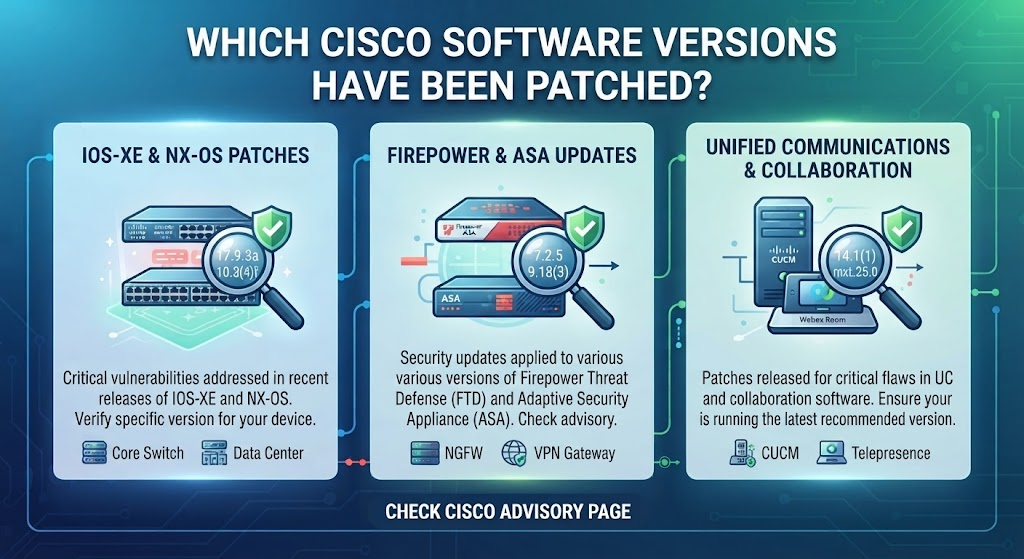
That advice matters because a security patch is not simply a new file. It should match the hardware, software train, and deployment model. A rushed software upgrade can create operational problems if teams ignore compatibility. Patch security first, but patch intelligently.
| Version detail | Administrator action |
|---|---|
| Affected release | Review immediately |
| Fixed release | Plan upgrade |
| Unsupported release | Review migration path |
| Unknown release | Identify before deciding |
How to Check if Your Cisco Device Is Vulnerable
Start with visibility. You cannot protect devices that you cannot identify. Create an inventory of Cisco routers, switches, security appliances, phones, and related systems.
Next, compare each device with the official advisory. This is the practical answer to how to check Cisco security vulnerabilities. If the release appears affected, review exposure and the recommended fix. Then record the result for your IT security teams.
| Step | What to do |
|---|---|
| 1 | Identify the Cisco product |
| 2 | Record the installed version |
| 3 | Find the matching advisory |
| 4 | Compare affected releases |
| 5 | Check the fixed release |
| 6 | Review exposure |
| 7 | Schedule remediation |
How to Install the Latest Cisco Security Updates Safely
Patching should protect the network without unexpectedly breaking it. Before installing a Cisco security patch, review compatibility, backups, maintenance requirements, and rollback options. Critical infrastructure deserves a controlled change window.
For large environments, test the upgrade first. Then deploy it in stages when practical. Afterward, verify routing, switching, authentication, monitoring, and application connectivity. Good security patch management treats an upgrade like surgery. You want the problem fixed without damaging healthy systems.
Should Businesses Immediately Patch Their Cisco Network Devices?
Urgency depends on risk. A critical flaw with public exploitation deserves faster action than a low-impact issue on an isolated device. However, even lower-severity weaknesses should enter the organization’s remediation process.
For Cisco security patches September 2026, teams should consider severity, exposure, exploitability, business importance, and patch availability together. A vulnerable internet-facing device deserves more attention than an isolated lab system. Risk should drive the queue.
| Risk factor | Priority effect |
|---|---|
| Critical severity | Raises priority |
| Internet exposure | Raises priority |
| Active exploitation | Raises priority sharply |
| Sensitive network role | Raises priority |
| Fixed software available | Makes remediation easier |
What Happens If You Delay Cisco Security Patches?
Delay creates an exposure window. The longer a vulnerable system remains online, the more time defenders give attackers to discover and abuse the weakness.
That does not mean every delayed patch causes a breach. It means your security risk can increase while the weakness remains unresolved. For enterprise environments, delayed remediation can also complicate audits, incident response, and vulnerability tracking.
Cisco Security Patches vs. Active Exploitation: What Users Should Watch For
A disclosed vulnerability is not automatically an active attack. Cisco may publish a flaw after internal testing or responsible disclosure. In other cases, the company may know that attackers are already abusing it.
This difference is crucial. A zero-day vulnerability generally refers to a newly exploited or previously unknown weakness. An actively exploited vulnerability has evidence of exploitation. Security teams should monitor Cisco, CISA, threat researchers, and trusted intelligence sources before making that claim.
How Cisco Customers Can Reduce Risk Before Patching
Sometimes teams cannot patch immediately. A maintenance window may be unavailable. A compatibility test may still be running. In those cases, temporary security mitigation can reduce exposure while the permanent fix is prepared.
The exact mitigation depends on the vulnerability. Possible controls may include restricting management access, reducing internet exposure, tightening authentication, or disabling unnecessary features. Never invent a workaround for a Cisco flaw. Use the official advisory whenever Cisco provides one.
Cisco Security Advisory: Where to Find Official Vulnerability Details
The best starting point is Cisco’s security center and official advisory database. Cisco publishes technical details, affected products, CVEs, severity information, and fixed software through its security advisory system.
Cisco’s PSIRT team manages these disclosures. The Cisco security response process helps customers understand newly disclosed weaknesses and available remediation. For September 2026, the individual advisory pages should remain the final authority for exact technical claims.
What Security Teams Should Do After Installing the Cisco Patches
Patching is not the finish line. After installation, verify the running version and confirm that the device operates normally. Then review logs and monitoring data for unusual activity.
A mature process also checks whether the device showed suspicious behavior before the update. That matters because remediation does not erase evidence of a previous security breach. Keep records of the patch, verification, and monitoring results.
Are Cisco Routers and Switches Safe After the September 2026 Update?
A patched device is safer than an affected device. However, no software update makes an entire network permanently secure. New Cisco networking vulnerabilities can appear later.
That is why Cisco router security and Cisco switch vulnerabilities require continuous monitoring. Security teams should keep asset inventories current and follow new advisories. One patch closes one known door. It does not remove every door from the building.
How Often Does Cisco Release Security Advisories?
Cisco follows a risk-based disclosure model. Its advance notification explains that hardening releases and other security advisories are generally scheduled for the first and third Wednesday of each month. Cisco also warns that the schedule can change.
This predictable cadence helps administrators prepare. It also makes September 2026 security updates easier to plan for. Still, teams should monitor Cisco between scheduled releases because urgent security events can require separate attention.
What Is Cisco PSIRT and How Does It Track Vulnerabilities?
Cisco PSIRT stands for Product Security Incident Response Team. It handles vulnerability response and coordinates security disclosures across Cisco products.
For security professionals, Cisco vulnerability disclosure provides a structured path from discovery to remediation. PSIRT advisories can include CVEs, impact ratings, affected releases, fixed software, and other technical information. That makes the process useful for both network security administrators and vulnerability-management teams.
What Should Small Businesses Know About Cisco Security Updates?
Small businesses often have fewer security staff. That makes simple patch routines especially valuable. A company doesn’t need a giant security operations center to improve its network device vulnerabilities management.
Start with an inventory. Know which Cisco devices exist. Record their software versions. Then monitor official advisories and apply fixed releases according to risk. If your team lacks technical expertise, a qualified network professional can help with testing and deployment.
What Should Enterprise IT Teams Do About the New Cisco CVEs?
Large organizations should treat the September release as an inventory exercise first. Find every affected Cisco asset. Then map each device to its business role, exposure, software version, and maintenance window.
This creates a useful risk assessment instead of a simple patch checklist. Enterprise IT administrators can then prioritize critical systems, document remediation, and provide clear status reports to security leadership.
How to Prioritize Critical Cisco Vulnerabilities in 2026
The highest priority should usually combine technical severity with real-world exposure. A critical vulnerability on an internet-facing device deserves immediate attention. A similar flaw on an isolated test system may follow a different schedule.
This is where Cisco critical vulnerabilities 2026 should be evaluated carefully. Don’t rank issues by CVSS alone. Consider exploit availability, asset value, network exposure, authentication requirements, and business impact. Context turns a score into a useful decision.
| Priority | Typical situation | Recommended response |
|---|---|---|
| Emergency | Critical and actively exploited | Immediate remediation |
| Very high | Critical and exposed | Accelerated patching |
| High | High severity and important asset | Rapid remediation |
| Medium | Limited exposure | Planned remediation |
| Lower | Low-risk isolated system | Track and remediate |
Cisco Security Update September 2026: Complete FAQ
What is the Cisco security update for September 2026?
Cisco is publishing security advisories and fixed software for several product families on September 2, 2026. The confirmed scope includes Desk Phone software, IOS XR, Nexus 9000 Silicon One, and Secure Email.
Are all September 2026 Cisco vulnerabilities critical?
Not necessarily. Cisco’s advance notification does not provide final severity ratings for every September 2 issue. Readers should use each published advisory to confirm whether a flaw is Critical, High, Medium, Low, or another rating.
What are the Cisco CVEs for September 2026?
The final CVE identifiers should be taken from Cisco’s individual September 2 advisories. The advance notification identifies the affected product families but does not list the final September CVE set.
How can I check Cisco affected software versions?
Find your exact Cisco product and installed software release. Then compare it with the affected-products and fixed-software sections of the relevant Cisco advisory.
Should businesses patch Cisco devices immediately?
Organizations should prioritize patches according to severity, exposure, exploitability, and business impact. Internet-facing critical systems normally deserve faster remediation than isolated systems.
Can Cisco vulnerabilities cause remote code execution?
Some Cisco vulnerabilities can cause RCE, but that does not mean every September 2026 vulnerability does. The individual advisory must confirm the vulnerability’s actual impact.
Where should I find Cisco security advisories?
Use Cisco’s official Security Advisories database and PSIRT resources. Cisco provides vulnerability information and fixed-software guidance through its official security center.
Final Verdict: What Cisco Customers Should Do Now
The September release deserves attention because it covers several important Cisco product families. Cisco security patches September 2026 should therefore become part of every affected organization’s vulnerability review process.
However, accuracy matters more than alarm. The advance notice confirms the products and fixed-software release plan. The final advisories determine the CVEs, severity ratings, affected versions, and technical impact.
For U.S. businesses, the smartest approach is straightforward. Identify affected assets, compare installed versions, review the official advisory, prioritize exposed systems, test the fixed release, and patch according to risk. Then monitor the devices after remediation.
The bigger lesson is simple. Cisco network security cannot depend on one update. Strong security comes from continuous inventory, sensible patching, access controls, monitoring, and fast response.
Official Sources
For the latest technical information, readers should use Cisco’s September 2, 2026 Security Advisory Notification, Cisco Security Advisories Database, and Cisco IOS XR Security Advisories. Nexus administrators can also consult Cisco Nexus 9000 Security Advisories and Secure Email administrators can use Cisco Secure Email Security Advisories.
Meta Description:
Cisco releases multiple critical security patches in September 2026. Learn about affected products, CVEs, severity, risks, and how to patch Cisco devices safely.
🔗 Related Cybersecurity Guides
| Topic | Read More |
|---|---|
| 🤖 AI Cybersecurity | AI-Driven Cyber Threats in 2026 |
| 🛡️ Cybersecurity | AI-Powered Cybersecurity |
| 🚨 Ransomware | What Is Ransomware? Types, Examples, Prevention & Protection Guide |
| 💻 Endpoint Security | Endpoint Security Explained |
| 📊 Data Loss Prevention | Data Loss Prevention (DLP): What It Is, How It Works & Best Practices |
| 🗂️ Data Classification | 10 Data Classification Methods: Complete Guide |
| 🌐 Network Security | How the Internet Works: Networks, Devices & Data Flow |
| ☁️ Cloud Security | Cloud Security Explained: Complete Guide |
| 🔍 Intrusion Detection | Intrusion Detection and Prevention System (IDPS) |
| 🔐 Identity Security | Identity Theft Protection: Complete Guide |
| 🤖 AI Agent Security | OpenAI AI Agent Warning: Autonomous AI Security Risks |
| 🦠 Malware / Account Security | Anthropic Claude Infostealer Attack |