

Software agents are changing how modern software handles complex tasks. They can observe information, make decisions, use tools, and respond to changing conditions. That makes them different from ordinary programs that simply follow fixed instructions.
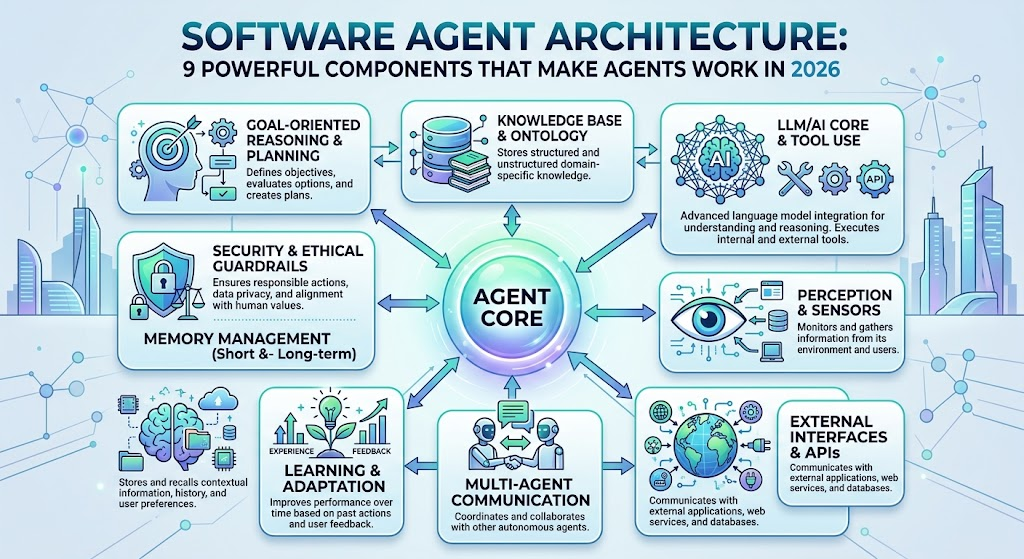
The real power comes from the system behind the agent. Software Agent Architecture defines how an agent receives inputs, understands its environment, stores memory, makes decisions, and performs actions. In 2026, these systems are becoming more capable across business, cybersecurity, customer support, and software development.
Understanding the architecture helps you see what happens behind the screen. It also helps you choose the right design for your own project.
“A capable agent needs more than intelligence. It needs a reliable system that turns decisions into useful actions.”
Trusted Sources
| Resource | Why It Matters |
|---|---|
| Microsoft Learn – Agent Architecture Components | Explains core agent architecture components, including models, tools, orchestration, memory, and governance. |
| Google Cloud – Choose Agentic AI Architecture Components | Covers agent architecture, runtime, memory, tools, orchestration, and how different components work together. |
| IBM – What Is Agentic Architecture? | Provides a practical explanation of agentic architecture, autonomous decision-making, tools, workflows, and orchestration. |
| Carnegie Mellon University – Intelligent Software Agents | Academic resource covering intelligent software agents, agent environments, autonomy, communication, and agent-based systems. |
What Is Software Agent Architecture and Why Does It Matter?
Software Agent Architecture is the internal design that controls how an agent observes, thinks, plans, and acts. It connects the major software agent components into one working system. These components can include perception, memory, reasoning, planning, tools, communication, and feedback.
Think of an agent like a digital employee. It receives information, understands the situation, checks what it knows, chooses a response, and completes a task. Good agent architecture gives each part a clear job. That structure makes the system easier to test, secure, improve, and scale.
The importance becomes clearer when an agent works with real systems. A cybersecurity agent may read thousands of events before deciding which one deserves attention. A business agent may need to check a database before updating another application. Without a sound structure, even a powerful model can produce unreliable results.
How Does a Software Agent Architecture Work?
The basic flow starts with perception. An agent collects information from users, applications, APIs, databases, files, or other systems. It then adds context and checks its memory or knowledge base. After that, its reasoning layer evaluates the situation and chooses an appropriate path.
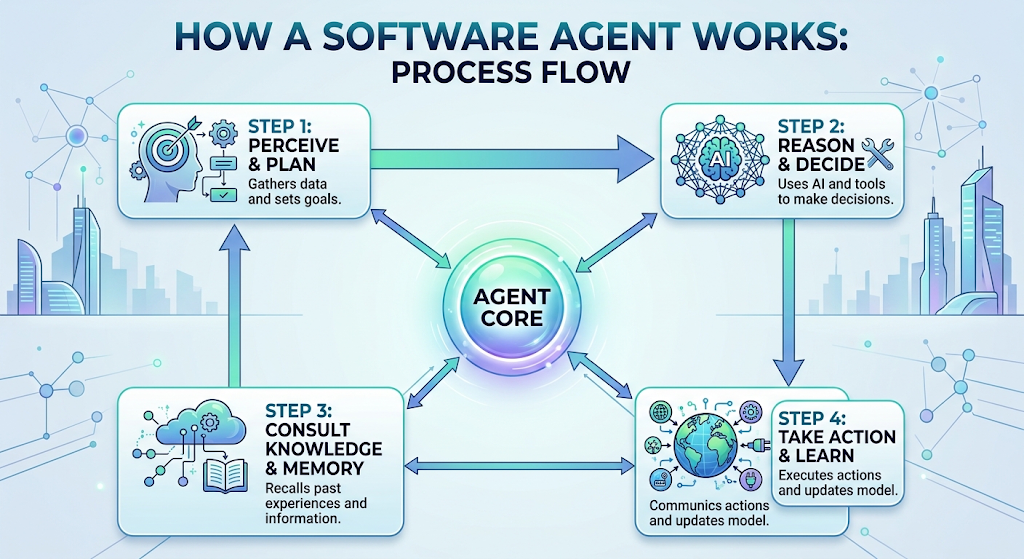
Next, the planning layer turns the objective into smaller steps. The agent performs task execution through approved tools and records the result. That result creates feedback, which can change the next decision. This creates a continuous feedback loop rather than a one-time response.
| Stage | What Happens |
|---|---|
| Perception | The agent receives information |
| Context | It understands the current situation |
| Knowledge | It checks useful stored information |
| Reasoning | It evaluates possible choices |
| Planning | It selects a sequence of steps |
| Action | It uses tools to complete work |
| Feedback | It checks what happened |
| Adaptation | It adjusts future behavior |
This cycle explains how software agent architecture works in practical systems. Not every agent needs every layer at the same complexity. A simple automation agent may use rules. A more advanced agent may combine machine learning, memory, planning, tools, and human approval.
9 Core Components of Software Agent Architecture
The strongest systems connect several capabilities instead of relying on one model. These software agent architecture components form the foundation of modern agent-based applications. Each component solves a different problem, from understanding information to checking whether an action produced the expected result.
The following nine components show how an agent moves from raw information to useful action. They also explain why modern software agent systems need more than a language model or automation script.
1. Perception and Input
Perception is the first stage of an agent’s workflow. It tells the system what is happening around it. Sensors, APIs, logs, documents, messages, databases, and user commands can provide inputs. The agent then converts those inputs into information that its decision system can understand.
For example, a security agent may receive login records, IP addresses, device details, and access times. Those signals can reveal unusual behavior. Strong perception reduces bad decisions because the agent starts with better information.
2. Environment and Context
An agent never operates in a vacuum. Its environment includes the systems, users, data, rules, and conditions surrounding it. Context tells the agent why information matters at a particular moment. This creates an agent environment that can change continuously.
Consider a failed login. One failed attempt may mean nothing. Hundreds of attempts from unfamiliar locations could signal an attack. Context allows the agent to treat these situations differently.
3. Knowledge and Memory
Knowledge gives an agent information it can use beyond the current request. A knowledge base may contain company policies, product information, technical documentation, or security rules. Memory can preserve previous interactions, decisions, and useful context.
Modern systems may use databases, retrieval systems, or vector stores for this purpose. Good knowledge representation also helps the agent retrieve relevant information instead of relying on guesswork. Memory must still have boundaries. Storing everything can create privacy, cost, and accuracy problems.
4. Reasoning and Decision-Making
Reasoning turns information into a choice. The system evaluates facts, rules, probabilities, goals, and available options. Its decision-making layer then selects the most suitable response. Some agents use fixed rules. Others use machine learning or language models.
A security agent could see an unusual login and compare it with previous behavior. It might decide to request stronger verification rather than block the account immediately. This is where decision logic becomes important.
5. Planning and Goal Management
Planning gives an agent a route toward its objective. The agent first understands its goals. It then divides a larger objective into manageable tasks. Planning becomes especially useful when a job requires several tools or decisions.
For example, an agent asked to prepare a sales report may gather data, clean it, calculate results, create a summary, and send it to an approved recipient. If one step fails, a strong system can revise its plan instead of stopping completely.
6. Action and Execution
An agent becomes useful when it can perform real work. The action layer connects decisions with tools, APIs, databases, applications, or other services. Actions can include sending a message, retrieving information, creating a record, or triggering an approved workflow.
The execution engine must also enforce permissions. An agent should not receive unrestricted access simply because it can use a tool. Least-privilege access reduces the damage caused by mistakes, compromised tools, or malicious instructions.
7. Communication and Interaction
Agents often need to communicate with people and other systems. Communication may happen through APIs, messages, application interfaces, or structured protocols. Human interaction becomes important when the agent needs approval or cannot safely complete a task alone.
In larger systems, agent communication allows specialized agents to exchange information. One agent might collect data while another analyzes it. A third could verify the result. This pattern becomes especially useful in multi-agent systems.
8. Learning and Adaptation
Learning allows an agent to improve based on useful information and outcomes. Learning can involve machine-learning models, feedback, updated rules, or improved retrieval. Adaptation allows the agent to respond when its environment changes.
However, uncontrolled learning can create serious problems. An agent should not change important behavior without safeguards. Production systems need evaluation, version control, monitoring, and approval mechanisms before major changes reach users.
9. Monitoring and Feedback
A production agent needs visibility into what it does. Monitoring tracks actions, errors, latency, costs, and unusual behavior. Feedback shows whether the agent produced the expected result. Together, they create a reliable feedback loop.
This layer is often overlooked during early development. That can become expensive later. When an agent makes a wrong decision, engineers need logs and traces to understand why it happened. Good observability turns mysterious failures into problems that teams can investigate.
Software Agent Architecture vs AI Agent Architecture
A software agent does not automatically require generative AI. Traditional agents can use rules, decision trees, planning systems, or other computational methods. An AI agent can add machine learning, language models, vision models, or other AI capabilities to the broader architecture.
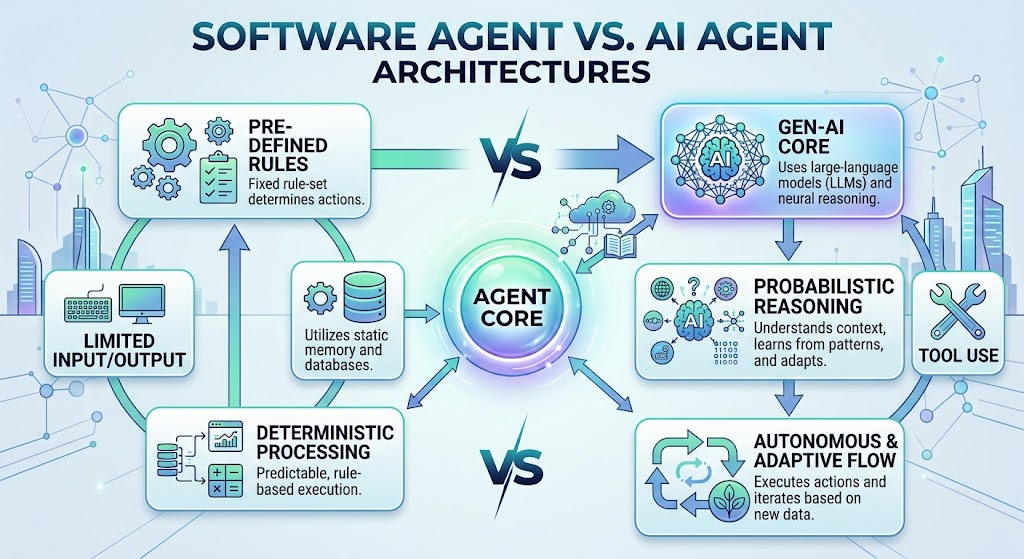
The key difference is not simply intelligence. AI agent architecture usually adds more flexible reasoning and generation capabilities. An intelligent software agent may understand less structured information and select actions dynamically. Still, both systems need clear goals, tools, permissions, monitoring, and reliable execution.
| Feature | Software Agent | AI Agent |
|---|---|---|
| Core logic | Rules or algorithms | AI models plus other logic |
| Reasoning | Often predefined | Often more flexible |
| Memory | Optional | Common in advanced systems |
| Tool use | Possible | Common |
| Learning | Depends on design | Often supported |
| Natural language | Optional | Common |
| Autonomy | Varies | Often higher |
This distinction matters when comparing software agent vs AI agent architecture. Adding an AI model does not automatically create a reliable agent. The surrounding system still determines how safely the agent can operate.
Types of Software Agent Architectures
Different problems require different designs. Types of software agent architecture range from simple reactive systems to complex multi-agent environments. The right choice depends on how much planning, memory, autonomy, communication, and adaptability your application requires.
A small automation workflow may need a simple design. A large enterprise system may require several specialized agents. Understanding these patterns helps developers avoid building unnecessary complexity.
Reactive Architecture
Reactive architecture responds directly to changes in the environment. It usually avoids deep internal planning. This makes it fast and relatively simple. A basic security rule that blocks a known malicious request can follow this pattern.
Deliberative Architecture
Deliberative architecture creates an internal model before acting. It considers information, goals, and possible outcomes. This deliberative agent architecture works well when tasks require planning. However, deeper reasoning can increase latency and system complexity.
Hybrid Architecture
Hybrid architecture combines reactive behavior with deliberate planning. A fast layer handles urgent events while another layer handles complex decisions. This hybrid agent architecture often fits practical systems because not every situation needs expensive reasoning.
BDI Architecture
BDI stands for beliefs, desires, and intentions. The architecture represents what an agent believes, what it wants, and what it intends to do. BDI agent architecture works well for goal-driven systems where internal state influences decisions.
Multi-Agent Architecture
A multi-agent design uses several agents that cooperate or specialize. This multi-agent architecture can divide complicated work across smaller systems. For example, one agent may research information while another checks it. Coordination becomes the major challenge as the system grows.
How Software Agents Make Decisions Step by Step
Decision-making starts with a goal. The agent receives information and examines its environment. It then retrieves relevant knowledge and memory before evaluating possible options. Its reasoning layer compares those options against rules, constraints, risks, and expected results.
The agent then selects a plan and performs approved actions. After execution, it examines the outcome. If the result differs from expectations, the agent can revise its plan. This process supports autonomous decision-making without requiring complete human control for every small task.
| Decision Stage | Main Question |
|---|---|
| Observe | What is happening? |
| Understand | What does the information mean? |
| Retrieve | What useful knowledge exists? |
| Reason | What choices are available? |
| Plan | Which path should be followed? |
| Act | What should the system do? |
| Verify | Did the action work? |
| Adjust | What should happen next? |
The important point is that autonomy should not mean unlimited freedom. Reliable agents operate within defined permissions, policies, and safety boundaries.
Software Agent Architecture in Real-World Applications
The value of agents becomes obvious when they solve practical problems. Agent-based systems can connect information with actions across many industries. Their architecture changes according to risk, data access, response time, and business requirements.
In the United States, organizations already use automation across customer service, cybersecurity, software development, and operations. More advanced agent systems can coordinate several steps instead of simply producing an answer.
Cybersecurity
Cybersecurity is one of the strongest use cases for agents. A security agent can inspect logs, compare events, identify suspicious patterns, and prioritize alerts. It can also support incident response when policies allow automated action.
For example, an agent may detect an unusual login, check device history, compare geographic signals, and request additional verification. A human analyst can then review the evidence before a high-impact action occurs.
Business Automation
Business agents can handle repetitive workflows that normally require several applications. They can collect information, update records, prepare reports, and route requests. Task automation becomes more useful when the workflow changes based on new information.
An accounting workflow offers a simple example. An agent could retrieve approved transaction data, check predefined rules, identify missing information, and send an exception to a human employee. The agent handles routine work while people handle judgment-heavy cases.
Customer Support
Customer support agents can combine conversation with actual system access. Instead of simply answering questions, an agent may retrieve an order, check account information, or start an approved support workflow.
The architecture matters because customer data requires careful controls. Memory should follow privacy rules. Tools should use limited permissions. Sensitive actions should trigger human review when appropriate.
E-Commerce
E-commerce agents can assist customers throughout the buying process. They can understand product needs, retrieve catalog information, compare options, and help with approved orders. Their usefulness grows when they can access real-time inventory and customer context.
A good system also knows its limits. It should not invent stock levels or promise unavailable products. Reliable retrieval and real-time response capabilities help prevent those errors.
Software Development
Software agents can support developers with code analysis, testing, documentation, debugging, and repository tasks. A specialized agent can inspect a change and identify possible problems before a human reviews it.
More advanced intelligent agent systems can coordinate several development tasks. One agent may inspect code while another runs tests. A third can summarize the findings. Human review remains important before production changes reach customers.
Software Agent Architecture vs Traditional Software
Traditional software usually follows predefined paths. Developers specify what should happen when particular conditions occur. A software agent can operate with a goal and choose among several possible actions based on changing information.
That flexibility brings both benefits and risks. Traditional software often provides easier testing and stronger predictability. Agents can handle less structured problems but may produce less predictable behavior. The right choice depends on the task rather than the popularity of the technology.
| Area | Traditional Software | Software Agent |
|---|---|---|
| Instructions | Mostly predefined | Goal-driven |
| Adaptation | Limited | Often stronger |
| Decision logic | Usually fixed | Can be dynamic |
| Autonomy | Usually limited | Can be high |
| Predictability | Often higher | Can vary |
| Complexity | Usually lower | Often higher |
| Best fit | Stable workflows | Changing environments |
A simple billing calculation probably doesn’t need an autonomous agent. A changing research or monitoring task may benefit from one.
Software Agent Architecture vs Chatbot Architecture
A chatbot mainly focuses on conversation. It receives a message and generates a response. A more capable agent can understand a goal, access tools, perform actions, check results, and continue working toward that goal.
This explains the difference between software agent vs chatbot systems. A chatbot might tell you that your package is delayed. An agent could check the order system, inspect shipping data, determine the issue, and start an approved support process.
The boundary is not always perfect. Modern chatbots can use tools and perform actions. The important question is what the system can reliably do beyond conversation.
How to Design a Reliable Software Agent Architecture
Good software agent design starts with the problem rather than the technology. Define the agent’s goal first. Then identify the information it needs, the tools it can use, and the decisions it should make. Avoid giving an agent autonomy simply because the technology allows it.
Next, design permissions, memory, monitoring, error handling, and human approval. Test normal cases and unusual cases. Measure accuracy, latency, cost, and failure rates. A useful software agent framework should make these controls easier rather than hiding them.
A practical design should answer several questions clearly. What can the agent see? What can it remember? What can it change? Which actions require approval? What happens when a tool fails? Who reviews serious mistakes? These questions turn an interesting prototype into a dependable software agent system.
Common Software Agent Architecture Challenges
Agent systems face challenges that ordinary applications may handle differently. Poor inputs can create poor decisions. Weak memory can produce incorrect context. Tool failures can interrupt workflows. Excessive permissions can turn a small mistake into a serious security incident.
Security deserves special attention. Prompt injection, unauthorized tool use, data leakage, and malicious instructions can affect AI-enabled agents. Developers should isolate sensitive tools, validate important inputs, limit permissions, and log meaningful actions. Reliability requires technical controls around the agent, not just a smarter model.
Another challenge is evaluation. An agent may succeed on one task and fail on another. Teams need realistic test cases that measure both successful behavior and failure handling. That is especially important for autonomous software agents operating in production environments.
The Future of Software Agent Architecture in 2026 and Beyond
The next stage of agent development will focus less on simple automation. Developers are building systems that can coordinate tools, remember useful context, and manage longer workflows. Autonomous agents will become more practical as monitoring, permissions, evaluation, and interoperability improve.
Multi-agent designs will also receive more attention. A single large agent isn’t always the best answer. Several focused agents can divide work and provide specialized capabilities. However, coordination creates new risks. Strong identity controls, clear communication, observability, and human oversight will become essential.
The future of software agent architecture is therefore not simply about making agents more autonomous. It is about making them more reliable, secure, observable, and controllable. The strongest systems will know when to act, when to ask, and when to stop.
Frequently Asked Questions About Software Agent Architecture
What is software agent architecture?
Software Agent Architecture describes the internal structure that lets an agent perceive information, reason about it, plan tasks, perform actions, and learn from results. It connects the major parts of an agent into one working system.
What are the main components of a software agent?
The main software agent components include perception, environment awareness, knowledge, memory, reasoning, planning, execution, communication, learning, and monitoring. Different agents may combine these components in different ways.
What are the different types of agent architecture?
Common designs include reactive, deliberative, hybrid, BDI, and multi-agent architectures. Each approach handles goals, planning, memory, and decision-making differently. Your choice should match the complexity of the problem.
How does a software agent make decisions?
An agent collects information, understands its context, retrieves relevant knowledge, evaluates choices, creates a plan, and performs an action. It then checks the result and adjusts its next step when necessary.
What is the difference between software agents and AI agents?
A software agent can use rules and traditional algorithms to achieve goals. An AI agent usually adds AI models for flexible reasoning, language understanding, learning, or generation. Both still require a reliable system around their decision-making capabilities.
Are software agents used in cybersecurity?
Yes. Security teams can use agents for alert analysis, monitoring, threat detection, investigation support, and response workflows. High-impact actions should usually include strong permissions and human oversight.
Final Thoughts
A modern agent is more than a clever model. It is a complete system that connects information, knowledge, decisions, tools, and feedback. Each layer contributes to the final result.
When you understand the architecture, you can make better technology choices. You can also spot weak designs before they become expensive problems. In 2026, that matters more than ever as organizations move from basic automation toward practical agent-based systems.
The best architecture isn’t necessarily the most complicated one. It is the one that gives an agent enough capability to solve its task while keeping its behavior reliable, secure, and understandable.
Article Related Information
| sources | Explore now |
|---|---|
| AI Agents in 2026: What Are AI Agents and How They Will Change Work, Business, and Daily Life | Learn now |
| Agentic AI in 2026: How Autonomous AI Systems Will Transform Business, Software, and Human Work | Learn now |
| AI Agent vs Software Agent: Key Differences, Examples, and Use Cases Explained | Learn now |
| Types of Software Agents: A Complete Guide to Intelligent Software Agents | Learn now |
| AI-Powered Cybersecurity: How Artificial Intelligence Is Changing Online Security in 2026 | Learn now |
| AI Workflow Automation in 2026: How Smart AI Workflows Are Transforming Business Productivity | Learn now |
| What Is AI Automation? Complete Guide to AI Automation Tools and Future Benefits (2026) | Learn now |
| Best AI Automation Tools in 2026: Top AI Platforms for Business, Workflows, and Productivity | Learn now |
| Generative AI in 2026: How Advanced AI Models Are Transforming Business, Creativity, and Everyday Life | Learn now |
| OpenAI AI Agent Warning: What You Need to Know About AI Agent Security | Learn now |
Description
Software Agent Architecture explained with 9 core components, architecture types, real-world examples, and design tips to build smarter autonomous agents.