

Search is entering a new phase. People still use Google to find websites, products, news, and answers. However, they are also asking AI tools to explain topics, compare options, summarize research, and recommend useful sources. This shift is creating a new layer of AI search visibility for website owners.
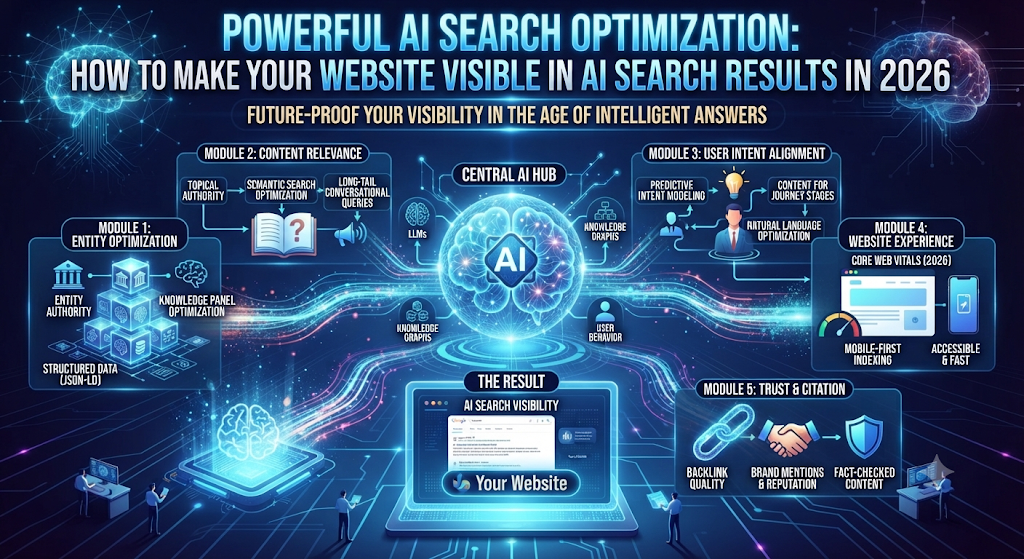
For publishers and technology websites like DailyTecho, this change matters. A page may no longer compete only for a traditional search position. Its information may also need to be clear enough for AI search engines to understand, summarize, and potentially reference. This guide explains how AI search optimization works and how you can prepare your website for the changing search landscape in 2026.
What Is AI Search Optimization?
AI search optimization is the process of making website information easier for modern search and AI systems to understand, interpret, and use. It builds on traditional search engine optimization but puts greater emphasis on meaning, context, entities, useful answers, and trustworthy information.
Traditional SEO often starts with keywords and rankings. AI search requires a broader view. Modern systems can interpret a complete question and connect related concepts across different sources. Therefore, your content needs to explain the subject clearly instead of simply repeating the same phrase.
For example, imagine someone searches, “How does AI protect a website from cyberattacks?” A strong page shouldn’t only target the phrase “AI cybersecurity.” It should explain threat detection, machine learning, security monitoring, automation, limitations, and practical examples. That broader context gives both readers and AI models more useful information.
The goal isn’t to trick an AI system. Instead, the goal is to make your website a reliable source of information that deserves to be discovered. Clear writing, logical organization, accurate facts, original insights, and useful references all contribute to stronger website visibility.
What Does AI Search Optimization Actually Mean?
At a practical level, AI search optimization means organizing information so that people and machines can understand it without unnecessary confusion. Your headings should describe the questions being answered. Your paragraphs should provide direct explanations. Your examples should add context rather than repeat the same idea.
This becomes especially important because AI-generated answers can combine information from several sources. If your article contains vague statements or unsupported claims, it offers less useful material. If it provides precise explanations and credible evidence, the page becomes a stronger information resource.
Consider a technology article explaining “serverless computing.” A weak article might define the term in two sentences and then repeat common benefits. A stronger article would explain how serverless works, when businesses use it, its pricing model, limitations, security concerns, real-world examples, and how it compares with traditional cloud servers.
That difference is important. AI content optimization isn’t about making an article sound robotic. It’s about making the information complete, understandable, and genuinely useful.
Why AI Search Matters for Websites in 2026
The biggest change isn’t that traditional search has disappeared. It hasn’t. The change is that users now have more ways to discover information. AI search can answer questions directly, summarize complex topics, compare alternatives, and guide users toward sources.
This creates a new opportunity for websites. A publisher can potentially gain visibility when its information contributes to an AI answer even when the user’s journey doesn’t look like a traditional search click.
For technology publishers, the opportunity is particularly interesting. Readers frequently ask questions that require explanation rather than a single fact. Topics such as artificial intelligence, cybersecurity, cloud computing, software, and SEO can all benefit from conversational search experiences.
How AI Search Is Changing Website Traffic
Traditional search often follows a familiar path: the user enters a query, scans results, clicks a page, and reads the information. AI search can shorten that journey by providing a synthesized response first.
That doesn’t mean websites have become unnecessary. Quite the opposite. AI systems need information to generate useful responses. High-quality websites remain important sources of knowledge.
The traffic pattern may simply become more complicated. A user could discover a brand through an AI answer, search for the brand later, visit its website directly, and eventually become a customer. That entire journey may not appear as one simple organic click.
For DailyTecho, this means organic traffic should remain an important metric. However, it shouldn’t be the only measure of success. Branded searches, returning visitors, referral traffic, conversions, and measurable AI mentions can provide additional context.
How AI Search Is Changing Traditional SEO
Traditional SEO still matters because AI systems don’t operate in a vacuum. Websites need to be discoverable, crawlable, indexable, and technically accessible. Strong content also needs relevance and authority.
The difference is that traditional SEO often treats a search result as the final destination. AI search can treat information as a building block for an answer. That makes context, relationships, and comprehensive explanations increasingly important.
A traditional result might show a page titled “Best Cloud Storage Services.” An AI-powered experience could instead answer a question such as, “Which cloud storage option is best for backing up photos and sharing files with family?”
The second question contains more context. A useful response may need to understand storage capacity, pricing, sharing features, security, platform compatibility, and user needs. A page that covers those relationships clearly has more useful information to offer.
Why Ranking Blue Links Is No Longer the Only Goal
Ranking remains valuable. A high-ranking page can generate traffic, links, brand recognition, and conversions. But AI search visibility introduces another possible discovery path.
The important point is not to abandon rankings. Instead, think beyond rankings.
Your website should aim to become a strong source for a subject. That requires technical SEO, useful content, internal connections, trustworthy sources, and genuine expertise.
In other words, the future isn’t simply SEO versus AI search. It’s SEO plus broader information optimization.
What Is Generative Engine Optimization (GEO)?
Generative engine optimization, commonly called GEO, is a term used for optimizing information for generative AI experiences. The idea is closely related to SEO but focuses more directly on how content may be represented within AI-generated responses.
The terminology is still developing. Different marketers may define GEO differently. Some treat it as a separate discipline while others consider it an extension of modern SEO.
The safest approach is to focus on the principles behind the term. Create information that is accurate, original, well-structured, relevant, and easy to understand.
A website doesn’t become optimized for generative engines simply because it adds the phrase “GEO” to an article. The underlying information quality matters much more.
AI SEO vs GEO: What’s the Difference?
| Approach | Main purpose | Important signals |
| Traditional SEO | Improve visibility in search results | Relevance, technical SEO, links, content quality |
| AI SEO | Prepare content for AI-powered discovery | Context, meaning, entities, intent, usefulness |
| GEO | Improve potential visibility in generative responses | Clear information, authority, sources, context |
These approaches overlap heavily. A technically weak website with poor content won’t suddenly succeed because it uses GEO terminology.
Strong GEO SEO should therefore complement traditional SEO rather than replace it.
How AI Search Engines Find and Understand Information
Modern AI search engines can process language in a much richer way than simple keyword matching. Technologies such as natural language processing, machine learning, and large language models help systems interpret relationships between words, concepts, questions, and entities.
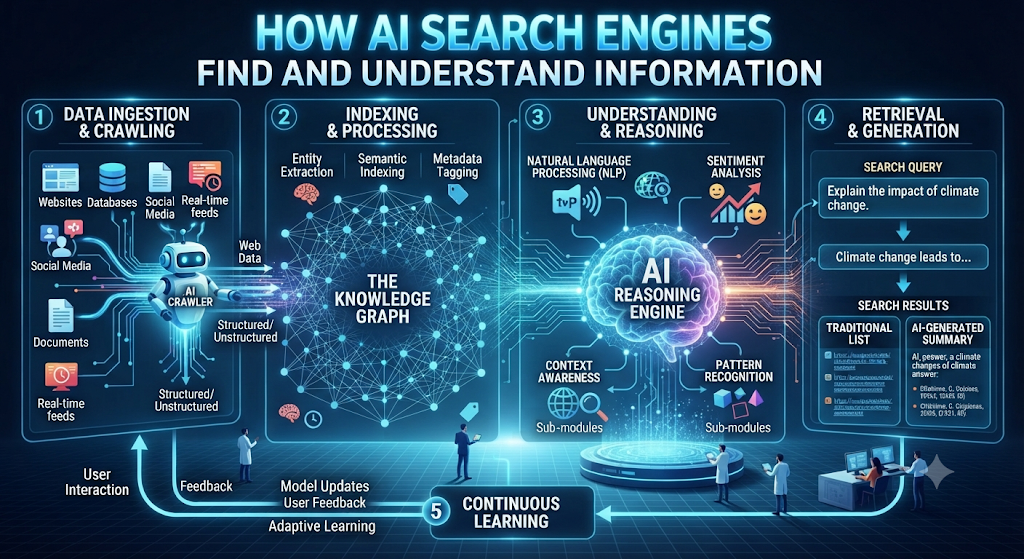
Consider the phrase “best laptop for college students.” The system may need to understand that the user could care about battery life, portability, price, performance, durability, and software compatibility.
The individual words aren’t enough. Their relationship matters.
This is where semantic search becomes important. Semantic systems try to understand what a query means rather than relying only on exact wording.
Why Context Matters in AI Search
Context helps systems distinguish between similar words and concepts.
Take the word “Apple.” One page might discuss fruit nutrition. Another might discuss smartphones and laptops. A third might discuss the company’s financial results.
The surrounding entities, terminology, and subject matter help clarify which meaning applies.
This is one reason comprehensive content can be valuable. When a page naturally explains related concepts, it gives search systems stronger contextual signals.
However, comprehensive doesn’t mean endless. A page should stay focused on its primary subject rather than adding unrelated information simply to increase word count.
How to Optimize Content for AI Search Results
The strongest starting point is surprisingly simple: answer the reader’s question clearly.
Don’t make visitors search through five paragraphs to find a basic definition. Give the direct answer first. Then provide deeper information, examples, evidence, and practical details.
This structure works well because people usually want the quick answer first. Readers who need more detail can continue into the deeper sections.
For example, if an article asks “What is cloud disaster recovery?” the opening should define it immediately. Later sections can explain backup strategies, recovery objectives, costs, security, testing, and common mistakes.
That creates useful content depth without making the opening unnecessarily complicated.
How to Make AI-Friendly Content More Useful
Use headings that describe real questions. Explain technical terms in plain English. Support important claims with credible sources. Include examples when a concept is difficult. Connect related articles using contextual links.
Most importantly, add information that actually helps the reader.
A page shouldn’t exist simply because a keyword has search volume. It should solve a problem.
That’s the difference between content created for a search engine and content created for a person who needs an answer.
Why Search Intent Matters for AI Search Optimization
Every query has an underlying purpose. Understanding that purpose is one of the most important parts of successful AI search optimization.
A person searching “what is AI SEO?” likely wants an explanation. Someone searching “best AI SEO tools” may be comparing products. A user searching for “DailyTecho” probably wants the website itself. Another person searching “buy SEO software” has a stronger transactional purpose.
These searches may contain similar words. Their intent is completely different.
Matching Content With the User’s Real Question
Imagine you publish an article targeting “AI SEO tools.” If the user expects a comparison but your article only provides definitions, the page may fail to satisfy the search.
A better article could explain what each tool does, who should use it, pricing considerations, limitations, important features, and practical use cases.
That is search intent in action.
The best content doesn’t ask, “How many times should I use this keyword?”
It asks, “What does the reader actually need to know?”
How E-E-A-T Helps Your Website Stand Out in AI Search
Trust becomes increasingly important as AI systems become better at summarizing information. Readers need to know whether a claim is reliable. Publishers therefore need to demonstrate E-E-A-T, which represents Experience, Expertise, Authoritativeness, and Trustworthiness.
For technology websites, this means avoiding unsupported claims and exaggerated promises. If you review software, explain how it was evaluated. If you discuss cybersecurity, use reliable technical references. If you publish statistics, identify where they came from.
Strong authoritativeness doesn’t come from saying “we are experts.” It comes from demonstrating useful knowledge.
Experience Can Make Technology Content Stronger
First-hand experience can add details that generic articles often miss.
For example, a software tutorial becomes more useful when it explains what happens during setup, where beginners commonly get stuck, and what practical limitations exist.
That is the value of experience.
Similarly, an expert article should explain difficult concepts accurately without hiding behind unnecessary technical language. Readers don’t need complicated words. They need clear answers.
Why Original Content Matters in AI Search
The web is already crowded with rewritten information. Publishing another article that says exactly what hundreds of existing pages say provides little additional value.
Original content can take many forms. It may include first-hand testing, original comparisons, interviews, unique examples, research, calculations, screenshots, experiments, or a fresh explanation of a difficult subject.
For DailyTecho, this creates a strong opportunity.
Instead of writing another generic article titled “What Is Artificial Intelligence?” you could investigate how a specific AI feature works, compare tools, test software, analyze a real workflow, or explain a recent technology development from a practical perspective.
How to Add Information Competitors Don’t Have
Before publishing, ask:
What useful information does this article provide that a reader cannot easily get from the first few competing pages?
The answer might be a better comparison table. It might be practical testing. It could be clearer explanations or a unique case study.
That additional value is what turns ordinary content optimization into meaningful publishing.
How Structured Data Can Help Search Engines Understand Your Website
Structured data provides machine-readable information about a webpage. Schema markup can help describe entities such as articles, organizations, products, events, authors, and other supported content types.
This can help search systems interpret what a page represents. However, schema isn’t a secret ranking button.
Adding markup doesn’t guarantee an AI citation, a featured result, or a higher ranking.
The markup should accurately represent the content already present on the page.
Why Schema Markup Should Support Good Content
Imagine an article with excellent schema but weak information. The markup cannot magically turn poor writing into authoritative content.
Instead, use structured data as part of a larger strategy.
Your page should first contain useful information. Then your schema can help machines understand relevant details about that information.
That approach is safer and more sustainable.
How Internal Linking Improves AI Search Visibility
Internal linking is one of the most overlooked ways to strengthen a large website. A useful internal link connects one page to another relevant page and helps both readers and search systems understand the relationship between subjects.
For DailyTecho, this is particularly valuable because technology topics naturally overlap.
An article about AI search could connect to related articles about AI tools, machine learning, cybersecurity, cloud computing, SEO, and future technology.
These connections can form meaningful topic clusters.
Building Strong Topic Clusters
Imagine “AI” as the central topic. Supporting pages might cover AI search, machine learning, generative AI, AI cybersecurity, AI tools, AI ethics, and AI automation.
The pages shouldn’t simply link randomly. Each link should provide additional information that naturally continues the reader’s journey.
Use descriptive anchor text rather than vague phrases such as “click here.”
For example, “how generative AI works” tells the reader much more than “read more.”
How External Sources and Citations Build Content Trust
A strong technology article should not ask readers to trust every claim blindly. When you discuss statistics, security risks, research findings, product specifications, or industry changes, support important statements with credible sources. Government agencies, universities, research organizations, official documentation, and respected industry sources can strengthen the factual foundation of your content.
External references also provide useful context. For example, an article about cybersecurity can reference official security guidance rather than repeating an unsupported claim. This approach improves content quality and gives readers a clear path to verify important information.
How to Use External Links Naturally
External links should add value rather than decorate an article. Link to the original research or official documentation whenever possible. Avoid adding dozens of unrelated references simply because they contain keywords.
The same principle applies to external links as internal links. Relevance matters more than quantity. One authoritative source that directly supports a claim can be more useful than several weak websites.
How to Optimize Your Website for ChatGPT Search
Optimizing for ChatGPT search doesn’t mean there is a secret formula that guarantees your website will appear in every answer. No responsible SEO strategy can promise that. Instead, focus on making your information easy to understand, factually useful, and relevant to questions people actually ask.
Clear definitions are especially valuable. When a page explains a subject directly and then provides supporting details, it gives search systems a stronger information source. Good structure also helps readers move from a quick answer into deeper explanations.
What Makes Content More Useful for ChatGPT?
Think about how a real person would research a topic. They may ask several connected questions rather than one short query.
For example, someone researching cloud computing might ask what it means, how it works, whether it’s secure, how much it costs, and when a business should use it.
A strong article can anticipate those natural follow-up questions without becoming repetitive. That creates helpful content for the reader while also providing richer context for AI-powered systems.
The goal isn’t to write for ChatGPT instead of humans. The goal is to publish information that both can understand.
How to Optimize Content for Google AI Overviews
Google AI Overviews have changed how some users interact with search by placing AI-generated information alongside traditional search results. This means a user may receive a summarized explanation before deciding which pages to visit.
However, publishers shouldn’t create content around a supposed “AI Overview trick.” Google’s search systems continue to evaluate pages using many signals. Traditional technical SEO, useful content, relevance, and overall site quality still matter.
The practical strategy is simple: satisfy the underlying question better than a shallow article does.
Build Content for the Question, Not the Feature
Suppose someone searches, “How does edge computing differ from cloud computing?”
A useful article should explain both technologies, compare latency, processing location, use cases, costs, limitations, and real-world examples.
Don’t write five paragraphs repeating “edge computing vs cloud computing.” Explain the difference clearly.
That approach supports traditional Google Search visibility while also creating information that can potentially work well in AI-assisted search experiences.
How to Optimize Content for Perplexity and Other AI Search Engines
Perplexity and other AI-powered search experiences place strong emphasis on answering questions with information gathered from multiple sources. That makes factual clarity particularly important.
A page should make important claims easy to understand. Definitions should be precise. Dates should be clear. Statistics should have context. Technical claims should avoid exaggerated language.
For technology publishers, this matters because outdated information can quickly become misleading. Software features change. Pricing changes. AI models evolve. Security threats develop.
Why Freshness Matters in AI Search
Imagine two articles explaining an AI tool. One was updated recently and accurately reflects the current product. The other describes features that disappeared years ago.
Even if the older article once performed well, its usefulness has declined.
Content freshness therefore matters when the subject changes quickly. Updating an article isn’t simply changing the publication date. You should review its facts, links, examples, screenshots, recommendations, and conclusions.
Why Topical Authority Matters for AI Search
A website becomes more useful when it develops genuine depth around a subject. This is the basic idea behind topical authority.
For example, a website that publishes one article about AI and then jumps randomly between unrelated subjects may provide less topical depth than a technology publisher that consistently covers AI from several connected angles.
DailyTecho has a natural opportunity here.
Its technology coverage can connect AI, cybersecurity, cloud computing, SEO, software, and emerging technology into related content ecosystems.
How DailyTecho Can Build Stronger Topic Coverage
Imagine DailyTecho creates a central AI topic cluster. Supporting articles could explain generative AI, AI search, AI cybersecurity, machine learning, AI tools, AI ethics, AI agents, and AI automation.
Each article answers a distinct question. Internal links connect the related subjects.
Over time, this creates a more coherent knowledge structure than publishing isolated articles around random keywords.
The important word is relevance. Don’t create dozens of thin pages simply to make a topic cluster look bigger.
How Website Technical SEO Supports AI Search Visibility
Great content cannot perform well if search systems cannot properly access it. That’s why technical SEO remains a foundation of AI search optimization.
Important technical areas include crawlability, indexing, mobile usability, HTTPS, page experience, canonical URLs, accessible content, and XML sitemaps.
Your website should make it easy for search crawlers to discover important pages. Your content should also exist in a form that users and search systems can actually access.
Technical Foundations to Check
| Technical area | Why it matters |
| Crawlability | Helps search crawlers discover pages |
| Indexing | Allows eligible pages to appear in search systems |
| XML sitemap | Helps communicate important URLs |
| Canonical URL | Helps identify the preferred version of a page |
| Mobile usability | Supports visitors using phones and tablets |
| HTTPS | Protects connections between users and the website |
| Page experience | Supports a smoother browsing experience |
These foundations don’t guarantee AI visibility. They simply remove technical obstacles that could prevent your content from being properly discovered or understood.
Don’t Ignore Page Experience
Readers notice slow pages immediately. A visitor may leave before reading your carefully researched article if the page takes too long to become usable.
That makes user experience part of the bigger picture.
For DailyTecho, improving loading performance, reducing unnecessary scripts, keeping layouts stable, and making articles comfortable to read can support both visitors and broader search performance.
Common AI Search Optimization Mistakes to Avoid
The biggest mistake is treating AI search optimization like a loophole. Repeating keywords, generating hundreds of shallow pages, inventing expertise, or stuffing articles with awkward phrases won’t create genuine authority.
Another problem is publishing information without checking it. AI tools can produce convincing text that contains errors. If a publisher simply accepts generated content without verification, those mistakes can damage trust.
Weak content quality also creates problems. An article that answers a question in two sentences and then repeats the same idea across fifteen sections isn’t comprehensive. Longer doesn’t automatically mean better.
What Should You Avoid?
Avoid fake statistics, unsupported claims, copied material, meaningless introductions, excessive keyword repetition, misleading titles, irrelevant internal links, and outdated facts.
Most importantly, don’t confuse AI assistance with expertise.
AI can help with brainstorming, organization, editing, and research workflows. Human review still matters when accuracy and trust are important.
AI Search Optimization vs Traditional SEO: What’s the Difference?
Traditional SEO and AI search optimization overlap heavily. You don’t need to choose one and abandon the other.
Traditional SEO helps your website become discoverable through search engines. AI-focused optimization adds greater attention to meaning, context, entities, direct answers, and information quality.
| Traditional SEO | AI Search Optimization |
| Focuses heavily on search rankings | Focuses on visibility within AI answers and search experiences |
| Targets keywords and search intent | Targets meaning, context, entities, and intent |
| Optimizes pages for search engines | Makes information easier for AI systems to understand |
| Measures rankings and organic traffic | Also considers AI visibility and brand mentions |
| Uses technical SEO foundations | Still depends on technical SEO foundations |
| Builds authority through useful content and links | Also benefits from clear, trustworthy information |
The key takeaway is simple: AI search optimization isn’t a replacement for SEO.
A strong website should do both.
How to Measure AI Search Visibility
Measuring AI search visibility is harder than measuring a traditional ranking because there isn’t one universal AI visibility score.
A website owner can still monitor several useful signals. Organic impressions, clicks, rankings, branded searches, referral traffic, conversions, and measurable mentions can reveal whether overall visibility is changing.
Don’t expect one dashboard to tell the entire story.
What Should You Track in 2026?
| Metric | What it can tell you |
| Organic impressions | How often pages appear in traditional search |
| Organic clicks | Whether searchers visit your pages |
| Search rankings | Where pages appear for tracked queries |
| Branded searches | Whether more people search for your brand |
| Referral traffic | Whether external platforms send visitors |
| Conversions | Whether visibility produces meaningful actions |
| AI mentions or citations | Whether your content appears in measurable AI experiences |
The important point is to look for patterns rather than obsess over a single number.
AI Search Optimization Strategy for a New Website
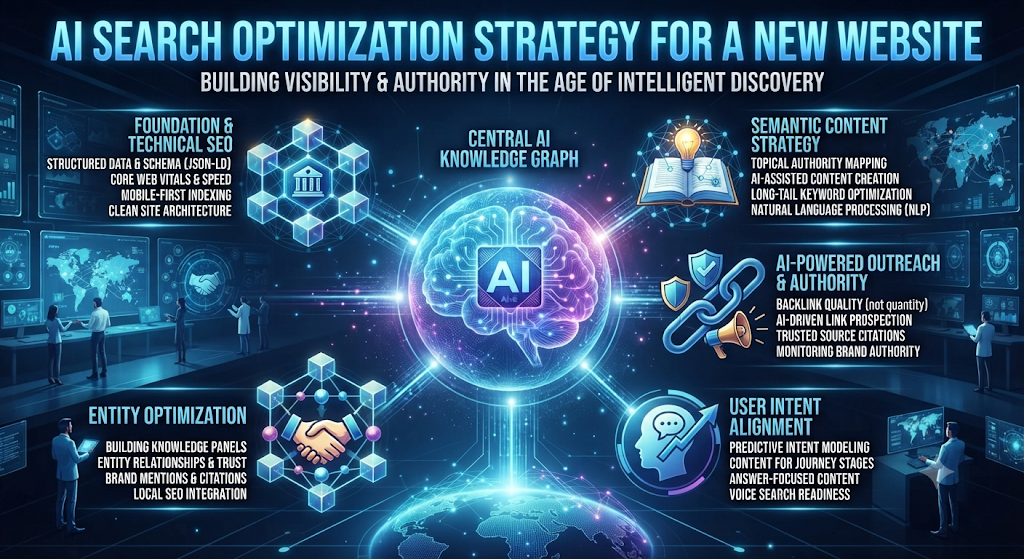
A new website should start with fundamentals. First, make sure the technical foundation works. Then identify the subjects your audience genuinely cares about.
Next, build content around clear search intent. Instead of publishing random articles, create related groups of useful pages.
For example, a new technology website might begin with one broad AI guide. Supporting articles could explain machine learning, generative AI, AI agents, AI cybersecurity, AI search, and practical AI tools.
Build Authority Step by Step
Each article should have a clear purpose. Give readers an answer. Add useful context. Link to related pages. Reference reliable sources where appropriate.
Then review performance and improve weak pages.
This approach takes longer than publishing dozens of thin articles. However, it creates a much stronger foundation for sustainable search visibility.
AI Search Optimization Strategy for Established Websites
Established websites have a different advantage: they already have content, links, historical data, and potentially an existing audience.
The challenge is usually organization.
Some older articles may overlap. Others may contain outdated information. Some important pages may have almost no internal links.
A content audit can reveal these weaknesses.
Improve Existing Content Before Creating More
Suppose DailyTecho has three articles covering almost the same cloud topic. Publishing a fourth article may create more confusion.
Instead, compare the existing pages. Consolidate overlapping information where appropriate. Update outdated facts. Strengthen weak sections. Improve internal links and add useful original insights.
This process can make an existing website more coherent without constantly increasing its page count.
AI Search Optimization Checklist for 2026
Use the following table as a practical review before publishing or updating an article.
| Optimization area | What to check |
| Search intent | Does the page answer the real question? |
| Content | Is the information useful and original? |
| Structure | Are headings clear and logical? |
| Sources | Are important claims supported? |
| Internal links | Are related pages connected? |
| Technical SEO | Can search engines crawl the page? |
| E-E-A-T | Is expertise and trust clear? |
| Updates | Is outdated information refreshed? |
| Readability | Can beginners understand the explanation? |
| Original value | Does the page offer something competitors don’t? |
A checklist won’t replace editorial judgment. It simply helps prevent important gaps.
Frequently Asked Questions About AI Search Optimization
What is AI Search Optimization?
AI search optimization is the practice of creating and organizing website information so AI-powered search systems can understand its meaning, context, relevance, and usefulness.
Is AI Search Optimization the same as SEO?
No. They overlap significantly. Traditional SEO remains essential while AI-focused optimization places additional emphasis on context, entities, clear answers, and information quality.
What is GEO in digital marketing?
GEO, or Generative Engine Optimization, generally refers to practices intended to improve how information may appear in generative AI search experiences.
How do I optimize my website for AI search?
Start with technical SEO. Then create original content that matches search intent, answers questions clearly, uses logical structure, demonstrates expertise, references reliable sources, and connects related pages with relevant internal links.
Can AI search replace Google?
AI search is changing how people discover information, but traditional search remains important. Users still rely heavily on conventional search experiences for many types of queries.
Final Thoughts: The Future of AI Search Optimization
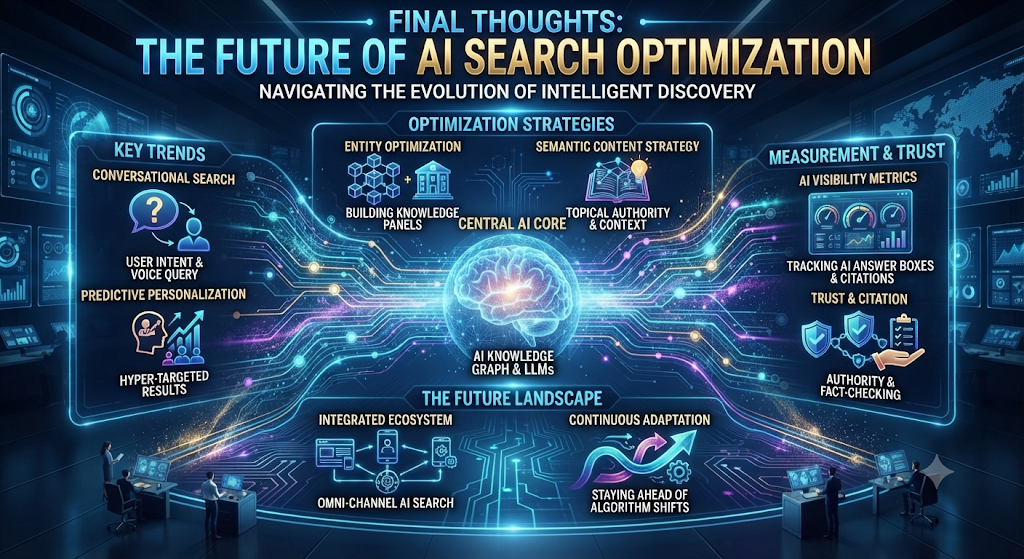
Search is expanding beyond the familiar list of blue links. People can now ask increasingly complex questions and receive synthesized information from AI-powered experiences. That creates new challenges for publishers, but it also creates new opportunities.
The strongest strategy isn’t trying to manipulate an AI system. It’s building a website that deserves attention. Create original content. Answer real questions. Demonstrate experience and expertise. Use trustworthy sources. Build meaningful internal connections. Keep information fresh. Maintain strong technical foundations. For DailyTecho, the opportunity is even broader. A well-connected knowledge base around AI, cybersecurity, cloud computing, SEO, and emerging technology can create lasting topical authority. The future of search will continue changing. Your strategy should change with it. But one principle is unlikely to become outdated:
Give people accurate information that genuinely helps them solve a problem.
That is the foundation of sustainable SEO, useful AI search content, and long-term website visibility.
Meta Description:
AI Search Optimization in 2026: Learn how to improve AI search visibility, optimize content for ChatGPT, Google AI Overviews, Perplexity, and build stronger website traffic.
Continue Reading
Expand your Artificial Intelligence knowledge with these related DailyTecho AI guides:
- AI-Powered Cybersecurity: How Artificial Intelligence Is Changing Online Security in 2026
- AI Prompt Engineering Guide (2026): Techniques, Best Practices, Examples & Real-World Use Cases
- AI Workflow Automation in 2026: How Smart AI Workflows Are Transforming Business Productivity
- AI-Native Companies in 2026: How Artificial Intelligence Is Building the Future of Business
- Generative AI in 2026: How Advanced AI Models Are Transforming Business, Creativity, and Everyday Life
- Best AI Automation Tools in 2026: Top AI Platforms for Business, Workflows, and Productivity
- Agentic AI in 2026: How Autonomous AI Systems Will Transform Business, Software, and Human Work
- AI Agents in 2026: What Are AI Agents and How They Will Change Work, Business, and Daily Life
- AI Tools for Content Creators in 2026: Best AI Apps for Writing, Video Creation & Design
- AI Tools for Students in 2026: Best AI Apps for Study and Learning
- What Is AI Automation? Complete Guide to AI Automation Tools and Future Benefits (2026)
- ChatGPT Search vs Perplexity AI: Which AI Search Engine Wins in 2026?
- Best AI Productivity Tools in 2026 (Complete Guide for Maximum Efficiency)
- Why 2026 Belongs to AI-Driven Social Media Managers: The Ultimate Game-Changing Guide
- Ultimate Guide to AI Regulations 2026: US, UK & EU Compliance Explained
The more you understand Artificial Intelligence, the better you can use AI tools, automation, and intelligent technologies in your work, studies, and everyday life.
Ready to Explore Artificial Intelligence?
AI is changing how people work, learn, create, search for information, and run businesses. Continue exploring our expert guides to learn about Generative AI, AI Agents, AI Automation, Prompt Engineering, AI Productivity Tools, and other important AI technologies.