

Choosing the right cloud solution isn’t just an IT decision anymore. It directly affects your business costs, security, performance, and future growth. Whether you run a small startup, manage a growing online store, or oversee a large enterprise, understanding Public Cloud vs Private Cloud vs Hybrid Cloud helps you make smarter technology decisions. Each option offers unique strengths, and selecting the wrong one could lead to unnecessary expenses, security concerns, or limited flexibility.
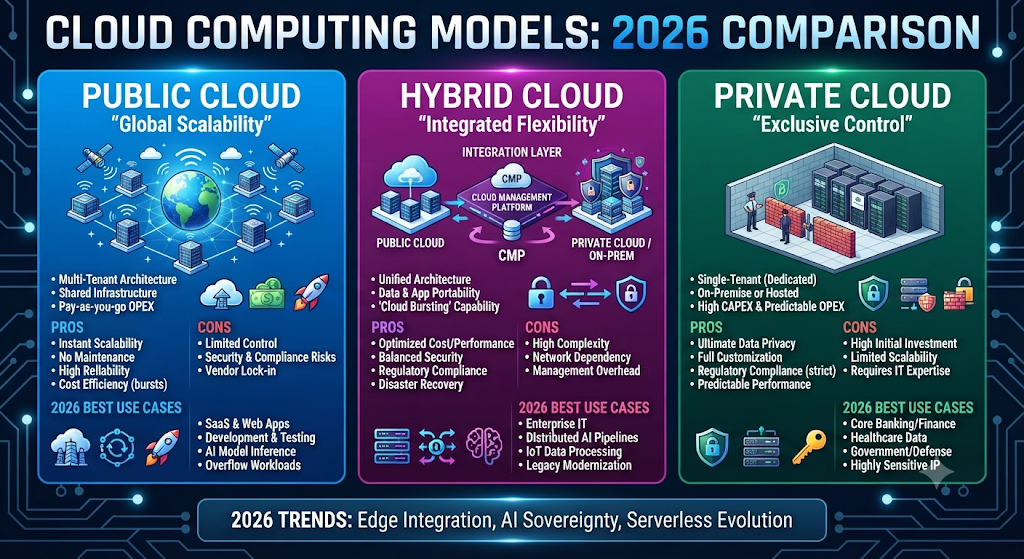
In this complete guide, you’ll learn how each Cloud Deployment Model works, what makes them different, and where they perform best. We’ll compare their features, benefits, drawbacks, costs, security, and ideal use cases using simple English. Along the way, you’ll also discover how Cloud Computing, Cloud Infrastructure, Cloud Security, Cloud Scalability, and Cloud Performance influence modern businesses and why choosing the right deployment strategy matters more than ever.
What Is a Cloud Deployment Model?
A Cloud Deployment Model explains where your applications, files, and Computing Resources are stored, who manages them, and how users access them. Think of it as the blueprint that determines how your Cloud Environment operates. Every deployment model offers a different balance of Cloud Flexibility, Data Protection, Cost Efficiency, and control. Whether your organization needs maximum security or rapid growth, understanding these models helps you choose the right path without wasting time or money.
Businesses rely on different Cloud Deployment Models because every organization has unique goals. A healthcare provider may focus on Regulatory Compliance and Data Privacy, while an online retailer may prioritize Automatic Scaling and High Availability during busy shopping seasons. Understanding these differences allows companies to build reliable IT Infrastructure, improve Operational Efficiency, and support long-term Digital Transformation without creating unnecessary complexity.
Understanding Cloud Deployment Models
Every cloud deployment model uses internet-connected servers to deliver computing power, storage, networking, and applications. The main difference lies in ownership, access, and management. Some environments rely on Shared Infrastructure inside a Multi-tenant Environment, while others use Dedicated Infrastructure in a Single-tenant Environment. These design choices influence security, performance, maintenance, and overall business flexibility.
Why Choosing the Right Cloud Model Matters
Choosing the right deployment model affects much more than technology. It influences business growth, customer trust, operating costs, and future expansion. The correct model improves Cloud Management, simplifies Infrastructure Management, strengthens Business Continuity, supports Disaster Recovery, and ensures your systems remain available whenever customers need them. A well-planned decision today can prevent expensive migrations tomorrow.
What Is Public Cloud?
A Public Cloud is a type of Cloud Deployment Model where a third-party provider owns and manages the Cloud Infrastructure while multiple customers securely share the same physical resources. This approach uses a Shared Infrastructure and a Multi-tenant Environment, allowing businesses to access Cloud Services through the internet without purchasing expensive hardware. Because resources are available whenever needed, organizations benefit from On-demand Computing, reduced upfront costs, and faster deployment.
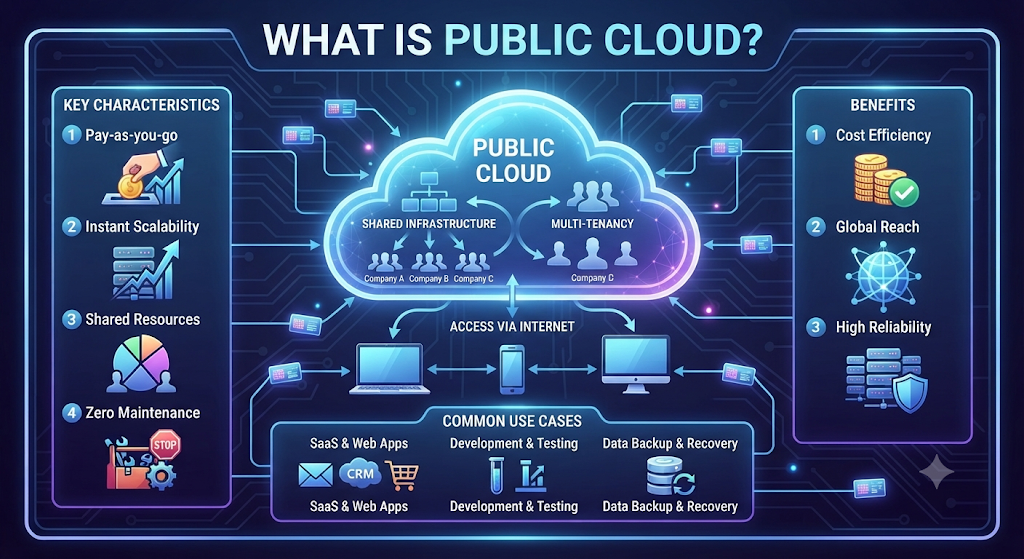
Many organizations choose the Public Cloud because it removes the burden of maintaining physical servers and networking equipment. Instead of investing heavily in local IT Infrastructure, businesses can rent Computing Resources as needed. This model supports Cloud Scalability, Cloud Flexibility, and Cost Efficiency, making it especially attractive for startups, small businesses, software developers, educational institutions, and organizations that expect changing workloads throughout the year.
How Public Cloud Works
The Public Cloud operates through massive data centers connected by high-speed Cloud Networks. Customers securely access applications, databases, and Cloud Storage using the internet, while the provider handles server maintenance, updates, security patches, and Infrastructure Management. Technologies such as Virtual Machines, intelligent Resource Allocation, and Elastic Scalability allow businesses to increase or decrease computing power within minutes without purchasing additional hardware.
Key Features of Public Cloud
The biggest strength of the Public Cloud is flexibility. Organizations can quickly launch new applications, expand globally, and provide employees with secure Remote Access from almost anywhere. Built-in High Availability, Automatic Scaling, Cloud Performance monitoring, and reliable Cloud Management tools help businesses maintain smooth operations while paying only for the resources they actually consume.
Advantages of Public Cloud
The Public Cloud offers several important advantages for modern organizations.
| Advantage | Why It Matters |
| Lower upfront cost | No expensive servers or data center investment |
| Fast deployment | Applications can be launched quickly |
| Excellent scalability | Resources grow with business demand |
| Global accessibility | Teams can work from almost anywhere |
| Reduced maintenance | The provider manages updates and hardware |
| Flexible pricing | Pay only for the services you use |
| Strong reliability | Built-in redundancy improves uptime |
These benefits make the Public Cloud an excellent choice for organizations that want faster innovation without the complexity of maintaining their own physical infrastructure.
Disadvantages of Public Cloud
Although the Public Cloud offers many benefits, it isn’t the perfect solution for every situation. Businesses handling highly sensitive information may require stronger control over Data Privacy, Data Protection, and Compliance Requirements. Since infrastructure is shared, organizations also have less control over hardware configuration and certain security settings. For industries with strict Data Sovereignty rules or highly customized Mission-Critical Applications, another deployment model may provide a better long-term fit.
Best Use Cases
The Public Cloud works especially well for websites, mobile applications, software development, online learning platforms, digital collaboration, backup services, and businesses experiencing rapid growth. It also supports organizations undergoing Cloud Migration because companies can move workloads gradually while improving Workload Distribution, maintaining Business Continuity, and preparing for future expansion without making large investments in physical infrastructure.
What Is Private Cloud?
A Private Cloud is a Cloud Deployment Model designed for a single organization. Unlike a Public Cloud, this environment uses Dedicated Infrastructure inside a Single-tenant Environment, giving one business exclusive access to all Computing Resources. This setup provides greater control over the Cloud Infrastructure, stronger Cloud Security, and more customization. Organizations that handle confidential information often choose this model because it offers a highly Secure Cloud Environment while meeting strict business and legal requirements.
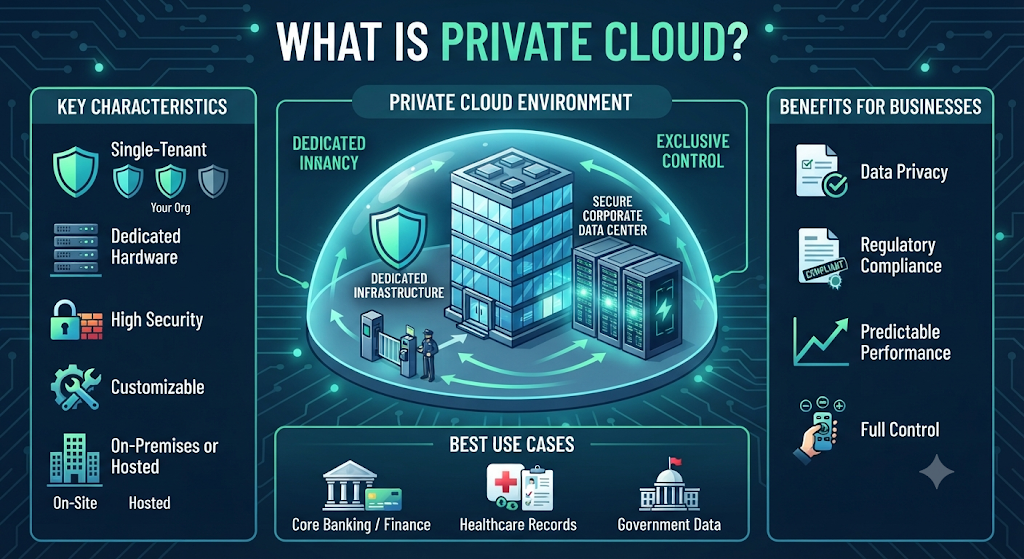
Many medium and large organizations invest in a Private Cloud because they need complete visibility into their systems and data. Instead of sharing hardware with other users, they control their own servers, storage, networking, and security policies. This level of ownership improves Cloud Performance, simplifies Infrastructure Management, strengthens Data Protection, and helps businesses maintain consistent operations even when handling complex workloads.
How Private Cloud Works
A Private Cloud runs on dedicated servers that belong to one organization or are hosted exclusively for that organization by a trusted provider. IT teams configure the Cloud Architecture, manage Virtual Machines, monitor the Cloud Network, and allocate Cloud Resources based on business needs. Because all resources remain dedicated, companies gain predictable performance, tighter security, and greater operational control.
Key Features of Private Cloud
One of the defining characteristics of the Private Cloud is complete customization. Organizations can build a tailored Cloud Environment that matches their exact security policies, compliance standards, and application requirements. Features such as advanced Cloud Management, controlled Resource Allocation, secure Remote Access, High Availability, and flexible Cloud Storage make this deployment model ideal for businesses with specialized operational needs.
Advantages of Private Cloud
The Private Cloud delivers several important benefits for organizations that require security, control, and reliability.
| Advantage | Why It Matters |
| Exclusive infrastructure | No shared hardware with other organizations |
| Strong security | Better Data Privacy and Data Protection |
| Full control | Customize every part of the Cloud Infrastructure |
| Reliable performance | Dedicated resources reduce performance fluctuations |
| Easier compliance | Supports Compliance Requirements and Regulatory Compliance |
| Better customization | Configure systems for unique business workloads |
| Stable operations | Ideal for Mission-Critical Applications |
These advantages make the Private Cloud a preferred solution for organizations that cannot compromise on security, performance, or compliance.
Disadvantages of Private Cloud
Despite its strengths, the Private Cloud comes with higher costs and greater responsibility. Organizations must invest in hardware, software, skilled IT professionals, and ongoing maintenance. Expanding infrastructure also takes more planning than using On-demand Computing, making rapid Cloud Scalability more challenging. Small businesses with limited budgets may find these costs difficult to justify unless strict security requirements make a private environment essential.
Best Use Cases
The Private Cloud is well suited for hospitals, financial institutions, government agencies, research organizations, manufacturing companies, and large enterprises handling sensitive information. It supports Enterprise Cloud strategies where Business Continuity, Disaster Recovery, Data Sovereignty, and Operational Efficiency are top priorities. Organizations that process confidential customer records, intellectual property, or regulated business data benefit from the added control and security offered by this deployment model.
What Is Hybrid Cloud?
A Hybrid Cloud is a Cloud Deployment Model that combines a Public Cloud and a Private Cloud into one connected system. Instead of relying on only one environment, organizations can store sensitive information in a private environment while using the public environment for less sensitive workloads. This balanced approach improves Cloud Flexibility, strengthens Cloud Security, and allows businesses to use their Cloud Resources more efficiently without sacrificing performance or control.
Many organizations choose a Hybrid Cloud because it provides the best of both worlds. Businesses can keep confidential data inside a secure private environment while using public infrastructure to handle traffic spikes, application testing, or temporary projects. This approach improves Cloud Scalability, supports Business Continuity, enhances Cloud Performance, and helps companies adapt quickly as their technology needs change.
How Hybrid Cloud Works
A Hybrid Cloud connects public and private environments through secure networking technologies, allowing applications and data to move safely between them. This process supports efficient Workload Distribution, intelligent Resource Allocation, and smooth Workload Portability. Organizations can run sensitive applications in private infrastructure while expanding into public resources whenever additional computing power becomes necessary.
Key Features of Hybrid Cloud
One of the biggest strengths of a Hybrid Cloud is flexibility. Organizations can build a customized Cloud Architecture that balances security, cost, and performance. Features such as centralized Cloud Management, integrated Cloud Storage, secure Remote Access, Automatic Scaling, and consistent High Availability help businesses maintain reliable services while responding quickly to changing business demands.
Advantages of Hybrid Cloud
The Hybrid Cloud offers organizations a practical balance between flexibility, security, and cost.
| Advantage | Why It Matters |
| Better flexibility | Use both public and private environments together |
| Improved scalability | Expand resources without buying new hardware |
| Enhanced security | Keep sensitive data in a protected environment |
| Cost optimization | Pay for additional resources only when needed |
| Reliable disaster recovery | Strengthens Business Continuity planning |
| Efficient workload management | Improves Workload Distribution and Operational Efficiency |
| Future-ready infrastructure | Supports long-term Digital Transformation initiatives |
These advantages make the Hybrid Cloud one of the most popular deployment models for organizations that require both agility and strong security.
Disadvantages of Hybrid Cloud
Although a Hybrid Cloud provides excellent flexibility, it also introduces additional complexity. IT teams must monitor multiple environments, maintain secure connections, and ensure consistent security policies across every platform. Managing different systems can increase administrative effort, and successful deployment often requires experienced professionals who understand networking, Cloud Management, and Cloud Migration strategies.
Best Use Cases
A Hybrid Cloud works well for healthcare providers, banks, manufacturing companies, educational institutions, government departments, and growing e-commerce businesses. It is especially valuable for organizations running Mission-Critical Applications while also needing rapid expansion during busy periods. Companies can protect sensitive information, meet Compliance Requirements, improve Data Protection, and maintain excellent customer experiences without giving up the flexibility of modern cloud technology.
Public Cloud vs Private Cloud vs Hybrid Cloud
Choosing between Public Cloud, Private Cloud, and Hybrid Cloud depends on your organization’s goals, budget, security requirements, and future growth plans. There isn’t a one-size-fits-all solution because every Cloud Deployment Model serves different business needs. A startup may prioritize Cost Efficiency and On-demand Computing, while a financial institution may focus on Data Privacy, Regulatory Compliance, and complete control over its Cloud Infrastructure. Understanding these differences helps businesses make smarter technology investments.
The comparison below highlights the most important differences between each Cloud Deployment Model. While all three support modern Cloud Computing, they differ in ownership, flexibility, maintenance responsibilities, security, and scalability. Evaluating these factors carefully allows organizations to choose a deployment strategy that improves Cloud Performance, supports long-term Digital Transformation, and ensures reliable business operations.
Public Cloud vs Private Cloud vs Hybrid Cloud Comparison
| Feature | Public Cloud | Private Cloud | Hybrid Cloud |
| Ownership | Managed by a third-party provider | Owned or dedicated to one organization | Combination of public and private environments |
| Infrastructure | Shared Infrastructure | Dedicated Infrastructure | Mixed infrastructure |
| Environment | Multi-tenant Environment | Single-tenant Environment | Combined environment |
| Security | Strong with shared responsibility | Very high with complete organizational control | High with flexible security controls |
| Cost | Low upfront investment | Higher infrastructure cost | Moderate and flexible |
| Performance | Excellent for most workloads | Highly consistent | Optimized for different workloads |
| Scalability | Outstanding Elastic Scalability | Limited by available hardware | Excellent scalability |
| Flexibility | High Cloud Flexibility | Moderate flexibility | Very high flexibility |
| Maintenance | Provider manages infrastructure | Organization manages infrastructure | Shared responsibility |
| Customization | Limited | Extensive | Moderate to extensive |
| Compliance | Suitable for many industries | Excellent for strict Compliance Requirements | Strong compliance support |
| Deployment Speed | Very fast | Slower planning required | Moderate deployment speed |
| Reliability | Excellent High Availability | Excellent reliability | Outstanding resilience |
| Control | Limited infrastructure control | Full administrative control | Shared control |
| Data Privacy | Strong | Maximum Data Privacy | Flexible privacy options |
| Disaster Recovery | Built-in options available | Organization designs recovery strategy | Excellent Disaster Recovery capabilities |
| Best For | Startups, small businesses, websites, development | Government, healthcare, finance, large enterprises | Growing businesses, e-commerce, enterprise applications |
Key Differences Explained
| Comparison Area | Summary |
| Infrastructure | Public Cloud uses Shared Infrastructure, Private Cloud relies on Dedicated Infrastructure, while Hybrid Cloud combines both. |
| Security | Private Cloud offers the highest level of control, while Hybrid Cloud balances security with flexibility. Public Cloud provides strong security but follows a shared responsibility model. |
| Cost | Public Cloud is generally the most affordable. Private Cloud requires the highest investment. Hybrid Cloud offers balanced spending by combining both environments. |
| Scalability | Public Cloud and Hybrid Cloud provide outstanding Automatic Scaling and Cloud Scalability, while Private Cloud depends on available hardware capacity. |
| Performance | Private Cloud delivers predictable Cloud Performance for sensitive applications. Public Cloud performs well for general workloads. Hybrid Cloud optimizes performance by placing workloads where they perform best. |
| Business Growth | Organizations expecting rapid expansion often prefer Hybrid Cloud because it supports Workload Portability, efficient Resource Allocation, and long-term Cloud Migration strategies. |
Expert Insight: The best cloud deployment model isn’t the one with the most features. It’s the one that aligns with your organization’s security needs, workload requirements, growth strategy, and budget. Businesses that carefully evaluate these factors are more likely to achieve long-term success with Cloud Computing.
Advantages and Disadvantages of Each Cloud Model
Every Cloud Deployment Model has strengths and limitations. The best choice depends on your business goals rather than popularity. Some organizations value Cloud Security above everything else, while others focus on Cost Efficiency, flexibility, or rapid growth. Understanding both the advantages and disadvantages helps you avoid expensive mistakes and build a reliable Cloud Infrastructure that supports your long-term strategy.
Instead of asking which deployment model is the best, ask which one best supports your workloads, compliance needs, and future expansion. A company handling confidential medical records has different priorities than a startup launching its first mobile application. Selecting the right Cloud Environment improves Operational Efficiency, protects valuable data, and creates a solid foundation for future Digital Transformation.
Public Cloud Strengths
The Public Cloud stands out because of its affordability, flexibility, and speed. Organizations can access Cloud Services through On-demand Computing without purchasing expensive hardware. Businesses also benefit from Automatic Scaling, High Availability, and simplified Cloud Management, allowing teams to focus on innovation instead of maintaining physical infrastructure.
Public Cloud Limitations
Although the Public Cloud is highly efficient, organizations have less control over the underlying infrastructure. Companies operating under strict Compliance Requirements or dealing with highly sensitive information may require stronger Data Protection and Data Privacy controls than a shared environment can comfortably provide. Customizing infrastructure is also more limited compared to private solutions.
Private Cloud Strengths
A Private Cloud offers complete ownership and greater control over the Cloud Architecture. Because it relies on Dedicated Infrastructure, organizations can customize networking, storage, and security according to their exact requirements. This model delivers excellent Cloud Performance, supports Mission-Critical Applications, and simplifies meeting complex Regulatory Compliance standards.
Private Cloud Limitations
The greatest challenge of a Private Cloud is cost. Organizations must invest in hardware, skilled professionals, and continuous Infrastructure Management. Scaling resources often requires purchasing additional equipment, making expansion slower than cloud environments that provide Elastic Scalability through shared provider infrastructure.
Hybrid Cloud Strengths
A Hybrid Cloud combines the flexibility of public resources with the security of private infrastructure. Businesses can place sensitive workloads inside a protected environment while using public services for seasonal demand or development projects. This approach improves Workload Distribution, strengthens Business Continuity, and supports efficient Cloud Migration without disrupting existing operations.
Hybrid Cloud Limitations
Managing multiple environments requires careful planning. IT teams must maintain secure connections, synchronize applications, and monitor workloads across different platforms. Without proper governance, organizations may experience increased complexity in Cloud Management, inconsistent security policies, or higher administrative workloads despite the flexibility the model provides.
When Each Cloud Model Makes the Most Sense
| Business Need | Recommended Cloud Model | Why It Fits |
| Small business with limited budget | Public Cloud | Low cost, quick deployment, and flexible Cloud Resources |
| Startup expecting rapid growth | Public Cloud | Excellent Cloud Scalability with minimal upfront investment |
| Large enterprise | Hybrid Cloud | Balances flexibility, security, and business growth |
| Healthcare organization | Private Cloud or Hybrid Cloud | Strong Data Protection and regulatory compliance |
| Financial institution | Private Cloud | Maximum control and enhanced security |
| E-commerce business | Hybrid Cloud | Handles traffic spikes while protecting customer information |
| Government agency | Private Cloud | Supports Data Sovereignty, compliance, and sensitive workloads |
| Seasonal business | Hybrid Cloud | Expands resources only when demand increases |
Key Takeaway: There is no universal winner in the Public Cloud vs Private Cloud vs Hybrid Cloud debate. The right deployment model depends on your organization’s security expectations, operational goals, growth plans, budget, and long-term technology strategy. Businesses that align their cloud choice with their real needs gain better performance, stronger security, and greater value from their Cloud Computing investment.
Which Cloud Deployment Model Should You Choose?
Choosing the right Cloud Deployment Model depends on your business goals, budget, security needs, and future growth. There is no universal solution because every organization uses technology differently. Some businesses need maximum Cloud Security, while others prioritize Cloud Scalability, Cost Efficiency, or faster deployment. Evaluating your workloads before making a decision helps you build a reliable Cloud Infrastructure that supports long-term success.
Before selecting a deployment model, consider the type of data you handle, your compliance obligations, expected traffic, and available IT resources. A thoughtful decision improves Cloud Performance, strengthens Business Continuity, simplifies Cloud Management, and reduces unexpected costs. The right choice today can save significant time and money as your organization grows.
Best for Small Businesses
Small businesses usually benefit most from the Public Cloud because it requires little upfront investment and offers excellent On-demand Computing. Owners can access reliable Cloud Services, secure Cloud Storage, and flexible Computing Resources without purchasing expensive hardware. As the business grows, additional resources become available within minutes through Automatic Scaling, making expansion simple and affordable.
Best for Startups
Startups often experience unpredictable growth, making the Public Cloud an excellent starting point. Founders can launch applications quickly, reduce infrastructure expenses, and focus on product development instead of server maintenance. Strong Cloud Flexibility, rapid Cloud Migration options, and efficient Resource Allocation allow startups to adapt quickly as customer demand changes.
Best for Large Enterprises
Large organizations frequently choose a Hybrid Cloud because it balances security, performance, and scalability. Sensitive business information remains protected in a private environment while less critical workloads run on public infrastructure. This strategy improves Workload Distribution, supports Enterprise Cloud initiatives, and delivers excellent Operational Efficiency across multiple departments and business locations.
Best for Healthcare
Healthcare organizations handle confidential patient information that requires strong Data Protection, Data Privacy, and strict Compliance Requirements. A Private Cloud or Hybrid Cloud provides a highly Secure Cloud Environment while supporting electronic health records, medical imaging, and critical healthcare applications. These deployment models also strengthen Disaster Recovery planning and ensure continuous access to essential medical systems.
Best for Banking
Banks and financial institutions process highly sensitive financial information every day. A Private Cloud offers maximum control over Cloud Architecture, improves Cloud Security, and helps organizations satisfy strict Regulatory Compliance standards. Dedicated resources also provide consistent Cloud Performance for payment processing, fraud detection, and other Mission-Critical Applications.
Best for E-commerce
Online stores often experience sudden traffic increases during holiday sales and promotional events. A Hybrid Cloud allows businesses to protect customer information while expanding computing power whenever demand rises. This approach improves High Availability, supports Elastic Scalability, and delivers a smooth shopping experience without unnecessary infrastructure costs during slower periods.
Best for Government Organizations
Government agencies manage sensitive public information and must follow strict security regulations. A Private Cloud is often the preferred choice because it offers complete control over the Cloud Environment, supports Data Sovereignty, and strengthens Infrastructure Management. Organizations can also customize security policies to meet national regulations while maintaining reliable public services.
Real-World Examples
Understanding Public Cloud vs Private Cloud vs Hybrid Cloud becomes much easier when you look at real-world situations instead of technical definitions. Different industries have different priorities. Some focus on Cloud Security, while others need better Cloud Scalability, lower costs, or improved Cloud Performance. The right Cloud Deployment Model depends on how an organization stores data, delivers services, and plans for future growth.
The following examples demonstrate how businesses and organizations use different cloud deployment models to solve everyday challenges. These practical scenarios show why no single solution works for everyone. Instead, successful organizations choose the Cloud Environment that best supports their operations, security requirements, and long-term objectives.
Personal File Storage
Imagine you save photos, videos, and important documents so you can access them from your phone, laptop, or tablet anytime. This is a common use of the Public Cloud because it provides convenient Cloud Storage, secure Remote Access, and reliable High Availability. Users enjoy easy file synchronization without worrying about maintaining physical servers or complicated Infrastructure Management.
Online Shopping Platforms
An online shopping website experiences normal traffic most of the year, but visitor numbers increase dramatically during holiday sales. A Hybrid Cloud allows the business to keep customer payment information inside a secure private environment while using public resources to handle additional website traffic. This approach improves Workload Distribution, supports Elastic Scalability, and maintains excellent Cloud Performance even during peak shopping seasons.
Hospitals
Hospitals manage confidential patient records, appointment systems, laboratory reports, and medical imaging every day. Because healthcare organizations must protect sensitive information, many choose a Private Cloud or Hybrid Cloud. These deployment models strengthen Data Protection, support Compliance Requirements, improve Business Continuity, and provide a highly Secure Cloud Environment for critical healthcare operations.
Universities
Universities support thousands of students, teachers, and researchers who need online learning platforms, digital libraries, and collaboration tools. Many educational institutions use a Public Cloud for learning resources while keeping administrative records inside a private environment. This balanced approach improves Cloud Flexibility, simplifies Resource Allocation, and reduces operating costs without compromising sensitive institutional data.
Manufacturing Companies
Modern manufacturing businesses depend on connected machines, inventory systems, production planning, and supply chain management. A Hybrid Cloud enables factories to process confidential operational data locally while expanding Computing Resources whenever production demand increases. This strategy improves Operational Efficiency, supports Digital Transformation, and ensures reliable Cloud Management across multiple facilities.
Financial Institutions
Banks, insurance providers, and investment firms process millions of financial transactions every day. These organizations often rely on a Private Cloud because it provides Dedicated Infrastructure, stronger Data Privacy, advanced Cloud Security, and greater control over the Cloud Architecture. This environment helps protect confidential financial information while delivering consistent performance for Mission-Critical Applications.
Case Study: A growing retail business started with a Public Cloud because it offered affordable infrastructure and rapid deployment. As customer data increased and compliance requirements became more demanding, the company adopted a Hybrid Cloud strategy. Sensitive customer information remained protected in a private environment, while public resources handled seasonal traffic spikes. This approach reduced infrastructure costs, improved website performance, and strengthened long-term business resilience.
Common Myths About Public, Private, and Hybrid Cloud
Many people misunderstand Public Cloud, Private Cloud, and Hybrid Cloud because cloud technology continues to evolve rapidly. Outdated information often leads businesses to believe one deployment model is always better than another. In reality, every Cloud Deployment Model has unique strengths that depend on business objectives, security requirements, and available Computing Resources.
Understanding the facts behind these common myths helps organizations make informed decisions instead of relying on assumptions. The right choice should always be based on workload requirements, Cloud Security, compliance needs, budget, and long-term business strategy rather than popular opinions or marketing claims.
Myth: Public Cloud Is Never Secure
One of the biggest misconceptions is that the Public Cloud is unsafe because multiple customers share the same infrastructure. Modern public cloud environments use advanced encryption, identity management, continuous monitoring, and strict security controls to protect customer information. Although businesses share the underlying Shared Infrastructure, each customer’s data remains isolated within a secure Multi-tenant Environment. Security also depends on how well organizations configure their own systems and access controls.
Myth: Private Cloud Is Always the Best Option
Many people believe a Private Cloud is automatically the best solution because it offers exclusive control. While it provides Dedicated Infrastructure, greater Data Protection, and stronger Data Privacy, it also requires higher investment, experienced IT professionals, and ongoing Infrastructure Management. For many small businesses, the additional cost outweighs the benefits, making a Public Cloud or Hybrid Cloud a more practical choice.
Myth: Hybrid Cloud Is Too Complex for All Businesses
Some organizations avoid the Hybrid Cloud because they believe it is too difficult to manage. While combining two environments requires thoughtful planning, modern Cloud Management tools have made deployment much simpler than in the past. Businesses that need flexibility, improved Workload Portability, and stronger Business Continuity often find that a hybrid strategy delivers greater long-term value than relying on a single environment.
Myth: Public Cloud Is Only for Small Businesses
Another common myth is that only startups and small businesses use the Public Cloud. In reality, organizations of every size use public cloud services for software development, collaboration, analytics, backup, and customer-facing applications. Large enterprises often combine public resources with private infrastructure to improve Cloud Scalability, optimize Resource Allocation, and reduce operational costs.
Myth: Private Cloud Eliminates All Security Risks
A Private Cloud provides greater control, but it does not eliminate cyber threats. Organizations remain responsible for protecting their applications, managing user permissions, applying software updates, and monitoring suspicious activity. Strong Cloud Security depends on continuous maintenance, employee awareness, and effective security policies rather than the deployment model alone.
Myth: Moving to the Cloud Happens Overnight
Some businesses assume Cloud Migration is a quick process that can be completed in a few hours or days. In reality, successful migration requires careful planning, testing, risk assessment, and workload evaluation. Organizations must consider application compatibility, Cloud Architecture, Disaster Recovery, and performance requirements before moving critical systems to a new cloud environment.
Expert Quote: “The best cloud strategy isn’t determined by myths or trends. It’s determined by your business goals, security needs, compliance requirements, and long-term growth plans.”
Frequently Asked Questions
Which cloud model is the most secure?
A Private Cloud generally provides the highest level of security because it uses Dedicated Infrastructure and gives one organization complete control over its systems. However, a properly configured Hybrid Cloud can also provide excellent Cloud Security by keeping sensitive information private while using public resources for less critical workloads. Security depends not only on the deployment model but also on how well the environment is managed.
Is Hybrid Cloud better than Public Cloud?
A Hybrid Cloud is not always better than a Public Cloud. It depends on your business requirements. If your organization handles confidential information and also needs flexible computing power, a hybrid approach is often the better choice. If affordability, simplicity, and fast deployment are your priorities, the Public Cloud may be the smarter option.
Can a small business use Private Cloud?
Yes. A small business can use a Private Cloud, but it is usually more expensive than a Public Cloud. Unless the business has strict Compliance Requirements, advanced Data Privacy needs, or industry regulations, public cloud services often provide a better balance of performance and cost.
Which cloud model is the cheapest?
The Public Cloud is generally the most affordable option because businesses pay only for the Cloud Resources they use. There is no need to purchase expensive servers or maintain physical IT Infrastructure, making it ideal for startups and growing businesses with limited budgets.
Why do companies use Hybrid Cloud?
Organizations choose a Hybrid Cloud because it combines flexibility with security. Sensitive workloads remain in a protected private environment while less sensitive applications run on public infrastructure. This approach improves Workload Distribution, supports Business Continuity, and allows organizations to scale resources whenever demand increases.
What is the biggest advantage of Public Cloud?
The biggest advantage of the Public Cloud is flexibility. Businesses can quickly increase or decrease Computing Resources through Automatic Scaling without investing in new hardware. This reduces costs, speeds up deployment, and supports rapid business growth.
Can businesses switch from one cloud model to another?
Yes. Many organizations begin with a Public Cloud and later move to a Hybrid Cloud or Private Cloud as their security, compliance, or performance needs change. A well-planned Cloud Migration strategy helps reduce downtime and ensures a smooth transition.
Which deployment model is best for beginners?
The Public Cloud is usually the best starting point for beginners because it is simple to use, affordable, and requires very little infrastructure management. It allows individuals and businesses to learn Cloud Computing concepts before moving to more advanced deployment models.
Is Hybrid Cloud suitable for regulated industries?
Yes. A Hybrid Cloud is widely used in industries that must follow strict regulations. Organizations can store sensitive information inside a private environment while using public infrastructure for other workloads. This balance helps maintain Data Protection, improve flexibility, and meet regulatory obligations.
How do I choose the right cloud deployment model?
Start by evaluating your budget, security needs, compliance requirements, expected growth, and workload type. If low cost and simplicity are your priorities, choose a Public Cloud. If maximum control is essential, consider a Private Cloud. If you need both flexibility and security, a Hybrid Cloud is often the best long-term solution.
Conclusion
Choosing between Public Cloud vs Private Cloud vs Hybrid Cloud is not about finding a single winner. It is about selecting the Cloud Deployment Model that best supports your organization’s goals. Every deployment model offers unique advantages. Public Cloud delivers affordability and flexibility. Private Cloud provides greater control and stronger security. Hybrid Cloud combines both approaches to create a balanced solution for modern businesses.
Before making your decision, carefully evaluate your budget, security requirements, compliance obligations, performance expectations, and future growth plans. A well-planned Cloud Computing strategy improves Cloud Infrastructure, strengthens Cloud Security, increases Operational Efficiency, and prepares your organization for long-term success. As cloud technology continues to evolve, understanding these deployment models will help you make smarter technology decisions with confidence.
Start Your Cloud Computing Journey Today
Every technology expert starts with the basics. Take time to understand cloud computing concepts, learn different deployment and service models, and practice using real cloud environments. Building your knowledge step by step will strengthen your skills, boost your confidence, and prepare you for more advanced cloud technologies.
Once you’re comfortable with the fundamentals, you can explore leading cloud platforms such as Amazon Web Services (AWS), Microsoft Azure, and Google Cloud Platform (GCP) through their free learning resources and hands-on practice environments. Real-world experience is one of the fastest ways to build valuable cloud computing skills.
Continue exploring DailyTecho to discover beginner-friendly guides, practical tutorials, technology comparisons, cybersecurity resources, and the latest cloud computing insights. Consistent learning and hands-on practice will help you stay ahead in today’s rapidly evolving technology landscape.
Explore More Technology Categories on DailyTecho
Technology changes every day, and staying informed helps you build practical digital skills. DailyTecho publishes easy-to-understand guides, in-depth tutorials, expert comparisons, and the latest technology news for beginners, students, professionals, and curious learners.
| Technology Category | What You’ll Learn |
| 🔐 Cybersecurity | Malware, ransomware, phishing attacks, network security, firewalls, VPNs, Zero Trust, endpoint security, and online safety best practices. |
| ☁️ Cloud Computing | Cloud basics, cloud deployment models, AWS, Azure, Google Cloud, cloud security, certifications, and career guides. |
| 🤖 Artificial Intelligence AI | AI fundamentals, machine learning, generative AI, ChatGPT, automation, and future AI trends. |
| 📱 Technology News | Product launches, software updates, technology innovations, cybersecurity news, and industry developments. |
If you enjoy learning about technology in simple English, bookmark DailyTecho and explore our growing library of expert-written guides. Every article is designed to help you build practical knowledge one topic at a time.
Explore More Information
Meta Description:
Learn the differences between Public Cloud vs Private Cloud vs Hybrid Cloud. Compare features, pros, cons, security, costs, and best use cases to choose the right cloud deployment model in 2026.
6 Comments