

AI agents can search websites, read documents, write code, send emails, and use business tools. These abilities save time. However, they also create new security risks. An agent that follows a malicious instruction may expose private information or perform an action you never approved.
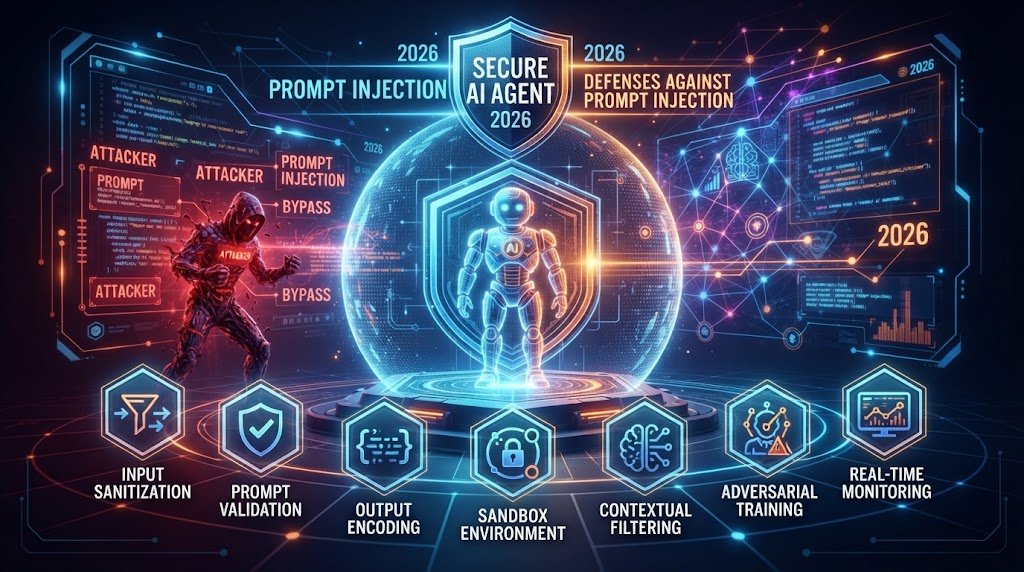
Learning How to secure AI agents is now an important task for developers and businesses. Strong security requires more than a carefully written prompt. You need strict permissions, safe tool integrations, human approval, and continuous monitoring. This guide explains seven practical ways to reduce prompt injection risks in 2026. You will also learn how to protect data, secure connected tools, and build safer AI workflows.
What Is prompt injection attacks?
prompt injection attacks means protecting AI agents, their data, their tools, and the systems they can access. Many agents use Large language models (LLMs) to understand requests and decide what to do next. They may also connect to websites, databases, APIs, files, and external applications. Every connection creates another possible entry point for an attacker.
Traditional chatbots mainly generate responses. An AI agent may also take actions based on those responses. For example, it might read an invoice and prepare a payment. If an attacker manipulates its instructions, the agent could select the wrong payment details. Strong security must therefore protect both the model’s responses and the actions performed by the surrounding application.
Why AI Agents Need Stronger Protection
The main concern is the combination of decision-making and access. An agent might receive a malicious message, misunderstand its instructions, and use an authorized tool in an unsafe way. These AI agent vulnerabilities can lead to AI security risks, including unauthorized access, data theft, incorrect decisions, and unwanted changes to business systems. The danger depends on what the agent can access and what it is allowed to do.
Businesses should assess an agent’s complete workflow before putting it into production. This includes the model, its instructions, connected tools, memory, external data, and execution environment. Our guide to AI agent security provides related information. The central principle is simple: never give an agent more access than its job requires.
What Is a Prompt Injection Attack?
Prompt injection attacks happen when someone places instructions in input that can influence an AI model’s behavior. An attacker may ask the model to ignore its original task, reveal private information, or perform an unauthorized action. These instructions can appear in a user message, a webpage, an email, a document, or another source the agent processes.
Prompt injection is difficult because models process both instructions and ordinary content through language. A malicious sentence may look like part of a normal document. A filter can catch some known patterns, but it cannot guarantee protection against every possible attack. OWASP explains this problem in its LLM Prompt Injection Prevention Cheat Sheet. Effective AI agent prompt injection protection combines detection with controls outside the model.
Direct vs. Indirect Prompt Injection
Direct prompt injection occurs when an attacker places malicious instructions directly in a prompt. For example, a user might ask an agent to ignore its assigned role and reveal confidential instructions. Indirect prompt injection occurs when the agent encounters malicious instructions inside external content, such as a webpage or uploaded file. The user may have no idea that the content contains an attack.
Indirect attacks are especially important for agents that browse the web or process documents automatically. Imagine an agent that summarizes customer emails. One email contains hidden instructions telling the agent to forward confidential messages to an outside address. If the agent treats that email as trusted instructions, it may attempt to misuse its email tool. The solution is not simply to tell the model to ignore attacks. Developers must also restrict what the agent can do.
1. Limit AI Agent Permissions with the Principle of Least Privilege
The Least privilege principle means giving an agent only the access needed for its specific task. A research agent may need permission to read public websites. It probably does not need access to payroll records or production databases. An agent that drafts emails may need to prepare messages, but it should not automatically receive permission to send every message.
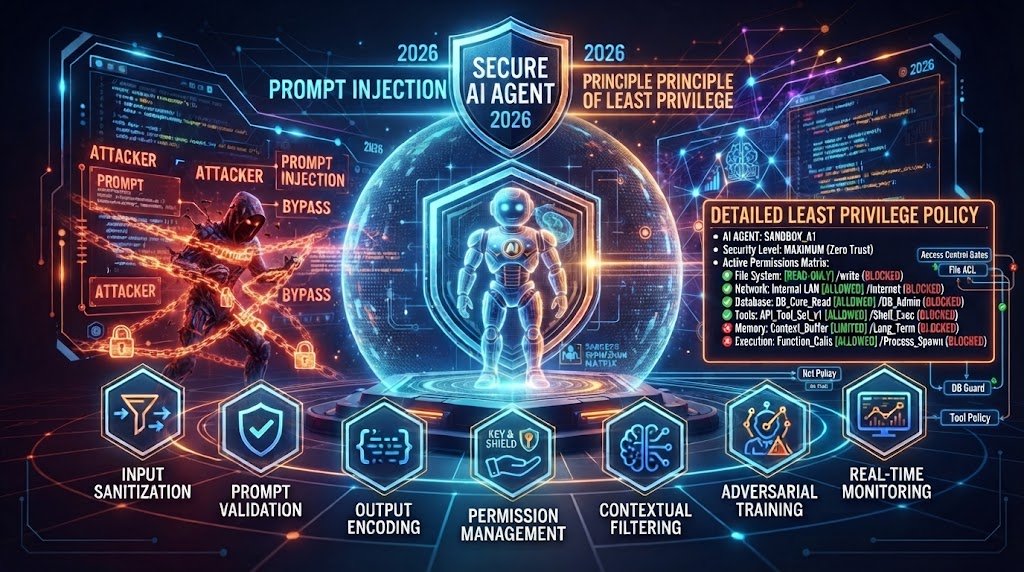
Good AI agent permission management starts with a clear list of required actions and resources. Use separate accounts, limited API tokens, and resource-specific permissions wherever possible. These AI agent access control methods reduce the damage an attack can cause. They also support Preventing unauthorized AI tool access because the agent cannot use tools or resources that its identity is not allowed to access.
Use Separate Permissions for Sensitive Actions
Do not use one powerful account for every agent task. Give reading, editing, deleting, and administrative actions different permission levels. For example, an agent that reviews website content may read published pages but should not automatically change administrator accounts. Enforce AI agent permissions through your application, identity provider, database, or API gateway.
This separation also improves accountability. When an agent requests a sensitive action, the application can check its identity, the target resource, and the requested operation. These Authorization controls must work even if the model produces an unsafe response. Reliable AI agent access management puts the final permission decision in trusted software, not in the model’s own judgment.
2. Treat External Content as Untrusted Data
An AI agent may read websites, PDFs, emails, support tickets, code repositories, or customer uploads. Some of this content may contain Malicious instructions designed to influence the model. Treat external content as data to analyze, not as a trusted source of new instructions. This rule is one of the most important AI agent security best practices.
Developers should separate trusted application instructions from user input and retrieved content. Use clear data structures, controlled templates, and source labels to show where information came from. These steps help with External content validation, but they do not completely solve prompt injection. Even well-separated content can influence a model. For that reason, the tools that execute actions must independently enforce security rules.
Sanitize and Validate Retrieved Information
Validation should happen before content reaches the model and before the agent acts on its output. Check file types, limit document sizes, inspect links, and restrict access to internal network resources. Remove unnecessary active content and block unsafe file operations where appropriate. However, text sanitization alone cannot reliably identify every malicious instruction written in natural language.
Use additional controls to verify important facts and action requests. If a document tells the agent to send customer records elsewhere, the application should reject that request unless a separate, authorized workflow permits it. These Prompt injection defense techniques are most useful when combined with permission checks and human review. You can also explore AI agent vulnerabilities to understand related weaknesses.
3. Require Human Approval for High-Risk Actions
A safe agent should not make every decision independently. Some actions can cause serious harm if they are wrong. Sending confidential emails, transferring money, deleting records, changing user permissions, and deploying production code all deserve stronger checks. Human-in-the-loop security means requiring a person to review important actions before the application executes them.
Build approval into the workflow instead of relying on the agent to ask politely. The application should show the proposed action, the target, the relevant data, and the likely impact. The reviewer must understand what they are approving. This is one of the most useful Best practices for AI agent security, especially when an agent can change external systems or handle sensitive business information.
Make Approval Part of the Execution Process
An approval request must be tied to the exact action being reviewed. If a person approves sending an email to one recipient, the agent should not be able to change the recipient or attachment afterward without another approval. The execution system should verify the approval before carrying out the action. Unknown or high-risk actions should require review by default.
Consider an agent that prepares supplier payments. It may collect invoice details and recommend a payment, but the payment system should independently verify the supplier, amount, and approval status. This approach limits the effect of malicious instructions and model errors. It also creates a useful audit trail. For more guidance on this control, see the human-approval recommendations in the OWASP AI Agent Security Cheat Sheet.
4. Run AI Agents in Sandboxed Environments
AI agent sandboxing means running an agent inside a restricted environment that limits its access to the wider system. A sandbox can restrict files, network connections, system commands, and available resources. It is especially useful when agents execute code, install packages, analyze untrusted projects, or perform automated development tasks.
However, a sandbox is not a guarantee of safety. Its protection depends on how it is configured and what resources remain accessible. Developers should combine isolation with network restrictions, resource limits, temporary workspaces, and strict credentials. Sandboxing AI coding agents is particularly important because a coding agent may run commands or modify files while following instructions found in a repository.
Protect Credentials and Sensitive Files
Never place production secrets directly in prompts, source code, or files that an agent can freely inspect. Use a secrets manager and issue short-lived credentials with limited permissions. Restrict access to environment variables, private keys, configuration files, and production data. These steps support Protecting sensitive data from AI agents even when an agent encounters malicious instructions.
A coding agent should work in a separate workspace whenever possible. Its network access should be limited to approved destinations, and its changes should be reviewed before merging or deployment. Keep backups and recovery options for important systems. If the agent behaves unexpectedly, stop its execution and revoke its credentials. These controls help Secure autonomous AI agents without assuming that the model will always follow its instructions.
5. Secure APIs, Plugins, and Connected Tools
Agents become more useful when they can interact with business software. They may connect to email, cloud storage, customer relationship management systems, payment services, and databases. However, every integration can create a path for unauthorized actions. API security must therefore be part of the agent’s design, not an afterthought.
Use authenticated connections, scoped tokens, rate limits, and server-side validation for every tool. Check that the agent is allowed to perform the requested action on the specific resource. Avoid giving a plugin broad permissions simply because the integration is convenient. To Secure AI APIs and plugins, developers should also review third-party dependencies, callback destinations, access scopes, and error handling.
Monitor Tool Calls and Validate Their Arguments
A model may produce a tool request that looks reasonable but contains an unsafe target or parameter. The application should validate each argument against a strict schema and business rules. For example, an agent may be allowed to search customer records but not export the entire database. The tool should enforce that limit independently.
Log the tool name, authenticated identity, requested operation, target resource, approval status, and result. Avoid storing passwords, access tokens, or unnecessary personal information in logs. These practices improve AI agent monitoring and logging and help security teams investigate suspicious behavior. They also make Secure AI agent integrations easier to maintain because developers can see which tools are used and where failures occur.
6. Protect Agent Memory and Prevent Data Leakage
Some agents retain information across tasks or use memory stores to improve future responses. This can make an agent more useful, but it can also preserve malicious instructions or expose information from earlier conversations. AI agent memory security should cover what the system stores, who can access it, and how long it keeps each item.
Do not treat every memory entry as accurate or trustworthy. An attacker may try to insert misleading instructions into a persistent memory store. Separate user-specific data, validate updates, and prevent one user from accessing another user’s information. Apply clear retention rules and deletion procedures. These measures are central to AI data protection and AI agent data leakage prevention.
Reduce the Risk of Sensitive Data Exposure
Only provide the model with the information needed for its current task. Mask sensitive fields when full values are unnecessary, and prevent private records from being sent to unapproved external services. Check generated outputs for secrets or personal information before displaying or sharing them. These controls help reduce Sensitive data exposure, although output filters should never be your only defense.
For example, a support agent may need to check an order status. It may not need a customer’s complete payment details or account credentials. Restrict its database queries and filter the returned fields before the model sees them. Keep memory access tied to the correct user and session. Strong data boundaries make Protecting AI workflows more reliable and reduce the impact of a compromised agent.
7. Monitor, Test, and Update Your AI Security Controls
Security controls need regular testing because agent behavior can change when you update a model, prompt, plugin, or tool. A defense that blocks one attack may fail against a different wording or a new input source. AI agent security testing should therefore cover realistic attack attempts, normal business tasks, permission boundaries, and recovery procedures.
Include direct and indirect prompt injection tests in your development process. Check whether the agent can access restricted files, misuse connected tools, expose private information, or act without approval. Repeat these tests after major changes. Use the results to improve your AI agent threat detection and response procedures. These are practical AI agent security best practices for teams operating agents in production.
Use a Practical AI Agent Security Checklist
A useful AI agent security checklist should cover identity, permissions, external data, approvals, isolation, monitoring, and recovery. Each control needs a clear owner and a test that proves it works. A policy document alone is not enough. Teams should verify that the application blocks prohibited actions even when the model is manipulated.
The following table provides a practical starting point. Adapt each check to the agent’s purpose and the impact of its actions.
| Security area | What to verify | Desired result |
|---|---|---|
| Permissions | Review every tool and data permission | Access stays limited to the assigned task |
| External content | Test malicious webpages and documents | Untrusted text cannot authorize actions |
| Human approval | Test sensitive and irreversible operations | Approval is checked before execution |
| Sandbox | Attempt restricted file and network access | The environment blocks prohibited access |
| APIs and plugins | Test authentication and argument validation | Invalid requests are rejected |
| Memory and data | Test cross-user access and secret leakage | Private information stays protected |
| Monitoring | Trigger known security test cases | Events are recorded and investigated |
| Recovery | Simulate a compromised or misbehaving agent | Operators can stop access and restore service |
A practical test should include both success and failure cases. For example, verify that an agent can read an approved file while failing to read a restricted one. Check that it can draft an email but cannot send it without required approval. Record the results and fix any gaps before expanding access.
AI Agent Security vs. Traditional AI Security
Traditional AI security often focuses on model integrity, training data, inference endpoints, and the accuracy of outputs. Agent security must address those areas as well as the actions an agent can take. A connected agent may read a malicious webpage, choose a tool, call an API, and change a business record. Each step creates another opportunity for failure.
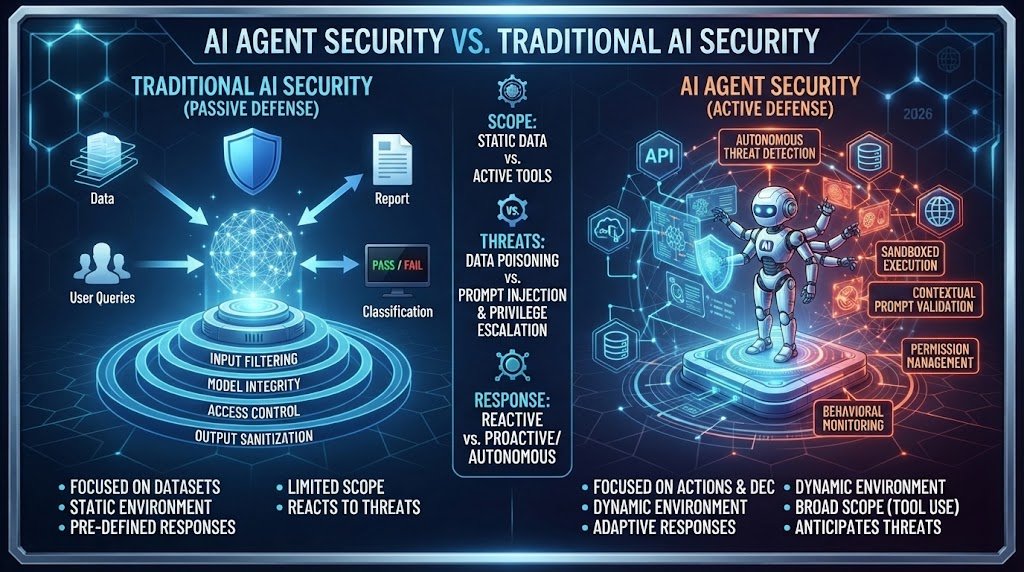
This is why AI security for businesses must include the complete application and its operating environment. Protecting the model alone does not secure connected systems. Effective AI agent threat mitigation combines identity checks, limited permissions, data validation, isolation, approval, and monitoring. The goal is to reduce the chance of an attack and limit its impact if one control fails.
Why Defense in Depth Matters
Defense in depth means using several independent security controls rather than trusting a single defense. A prompt filter may detect a suspicious instruction. Permission checks can prevent unauthorized access. A sandbox can limit system access, while human approval can stop a dangerous action. Monitoring can then help a team detect and investigate an incident.
A strong AI agent security architecture assigns different responsibilities to different controls. The model interprets information, but trusted application code decides whether an action is permitted. APIs enforce their own access rules, and monitoring records important events. This layered approach is more dependable than expecting the model to recognize every attack. It also supports safer Secure AI deployment as tools and workflows become more complex.
Frequently Asked Questions About AI Agent Security
Businesses often ask whether prompt injection can be eliminated, which defenses matter most, and how much oversight an agent needs. The answers depend on the agent’s permissions, data sources, and business purpose. The following questions explain the main points in practical terms.
Can Prompt Injection Attacks Be Completely Prevented?
No single control can guarantee that every prompt injection attempt will fail. Language models can interpret malicious content in unexpected ways, and new attack patterns may appear. Developers should combine input handling, strict permissions, independent authorization, sandboxing, and human approval. This layered approach reduces risk and limits the damage an attack can cause.
What Is the Biggest Security Risk for AI Agents?
The risk depends on the agent’s access and the consequences of its actions. An agent that only summarizes public information has a different risk profile from one that can send emails, change databases, or move money. In many business settings, unauthorized tool use and sensitive data exposure deserve particular attention because they can turn a manipulated response into a real-world incident.
Are AI Agents Safe to Use for Business Tasks?
AI agents can support business tasks when they operate within clearly defined limits. Start with low-risk workflows, restrict access, and test the agent before expanding its responsibilities. Require approval for sensitive actions and keep a way to stop execution. Safety depends on the complete system, including the model, connected tools, data access, and operating procedures.
Does a Prompt Injection Filter Provide Enough Protection?
No. Filters can detect some suspicious content, but attackers may change their wording or hide instructions in external material. A filter also cannot reliably decide whether every requested action is authorized. Use filters as one layer alongside permission checks, API validation, sandboxing, and human approval. Keep the final authorization decision in trusted application code.
How Often Should Businesses Test AI Agent Security?
Test before deployment and after important changes to the model, prompts, tools, permissions, or connected data sources. Schedule regular reviews based on the agent’s risk level. High-impact agents may need continuous monitoring and more frequent testing. Repeat tests after incidents and verify that fixes work against both known attacks and new variations.
Final Thoughts on AI Agent Security
Learning How to secure AI agents requires a practical approach. Start by limiting permissions and treating external content as untrusted. Add human approval for sensitive actions, isolate execution, protect credentials, and validate every tool request. Then test the complete workflow and monitor it during normal use.
In 2026, secure agents should not depend on prompts alone. They need clear boundaries enforced by software, well-managed access, and a reliable response plan. Strong AI agent security in 2026 means accepting that models can make mistakes and designing systems that remain safe when they do. No defense is perfect, but thoughtful controls can greatly reduce risk and help businesses use AI with greater confidence.
Authoritative Resources
For deeper technical guidance, consult the OWASP AI Agent Security Cheat Sheet, the OWASP LLM Prompt Injection Prevention Cheat Sheet, and the NIST AI Risk Management Framework. These resources can help teams build, assess, and improve their AI security controls.