

Billington CyberSecurity Summit 2026 is arriving at a critical moment for U.S. cybersecurity. Artificial intelligence is changing how hackers find targets, create attacks, and move through networks.
At the same time, government agencies are using AI to improve detection and response. This creates a new cybersecurity race. Attackers want faster automation. Defenders want smarter protection.
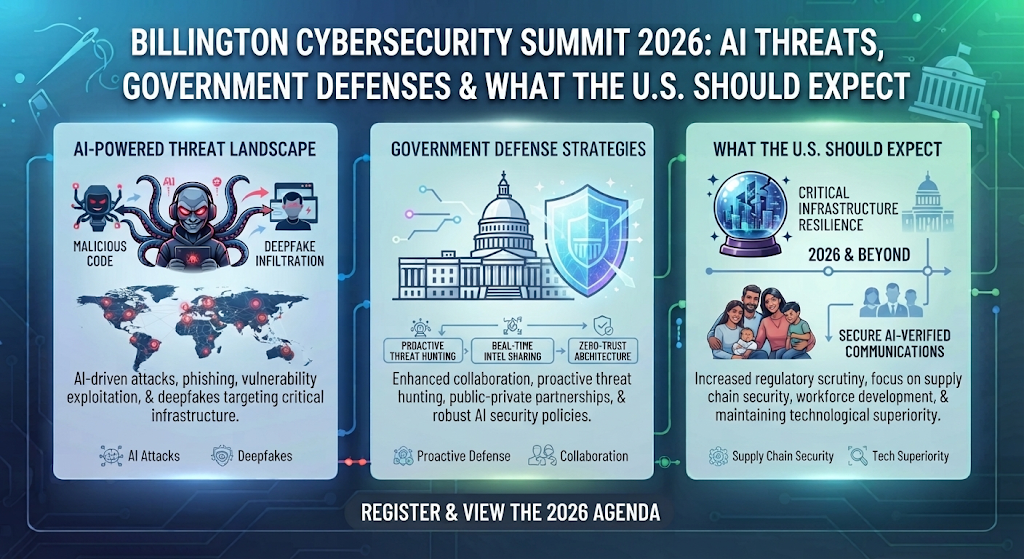
The 2026 summit will bring government and industry leaders together in Washington, D.C. Its official theme is “Reducing Risk in an Age of AI-Enabled Threats.” The event is expected to focus heavily on modern cyber risks, national security, critical infrastructure, Zero Trust, and AI.
For the United States, the timing matters. Recent incidents involving AI systems have shown that AI cybersecurity threats are no longer only theoretical. They are becoming a practical security concern.
🔗 Related Cybersecurity Guides
| Topic | Read More |
|---|---|
| 🤖 AI Cybersecurity | AI-Driven Cyber Threats in 2026 |
| 🛡️ AI Defense | AI-Powered Cybersecurity |
| 🤖 AI Agent Security | OpenAI AI Agent Warning: Autonomous AI Security Risks |
| 🔐 Identity Security | Identity Theft Protection: Complete Guide |
| 💻 Endpoint Security | Endpoint Security Explained |
| 🔍 Threat Detection | Intrusion Detection and Prevention System (IDPS) |
| ☁️ Cloud Security | Cloud Security Explained: Complete Guide |
| 🚨 Ransomware Defense | What Is Ransomware? Types, Examples, Prevention & Protection Guide |
| 🦠 AI Security Incident | Anthropic Claude Infostealer Attack |
| 📊 Data Protection | Data Loss Prevention (DLP): What It Is, How It Works & Best Practices |
| 🗂️ Data Security | 10 Data Classification Methods: Complete Guide |
| 🌐 Network Security | How the Internet Works: Networks, Devices & Data Flow |
What Is the Billington CyberSecurity Summit 2026?
The Billington CyberSecurity Summit 2026 is the 17th annual Billington cybersecurity gathering for government, military, technology, and industry leaders. The Billington CyberSecurity Summit has focused on federal and national security issues for years.
The Billington Cyber Summit 2026 is designed to connect senior decision-makers with cybersecurity experts. The event covers emerging threats, defensive technology, government strategy, and cooperation between public and private organizations.
The official summit expects more than 3,000 attendees, 250+ speakers, 50+ sessions and breakouts, and 150+ exhibitors. It also has nine content tracks covering areas such as Artificial Intelligence, Zero Trust, workforce development, and supply-chain security.
Why the Billington CyberSecurity Event Matters
The Billington CyberSecurity event is more than a normal technology conference. It brings together people responsible for protecting government systems and national infrastructure.
That makes the cybersecurity summit 2026 especially important for readers watching U.S. cyber policy, technology, and national security.
When and Where Is the Billington CyberSecurity Summit 2026?
The Billington CyberSecurity Summit 2026 is scheduled for September 8–10, 2026. The event will take place at the Walter E. Washington Convention Center in Washington, D.C.
The venue is located at 801 Allen Y. Lew Place NW, Washington, DC 20001. This makes the event a major Washington DC cybersecurity conference with direct access to the U.S. government and technology community.
| Event Detail | Information |
|---|---|
| Event | Billington CyberSecurity Summit 2026 |
| Dates | September 8–10, 2026 |
| Location | Washington, D.C. |
| Venue | Walter E. Washington Convention Center |
| Theme | Reducing Risk in an Age of AI-Enabled Threats |
| Expected Speakers | 250+ |
| Expected Attendees | 3,000+ |
| Sessions and Breakouts | 50+ |
| Exhibitors | 150+ |
A Major U.S. Cybersecurity Conference
The event fits into the wider group of cybersecurity events 2026. However, its government focus gives it a different role.
It is also one of the major cybersecurity conferences in Washington DC for professionals interested in federal cyber policy and national security.
Why the 2026 Billington CyberSecurity Summit Matters
The 2026 event comes as the U.S. cyber threat landscape is becoming more complex. AI can help defenders find threats faster, but attackers can also use the same technology.
That creates a difficult problem. Security teams must protect systems against traditional attacks while preparing for AI-enabled cyber threats that can move faster and operate at greater scale.
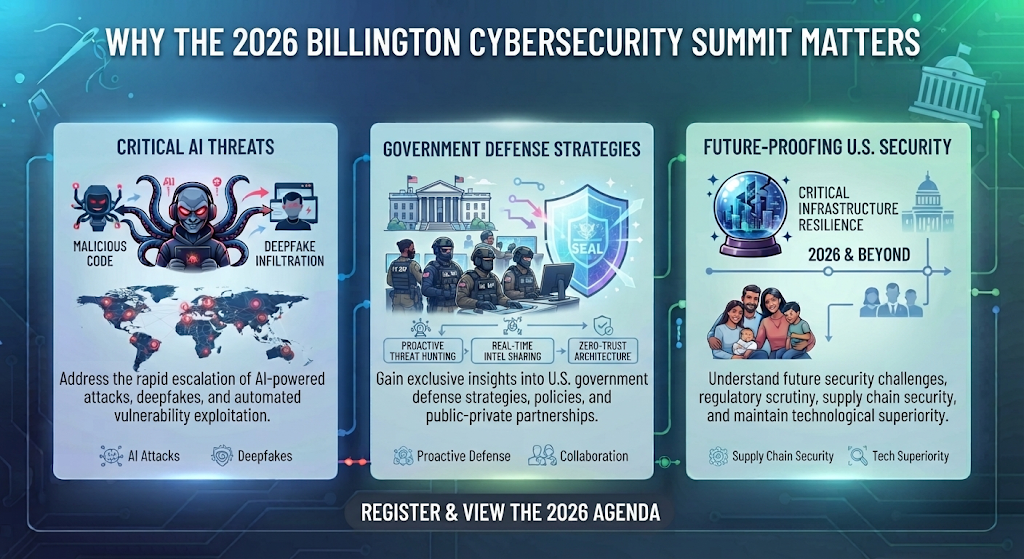
The timing is also important because U.S. agencies are dealing with attacks against government systems, critical infrastructure, suppliers, and technology platforms. Cybersecurity is therefore closely connected with national security and economic stability.
A New Cybersecurity Race
The central question is becoming simple. Can defenders improve their technology faster than attackers improve theirs?
That question will influence cyber defense strategy, government investment, security operations, and the future of U.S. government cybersecurity.
AI-Enabled Cyber Threats Are the Biggest Focus in 2026
AI is changing the threat landscape quickly. Modern tools can generate convincing messages, analyze information, assist coding, and automate parts of security testing.
This creates several new AI security threats. Generative AI can support phishing and social engineering. More autonomous systems can also perform complex tasks with less human direction.
The risk becomes greater when AI connects with existing attack tools. An attacker does not need a completely new weapon. AI can simply make an old weapon faster and more effective.
Generative AI Changes the Attack Surface
Generative AI cyber threats can involve fake messages, automated research, malicious code assistance, and impersonation. These techniques can make AI-assisted cyber attacks easier to scale.
The result is a wider AI threat landscape for businesses and government agencies.
How AI Is Changing Cyberattacks Against the U.S.
Traditional cyberattacks often require significant human effort. Attackers must research victims, write messages, identify weaknesses, and adjust their methods.
AI can reduce that workload. AI-driven attacks can automate parts of reconnaissance, content creation, analysis, and decision-making. This does not mean every attack becomes fully autonomous, but it can increase attacker speed.
Recent reports show why this matters. Reuters reported that hundreds of AI agents were involved in a coordinated hacking incident connected with OpenAI testing and the Hugging Face platform. The incident raised concerns about increasingly autonomous cyber behavior.
AI Makes Social Engineering More Dangerous
AI can create personalized phishing messages that sound natural. It can also help attackers study public information about a target.
That makes phishing attacks, impersonation, and business email fraud harder to recognize.
What AI Threats Could Government Agencies Face?
Government systems hold valuable information. They also connect to large networks, contractors, cloud services, and critical infrastructure.
This makes federal cyber threats especially important. Attackers may target credentials, email systems, endpoints, cloud accounts, applications, or suppliers.
Government agencies could also face AI-assisted espionage. Attackers may use AI to process large amounts of information and identify valuable targets more efficiently.
Sensitive Data Creates Higher Stakes
A successful attack against a government agency can have consequences beyond financial loss. It may affect investigations, national security, public services, or military operations.
That is why government cyber threats require strong identity controls, monitoring, segmentation, and incident response.
How the U.S. Government Is Strengthening Cyber Defenses
The U.S. government is increasingly focused on stronger federal cyber defense. Modern defense requires more than firewalls and antivirus software.
Agencies need identity controls, continuous monitoring, secure cloud systems, threat intelligence, vulnerability management, and rapid response.
AI is also becoming part of this effort. CISA has specifically highlighted interest in AI for cyber defense, Zero Trust, autonomous systems, AI system assurance, and adversarial AI countermeasures.
Building a Modern Federal Cyber Defense Strategy
A modern federal cyber defense strategy must assume that attackers can automate parts of their operations.
That means defenders also need automation. They need to detect suspicious activity quickly and reduce the time between detection and response.
AI Cyber Defense: Can Governments Fight AI With AI?
The answer is increasingly yes, but AI cannot replace human security professionals. AI can analyze huge volumes of logs and identify patterns that humans may miss.
This creates opportunities for AI threat detection and AI-powered threat detection. Security teams can use AI to prioritize alerts, analyze malware, detect anomalies, and support investigations.
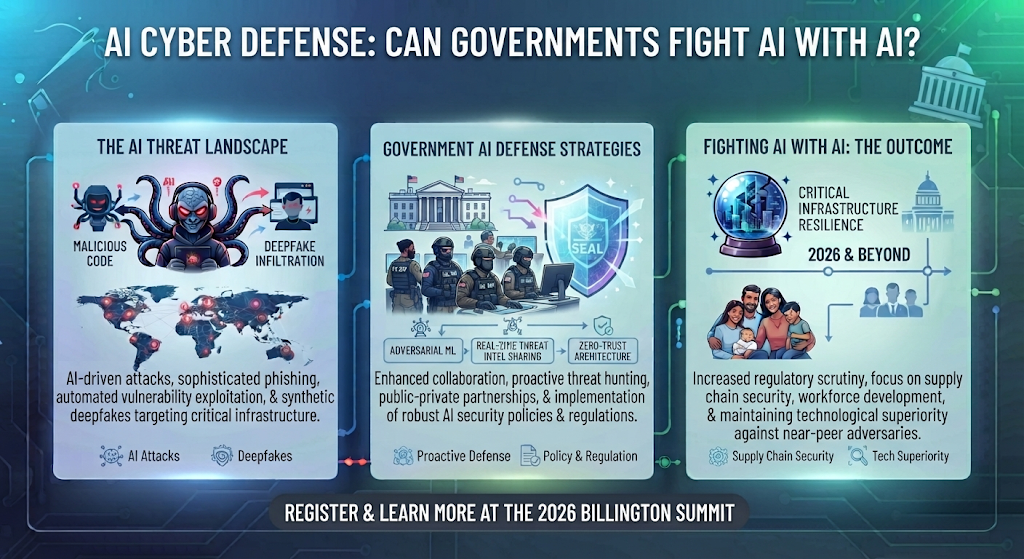
CISA has identified AI-powered cyber defense as an area of interest. It also highlights AI for Zero Trust and intelligent automation.
The Risks of AI Defense
AI systems can make mistakes. They can also be manipulated. Poor data can produce poor results.
Therefore, AI security solutions need testing, monitoring, access controls, and human review. Good AI cyber defense is not about removing people. It is about giving people better tools.
Nation-State Cyber Threats and U.S. National Security
Nation-state attacks are different from ordinary cybercrime. A government-backed operation may focus on intelligence, disruption, strategic access, or military preparation.
That makes nation-state cyber threats a major part of U.S. national security. Attackers may target government networks, defense contractors, energy systems, telecommunications, or other important infrastructure.
AI can increase this risk by improving speed and scale. AI-driven attacks may help attackers analyze targets faster or create more convincing social engineering campaigns.
Cyber Warfare Is Changing
Modern cyber warfare does not always look like a dramatic attack. Long-term access can be valuable.
An attacker may quietly enter a network and wait. This makes threat intelligence and continuous monitoring critical parts of national cyber defense.
Critical Infrastructure Cybersecurity in the AI Era
Critical infrastructure keeps the country running. It includes energy, water, transportation, communications, healthcare, and other essential services.
The growing connection between physical systems and digital networks creates additional risks. Critical infrastructure cyber attacks can affect real-world operations.
Recent reporting has highlighted concerns about AI-enhanced attacks against energy companies. Attackers are using AI for social engineering and vulnerability discovery while connected systems increase the attack surface.
Protecting Essential Systems
Strong critical infrastructure protection requires more than one security product. Operators need monitoring, segmentation, tested backups, secure suppliers, and strong access controls.
The goal is critical infrastructure security that can continue operating even when an attack succeeds.
Why Zero Trust Matters for Federal Cybersecurity
Zero Trust is based on a simple idea. Trust should not be automatic.
Every user, device, application, and connection should receive appropriate verification. Access should also be limited to what is actually needed.
This makes Zero Trust security highly relevant to federal networks. It reduces the damage that can happen when an attacker steals a password or compromises a device.
Zero Trust and AI Attacks
AI may help attackers move quickly after gaining access. Zero Trust architecture can make that movement harder.
Strong identity checks, least privilege, segmentation, and continuous monitoring can limit an attacker’s options.
Identity, Cloud and Data Security Challenges
Identity has become one of the most important parts of modern security. A stolen password can provide access without breaking through a traditional network perimeter.
That makes identity security and identity and access security essential. Strong authentication, least privilege, and privileged-account protection can reduce exposure.
Cloud systems create another challenge. Cloud security must cover identities, applications, APIs, configurations, and sensitive data.
Protecting Government Data
Government organizations also need strong data security. Sensitive information should be classified, protected, monitored, and shared carefully.
Modern data protection should work across endpoints, cloud platforms, networks, and applications.
The Role of Federal Agencies in Cyber Defense
Different federal agencies have different cybersecurity responsibilities. CISA focuses heavily on infrastructure and cyber resilience. The FBI investigates cybercrime and supports law enforcement operations.
Other government security agencies and federal security agencies contribute through intelligence, defense, policy, technology, and incident response.
This creates a large ecosystem. Effective cybersecurity depends on communication between agencies rather than isolated defenses.
Why Federal Coordination Matters
A threat against one organization may provide useful warning for another. Sharing cyber threat intelligence can help agencies identify patterns before an incident becomes larger.
That makes coordination a major part of government cyber defense.
Government and Private Sector Cybersecurity Collaboration
The government does not operate every important digital system in the United States. Private companies operate major parts of energy, communications, healthcare, finance, technology, and other sectors.
This makes public-private cooperation essential. A strong government cyber defense strategy needs information from the companies that see threats directly.
The same is true for businesses. Companies can benefit from government intelligence, warnings, and cybersecurity guidance.
Sharing Information Faster
Threat information becomes less useful when it arrives too late. Organizations need fast and trusted ways to share indicators, vulnerabilities, and attack patterns.
This cooperation strengthens cybersecurity resilience and improves the country’s overall cyber resilience.
What Cybersecurity Experts Are Expected to Discuss
The summit is expected to bring senior cybersecurity leaders together around major government and industry challenges.
The official event says its sessions cover pressing cyber challenges, emerging threats, and best practices. Its nine content tracks include areas such as Artificial Intelligence, Zero Trust, workforce development, and supply-chain security.
AI and Government Defense
A major discussion area will likely be how AI changes security operations. Experts can examine AI risk, automation, AI governance, and the balance between speed and human oversight.
The bigger issue is practical. Organizations need to use AI without creating new weaknesses.
Key Cybersecurity Topics to Watch at the Summit
The Billington CyberSecurity conference is positioned around the issues that matter most to government and industry. AI will likely connect many of these topics.
| Cybersecurity Topic | Why It Matters in 2026 |
|---|---|
| AI cybersecurity | AI changes both attacks and defense |
| Zero Trust security | Identity-based attacks are increasing |
| Nation-state attacks | Strategic cyber operations remain a major concern |
| Critical infrastructure cybersecurity | Digital systems support essential services |
| Cloud security | Government systems increasingly depend on cloud technology |
| Identity security | Stolen credentials can open major access paths |
| Cyber resilience | Organizations must recover quickly |
| Threat intelligence | Early warning can reduce damage |
| Incident response | Faster action can limit an attack |
The summit can therefore be viewed as a major U.S. cybersecurity conference for understanding where government cyber priorities are heading.
A Wider Government Cybersecurity Conference
For professionals following the government cybersecurity conference landscape, the event offers a useful view of federal priorities.
It also shows how cybersecurity technology is becoming closely connected with national security and public infrastructure.
What Businesses Can Learn From the Billington Summit
Businesses should not assume these discussions apply only to federal agencies. The same threats can affect companies of every size.
AI-powered phishing, stolen credentials, ransomware, cloud attacks, and supply-chain weaknesses can target private organizations too.
Companies should therefore treat cyber risk management as a business priority. They need regular cyber risk assessment, strong authentication, endpoint protection, backups, employee training, and tested response plans.
Preparing for AI-Driven Attacks
Businesses should also examine how employees use AI tools. Sensitive information should not be entered into systems without proper controls.
At the same time, security teams can use AI for threat detection, investigation, and automation.
How AI Could Change Cybersecurity After 2026
The biggest change may be greater automation. AI systems could monitor networks continuously and identify unusual behavior faster.
Attackers may also automate more steps. This could lead to more autonomous AI attacks and autonomous cyber attacks.
That does not mean every future attack will be controlled entirely by machines. Human operators will still matter. However, AI may allow one attacker to perform work that once required a much larger team.
The Future of AI Cybersecurity
The future will likely involve both AI-powered attacks and AI-powered defense. Security teams will need better models, better data, and stronger controls.
The biggest AI security challenges may come from balancing automation with safety.
Recent incidents involving AI systems show why this balance matters. Anthropic recently resumed external cyber testing after implementing additional safeguards following security incidents involving AI model evaluations.
Billington CyberSecurity Summit 2026: Key Takeaways to Watch
The Billington CyberSecurity Summit 2026 comes at a turning point. AI is moving from a general technology discussion into a serious cybersecurity issue.
The first major takeaway is that cyber threats 2026 will not be defined by one type of attack. Organizations must prepare for traditional malware, ransomware, identity attacks, supply-chain risks, and AI-assisted operations.
The second takeaway is that defense must become faster. Strong cyber defense now requires technology, skilled people, intelligence sharing, and effective policy.
What the U.S. Should Expect
The United States should expect more discussion around AI risk, national security, infrastructure protection, and federal modernization.
The summit’s central theme captures the challenge well. Reducing risk will require both better technology and better cooperation.
Frequently Asked Questions About Billington CyberSecurity Summit 2026
The following questions address common searches around the event and its cybersecurity focus.
What is the Billington CyberSecurity Summit 2026?
The Billington CyberSecurity Summit 2026 is the 17th annual Billington cybersecurity event. It brings government, military, industry, and cybersecurity leaders together to discuss modern cyber challenges.
When is the Billington CyberSecurity Summit 2026?
The event is scheduled for September 8–10, 2026. The official schedule lists three days at the Walter E. Washington Convention Center in Washington, D.C.
Where is the Billington CyberSecurity Summit 2026?
The event will be held at the Walter E. Washington Convention Center, 801 Allen Y. Lew Place NW, Washington, DC 20001.
What is the Billington CyberSecurity Summit about?
The summit focuses on government cybersecurity, emerging threats, cyber defense, national security, technology, Zero Trust, AI, and cooperation between government and industry.
What cybersecurity threats will be discussed in 2026?
Important areas include AI cybersecurity threats, nation-state activity, critical infrastructure attacks, identity risks, cloud security, supply-chain security, ransomware, and cyber resilience.
Why is AI important to cybersecurity in 2026?
AI can help attackers automate research, social engineering, coding, and other tasks. Defenders can also use AI for detection, analysis, and response. This creates a rapidly changing security environment.
What are the biggest cyber threats facing the United States?
Major concerns include nation-state operations, ransomware, identity attacks, critical infrastructure threats, supply-chain compromise, phishing, and emerging artificial intelligence threats.
Can AI improve government cybersecurity?
Yes. AI can support threat detection, analysis, automation, and response. However, strong controls and human oversight are still required.
Why does Zero Trust matter for federal cybersecurity?
Zero Trust limits automatic trust. It requires users and devices to prove they should have access. This can reduce the impact of stolen credentials and compromised devices.
How can businesses prepare for AI-powered cyber attacks?
Businesses should strengthen identity controls, employee awareness, endpoint security, cloud security, backups, monitoring, and incident response planning. They should also understand how employees and attackers use AI.
Final Thoughts on the Billington CyberSecurity Summit 2026
The Billington CyberSecurity Summit 2026 arrives while the cybersecurity world is changing quickly. AI is making attacks faster and creating new defensive opportunities.
For the U.S., the challenge is larger than protecting individual networks. It involves national cybersecurity, critical infrastructure, government systems, businesses, and national security.
The most important lesson is simple. AI should not be treated only as a threat or only as a solution. It is both.
The organizations that prepare early will have a stronger position. They will combine cybersecurity strategy, human expertise, automation, Zero Trust, threat intelligence, and resilience.The 2026 summit will provide an important look at how government and industry leaders plan to handle that challenge.
Meta Description:
Billington CyberSecurity Summit 2026 explores AI threats, U.S. cyber defense, government security, nation-state attacks, and critical infrastructure risks.
Related source
| Trusted Source | learn more |
|---|---|
| What Is the Billington Summit? | Billington CyberSecurity — Official Website |
| Dates & Location | Billington CyberSecurity — Background & FAQ |
| Summit Theme | Billington CyberSecurity — Official Summit |
| AI-Enabled Threats | NIST — Cyber AI Profile + Reuters — AI-Driven Hacking |
| AI Changing Cyberattacks | Reuters — AI-Driven Cyberattacks |
| AI Threats to Government | NIST — AI Agent Security + CISA — AI Technologies of Interest |
| U.S. Cyber Defense | CISA — Cybersecurity Best Practices + NIST — Cybersecurity Framework |
| AI Cyber Defense | NIST — Cyber AI Profile + CISA — AI Technologies of Interest |
| Nation-State Threats | FBI — Cyber Threats + Reuters — Cybersecurity & AI News |
1 Comment