

Choosing the right cloud deployment models are one of the most important decisions you can make when building a modern IT system. Whether you run a small startup, a growing online business, or a large enterprise, the way you deploy your cloud services affects security, performance, cost, and future growth. In 2026, businesses across the United States continue to adopt cloud technologies because they offer flexibility, speed, and better ways to manage digital operations.
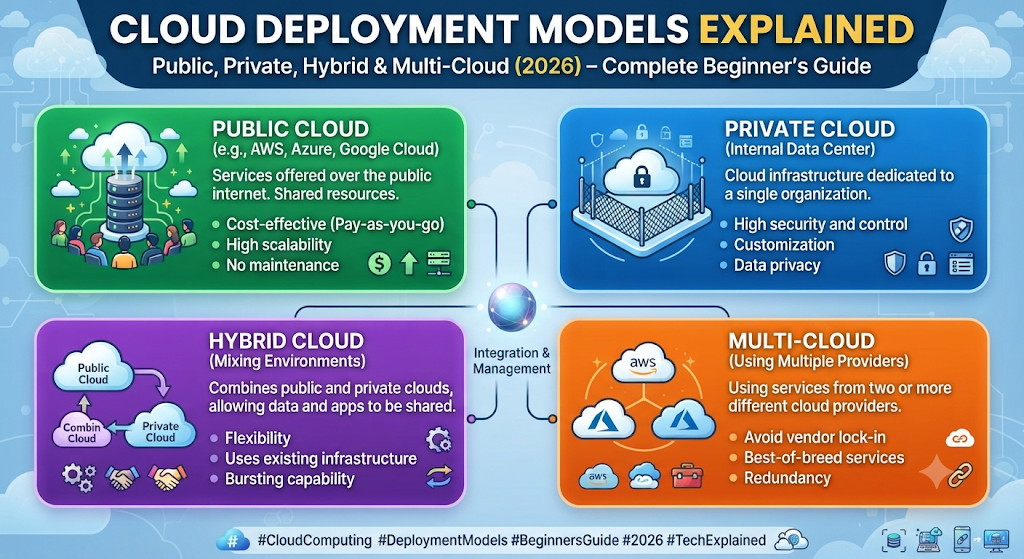
This guide explains every major cloud deployment model in simple English. You’ll learn how public cloud, private cloud, hybrid cloud, and multi-cloud environments work. You’ll also discover when each model makes the most sense, how leading providers support them, and how to choose the best option for your organization. If you’re new to cloud computing or planning your next cloud migration, this guide will help you make informed decisions with confidence.
Introduction: Why Cloud Deployment Models Matter in 2026
Businesses no longer rely only on traditional servers inside office buildings. Today, organizations use flexible cloud infrastructure to store data, run applications, and support remote teams. Choosing the right cloud deployment strategy helps improve performance, reduce operating costs, and strengthen cloud security. As technology continues to evolve, selecting the right deployment model has become a business decision instead of just an IT decision.
The demand for digital services keeps growing across industries. Healthcare providers, retailers, financial institutions, and software companies all use different cloud environments to solve different challenges. Understanding cloud deployment models allows you to match technology with your business goals while supporting digital transformation and long-term innovation.
What Are Cloud Deployment Models?
A cloud deployment model describes where cloud resources are located, who owns them, and how users access them. It defines the structure of your cloud environment and determines how applications, databases, and workloads operate. Every deployment model offers a different balance between cost, flexibility, performance, and security.
Why Businesses Need the Right Cloud Strategy
Every business has unique requirements. A small online store needs different resources than a national bank. Choosing the correct cloud deployment strategy helps improve efficiency, simplify cloud management, and support future growth without unnecessary spending or technical limitations.
What You Will Learn in This Guide
By the end of this guide, you’ll understand every major deployment model, compare their strengths and weaknesses, explore real-world examples, and learn how organizations choose the right cloud solution for different business needs.
What Are Cloud Deployment Models?
Think of a cloud deployment model as the blueprint that determines where your applications and data live. Instead of purchasing physical servers for every task, businesses use cloud services that provide computing power whenever needed. Different deployment models offer different levels of ownership, customization, and control. Understanding these options helps organizations build reliable systems that match their goals.
Modern cloud computing deployment supports everything from website hosting to artificial intelligence. Companies also combine technologies like virtualization, virtual machines, and cloud storage to deliver applications quickly and securely. The right deployment model makes these technologies easier to manage while improving scalability and operational efficiency.
Definition of Cloud Deployment Models
A cloud deployment model is the method used to organize and deliver cloud services. It defines where the infrastructure exists, who manages it, and how users securely access cloud resources across different locations.
How Deployment Models Work
Cloud providers build powerful data center facilities filled with servers, networking equipment, and storage devices. Users connect through the internet or private networks to access computing resources without owning all the physical hardware themselves.
Cloud Deployment vs Cloud Service Models
Deployment models explain where cloud services run. Service models explain what services you receive. For example, IaaS, PaaS, and SaaS describe the service you use, while Public, Private, Hybrid, and Multi-Cloud describe where that service operates.
Cloud Deployment Models vs Cloud Service Models
| Feature | Cloud Deployment Models | Cloud Service Models |
| Main Focus | Infrastructure location | Type of service |
| Controls | Environment ownership | Service management |
| Examples | Public Cloud, Private Cloud | IaaS, PaaS, SaaS |
| Purpose | Where workloads run | What customers receive |
Why Choosing the Right Cloud Deployment Model Is Important
The cloud model you choose affects nearly every part of your technology strategy. A good decision supports business growth, improves customer experience, and protects valuable information. A poor decision can increase costs, reduce flexibility, and create unnecessary complexity. That is why understanding cloud deployment models is essential before investing in cloud technology.
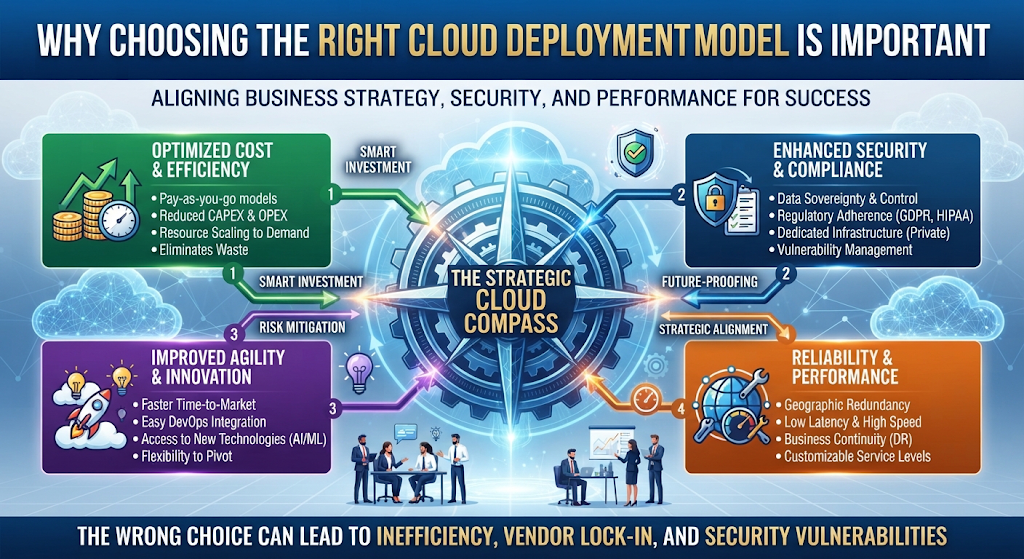
Different industries have different priorities. Healthcare organizations often focus on compliance and data security. Technology startups usually prioritize flexibility and fast deployment. Manufacturers may require reliable application hosting and efficient workload management. Matching the deployment model to your business goals creates stronger results over time.
Business Performance
A well-designed cloud architecture allows applications to respond faster, process data efficiently, and support growing numbers of users without major infrastructure changes.
Cost Optimization
Choosing the correct deployment model helps businesses pay only for the resources they actually use while avoiding unnecessary hardware investments and reducing operational expenses.
Security and Compliance
Organizations handling sensitive information often require stronger cloud Services model, advanced identity and access management, and industry-specific compliance standards to protect customer data.
Long-Term Scalability
Businesses grow over time. A flexible enterprise cloud supports expansion by adding computing resources whenever demand increases without replacing the entire infrastructure.
Types of Cloud Deployment Models Explained
There are four primary cloud deployment models used by organizations around the world. Each one offers unique advantages depending on business goals, security requirements, technical expertise, and available budget. Understanding these differences makes it easier to choose the right solution for your organization.
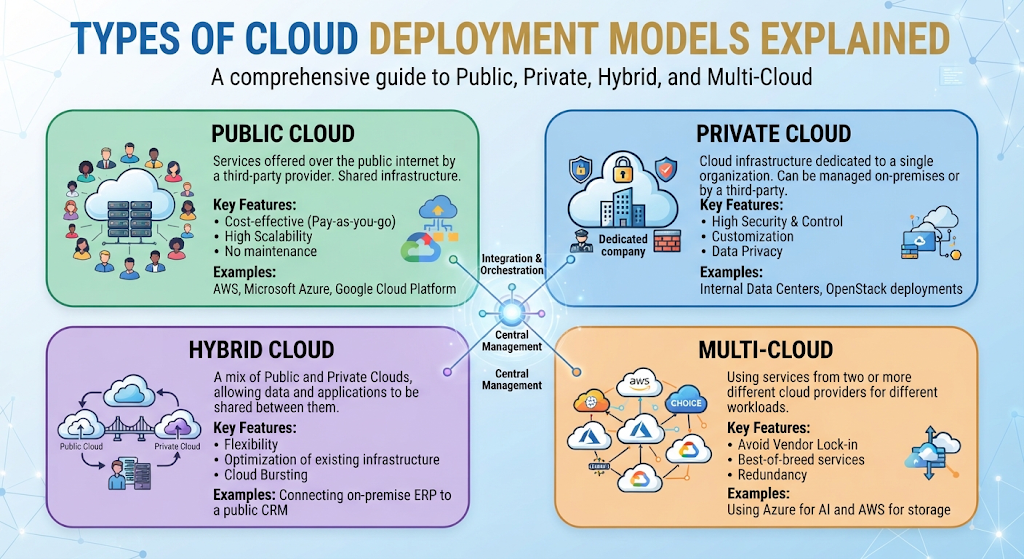
Some companies use only one deployment model. Others combine multiple environments to increase flexibility and resilience. As cloud technology evolves, businesses continue adopting deployment strategies that balance innovation, performance, and reliability while supporting modern IT infrastructure.
Public Cloud
The public cloud delivers computing resources over the internet through shared infrastructure. Providers manage the hardware while customers pay only for the resources they consume.
Private Cloud
A private cloud provides dedicated computing resources for a single organization. This approach offers greater control, stronger customization, and improved security for sensitive workloads.
Hybrid Cloud
A hybrid cloud combines public and private environments into one connected solution. Businesses keep sensitive workloads private while using public resources for additional flexibility and scalability.
Multi-Cloud
A multi-cloud strategy uses services from multiple cloud providers instead of relying on a single vendor. This approach increases resilience, improves performance, and reduces dependence on one platform.
Quick Comparison of Cloud Deployment Models
| Deployment Model | Best For | Security | Cost | Scalability |
| Public Cloud | Startups, websites, developers | High | Low | Excellent |
| Private Cloud | Healthcare, finance, government | Very High | High | High |
| Hybrid Cloud | Growing businesses | Very High | Medium | Excellent |
| Multi-Cloud | Large enterprises | Very High | Medium to High | Excellent |
Did You Know? Many large U.S. organizations now combine AWS, Microsoft Azure, Google Cloud Platform, IBM Cloud, and Oracle Cloud Infrastructure to improve resilience, support business continuity, strengthen disaster recovery, and optimize workloads across multiple cloud environments.
What Is a Public Cloud?
A public cloud is the most widely used type of cloud deployment model. In this model, a cloud provider owns and manages the infrastructure while customers access services over the internet. You don’t need to purchase expensive servers or maintain a physical data center because the provider handles everything behind the scenes. This makes the public cloud an excellent choice for startups, developers, and businesses that want to launch applications quickly.
One of the biggest strengths of the public cloud is flexibility. You can increase or reduce cloud resources whenever your business changes. This supports cloud scalability and helps organizations avoid paying for unused hardware. Popular providers such as AWS, Microsoft Azure, and Google Cloud Platform offer reliable services with built-in load balancing, high availability, and advanced cloud hosting options that keep applications running smoothly.
How Public Cloud Works
The public cloud operates through shared cloud infrastructure managed by a third-party provider. Multiple customers use the same physical hardware through multi-tenant architecture, while advanced virtualization technology securely separates every customer’s data and workloads.
Benefits of Public Cloud
Organizations benefit from fast deployment, lower costs, automatic updates, and access to modern technologies like serverless computing, containerization, and DevOps tools without managing the underlying hardware.
Limitations of Public Cloud
Although the public cloud offers excellent flexibility, some businesses require greater control over sensitive information. Industries with strict compliance rules may need additional security controls before moving critical workloads to shared infrastructure.
Best Use Cases
The public cloud works well for website hosting, mobile applications, software development, online learning platforms, digital marketing systems, testing environments, and growing businesses that need rapid expansion.
Public Cloud Overview
| Feature | Details |
| Ownership | Cloud provider |
| Infrastructure | Shared |
| Cost | Pay-as-you-go |
| Scalability | Excellent |
| Security | High |
| Best For | Startups, SMBs, Developers |
What Is a Private Cloud?
A private cloud gives a single organization exclusive access to dedicated computing resources. Unlike the public cloud, no other company shares the infrastructure. This approach provides greater control over the cloud environment, making it a popular choice for organizations that manage sensitive customer information or operate under strict industry regulations.
Many healthcare organizations, banks, government agencies, and large enterprises choose a private cloud because they require advanced cloud security, stronger identity and access management, and complete control over their IT infrastructure. Although this model usually costs more than a public solution, many organizations consider the additional protection worthwhile.
How Private Cloud Works
A private cloud runs on dedicated servers using single-tenant infrastructure. The organization owns or leases the environment while controlling security settings, networking, and resource allocation.
Benefits of Private Cloud
Businesses receive greater customization, predictable performance, enhanced data security, improved compliance, and complete administrative control over their cloud operations.
Challenges of Private Cloud
Private environments require larger budgets, experienced IT teams, ongoing maintenance, and careful capacity planning. Organizations must also manage hardware upgrades and operational costs.
Best Industries for Private Cloud
Healthcare providers, financial institutions, defense organizations, government agencies, insurance companies, and research organizations often benefit from a private cloud because of strict regulatory requirements.
Private Cloud Overview
| Feature | Details |
| Ownership | Single organization |
| Infrastructure | Dedicated |
| Cost | Higher |
| Scalability | High |
| Security | Very High |
| Best For | Healthcare, Finance, Government |
What Is a Hybrid Cloud?
A hybrid cloud combines the strengths of both public and private environments. Businesses keep sensitive information inside a private cloud while running less critical applications in a public cloud. This balanced approach improves flexibility without sacrificing security.
As organizations continue their digital transformation, the hybrid cloud has become one of the most popular deployment choices. Companies can protect confidential information while expanding into public infrastructure whenever additional computing power is needed. This combination supports efficient cloud management and long-term business growth.
How Hybrid Cloud Works
The hybrid cloud securely connects public and private environments through networking technologies. Applications and data move between platforms when business requirements change.
Advantages of Hybrid Cloud
Organizations gain better flexibility, stronger business continuity, improved disaster recovery, efficient cloud migration, and optimized cloud computing deployment without depending on a single environment.
Common Business Applications
Retail businesses manage seasonal traffic. Hospitals protect patient records. Manufacturers analyze production data. Financial companies separate sensitive transactions from customer-facing applications.
Hybrid Cloud Examples
An online retailer stores payment information inside a private cloud while hosting its shopping website in a public cloud. This improves security while maintaining excellent customer performance.
Hybrid Cloud Overview
| Feature | Details |
| Ownership | Mixed |
| Infrastructure | Public + Private |
| Cost | Moderate |
| Scalability | Excellent |
| Security | Very High |
| Best For | Growing Businesses |
What Is Multi-Cloud?
A multi-cloud strategy means using cloud services from two or more providers at the same time. Instead of depending on one vendor, businesses distribute workloads across different platforms. This approach improves reliability and reduces the risk of service interruptions.
Large organizations often combine AWS, Microsoft Azure, Google Cloud Platform, IBM Cloud, and Oracle Cloud Infrastructure because each provider offers unique strengths. Some platforms may deliver better artificial intelligence services while others provide stronger analytics, databases, or networking capabilities.
How Multi-Cloud Works
A multi-cloud environment connects several cloud platforms into one business strategy. Applications and workloads run where they perform best while centralized cloud management tools monitor operations.
Benefits of Multi-Cloud Strategy
Businesses reduce vendor dependency, improve resilience, increase flexibility, optimize costs, and strengthen cloud deployment strategy by selecting the best services from multiple providers.
Multi-Cloud vs Hybrid Cloud
A hybrid cloud connects public and private environments. A multi-cloud uses multiple public or private providers. Some organizations combine both approaches for maximum flexibility.
Real-World Examples
A company hosts customer applications on AWS, stores analytics data on Google Cloud Platform, manages office productivity through Microsoft Azure, and maintains backups using IBM Cloud.
Multi-Cloud Overview
| Feature | Details |
| Ownership | Multiple Providers |
| Infrastructure | Multiple Clouds |
| Cost | Moderate to High |
| Scalability | Excellent |
| Security | Very High |
| Best For | Large Enterprises |
Public Cloud vs Private Cloud vs Hybrid Cloud vs Multi-Cloud
Choosing between these cloud deployment models depends on your goals rather than finding one “perfect” solution. Small businesses often value affordability and speed. Large enterprises usually prioritize security, compliance, and long-term flexibility. Understanding each option helps you build a cloud strategy that matches your business needs.
The best decision also depends on future growth. A startup may begin with a public cloud, then move to a hybrid cloud as it expands. Global enterprises often adopt a multi-cloud strategy to improve resilience and optimize performance across different regions.
Feature Comparison
Each deployment model provides different levels of control, ownership, and scalability. Organizations should compare technical requirements before making long-term investments.
Security Comparison
The private cloud provides the highest level of direct control. The hybrid cloud balances flexibility with protection. Modern public cloud platforms also deliver strong security when configured correctly.
Cost Comparison
The public cloud usually offers the lowest starting cost because businesses pay only for what they use. Private environments require larger investments, while hybrid and multi-cloud solutions fall between the two.
Performance Comparison
Performance depends on application design, network quality, workload optimization, and provider capabilities rather than the deployment model alone.
Cloud Deployment Models Comparison
| Feature | Public Cloud | Private Cloud | Hybrid Cloud | Multi-Cloud |
| Ownership | Provider | Organization | Shared | Multiple Providers |
| Infrastructure | Shared | Dedicated | Mixed | Multiple Platforms |
| Initial Cost | Low | High | Medium | Medium–High |
| Security | High | Very High | Very High | Very High |
| Flexibility | Excellent | High | Excellent | Excellent |
| Scalability | Excellent | High | Excellent | Excellent |
| Best For | Startups | Regulated Industries | Growing Companies | Large Enterprises |
Expert Insight: There isn’t a single deployment model that’s best for every business. The right choice depends on your budget, security needs, compliance requirements, and long-term growth plans.
Advantages of Cloud Deployment Models
Modern cloud deployment models help businesses work faster, reduce hardware costs, and adapt to changing customer demands. Instead of relying on outdated infrastructure, organizations can choose an environment that supports growth while improving performance and reliability. Whether you select a public cloud, private cloud, hybrid cloud, or multi-cloud, each option offers valuable benefits when matched with the right business goals.
Cloud technology also encourages innovation. Companies can launch new applications, expand into new markets, and improve customer experiences without rebuilding their entire cloud infrastructure. Combined with cloud computing, elastic computing, and modern cloud management, deployment models allow businesses to stay competitive in a rapidly changing digital world.
Better Flexibility
Businesses can quickly increase or reduce cloud resources as demand changes. This flexibility supports seasonal traffic, software updates, and new projects without purchasing additional physical hardware.
High Availability
Most cloud providers build systems with high availability, load balancing, and redundant infrastructure. If one server experiences a problem, another automatically handles the workload to minimize downtime.
Business Continuity
A reliable cloud deployment strategy helps organizations continue operating during unexpected disruptions. Features such as backup and recovery and business continuity planning reduce the impact of hardware failures and cyber incidents.
Disaster Recovery
Cloud providers store data across multiple locations, making disaster recovery faster and more reliable. Businesses can restore critical systems quickly after natural disasters, ransomware attacks, or equipment failures.
Key Benefits of Cloud Deployment Models
| Benefit | Business Value |
| Flexibility | Scale resources on demand |
| Cost Efficiency | Reduce hardware expenses |
| High Availability | Minimize downtime |
| Disaster Recovery | Faster recovery after failures |
| Business Continuity | Keep operations running |
| Performance | Improve application speed |
| Innovation | Support rapid development |
| Scalability | Grow without replacing infrastructure |
Challenges of Cloud Deployment Models
Although cloud deployment models provide many advantages, they also introduce challenges that every organization should understand before moving important workloads. Planning ahead helps reduce risks and prevents expensive mistakes. The right preparation makes cloud adoption much smoother.
Technology alone isn’t enough for success. Businesses also need experienced teams, clear security policies, and ongoing monitoring. Strong governance improves cloud security, protects sensitive information, and supports long-term cloud computing deployment without creating unnecessary complexity.
Data Security
Protecting customer information remains a top priority. Organizations should use encryption, strong authentication, and regular security reviews to improve data security and reduce cyber risks.
Vendor Lock-In
Depending too heavily on one cloud provider may limit flexibility. A carefully planned multi-cloud approach can reduce vendor lock-in while increasing business resilience.
Compliance Issues
Industries such as healthcare and finance must follow strict compliance regulations. Organizations should confirm that their cloud environment supports legal and industry-specific requirements before deployment.
Cost Management
Cloud pricing is flexible, but poor planning can increase expenses. Regular monitoring and efficient workload management help businesses control costs while maintaining excellent performance.
Common Challenges and Solutions
| Challenge | Recommended Solution |
| Data Security | Encryption and access controls |
| Vendor Lock-In | Multi-cloud planning |
| Compliance | Regular compliance audits |
| Cost Overruns | Monitor resource usage |
| Skills Gap | Employee training |
| Performance Issues | Optimize workloads |
How to Choose the Best Cloud Deployment Model
Selecting the right cloud deployment model starts with understanding your business needs rather than following technology trends. Every organization has different priorities. Some focus on affordability while others require advanced security or strict regulatory compliance. Evaluating these requirements before deployment helps you make a smarter long-term decision.
You should also think about future growth. A deployment model that works today may not support your business three years from now. Choosing a flexible cloud architecture with room for expansion reduces future migration costs and supports continuous innovation.
Business Size
Small companies often prefer the public cloud because it offers affordable pricing and simple management. Large organizations usually need more advanced deployment strategies.
Budget
Your available budget influences every decision. Cloud services allow businesses to avoid large hardware investments while paying only for the computing resources they actually use.
Security Requirements
Organizations handling confidential information should prioritize strong cloud security, advanced identity and access management, and secure networking before choosing a deployment model.
Compliance Needs
Businesses operating in regulated industries should verify that their cloud provider supports required certifications and compliance standards before moving critical applications.
Future Growth
Choose a solution that supports long-term cloud scalability. A flexible deployment model allows your infrastructure to grow naturally as your customer base expands.
Cloud Deployment Model Selection Guide
| Business Requirement | Recommended Model |
| Startup | Public Cloud |
| Healthcare | Private Cloud |
| Retail | Hybrid Cloud |
| Global Enterprise | Multi-Cloud |
| Government | Private Cloud |
| Software Company | Hybrid Cloud |
Cloud Deployment Models for Small Businesses
Small businesses often need affordable technology that is simple to manage and easy to expand. Many startups begin with a public cloud because it eliminates the cost of purchasing servers while providing reliable cloud hosting and excellent scalability. This allows owners to focus on growing their business instead of maintaining hardware.
As the company grows, it can gradually expand its cloud deployment strategy by adding more services or moving selected workloads into a hybrid cloud. This gradual approach keeps costs under control while preparing the business for future success.
Best Options
The public cloud is usually the best starting point because it provides flexible pricing, reliable infrastructure, and quick deployment for websites, applications, and business software.
Budget Considerations
Pay-as-you-go pricing allows small businesses to spend only on the resources they actually use, reducing unnecessary expenses and improving financial planning.
Scalability Tips
Choose services that support automatic scaling. This helps applications handle traffic increases without interrupting customer experiences or requiring manual upgrades.
Cloud Deployment Models for Large Enterprises
Large enterprises often manage thousands of users, global operations, and sensitive business information. These organizations usually require advanced enterprise cloud solutions that combine strong security with exceptional performance. Many enterprises also distribute workloads across multiple providers to improve resilience.
A multi-cloud or hybrid cloud strategy gives large organizations greater flexibility while reducing dependence on a single provider. This approach also supports international expansion, improves service availability, and strengthens disaster recovery planning across multiple regions.
Enterprise Infrastructure
Large organizations rely on powerful IT infrastructure, modern cloud platform services, and automated monitoring tools to manage complex business operations efficiently.
Security Strategy
Enterprises strengthen protection through layered network security, encryption, continuous monitoring, and advanced access controls that safeguard valuable business data.
Multi-Cloud Adoption
Many enterprises combine AWS, Microsoft Azure, Google Cloud Platform, IBM Cloud, and Oracle Cloud Infrastructure to optimize workloads, improve reliability, and take advantage of each provider’s specialized services.
Enterprise Deployment Comparison
| Enterprise Goal | Recommended Deployment |
| Global Expansion | Multi-Cloud |
| Maximum Security | Private Cloud |
| Balanced Performance | Hybrid Cloud |
| Business Flexibility | Multi-Cloud |
| Regulatory Compliance | Private Cloud |
Best Practice: The most successful organizations don’t choose a deployment model based only on today’s needs. They select a solution that supports future growth, stronger security, and continuous innovation.
Top Cloud Providers Supporting Different Deployment Models
Choosing the right cloud provider is just as important as selecting the right cloud deployment model. Every provider offers unique services, pricing options, and global infrastructure. While they all support modern cloud computing, each platform focuses on different strengths such as artificial intelligence, analytics, enterprise software, or hybrid solutions.
Businesses in the United States often compare providers before making a long-term decision. The best choice depends on your budget, security requirements, application type, and future growth plans. Understanding what each platform offers helps you build a reliable cloud deployment strategy that supports long-term success.
Amazon Web Services (AWS)
AWS is the world’s largest cloud provider and supports every major cloud deployment model. It offers hundreds of services for application hosting, databases, networking, machine learning, storage, and security, making it suitable for startups and global enterprises alike.
Microsoft Azure
Microsoft Azure integrates closely with Microsoft products such as Windows Server, Microsoft 365, and Active Directory. Many organizations choose Azure because it simplifies cloud migration, strengthens identity and access management, and supports enterprise environments.
Google Cloud Platform
Google Cloud Platform is known for powerful data analytics, artificial intelligence, and container technologies. It provides excellent support for Kubernetes, Docker, and modern software development, making it popular among developers and technology companies.
IBM Cloud
IBM Cloud focuses on enterprise computing, hybrid environments, and regulated industries. Many financial institutions and healthcare organizations use IBM Cloud because of its strong security, compliance features, and business consulting services.
Oracle Cloud Infrastructure
Oracle Cloud Infrastructure delivers high-performance databases, enterprise applications, and reliable computing services. It is widely used by organizations running Oracle business software and demanding enterprise workloads.
Major Cloud Providers Comparison
| Cloud Provider | Best Known For | Best Deployment Support |
| AWS | Largest cloud ecosystem | Public, Hybrid, Multi-Cloud |
| Microsoft Azure | Enterprise integration | Public, Private, Hybrid |
| Google Cloud Platform | AI, Analytics, Containers | Public, Hybrid, Multi-Cloud |
| IBM Cloud | Enterprise security | Private, Hybrid |
| Oracle Cloud Infrastructure | Enterprise databases | Public, Hybrid |
Future Trends in Cloud Deployment Models (2026 and Beyond)
Cloud technology continues to evolve every year. Businesses are no longer using the cloud only for storage or virtual servers. Modern organizations now build intelligent applications, automate operations, and improve customer experiences using advanced cloud infrastructure and innovative computing services.
Future cloud deployment models will focus on automation, sustainability, and intelligent decision-making. Businesses that embrace these technologies early will improve efficiency, strengthen cloud management, and remain competitive in an increasingly digital economy.
AI-Powered Cloud
Artificial intelligence helps automate cloud operations, improve resource allocation, detect security threats, and optimize application performance without constant manual intervention.
Edge Computing
Edge computing processes information closer to users instead of sending everything to a central data center. This reduces latency and improves performance for real-time applications such as smart devices and autonomous systems.
Serverless Computing
Serverless computing allows developers to run applications without managing servers. The cloud provider automatically handles infrastructure, scaling, and maintenance while developers focus on writing code.
Sustainable Cloud Infrastructure
Cloud providers continue investing in renewable energy, energy-efficient hardware, and environmentally responsible cloud infrastructure to reduce carbon emissions while maintaining reliable services.
Frequently Asked Questions About Cloud Deployment Models
What are the four cloud deployment models?
The four main cloud deployment models are public cloud, private cloud, hybrid cloud, and multi-cloud. Each model offers different levels of security, flexibility, ownership, and scalability.
Which cloud deployment model is the most secure?
A private cloud usually provides the highest level of control because one organization owns or manages the infrastructure. However, properly configured public cloud platforms also deliver strong enterprise-grade security.
What is the difference between Hybrid Cloud and Multi-Cloud?
A hybrid cloud connects public and private environments into one solution. A multi-cloud strategy uses services from multiple cloud providers regardless of whether they are public or private.
Which deployment model is best for small businesses?
Most small businesses begin with a public cloud because it offers affordable pricing, easy management, and excellent scalability without requiring major hardware investments.
Which cloud deployment model is the cheapest?
The public cloud generally has the lowest initial cost because customers pay only for the computing resources they consume.
Which cloud provider is best?
There is no single best provider. AWS, Microsoft Azure, Google Cloud Platform, IBM Cloud, and Oracle Cloud Infrastructure all offer excellent services. The right choice depends on your technical requirements and business goals.
Can businesses use multiple deployment models together?
Yes. Many organizations combine deployment models to improve flexibility, strengthen security, and support long-term business growth.
Conclusion: Which Cloud Deployment Model Should You Choose?
Selecting the right cloud deployment models isn’t about choosing the most popular option. It’s about finding the solution that matches your business objectives, security needs, budget, and future plans. Every organization has different priorities, so the best deployment model will vary from one business to another.
If you’re launching a startup, a public cloud often provides the fastest and most affordable path forward. Organizations that manage highly sensitive information may benefit from a private cloud. Businesses seeking flexibility usually prefer a hybrid cloud, while large enterprises often adopt a multi-cloud strategy to improve resilience and avoid vendor dependency.
As cloud computing continues to shape the future of technology, understanding deployment models becomes an essential skill for business owners, IT professionals, developers, and students. Learning how these environments work helps you make smarter technology decisions that support long-term growth, stronger security, and better customer experiences.
Whether you’re planning your first cloud project or expanding an existing environment, investing time in understanding cloud deployment models will help you build a more reliable, scalable, and future-ready digital infrastructure.
Final Recommendations
Choose a deployment model based on your business goals rather than current trends. Review your security, budget, and scalability requirements before making a long-term decision.
Key Takeaways
Each deployment model offers unique advantages. Understanding their differences helps you select the right solution for performance, security, flexibility, and future growth.
Continue Learning Cloud Computing
To deepen your knowledge, explore related topics such as Cloud Computing, Types of Cloud Computing, Cloud Service Models (IaaS, PaaS & SaaS), Cloud Storage, Cloud Security, and Edge Computing to build a strong understanding of modern cloud technologies.
Meta Description
Learn about Cloud Deployment Models in this complete 2026 beginner’s guide. Compare Public, Private, Hybrid, and Multi-Cloud environments, discover their benefits, differences, use cases, and choose the best cloud strategy for your business.
Start Your Cloud Computing Journey Today
Every technology expert starts with the basics. Take time to understand cloud computing concepts, learn different deployment and service models, and practice using real cloud environments. Building your knowledge step by step will strengthen your skills, boost your confidence, and prepare you for more advanced cloud technologies.
Once you’re comfortable with the fundamentals, you can explore leading cloud platforms such as Amazon Web Services (AWS), Microsoft Azure, and Google Cloud Platform (GCP) through their free learning resources and hands-on practice environments. Real-world experience is one of the fastest ways to build valuable cloud computing skills.
Continue exploring DailyTecho to discover beginner-friendly guides, practical tutorials, technology comparisons, cybersecurity resources, and the latest cloud computing insights. Consistent learning and hands-on practice will help you stay ahead in today’s rapidly evolving technology landscape.
Explore More Technology Categories on DailyTecho
Technology changes every day, and staying informed helps you build practical digital skills. DailyTecho publishes easy-to-understand guides, in-depth tutorials, expert comparisons, and the latest technology news for beginners, students, professionals, and curious learners.
| Technology Category | What You’ll Learn |
| Cybersecurity | Malware, ransomware, phishing attacks, network security, firewalls, VPNs, Zero Trust, endpoint security, and online safety best practices. |
| Cloud Computing | Cloud basics, cloud deployment models, AWS, Azure, Google Cloud, cloud security, certifications, and career guides. |
| Artificial Intelligence AI | AI fundamentals, machine learning, generative AI, ChatGPT, automation, and future AI trends. |
| Technology News | Product launches, software updates, technology innovations, cybersecurity news, and industry developments. |
If you enjoy learning about technology in simple English, bookmark DailyTecho and explore our growing library of expert-written guides. Every article is designed to help you build practical knowledge one topic at a time.
2 Comments