

Running Google Ads can bring more customers to your business. But it can also waste money when you choose the wrong keywords, set a poor budget, or send visitors to a weak website. So, how much should you actually spend?
There is no single price for every business. Some advertisers pay a few dollars for a click. Others pay much more because their keywords attract strong competition. Your final cost depends on your industry, location, campaign type, and ability to turn visitors into customers.
In this guide, you will learn how Google Ads pricing works in 2026. You will also see US industry benchmarks, daily budget examples, and practical ways to reduce wasted spending. Most importantly, you will learn how to judge advertising by leads and sales rather than clicks alone.
1. How Much Do Google Ads Cost in 2026? A Quick Overview
The Google Ads Cost depends on what you advertise and who you want to reach. Google does not charge every business a fixed monthly fee. You choose an average daily budget, while the auction helps determine the price of each click or other advertising interaction. A local plumber and a national law firm can face very different prices.
For a useful US reference, WordStream and LocaliQ analysed 13,474 search advertising campaigns across 23 industries. Their 2026 report gives an overall median Average Google Ads CPC of $5.42 and a median cost per lead of $66.69. These figures cover campaigns running from April 2025 to March 2026. They are useful benchmarks, not promises about your results. WordStream+1
| 2026 US search benchmark | Reported figure |
|---|---|
| Median cost per click | $5.42 |
| Median cost per lead | $66.69 |
| Median click-through rate | 6.64% |
| Median conversion rate | 8.18% |
Source: WordStream and LocaliQ 2026 search advertising benchmark. Figures are medians across the study sample, not guaranteed prices for an individual account. WordStream+1
These numbers show why clicks alone do not tell the full story. A business may pay more for each visitor but still generate leads at a reasonable cost. Another business may attract cheap traffic that never becomes a customer. Your Google Advertising Costs should therefore be judged against lead quality, sales, and profit. The right budget is one your business can afford and measure.
2. How Does Google Ads Pricing Work?
Google Ads uses different pricing and bidding models. Search campaigns often use Pay Per Click Advertising, where advertisers pay when someone clicks an ad. Other campaign types may use impression-based pricing or automated bidding that focuses on conversions. Your campaign settings decide how Google tries to spend the budget and achieve your goal.
Your bid is not always the amount you pay. Google runs an auction when an eligible ad opportunity appears. The system considers several signals, including the bid, ad quality, competition, and context. This is why understanding Google Ads Pricing matters before you launch a campaign. You need to know what you are bidding for and what result you expect.
How the Google Ads Auction Determines Your Cost
Every eligible search can trigger a new Google Ads Auction. Advertisers compete for the chance to show an ad, but the highest bid does not automatically win the best position. Google uses Ad Rank to decide whether an ad can appear and where it may appear. Ad Rank considers the bid, ad and landing page quality, auction competition, search context, and expected impact of ad assets.
Your Maximum CPC Bid is the highest amount you are willing to pay for a click in a manual CPC setup. Your Actual CPC may be lower. It can change from one auction to another because competitors, search terms, and user context also change. Google explains that Ad Rank is calculated for each auction, so your position and cost can vary even when your settings stay the same. Paid Pilot
Do You Pay for Clicks, Impressions, or Conversions?
The payment model depends on the campaign and bidding strategy. Search advertisers commonly use CPC bidding, which charges for clicks. Some display and video campaigns use CPM or view-based models. Conversion-focused bidding tells Google to seek actions such as purchases or leads, but it does not mean every campaign automatically charges only when a sale happens.
Understand the difference between billing and optimization. A campaign can optimize for conversions while still charging based on clicks. Check the campaign’s bidding and payment settings before estimating costs. For example, a store may use conversion value bidding to seek profitable purchases, while a video campaign may focus on views or reach. The correct model depends on what you need the advertising to achieve.
Is There a Minimum Budget to Start Google Ads?
Google does not set one universal minimum daily budget for every advertiser. You can choose an average daily budget for a campaign, but a very small amount may limit the traffic and data you receive. The Google Ads Minimum Daily Budget is therefore better understood as a practical planning question than one fixed price that applies to all businesses.
A beginner could test a narrow local campaign with a controlled budget. However, the budget must still make sense beside the likely CPC and available search volume. If a click costs several dollars, a $5 daily budget may buy very few visits. Start with one clear goal, one focused campaign, and a spending limit you can afford to test. Google’s official guide explains how average daily budgets work. Google Ads Help
3. What Is the Average Google Ads Cost Per Click (CPC) in 2026?
The Google Ads Cost Per Click is the amount you spend, on average, for each click on your ad. Calculate it by dividing total click-based advertising spend by the number of clicks. If you spend $500 and receive 100 clicks, your average CPC is $5. This simple figure helps you understand traffic costs, but it does not show whether those visitors become customers.
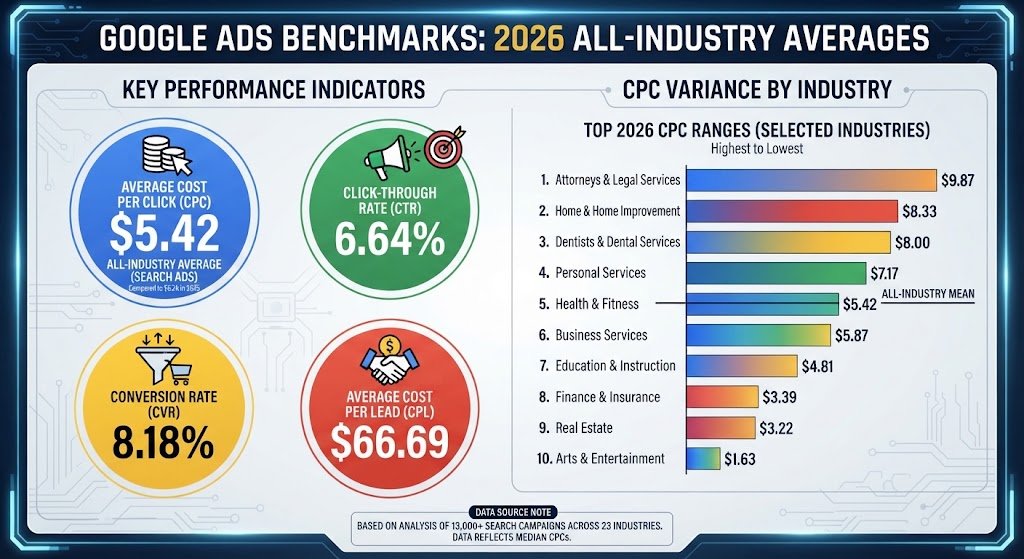
The 2026 US benchmark places the median search CPC at $5.42. That figure combines many industries, so it should not become your automatic bidding target. A lawyer, retailer, and home repair company may face different competition and customer values. Use the benchmark to start your research, then compare it with your own campaign data and the value of each conversion. WordStream+1
Average Google Ads CPC Across Different Industries
The Google Ads Cost Per Click by Industry can vary sharply. Legal services and home improvement often attract expensive clicks because one new customer may be worth a large amount. Other industries may have lower CPCs but also smaller order values or lower conversion rates. The table below uses selected figures from the 2026 WordStream and LocaliQ search benchmark.
| US industry | Median CPC | Median cost per lead |
|---|---|---|
| Attorneys and legal services | $9.87 | $131.63 |
| Home and home improvement | $8.33 | $90.92 |
| Dentists and dental services | $8.00 | $72.97 |
| Business services | $5.87 | $93.69 |
| Shopping, collectibles and gifts | $4.14 | $49.40 |
| Automotive repair and service | $4.35 | $29.96 |
| All industries | $5.42 | $66.69 |
Selected categories from WordStream and LocaliQ’s 2026 US search advertising benchmark. Industry figures are medians; use the original report for full methodology and category definitions. WordStream+1
The Google Ads Cost Per Lead by Industry is often more useful than CPC alone. For example, a $9 click may be acceptable if it brings a qualified customer who produces strong profit. A $2 click can still be expensive if it attracts people who never contact the business. Compare both traffic cost and conversion quality before deciding whether a campaign performs well.
Why Some Google Ads Keywords Cost More Than Others
Some keywords attract people who are ready to buy. Others attract people who are only looking for free information. Advertisers often compete more strongly for searches that can lead to valuable sales. A phrase such as “emergency roof repair near me” may have greater commercial value than a broad search about roof styles. This difference can affect bids and auction competition.
Keyword Competition is only one part of the price. Search location, customer demand, industry value, ad quality, and the time of the auction can also matter. A keyword may cost more in a major city than in a smaller market. Before choosing keywords, review their likely intent and use Google’s Keyword Planner to research search volume and estimated bid ranges. Treat those estimates as planning data, not guaranteed click prices.
Google Search Ads vs. Display Ads: CPC Differences
Google Search Ads appear when people search for related products, services, or information. These users may already know what they need, which can make search traffic valuable. Google Display Ads can reach people across websites and apps through visual placements. Display campaigns may support awareness and remarketing, even when users are not actively searching for a product.
The difference between Google Search Ads vs Display Ads is not simply that one is always cheaper. Pricing depends on the bidding model, audience, placement, and campaign goal. Search may produce stronger purchase intent, while Display can help a business reach more people. Compare each campaign by its purpose, conversion quality, and total business value rather than choosing the format with the lowest click price.
4. How Much Should You Spend on Google Ads Per Day?
Your daily budget should come from your business goals, not a competitor’s spending. Think about how many leads or sales you need and what each customer is worth. Then estimate the clicks required to reach that goal. This is the foundation of Google Ads Budget planning. It helps you avoid spending money without knowing what you expect in return.
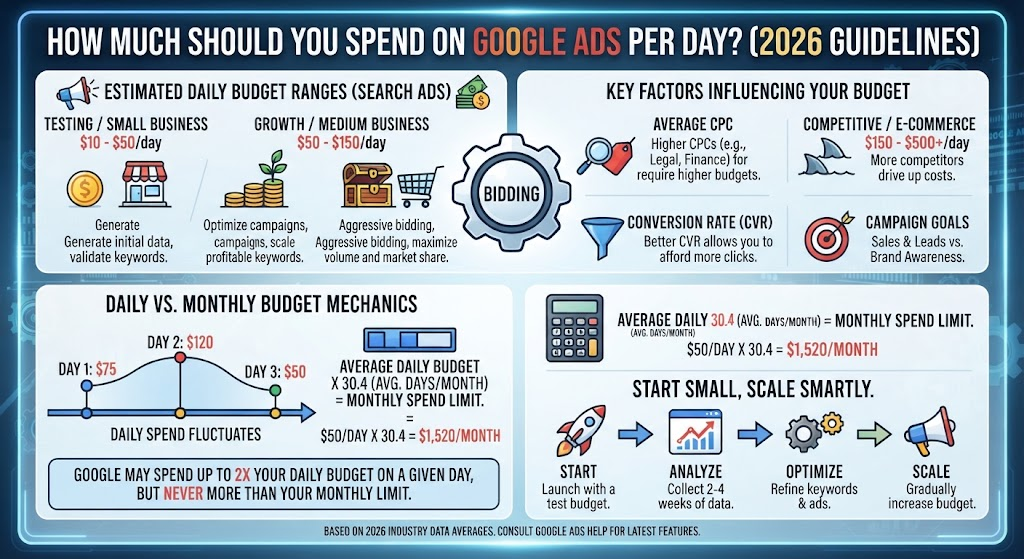
Google lets you set an average daily budget for each campaign. Your actual daily spend can change because search traffic changes from day to day. For most campaigns, Google may spend up to twice the average daily budget on a particular day, while the monthly spending limit is generally 30.4 times that budget. Google Ads Help+1
Recommended Daily Google Ads Budget for Beginners
A beginner should start with a budget that allows a useful test without putting the business under financial pressure. For example, a local service company might begin with one campaign targeting a small service area and a few closely related keywords. A national campaign with many products and locations usually needs a different budget. The Google Ads Daily Budget should match the size of the test and the likely cost of each click.
Do not spread a small budget across too many campaigns. That can leave each campaign with too little traffic to produce useful data. Start with one clear goal, such as phone calls or quote requests. Check search terms, clicks, and conversions regularly. Increase spending only when the campaign brings relevant enquiries at a cost your business can support.
Google Ads Monthly Budget Examples
Your Google Ads Monthly Budget is based on the average daily budget multiplied by 30.4. The following examples show the standard monthly spending limits for common daily budgets. They are budget calculations, not promises that Google will spend the exact amount each month or deliver a set number of clicks.
| Average daily budget | Approximate monthly limit |
|---|---|
| $10 | $304 |
| $25 | $760 |
| $50 | $1,520 |
| $100 | $3,040 |
| $200 | $6,080 |
These figures follow Google’s 30.4-day monthly calculation for most campaigns. Actual daily charges can vary, and campaign changes can affect the amount spent during a month. Check the official explanation of Google Ads spending limits before setting your budget. Google Ads Help
How to Set a Realistic Advertising Budget for Your Business
To decide How Much Should I Spend on Google Ads, start with the result you want. A business that needs 20 qualified leads each month should estimate its likely cost per lead and work backward. If the expected cost is $60 per lead, the rough advertising budget would be $1,200. This is only a planning estimate. Your actual cost depends on the market and campaign performance.
Also consider profit margins, customer value, and how many leads become paying customers. A $100 lead may be affordable for a business that earns thousands from a new customer. The same cost may be too high for a low-margin product. Use Google Advertising Budget Planning to set a spending limit that fits your finances. Review the results before increasing it.
5. Google Ads Costs by Industry: Which Businesses Pay More?
Different industries face different advertising costs because customer value and competition are not equal. A legal firm may earn a large fee from one new client. A small online store may earn only a modest profit from one order. These differences affect what advertisers can afford to bid and how they judge campaign results.
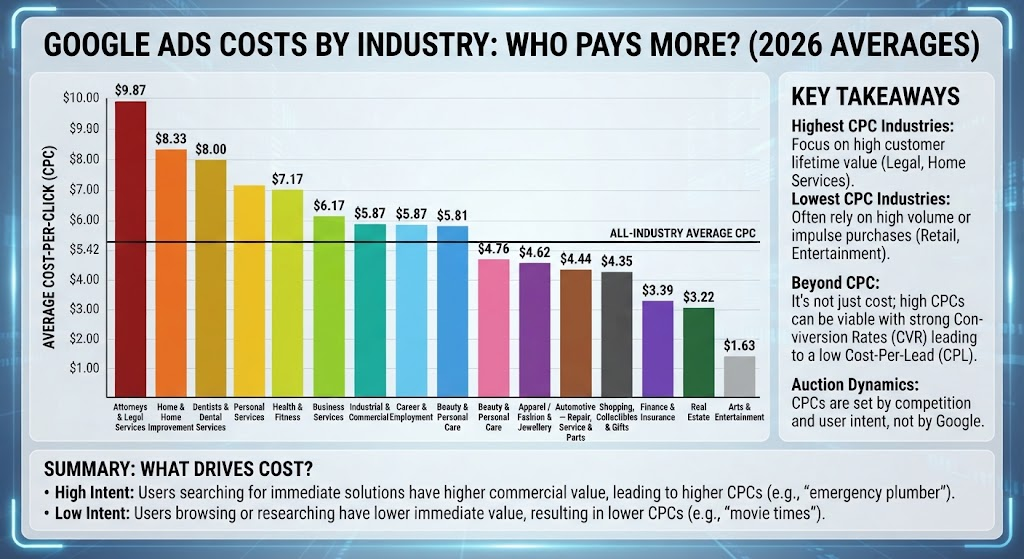
The Google Ads Cost Breakdown should therefore include both CPC and conversion costs. The 2026 benchmark reports a median cost per lead of $131.63 for attorneys and legal services, $102.51 for real estate, and $90.92 for home and home improvement. These figures show why businesses should compare themselves with similar industries rather than rely only on the overall average. WordStream+1
Google Ads Costs for Legal Services
Legal advertising can be expensive because a new client may bring significant long-term revenue. Searches for personal injury lawyers, divorce attorneys, criminal defence, and other legal services can attract strong competition. The 2026 US benchmark reports a median CPC of $9.87 and a median cost per lead of $131.63 for attorneys and legal services. WordStream+1
The Google Ads Cost for Lawyers depends on practice area, city, lead quality, and the value of a signed client. A form submission is not always a qualified case. Law firms should track consultation bookings and signed clients where possible. They should also use clear landing pages and accurate claims. Advertising rules for legal services must be checked before launching campaigns.
Google Ads Costs for Real Estate Businesses
Real estate advertisers may target people who want to buy, sell, rent, or value a property. The value of a completed transaction can be high, but the sales process may take weeks or months. Many enquiries may not turn into clients. Campaigns should therefore track more than the number of form submissions.
The Google Ads Cost for Real Estate changes with property prices, location, keyword demand, and competition between agents. The 2026 benchmark lists a median cost per lead of $102.51 for real estate. A business should measure whether those leads become appointments, active clients, and completed transactions. A lower lead price is not useful if the enquiries have no buying or selling intent. Clickem+1
Google Ads Costs for Home Services
Plumbers, electricians, roofers, HVAC companies, and other home service providers often target local searches. Some customers need urgent help, while others are comparing prices for planned work. These different needs can affect the value of a click. Mobile searches and calls can also play an important role in local service campaigns.
The 2026 benchmark reports a median CPC of $8.33 and a median cost per lead of $90.92 for home and home improvement. The Google Ads Cost for Local Businesses depends on the service area, job type, availability, and local competition. Track calls and quote requests, then check which enquiries lead to completed jobs. WordStream+1
Google Ads Costs for E-commerce Stores
Online stores often advertise individual products, product categories, and seasonal offers. Their costs depend on product demand, competition, profit margins, and the quality of product data. A store selling low-cost items may struggle to support high CPCs. A store with higher order values or repeat customers may have more room to spend.
The Google Ads Cost for E-commerce should be measured against order value and profit, not just clicks. Shopping campaigns can show product images, prices, and store details to people searching for products. However, a sale does not automatically mean a profit. Include product costs, shipping, discounts, returns, and payment fees when measuring results.
Google Ads Costs for Healthcare and Education
Healthcare providers and education businesses often use search campaigns to attract appointment requests, course enquiries, and registrations. Their costs depend on location, service type, competition, and the value of each new customer. A dental clinic, private healthcare provider, tutoring company, and university may have very different campaign goals.
Do not treat all enquiries as equal. A healthcare form submission may not become a booked appointment, and a course enquiry may not become an enrolled student. Track the full path where possible. Advertisers should also review Google’s healthcare and personalised advertising policies, along with relevant privacy and professional rules, before using sensitive audience or customer data.
6. What Factors Affect Your Google Ads Costs?
Several factors shape what you pay and what you receive. Keyword competition matters, but it is not the only reason a campaign becomes expensive. Ad quality, location, landing page experience, conversion tracking, and bidding choices can all affect performance. Understanding these factors helps you find problems before increasing the budget.
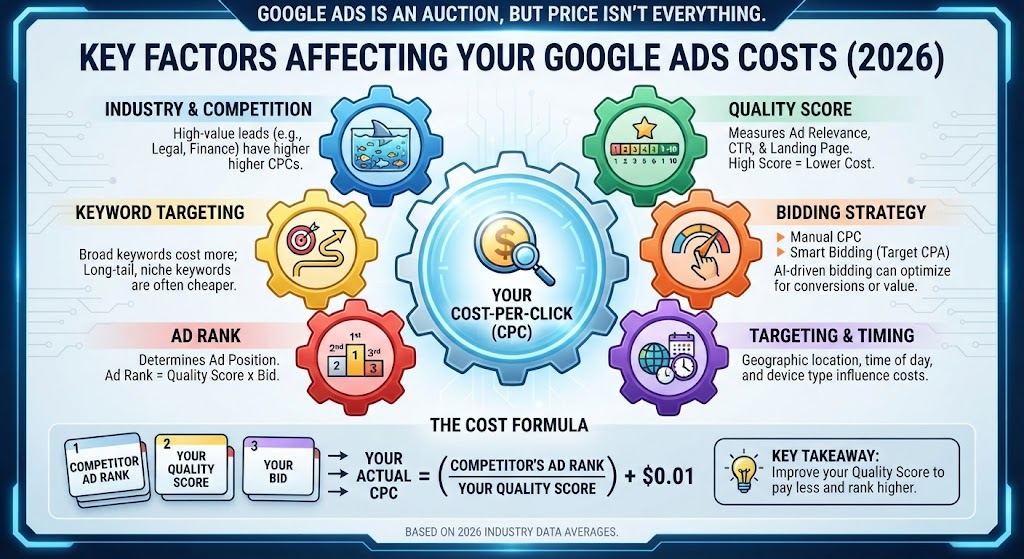
Your Google Ads Campaign Performance should be reviewed as a complete system. A low CPC does not help if visitors leave without taking action. A high CPC may still be acceptable when it brings valuable customers. Review search terms, ad relevance, conversion rates, and cost per lead together. This gives you a clearer picture than looking at one metric.
Keyword Competition and Search Intent
Keywords with strong buying intent can attract more advertisers. A person searching for “buy office chairs” may be closer to making a purchase than someone searching for “history of office furniture.” The first phrase may have greater commercial value, even if the second phrase receives more searches. Your keyword choices should reflect what your business sells and the customers you want.
Use keyword research to understand search demand and likely competition. Separate broad research searches from phrases that show a clear need. You should also review the actual search terms that trigger your ads. This helps you find irrelevant traffic and add suitable Negative Keywords. Good targeting can reduce wasted clicks without blocking searches that could bring real customers.
Quality Score and Ad Relevance
Google’s Quality Score is a diagnostic tool that helps advertisers understand parts of their search campaign quality. It uses three main components: expected click-through rate, ad relevance, and landing page experience. It is not a simple score that directly sets every auction price. Google also uses auction-time quality signals when calculating Ad Rank.
To How to Improve Google Ads Quality Score, focus on making each part of the customer journey relevant. Match keywords to useful ad copy, then send visitors to a page that answers their search. Do not send every visitor to the homepage if a specific service page would be more helpful. Better relevance can support stronger performance, but it does not guarantee a particular CPC or position.
Location, Audience, and Device Targeting
A business does not always need to advertise across the entire United States. A plumber in Dallas may only serve customers within a limited area. A national online store may need broader coverage. Location settings should match where the business can actually sell or provide its services. Otherwise, clicks may come from people the company cannot serve.
Audience and device settings also affect who sees an ad. Review mobile and desktop performance separately, especially if customers often call from their phones. Check location reports and search terms to see where useful leads come from. Avoid narrowing targeting without enough evidence. A setting that looks precise can still exclude valuable customers if it is based on the wrong assumptions.
Landing Page Experience and Conversion Rates
A click is only the start of the customer journey. Visitors need to understand what you offer, why it matters, and what to do next. A slow page, confusing form, weak message, or missing contact details can cause people to leave. A relevant Landing Page Experience makes it easier for visitors to complete the action you want.
Keep the page closely connected to the ad. If the ad promises a roof repair quote, the landing page should explain that service and make requesting a quote simple. Show real business details, clear pricing information where possible, and trust signals that you can support. Test the page on mobile devices. Improving the page may increase your Conversion Rate without requiring more clicks.
Bidding Strategy and Advertising Competition
Your bidding strategy tells Google what outcome to prioritise. Manual CPC gives advertisers more direct control over bids. Automated strategies can adjust bids based on signals available at auction time. Options include Maximize Clicks, Maximize Conversions, Target CPA, and Target ROAS. Each strategy serves a different purpose and needs the right campaign setup.
The Best Bidding Strategy for Google Ads depends on your goal and data quality. A campaign with reliable conversion tracking may be ready to optimise for leads or sales. A new campaign with little data may need a more careful test. Do not select an automated strategy and assume the work is finished. Review results, budget limits, conversion actions, and lead quality as the campaign develops.
7. How Much Do Different Google Ads Campaign Types Cost?
Google offers several campaign types, and they do not all work in the same way. Search campaigns reach people using Google search. Display campaigns show visual ads across websites and apps. Shopping campaigns promote products, while YouTube campaigns use video. Performance Max can reach people across multiple Google channels using automated delivery.
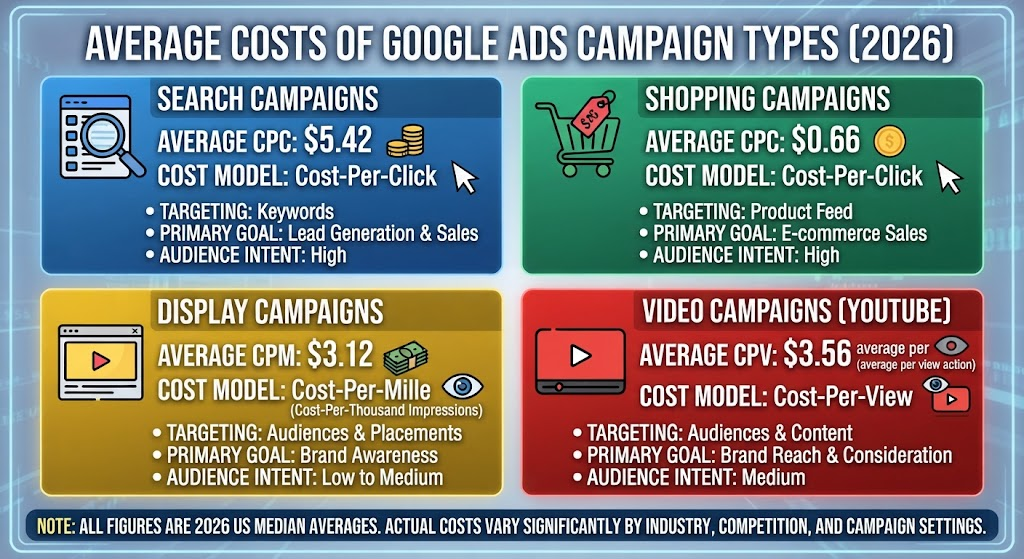
Do not compare every campaign using CPC alone. Some campaigns focus on views, impressions, purchases, or leads. The right measure depends on the goal. Compare cost per qualified lead for lead generation, revenue and profit for online sales, and reach or completed views for awareness campaigns. This gives you a fairer view of each format.
Google Search Ads Costs
Search campaigns can be useful when people are actively looking for a product or service. Advertisers choose keywords, write text ads, set locations, and select a bidding strategy. Costs depend on the search terms, competition, bid settings, and auction context. The 2026 benchmark figures discussed earlier relate to search advertising, so they are more relevant to Search than other campaign types.
Search ads need careful keyword control. A broad keyword may attract many searches that have little connection to the business. A specific keyword can bring fewer clicks but stronger intent. Review the search terms report and conversion data. Make sure the landing page answers the searcher’s need. This is how you assess Google Search Ads beyond the amount spent on each click.
Google Display Ads Costs
Display campaigns use visual ads that can appear across websites and apps in Google’s Display Network. They can help businesses build awareness, reach relevant audiences, and reconnect with people who have visited a website. Depending on the campaign setup, advertisers may use CPC or impression-based bidding. The cost depends on the audience, placement, competition, and campaign objective.
Display traffic may behave differently from search traffic because users are not always looking for a product at that moment. A person reading an article may notice an ad without planning to buy. That does not make Display useless. It means you should judge it by the right goal, such as reach, qualified visits, or assisted conversions.
Google Shopping Ads Costs
Shopping campaigns show product details such as an image, title, price, and store information. They rely on product data in Google Merchant Center. Retailers need accurate product titles, prices, availability, images, and landing page details. The quality of the product feed can affect how well products match relevant searches.
Your costs depend on product competition, bids, margins, and demand. A product with a small profit margin may not support the same advertising cost as a premium product. Track purchases and order value, then compare advertising spend with gross profit. Google Shopping Ads should bring profitable sales, not just visits to product pages.
YouTube Video Ads Costs
YouTube campaigns can help businesses introduce a product, explain a service, or build awareness. Pricing and bidding depend on the video ad format and campaign objective. Some campaigns focus on views, while others optimise for reach or conversions. Advertisers should understand the payment model selected for their campaign before estimating the cost.
YouTube Advertising Costs are difficult to compare directly with search CPC because a video view and a search click are different actions. A useful campaign may reach thousands of relevant people without producing immediate sales. Measure view rates, website visits, enquiries, and later conversions where tracking allows. The right metric depends on what the video is meant to achieve.
Performance Max Campaign Costs
A Performance Max Campaign uses Google’s automated systems to show ads across eligible Google channels. It can include Search, YouTube, Display, Discover, Gmail, and Maps inventory. Advertisers provide assets, audience signals, conversion goals, and a budget. Google’s systems then help find opportunities to meet the campaign objective.
Performance Max does not have one fixed price. Its results depend on competition, conversion settings, product or service data, creative quality, and budget. Check which conversions the campaign records and whether they represent real business value. For online stores, review purchase value and product margins. For service companies, assess qualified leads rather than counting every form interaction as a successful result.
8. Google Ads vs. Facebook Ads: Which Costs Less in 2026?
Google Ads and Facebook Ads can both help businesses find customers, but they reach people in different ways. Google often connects with users who are already searching for a solution. Facebook and Instagram can help businesses reach people based on interests, behaviour, and audience signals. The better choice depends on how customers discover and buy your product.
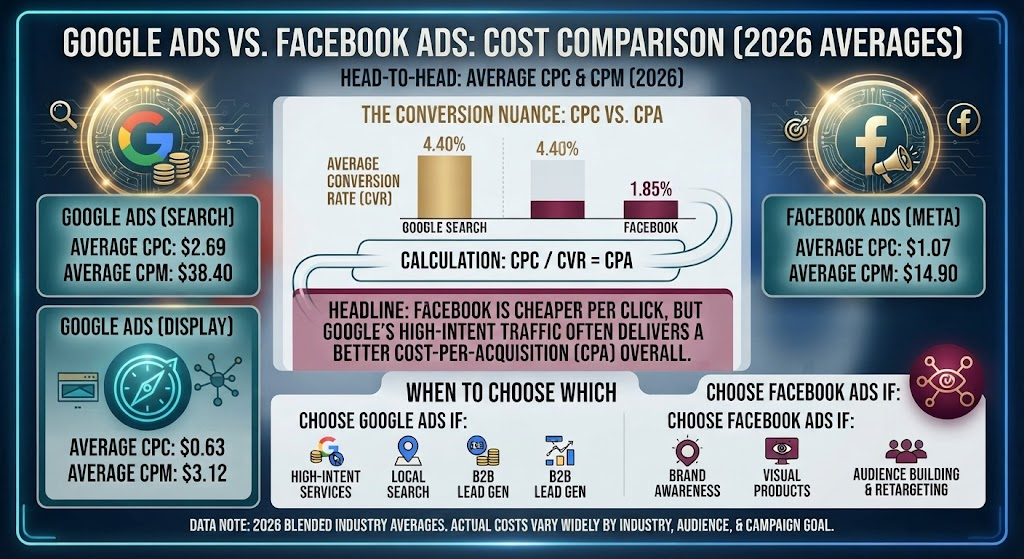
The Google Ads vs Facebook Ads Cost comparison needs care. CPC, CPM, cost per lead, and purchase costs measure different things. WordStream’s 2026 Meta benchmark uses separate US campaign samples and different objectives from its Google search benchmark. These figures should not be treated as a direct experiment between the two platforms. WordStream+1
Average CPC Comparison
Google Search and Meta campaigns can have different click prices because the user experience and campaign objectives differ. A search click may come from someone actively looking for a service. A Facebook or Instagram click may come from someone who noticed an offer while browsing. The value of those visits depends on the business and the way the campaign is designed.
WordStream’s 2026 reports use separate datasets for Google search and Meta advertising. The Google report covers 13,474 US search campaigns from April 2025 to March 2026. The Meta report covers separate traffic and lead campaign samples over a different period. Compare each platform using the same business goal and your own conversion data, not a single headline CPC. WordStream+1
Audience Targeting and Advertising Intent
Google Search can reach people when they express a need through a search query. This can work well for services people actively seek, such as plumbing, legal advice, or emergency repairs. Meta can introduce a product to people who may be interested but are not searching for it right now. Visual products and lifestyle offers may benefit from this discovery approach.
The customer journey can also differ. Search visitors may compare providers before making a decision. Social media users may need repeated exposure before they purchase. Choose the platform that matches how your audience makes decisions. Track calls, purchases, and qualified leads so you can see which channel brings customers rather than only website traffic.
Which Platform Offers Better Value for Small Businesses?
A small local business may prefer Google Search when customers already search for its service. An online store may test both platforms, using Search or Shopping to capture product demand and Meta to introduce products to new audiences. A business with a long sales cycle may need more than one touchpoint before a customer is ready to buy.
There is no platform that is automatically cheaper or more profitable for every company. Compare cost per qualified lead, customer acquisition cost, average order value, and profit. Start with a focused test and give each channel a clear goal. Small Business Advertising works best when the business can measure what happens after someone clicks or views an ad.
9. 7 Proven Ways to Reduce Your Google Ads Costs
Reducing advertising costs does not mean chasing the cheapest possible clicks. It means getting more useful results from the money you spend. A low-cost visitor who never becomes a customer can still waste your budget. Focus on relevant traffic, qualified leads, strong landing pages, and accurate tracking.
The best Google Ads Optimization work often starts with small changes. Review the searches that trigger your ads. Improve weak messages and remove irrelevant traffic. Check whether the website makes it easy to contact or buy from you. These steps can help How to Reduce Google Ads Costs in a way that supports business results instead of simply lowering a number in the account.
Choose High-Intent Keywords
High-intent keywords show that a person may be ready to take action. Searches such as “book a roof inspection” or “buy running shoes online” can signal a stronger need than broad research phrases. Choose keywords that match your products, services, and customers. Make sure the landing page offers exactly what the searcher expects to find.
Do not choose keywords only because they have high search volume. A popular phrase may attract students, job seekers, or people looking for free information. Review the search intent before adding a keyword. Group related phrases into focused ad groups. This makes it easier to write relevant ads and understand which searches bring valuable visitors.
Add Negative Keywords to Prevent Wasted Spending
Negative keywords stop your ads from appearing for searches that are not relevant to your business. A paid training provider, for example, may want to exclude searches for free courses if those visitors are unlikely to buy. A company selling new products may exclude terms related to used items if it does not offer them.
Review your search terms report to find unwanted searches. Add negative keywords carefully because an overly broad exclusion can block useful traffic. Check how different match types work before making large changes. This is one practical way How to Stop Wasting Google Ads Budget without cutting keywords that could bring genuine customers.
Improve Your Quality Score
A useful ad should match the search and lead to a page that answers the visitor’s question. Review expected click-through rate, ad relevance, and landing page experience. If an ad group contains unrelated keywords, split it into smaller groups. Then write ad copy that reflects the main need behind each group.
Do not try to raise Quality Score through tricks or repeated keyword placement. Focus on making the ad genuinely useful. Improve page speed, clarify the offer, and make the next step easy to find. These changes can support a better user experience and more efficient campaigns, although no Quality Score guarantees a specific position or click price.
Write More Relevant and Compelling Ads
Your ad is often the first message a potential customer sees from your business. It should explain what you offer and why the visitor should care. Use clear language, real benefits, and a direct call to action. Avoid claims that you cannot prove. A strong ad should set the right expectation before someone visits your website.
Test different messages when you have enough traffic to compare them. One version may focus on speed, while another highlights experience or a useful service feature. Make sure every claim is accurate and that the landing page supports it. Relevant ads can attract better-matched visitors and help prevent clicks from people who expected something else.
Optimize Your Landing Pages
A landing page should make the next step clear. Visitors should quickly understand the service, product, price information, and contact options. Remove distractions that do not support the page goal. Keep forms simple and make sure the page works well on mobile devices. A confusing page can waste money even when the ad itself is relevant.
Test one improvement at a time. You could make the main call to action clearer, shorten a form, or add useful customer information. Measure whether more visitors complete the desired action. Better landing pages can improve conversion performance, which may reduce the amount you need to spend to generate a lead or sale.
Use Smart Bidding Carefully
Automated bidding can help Google adjust bids using signals available during each auction. Strategies such as Maximize Conversions and Target CPA can be useful when the account has reliable conversion data. However, automation cannot fix incorrect tracking, weak offers, or irrelevant traffic. It needs clear goals and regular review.
Set a realistic target based on your business numbers. Avoid switching strategies repeatedly before you have enough data to understand the results. Check whether the system is optimising for actions that matter. If it counts low-value interactions as conversions, it may chase those actions instead of genuine customers. Keep budget controls in place while you test.
Track Conversions and Pause Underperforming Ads
Clicks tell you that someone visited your website. They do not tell you whether that person called, bought something, or became a customer. Set up Google Ads Conversion Tracking for important actions such as purchases, calls, quote requests, and booked appointments. Check that each conversion is recorded correctly and does not count the same action more than once.
Review campaigns using conversion data and lead quality. Pause or adjust keywords that spend money without producing useful results, but do not make decisions from a tiny sample. Some sales take time, and some leads convert after a follow-up. Use clear evidence before removing a campaign that may still bring profitable customers.
10. How to Calculate Your Google Ads Budget and Expected Results
A budget estimate helps you understand what your campaign might deliver before you spend money. You can use expected CPC, daily budget, conversion rate, and customer value to create a simple forecast. These numbers are assumptions, not guarantees. Actual results can change with competition, search volume, ad quality, and the strength of your offer.
A Google Ads Budget Calculator can make planning easier, but you do not need a complicated tool for a first estimate. Start with simple calculations and update them using real campaign data. Your Google Ads ROI Calculator should eventually include revenue, profit margins, and customer acquisition costs. That gives you a more useful picture than estimating clicks alone.
Estimate Clicks From Your Daily Budget
To estimate clicks, divide your available budget by your expected average CPC. For example, a $30 daily budget and an assumed $5 CPC could produce around six clicks in a day. This is a simple planning example. Your actual number may be lower or higher because CPC and search demand can change.
Use keyword research and your own account history to make the CPC assumption more realistic. Do not assume every dollar will produce the same amount of traffic. Some searches may have limited volume, and some clicks may cost more than your average. Recalculate the estimate when you have real data from the campaign.
Calculate Cost Per Lead and Conversion Rate
Conversion rate is the percentage of clicks that lead to a recorded conversion. If 100 people click an ad and five submit a form, the conversion rate is 5%. If the campaign spends $500 to produce those five leads, the cost per lead is $100. These calculations help you compare campaigns using the same definitions.
A lead is not always a paying customer. Check how many enquiries are relevant, how many receive a response, and how many become sales. If half of your leads are unsuitable, your true cost to acquire a customer may be much higher than the reported CPL. Connect advertising data with sales records whenever possible.
Understand Your Advertising Return on Investment (ROI)
Revenue alone does not show whether an advertising campaign is profitable. You also need to account for the cost of products, staff, delivery, service work, discounts, and other business expenses. Advertising Return on Investment (ROAS) compares the revenue attributed to advertising with the advertising spend. It is useful, but it does not equal net profit.
For example, a campaign that spends $1,000 and generates $4,000 in tracked sales has a 4:1 ROAS. But if product and fulfilment costs are $3,300, the campaign may leave little profit before other overheads. Work out your break-even point before raising the budget. Measure both sales value and the profit left after costs.
11. Is Google Ads Worth It for Small Businesses in 2026?
Is Google Ads Worth It in 2026 depends on what your business sells and how much profit it can make from a new customer. Search advertising can help a company reach people who are already looking for a product or service. It can also provide measurable data about clicks, enquiries, and sales. However, those benefits only matter when the campaign reaches the right audience.
The Average Cost of Google Ads for Small Businesses is not one fixed monthly amount. A local company may start with a small, focused campaign, while a national business may need a much larger budget. The important question is whether the campaign can bring customers at a cost the business can afford. Calculate your margins and customer value before deciding how much to spend.
When Google Ads Can Be a Good Investment
Google Ads may suit businesses that offer something people already search for. Local repair services, professional firms, online stores, and specialist providers can use Search campaigns to reach potential customers. It can also help a business test demand for a new service or reach people in a specific location.
The campaign needs a clear offer and a useful website. Customers should be able to understand the service, trust the business, and take the next step. Track phone calls, purchases, and qualified enquiries. When the campaign produces profitable customers, you can use that evidence to decide whether more spending makes sense.
Common Reasons Google Ads Campaigns Lose Money
Many campaigns lose money because they attract the wrong visitors. Broad keywords, poor location settings, weak ads, and unclear landing pages can all reduce results. Some businesses also forget to add negative keywords or leave campaigns running without checking their search terms. These problems can create spending without bringing useful enquiries.
Incorrect conversion tracking is another common issue. If an account counts page views or button clicks as sales, its reports may look better than the real business results. A business may then increase its budget based on misleading data. Check what each conversion action measures and compare the reports with actual sales records.
How to Decide Whether Your Business Is Ready for Paid Advertising
Before starting, make sure you know what you want the campaign to achieve. You should have a clear product or service, a suitable landing page, and a way to respond to enquiries. You also need a budget that you can afford to test without relying on immediate sales to pay essential business costs.
Google Ads for Small Business Owners can be useful when the business has a clear offer and can measure results. Start with a focused campaign and define what counts as a valuable lead or sale. Make sure someone can answer calls and follow up quickly. Advertising cannot fix a poor sales process or an offer that customers do not want.
12. Common Google Ads Budgeting Mistakes to Avoid
One common mistake is choosing a budget without researching keyword costs or customer value. Another is copying a competitor’s spending without knowing their margins or sales volume. Some advertisers also spread a small budget across too many campaigns. This can make it difficult to collect enough useful data from any one campaign.
Other mistakes include ignoring negative keywords, changing settings too often, and judging success by clicks alone. Businesses should also understand Google Ads Spending Limits before setting their budgets. For most campaigns, the monthly spending limit is generally 30.4 times the average daily budget. Review Google’s official budget guidance and check the account’s billing reports. Google Ads Help+1
13. Frequently Asked Questions About Google Ads Costs
These answers cover common questions from US business owners who are planning their first campaign or reviewing an existing account. The right budget depends on industry, competition, location, campaign type, and business goals. Use the answers as a starting point, then check your own campaign data before making spending decisions.
There is no guaranteed CPC, lead price, or time to profitability. Industry benchmarks can help you understand the market, but your own results depend on the quality of your offer and customer journey. Keep your budget under control, track meaningful conversions, and make changes based on evidence rather than assumptions.
How Much Do Google Ads Cost Per Month?
How Much Do Google Ads Cost Per Month depends on the average daily budget you choose. For example, a $25 average daily budget gives a standard monthly spending limit of about $760, using Google’s 30.4-day calculation. This covers advertising spend, not optional agency or management fees.
Can I Run Google Ads With $10 a Day?
Yes, you can set a $10 average daily budget for many campaign types. It may work for a narrow test with specific keywords and a small service area. However, if clicks are expensive, the campaign may receive very little traffic. Choose a focused goal and review whether the budget can collect enough useful data.
Are Google Ads Free to Use?
Creating a Google Ads account does not make paid advertising free. You can access the platform and set up campaigns without paying an account subscription fee, but eligible ad interactions can create charges. Your costs depend on the campaign, bidding model, and actual advertising activity. Always check billing settings before launching.
Why Are My Google Ads So Expensive?
High costs can come from strong keyword competition, expensive locations, broad targeting, and weak campaign relevance. A landing page that fails to convert can also make every lead more expensive. Review search terms, bids, ad quality, and conversion data. Then identify whether the main problem is traffic cost or the number of visitors who take action.
How Long Does It Take for Google Ads to Work?
A campaign can start receiving impressions and clicks soon after it is approved and eligible to run. However, useful results may take longer because the business needs enough traffic and conversion data to judge performance. The time depends on search volume, budget, competition, and the sales process. Do not expect every campaign to become profitable within a fixed number of days.
Is Google Ads Better Than Facebook Ads?
Neither platform is better for every business. Google can reach people who are actively searching for a solution. Facebook and Instagram can help introduce products and services to audiences based on interests and other signals. Compare qualified leads, customer acquisition costs, and profit to see which platform fits your goals.
14. Final Thoughts: How to Get More Results From Your Google Ads Budget
A successful campaign starts with a clear goal and a realistic budget. Choose keywords that match what your customers need. Write useful ads, build relevant landing pages, and track the actions that matter to your business. Review the results regularly, then improve the parts of the campaign that waste money or attract poor-quality leads.
The best approach is not always to spend more or chase the lowest CPC. It is to understand what each click can produce and how much a new customer is worth. Use reliable data, protect your budget, and increase spending only when the results support it. That is how you build a more controlled and sustainable paid search campaign.
Sources and further reading
The following sources support the pricing rules, benchmarks, and campaign guidance in this article.
- WordStream and LocaliQ: 2026 Google Ads Benchmarks — US search campaign benchmarks and industry comparisons.
- Google Ads Help: About Average Daily Budgets — How average daily budgets work.
- Google Ads Help: About Spending Limits — Daily and monthly spending limits.
- WordStream: PPC Benchmarks by Industry — Industry data for paid search.
- WordStream: 2026 Facebook Ads Benchmarks — Separate US Meta campaign benchmark data.
Editorial note about internal links: I have not inserted unverified DailyTecho article URLs. The article can safely link to the DailyTecho homepage at DailyTecho, but specific internal article links should use pages that are confirmed to exist. This avoids broken or invented links.
1 Comment