

Imagine software that doesn’t just wait for your command. It watches, reasons, plans, and acts toward a goal. That is the basic idea behind a software agent. Modern agents can connect information with tools, workflows, and decisions instead of simply displaying an answer.
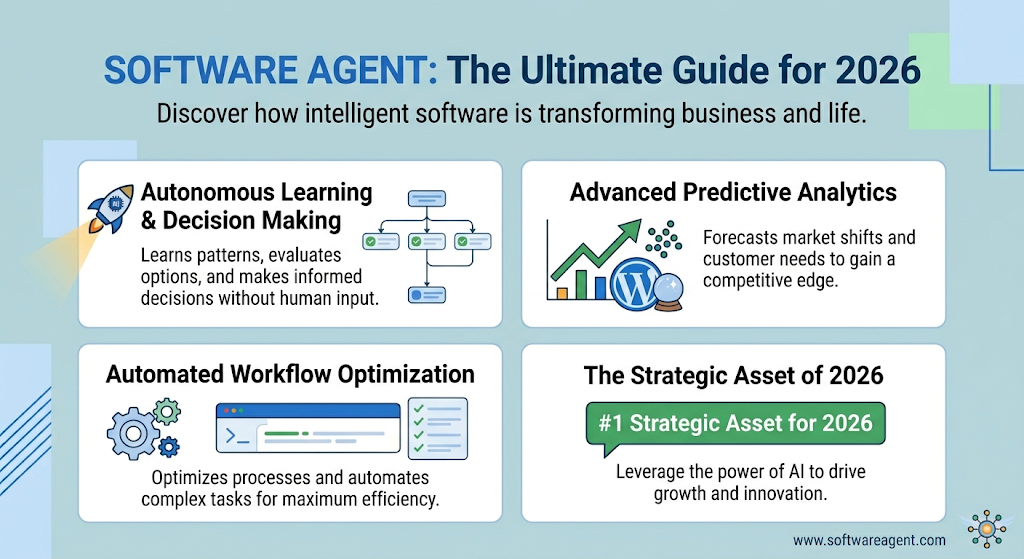
In 2026, this technology is moving quickly from experiments into practical business systems. AI agent platforms can handle multi-step work, while traditional agents still manage rule-based processes. Google Cloud describes modern AI agents as systems that can pursue goals, reason, plan, use tools, and act with varying levels of autonomy.
The change matters because digital work keeps getting more complicated. Businesses handle huge datasets, customers expect faster answers, and security teams face constant alerts. A capable agent can connect those moving pieces. In this guide, you’ll learn how agents work, where they fit, what can go wrong, and why DailyTecho belongs in this wider technology conversation.
What Is a Software Agent?
A software agent is a program designed to perform tasks for a user, system, or specific goal. It can receive information, process that information, choose an action, and observe the result. Simple agents follow fixed rules. Modern AI-based systems can handle uncertainty and more complicated tasks.
Think of an agent like a digital worker with a defined job. A monitoring agent might watch a server, detect unusual activity, and send an alert. An advanced AI software agent could gather information, compare sources, create a plan, and use connected tools. The level of autonomy depends on its design.
Software Agent Definition and Core Characteristics
The most useful software agent examples share several traits. They receive inputs, maintain some context, pursue goals, and produce actions. An agent may also adapt when conditions change. Modern intelligent software agent systems can combine models, memory, tools, data, and orchestration into one workflow.
| Agent capability | What it means |
|---|---|
| Perception | Receives information from users or systems |
| Reasoning | Interprets information and evaluates options |
| Planning | Breaks a goal into smaller tasks |
| Action | Uses tools or software to complete work |
| Feedback | Checks what happened after an action |
| Adaptation | Changes its next step when conditions change |
How Does a Software Agent Work?
A modern software agent usually follows a cycle rather than one isolated command. First, it receives information. Next, it interprets that information and compares it with its goal. Then it selects an action and uses an available tool. Finally, it checks the result and continues when necessary.
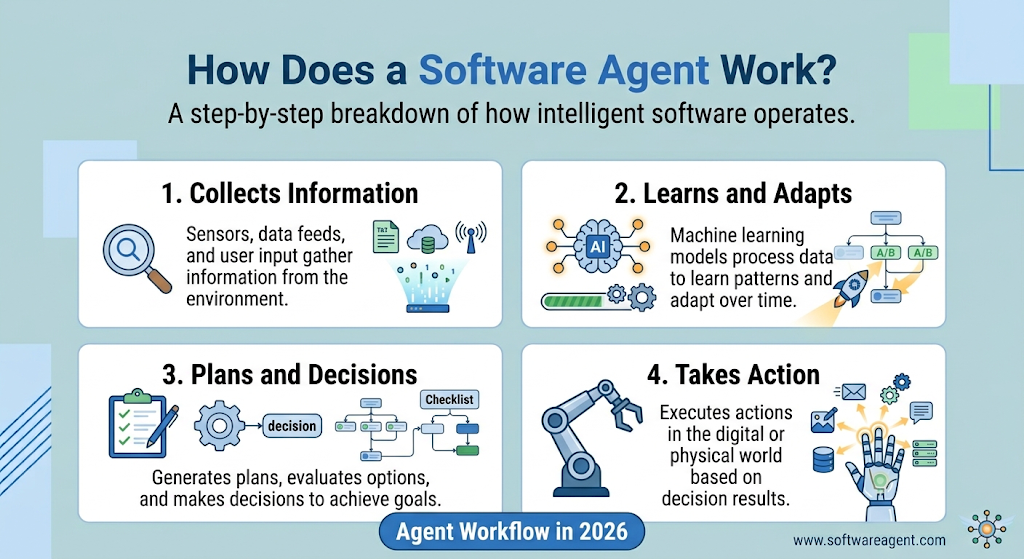
This process can look simple from the outside. Behind the screen, however, several components may work together. An agent can use a model for reasoning, a knowledge source for grounding, tools for actions, memory for context, and orchestration for multi-step work. Google Cloud identifies these as important building blocks for production agent systems.
How Software Agents Work From Input to Action
The basic cycle is easy to understand: input → interpretation → planning → action → feedback. For example, a research agent receives a question, performs information gathering, evaluates sources, and organizes the findings. A stronger system can repeat that cycle until it reaches a defined stopping condition.
What Can a Software Agent Do?
A modern software agent can perform far more than simple automation. It can monitor systems, organize information, interact with applications, answer requests, analyze documents, and coordinate workflows. Its real ability depends on the tools and permissions developers give it.
For businesses, the biggest opportunity comes from combining several tasks. An agent might read an incoming request, check company records, create a response, update a database, and notify a team member. That turns separate steps into one connected process. This is where workflow automation becomes especially powerful.
Software Agent Applications Across Industries
The range of software agent applications keeps expanding. Financial companies can use agents for research and workflow support. Retailers can improve customer service. Security teams can investigate alerts. Media platforms can organize real-time information and help readers discover important developments.
| Industry | Possible agent use |
|---|---|
| Finance | Research and workflow support |
| Healthcare | Administrative assistance |
| Retail | Customer service |
| Cybersecurity | Alert analysis |
| Media | Information discovery |
| Logistics | Scheduling and monitoring |
| Software | Testing and development |
What Is the Difference Between an AI Agent and a Software Agent?
The terms often overlap, but they aren’t identical. A software agent can operate with simple rules, while an AI agent usually uses artificial intelligence to handle more flexible tasks. Therefore, every AI agent is software, but not every software agent needs advanced AI.
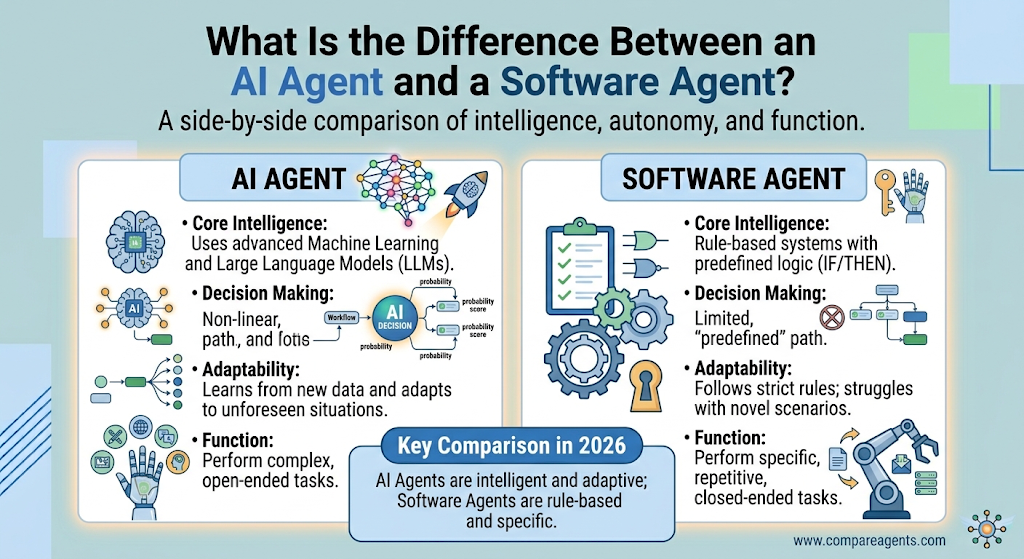
Modern AI agents often combine reasoning, planning, memory, tools, and model capabilities. Google Cloud notes that AI agents can handle complex, multi-step tasks and operate more proactively than traditional bots or basic assistants. This distinction becomes important when evaluating what a system can actually do.
AI Agent vs Software Agent
A rule-based system may trigger an email whenever a specific event occurs. An AI agent can interpret a less predictable request and decide what steps make sense. This difference comes from capabilities such as machine learning, planning, reasoning, and natural language processing.
| Feature | Traditional software agent | AI agent |
|---|---|---|
| Rules | Usually predefined | Can be flexible |
| Learning | Limited or absent | May use learning |
| Reasoning | Narrow | More advanced |
| Adaptation | Limited | Often stronger |
| Autonomy | Varies | Often higher |
How Are Software Agents Used in Everyday Life?
You probably encounter agent-like systems more often than you realize. Search tools, recommendation engines, customer-service systems, fraud monitors, and scheduling platforms can all automate decisions or actions. Some systems work quietly in the background. Others interact with you directly.
For example, a travel platform can monitor prices and notify you when conditions change. A customer-service agent can classify a request and route it to the right department. These examples show how digital agents can reduce friction without requiring users to understand the technology underneath.
Everyday Software Agent Examples
A useful example is a smart support system. You ask about an order, and the system checks the order database. It then identifies the delivery status and prepares a response. If the system can also take approved actions, it becomes closer to an autonomous workflow.
What Are the Main Types of Software Agents?
There isn’t one universal classification for every agent. Developers can classify agents by their behavior, intelligence, autonomy, or environment. Common categories include reflex agents, model-based agents, goal-based agents, utility-based agents, and learning agents.
The key difference is how each system responds to information. A simple agent might follow a predefined condition. A more advanced agent can evaluate several possibilities before acting. Modern autonomous agents push this idea further by planning and executing multiple steps.
Types of Software Agents Explained
A reflex agent responds to current conditions. A model-based agent keeps information about its environment. A goal-based agent selects actions that move toward a desired outcome. A utility-based agent compares possible results. A learning agent can improve its behavior from experience.
| Agent type | Main idea |
|---|---|
| Reflex | Responds to current conditions |
| Model-based | Maintains environmental context |
| Goal-based | Works toward a target |
| Utility-based | Compares possible outcomes |
| Learning | Improves through experience |
How Do Autonomous Software Agents Make Decisions?
Decision-making becomes more interesting when an agent faces uncertainty. Instead of following one fixed instruction, an autonomous software agent can examine its goal, available information, tools, and constraints. It then chooses a reasonable next action.
Modern systems can divide large goals into smaller tasks. They may search for information, call a tool, evaluate the result, and continue. This creates a feedback loop. NIST describes AI agents as systems capable of autonomous actions that can affect real-world systems and environments.
AI Decision Making and Planning
Good AI decision making requires more than producing text. The system needs context, reliable information, appropriate tools, and clear boundaries. Planning also matters. Without those controls, an agent can pursue the wrong interpretation of a goal with surprising efficiency.
Software Agent vs AI Assistant: What’s the Difference?
An AI assistant usually responds directly to your request. An agent can take a broader objective and complete several steps toward it. Google Cloud describes assistants as user-facing systems that generally require more user direction, while agents can operate with greater autonomy.
Consider asking an assistant to find three cybersecurity reports. It may provide search results or summaries. An agent could potentially search approved sources, compare the reports, extract important findings, organize them, and prepare a final research file. The distinction is subtle but important.
AI Assistants and Autonomous Agents
AI assistants focus heavily on interaction. Agents focus more heavily on goal completion. However, modern products can combine both approaches. A user might chat with an assistant while an agent works behind the scenes to complete approved tasks.
| Capability | AI assistant | Autonomous agent |
|---|---|---|
| Conversation | Strong | Strong |
| User direction | Usually higher | Can be lower |
| Multi-step work | Moderate | Strong |
| Independent action | Limited | Higher |
| Goal planning | Varies | Common |
How Software Agents Are Changing Technology and Business
Businesses are moving beyond basic software automation because many workflows contain judgment calls. An agent can connect information, tools, and actions across several systems. That makes it useful for operations that previously required constant human attention.
This shift supports broader digital transformation. Companies can automate routine work while allowing employees to focus on strategy, relationships, and difficult decisions. NIST says AI agents can improve productivity and decision-making, while also requiring stronger controls around data, tools, and access.
Software Agents and Business Automation
Business automation becomes more powerful when an agent can coordinate several systems. For example, it could receive a sales request, verify customer information, check inventory, and prepare an internal notification. The agent doesn’t replace every employee. Instead, it removes digital busywork.
How Software Agents Help Automate Repetitive Tasks
Repetitive work drains attention. Humans are good at judgment and creativity, but repeating the same digital process hundreds of times isn’t always productive. Agents can handle automated tasks such as monitoring, classification, scheduling, notifications, and routine information processing.
The strongest approach combines automation with safeguards. A system can complete low-risk actions automatically while requesting approval for sensitive operations. This balance helps organizations gain efficiency without handing unlimited authority to software.
Task Automation With Human Oversight
Task automation works best when the task has clear inputs and predictable outcomes. For example, an agent can monitor a service and alert a technician when a defined threshold changes. Higher-risk actions should involve human intervention before execution.
How Software Agents Process Information and Make Decisions
Information is the fuel behind an agent. It may come from documents, databases, APIs, websites, sensors, messages, or internal systems. The agent then filters and interprets that information before selecting an action.
Modern AI systems can process different information types and use models to reason over context. Yet intelligence alone isn’t enough. Good data processing also requires trustworthy sources, clean data, clear permissions, and sensible rules. Poor inputs can still produce poor outcomes.
Data Processing and Decision Logic
An agent’s architecture may include a model, memory, tools, retrieval systems, and orchestration. Problem solving happens when these pieces work together toward a goal. If one component fails, the final result can become unreliable.
Can Software Agents Work Without Human Intervention?
Yes, some systems can perform tasks with little direct input. However, autonomy exists on a spectrum. A simple agent might need approval after every action. Another could monitor a process continuously and act automatically within strict boundaries.
The phrase “fully autonomous” can sound more dramatic than reality. Agents still operate within software permissions, infrastructure, policies, and predefined objectives. NIST’s 2026 work on agent security highlights the need for identity and authorization because agents may access data, tools, and applications.
Human-in-the-Loop Agent Systems
Human oversight matters most when actions can cause serious harm. Financial transactions, sensitive records, production systems, and security controls deserve additional review. The goal isn’t to stop autonomy. It is to place human intervention where mistakes become costly.
What Are the Benefits of Using Software Agents?
The biggest advantage is coordination. An agent can connect several digital tasks instead of forcing you to manage each step manually. This can reduce delays and improve consistency across repetitive workflows.
Agents can also operate continuously. That matters for monitoring, customer support, security operations, and global services. When properly designed, intelligent automation can help teams process more work without simply adding more people to every workflow.
Why Businesses Are Exploring AI Automation
AI automation can create value when it solves a genuine workflow problem. A company shouldn’t deploy an agent merely because AI is fashionable. The better question is simple: which process wastes time, creates errors, or slows customers down?
| Benefit | Practical result |
|---|---|
| Speed | Faster routine workflows |
| Scale | More work without equal manual effort |
| Consistency | Repeatable processes |
| Availability | Continuous operation |
| Personalization | More tailored interactions |
| Efficiency | Less repetitive digital work |
What Are the Risks and Limitations of Software Agents?
More autonomy creates a larger attack surface. An agent that can read information and use tools may also encounter malicious instructions. It might misunderstand a goal, trust poor data, or take an unwanted action.
NIST has highlighted risks such as indirect prompt injection, data poisoning, specification gaming, and harmful actions caused by combining AI outputs with software capabilities. These risks deserve attention before companies give agents broad access.
Agent Reliability and Security Risks
The central problem is authority. An agent with access to sensitive systems can do more damage than an isolated chatbot. Developers therefore need strong authentication, limited permissions, monitoring, testing, and clear boundaries.
| Risk | Why it matters |
|---|---|
| Wrong decisions | Can trigger bad actions |
| Prompt injection | Can manipulate agent behavior |
| Data exposure | May reveal sensitive information |
| Excessive permissions | Expands potential damage |
| Poor monitoring | Makes failures harder to detect |
| Goal misalignment | Agent may optimize the wrong outcome |
Are Software Agents Safe to Use?
They can be, but safety depends on design. Treating an agent like an ordinary chatbot can create trouble. Agents may have tools, credentials, memory, and access to external systems. Each additional capability increases the importance of proper controls.
A useful rule is simple: give an agent only the access it genuinely needs. This principle resembles giving a contractor one building key instead of the entire key ring. NIST is actively working on standards and security practices for agent systems because this problem is becoming more important.
Building Safer Intelligent Systems
Secure intelligent systems need identity controls, authorization, logging, testing, monitoring, and carefully limited tool access. Organizations should also define what an agent may do without approval. Security should become part of the architecture, not an afterthought.
How Software Agents Are Being Used in Cybersecurity
Cybersecurity teams already manage enormous streams of alerts. Analysts must investigate events, compare evidence, identify patterns, and decide what deserves attention. Agents can assist with those repetitive stages while humans retain control over important decisions.
This creates opportunities for cybersecurity automation. An agent could collect approved evidence, summarize an alert, correlate related events, and prepare a suggested response. However, autonomous security actions require careful testing because attackers may deliberately feed agents misleading information.
AI Agents for Security Operations
Security agents can support detection, investigation, triage, and response. NIST research has specifically examined agent hijacking through indirect prompt injection, where malicious instructions hidden inside external data can influence an agent.
The smarter the agent becomes, the more carefully you must control what it can access and change.
How Software Agents Are Changing AI-Powered News and Research
Technology news moves at a frantic pace. New models, security flaws, software releases, research papers, and company announcements can appear throughout the day. That makes information gathering increasingly difficult for people who want a clear picture instead of a noisy stream.
Agents can help organize this flood of information. They can monitor approved sources, classify stories, compare developments, identify related events, and support research. However, automated discovery should not replace editorial judgment. Accuracy, source quality, context, and originality still matter.
AI-Powered Research and Technology News
Modern AI-powered tools can support research by reducing mechanical work. A researcher might use an agent to collect source material and identify common themes. The human can then verify important claims and add context. This creates a useful human-agent partnership.
| News workflow | Potential agent role |
|---|---|
| Source monitoring | Find new developments |
| Story discovery | Identify relevant events |
| Research | Gather supporting information |
| Comparison | Connect related developments |
| Organization | Group stories by topic |
| Editorial review | Human verifies important claims |
How DailyTecho Fits Into the Software Agent Era
DailyTecho sits naturally within this conversation because modern technology readers need more than isolated headlines. They need context around technology news, AI developments, cybersecurity events, software changes, and other emerging technology trends.
As technology becomes more agent-driven, information discovery itself becomes more sophisticated. DailyTecho can serve readers by covering major developments and explaining why they matter. That role becomes especially valuable when several technologies evolve at once and the average reader needs a clear explanation.
DailyTecho and the Future of Technology Information
DailyTecho’s focus on technology information creates a natural connection with AI research and automated discovery. The important point is transparency. Readers should know what happened, why it matters, and where the information came from. Agent-assisted workflows should strengthen that process rather than obscure it.
What Is the Future of Software Agents in 2026 and Beyond?
The next phase will likely involve agents that can handle longer workflows. Instead of answering one question, they may manage a sequence of related tasks. They could search approved sources, use business tools, check results, and continue until they meet a defined objective.
Another major direction is collaboration between agents. One system could research information while another checks it. A third might organize the output. Google Cloud already describes multi-agent coordination as an emerging capability for complex workflows.
Agentic AI and Autonomous AI Agents
Agentic AI represents a shift from passive software toward goal-driven systems. NIST describes agentic AI as systems capable of independent decisions, learning from interactions, and adapting to changing environments.
The future won’t simply be about replacing people. The stronger model is collaboration. Humans define goals, boundaries, and values. Agents handle appropriate digital work. People then review important outcomes and remain accountable for critical decisions.
| Future direction | Likely impact |
|---|---|
| Multi-agent systems | Complex tasks become easier to coordinate |
| Better tool use | Agents can perform more useful actions |
| Stronger identity | Safer access to systems |
| Better evaluation | More reliable agent behavior |
| Human-agent collaboration | People supervise higher-risk work |
| Agent interoperability | Different systems can work together |
Frequently Asked Questions About Software Agents
What is a software agent?
A software agent is a program that can receive information, process it, pursue a goal, and perform actions. Simple agents follow predefined rules. More advanced AI-powered systems can reason, plan, use tools, and adapt to changing conditions.
How does a software agent work?
It usually follows a cycle of receiving information, interpreting it, planning an action, executing that action, and checking the result. Modern agents may also use memory, retrieval systems, tools, and orchestration to complete multi-step workflows.
What is an AI software agent?
An AI software agent uses artificial intelligence to handle tasks that require more flexible reasoning or interpretation. Depending on its design, it may use machine learning, language models, planning systems, memory, and external tools.
What is the difference between an AI agent and a software agent?
A software agent is the broader category. An AI agent is a software-based agent that uses AI capabilities to make decisions or handle more complex tasks. Traditional agents can work entirely through fixed rules.
What are software agent examples?
Common examples include automated monitoring systems, customer-service agents, research assistants, recommendation systems, cybersecurity tools, scheduling systems, and workflow automation platforms. Their capabilities depend heavily on their available data and tools.
Can software agents work autonomously?
Yes. Some agents can perform tasks with little direct supervision. However, autonomy should match the risk of the task. Sensitive operations should use approval controls, limited permissions, monitoring, and strong security practices.
Are software agents safe?
They can be safe when developers control access, validate inputs, monitor behavior, and test the system. Security becomes more important when an agent can access private data or make changes to external systems. NIST identifies agent-specific security challenges as an active area of work.
What is the future of software agents?
The technology is moving toward longer workflows, better tool use, multi-agent cooperation, and stronger autonomy. At the same time, standards for identity, authorization, security, and interoperability will become increasingly important. NIST launched an AI Agent Standards Initiative in 2026 to support secure and interoperable agent development.
Final Thoughts: Why Software Agents Matter for the Future
The real importance of agents isn’t simply that they can automate work. Their bigger promise comes from connecting information, reasoning, tools, and actions inside one workflow. That can reshape customer service, research, cybersecurity, software development, and business operations.
Still, autonomy needs boundaries. An agent with useful capabilities also carries new risks. As adoption grows, organizations will need stronger identity, authorization, monitoring, testing, and governance. For readers following AI technology, that balance between capability and control may become one of the defining technology stories of 2026.
For DailyTecho readers, the trend is worth watching closely. The rise of agents touches almost every corner of modern computing. From technology automation to cybersecurity and AI-powered research, these systems are changing how software interacts with people and other software.
Google also emphasizes that websites should prioritize useful, original content rather than producing large volumes of low-value pages simply to capture search variations. That principle matters here too. The future of technology belongs to systems that create genuine value, not merely more noise.
Sources and Further Reading
For readers who want deeper technical context, Google Cloud’s current overview explains AI-agent capabilities, autonomy, tools, planning, and the difference between agents, assistants, and bots. Google Cloud: What are AI agents?
For security-focused research, NIST’s 2026 work covers agent identity, authorization, autonomous actions, and emerging security risks. NIST: AI Agent Standards Initiative
For publishing and SEO guidance, Google Search Central explains how AI-assisted content should provide genuine value rather than exist primarily to manipulate search rankings. Google Search Central: Guidance on generative AI content
Meta Description
What is a software agent? Discover how AI agents work, automate tasks, make decisions, handle real-world workflows, and shape the future of technology in 2026.