

Introduction: The Rise of AI-Native Companies in the New Business Era
Business is changing faster than ever before. In the past, companies used computers, websites, and cloud tools to improve their work. Today, a new transformation is happening. Companies are building their entire operations around artificial intelligence. This new approach is creating AI-Native Companies. These businesses do not simply add AI tools after building their systems. Instead, they design products, services, and workflows with AI at the center from the beginning. In 2026, AI is becoming more than a helpful technology. It is becoming the foundation of modern business. Companies are using generative AI, machine learning, and AI agents to create faster solutions, improve customer experiences, and reduce repetitive tasks. The idea is simple. A traditional company uses technology to support its business.
An AI-native company uses technology to build its business. This shift is part of a larger digital transformation happening across industries. From startups to large enterprises, businesses are exploring new ways to use AI for growth, creativity, and efficiency. The future of work is also changing. Employees are working alongside AI-powered employees, digital workers, and intelligent systems that help them complete tasks faster. Instead of replacing people completely, AI is creating a new model where humans and machines work together.A report from many technology leaders shows that businesses investing in AI today are preparing for a more automated and intelligent future. Companies that understand this change early can create stronger advantages.
| Traditional Business Model | AI-Native Business Model |
| Uses software as a tool | Builds operations around AI |
| Human-led processes | AI-supported workflows |
| Manual decisions | data-driven decision making |
| Standard customer experiences | Personalized AI experiences |
| Slow innovation cycles | Faster business innovation |
AI-native businesses represent one of the biggest technology trends 2026. They combine creativity, automation, and advanced computing to create a new generation of companies. In this guide, we will explore what AI-native companies are, how they work, why they are growing, and how they are shaping the future of business.
What Are AI-Native Companies? Understanding the New Era of AI-Powered Business
AI-native companies are businesses that build their products, services, and internal systems around AI from day one. AI is not an extra feature for these companies. It is the core engine that helps them operate and grow. Unlike traditional companies, AI-native businesses use artificial intelligence as a foundation for decision-making, customer service, product creation, and daily operations. They combine large language models (LLMs), automation systems, and advanced data technologies to create smarter solutions. For example, a traditional company may add a chatbot to its website after many years of operation. An AI-native company builds its customer experience around AI from the beginning.
Every interaction, recommendation, and service improvement is designed with intelligence built into the system. These companies often use AI-powered software to manage complex tasks. They may use AI for marketing, sales, research, software development, and customer communication. This allows them to move faster than businesses that depend only on manual processes.AI-native companies are also connected with next-generation technology. They use modern tools that allow computers to understand information, generate content, analyze patterns, and make helpful recommendations.
Understanding the AI-Native Business Model
The AI-native business model focuses on creating a company where AI supports almost every important activity.
These businesses usually have:
| Area | How AI Supports The Business |
| Product Development | AI helps create and improve products |
| Customer Service | AI customer support provides faster answers |
| Marketing | AI analyzes customers and improves campaigns |
| Operations | AI workflows automate repetitive tasks |
| Decision Making | predictive analytics helps forecast outcomes |
The main difference is mindset. AI-native companies do not ask, “Where can we add AI?”
They ask, “How can we build this business better with AI?”
This thinking creates more flexible and intelligent organizations.Many AI-native companies also depend on AI infrastructure and cloud AI platforms. These technologies provide the computing power needed to train models, process information, and deliver AI services at scale.As AI continues to improve, more businesses will follow this approach. The future will likely include companies where AI is deeply connected with every department.
How AI-Native Companies Are Different From Traditional Businesses
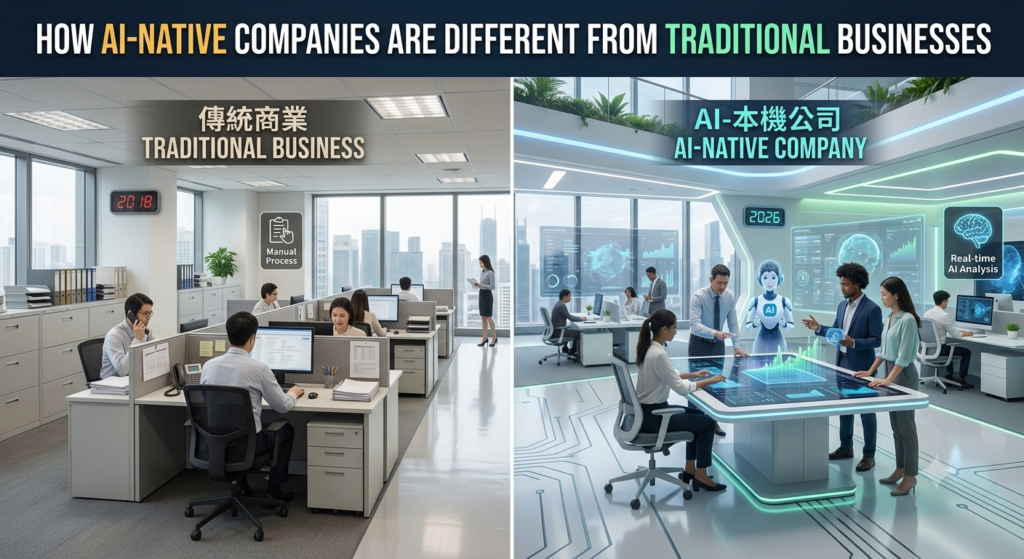
The difference between AI-native companies and traditional businesses is not only about using new tools. The biggest difference is how they think, build, and operate.Traditional companies usually create a business process first and add technology later. AI-native companies reverse this approach. They design their entire structure around intelligent systems from the beginning. For example, a traditional company may hire more employees when customer demand increases. An AI-native company may use autonomous AI systems and automation technology to handle increasing demand without growing costs at the same speed.This creates a new level of business efficiency.
| Feature | Traditional Companies | AI-Native Companies |
| Business Design | Human-first approach | AI-first approach |
| Operations | Manual processes | intelligent business systems |
| Growth | More people and resources | AI-powered scalability |
| Customer Service | Fixed support channels | AI-driven experiences |
| Innovation | Slower development | Faster experimentation |
AI-native businesses also create better smart business operations. Their systems can analyze information quickly and suggest improvements.For instance, an online business can use AI to understand customer behavior, predict product demand, and personalize recommendations. This creates a better experience for customers while improving company performance. Another major difference is speed. AI-native companies can test ideas faster because AI helps with research, design, coding, and analysis.A small team can now achieve what previously required a much larger workforce. This is one reason why startups using AI are becoming more competitive.
AI-Native Companies and Traditional Business Thinking
The old business model focused mainly on human effort and fixed processes. The new AI-native model focuses on collaboration between humans and intelligent systems.Workers still provide creativity, leadership, and important decisions.
However, AI handles repetitive tasks and complex data analysis. This partnership creates a stronger workplace. Modern companies are moving toward a model where employees use AI productivity tools every day. These tools help with writing, research, planning, coding, and communication. The goal is not simply replacing humans. The goal is creating better results through human and AI collaboration.
Why AI-Native Companies Are Growing Rapidly in 2026
The growth of AI-native companies in 2026 is not happening by accident. Several important changes have made AI more powerful, accessible, and useful for businesses.First, AI technology has improved significantly. Modern AI models can understand language, analyze data, create content, and solve complex problems. Businesses now have access to tools that were impossible a few years ago.The rise of generative AI has also changed how companies create content, products, and services. Businesses can now produce ideas, designs, reports, and software faster than before.Another major reason is increasing AI adoption. Companies are realizing that AI can improve productivity and reduce unnecessary work.
Businesses are investing in:
| Growth Factor | Business Impact |
| Better AI Models | More accurate and useful results |
| Lower Technology Costs | Easier AI adoption |
| Automation Growth | Faster operations |
| Better Data Systems | Improved decisions |
| AI Tools | Higher employee productivity |
The demand for business automation is also increasing. Companies want systems that can complete repetitive tasks automatically while employees focus on higher-value work.
Why Businesses Are Choosing AI-Native Strategies
Companies are choosing AI-native strategies because customers now expect faster and smarter services.People want instant answers, personalized recommendations, and smooth digital experiences. AI helps businesses provide these services at a larger scale.For example, online retailers use AI to recommend products. Financial companies use AI to detect risks. Healthcare organizations use AI to support research and patient services.These examples show why AI-native companies are becoming important across different industries.The combination of AI algorithms, better data, and advanced computing is creating a new business environment.Companies that understand these changes can build stronger competitive advantages in the years ahead.
How Artificial Intelligence Is Becoming the Core of Modern Businesses
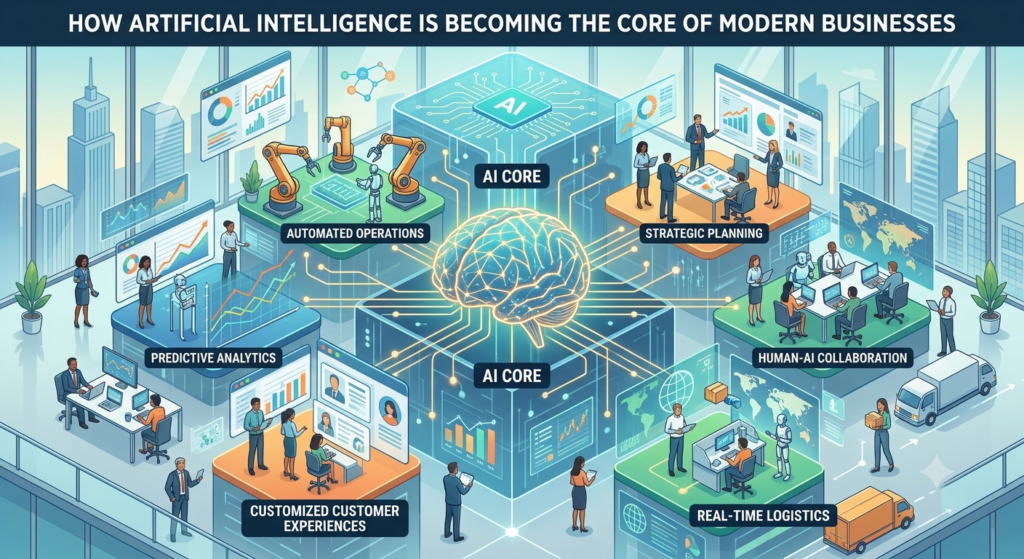
Businesses are entering a new phase where artificial intelligence is no longer just a support tool. It is becoming the central system behind many important decisions, services, and operations. In the past, companies used software mainly to store information and complete simple tasks. Today, modern businesses use AI to understand customers, predict market changes, improve products, and create better strategies. This change is creating a new model of modern enterprise technology. Companies are building smarter systems that can learn from data and improve over time.
AI is now helping businesses in many areas:
| Business Area | How AI Helps |
| Marketing | Understands customer interests and improves campaigns |
| Sales | Predicts customer needs and finds opportunities |
| Customer Service | Provides faster answers through intelligent support |
| Finance | Detects patterns and manages risks |
| Product Development | Creates ideas and improves designs |
One major advantage of AI is speed. A human team may take days to analyze thousands of records. An AI system can process large amounts of information within minutes.This ability helps companies make better choices using data-driven decision making.For example, an online company can analyze customer behavior and predict which products may become popular. A software company can study user feedback and improve features faster.These systems use AI algorithms and machine learning to find patterns that humans may not notice easily.
AI as the New Business Operating System
The role of AI is expanding because businesses need smarter ways to compete. Companies are no longer asking whether they should use AI. They are asking how deeply AI should become part of their operations. This is where intelligent business systems become important. These systems connect data, automation, and AI tools to create smoother workflows. They help companies reduce delays, improve accuracy, and provide better services. For example, a company may combine customer data, sales information, and AI analysis to create personalized experiences. This approach helps businesses create stronger relationships with customers while improving internal performance. The future of business will not be controlled only by companies with more employees or bigger budgets. It will be shaped by companies that can use AI effectively.
The Role of Generative AI in Building AI-Native Companies
Generative AI has become one of the most important technologies behind AI-native companies. It allows businesses to create content, designs, software, and solutions with the help of advanced AI models. Unlike traditional software that follows fixed instructions, generative AI can create new outputs based on patterns it has learned.This technology is helping companies become faster and more creative.
For example, businesses use generative AI for:
| Use Case | Business Benefit |
| Content Creation | Faster marketing materials |
| Software Development | Quicker coding and testing |
| Research | Faster information analysis |
| Product Design | New creative ideas |
| Customer Communication | Personalized messages |
The growth of large language models (LLMs) has made generative AI more powerful. These models can understand human language and generate useful responses.AI-native companies use these models as part of their daily operations.A marketing team can use AI to create campaign ideas. Developers can use AI to write and improve code. Customer teams can use AI to answer common questions.This creates faster workflows and improves overall productivity.
How Generative AI Creates New Business Opportunities
Generative AI is not only improving existing businesses. It is creating completely new business models. Many startups are now building products that depend on AI from the beginning. These companies create AI-powered platforms, smart tools, and automated services. For example, an AI software company may build a platform that helps businesses analyze documents, create reports, or automate communication. This is different from traditional software. AI-native products continue improving as they learn from more data and user interactions. Through AI-powered products, companies can offer more personalized experiences. Generative AI is also changing creativity. Designers, writers, developers, and entrepreneurs can use AI as a creative partner. Instead of replacing human ideas, AI expands what people can create. This partnership between humans and AI is becoming a key part of the future of business.
How AI Agents Are Creating Autonomous Business Operations
One of the biggest developments in AI-native companies is the rise of AI agents.AI agents are systems that can understand goals, make decisions, and complete tasks with limited human guidance.Unlike basic automation tools, AI agents can handle more complex activities. They can analyze information, plan actions, and adjust their approach based on results.This technology is helping companies create more independent operations.For example, an AI sales agent can research potential customers, prepare information, and support sales teams. An AI customer service agent can answer questions, understand problems, and provide solutions.These systems are becoming an important part of autonomous AI systems.
| AI Agent Type | Example Function |
| Sales Agent | Finds leads and supports sales |
| Research Agent | Collects and analyzes information |
| Support Agent | Handles customer questions |
| Development Agent | Helps create software |
AI agents allow businesses to move beyond simple automation.Traditional automation follows a fixed path. AI agents can understand situations and choose better actions.
AI Agents and the Future of Business Operations
The combination of AI agents and automation is creating a new business environment.Companies can now build workflows where different AI systems work together. One agent may collect information while another analyzes data and another creates a final report.This creates advanced AI workflows.For example, a business may use AI agents to monitor customer feedback, identify problems, and suggest improvements automatically.These systems help companies save time and improve decision-making.However, human supervision remains important. Businesses still need people to set goals, review important decisions, and maintain responsible AI use.The future will likely involve human workers managing teams of digital AI assistants.
AI Automation: The Technology Powering AI-Native Workflows
AI automation is one of the strongest foundations of AI-native companies. It allows businesses to complete repetitive tasks faster while reducing manual effort. Traditional automation follows simple rules. AI automation is more advanced because it can understand information and adapt to changing situations. This makes it useful for modern businesses that need flexibility.
Companies use AI automation in areas such as:
| Department | AI Automation Example |
| Marketing | Automated campaign analysis |
| Finance | Smart invoice processing |
| HR | Employee support systems |
| Sales | Automated customer research |
| Operations | Workflow management |
AI automation improves operational automation by connecting different systems together.For example, when a customer contacts a company, AI can understand the request, find information, and provide a helpful response.This reduces waiting time and improves customer satisfaction.
Building Smarter AI Workflows
The goal of AI automation is not just completing tasks. The goal is creating smarter business processes.AI-native companies design workflows where technology handles repetitive work while humans focus on strategy and creativity.These workflows can improve speed, accuracy, and consistency.For example, a software company can use AI automation to test code, identify errors, and suggest improvements.This allows developers to spend more time creating new features.As AI technology continues improving, automation will become a normal part of business operations.Companies that build strong AI workflows today will have a stronger position in the future.
Digital Employees and AI Assistants in the Future Workplace
The workplace is changing quickly because of AI. Companies are now using digital workers and smart systems to support human employees. These digital assistants can handle repetitive activities, analyze information, and help teams complete tasks faster.In the past, employees depended mainly on traditional software. Today, businesses are creating workplaces where humans work together with AI-powered employees and intelligent tools.These systems do not simply follow commands. Many can understand requests, organize information, and provide useful suggestions.For example, a marketing employee can use an AI assistant to research customers, create campaign ideas, and analyze results. A developer can use AI tools to write code and solve technical problems faster.
| Digital Assistant Type | Main Purpose |
| AI Research Assistant | Finds and summarizes information |
| AI Writing Assistant | Helps create content and documents |
| AI Coding Assistant | Supports software development |
| AI Customer Assistant | Answers customer questions |
| AI Business Assistant | Helps with planning and analysis |
These technologies are creating a new model for the future of work. Employees are not working alone anymore. They have intelligent partners that help them improve productivity.
Human Workers and AI Collaboration
The future workplace will focus on cooperation between humans and machines. AI can process information quickly. However, humans still provide creativity, emotional understanding, leadership, and important decisions. For example, an AI system may analyze customer data and suggest a strategy. A human manager can then review the information and make the final choice. This combination creates better results. Many companies are also daily operations. These assistants can schedule meetings, organize tasks, manage information, and support employees. As AI continues to improve, companies will create more flexible workplaces where people focus on creative and strategic work while AI handles repetitive tasks. The goal is not a workplace without humans. The goal is a smarter workplace where humans can achieve more.
Key Technologies Behind Successful AI-Native Companies
Behind every successful AI-native company, there is a strong technology foundation. AI does not work alone. It depends on several advanced systems working together.These technologies allow companies to build smarter products, automate operations, and create better customer experiences.
The most important technologies include:
| Technology | Role in AI-Native Companies |
| large language models (LLMs) | Understand and generate human-like text |
| machine learning | Learns from data and improves predictions |
| deep learning | Helps AI understand complex patterns |
| neural networks | Supports advanced AI learning |
| natural language processing | Helps computers understand human language |
| multimodal AI | Understands text, images, audio, and video |
These technologies allow businesses to create powerful systems.For example, a company can use deep learning to analyze customer behavior. It can use natural language processing to understand customer questions. It can use multimodal AI to analyze different types of information together.
The Importance of AI Infrastructure
A strong technology foundation is essential for AI-native businesses.Companies need reliable AI infrastructure to train models, manage data, and deliver AI services. Many organizations use cloud AI platforms because they provide flexible computing power.Without strong infrastructure, AI systems cannot perform at their full potential.Modern AI companies also focus on quality data. AI systems learn from information, so businesses need accurate and organized data.This is why successful companies combine technology, data, and strategy.A strong AI foundation helps businesses create better products and maintain long-term growth.
Benefits of AI-Native Companies for Businesses and Customers
AI-native companies provide benefits for both businesses and customers. By using AI as a core part of operations, these companies can create faster services, better products, and improved experiences.One major advantage is business efficiency. AI helps companies complete tasks faster and reduce unnecessary manual work.
For businesses, the benefits include:
| Business Benefit | How AI Helps |
| Faster Operations | Automates repetitive tasks |
| Better Decisions | Provides useful insights |
| Lower Costs | Reduces manual workload |
| More Innovation | Creates new ideas and products |
| Improved Customer Service | Provides faster support |
AI-native companies can also create more personalized customer experiences.For example, online platforms can recommend products based on customer interests. Financial services can provide personalized suggestions. Healthcare platforms can improve patient support.These improvements happen because AI can analyze large amounts of information quickly.
Benefits for Customers
Customers today expect fast, simple, and personalized experiences.AI helps companies meet these expectations through smarter services. For example, AI customer support systems can answer questions immediately. AI-powered platforms can recommend products that match customer needs. This creates stronger customer relationships. Another advantage is better innovation. Companies can use AI to create AI-powered products that solve problems in new ways. As AI becomes more advanced, customers will see more intelligent services across different industries.
Real-World Examples of AI-Native Companies and AI-First Businesses
AI-native companies are appearing across many industries. These businesses use AI as a major part of their products, services, and operations.Some companies were created around AI from the beginning. Others are becoming more AI-focused by changing their strategies.
Examples include:
| Industry | AI-Native Approach |
| Software | AI-powered development tools |
| Healthcare | AI research and diagnosis support |
| Finance | AI risk analysis and automation |
| Marketing | AI content and customer insights |
| Education | AI learning assistants |
Many AI-first businesses are creating products that were not possible before advanced AI models existed.For example, companies are building AI platforms that help users write, design, analyze information, and automate work.These businesses focus on using AI to solve specific problems.
How AI-First Businesses Create Competitive Advantages
AI-native companies often move faster because AI is part of their foundation.They can test ideas quickly, improve products, and respond to customers faster.This creates strong business innovation.A traditional company may need several systems and teams to complete a task. An AI-native company may use connected AI systems to complete the same process more efficiently.However, success depends on more than using AI tools. Companies need a clear AI strategy.They must understand where AI creates real value and how to use it responsibly.
Challenges and Risks of Building an AI-Native Company
Although AI-native companies offer many benefits, building them also creates challenges.AI technology is powerful, but businesses must use it carefully.One major challenge is data privacy. Companies need to protect customer information and follow responsible data practices.Another challenge is AI accuracy. AI systems can make mistakes, so businesses need human review.
Common challenges include:
| Challenge | Explanation |
| Data Security | Protecting sensitive information |
| AI Accuracy | Reducing incorrect results |
| Cost | Building AI systems requires investment |
| Skills | Employees need AI knowledge |
| Ethics | Using AI responsibly |
Companies also need strong security systems. As AI becomes more important, protecting AI systems becomes a major priority.
Creating Responsible AI Systems
Successful AI-native companies focus on responsible development. They create rules for how AI should be used. They train employees and monitor AI performance. Human oversight remains important. AI should support better decisions, not create uncontrolled risks. Businesses that balance innovation with responsibility will build stronger AI systems in the long term.
How Businesses Can Transform Into AI-Native Organizations
Many existing companies want to become AI-native, but transformation requires careful planning.The first step is understanding where AI can create the most value.Businesses should examine their daily processes and identify areas where AI can improve speed, quality, or customer experience.
A successful transformation usually includes:
| Step | Action |
| 1 | Identify AI opportunities |
| 2 | Improve data systems |
| 3 | Adopt useful AI tools |
| 4 | Train employees |
| 5 | Build AI workflows |
| 6 | Measure results |
Companies also need a long-term AI strategy.Simply buying AI software is not enough. Businesses need to understand how AI fits into their goals.
Creating an AI-First Business Culture
A successful AI transformation requires people and technology working together.Employees should learn how to use AI tools effectively.Companies should encourage experimentation and learning.When workers understand AI, they can find new ways to improve processes.This creates a culture where innovation becomes part of everyday work.AI-native transformation is not only about technology. It is about changing how a company thinks and operates.
The Future of AI-Native Companies Beyond 2026
The future of AI-native companies will be shaped by faster AI development, smarter systems, and deeper automation.Beyond 2026, businesses may use AI systems that can handle more complex tasks with less human involvement.The growth of autonomous AI systems, advanced AI models, and intelligent automation will continue changing industries.
Future AI-native companies may have:
| Future Development | Possible Impact |
| Advanced AI Agents | More autonomous business operations |
| Smarter AI Software | Better business solutions |
| AI Employees | New workplace models |
| Personal AI Services | Better customer experiences |
The next generation of companies will not simply use AI. They will be built around it.
The Long-Term Impact of AI-Native Businesses
AI-native companies may reshape how people create products, provide services, and solve problems.Industries like healthcare, finance, education, and software development will continue adopting AI.The companies that adapt early may gain stronger advantages.AI will not remove the importance of humans. Instead, it will change how people work.The future belongs to businesses that combine human creativity with advanced AI capabilities.AI-native companies represent a new chapter in business history. They show how next-generation technology can create smarter, faster, and more innovative organizations.
FAQs
What are AI-Native Companies?
AI-Native Companies are businesses that build their products, operations, and strategies around AI from the beginning. AI becomes the central part of how the company works.
How are AI-native companies different from traditional businesses?
Traditional businesses usually add AI later. AI-native companies design their systems around AI from the start.
Why are companies becoming AI-native in 2026?
Companies are adopting AI because it improves efficiency, reduces repetitive work, and helps create better products and services.
What role does generative AI play in AI-native companies?
Generative AI helps companies create content, software, designs, and solutions faster.
Will AI-native companies replace human workers?
AI will change many jobs, but human creativity and decision-making will remain important. The future will focus on human-AI collaboration.
How can a business become AI-native?
A business can start by identifying AI opportunities, improving data systems, training employees, and building AI-powered workflows.
Conclusion: AI-Native Companies Are Building the Future of Business
AI-native companies are changing the way businesses operate. They use AI as the foundation of their products, services, and strategies.In 2026, AI is moving beyond simple automation. It is creating smarter organizations with better workflows, faster innovation, and improved customer experiences.
Businesses that understand AI early can prepare for the future.The rise of AI-Native Companies shows that the next generation of business will combine human creativity with intelligent technology.The future is not only digital. It is intelligent.
Meta Description:
Discover how AI-Native Companies are changing business in 2026 through artificial intelligence, AI agents, automation, generative AI, and future technology.
5 Comments