


For American companies competing across high-stakes digital auctions, running profitable search campaigns in 2026 demands far more than basic keyword research and responsive copy. Between rapid algorithmic automation, rising cost-per-click averages, and the evolving behavior of commercial buyers across the United States, outdated PPC tactics will quickly drain capital without moving the revenue needle. This comprehensive Google Ads Playbook 2026 is designed to serve as an authoritative, step-by-step blueprint for US business leaders, marketing directors, and media buyers who need to turn paid search into a predictable customer acquisition machine.
In this in-depth guide, we will unpack the modern account architecture, smart bidding controls, negative keyword defenses, and conversion rate optimizations required to generate high Return on Ad Spend (ROAS) across competitive US markets.
The Current State of US Paid Search Auctions in 2026
Operating a successful paid search engine marketing program today requires an unvarnished understanding of the American auction landscape. In major commercial sectors—including enterprise SaaS, legal services, private healthcare, commercial insurance, and fintech—average CPCs frequently range from $4.50 to $18.00 per click. According to official performance guidelines published by the Google Ads Help Center, algorithmic auction dynamics evaluate both maximum bid and real-time Quality Score to determine actual ad rank.
Before allocating six-figure quarterly budgets, businesses must understand the baseline economic benchmarks of paid search. As detailed in our comprehensive analysis of how much Google Ads cost in 2026 and average daily budgets, commercial intent keywords require disciplined bidding guardrails to prevent rapid budget exhaustion.
Furthermore, paid search does not exist in a silo. High-performing growth teams harmonize their paid campaigns alongside foundational SEO & organic traffic strategies and targeted content marketing frameworks to dominate both paid and organic search result real estate simultaneously.
Phase 1: Advanced Account Architecture & Signal Isolation
The single greatest cause of wasted ad spend across US accounts is structural clutter. When an account blends high-intent transactional search queries with generic discovery terms inside the same ad groups, machine learning bidding models lose the ability to differentiate between high-value buyers and casual research traffic.
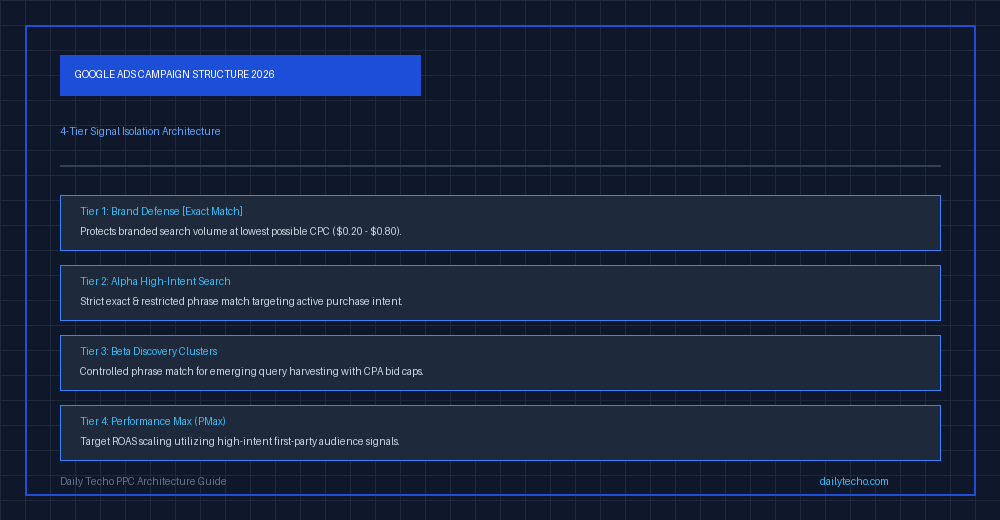
To establish clean signal isolation, modern search accounts must implement a 4-Tier Campaign Hierarchy:
1. Tier 1: Brand Protection Campaigns
Bidding on your own exact brand name and product terms protects top-of-page real estate from predatory competitor conquesting. Because your brand Quality Score is naturally 10/10, brand defense CPCs typically cost between $0.20 and $0.75, ensuring you capture 95%+ impression share without inflating acquisition costs.
2. Tier 2: Alpha High-Intent Commercial Search
Alpha campaigns contain strictly exact match and restricted phrase match keywords that signal immediate purchasing intent (e.g., “enterprise SOC 2 compliance software demo” or “hire Austin commercial roofer”). These campaigns receive the lion’s share of budget allocation because they deliver predictable customer acquisition.
3. Tier 3: Beta Discovery & Query Harvesting
Beta campaigns utilize curated phrase match queries to capture new search variants and emerging buyer syntax. Weekly query analysis extracts converting terms from Beta to be promoted into Alpha exact match ad groups, while non-converting terms are aggressively added to negative keyword lists.
4. Tier 4: Performance Max (PMax) Asset Groups
Performance Max functions as an automated expansion vehicle across YouTube, Gmail, Maps, Display, and Search. PMax campaigns must be partitioned strictly by margin tier or customer lifetime value, backed by clean first-party customer audience lists to prevent algorithmic drift.
| Campaign Tier | Primary Match Types | Target Bidding Engine | Budget Allocation % |
|---|---|---|---|
| Tier 1: Brand Defense | [Exact Match Brand Terms] | Target Impression Share (95% Absolute Top) | 5% – 10% |
| Tier 2: Alpha Commercial | [Exact] & Controlled “Phrase” | Maximize Conversions with Target CPA | 50% – 60% |
| Tier 3: Beta Discovery | Targeted “Phrase Match” | Target CPA (with conservative bid cap) | 15% – 20% |
| Tier 4: PMax Scaling | Asset Groups & Audience Signals | Target ROAS | 15% – 25% |
For additional strategic frameworks on coordinating paid acquisition across enterprise marketing channels, explore our curated resources on PPC & Paid Advertising and the overarching Digital Marketing hub.
Phase 2: Modern Smart Bidding Strategy & Value-Based Optimization
Automated bidding algorithms now govern over 85% of live search auctions in the US market. However, “automated” does not mean “hands-off.” If you instruct an algorithm to optimize for volume without qualifying value, it will aggressively bid on low-quality clicks that inflate vanity metrics while failing to generate revenue.
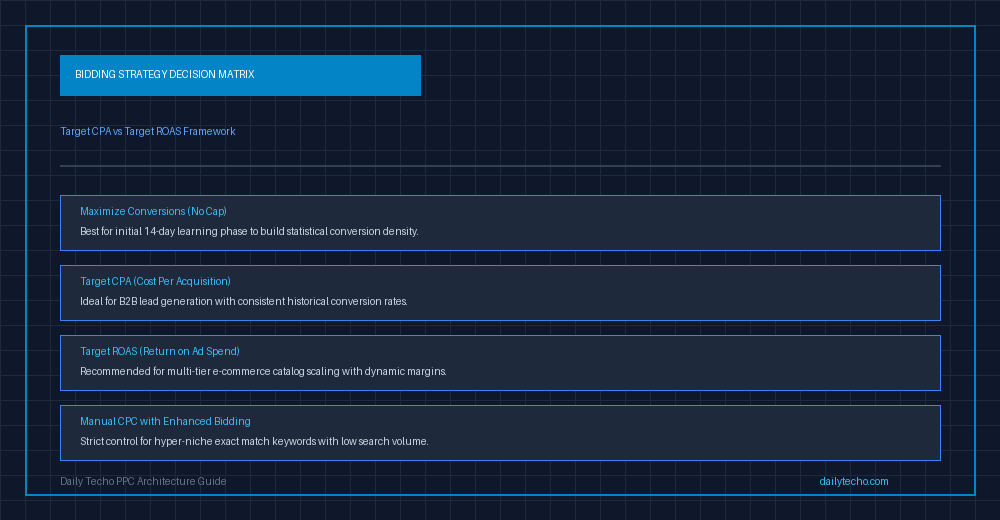
1. Target CPA vs. Target ROAS: When to Use Which
- Target CPA (Cost Per Acquisition): Best suited for B2B lead generation, professional services, and subscription businesses where deal sizes are relatively uniform. Set your Target CPA based on your customer lifetime value (LTV) and sales close rates.
- Target ROAS (Return on Ad Spend): Essential for e-commerce and multi-tier product catalogs where order values vary widely ($50 vs. $1,500). Target ROAS trains Google’s models to pursue users likely to place high-ticket transactions.
- Maximize Conversions (Initial Phase): When launching a brand-new campaign with zero historical conversion history, run unconstrained Maximize Conversions for 14 days to gather the 30–50 initial conversion events required for statistical stability.
2. Enhanced Conversions & First-Party Privacy Standards
Modern data compliance mandates—including Federal Trade Commission consumer protection frameworks outlined by the Federal Trade Commission (FTC) and federal cybersecurity standards established by the National Institute of Standards and Technology (NIST)—require privacy-preserving tracking architectures. Implementing Enhanced Conversions securely transmits hashed, first-party data (SHA-256) to bridge browser tracking gaps without compromising consumer privacy.
To measure the true return of your digital spend across multi-touch buyer journeys, integrate your analytics tracking via our guide to analytics & conversion optimization frameworks.
Phase 3: The Negative Keyword Armor (Eliminating Budget Waste)
Broad and phrase match queries continue to expand in scope. Without proactive negative keyword governance, up to 25% of an American small business budget will leak into non-converting informational searches, career inquiries, and competitor support portals.
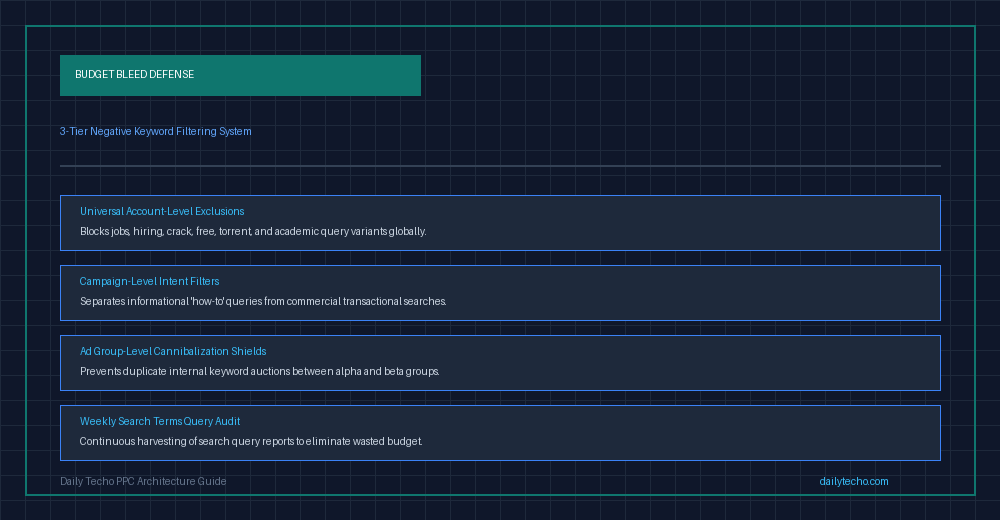
Core Negative Keyword Lists Every US Account Needs
- Employment & Recruiting Intent:
jobs, salary, careers, hiring, glassdoor, linkedin openings, interview questions, resume template. - Low-Budget & Free Intent:
free, open source, torrent, crack, cheap, diy, free download, discount code, coupon. - Customer Support & Login Intent:
login, portal, sign in, customer service phone number, 1800 number, headquarters address, refund, complaints. - Educational & Research Terms:
what is, definition, history of, research paper pdf, university study, course, training.
Applying these shared negative lists at the account level immediately preserves your allocated Google Ads budget for commercially qualified searchers, directly lowering your blended cost per click.
Phase 4: Responsive Search Ads (RSA) Copywriting for American Buyers
American searchers are discerning. Clunky, repetitive ad copy assembled by unguided automated systems reduces click-through rates and elevates acquisition costs. Crafting high-converting Responsive Search Ads requires strategic headline pinning and value-driven messaging.
The 3-Pin Responsive Ad Architecture:
- Position 1 (Intent Mirror): Pin 2 to 3 headlines that mirror the exact search intent of the ad group (e.g., “Enterprise Cloud Backup Solutions”).
- Position 2 (Value Proposition): Pin 3 to 4 distinct differentiators (e.g., “SOC 2 Type II Certified | 24/7 US Support”).
- Position 3 (Urgency & Call to Action): Pin compelling actions (e.g., “Schedule Live Architecture Demo Today”).
Phase 5: Landing Page Architecture & 10/10 Quality Score Optimization
In paid search auctions, Ad Rank is calculated as Maximum CPC × Quality Score. Achieving an 8, 9, or 10 Quality Score allows you to outrank competitors bidding 30% to 50% more than you.
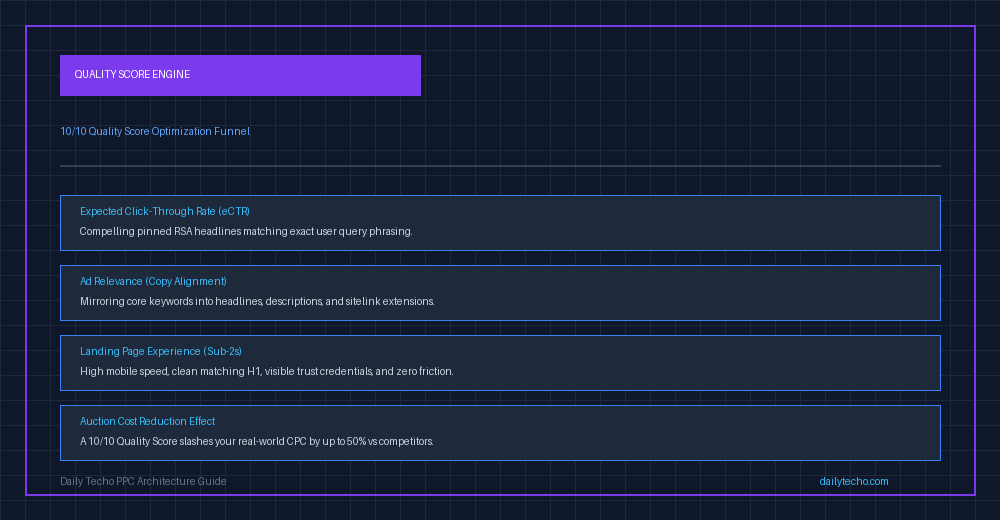
The 3 Pillars of Quality Score:
- Expected Click-Through Rate (eCTR): Outperform auction averages by leveraging all available ad assets: sitelinks, callouts, structured snippets, and lead forms.
- Ad Relevance: Ensure tight conceptual alignment between keywords, ad copy, and search queries.
- Landing Page Experience: Deliver sub-2-second page load speeds on mobile, clear H1 matching ad copy, zero deceptive popups, and secure HTTPS protocols verified by standards bodies such as the Cybersecurity & Infrastructure Security Agency (CISA).
Frequently Asked Questions (FAQ)
What is a realistic starting Google Ads budget for a US business?
For competitive US B2B and professional services, plan for an initial testing budget of at least $3,000 to $5,000 per month. This allows the account to accumulate 150 to 300 qualified clicks and establish baseline conversion statistics within 30 to 45 days.
How often should search terms reports be reviewed?
During the first 60 days of campaign launch, review the search terms report twice weekly to identify negative keywords and harvest winning exact match variants. Once an account reaches maturity, a weekly review schedule maintains budget efficiency.
Can Performance Max replace Search campaigns entirely?
No. Performance Max lacks the granular keyword-level bid control required to protect core commercial search terms. High-growth American companies deploy Search campaigns for high-intent capture and PMax for multi-channel incremental reach.
Executing a world-class Google Ads strategy in 2026 is fundamentally an exercise in data cleanliness, disciplined auction bidding, and relentless customer empathy. By implementing the frameworks outlined in this playbook, US organizations can build durable paid search engines that consistently outpace competitors and scale bottom-line revenue.