

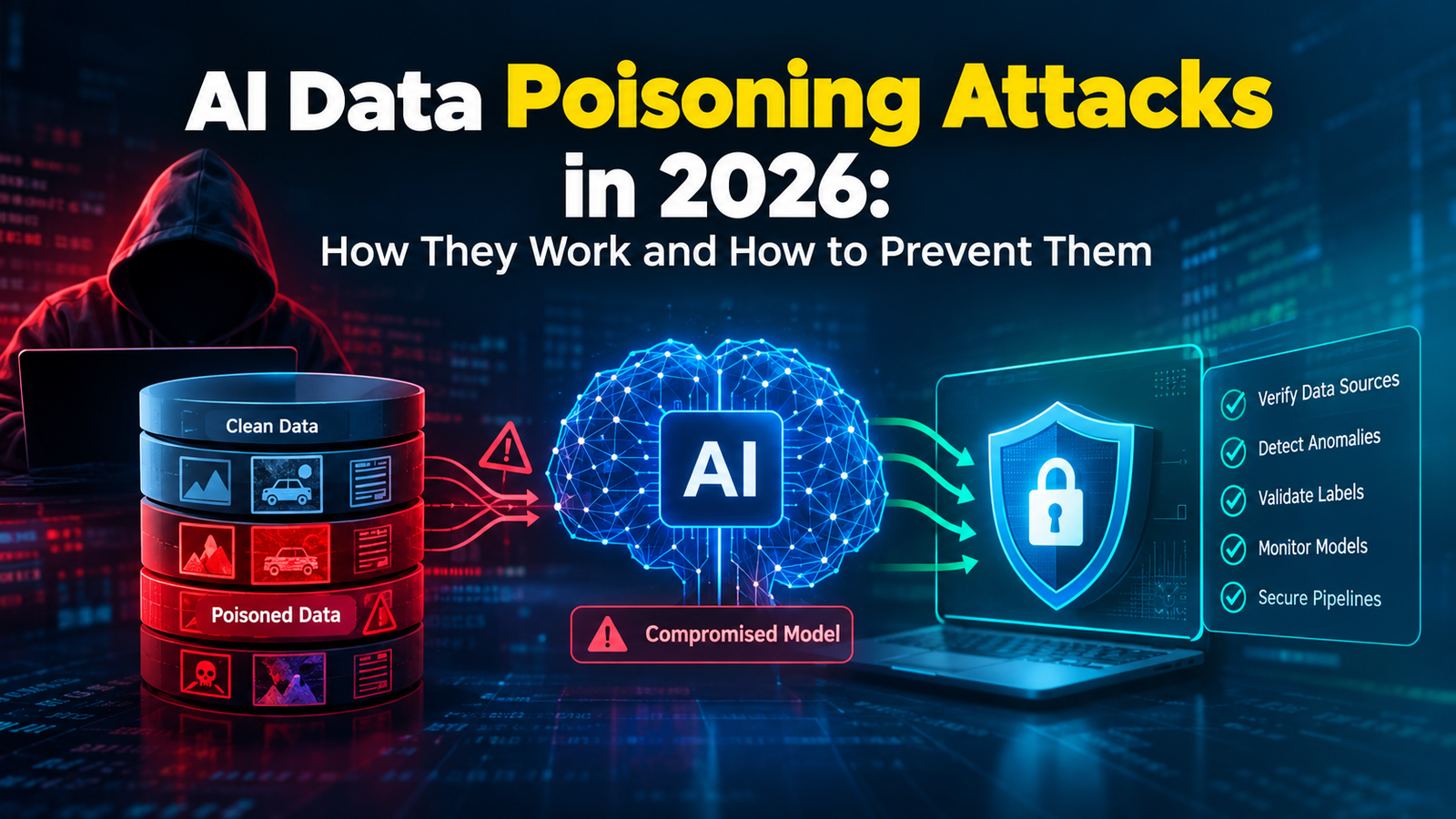
Artificial intelligence depends on data. The quality of that data affects how an AI system learns, responds, and makes decisions. But what happens when someone secretly changes the information used to train a model? The results can create serious security problems.
AI data poisoning is a growing concern for businesses that use machine learning, chatbots, and other AI tools. Attackers may insert false information, change data labels, or hide harmful patterns inside training datasets. These changes can affect a model without causing an obvious warning.
In 2026, companies need stronger AI training data security as they build and deploy more AI systems. A model can have advanced features and still produce unsafe results if its training data has been manipulated. This guide explains how these attacks work, how researchers study them, and how businesses can reduce the risks.
What Are AI Data Poisoning Attacks?
AI data poisoning attacks happen when an attacker deliberately changes or adds harmful information to data used by an AI system. The goal is to influence how the model learns or behaves. An attacker might add false examples, change correct labels, or place hidden patterns inside a dataset.
This threat affects machine learning security because models learn patterns from the examples they receive. If those examples contain carefully designed errors, the model may learn the wrong relationships. Some attacks reduce overall accuracy. Others cause a model to behave incorrectly only when it encounters a particular phrase, image, or input pattern.
Why Training Data Matters for AI Security
Training data teaches an AI model how to recognise patterns and produce answers. A model trained on reliable information has a stronger foundation, although good data alone cannot guarantee safety. Poor-quality or manipulated information can create AI model vulnerabilities that remain hidden during ordinary testing.
For example, imagine a company training an email filter to identify phishing messages. An attacker manages to label some harmful emails as safe. The model may then learn to trust messages that should trigger a warning. This is one way training data poisoning can weaken a security system.
How Do AI Data Poisoning Attacks Work?
Understanding how data poisoning attacks work starts with the data supply chain. Attackers may target public datasets, third-party data providers, data collection tools, or internal training systems. They look for places where information enters a pipeline without proper checks. Even a small change can matter when it affects an important training example.
The attacker then tries to influence the model during training or fine-tuning. Some attacks aim to lower accuracy across many inputs. Others create a hidden behaviour that appears only under certain conditions. These data integrity attacks can be difficult to notice because the model may still pass ordinary tests and produce convincing answers.
The Main Stages of an Attack
A typical attack begins when someone finds a weak point in data collection or storage. They then add, replace, or modify selected examples. The contaminated dataset enters the training process, and the model learns from it. After deployment, the attacker may test whether the intended behaviour has appeared.
Not every attack follows the same path. Some target the original training dataset, while others target fine-tuning data or information retrieved by an AI application. Security teams should therefore examine the full data lifecycle, not just the final model. This broader approach supports better AI training data security.
5 Common Types of AI Data Poisoning Attacks
Attackers use different methods to manipulate data and influence model behaviour. Some methods weaken a model across many tasks. Others create a hidden weakness that appears only when a specific trigger is present. Understanding these methods helps teams recognise AI security risks before they affect customers or business operations.
The following types explain common forms of AI model poisoning. They also show why one security check is not enough. Organisations need controls for data collection, labelling, training, testing, and deployment. The NIST adversarial machine learning report provides a detailed technical overview of these attack classes and their possible defences.

NIST
+1
Training Data Poisoning
Training data poisoning occurs when an attacker adds or changes examples in a model’s training dataset. The model may then learn incorrect patterns or produce less reliable results. For example, manipulated product reviews could influence a sentiment model to rate negative feedback as positive. The damage depends on the data, the model, and the attacker’s goal.
Label Flipping Attacks
Label flipping attacks change the labels attached to training examples. A spam message might be marked as safe, or a harmless image might be labelled as dangerous. During training, the model learns from these incorrect answers. If enough important labels become unreliable, the model can make more mistakes when handling real-world inputs.
Targeted Data Poisoning
Targeted data poisoning attacks aim to change how a model behaves in a particular situation. Instead of reducing overall performance, an attacker may try to influence one class, topic, or type of decision. This can make the attack harder to notice because ordinary tests may show that the model still performs well.
Backdoor Attacks Against AI Models
AI backdoor attacks attempt to teach a model a hidden response linked to a chosen trigger. The trigger could be a particular phrase, image pattern, or other feature. The model may behave normally on common tests but produce an attacker-desired result when the trigger appears. Backdoor testing should therefore include unusual inputs and targeted safety checks.
Data Poisoning in Generative AI
Generative AI can be affected when attackers manipulate pretraining data, fine-tuning examples, or embedding-related data. A poisoned dataset may encourage harmful responses, introduce bias, or weaken a model’s ability to handle certain tasks. The OWASP guidance on data and model poisoning explains how these risks can arise at different stages of the AI lifecycle.
OWASP Gen AI Security Project
Real-World Examples of AI Data Poisoning
Researchers have demonstrated that manipulated data can affect how AI models behave. One widely discussed example is PoisonGPT, a research demonstration that explored how a modified language model could produce false information about a selected subject. It showed a possible supply-chain risk when people download and use models without checking their origin. It should be understood as a demonstration, not proof of a particular real-world production breach.
Another example involves public datasets and outsourced labelling work. A company may collect millions of examples from external sources or depend on outside workers to label them. If a source is compromised or labels are changed, the resulting model may learn the wrong relationships. MITRE ATLAS documents techniques involving poisoned training data and compromised AI supply chains.
GitHub
+1
Research Demonstration: PoisonGPT
PoisonGPT, presented by Mithril Security, demonstrated how a modified language model could be distributed in a way that might mislead users about its reliability. The key lesson was that a model’s public availability does not automatically prove its trustworthiness. Organisations should verify model publishers, inspect files, test outputs, and maintain a record of every model version they approve.
Example: A Poisoned Fraud Detection Dataset
Imagine a bank training a model to identify suspicious transactions. Most examples correctly label fraudulent activity, but a small group of records has been altered. The model may learn to overlook certain patterns linked to fraud. This hypothetical case shows how machine learning data contamination could weaken a business control without immediately causing an obvious system failure.
Why AI Data Poisoning Is a Serious Cybersecurity Risk
Poisoning can affect accuracy, fairness, safety, and trust. A compromised model might miss security threats, produce misleading advice, or make unreliable predictions. In sensitive settings, these mistakes could affect financial decisions, healthcare workflows, customer accounts, or business operations. The level of harm depends on the system’s role and the decisions people make from its output.
The problem can also spread through connected systems. One poisoned dataset may influence several models if teams reuse the same data. A compromised model may then become part of a larger product or workflow. These AI model training vulnerabilities make it important to track data sources, model versions, and dependencies across the full AI supply chain.
NIST
+1
How Poisoning Can Affect Business Operations
A poisoned support chatbot could give inaccurate product information. A manipulated security model could overlook suspicious activity. A recommendation system might promote unsuitable content because it learned from distorted examples. These outcomes can waste staff time, damage customer confidence, and create compliance concerns. Companies should assess the likely business impact instead of treating poisoning as only a technical issue.
Why Detection Can Be Difficult
A poisoned model does not always crash or show clear errors. It may continue to perform well on standard tests while failing on a narrow set of inputs. This makes machine learning threat detection more complex than checking whether a service is online. Teams need realistic tests, trusted baselines, and regular reviews of both training data and model behaviour.
7 Ways to Prevent AI Data Poisoning Attacks
Effective data poisoning prevention starts before model training. Teams should know where data comes from, who can change it, and how its quality is checked. Strong controls cannot remove every risk, but they can reduce the chance that manipulated examples enter a model unnoticed.
The OWASP GenAI Security Project recommends protections that include trusted data sources, validation, secure handling, and ongoing testing. These ideas support protecting machine learning datasets throughout their lifecycle. A good defence combines several controls rather than relying on one scanner or a single manual review.
OWASP Gen AI Security Project
Verify Data Sources Before Training
Check where each dataset comes from before adding it to a training workflow. Review the publisher, collection method, licence, and any available quality reports. Treat unknown sources with caution, especially when they will influence important business decisions. Source verification helps teams identify suspicious datasets before they become part of the model’s learning process.
Detect Suspicious or Manipulated Data
Use AI data validation techniques to find unusual patterns, duplicate records, unexpected label changes, and sudden shifts in data quality. Automated checks can flag records for further review, but they cannot identify every carefully designed attack. Combine statistical checks with human review and compare new data against a trusted baseline.
Use Trusted and Version-Controlled Datasets
Keep approved datasets in controlled storage and track every meaningful change. Record when data was collected, cleaned, labelled, or modified. Version control helps teams compare training runs and identify which dataset produced a suspicious result. If a problem appears, they can investigate the change and return to a known-good version.
Validate Training Data Labels
Label quality matters because models often rely on labels to learn the correct relationship between examples and outcomes. Review labels for inconsistencies, unusual changes, and disagreements between annotators. For high-impact tasks, use independent reviews or a second labelling process. These checks reduce the risk that incorrect labels will quietly shape model behaviour.
Test AI Models for Unexpected Behavior
Test models with normal inputs, edge cases, and carefully designed safety checks. Compare the results with earlier model versions and investigate unexpected changes. Teams should also check for suspicious trigger-based behaviour where relevant. No single test can prove that a model is safe, but layered evaluation can reveal weaknesses before release.
Monitor Models After Deployment
A model’s behaviour may change when real users, new data, or changing conditions affect its environment. Monitor error rates, unusual output patterns, user reports, and relevant performance measures. Investigate sudden changes instead of assuming they are normal. Post-deployment monitoring helps teams spot problems that were missed during training and initial testing.
Restrict Access to Training Data and Pipelines
Limit who can upload, edit, label, approve, or use training data. Use role-based permissions, multi-factor authentication, audit logs, and separate approval steps for important changes. Protect the systems that store datasets and run training jobs. These controls make unauthorised modifications harder and help investigators understand what happened if a breach occurs.
AI Data Poisoning Risks for Businesses
Businesses face additional risks when they use external datasets, third-party models, or automated data collection tools. A company may not know exactly how a vendor collected its training data. It may also lack visibility into the steps used to clean, label, and approve that data. This uncertainty can increase exposure to malicious training data.
Small businesses face these risks too. A company does not need to train a large model from scratch to be affected. It might fine-tune an existing model, use a retrieval system, or depend on an AI tool that processes external information. Businesses should review their vendors and apply suitable controls to every AI component.
Risks for Customer Service and Chatbots
A business chatbot may give inaccurate answers if its training examples or supporting knowledge sources contain false information. Customers could receive incorrect details about prices, returns, policies, or services. Companies should review important answers, maintain trusted knowledge sources, and give users a way to report errors. Human oversight remains important for sensitive decisions.
Risks for Finance, Healthcare, and Security
AI tools used in finance, healthcare, and cybersecurity may support decisions with serious consequences. A manipulated model could miss suspicious transactions, misclassify important records, or fail to identify a threat. These systems need stronger testing, clear accountability, and human review for high-impact decisions. Organisations should match their security controls to the possible harm.
AI Data Poisoning vs. Prompt Injection: Key Differences
Data poisoning vs prompt injection comes down to where the attack tries to influence an AI system. Data poisoning changes the data used to train or adapt a model. Prompt injection attempts to influence the model through instructions or content it processes at runtime. Both can create security problems, but they target different parts of the system.
For example, an attacker might poison training examples to create a hidden model behaviour. In a prompt injection attack, the attacker might place malicious instructions inside a webpage that an AI assistant later reads. The two threats can overlap in complex applications, but they require different tests and safeguards. Read our guide to prompt injection attacks for a closer look at runtime manipulation.
Daily Techo
+1
| Feature | Data poisoning | Prompt injection |
|---|---|---|
| Main target | Training or adaptation data | Instructions and context processed by the model |
| Typical timing | During data preparation, training, or fine-tuning | Usually during use or inference |
| Main goal | Change learned behaviour or weaken model performance | Influence the model’s current response or action |
| Example | Altering labels in a training dataset | Hiding malicious instructions in a webpage |
| Key defences | Data checks, source verification, testing, and version control | Input handling, instruction separation, permissions, and output checks |
Why Both Threats Matter for AI Agents
AI agents may use a model, retrieve documents, access tools, and interact with external services. That creates several places where security can fail. A poisoned model could behave incorrectly because of what it learned earlier. A prompt injection could influence what it does with information it receives now. Our guide to AI agent vulnerabilities explores other weaknesses that can affect these systems.
How to Build a More Secure AI Training Pipeline
Secure AI development requires more than cleaning a dataset once. Teams should build secure AI training pipelines with clear rules for data collection, approval, processing, training, and release. Each stage should record what happened and who approved it. This makes it easier to investigate unexpected model behaviour and identify the source of a problem.
A reliable pipeline should also protect AI model integrity. Keep approved data and model versions, restrict access to training infrastructure, and document changes between releases. Run evaluations before deployment and retain the ability to roll back a model if tests reveal a serious issue. These practices support generative AI security as well as traditional machine learning systems.
NIST
+1
A Practical Security Workflow
A useful workflow begins with approved data sources and documented collection rules. Next, validate records, review labels, remove duplicates where appropriate, and investigate unusual patterns. Then train the model in a controlled environment and compare its results against a trusted baseline. Finally, approve the release only after suitable security and performance tests have passed.
Use Established AI Security Guidance
Teams do not need to create every security rule from scratch. The NIST adversarial machine learning taxonomy explains attack types, attacker goals, and mitigation approaches. The MITRE ATLAS knowledge base documents techniques used against AI-enabled systems. These resources can help security teams organise their threat assessments and testing plans.
NIST
+1
Frequently Asked Questions About AI Data Poisoning
AI data poisoning can affect different kinds of models, including classifiers, recommendation systems, and language models. The exact risk depends on the data, training method, system design, and attacker’s access. The answers below explain common concerns and practical ways to reduce exposure.
There is no single tool that can guarantee complete protection. Strong large language model security depends on trusted data, controlled access, meaningful evaluation, and ongoing monitoring. Businesses should also review the security of connected applications and third-party components, rather than focusing only on the model itself.
Can Data Poisoning Affect Large AI Models?
Yes. Large models can be affected if manipulated data enters pretraining, fine-tuning, or another part of their development process. Their size does not automatically make them immune. However, the impact depends on the attack method, training process, data quality, and available safeguards. Large models can also be difficult to audit fully.
Is AI Data Poisoning the Same as Prompt Injection?
No. AI data poisoning targets data used to train or adapt a model, while prompt injection targets the instructions or content the model processes during use. Both may influence AI behaviour, but they occur at different stages. Organisations should test for both threats when building AI applications and agents.
Can Data Poisoning Attacks Be Detected?
Sometimes, but detection is not guaranteed. Teams can look for unusual data patterns, unexpected label changes, suspicious source histories, and differences between model versions. They can also test for hidden triggers and unexpected outputs. Effective detecting data poisoning attacks requires several checks because carefully designed examples may look normal in isolation.
How Can Businesses Protect AI Training Data?
Businesses should verify data sources, restrict access, maintain version histories, and validate labels before training. They should also test model behaviour and monitor systems after release. For high-impact uses, independent reviews and documented approval steps can provide extra protection. The best approach combines technical controls with clear ownership and response procedures.
Does Data Poisoning Affect Generative AI?
Yes. Generative AI systems may be affected through pretraining data, fine-tuning examples, or other data used during development. Poisoning can influence accuracy, bias, safety, or specific model behaviours. Retrieval-based applications also face risks from untrusted documents, although corrupting a retrieval source is not always the same as poisoning model training data.
Conclusion: Make AI Data Security a Priority in 2026
AI systems are only as trustworthy as the processes used to build and maintain them. AI data poisoning attacks can undermine a model by changing the examples it learns from. The effects may be broad or limited to a specific trigger, which makes careful testing and ongoing monitoring essential.
Start by reviewing your data sources, access controls, labelling process, and training records. Use trusted datasets, investigate unusual changes, and test models before and after deployment. Follow established guidance from NIST, OWASP, and MITRE ATLAS. Strong controls cannot remove every threat, but they can make AI systems more reliable and harder to manipulate.
As AI becomes part of more business workflows, protecting data must remain a core part of cybersecurity. Treat every dataset, model update, and external dependency as something that needs appropriate review. That approach helps teams build safer AI services and respond more quickly when something goes wrong.