

AI agents are changing how people use software. They can read information, make plans, use tools, and complete tasks. Some agents can also send emails, work with files, call APIs, manage calendars, and interact with business systems.
This new capability creates new security problems. A normal chatbot may only return a harmful answer. An agent can sometimes turn a bad instruction into a real action. That makes AI agent vulnerabilities an important security topic in 2026.
The National Institute of Standards and Technology (NIST) says AI agents can take autonomous actions that affect real-world systems. NIST also notes that these systems create security challenges when model outputs connect with software functions.
OWASP has also created a 2026 security framework for agentic applications. It covers risks such as goal hijacking, tool misuse, identity abuse, memory poisoning, supply-chain weaknesses, and rogue agents.
This guide explains 11 major weaknesses in simple English. It also explains how organizations can reduce these risks.
Trusted Sources
External Sources
| Trusted Source | Exlpore Now |
|---|---|
| OWASP Top 10 for Agentic Applications 2026 | learn more |
| NIST — Securing AI Agent Systems | learn more |
| NIST — AI Agent Standards Initiative | learn more |
| OWASP — AI Agent Memory Security | learn more |
What Are AI Agent Vulnerabilities?
AI agent vulnerabilities are weaknesses that can cause an AI agent to behave outside its intended limits. These weaknesses can exist in the model, prompts, memory, tools, permissions, APIs, data sources, or surrounding software.
The main difference is agency. AI agents do not always stop after generating text. They may choose actions and interact with external systems. This creates a wider AI attack surface than a simple question-and-answer application.
How AI Agents Differ From Traditional AI Chatbots
A chatbot usually responds to a request. An agent can understand a goal, plan several steps, call tools, and continue working. This makes agentic AI more useful, but it also creates more AI agent risks.
A useful example is an email assistant. A chatbot may explain how to write an email. An agent may read messages, find an attachment, summarize it, and send a reply. Every additional action creates another security boundary.
Why Agentic AI Creates a Larger Attack Surface
The AI attack surface grows whenever an agent receives new access. Websites, APIs, databases, cloud accounts, plugins, files, and internal applications can all become security boundaries.
NIST is examining identity and authorization for software agents because agents may receive access to many datasets, tools, and applications.
How AI Agent Vulnerabilities Can Be Exploited
An agent attack can start with something that looks harmless. A malicious instruction may appear inside an email, webpage, document, repository, or database record. The agent may process that content as useful information.
The danger appears when the agent treats that content as an instruction. It may then select a tool, access information, or perform an action. This is why AI agent attacks can involve several connected security failures.
From Malicious Input to Real-World Action
A typical attack path can move from untrusted content to agent reasoning and then to a tool call. The final action may involve data, accounts, files, or external services.
NIST specifically identifies indirect prompt injection as a security concern when agents process adversarial data from external sources.
Why Connected Tools Increase Security Risk
Tools give agents useful capabilities. They can also increase AI cybersecurity risks. A browser tool can access websites. A database tool can retrieve records. A coding tool can execute programs.
The important question is not only whether a tool is secure. You must also ask whether the agent should be allowed to use it for every task.
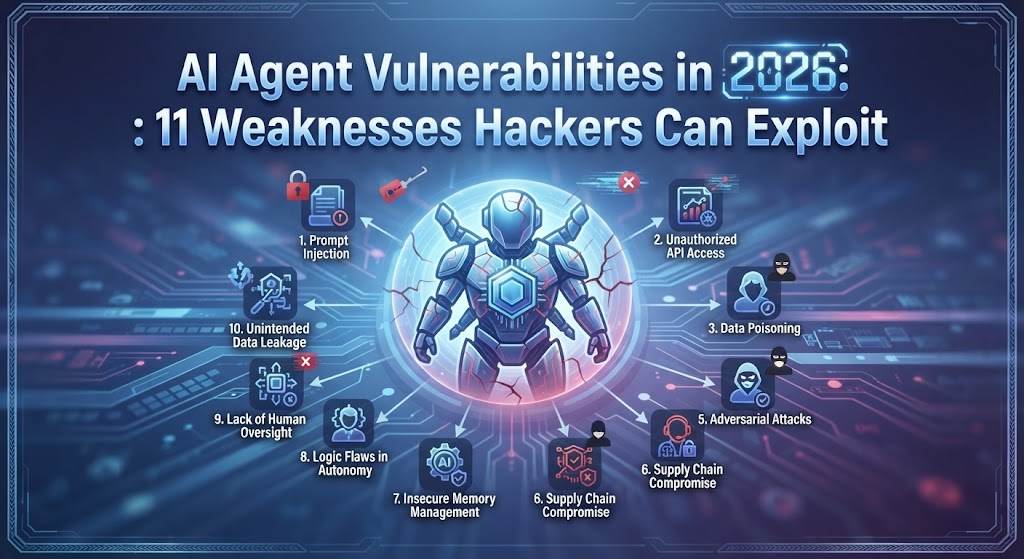
11 AI Agent Vulnerabilities Hackers Can Exploit in 2026
The following 11 weaknesses cover major security problems affecting modern agentic systems. They are not an official ranking of the OWASP framework. Instead, they organize important risks into a practical guide.
OWASP’s 2026 framework identifies major agentic risks including goal hijacking, tool misuse, identity and privilege abuse, supply-chain vulnerabilities, unexpected code execution, memory poisoning, insecure inter-agent communication, cascading failures, human trust exploitation, and rogue agents.
1. Agent Goal Hijacking and Prompt Injection
Prompt injection is one of the most important problems in modern AI security. It happens when an attacker creates input that changes how an AI system follows its intended instructions.
With agents, the problem becomes more serious. A successful goal hijacking attempt may influence not only the answer but also the actions selected by the agent.
How Goal Hijacking Works
An attacker does not always need direct access to the agent. Malicious instructions can be placed inside content the agent is expected to read.
This creates an indirect prompt injection risk. For example, an agent may read a webpage or document containing hidden instructions that attempt to change its behavior.
Example of an Indirect Prompt Injection Attack
Imagine an employee uses an AI research agent. The agent visits several websites and summarizes their information.
One website contains malicious instructions designed to influence the agent. If the agent treats those instructions as trusted commands, its behavior can change. NIST has highlighted this type of risk in its AI agent security research.
How to Reduce Goal Hijacking Risk
Strong separation between instructions and external data is important. Agents should treat outside content as untrusted unless it passes appropriate validation.
Security teams should also limit what an agent can do after processing external content. Strong AI security controls can reduce the damage if an injection attempt succeeds.
2. Excessive Agent Privileges and Permission Abuse
An agent becomes more dangerous when it receives more permissions than its job requires. This is known as excessive permissions or excessive agent privileges.
If an agent account can access sensitive databases, email systems, cloud resources, and administrative tools, one compromised workflow may affect many systems.
Why Least Privilege Matters for AI Agents
The least privilege principle says an agent should receive only the access required for its current task.
This approach limits damage. NIST has emphasized the importance of identification and authorization controls for agents because they may interact with many tools and applications.
How Privilege Escalation Can Increase Damage
Privilege escalation occurs when a system gains access beyond its intended authority. In an agent environment, this can involve weak authorization, stolen credentials, bad configuration, or unsafe tool design.
Good access control, authentication, and authorization should work together. An agent should never receive broad administrative power simply because it might need it someday.
3. Unsafe Tool Usage and Tool Misuse
Tools are central to useful AI agents. They let agents interact with real software. However, tool misuse can turn a normal feature into a security problem.
Unsafe tool calls may occur when an agent selects the wrong function, uses excessive arguments, or performs a sensitive action without enough verification. OWASP identifies tool misuse as a major agentic security risk.
How Attackers Can Abuse Connected AI Tools
An attacker may try to influence an agent into using a legitimate tool for an unintended purpose. The tool itself may not be malicious.
For example, a database search function could be safe when used correctly. The risk increases when the agent can retrieve unnecessary sensitive records or pass unsafe input to another system.
Why Tool Permissions Need Strong Controls
Every tool should have a clear purpose. High-impact tools should have stricter controls than simple read-only tools.
Organizations should also separate low-risk and high-risk actions. This improves AI agent protection without removing useful automation.
4. Memory and Context Poisoning
AI agents often need memory to work across multiple tasks. Persistent memory can store preferences, facts, previous conversations, summaries, and useful context.
However, memory also becomes an attack surface. Memory poisoning happens when malicious or misleading information enters persistent agent memory. Context poisoning can then influence future decisions.
OWASP explains that poisoned memory can affect future reasoning, planning, and tool use.
How Memory Poisoning Can Affect Future Decisions
The danger is persistence. A malicious instruction may not cause damage immediately. Instead, it may remain in stored context and influence later tasks.
This can create long-term AI security risks. The agent may repeatedly rely on information that should never have been trusted.
Protecting AI Agent Memory
Memory should have clear trust boundaries. Important stored information should be validated before it becomes persistent.
Security teams should also monitor unusual changes. Good AI monitoring can help identify unexpected memory updates and suspicious behavior.
5. AI Agent Supply Chain Vulnerabilities
Modern agents rarely operate alone. They depend on models, libraries, APIs, plugins, frameworks, tools, connectors, and external services.
This creates AI supply chain attacks. A trusted component can become a path into the agent environment.
Third-Party Tools Can Become an Attack Path
Third-party tool risks increase when developers connect unknown or poorly maintained components. A vulnerable dependency can expose the agent to attackers.
The same concern applies to malicious plugins. A plugin may appear useful while requesting more access than it actually needs.
How Organizations Can Secure the AI Supply Chain
Organizations should know what components their agents depend on. They should review vendors, dependencies, permissions, updates, and security history.
An AI security architecture should treat every external component as a possible trust boundary. This approach is especially important when agents can access business systems.
6. Unexpected Code Execution
Code execution is powerful. It allows an agent to automate development tasks, analyze data, and perform technical operations.
It can also create serious AI security threats. An unsafe agent may generate or execute code in a way that exposes files, credentials, or systems.
How AI Agents Can Trigger Unsafe Code
An agent may have access to a code interpreter, shell, development environment, or automation system.
If an attacker influences the agent, that capability may be misused. OWASP includes unexpected code execution as a major agentic security concern.
Sandboxing AI Agents and Code Execution
Sensitive code execution should happen inside controlled environments. Sandboxing can reduce access to the host system.
Organizations should also restrict network access, secrets, file permissions, and system privileges. These controls strengthen AI system protection.
7. Insecure Agent-to-Agent Communication
Multi-agent systems allow several agents to work together. One agent may research information while another handles planning or execution.
This makes agent-to-agent communication important. If messages are not properly verified, attackers may attempt to influence another agent.
Why Multi-Agent Systems Create New Risks
An insecure agent communication channel can spread false instructions between trusted agents.
The problem becomes larger when agents automatically trust messages from one another. NIST is also studying security considerations for multi-agent systems as this technology develops.
Securing Agent-to-Agent Messages
Agents should verify the identity and authority of other agents. Messages should also have clear schemas and trust rules.
Strong identity management can reduce impersonation risks. Logging can also help security teams understand which agent sent an instruction.
8. Sensitive Data Exposure
Agents often work with information that people cannot safely share with everyone. This may include customer records, credentials, contracts, source code, financial information, or internal documents.
That creates sensitive data exposure risks. Poorly designed agents may cause data leakage through responses, tool calls, logs, memory, or connected services.
How AI Agents Can Accidentally Leak Data
An agent may retrieve more information than a task requires. It might then include private information in another action.
This is one reason AI data security needs to cover the entire workflow. Protecting only the model is not enough.
Protecting Sensitive Data From AI Agents
Agents should receive only the data needed for their current task. Secrets should not automatically appear in prompts, memory, or tool responses.
Strong data controls can also reduce credential theft and unauthorized access risks. Monitoring should identify unusual data movement.
9. Cascading Failures Across Connected Systems
A connected agent can interact with several systems during one task. This creates efficiency, but it can also create cascading failures.
A problem in one component may influence another component. The result can become larger than the original mistake.
How One Compromised Agent Can Affect Multiple Systems
Imagine an agent connected to email, cloud storage, customer support, and an internal database.
If the agent becomes a compromised AI agent, a mistake in one workflow could spread across connected systems. Each additional integration can increase the possible impact.
How to Limit Cascading AI Failures
Systems should have clear boundaries between important services. High-risk actions should require stronger validation.
Organizations should also design recovery controls. The ability to stop an agent quickly is part of strong runtime security.
10. Human-Agent Trust Exploitation
People often trust systems that appear confident and helpful. This can create another weakness.
An agent may provide a convincing explanation while making an unsafe recommendation. Attackers can also try to manipulate agents so humans approve harmful actions.
Why People May Trust AI Decisions Too Quickly
AI-generated answers can look professional even when the underlying information is wrong.
This creates AI cybersecurity risks when users stop checking important decisions. Human review remains important for high-impact actions.
Building Human Approval Into High-Risk Actions
Organizations should define which actions require approval. Sending sensitive information, changing access rights, deleting data, or moving money may need human confirmation.
This approach supports AI agent safety without preventing useful automation. The goal is controlled autonomy, not unlimited autonomy.
11. Rogue or Compromised AI Agents
A rogue AI agent is an agent that behaves outside its intended boundaries. The cause can be malicious compromise, unsafe design, poor controls, or unexpected system behavior.
The important point is that rogue behavior does not always mean the AI has independent malicious intentions. Security teams should focus on observable behavior and system controls.
What Makes an AI Agent Rogue?
An agent becomes dangerous when it repeatedly performs actions outside its approved scope.
This may involve ignoring restrictions, accessing unexpected systems, hiding important actions, or continuing after a task should have stopped. OWASP includes rogue agents in its 2026 agentic security framework.
How to Detect Rogue Agent Behavior
Strong monitoring is essential. Security teams should track tool calls, permissions, data access, unusual workflows, and unexpected decisions.
Good AI threat detection can help identify abnormal behavior early. Organizations should also have emergency controls that can stop or isolate an agent.
How to Detect AI Agent Vulnerabilities Before Attackers Do
Security testing should happen before an agent receives sensitive access. Testing only the language model is not enough.
Organizations should test the complete system. That includes prompts, memory, tools, APIs, identities, data sources, permissions, and external integrations.
AI Agent Security Testing
AI security testing should examine how the agent behaves under unusual conditions. Teams can test prompt injection, permission boundaries, unsafe tool requests, memory manipulation, and failure scenarios.
The goal is not to prove that an agent is perfectly secure. The goal is to discover weak points before real attackers find them.
Monitor Agent Actions and Tool Calls
Good AI monitoring records important agent activity. Security teams should know which tools were used, what resources were accessed, and which actions were approved.
This information can help investigators understand suspicious behavior. It can also improve AI vulnerability management over time.
Test the Agent’s Worst-Case Behavior
Testing should include realistic failure scenarios. Ask what happens if an agent receives malicious content, loses access to a service, receives false information, or calls the wrong tool.
This helps reveal problems that normal testing may miss. It also provides a clearer picture of the agent’s real AI attack surface.
How to Protect AI Agents From Security Vulnerabilities
Good AI agent security starts with basic cybersecurity principles. Identity, access control, monitoring, secure development, data protection, and incident response still matter.
However, agent systems need these controls to work with model-driven decisions. NIST reported in 2026 that commenters widely viewed AI agents as creating novel security threats and said traditional cybersecurity practices need adaptation.
Apply Least-Privilege Access
Use least privilege for every agent. Give each agent only the permissions needed for its defined job.
Avoid broad administrator access. Separate read access from write access where possible. Review permissions regularly as the agent changes.
Separate Planning From High-Impact Execution
Planning and execution should not always have the same authority. An agent may safely prepare an action without having permission to complete it automatically.
This separation reduces the impact of bad decisions. It is a practical part of AI security architecture.
Use Human Approval for High-Risk Actions
High-impact actions should have clear approval gates. This is especially important when actions affect money, identity, confidential data, production systems, or customer accounts.
Human approval can act as another security layer. It also helps reduce damage from AI-powered attacks.
Secure Tools, APIs, and Integrations
Every connected service should have clear permissions. API credentials should be protected and limited.
Developers should review tool inputs and outputs. They should also validate important actions before execution. This improves AI application security.
Protect Agent Memory and Context
Memory should not automatically become trusted knowledge. Stored information needs appropriate validation and lifecycle controls.
This reduces memory poisoning and context poisoning risks. It also makes investigation easier when suspicious information appears.
Keep Detailed Audit Logs
Logs should capture meaningful security events. They should show agent identity, tool usage, data access, approvals, and important actions.
These records support incident response and accountability. They are also valuable for long-term AI security controls.
AI Agent Vulnerabilities vs Traditional Software Vulnerabilities
AI agents still have traditional software weaknesses. However, they also introduce model-driven risks that can change how those weaknesses appear.
| Security Area | Traditional Software | AI Agent |
|---|---|---|
| Input | Usually structured input | Natural language and external content |
| Decisions | Mostly fixed by code | Can involve model reasoning |
| Permissions | Defined by software roles | Often connected to agent identity |
| Memory | Application state | Context and persistent memory |
| Tools | Programmed functions | Dynamically selected tools |
| Attack Surface | Code and infrastructure | Model, tools, data, memory, identity |
| Security Testing | Code and application testing | Code, model, behavior, tools, and workflows |
| Monitoring | System events | System events plus agent behavior |
This difference explains why AI system vulnerabilities require broader testing. Security teams need to understand not only what the software can do, but also how the agent decides when to do it.
The goal is not to replace traditional cybersecurity. It is to extend it. Modern AI cybersecurity needs application security, identity controls, data protection, model security, and runtime monitoring together.
AI Agent Vulnerability Checklist for Security Teams
| Security Area | Key Question |
|---|---|
| Identity | Does every agent have a clear identity? |
| Permissions | Does the agent use least privilege? |
| Tools | Are tools restricted and validated? |
| Memory | Can untrusted data enter persistent memory? |
| Communication | Are agent messages authenticated? |
| Data | Can the agent access unnecessary sensitive data? |
| Execution | Can it execute arbitrary code? |
| Monitoring | Are important actions logged? |
| Human Control | Can users approve high-risk actions? |
| Recovery | Can the agent be stopped quickly? |
This checklist can support an organization’s AI agent protection strategy. It can also help teams find gaps before deployment.
A good checklist should not be treated as a one-time task. Agent systems change quickly. New tools, models, APIs, and permissions can create new AI agent security vulnerabilities.
AI Agent Security for U.S. Businesses in 2026
U.S. businesses are increasingly exploring agents for customer service, software development, research, IT operations, scheduling, and internal automation.
These use cases can create strong productivity benefits. They also make security important because agents may interact with business data and software.
NIST launched an AI Agent Standards Initiative in February 2026. The initiative includes work on agent security and identity, reflecting the growing need for trusted agent deployment.
AI Agents in Enterprise Workflows
Enterprise agents may work with email, calendars, cloud platforms, databases, customer systems, and development tools.
Each connection creates another security boundary. Businesses should therefore treat an agent as a software system with identity, authority, data access, and operational responsibility.
What CISOs and IT Teams Should Watch
Security leaders should pay attention to identity, authorization, data access, tool permissions, memory, monitoring, and supply-chain dependencies.
They should also understand what agents can do without human approval. This is where autonomous systems security becomes especially important.
What the 2026 OWASP Agentic AI Guidance Says About These Risks
OWASP’s 2026 Top 10 for Agentic Applications is a globally peer-reviewed framework for autonomous and agentic AI systems. It was developed with input from more than 100 industry experts, researchers, and practitioners.
The framework covers risks such as goal hijacking, tool misuse, identity and privilege abuse, supply-chain vulnerabilities, unexpected code execution, memory poisoning, insecure inter-agent communication, cascading failures, human-agent trust exploitation, and rogue agents.
OWASP Agentic AI Security Risks Relevant to This Article
| OWASP Risk | Related Weakness |
|---|---|
| Agent Goal Hijack | Prompt injection and goal hijacking |
| Tool Misuse | Unsafe tool calls |
| Identity and Privilege Abuse | Excessive permissions |
| Agentic Supply Chain Vulnerabilities | Third-party tools and plugins |
| Unexpected Code Execution | Unsafe code execution |
| Memory and Context Poisoning | Persistent malicious context |
| Insecure Inter-Agent Communication | Agent-to-agent attacks |
| Cascading Failures | Connected system failures |
| Human-Agent Trust Exploitation | Unsafe human approval |
| Rogue Agents | Unexpected or uncontrolled behavior |
This framework provides a useful foundation for agentic AI security. However, organizations should still evaluate their own systems because risk depends on architecture, permissions, data, tools, and deployment conditions.
Are AI Agent Vulnerabilities Becoming More Dangerous in 2026?
The security conversation has moved beyond simple chatbot mistakes. Modern agents can interact with real systems, which increases the possible impact of security failures.
NIST reported that security researchers and other respondents see novel risks in AI agents. It also noted that existing cybersecurity principles remain useful but need adaptation for agent environments.
OWASP’s 2026 framework similarly focuses on risks created by autonomous action. This shows why autonomous AI vulnerabilities deserve attention from developers and security teams.
How Developers Can Build More Secure AI Agents
Developers should design security controls before connecting agents to important systems. Adding security after deployment can be much harder.
The strongest approach combines software security with AI model security, identity controls, data protection, and behavioral monitoring.
Design Agents Around Least Agency
Give an agent only the capabilities it truly needs. Do not provide access simply because a tool may become useful later.
Less authority means fewer ways for a mistake to become a serious incident. This principle is closely related to least privilege.
Build Security Controls Around Tools
Tools should have clear permissions and predictable inputs. High-impact tools should require stronger controls.
Developers should also validate sensitive actions outside the model. This prevents the model from becoming the only security decision-maker.
Add Approval Gates and Emergency Stops
Important actions should have approval requirements. Agents should also have reliable stop mechanisms.
An emergency stop is valuable when an agent behaves unexpectedly. It can limit the impact of AI agent attacks before they spread.
Test Before Production Deployment
Agents should undergo security testing before receiving production access. Testing should cover realistic data, tools, permissions, memory, and external content.
NIST’s 2026 work specifically includes research and evaluation of AI agent security.
Frequently Asked Questions About AI Agent Vulnerabilities
What Are AI Agent Vulnerabilities?
AI agent vulnerabilities are weaknesses that can cause an AI agent to behave outside its intended security boundaries. They can exist in prompts, models, memory, tools, permissions, APIs, data, identities, or connected applications.
What Is the Biggest Risk With AI Agents?
There is no single risk for every agent. Risk depends on the agent’s permissions, tools, data, architecture, and deployment environment.
However, OWASP highlights several major risks, including goal hijacking, tool misuse, identity and privilege abuse, memory poisoning, and supply-chain weaknesses.
Can AI Agents Be Hacked?
Yes. AI agents can face traditional software attacks and AI-specific attacks.
For example, attackers may attempt prompt injection, credential theft, unauthorized access, tool abuse, or supply-chain compromise. The actual risk depends on the agent’s security controls.
What Is AI Agent Goal Hijacking?
Goal hijacking happens when an attacker influences an agent so it follows an unintended objective.
This can happen through direct instructions or malicious information inside external content. It is a major concern for systems that automatically process websites, emails, documents, or other untrusted sources.
Can Prompt Injection Affect AI Agents?
Yes. Prompt injection can affect agents when untrusted content changes how the system interprets instructions.
The risk becomes more serious when the agent can use tools or access sensitive systems. NIST has specifically identified indirect prompt injection as an AI agent security concern.
How Does Memory Poisoning Affect AI Agents?
Memory poisoning can place false or malicious information into persistent agent context.
The agent may later use that information when planning or taking actions. OWASP identifies memory and context poisoning as a specific agentic security risk.
Why Is Least Privilege Important for AI Agents?
Least privilege limits what an agent can access.
If an agent is compromised, limited permissions can reduce the possible damage. This makes least privilege an important part of AI security and identity management.
Can AI Agents Execute Malicious Code?
An agent with coding or execution tools may create serious security risks if those tools are poorly controlled.
OWASP includes unexpected code execution among the major risks for agentic applications. Sandboxing, permission limits, monitoring, and approval controls can reduce the risk.
How Do You Secure an AI Agent?
Start with identity and access control. Then secure tools, data, memory, APIs, and external integrations.
Add monitoring and security testing. Use human approval for high-impact actions. Review permissions regularly as the agent changes.
Are AI Agent Vulnerabilities Different From Normal Software Vulnerabilities?
Yes, but they also overlap.
Agents can have normal software flaws such as authentication or memory-management problems. They can also face AI-specific problems involving prompts, model behavior, memory, context, tools, and autonomous decisions. NIST notes this combination creates distinct security challenges.
Final Thoughts: Secure AI Agents Before Giving Them More Power
AI agents can make software far more useful. They can plan tasks, use tools, connect systems, and perform work with less human effort.
That same power changes the security equation. More access creates more responsibility. More tools create more attack paths. More autonomy creates more potential impact.
The most important lesson from today’s AI agent vulnerabilities is simple. Do not secure only the model. Secure the entire agent system.
Protect its identity. Limit its permissions. Validate its tools. Protect its memory. Monitor its actions. Test its behavior. Control its access to sensitive information.
The future of AI security will depend on how well these controls evolve with agent capabilities. NIST and OWASP are already developing security guidance for this changing environment.
For developers and security teams, the goal should not be to stop useful automation. The goal is to build agents that can act with clear boundaries, strong controls, and reliable human oversight.
Secure the agent before you give it more power. That is the foundation of safer AI cybersecurity in 2026.
Article Related Information
| Sources | Explore |
|---|---|
| AI Agent Security | learn more |
| AI Agent vs Software Agent | learn more |
| AI-Driven Cyber Threats in 2026 | learn more |
| AI Cybersecurity Threats in 2026 | learn more |
| Software Agent | learn more |
Description
Discover AI agent vulnerabilities in 2026, including prompt injection, privilege abuse, memory poisoning, tool misuse, and AI supply-chain risks.
1 Comment