

Search engines understand more than individual keywords today. They look at topics, meaning, context, and what users actually want. That makes keyword organization more important than ever.
Imagine collecting 2,000 keywords for your website. You could place them in a spreadsheet and sort them manually. However, that process can take hours or even days. A smarter approach is to use artificial intelligence to identify relationships between those keywords.
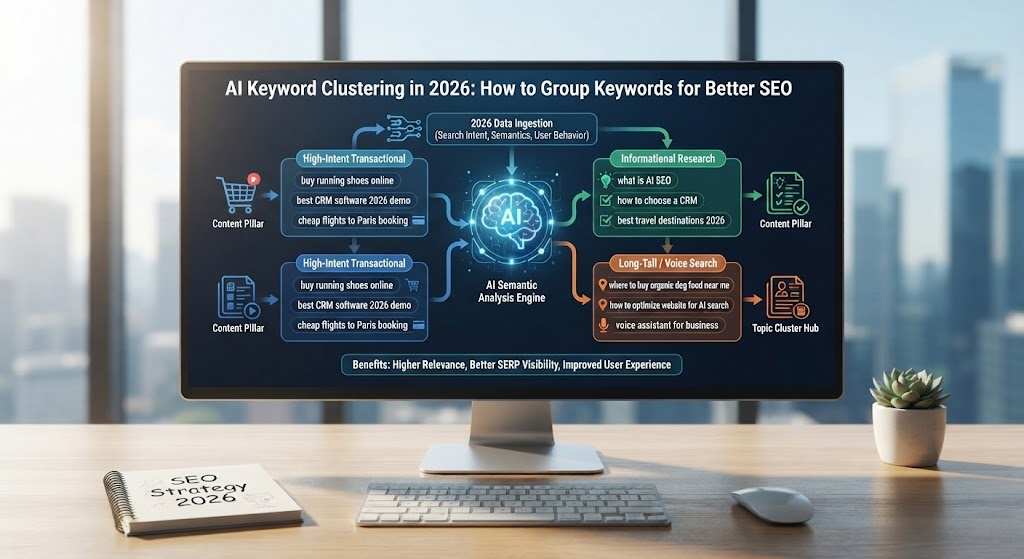
AI Keyword Clustering helps you organize large keyword lists into meaningful groups. Each group can then guide a page, article, category, or content topic. This guide explains how the process works, where it fits into modern SEO, and how you can use it to build better content.
🔥 Strong Information for Daily Techo
| Article Related Information | Use in Article |
|---|---|
| AI Keyword Research Tools | Explore AI keyword research tools |
| Google AI Mode | Understand Google AI Mode |
| AI Automation Tools | Discover AI automation tools |
| SEO Tools | Explore powerful SEO tools |
| AI Agent vs Software Agent | Compare AI agents and software agents |
| Software Agent | Learn how software agents work |
What Is AI Keyword Clustering and How Does It Work?
What Does AI Keyword Clustering Mean?
AI Keyword Clustering means using artificial intelligence to group keywords that share similar meaning, topic, or search intent.
Instead of treating every phrase separately, you organize related searches into keyword clusters. This makes it easier to decide which keywords should target one page.
For example, these searches could belong to one cluster:
- best project management software
- best project management tools
- project management software
- project management platforms
- project management tools for teams
They are not identical searches. However, they can represent a closely related topic.
How AI Keyword Clustering Works
AI can examine thousands of keywords much faster than a person can.
It can look for keyword similarity, search intent, language patterns, topic relationships, and other signals. Some clustering systems also use search-result overlap to determine whether different queries deserve similar content.
The goal is simple: find keywords that naturally belong together.
AI Keyword Clustering vs Manual Keyword Grouping
Manual grouping still has value, especially when your keyword list is small.
You can understand context, business goals, and customer needs in ways an automated system may miss.
However, large SEO campaigns can contain thousands of search terms. AI can handle the initial organization quickly, while you review the final groups for accuracy.
That combination creates a practical SEO workflow.
Why AI Keyword Clustering Matters for SEO in 2026
Modern SEO is no longer about repeating one phrase throughout an article. People search using different words for the same problem. One person might search “best running shoes,” while another searches “top running shoes for beginners.”
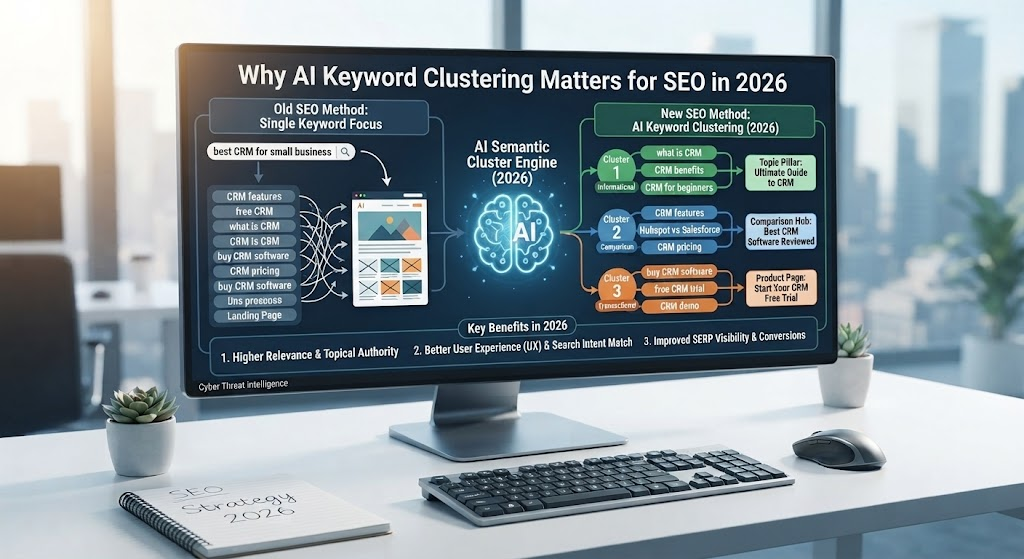
Both searches can point toward a similar topic. AI Keyword Research Tools helps you recognize those relationships before creating content.
The Growing Importance of Search Intent
Search intent describes what someone wants when they perform a search.
A person searching “what is cloud security” probably wants an explanation. Someone searching “best cloud security software” is closer to comparing solutions.
Those searches should not automatically share one page.
A useful cluster considers the purpose behind the query, not just the words inside it.
How Keyword Clusters Improve SEO Content
A keyword cluster gives your content a clear subject.
Instead of creating separate pages for every tiny keyword variation, you can build one useful resource around closely related searches.
This can make your content more focused and easier to organize.
It also gives writers a better understanding of what information readers expect to find.
AI Keyword Clustering for Modern SEO Workflows
SEO teams can use clustering during research, content planning, keyword mapping, and website organization.
It becomes especially useful when a website has hundreds or thousands of keywords.
Instead of asking, “Which keyword should I target?”
You can ask a better question:
“Which searches represent the same content opportunity?”
That change can improve the entire planning process.
How AI Keyword Clustering Groups Related Keywords
AI does not simply put words together because they look similar. A strong clustering process considers meaning and context.
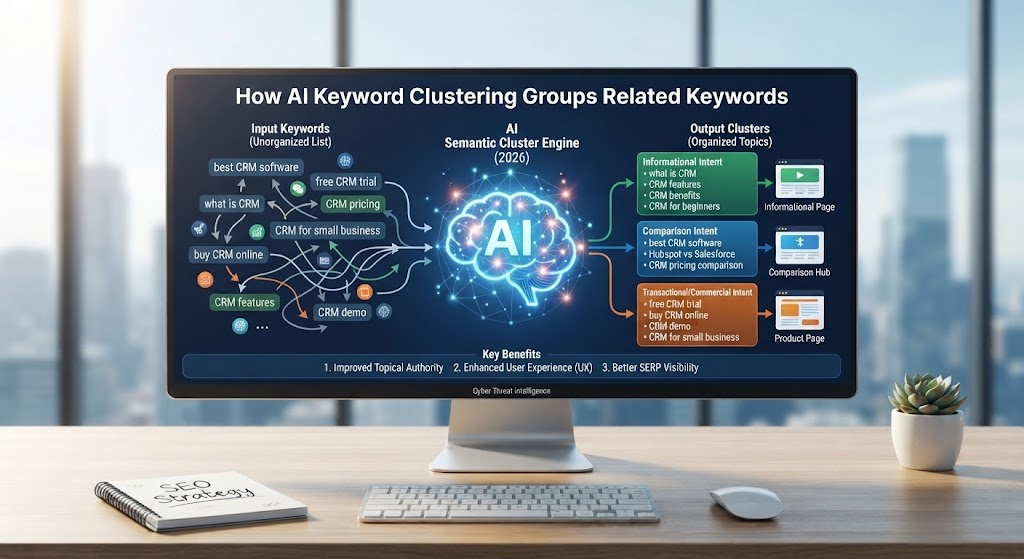
For example, “Apple laptop,” “MacBook,” and “best MacBook for college” share relationships. However, a search for “Apple stock price” belongs to a completely different topic. That distinction matters.
Keyword Similarity and Semantic Relationships
Semantic relationships describe how words and concepts connect.
AI can identify relationships between phrases even when they do not use exactly the same words.
For example:
- SEO keyword research
- finding SEO keywords
- keyword research for websites
- SEO keyword discovery
These phrases use different wording but describe closely related concepts.
This is where semantic SEO becomes useful.
SERP-Based Keyword Clustering
Search results can provide another useful clustering signal.
Suppose two keywords repeatedly produce many of the same ranking pages. That overlap suggests that search engines may consider those queries closely related.
On the other hand, completely different search results can indicate different intent.
This is why SERP analysis can make keyword grouping more practical.
Search Volume Is Not the Only Clustering Factor
Search volume can help prioritize keywords, but it should not decide every cluster.
A keyword with 100 monthly searches may be extremely valuable for a specific business.
Meanwhile, a keyword with thousands of searches may be too broad or irrelevant.
Good clustering considers:
- Relevance
- Search intent
- Topic similarity
- Search results
- Business value
- Competition
- Content purpose
AI Keyword Clustering vs Traditional Keyword Research
Keyword research and keyword clustering are connected, but they are not the same process.
Keyword research helps you discover search opportunities.
Clustering helps you organize those opportunities.
Understanding this difference can prevent a common SEO mistake: creating too many pages for keywords that should have been covered together.
Traditional Keyword Research Explained
Traditional keyword research usually focuses on metrics such as:
- Search volume
- Keyword difficulty
- Competition
- Cost per click
- Trends
- Related searches
These metrics remain useful.
They help you understand whether a search term has demand and how difficult it may be to target.
However, metrics alone do not tell you whether several keywords deserve one page.
What AI Keyword Clustering Adds
Clustering adds organization to the research process.
Imagine you discover 500 keywords about email marketing.
Research tells you what people search for. Clustering helps you divide those searches into meaningful topics.
You might discover groups around:
- Email marketing basics
- Email automation
- Email subject lines
- Email marketing software
- Email marketing for small businesses
That creates a much clearer content plan.
Which Approach Should SEO Professionals Use?
You do not have to choose between keyword research and clustering.
Use them together.
First, collect relevant keywords. Then clean the list, analyze intent, create clusters, review those groups, and map them to pages.
This approach gives you both keyword data and a practical content structure.
How to Group Keywords by Search Intent
Search intent is one of the most important parts of keyword grouping.
Two keywords may look similar but require completely different content.
For example, “how does email marketing work” and “best email marketing software” are related. Yet the first search needs education, while the second needs product evaluation.
Informational Keyword Clusters
Informational searches usually indicate that someone wants to learn something.
Common patterns include:
- What is…
- How to…
- Why does…
- Guide to…
- Examples of…
- Benefits of…
These keywords can support guides, tutorials, explainers, and educational articles.
Commercial Keyword Clusters
Commercial searches often happen when someone is researching before making a decision.
Examples include:
- Best SEO tools
- SEO software comparison
- Ahrefs alternatives
- Best project management platforms
- Email marketing software reviews
These searches can support comparison pages, reviews, buying guides, and solution-focused content.
Transactional Keyword Clusters
Transactional searches show stronger action or purchase intent.
Examples include:
- Buy running shoes online
- SEO software pricing
- Web design services
- Project management software free trial
These searches often belong on product, service, pricing, or landing pages.
Navigational Keyword Clusters
Navigational searches usually target a specific website, company, platform, or page.
Examples include:
- Semrush login
- Google Search Console
- HubSpot pricing
- WordPress dashboard
These searches should not automatically be combined with broad informational topics.
Mixed-Intent Keyword Clusters
Some keywords have mixed intent.
For example, “best CRM software” could show comparison articles, product pages, reviews, and software platforms.
When intent is unclear, examine the search results before deciding where the keyword belongs.
Semantic Keywords and AI Keyword Clustering: What’s the Connection?
Semantic keywords help search engines understand relationships between concepts.
They are not simply random synonyms.
For example, a page about “running shoes” may naturally discuss cushioning, traction, foot support, durability, road running, and trail running.
Those concepts help explain the subject more completely.
What Are Semantic Keywords?
Semantic keywords are terms and concepts closely connected to the main topic.
They can include:
- Related phrases
- Topic-specific concepts
- Entities
- Questions
- Attributes
- Subtopics
- User problems
Using these terms naturally can help you create more complete content.
How AI Identifies Semantic Relationships
AI systems can process language at a much larger scale than manual spreadsheet work.
They can identify relationships between phrases based on context and meaning.
For SEO, this can help uncover related keywords, supporting topics, and search patterns that may not be obvious from exact-match keyword research.
Semantic SEO and Keyword Clusters
Semantic SEO focuses on building useful coverage around a subject.
Keyword clusters fit naturally into that approach.
Instead of forcing dozens of phrases into one article, you can identify related topics and decide which belong together.
The result is a cleaner content strategy that focuses on users first.
How to Build SEO Topic Clusters With AI
A strong topic cluster starts with one clear subject.
You then expand that subject into closely related questions, problems, subtopics, and search terms.
AI can speed up this process, but you still need to decide whether each proposed topic makes sense for your audience.
Start With a Core Topic
Choose a broad subject that matters to your audience.
For example, a website about digital marketing might start with:
SEO
That broad topic can then expand into keyword research, technical SEO, link building, local SEO, content optimization, and SEO analytics.
Generate and Collect Related Keywords
Build a large keyword list before clustering.
Use multiple sources where possible:
- Keyword research platforms
- Google search suggestions
- Related searches
- Competitor pages
- Search questions
- Existing website data
- Customer questions
A larger source list gives AI more information to work with.
Create Topic-Based Keyword Groups
Once the keywords are collected, group them around meaningful topics.
For example:
Core topic: SEO
Cluster: Keyword Research
Cluster: Technical SEO
Cluster: Local SEO
Cluster: Link Building
Cluster: SEO Content
Each cluster can then be reviewed for intent and page suitability.
Build Pillar and Supporting Content
A pillar page covers a broad subject.
Supporting pages cover narrower topics related to that subject.
For example:
Pillar: Complete SEO Guide
Supporting pages:
- Keyword Research Guide
- Technical SEO Guide
- Local SEO Guide
- Link Building Guide
- SEO Content Strategy
Internal links can connect these pages into a logical structure.
AI Keyword Clustering for Blog Content Strategy
Bloggers often collect hundreds of keywords without knowing what to publish first.
Clustering solves part of that problem.
Instead of treating every keyword as a separate article idea, you can organize searches into content opportunities.
This makes your editorial calendar more focused.
Turn Keyword Clusters Into Blog Topics
Suppose your cluster contains:
- How to improve website speed
- Improve website loading speed
- Website speed optimization
- Make a website faster
- Website performance tips
You probably do not need five separate articles.
One comprehensive article may satisfy the shared intent better.
Create a Content Calendar From Keyword Clusters
Once your clusters are ready, prioritize them.
Consider:
- Audience demand
- Business relevance
- Search intent
- Competition
- Existing content
- Content difficulty
- Conversion potential
This gives your publishing schedule a strategic foundation.
Map Keywords to Existing and New Pages
Before creating a new article, check your existing URLs.
You may already have a page targeting the same topic.
If you do, improve that page instead of automatically publishing another one.
This simple step can reduce unnecessary content overlap.
AI Keyword Clustering for E-Commerce SEO
E-commerce websites can benefit significantly from organized keyword groups.
Online stores often have thousands of searches around products, categories, features, brands, prices, comparisons, and buying needs.
Without proper organization, those keywords can quickly become difficult to manage.
Group Product and Category Keywords
Consider an online store selling running shoes.
Possible groups could include:
- Running shoes
- Road running shoes
- Trail running shoes
- Running shoes for beginners
- Men’s running shoes
- Women’s running shoes
- Lightweight running shoes
These groups can help shape the website structure.
Build Better E-Commerce Category Pages
Keyword groups can reveal potential category and subcategory opportunities.
For example:
Running Shoes
→ Road Running Shoes
→ Trail Running Shoes
→ Lightweight Running Shoes
→ Running Shoes for Beginners
The exact structure should depend on products, demand, and user behavior.
Cluster Commercial and Transactional Keywords
E-commerce keywords often contain strong buying signals.
Examples include:
- Buy wireless headphones
- Wireless headphones under $100
- Best wireless headphones
- Wireless headphones deals
- Wireless headphones with noise cancellation
These searches can be grouped carefully according to intent and page purpose.
Avoid Creating Thin or Duplicate Product Pages
Not every keyword needs its own page.
Creating hundreds of nearly identical pages can make a website harder to manage.
Before creating a new URL, ask whether the search represents a genuinely different product need, category, or intent.
That question can save significant SEO work later.
Best AI Keyword Clustering Tools in 2026
The right tool can turn a messy keyword list into useful content groups.
However, every platform handles clustering differently. Some focus on SERP similarity, while others combine AI, semantic analysis, keyword metrics, and automation.
Choose a tool based on your workflow rather than its feature count.
AI-Powered Keyword Clustering Platforms
AI clustering platforms can process large keyword lists quickly.
Depending on the platform, they may identify keyword similarity, search intent, related topics, and overlapping search results.
Before choosing one, test whether its clusters actually match the way you plan to create content.
Keyword Research Tools With Clustering Features
Some SEO platforms combine keyword discovery with grouping and content planning features.
This can simplify your workflow because research and organization happen within one system.
Still, check the exact clustering method. A tool that groups words by similarity may produce different results from one using SERP-based analysis.
What to Look for Before Choosing a Tool
Look for practical features instead of impressive marketing language.
A useful clustering tool may offer:
- Large keyword-list processing
- Search intent classification
- SERP-based clustering
- Semantic grouping
- Keyword metrics
- Export options
- Content mapping
- Competitor analysis
- API or workflow integrations
Your ideal choice depends on your website size and SEO goals.
How to Use AI for Keyword Clustering Step by Step
A good clustering process starts before you open an AI tool.
You first need useful keyword data. Then you clean, organize, analyze, and review the results.
This creates more reliable keyword clusters than simply uploading a random keyword list.
Step 1: Build a Large Keyword List
Start by collecting relevant search terms from several sources.
Include short-tail keywords, long-tail keywords, questions, variations, competitor terms, and existing Search Console queries.
Do not worry about perfect organization at this stage.
Your goal is to create a useful pool of potential search opportunities.
Step 2: Clean and Normalize Your Keywords
Remove obvious duplicates and irrelevant phrases.
You can also separate branded searches from non-branded terms when necessary.
Cleaning your list prevents unrelated terms from entering the same cluster.
It also makes the final analysis easier to review.
Step 3: Analyze Search Intent
Review what users probably want from each search.
Classify keywords as informational, commercial, transactional, or navigational where appropriate.
If a keyword has unclear intent, check the actual search results before assigning it to a cluster.
Step 4: Run AI Keyword Clustering
Now process your cleaned keyword list through your chosen clustering workflow.
The system can identify relationships between keywords and create potential groups.
Depending on the tool, clustering may use semantic similarity, search intent, SERP overlap, or multiple signals.
Step 5: Review the Generated Clusters
Never publish content based on automated groups without checking them.
Look for unrelated keywords, overly broad groups, and missing relationships.
Human review matters because your audience and business context may differ from the patterns an AI system detects.
Step 6: Assign a Primary Keyword to Each Cluster
Choose one clear primary keyword for each meaningful group.
Then identify supporting keywords and related search terms.
The primary keyword should represent the main topic rather than simply having the highest search volume.
Step 7: Map Clusters to Content
Finally, connect each cluster with an existing or planned URL.
Some groups may deserve new articles. Others may belong on existing pages.
This process turns keyword research into an actionable SEO content strategy.
How AI Keyword Clustering Helps Prevent Keyword Cannibalization
Publishing several pages about nearly the same topic can create unnecessary overlap.
Keyword clustering can help you discover that overlap before it becomes a bigger content problem.
The goal is not to avoid every ranking overlap. Instead, you want each page to have a clear purpose.
What Is Keyword Cannibalization?
Keyword cannibalization happens when multiple pages on the same website target closely overlapping topics or search intent.
For example, you might have three articles targeting:
- Best SEO tools
- Top SEO tools
- SEO software tools
If their purpose and content are nearly identical, you may not need three separate pages.
Identify Overlapping Keyword Clusters
Clustering can reveal groups that point toward the same content opportunity.
Compare those clusters with your existing URLs.
If several pages target nearly identical search intent, investigate whether they should remain separate.
Decide Whether to Merge, Update, or Separate Pages
You may have several options.
You could consolidate overlapping content, improve one stronger page, redirect an unnecessary URL, or clearly separate pages by search intent.
The correct choice depends on your existing rankings, backlinks, traffic, content quality, and user needs.
Build a Cleaner Keyword-to-URL Map
Create a simple mapping system:
Keyword cluster → Primary keyword → Target URL
This makes your SEO plan easier to manage.
It also gives writers and editors a clear understanding of what each page should target.
AI Keyword Clustering and Topical Authority
A website becomes easier to understand when related content is organized around meaningful subjects.
Keyword clusters can help you identify those subjects and their supporting subtopics.
This does not guarantee rankings, but it can create a more logical content structure for users and search engines.
What Is Topical Authority?
Topical authority generally refers to demonstrating broad and relevant coverage of a subject.
For example, an SEO website could cover:
- Keyword research
- Technical SEO
- Content optimization
- Internal linking
- Local SEO
- Link building
Each subject can contain more focused supporting content.
Build Content Clusters Around Core Topics
Start with a broad pillar topic.
Then create supporting pages that answer narrower questions.
For example:
Pillar: Keyword Research
Supporting content:
- Keyword Clustering
- Long-Tail Keywords
- Search Intent
- Keyword Mapping
- Keyword Difficulty
- Competitor Keyword Research
Connect relevant pages through useful internal links.
Use Keyword Clusters to Find Content Gaps
Your clusters can also reveal missing topics.
Suppose competitors cover keyword research, search intent, clustering, and content mapping, while your site only covers keyword research.
That gap can help you identify future content opportunities.
Free vs Paid AI Keyword Clustering Tools
You do not always need an expensive SEO platform to begin clustering keywords.
Your best option depends on the size of your keyword database, workflow, and required automation.
A small website and a large SEO agency may need completely different solutions.
When Free Keyword Clustering Tools Make Sense
Free options can work for smaller projects and basic experiments.
They may be useful when you have a limited keyword list or want to understand how clustering works.
However, free tools may include restrictions around keyword volume, exports, processing limits, or advanced features.
When Paid Clustering Tools Are Worth Considering
Paid platforms can become more useful when your workflow involves thousands of keywords.
They may save time through automation, bulk processing, advanced filtering, and integrations.
Agencies, large websites, publishers, and e-commerce businesses may benefit more from these capabilities.
How to Choose Based on Your SEO Needs
Do not choose a tool only because it has more features.
Consider:
- Keyword volume
- Clustering accuracy
- Search intent analysis
- SERP data
- Export options
- Ease of use
- Processing speed
- Monthly cost
- Integration needs
Test the workflow before making a long-term commitment.
Common AI Keyword Clustering Mistakes to Avoid
AI can make clustering faster, but faster does not always mean better.
Poor input data can produce poor groups. Incorrect assumptions can also lead to unnecessary pages.
Review every important cluster before turning it into a content plan.
Grouping Keywords Only by Similar Words
Two keywords can contain similar words but represent different searches.
For example, “Apple laptop” and “Apple stock” share the word Apple.
Their topics and user intent are completely different.
Good keyword analysis looks beyond surface-level wording.
Creating Too Many Tiny Keyword Clusters
Over-segmentation can create an unnecessary number of pages.
If ten keywords all answer the same question, creating ten articles may weaken your content strategy.
Look for meaningful differences rather than tiny wording changes.
Combining Keywords With Different Search Intent
Search intent should influence clustering decisions.
A query asking “what is CRM software” should not automatically share a page with “buy CRM software.”
The topics are related, but the user goals differ.
Trusting AI Without Human Review
AI-generated clusters are suggestions, not final SEO decisions.
Review the groups against actual search results, your audience, and your business goals.
A short manual review can catch mistakes that automation misses.
Ignoring Existing Website Content
Always compare new clusters with your current pages.
You may already have a strong article covering the same topic.
Updating that page may be more useful than creating another URL.
Optimizing for Keywords Instead of Searchers
Keywords are planning signals.
They should help you understand what people want, not dictate awkward writing.
Your final content should answer questions naturally and provide useful information.
How to Create a Keyword Cluster From a Real Example
A practical example makes the process easier to understand.
Imagine you operate a USA-focused website about business software.
You want to create content around project management platforms.
Your initial keyword research produces dozens of related searches.
Example Topic: “Best Project Management Software”
Start with a broad keyword:
best project management software
Then collect closely related searches such as:
- best project management tools
- project management platforms
- project management software for teams
- best tools for project management
- project management apps for business
These searches may indicate a shared commercial research intent.
Example Keyword Group
A possible cluster could look like this:
| Keyword | Likely Intent | Possible Role |
|---|---|---|
| best project management software | Commercial | Primary |
| best project management tools | Commercial | Supporting |
| project management platforms | Commercial | Supporting |
| project management software for teams | Commercial | Supporting |
| best tools for project management | Commercial | Supporting |
The final grouping should still be checked against current search results.
Separate Related Search Intent
Now imagine another keyword:
how does project management software work?
That search is informational.
It may deserve a separate educational article because the user wants an explanation rather than product comparisons.
This is why intent matters more than simple keyword similarity.
Turn the Cluster Into Content
The commercial cluster could become one detailed comparison article.
The informational cluster could become an educational guide.
Both pages can then link to relevant resources where the connection helps readers.
What the Example Teaches
The key lesson is simple.
Keyword clustering does not mean putting every related phrase into one group.
It means finding keywords that represent the same useful content opportunity.
AI Keyword Clustering for Google Rankings and Organic Traffic
Keyword clustering does not guarantee higher rankings.
However, it can make your SEO workflow more organized and help you create pages around clearer search needs.
That can make content planning, optimization, and measurement easier.
Create More Focused Content
A well-defined cluster gives each page a clearer purpose.
You know which topic the page should address and which related searches may naturally fit within it.
That can reduce random keyword targeting.
Improve Internal Linking
Related keyword clusters can reveal logical internal linking opportunities.
For example, an article about keyword research can link naturally to pages about search intent, clustering, and keyword mapping.
Use descriptive anchor text that helps readers understand the destination.
Expand Organic Search Coverage
One strong page may naturally appear for several closely related queries.
That does not mean you should force every variation into the article.
Instead, create useful content that genuinely answers the broader topic.
Measure SEO Performance After Clustering
After publishing or updating content, monitor relevant metrics.
Track:
- Impressions
- Clicks
- CTR
- Average position
- Organic traffic
- Indexed URLs
- Conversions
Compare performance over a meaningful period rather than reacting to very short-term changes.
Future of AI Keyword Clustering and Semantic SEO
Search behavior continues to become more conversational and contextual.
People increasingly use detailed questions instead of short keyword phrases.
That creates more opportunities for intelligent keyword organization.
AI and Search Behavior Are Becoming More Contextual
Modern searches can contain multiple ideas in one query.
For example, someone might search for “best project management software for remote teams under $20 per user.”
That query contains product type, audience, use case, and price requirements.
Clustering systems need to understand those relationships.
Automated SEO Workflows
AI can already assist with several SEO tasks.
These include keyword discovery, clustering, search-intent analysis, content briefs, topic planning, and internal-link suggestions.
However, automation works best when people review the output.
AI Keyword Clustering Beyond Traditional Search
Search is expanding beyond short text queries.
People now interact with search systems through conversational prompts, voice queries, and AI-assisted interfaces.
This makes context increasingly important.
Future clustering workflows will likely need to organize natural-language searches rather than just short keyword phrases.
Frequently Asked Questions About AI Keyword Clustering
What is AI Keyword Clustering?
AI Keyword Clustering is the process of using artificial intelligence to organize related search terms into meaningful groups.
These groups can help you plan pages, articles, categories, and supporting content.
How does AI group keywords?
AI can examine language, meaning, search intent, keyword similarity, and sometimes SERP overlap.
Different tools use different methods, so results can vary between platforms.
Is AI keyword clustering better than manual keyword grouping?
AI is faster when you have large keyword lists.
Manual review is better for understanding business context and unusual search intent.
Using both approaches can provide a more reliable workflow.
Can AI keyword clustering improve SEO?
It can improve organization, content planning, keyword mapping, and topic coverage.
However, clustering itself does not guarantee higher rankings or more traffic.
Content quality, relevance, technical SEO, competition, and many other factors still matter.
What are the best AI keyword clustering tools in 2026?
The right tool depends on your project.
Compare clustering method, keyword limits, SERP analysis, intent detection, exports, integrations, accuracy, and pricing before choosing one.
How many keywords should be in one cluster?
There is no universal number.
A cluster might contain a few closely related keywords or many variations.
The important factor is whether those searches share a similar topic and content intent.
Can keyword clustering prevent keyword cannibalization?
It can help identify overlapping keyword targets.
You can compare clusters with existing URLs and investigate pages that target nearly identical search intent.
Is AI keyword clustering useful for e-commerce SEO?
Yes.
It can help organize product, category, feature, comparison, pricing, and transactional searches.
The key is matching each cluster with the right page type.
Can beginners use AI keyword clustering?
Yes.
Start with a small keyword list, clean the data, group related searches, review search intent, and map each cluster to a suitable page.
You can increase the scale as your workflow improves.
Does keyword clustering replace keyword research?
No.
Keyword research discovers potential search opportunities.
Clustering organizes those opportunities into useful groups.
The two processes work best together.
Final Thoughts: Is AI Keyword Clustering Worth Using in 2026?
Keyword research gives you the raw material.
Clustering helps you turn that material into a practical SEO structure.
When used carefully, AI can save time while helping you discover relationships between searches, topics, and user intent.
Key Takeaways
The strongest clustering workflow is simple:
Research → Clean → Analyze Intent → Cluster → Review → Map → Publish → Measure
Do not blindly follow automated groups.
Always check whether the keywords genuinely belong together and whether the resulting page will satisfy the searcher.
Build a Smarter SEO Workflow
Start with the keywords you already have. Group related searches, identify content gaps, review your existing URLs, and create a clear keyword-to-page map. Then connect relevant pages through useful internal links. This turns scattered keyword data into a structured SEO content strategy.
Meta Description
AI Keyword Clustering in 2026 helps you group related keywords, understand search intent, build topic clusters, prevent cannibalization, and create a smarter SEO strategy.
🚀 Strong Authority Sources
| Authoritative Source | Use in Article |
|---|---|
| Google Search Central – SEO Starter Guide | Learn Google SEO fundamentals |
| Google Search Central – Search Essentials | Check Google Search Essentials |
| Google Search Central – Creating Helpful Content | Learn how to create helpful content |
| Google Keyword Planner | Research keywords with Google Keyword Planner |
| Google Search Console | Monitor your Google Search performance |
1 Comment