

Artificial intelligence now depends on much more than one model. Modern AI systems use data, code, APIs, models, cloud services, plugins, and external tools. Each part can create a new security weakness.
This makes AI supply chain attacks an important cybersecurity issue in 2026. Attackers may not need to attack an AI system directly. They can target something the system already trusts.
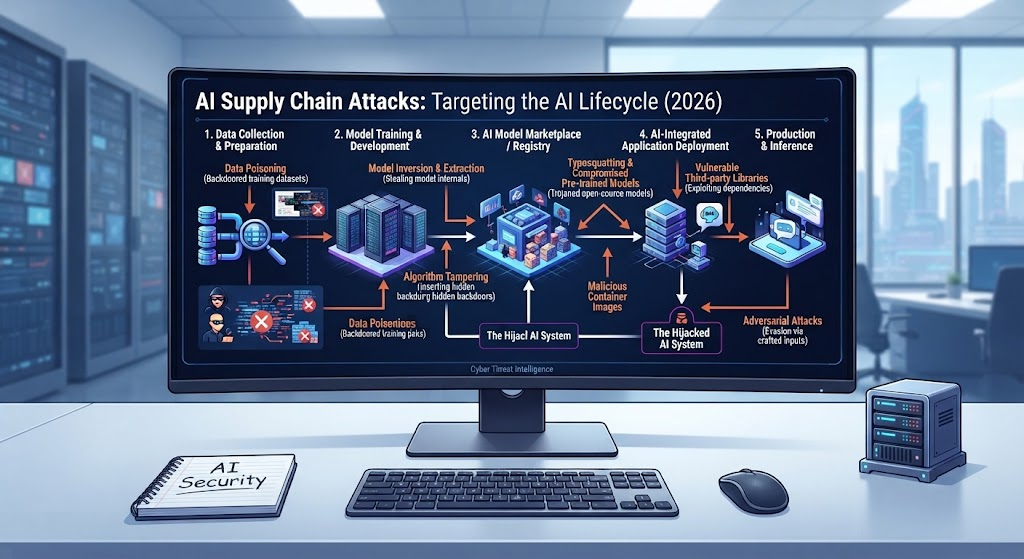
That trusted component could be an AI model, dataset, library, package, plugin, API, or supplier. Once compromised, the weakness can move into the final AI application.
OWASP identifies supply-chain risks across training data, models, deployment platforms, third-party components, and other parts of the AI lifecycle.
Trusted Sources:
| Authoritative Source | Explore Now |
|---|---|
| OWASP – LLM03:2025 Supply Chain | Link in the definition and AI supply chain risks sections. OWASP specifically covers training data, models, dependencies, third-party models, and deployment risks. Read OWASP |
| CISA – SBOM Minimum Elements | Link where you discuss software dependencies, SBOMs, package visibility, and supply-chain monitoring. Read CISA Guide |
| CISA – SBOM Resources | Link from your protection section when explaining software-component visibility. Explore CISA Resources |
| CISA – Software Supply Chain Security | Link when comparing software supply chain attacks with AI supply-chain attacks. Read CISA Guidance |
What Are AI Supply Chain Attacks?
An AI supply chain attack happens when attackers compromise a component used to build, train, deploy, or operate an AI system. The target may be upstream from the company using the final AI product.
The attack can involve training data, AI datasets, models, libraries, software dependencies, APIs, or suppliers. This creates AI supply chain risks because one compromised component can affect many downstream users.
For example, a company may download an open-source AI model from a public repository. The model may look legitimate. However, its origin, files, dependencies, or training process may not have been properly verified.
OWASP notes that AI supply chains can affect model integrity, training data integrity, and deployment platforms.
Why AI Supply Chain Security Matters in 2026
AI development is becoming more connected. Developers often combine foundation models, large language models, APIs, cloud platforms, AI libraries, and external services.
This expands the attack surface. A security problem inside one supplier can reach many organizations that depend on it. That is why AI supply chain security now belongs inside normal cybersecurity planning.
The risk is also visible in wider software security. Google Threat Intelligence reported major open-source supply-chain campaigns during 2025 and early 2026. Some incidents targeted software dependencies used by AI environments.
How AI Supply Chain Attacks Work
The basic process is simple. An attacker first finds something that many AI systems trust. The attacker then compromises that component or supplier.
The compromised component reaches developers or production systems through a normal update, download, integration, or deployment process. This can make the attack difficult to notice because the victim may believe the component is legitimate.
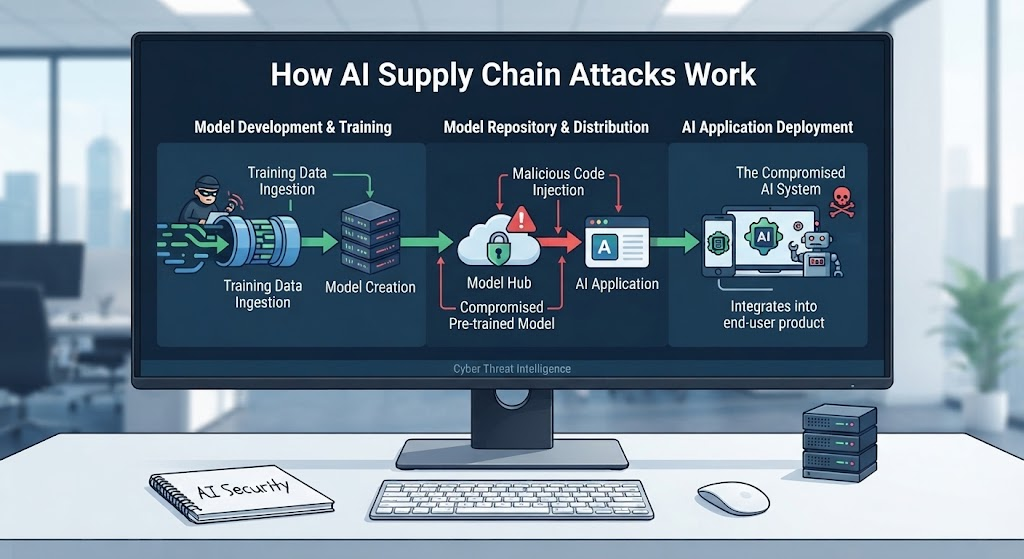
The attack can target AI models, machine learning models, datasets, open-source packages, cloud services, or credentials. The final objective may include data theft, unauthorized access, model manipulation, or malware delivery.
7 Ways Hackers Can Attack the AI Supply Chain
Attackers have several paths into modern AI environments. Some paths look similar to traditional software supply chain attacks.
Others are specific to AI. They involve models, training data, model repositories, AI agents, plugins, and external AI services.
Malicious AI Models and Model Dependencies
Attackers can publish or modify an AI model that appears trustworthy. A developer may download it because it has a familiar name or high usage.
The danger increases when teams fail to verify model integrity and provenance. A modified model can contain hidden weaknesses or unexpected behavior. OWASP specifically warns about vulnerable pre-trained models and weak model provenance.
A model can also depend on external libraries. If those libraries contain vulnerable dependencies, the final AI application can inherit their risks.
Poisoned Training Data and Datasets
AI systems learn from data. If attackers manipulate that data, they may influence future model behavior.
This technique is called data poisoning. More specifically, AI data poisoning can insert misleading or harmful information into training data.
A poisoned dataset may appear normal during basic review. The harmful information could be designed to trigger specific behavior later. OWASP lists data and model poisoning as a major GenAI risk.
Compromised AI Libraries and Packages
AI applications commonly use AI libraries, AI frameworks, and open-source packages. Developers may install many packages during model development.
An attacker who compromises one package can potentially reach the developer environment or production system. The package may contain malicious code that runs during installation or execution.
This is not only theoretical. Google reported a 2026 compromise involving malicious code introduced through a popular npm package. The package had more than 100 million weekly downloads for one affected version line.
Malicious AI Plugins and Extensions
AI applications increasingly use plugins, extensions, tools, and agent skills. These components can provide extra abilities to an AI system.
The problem begins when a plugin receives excessive permissions. A malicious plugin could attempt to access files, credentials, APIs, or connected services.
This makes plugin verification part of AI system security. Security teams should inspect the source, permissions, dependencies, update process, and reputation of every external extension.
Stolen API Keys and AI Credentials
AI systems often connect to external services through APIs. These connections require API keys, tokens, and access credentials.
If attackers steal these secrets, they may use legitimate services without immediately triggering traditional malware alerts. They could consume AI resources, access private data, or move deeper into connected systems.
Strong API security therefore needs secret protection, short-lived credentials, access limits, logging, and regular rotation.
Compromised Open-Source AI Components
Open-source development brings major benefits. It also introduces new security responsibilities.
Open-source AI security requires more than checking whether a project is popular. Teams should examine its maintainers, releases, dependencies, signatures, vulnerabilities, and update history.
The same principle applies to open-source AI models. A public model is not automatically a verified model. Teams should establish trust before putting it into production.
Third-Party AI Services and Dependencies
Many businesses now depend on third-party AI services for inference, embeddings, data processing, security scanning, or automation.
Each provider becomes part of the company’s AI ecosystem. A compromise at one provider can therefore become a downstream cybersecurity risk.
Companies should assess providers before integration. They should also review contracts, access permissions, security controls, incident reporting, and data handling practices.
How AI Supply Chain Attacks Can Affect Businesses
A compromised AI component can cause more than an incorrect model response. It can expose customer information, intellectual property, credentials, source code, or internal business data.
The impact depends on the compromised component and its permissions. A simple library may expose a developer machine. A compromised production service could affect a much larger environment.
Businesses should therefore treat AI supply chain threats as part of enterprise AI risk management. Security teams need visibility from development through production.
| Risk area | Possible business impact |
|---|---|
| Compromised model | Manipulated or unsafe outputs |
| Poisoned dataset | Hidden model behavior |
| Malicious package | Malware or credential theft |
| Stolen API key | Unauthorized service access |
| Compromised supplier | Data or system exposure |
| Vulnerable plugin | Unauthorized actions |
| Weak deployment | Production compromise |
AI Supply Chain Attacks vs Traditional Software Supply Chain Attacks
Traditional software supply chain attacks usually target source code, packages, build systems, dependencies, or developer tools.
AI introduces additional layers. The supply chain can include machine learning models, datasets, model weights, embeddings, fine-tuning adapters, prompts, plugins, and AI services.
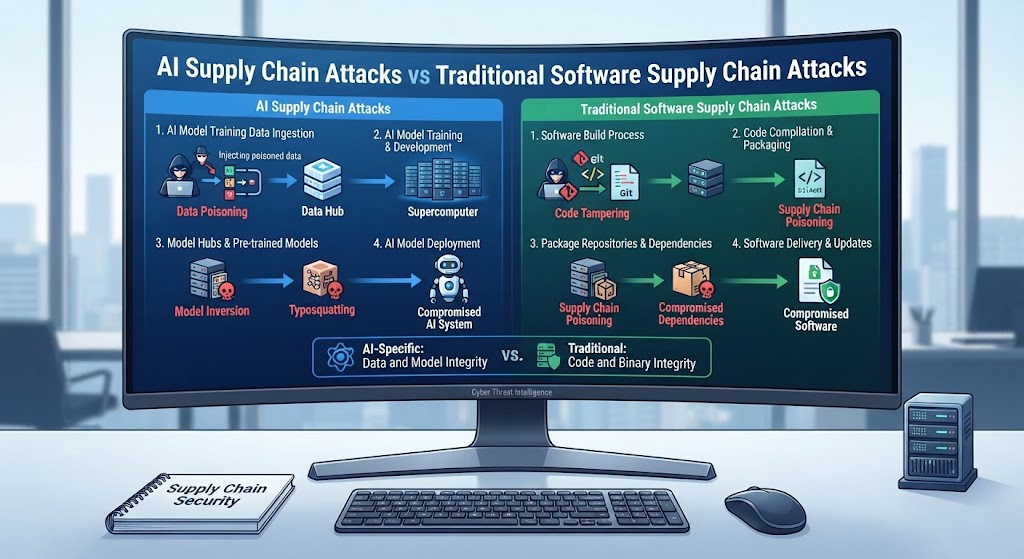
This does not mean AI replaces traditional security. Instead, AI adds new assets that need protection. OWASP explains that AI supply chains include traditional dependency risks plus risks involving models and data.
| Traditional software | AI environment |
|---|---|
| Source code | Source code plus models |
| Libraries | AI libraries and frameworks |
| Packages | Packages plus model files |
| Dependencies | Software and model dependencies |
| Build pipeline | ML and AI pipelines |
| Data | Training and evaluation data |
| Application | AI application or agent |
Real-World AI Supply Chain Security Risks
Real incidents show why supply-chain security matters. Google Threat Intelligence reported that large open-source supply-chain campaigns expanded during 2025 and early 2026.
One 2026 incident involved malicious changes to the popular axios npm package. Attackers introduced a malicious dependency after compromising a maintainer account.
Google also reported activity involving AI environments, software dependencies, and AI tools. In September 2026, its threat research described attackers targeting open-source ecosystems and AI-related assets.
These cases demonstrate a basic lesson. Attackers do not always need to break the final application. They can attack something the application already trusts.
How Hackers Could Poison AI Models and Data
Model poisoning can happen when attackers manipulate model parameters, training material, adapters, or other AI components.
Model poisoning can be subtle. The model may perform normally during general testing. A hidden trigger could cause different behavior under specific conditions.
The same concept applies to compromised datasets. An attacker may alter selected records while leaving most of the dataset unchanged.
OWASP describes risks involving poisoned datasets, tampered models, vulnerable pre-trained models, and compromised model-development processes.
Detection requires strong data integrity, model integrity, version control, provenance checks, and controlled testing. Teams should compare trusted hashes and investigate unexpected changes.
How to Detect an AI Supply Chain Attack
Detection starts with visibility. A company cannot protect components it does not know it uses.
Security teams should maintain inventories of models, packages, datasets, APIs, plugins, suppliers, and deployment environments. This supports vulnerability management and faster threat detection.
Monitoring should also cover unusual package changes, unexpected network traffic, new credentials, abnormal model behavior, and unauthorized deployment changes.
When suspicious activity appears, incident response should isolate the affected component quickly. Teams should preserve logs and determine whether the compromise moved downstream.
10 Ways to Protect AI Systems From Supply Chain Attacks
Protecting AI requires layered controls. No single scanner can verify every model, package, dataset, and supplier.
A mature program combines AI security best practices, supplier assessment, technical controls, monitoring, testing, access restrictions, and governance. OWASP recommends supplier vetting, vulnerability scanning, model integrity checks, component inventories, red teaming, and strong monitoring.
Verify AI Models Before Deployment
Never treat a downloaded model as automatically safe. Check its source, version, hash, documentation, dependencies, and known security issues.
Model repositories should be part of your risk assessment process. Use trusted sources and preserve evidence about where every production model came from.
Secure Training Data and Datasets
Protect AI datasets like important software assets. Control who can add, change, or remove training records.
Use validation and anomaly checks before data enters a training pipeline. Keep clean versions so teams can investigate unexpected model behavior later.
Monitor Third-Party AI Dependencies
Every external dependency creates potential exposure. Maintain an inventory of third-party dependencies and review them regularly.
Teams should know which application uses each dependency. They should also know who maintains it and whether it still receives security updates.
Scan Open-Source AI Packages
Package scanning can identify known security vulnerabilities before deployment. However, scanning should not be the only control.
Developers should also verify package ownership, release integrity, signatures, source changes, and unexpected dependencies. This strengthens package integrity.
Protect AI API Keys and Credentials
Never store sensitive API keys inside public repositories or application code.
Use a secure secret-management system. Limit credentials to the permissions they actually need. Rotate exposed credentials quickly and monitor their usage.
Control AI Plugins and Extensions
AI plugins should follow the same principle as other third-party software. Verify the source and limit permissions.
This becomes even more important when AI agents can call tools automatically. A compromised tool can turn a small supply-chain weakness into a wider security incident.
Use Software and AI Supply Chain Monitoring
Modern environments need continuous security monitoring. A one-time security review cannot identify every new dependency compromise.
Monitoring should cover packages, models, repositories, credentials, APIs, deployment systems, and AI behavior. Automated alerts can help security teams respond faster.
Apply Zero-Trust Security to AI Systems
Zero trust security assumes that every connection must be verified. AI applications should not receive unlimited access simply because they operate inside a trusted network.
Use identity checks, least privilege, segmentation, and continuous verification. Combine this with identity and access management to control human and machine permissions.
Keep AI Components Updated
Outdated components can contain known weaknesses. However, updating blindly can also introduce risk.
Use controlled updates. Test new versions before production deployment. Maintain rollback procedures and verify release integrity before installation.
Test AI Systems Before Production
Security testing should happen before an AI system reaches production. This includes dependency scanning, model evaluation, adversarial testing, and penetration testing where appropriate.
Testing should cover the complete system. That means the model, application, APIs, plugins, infrastructure, identities, and data pipeline.
Why Open-Source AI Can Create New Security Risks
Open-source AI can accelerate development. Developers can access models, datasets, frameworks, and tools without building everything from zero.
The challenge is trust. Popularity does not guarantee security. A project may have hidden dependencies, weak maintenance, compromised accounts, or unclear provenance.
Strong open-source AI security requires technical and organizational controls. Teams should verify components before deployment and continue monitoring them after deployment.
AI Agents and the Supply Chain Security Problem
AI agents create another layer of risk. Agents can connect models with tools, APIs, websites, files, and business systems.
This means an attacker may target the tool instead of the model. A compromised tool can potentially inherit the agent’s permissions.
Google reported in 2026 that threat actors were targeting AI tools and open-source software ecosystems. Its research also described attackers manipulating AI coding assistants and security scanners.
Agent security therefore needs strict permissions, tool verification, logging, and AI threat detection. Every connected tool should be treated as part of the agent’s attack surface.
How Companies Can Build a Secure AI Supply Chain
A secure AI supply chain starts with visibility. Companies should map every component from data collection to production deployment.
This includes models, datasets, packages, APIs, cloud services, suppliers, plugins, and credentials. The inventory should also identify owners and security responsibilities.
Companies can then build an AI security architecture around those assets. This architecture should combine AI security controls, access management, monitoring, testing, and response processes.
NIST’s 2026 work on AI and supply-chain management also highlights the growing importance of understanding AI-related supply-chain risks and opportunities.
Common AI Supply Chain Security Mistakes to Avoid
One common mistake is trusting a component because it is popular. Popular software can still be compromised.
Another mistake is focusing only on application code. Modern AI systems also depend on data, models, services, packages, and deployment infrastructure.
Weak AI governance creates another problem. Without clear ownership, teams may not know who should approve models, suppliers, plugins, or sensitive AI integrations.
A strong security program connects AI security, vulnerability management, risk assessment, and incident response instead of treating them as separate tasks.
Frequently Asked Questions About AI Supply Chain Attacks
What Is an AI Supply Chain Attack?
An AI supply chain attack targets a component used by an AI system. The target can be a model, dataset, package, API, plugin, supplier, or development tool.
The attacker compromises that component before it reaches the final system. The victim then receives the malicious or vulnerable component through a trusted workflow.
How Do Hackers Attack AI Systems?
Hackers can target models, datasets, packages, credentials, APIs, plugins, repositories, and suppliers.
Common AI attack vectors include poisoned data, compromised packages, stolen credentials, malicious models, vulnerable dependencies, and compromised third-party services.
Can AI Models Be Compromised?
Yes. AI models can be modified, poisoned, or replaced.
Attackers may target model files, training processes, fine-tuning components, or model repositories. Strong model integrity checks can reduce this risk.
Can Training Data Be Poisoned?
Yes. Training data can be manipulated before or during model development.
This is known as data poisoning. The goal may be to change model behavior, create hidden triggers, or influence selected outputs.
Are Open-Source AI Models Safe?
An open-source model is not automatically safe or unsafe. Its security depends on its source, maintenance, dependencies, provenance, testing, and deployment environment.
Organizations should perform appropriate AI security checks before using external models in production.
How Can Businesses Protect AI Supply Chains?
Businesses should verify suppliers, models, datasets, packages, APIs, and plugins. They should also use access controls, scanning, monitoring, testing, and incident response.
These controls form the foundation of AI supply chain protection.
What Is AI Supply Chain Security?
AI supply chain security protects the components used to develop, deploy, and operate AI systems.
It covers models, data, software, infrastructure, suppliers, APIs, credentials, and external services.
Are AI Agents Vulnerable to Supply Chain Attacks?
Yes. AI agents can depend on external tools, plugins, APIs, packages, and services.
A compromised component may affect the agent’s actions or expose connected systems. Strong permissions and monitoring are therefore essential.
Final Thoughts: Securing the AI Supply Chain in 2026
AI supply chain security is becoming a core part of modern cybersecurity. AI systems now depend on large ecosystems of software, data, models, services, and tools.
Attackers can exploit this complexity. They may target a package instead of an application. They may poison data instead of attacking a server. They may compromise a supplier instead of breaking into a company directly.
The answer is not to avoid AI. The goal is to build secure AI systems with visibility and strong controls.
Companies should verify components, protect credentials, monitor dependencies, test models, control access, and maintain clear ownership.
The most important principle is simple: trust should be verified, not assumed.
As AI systems become more connected and autonomous, AI security in 2026 requires protection across the entire lifecycle. That includes development, training, deployment, integration, monitoring, and incident response.
Strong AI threat intelligence, continuous AI security monitoring, and practical AI security solutions can help organizations reduce exposure before a small supply-chain weakness becomes a major incident.
Article Related Information:
| Article Related Information | Explore Now |
|---|---|
| AI Agent Security in 2026: How Autonomous AI Is Changing Cyberattacks | Link from the section about AI agents and supply-chain security. Learn now |
| AI Cybersecurity Threats in 2026: 15 New Risks You Need to Know | Link from AI supply chain threats, AI security risks, or the introduction. Learn now |
| AI-Driven Cyber Threats in 2026 | Link from the section discussing AI cyberattacks, threat actors, and changing attack methods. Learn now |
| AI Agent vs Software Agent: 7 Powerful Differences | Link from the AI Agents and the Supply Chain Security Problem section. Learn now |
| Software Agent: The Ultimate Guide | Link when explaining software dependencies, agents, tools, and autonomous systems. Learn now |
| OpenAI AI Agent Warning | Link from the section discussing real-world AI-agent security risks. Learn now |
| AI Security Warning: OpenAI, Anthropic and 100+ Companies | Link from the section about AI security threats and the wider AI threat landscape. Learn now |
| OpenAI Hugging Face Cybersecurity Breach | Link from Real-World AI Supply Chain Security Risks or the AI-agent section. Learn now |
Description:
AI supply chain attacks can target models, data, packages, and APIs. Learn 7 major risks and how to protect AI systems in 2026.