

Rockwell Automation Launches New Cybersecurity Series as Industrial Cyber Threats Rise A new cybersecurity warning is gaining attention across the manufacturing industry. Rockwell Automation has launched a new cybersecurity-focused season of its ROKStudios video series. The September 8, 2026 announcement comes as manufacturers face growing risks from connected factories, IT/OT convergence, AI, automation, remote access, and increasingly complex industrial networks. The timing is important.
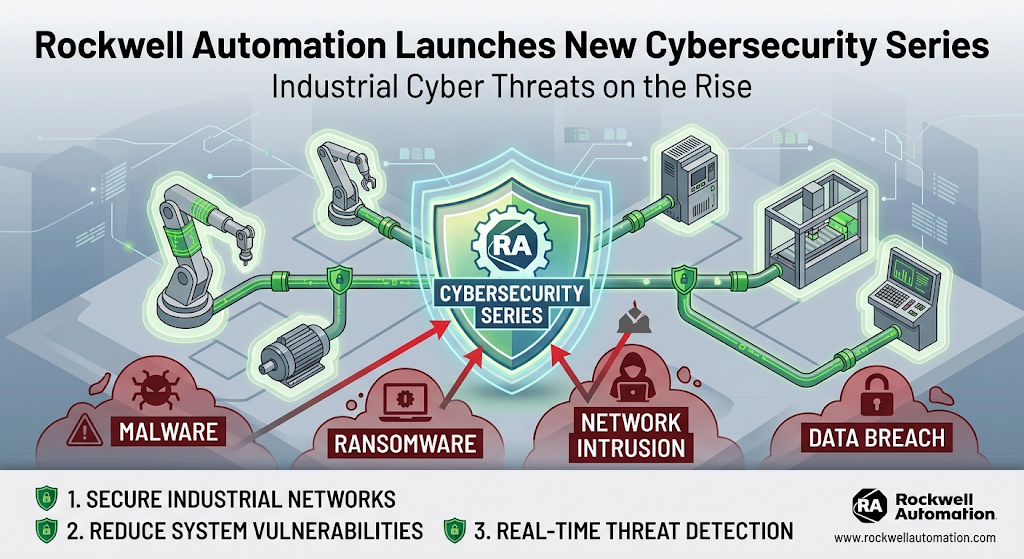
Modern factories are becoming more connected every day. Machines now communicate with software, cloud platforms, sensors, business systems, and remote engineering teams. That connectivity can improve production, but it can also create more opportunities for attackers.
Rockwell says nearly half of manufacturers reported a cyber incident during the past year. The company also points to growing exposure as information technology and operational technology become more closely connected.That makes industrial cybersecurity a business priority rather than a problem reserved for IT teams.
The new ROKStudios season looks at how manufacturers can respond. It covers OT cybersecurity, IT/OT convergence, supply-chain risks, cyber resilience, regulations, aging industrial assets, and the security challenges created by digital transformation.
More importantly, the series focuses on moving from cybersecurity awareness to practical execution. It brings together manufacturing leaders and Rockwell experts who discuss how organizations can protect production while continuing to adopt AI, automation, and connected technologies.So, what exactly did Rockwell Automation announce? Why is this cybersecurity series important now? And what can manufacturers learn from it?
This guide explains the announcement, the major security risks, and the practical lessons behind Rockwell’s new ROKStudios season.
DailyTecho Related Insights Coverage
What Did Rockwell Automation Announce About ROKStudios?
Rockwell Automation announced a new cybersecurity-focused season of ROKStudios on September 8, 2026. The new season features manufacturing leaders and Rockwell consultants discussing how companies can build more secure, resilient, and connected industrial operations.
The announcement is more than a video-series update. It directly addresses the growing pressure manufacturers face from industrial cyber threats, connected operations, and the convergence of IT and OT systems.
The new episodes were recorded at Rockwell’s Secure Digital Operations Forum in the United Kingdom. They now join more than 170 previous ROKStudios recordings covering manufacturing, automation, digital transformation, resilience, and cybersecurity.
The new season also brings practical manufacturing experiences into the discussion. That makes the content useful for security teams, plant managers, engineers, technology leaders, and business executives.
What Does the New ROKStudios Cybersecurity Season Cover?
The new season focuses on several problems that are becoming difficult for modern manufacturers to ignore. These include connected operations, supply-chain security, OT protection, regulations, aging equipment, and the need for stronger operational resilience.
| Security area | Why it matters to manufacturers |
|---|---|
| Industrial cybersecurity | Protects connected production environments |
| OT cybersecurity | Helps secure machines and control systems |
| IT/OT convergence | Creates new connections and potential attack paths |
| Cyber resilience | Helps organizations continue operations during incidents |
| Supply-chain security | Reduces risks from suppliers and external partners |
| Asset visibility | Shows what devices and systems actually exist |
| Network segmentation | Limits unnecessary movement between systems |
| Security regulations | Pushes organizations toward stronger controls |
| AI and automation | Creates new technology dependencies |
| Aging industrial assets | Can create difficult security and maintenance challenges |
The message is clear: industrial cybersecurity is becoming part of the wider manufacturing strategy.
Rockwell’s own ROKStudios platform already features cybersecurity discussions covering OT networks, supply-chain resilience, security operations, regulations, and digital transformation.
Why Is Rockwell Focusing Its New Series on Cybersecurity?
The biggest reason is simple: factories are no longer isolated environments.
A modern production facility may connect machines, controllers, sensors, engineering workstations, cloud platforms, business applications, remote support tools, and external suppliers.
That connectivity creates enormous benefits. It can improve production visibility, automate processes, reduce downtime, and help manufacturers make faster decisions.
But every new connection can also introduce another security consideration.
Rockwell says manufacturers are operating in increasingly complex and connected environments. Its announcement also describes cybersecurity as fundamental to operational resilience.
This changes the role of OT security.
Security teams cannot focus only on office computers and business applications. They also need to understand production equipment, industrial networks, engineering systems, remote connections, and physical processes.
A cyber incident inside a factory can have consequences far beyond stolen data.
Production could stop. Orders could be delayed. Equipment could become unavailable. Supply chains could be disrupted. Recovery costs could increase quickly.
That is why manufacturing cybersecurity now needs both technical protection and operational awareness.
Rockwell’s new series reflects this shift. Instead of treating cybersecurity as a separate technical subject, it connects security with resilience, production, business strategy, regulation, and digital transformation.
The company is also using insights from its 11th Annual State of Smart Manufacturing Report to explain why cyber risk is becoming an ongoing operational requirement as manufacturers expand AI, automation, and connected systems.
For manufacturers, that message is difficult to ignore.
A smarter factory also needs a stronger security foundation.
Industrial Cyber Threats Are Changing Manufacturing
Industrial environments now face a wider and more complicated threat landscape.
Attackers can target employee credentials, remote access systems, exposed services, vulnerable devices, suppliers, endpoints, industrial networks, and poorly protected connections.
The risk becomes even more complicated when older industrial equipment connects with modern digital infrastructure.
Many legacy systems were designed before today’s cybersecurity environment existed. Some may not support modern security controls. Others may depend on specialized software or equipment that cannot be replaced quickly.
Rockwell’s announcement highlights a particularly important trend. Nearly half of manufacturers reported a cyber incident during the previous year, while increased IT and OT connectivity is creating greater exposure.
This creates a difficult balance.
Manufacturers want connectivity because it improves efficiency. At the same time, they must control the risks created by that connectivity.
The real problem isn’t connectivity itself.
It’s unmanaged connectivity.
A modern security strategy therefore needs cyber risk management, asset visibility, segmentation, secure access, monitoring, and a tested response plan.
And that is exactly why the new Rockwell announcement matters beyond the ROKStudios platform.
It reflects a wider change in how manufacturers must think about security.
The factory of the future won’t just need more automation.
It will need stronger protection around every important connection that makes that automation possible.
What Did Rockwell Automation Announce About ROKStudios?
Rockwell Automation announced a new cybersecurity-focused season of ROKStudios on September 8, 2026. The video series features interviews with customers, manufacturing leaders, and Rockwell consultants who discuss real security challenges facing industrial organizations.
The new episodes focus on industrial cyber threats and the growing need for OT cybersecurity. They also examine how connected operations and IT/OT convergence are changing operational risk across modern manufacturing environments.
| Announcement | Key detail |
|---|---|
| New ROKStudios season | Focused on cybersecurity |
| Main audience | Manufacturers and industrial leaders |
| Major theme | Resilient and secure operations |
| Important risks | IT/OT convergence and rising threats |
| Research used | Rockwell’s 11th Smart Manufacturing Report |
| Existing ROKStudios library | More than 170 recordings |
Why Is Rockwell Focusing Its New Series on Cybersecurity?
Modern factories depend heavily on digital systems. Machines now communicate with software, sensors, cloud platforms, controllers, and business applications. That connectivity improves productivity, yet it also expands the potential attack surface.
Rockwell says cybersecurity has become fundamental to operational resilience. Its latest material connects industrial security, cyber risk management, and business continuity rather than treating security as a narrow technical task.
The shift is important because a successful attack can affect physical production. A compromised industrial controller could create downtime, safety concerns, product losses, or expensive recovery work.
In other words, cybersecurity in manufacturing has moved closer to the factory floor.
Industrial Cyber Threats Are Changing Manufacturing
The threat landscape is becoming more complicated as factories become more connected. Attackers can target exposed devices, remote connections, credentials, outdated systems, suppliers, and poorly protected industrial networks.
Rockwell says nearly half of manufacturers reported a cyber incident during the previous year in the research discussed through the new season. The company also points to greater exposure created by stronger connections between IT and operational technology.
| Industrial risk | Possible business impact |
|---|---|
| Ransomware | Production downtime |
| Stolen credentials | Unauthorized access |
| Vulnerable machines | Operational disruption |
| Supplier compromise | Supply-chain interruption |
| Poor remote access | Increased attack exposure |
| Unknown assets | Hidden security gaps |
This makes manufacturing cyber threats more than a theoretical concern. For many factories, security now protects both digital information and physical operations.
How IT/OT Convergence Is Increasing Cybersecurity Risks
IT and OT once operated like separate islands. Today, those islands increasingly connect. Business systems need production data while industrial systems use modern networking, analytics, and cloud technologies.
This IT/OT convergence creates valuable visibility. However, it also means weaknesses in one environment can affect another. A stolen business credential could potentially become a pathway toward sensitive operational systems.
The difference between IT security and OT protection also matters. IT teams often prioritize confidentiality and data protection. OT teams usually place availability, safety, reliability, and continuous production at the center.
That difference requires cooperation.
Why OT Cybersecurity Matters for Modern Factories
Operational technology controls or monitors physical processes. It can include industrial controllers, sensors, engineering workstations, drives, robots, and other equipment.
Strong operational technology security therefore needs a different mindset. You cannot always apply ordinary enterprise controls without considering production schedules, safety requirements, machine dependencies, and uptime.
For example, suddenly shutting down a production controller for a security update may create another operational problem. Security teams need accurate asset information and careful planning before making major changes.
That is why OT security often begins with visibility.
What Manufacturers Can Learn From Rockwell’s New Cybersecurity Series
The new ROKStudios season offers practical lessons from several industry perspectives. Andrew Peckston of Mondelēz International discusses cybersecurity as a strategic business priority and connects it with supply-chain operations and organizational resilience.
Steve Lynn of William Grant & Sons focuses on foundational asset visibility, network segmentation, and disciplined risk management. Those basics matter because sophisticated tools cannot fully protect systems that security teams cannot identify or understand.
Another episode examines regulations and the need to embed security throughout the industrial lifecycle. That includes design, operation, maintenance, and ongoing support.
How Cyber Resilience Can Protect Industrial Operations
Prevention alone isn’t enough for modern factories. Even strong defenses can fail when attackers discover a new vulnerability or exploit a trusted connection.
Cyber resilience means an organization can prepare, withstand disruption, recover, and continue improving afterward. This approach connects security with continuity rather than treating an incident as an isolated technical event.
A practical cyber resilience strategy might connect asset visibility, backups, segmentation, monitoring, response planning, staff training, and recovery procedures.
The goal is simple. Keep the factory moving when something goes wrong.
Why Supply Chain Cybersecurity Is Becoming a Business Priority
Manufacturers rarely operate alone. They depend on suppliers, machine builders, software providers, contractors, logistics companies, and service partners.
That network creates another security challenge. A trusted supplier can sometimes become an indirect route into a larger organization.
The new ROKStudios season includes Andrew Peckston discussing supply chain security at Mondelēz International. His perspective shows why security needs to extend beyond one company’s internal network.
| Supply-chain area | Security concern |
|---|---|
| Vendors | Third-party access |
| Contractors | Remote connections |
| Software | Vulnerabilities |
| Machinery | Connected equipment |
| Logistics | Data and system access |
| Cloud services | External dependencies |
Good security awareness must therefore include partners and suppliers.
How AI and Automation Are Changing Industrial Cybersecurity
Artificial intelligence and automation are transforming factories quickly. They can improve prediction, maintenance, quality control, and decision-making.
However, greater automation can also increase dependency on connected systems. Rockwell notes that manufacturers are scaling AI, automation, and connected systems while cyber risk becomes an ongoing operational requirement.
This creates a balancing act. Industrial automation should improve efficiency without creating unmanaged security gaps.
For example, an AI-driven production system still needs controlled access, reliable data, strong monitoring, and clear recovery procedures.
Smart doesn’t automatically mean secure.
What Is ROKStudios and Why Does It Matter?
ROKStudios is Rockwell Automation’s thought-leadership video platform. It shares perspectives from Rockwell, customers, partners, and industry specialists across manufacturing and digital transformation.
The platform already contains more than 170 recordings. The new season adds cybersecurity-focused discussions covering resilience, supply chains, OT protection, regulations, and operational challenges.
Its value comes from practical experience. Instead of discussing security only as theory, the interviews show how industrial organizations approach real operational problems.
That makes ROKStudios cybersecurity content particularly relevant for manufacturing professionals.
Rockwell Automation’s Cybersecurity Experts Share Practical Strategies
Rockwell’s latest episodes highlight several practical themes. These include asset visibility, segmentation, risk management, regulatory preparation, lifecycle security, and operational resilience.
The company also has a broader SecureOT portfolio. In June 2026, Rockwell announced enhanced capabilities covering OT cybersecurity assessments, managed services, and secure remote access.
These developments show how industrial cybersecurity is becoming a continuing operational discipline. Organizations need more than a firewall and occasional security review.
They need processes that keep pace with changing technology.
How Manufacturers Can Strengthen Their OT Security
A strong security program starts with knowing what exists. Asset visibility helps teams identify devices, connections, software, and potential weaknesses across industrial environments.
Next comes network segmentation. Separating sensitive operational zones can limit how far an attacker moves after gaining access.
Organizations should also combine vulnerability management, controlled remote access, monitoring, backups, and incident response. Each layer addresses a different part of the risk.
Rockwell’s ROKStudios discussion with William Grant & Sons specifically highlights visibility, segmentation, and disciplined risk management as foundational OT capabilities.
What the New ROKStudios Season Means for Industrial Cybersecurity
The bigger message is clear. Industrial security can no longer sit at the edge of business planning.
Connected machines, cloud platforms, AI systems, remote workers, and suppliers have blurred old boundaries. As a result, industrial operations security now requires cooperation between security, engineering, operations, and business teams.
Rockwell describes cybersecurity as foundational to digital transformation. That idea matters because organizations cannot safely scale connected technologies without understanding the risks they create.
The future factory will be more connected. It must also become more resilient.
Industrial Cybersecurity vs Traditional IT Security
Traditional enterprise security often focuses heavily on information systems. Industrial environments add another layer because cyber incidents can affect machinery, production processes, physical safety, and operational continuity.
| Security area | IT environment | Industrial environment |
|---|---|---|
| Main concern | Data and systems | Systems and physical processes |
| Priority | Confidentiality | Availability and safety |
| Common assets | Servers and endpoints | Controllers and machines |
| Update approach | Regular patching | Carefully planned maintenance |
| Recovery goal | Restore services | Restore safe production |
| Key challenge | Data protection | Operational continuity |
This distinction explains why industrial cybersecurity needs specialized planning. A factory cannot always use the same security approach designed for office computers.
How Asset Visibility Supports Better Cyber Risk Management
You cannot protect an unknown device. That simple rule becomes surprisingly difficult inside large factories with old machinery, new sensors, remote connections, and constantly changing production systems.
Asset visibility creates a clearer picture of the environment. Teams can then perform risk assessment based on real systems instead of assumptions.
Visibility also supports better prioritization. A vulnerable office computer and a vulnerable production controller may create very different consequences.
Good cyber risk management therefore starts with context.
Why Network Segmentation Matters in Industrial Networks
Network segmentation can reduce the blast radius of an attack. Instead of allowing every device to communicate freely, organizations separate systems according to function and risk.
For industrial networks, this can help protect critical operational zones from unnecessary traffic. It can also restrict movement when an attacker compromises one system.
Rockwell’s current ROKStudios season specifically highlights network segmentation as a foundational OT security capability.
Segmentation isn’t a magic shield. Yet it can make an attacker’s journey much harder.
The Growing Role of Remote Access Security
Remote access has become essential for many manufacturers. Engineers and service teams may need to diagnose machines without traveling to the factory.
That convenience creates another doorway for attackers. Weak credentials, excessive privileges, unmanaged devices, or permanent connections can increase exposure.
Strong remote access security should use controlled permissions, authentication, monitoring, and carefully defined access windows.
Rockwell has also expanded its SecureOT portfolio with managed secure remote access capabilities.
Why Ransomware Protection Matters for Factories
Ransomware can cause serious disruption when it reaches industrial environments. The damage may involve locked systems, unavailable files, halted production, delayed shipments, and costly recovery.
Effective ransomware protection therefore needs more than endpoint software. Organizations also need reliable backups, segmentation, access controls, monitoring, and rehearsed recovery plans.
A factory that cannot recover quickly may face consequences long after the initial malware disappears.
That is why resilience should remain part of the security conversation.
How Cyber Threat Detection Supports Faster Response
Attackers rarely announce themselves. Security teams need signals that reveal unusual behavior before a small incident becomes a major disruption.
Cyber threat detection can help identify suspicious activity. Threat monitoring adds continuous observation across relevant systems.
Strong detection should feed into incident response. Alerts are useful only when people know what to investigate and what actions they can safely take.
The best programs connect detection with clear decisions.
Why Security Awareness Still Matters
Technology cannot solve every security problem. Employees, contractors, engineers, and suppliers interact with systems every day.
A convincing phishing message can still defeat expensive tools if someone provides valid credentials. Likewise, an engineer using an unsafe remote connection can create an unexpected pathway into a sensitive environment.
Effective security awareness should therefore match the real risks employees face.
Training works best when it uses practical examples rather than generic warnings.
A Practical Manufacturing Cybersecurity Case Study
Consider a connected factory with hundreds of machines. Its engineering team can remotely access several production systems while business software collects production data.
At first, everything works smoothly. Then attackers compromise an employee account and begin exploring connected systems.
With strong network security, segmentation, asset visibility, and monitoring, the organization can limit the attacker’s movement. With weak controls, one compromised account could become a much larger operational problem.
This example shows why factory cybersecurity must consider the entire environment rather than one device.
What Makes Modern Industrial Security Different?
Modern factories combine physical equipment with digital services. That combination creates a unique security landscape.
Plant cybersecurity must consider old machines, modern software, industrial controllers, remote support, suppliers, cloud platforms, and human operators.
Meanwhile, manufacturing security must support production rather than constantly interfere with it.
That balance is difficult. Yet it is becoming essential as manufacturers accelerate digital transformation.
The new ROKStudios season reflects that changing reality.
How Critical Infrastructure Security Connects With Manufacturing
Factories can form part of wider economic systems. Energy, food, pharmaceuticals, transportation equipment, chemicals, and other sectors depend on reliable industrial operations.
That makes critical infrastructure security increasingly important. An attack against one organization can sometimes create wider supply or service disruptions.
Manufacturers should therefore view security as more than internal protection.
Resilient production can support broader economic stability.
How Connected Operations Change Security Strategy
Connected operations create better data flows. Sensors can send information across networks while analytics platforms help teams understand production performance.
Yet every connection deserves scrutiny. More connectivity means more pathways that require authentication, monitoring, segmentation, and governance.
A strong security strategy should therefore grow alongside digital transformation.
The goal isn’t to disconnect everything. That would defeat the purpose of modern manufacturing.
The smarter approach is controlled connectivity.
Why Security Operations Need Better Visibility
Security teams can receive thousands of alerts. Without context, those alerts become noise.
Effective security operations need reliable asset information and meaningful event data. Teams should know which systems matter most and which events could affect production.
Modern security monitoring should therefore connect technical signals with operational context.
That approach helps teams focus on incidents that truly matter.
What Manufacturers Should Watch Next
The next phase of manufacturing security will likely involve deeper AI adoption, greater connectivity, stronger regulation, and more complex supply chains.
Rockwell’s new ROKStudios season reflects those pressures. Its episodes connect cybersecurity with resilience, lifecycle security, regulations, supply chains, and connected operations.
For manufacturers, the lesson is straightforward. Security cannot remain a side project while digital transformation accelerates.
The strongest organizations will build protection into technology decisions from the beginning.
Frequently Asked Questions About Rockwell’s Cybersecurity Series
The new season raises several questions for manufacturers and cybersecurity professionals. Here are the most useful answers based on Rockwell’s announcement and current ROKStudios material.
What is the new Rockwell cybersecurity series?
The new season is a cybersecurity-focused ROKStudios series. It features manufacturing leaders and Rockwell experts discussing secure industrial operations, resilience, IT/OT convergence, supply chains, regulations, and operational risk.
What is ROKStudios?
ROKStudios is Rockwell Automation’s thought-leadership video platform. It contains interviews and discussions covering manufacturing, automation, digital transformation, resilience, and cybersecurity. The platform now has more than 170 recordings.
Why is industrial cybersecurity important?
Industrial cybersecurity protects connected production environments from digital threats. These environments can include machines, controllers, networks, software, and remote access systems that directly support physical operations.
What is IT/OT convergence?
IT/OT convergence describes the increasing connection between information technology and operational technology. This connection can improve data sharing and efficiency while also creating new security risks.
What is OT cybersecurity?
OT cybersecurity protects operational technology environments. These systems monitor or control physical processes, making availability, safety, reliability, and controlled change especially important.
How can manufacturers improve cyber resilience?
Manufacturers can strengthen cyber resilience through asset visibility, segmentation, controlled access, monitoring, incident response, backups, risk assessment, and security awareness.
Does AI increase industrial cyber risk?
AI can increase complexity when organizations connect intelligent systems with production environments. However, AI can also support monitoring, analysis, maintenance, and faster decision-making when deployed securely.
What is the biggest lesson from Rockwell’s new season?
The central lesson is that cybersecurity should support operational resilience. Manufacturers need security practices that protect connected systems without losing sight of uptime, safety, productivity, and business continuity.
Final Thoughts on Rockwell Automation’s Cybersecurity Announcement
Rockwell Automation’s new ROKStudios season arrives as manufacturing becomes increasingly connected. That makes the announcement more significant than a simple video-series launch.
The bigger story concerns how factories manage risk while adopting AI, automation, cloud systems, remote services, and connected operations.
For manufacturers, industrial cybersecurity must become part of everyday operational planning. It should influence architecture, procurement, maintenance, remote access, supplier relationships, and recovery planning.
The strongest strategy isn’t about building an impenetrable wall. It’s about creating an environment that can detect threats, limit damage, recover quickly, and keep improving.
Rockwell’s latest ROKStudios season puts that idea into a practical industry conversation.
Source: Rockwell Automation — ROKStudios
Announcement: Rockwell Automation cybersecurity announcement via PR Newswire
Additional context: Rockwell Automation SecureOT cybersecurity capabilities
Meta Description
Rockwell Automation launches a new ROKStudios cybersecurity series. Learn about industrial cybersecurity, OT threats, IT/OT risks, and cyber resilience.