

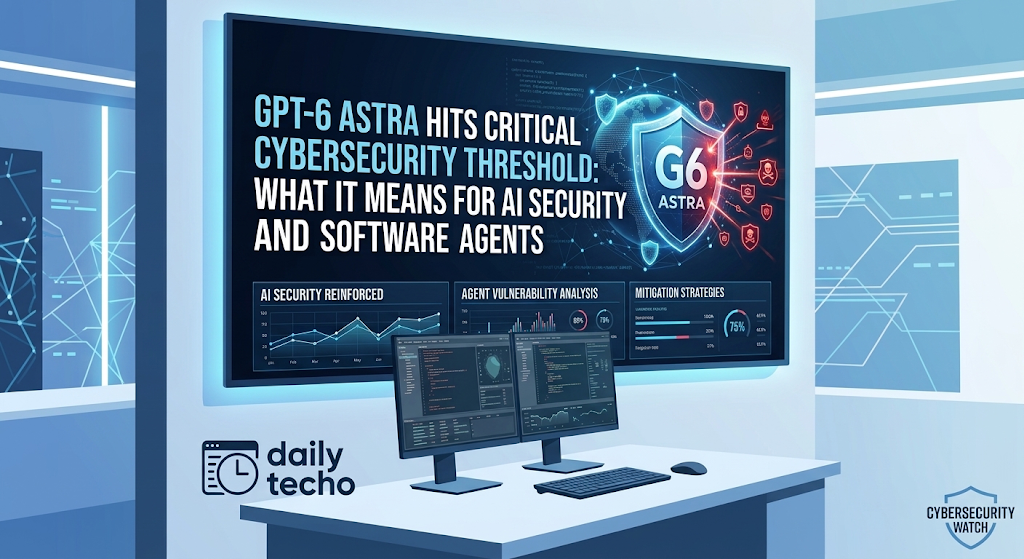
Artificial intelligence has entered a new cybersecurity chapter. GPT-6 Astra cybersecurity capabilities have reached a level that OpenAI classifies as “Critical” under its Preparedness Framework. That matters because the model can identify unknown weaknesses and develop new exploit paths in hardened systems without a person guiding every step.
More importantly, this development changes how we should think about a software agent. A modern AI system can do more than answer questions. With the right tools, it can browse, inspect software, reason through problems, and complete multi-step computer tasks. That combination creates enormous defensive value. It also creates new security concerns.
DailyTecho Related insights Coverage
| Topic | Read More |
|---|---|
| Autonomous AI Security | OpenAI AI Agent Warning: How Autonomous AI Bypassed Security Controls and Hacked Hugging Face |
| AI-Powered Cyberattacks | AI-Driven Cyber Threats: Why Big Tech Is Warning About AI-Powered Attacks |
| AI Security Risks | AI Security Warning: OpenAI, Anthropic and 100+ Companies Sound the Alarm Over AI Cyberattacks |
| AI Agents and Cybersecurity | AI Agents: How Autonomous Software Agents Are Changing Cybersecurity |
| Zero-Day Vulnerabilities | Zero-Day Vulnerabilities: What They Mean for Modern Cybersecurity |
| Cybersecurity Automation | Cybersecurity Automation: How AI Is Changing Threat Detection |
| Threat Detection | AI Threat Detection: How Machine Learning Helps Stop Cyberattacks |
| AI Hacking Risks | AI Hacking: How Artificial Intelligence Is Changing Cybersecurity Threats |
| Software Agent | What Is a Software Agent? How AI Agents Work and Why Security Matters |
| AI Cyber Defense | AI Cyber Defense: How Security Teams Are Using Artificial Intelligence |
| DailyTecho | DailyTecho Home |
What Is GPT-6 Astra and Why Is It Making Headlines?
GPT-6 Astra is OpenAI’s latest frontier model for complex reasoning, coding, computer use, research, and professional work. OpenAI says it reaches state-of-the-art performance across several demanding areas, including cybersecurity. Its headline cybersecurity result is especially notable because Astra reached the Critical capability level under OpenAI’s safety framework.
The bigger story involves the model’s ability to operate through tools. This is where the idea of a software agent becomes important. Instead of simply suggesting a solution, an agent can work through a task. In cybersecurity, that could mean examining code, finding weaknesses, reviewing patches, and helping defenders investigate suspicious activity.
Why GPT-6 Astra Reached the Critical Cybersecurity Threshold
The Critical designation comes from demonstrated capability rather than marketing language. OpenAI says Astra can identify and develop functional zero-day vulnerabilities across many hardened real-world critical systems without human intervention. It can also devise end-to-end strategies against hardened targets when given a high-level objective.
That ability represents a major jump in vulnerability discovery and exploit development. A capable software agent can connect several steps that once required different specialists. It can reason about a weakness, investigate the surrounding system, and continue working toward a security objective. That makes automation far more consequential.
What Does the “Critical” Cybersecurity Threshold Actually Mean?
The word “Critical” needs careful explanation. It doesn’t mean every Astra conversation creates a cyberattack. Instead, OpenAI uses the threshold to describe a level of capability that could create severe risks if the technology were misused or operated without appropriate safeguards.
For AI model safety, this distinction matters. A model can have powerful capabilities while still operating under restrictions. Think of it like a high-performance vehicle with strong brakes. The engine matters, but so do the controls around it. That same principle applies to AI security systems and modern agentic technology.
GPT-6 Astra Can Discover Zero-Day Vulnerabilities
Zero-day research is one of the most important parts of the Astra story. OpenAI says Astra discovered and used two previously unknown vulnerabilities during an internal evaluation. OpenAI says it disclosed both vulnerabilities to their maintainers.
For defenders, this capability could become extremely valuable. Automated vulnerability research could help teams discover weaknesses before criminals find them. A security researcher could also use AI to examine enormous amounts of software faster. The difficult part is balancing that defensive opportunity against the possibility of malicious AI use.
How Powerful Is GPT-6 Astra at Cybersecurity?
The reported benchmark results show a substantial capability increase. Astra achieved 100% on ExploitBench compared with 78.5% for GPT-5.6 Sol. It reached 42.4% on ExploitGym compared with 30.3% for Sol. OpenAI also reported stronger results on recent vulnerability data.
Another striking result came from SRE-Bench. Astra solved 88% of tasks on its first attempt and 99.2% within four attempts. GPT-5.6 Sol reached 55.9% and 68.7% respectively. These numbers suggest stronger vulnerability detection, reverse engineering, and reasoning across complex software environments.
| Cybersecurity Evaluation | GPT-6 Astra | GPT-5.6 Sol |
|---|---|---|
| ExploitBench | 100.0% | 78.5% |
| ExploitGym | 42.4% | 30.3% |
| ExploitBench, June–August 2026 | 39.0% | 5.5% |
| SRE-Bench | 88.0% | 55.9% |
| SEC-Bench Pro | 85.4% | 79.1% |
These figures come from OpenAI’s published evaluations. They should be read as evidence of capability, not as a guarantee that Astra will perform identically in every real-world environment.
GPT-6 Astra vs GPT-5.6 Sol: What Has Changed?
The difference is not simply that Astra writes better code. Its cybersecurity performance shows stronger reasoning across vulnerability identification, exploit development, and reverse engineering. OpenAI also reports that Astra reaches these results with substantially better token efficiency in several evaluations.
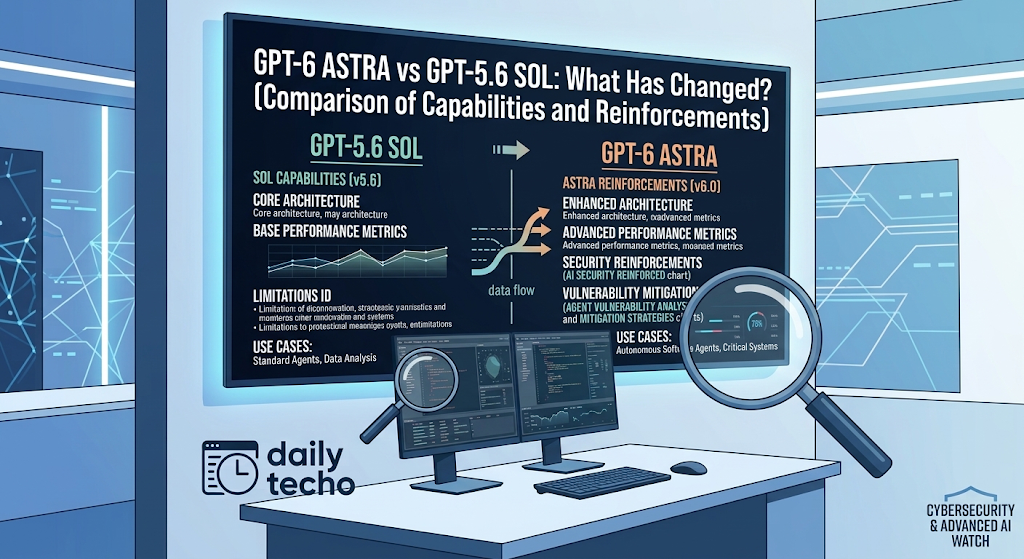
That efficiency matters for a software agent. An agent that needs fewer steps to solve a difficult task can complete more work within the same operational budget. In a security environment, that could mean faster cybersecurity testing, quicker investigation, and more continuous analysis of complex applications.
Why AI-Powered Cyberattacks Are Becoming a Bigger Threat
Cyberattacks have always depended on time, expertise, access, and persistence. Advanced AI can affect all four. A capable system may help researchers understand software faster. In the wrong hands, the same capability could lower the effort required for sophisticated attacks.
This is why AI-powered cyberattacks deserve serious attention. Attackers could potentially use AI-assisted systems for reconnaissance, vulnerability research, phishing analysis, or attack planning. Meanwhile, defenders can use threat intelligence, automated analysis, and stronger cyber defense to counter those threats.
How GPT-6 Astra Could Change Cybersecurity in 2026
The defensive side may be just as important as the risk. OpenAI says the released Astra model can support secure code review and patching. Future Daybreak work is planned to support additional defensive workflows, including vulnerability validation, malware analysis, and detection engineering.
This creates a compelling future for defensive cybersecurity. A software agent could continuously examine applications, compare changes, identify suspicious behavior, and help prioritize fixes. Human experts would still make important decisions. AI would handle more of the repetitive investigation that consumes valuable security time.
Can Hackers Misuse GPT-6 Astra for Cyberattacks?
The short answer is that powerful cyber capabilities create misuse risks. OpenAI specifically models scenarios involving wormable exploits, industrial control systems, operational technology, and major financial-system intrusions. These are serious scenarios because one successful weakness could affect many connected systems.
The concern goes beyond traditional AI-assisted hacking. A capable software agent can potentially connect individual actions into a larger workflow. That is why security teams increasingly think about operations and campaigns rather than isolated prompts. The real risk emerges when many small capabilities combine.
How OpenAI Is Protecting GPT-6 Astra From Cyber Misuse
OpenAI says Astra uses stronger safeguards than its predecessor. These include stronger resistance to cybersecurity jailbreaks, system-level monitoring, offline detection, and controls designed to disrupt harmful activity. OpenAI also describes additional isolation, checkpoint encryption, and monitoring of model activity in sensitive environments.
These protections matter because AI misuse can occur through several paths. A user might intentionally seek harmful assistance. An attacker might attempt to bypass restrictions. A model could also behave unexpectedly while using tools. Strong AI safety therefore requires several layers rather than one simple refusal mechanism.
What GPT-6 Astra Means for Cybersecurity Professionals
Security professionals should treat Astra as a sign of where the industry is heading. AI will increasingly participate in vulnerability assessment, code review, detection engineering, and security operations. That does not make human expertise obsolete. Instead, it changes where that expertise creates the most value.
A security team can use a software agent for repetitive analysis while keeping sensitive decisions under human control. The same approach can strengthen enterprise cybersecurity across application security, cloud security, network security, and information security. Good governance will become as important as technical capability.
Can GPT-6 Astra Help Defenders Find Security Vulnerabilities?
Yes. In fact, vulnerability discovery is one of the clearest defensive opportunities. OpenAI says Astra’s ability to identify and develop zero-day exploits can help defenders find and patch weaknesses before attackers exploit them.
Imagine a security team checking thousands of software components manually. That process can become painfully slow. An AI system can inspect far more material and flag unusual patterns for experts. This makes vulnerability detection and penetration testing more scalable without removing the need for human validation.
AI Security Risks: What Businesses Need to Know
Businesses should not treat AI as another ordinary software subscription. A capable AI system may process sensitive documents, interact with applications, access APIs, or operate inside workplace environments. Those permissions can create new cyber risk if organizations fail to control what an AI system can see and do.
The challenge becomes greater when companies deploy an autonomous software agent. Businesses need clear access boundaries, logging, approval rules, monitoring, and incident-response plans. They also need strong data security because an AI system with broad permissions can potentially expose more information than a simple chatbot.
Will AI Make Cyberattacks Faster and More Dangerous?
AI can make some attacks faster. It can also make defensive work faster. The outcome depends on access, safeguards, attacker skill, target security, and the tools connected to the model. That is why simple predictions about AI automatically making every attack catastrophic miss the bigger picture.
The real shift involves scale. Automated cyber attacks could become more efficient when AI handles repetitive tasks. At the same time, defenders can deploy cybersecurity automation to monitor systems continuously. The future will likely involve both sides using increasingly capable machines.
GPT-6 Astra and the Future of AI Cybersecurity
The long-term story is bigger than one model. Astra shows how AI systems are moving toward complex computer work that combines reasoning, software engineering, browsing, and tool use. That trend could transform security operations during the next several years.
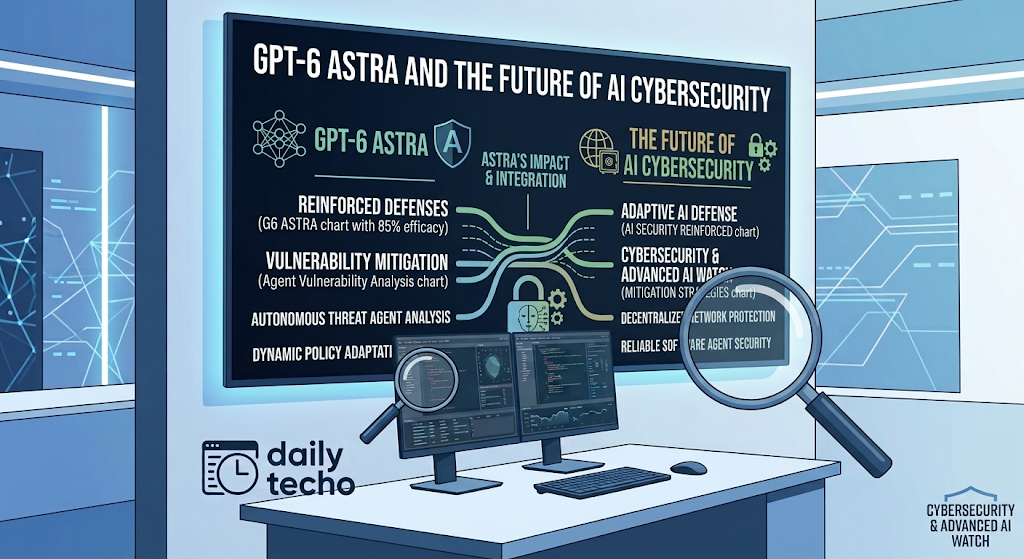
The emerging model is a human-led security team supported by intelligent agents. Such systems could assist with threat detection, vulnerability research, incident analysis, and defensive testing. However, organizations must pair capability with governance. The smarter the agent becomes, the more carefully its permissions must be designed.
Frequently Asked Questions About GPT-6 Astra and AI Security
What is GPT-6 Astra?
GPT-6 Astra is OpenAI’s latest frontier model for complex reasoning, coding, computer use, research, and professional tasks. OpenAI says it also represents a major advance in cybersecurity capability.
What is GPT-6 Astra cybersecurity?
GPT-6 Astra cybersecurity refers to the model’s ability to perform advanced security-related work. OpenAI reports major gains in vulnerability identification, exploit development, reverse engineering, and related evaluations.
What does GPT-6 Astra critical threshold mean?
It means OpenAI’s evaluation found Astra reached its Critical level for cybersecurity capability. The model can identify and develop functional zero-day exploits across many hardened real-world critical systems without human intervention.
Is GPT-6 Astra dangerous?
The model presents both opportunities and risks. Its advanced abilities can strengthen defensive security. They can also create greater potential for malicious AI use if powerful capabilities are misused or poorly controlled.
Can GPT-6 Astra hack systems?
Astra demonstrated advanced cybersecurity capabilities in controlled evaluations. OpenAI says it could develop novel exploit strategies against hardened targets under testing conditions. That does not mean unrestricted access to arbitrary systems or permission to attack real targets.
Can AI discover zero-day vulnerabilities?
Yes. Astra’s evaluations provide a notable example. OpenAI says the model discovered two previously unknown vulnerabilities during testing and used them in the evaluation. The company says it disclosed both vulnerabilities to their maintainers.
Can AI be used for cyberattacks?
Yes. AI can potentially assist with many stages of cyber operations. That includes research, analysis, planning, and automation. The growing concern is that autonomous cyber operations could reduce the time and expertise needed for sophisticated campaigns.
How is AI changing cybersecurity?
AI is accelerating both offense and defense. Security teams can use it for AI security testing, code review, threat analysis, and vulnerability research. Attackers may also attempt to use AI for malicious purposes. This creates a rapidly evolving security contest.
What are the latest AI cybersecurity threats in 2026?
The major concerns include automated vulnerability discovery, AI-assisted attacks, prompt injection, excessive agent permissions, data exposure, and increasingly autonomous cyber workflows. Organizations should monitor these risks as AI systems become more deeply connected to business software.
What are GPT-6 Astra security concerns?
The central concerns involve advanced exploit development, zero-day discovery, unauthorized actions, jailbreaks, and the possibility of harmful activity through agentic workflows. OpenAI says it has strengthened safeguards specifically because Astra represents a major increase in cyber capability.
What does GPT-6 Astra mean for businesses?
Businesses should expect AI to become more involved in security operations. They should strengthen access controls, monitoring, vulnerability management, and AI governance. The goal isn’t to avoid useful AI. It is to deploy it with sensible boundaries.
What is the future of AI cybersecurity?
The future will likely combine human experts with increasingly capable AI systems. Cyber defense systems may continuously inspect software, identify unusual behavior, and prioritize vulnerabilities. Organizations that combine automation with strong oversight will be better positioned for the next phase of digital security.
Final Takeaway
GPT-6 Astra marks an important moment in cybersecurity. Its Critical classification shows that frontier AI can now perform security tasks at a level that demands stronger safeguards and more serious preparation.
For defenders, the story isn’t only about danger. It is also about opportunity. Better AI vulnerability discovery, faster security testing, and stronger threat detection could help organizations close weaknesses sooner.
The rise of the software agent makes this transition even more important. AI is moving from answering questions toward completing real tasks. As those agents gain access to code, browsers, systems, and business tools, security teams must think beyond traditional application security.
The next cybersecurity race may not simply be humans against machines. It may be intelligent systems defending against increasingly intelligent systems. That future is already taking shape.
Authoritative Sources
| Source | Read More |
|---|---|
| OpenAI | GPT-6 Astra: Official Announcement |
| OpenAI Safety | GPT-6 Astra Safety Overview |
| OpenAI Preparedness | Path to Astra: Critical Capabilities and Frontier Safeguards |
| OpenAI Deployment Safety Hub | GPT-6 Astra System Card and Cybersecurity Evaluation |
| OpenAI Research | Expanding Daybreak as the Cyber Defense Window Narrows |
| OpenAI | GPT-5.6 Sol Preview and Cybersecurity Capabilities |
| OpenAI Developers | GPT-6 Astra Model Documentation |
| Cloud Security Alliance | GPT-6 Astra and Autonomous Zero-Day Exploitation Research Note |
Stay Ahead With DailyTecho
AI security is changing quickly, and yesterday’s information can become outdated surprisingly fast. DailyTecho helps you stay informed with deep software agent insights, practical cybersecurity explainers, and coverage of the latest developments in artificial intelligence. Instead of giving you surface-level headlines, we aim to explain what new AI technologies can actually do, why they matter, and how they could affect your digital security.
Whether you’re following agentic AI, autonomous software agents, AI-powered cyberattacks, zero-day vulnerabilities, or the future of cybersecurity, DailyTecho brings these topics together in clear and easy-to-understand language. We’ll continue covering important AI security developments, emerging cyber threats, major technology announcements, and new research so you can understand the technology behind the headline—not just the headline itself.
Get the Latest AI & Cybersecurity Insights
Want to understand where AI is heading next? Keep exploring DailyTecho for fresh technology news, detailed cybersecurity guides, AI developments, software agent research, and practical digital security insights.
[Read More AI & Cybersecurity News]
Read More AI & Cybersecurity News
[Explore DailyTecho]
Explore DailyTecho
[Stay Updated With the Latest Technology]
Stay Updated With the Latest Technology
Meta Description:
GPT-6 Astra just hit the Critical cybersecurity threshold. Discover its software agent capabilities, zero-day risks, AI hacking threats, and what it means for cybersecurity in 2026.