

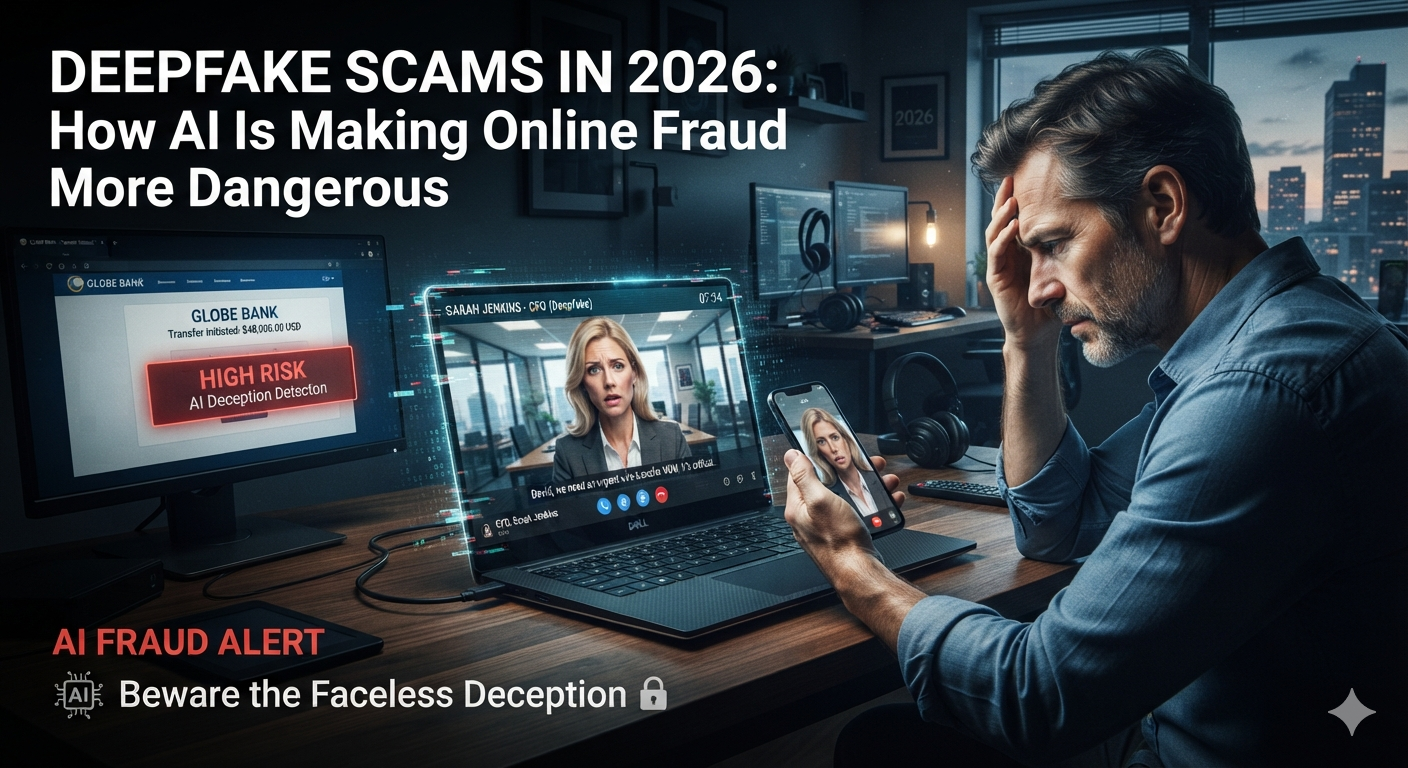
Imagine getting a video call from someone you trust. Their face looks familiar. Their voice sounds right. They know your name and even mention a few details about your life. Then they tell you there is an emergency and ask you to send money immediately.
That question is becoming more important in 2026. Deepfake technology has moved beyond obvious fake videos and strange-looking faces. Criminals can now combine generative AI, cloned voices, manipulated images, fake profiles, and traditional social engineering to make an online identity appear much more believable.
This doesn’t mean every strange video is a deepfake. It also doesn’t mean AI-generated content is automatically malicious. The real problem begins when criminals use synthetic media to impersonate another person and manipulate someone into giving away money, information, account access, or trust.
For people in the United States, this is becoming a serious online fraud concern. The FBI’s 2025 Internet Crime Report recorded more than one million complaints and more than $20 billion in reported losses from internet crime overall. The FBI also reported that AI-related complaints were associated with more than $893 million in reported losses.
The technology is changing quickly. The basic scam psychology isn’t.
A criminal still wants you to believe a story. They still want you to act before thinking. What has changed is the quality of the disguise.
This article will explain deepfake scams in 2026 from the ground up. You’ll learn how these scams work, where they appear, how criminals use AI-generated content, how to recognize warning signs, and what you can do when something doesn’t feel right.
The most important rule: A familiar face or voice is no longer enough to prove someone’s identity.
Trusted Sources
FBI Internet Crime Complaint Center — 2026 Deepfake/Impersonation Warning
FBI — Cryptocurrency and AI Scams Bilk Americans of Billions
FTC — Scammers Use Fake Emergencies to Steal Your Money
CISA — Contextualizing Deepfake Threats to Organizations
What Are Deepfake Scams and How Do They Work?
What are deepfake scams? They are scams that use AI-generated or manipulated media to make someone appear to be another person. The media can include AI-generated video, AI-generated audio, synthetic photographs, or a combination of several formats.
The scam itself usually isn’t completely new. A criminal might use a traditional family emergency story, investment pitch, job offer, romance scheme, or payment request. Deepfake fraud simply gives that story a more convincing identity.
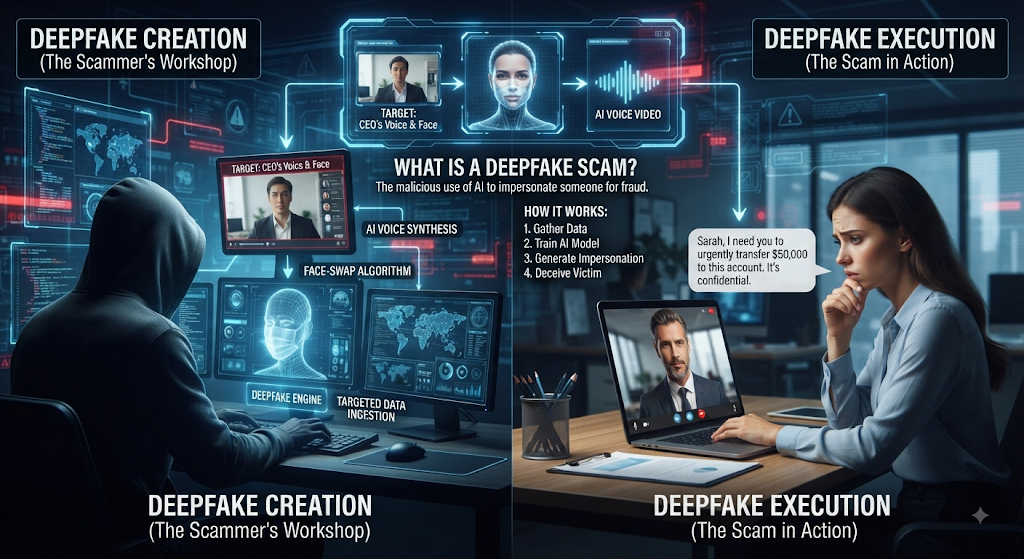
For example, imagine receiving a video call from someone who appears to be your company’s chief executive. The person tells you to approve an urgent payment. Their face looks correct. Their voice sounds familiar. The request seems believable because the criminal has combined several pieces of information into one convincing impersonation.
That’s where digital impersonation becomes dangerous.
The technology becomes the disguise. Social engineering becomes the persuasion method. The financial request becomes the objective.
How Deepfake Technology Enables Online Fraud
To understand how do deepfake scams work, it helps to separate the technology from the crime.
Artificial intelligence can analyze patterns in faces, voices, speech, and other media. Generative AI can then create or alter content based on those patterns. The result may be an artificial voice, manipulated face, synthetic photograph, or generated video.
One important category is voice cloning. The FTC has warned that scammers can use a short audio sample to create a voice that sounds like a loved one. That audio might come from material publicly posted online.
Another category involves video. Criminals can manipulate existing footage or create synthetic material that makes a person appear to speak or behave differently.
The important point is that scammers don’t necessarily need to invent everything from scratch.
They can combine real information with fake media.
That makes the scam harder to recognize.
Consider a simple example. A criminal discovers that a company executive is attending a conference. They find the executive’s public photograph, learn the company’s name, identify an employee from social media, and then create a believable story around an urgent payment.
The information may be real.
The person making the request is not.
That distinction is at the heart of modern AI fraud.
Deepfake Technology Is Only One Part of the Scam
It would be a mistake to think that deepfakes work because AI alone is powerful. In reality, criminals often combine synthetic media with older techniques such as phishing scams, fake websites, stolen information, spoofed accounts, and emotional pressure.
The FBI’s recent warnings show this combination clearly. In July 2026, the FBI warned about scammers using AI-generated videos that impersonated a senior FBI leader and directed people toward a spoofed Internet Crime Complaint Center website.
The fake video created credibility.
The fake website created a believable destination.
The impersonation created trust.
The scam depended on all three pieces working together.
This is why deepfake scams in 2026 should not be viewed simply as a problem with fake videos. They’re part of a much broader change in cybercrime.
Why Are Deepfake Scams Becoming More Dangerous in 2026?
The biggest concern isn’t that AI suddenly invented fraud. Criminals have been impersonating people for decades. The difference is that AI scams can make impersonation faster, more personalized, and more convincing.
The FBI has warned that criminals are increasingly using AI-generated audio to impersonate public figures and personal contacts. It has also documented AI-generated content being used alongside impersonation schemes.
That creates a difficult situation for ordinary users.
In the past, someone might receive a poorly written phishing email from an unknown address. Today, the scam may arrive through a familiar-looking social account, a realistic voice message, or a convincing video.
The victim doesn’t necessarily see a red flag immediately.
AI Is Making Impersonation More Convincing
The biggest change is the ability to combine different forms of synthetic media.
A criminal may use an AI-generated image for a fake social profile. They might use AI-generated audio during a phone call. They could then use manipulated video to reinforce the identity.
Each piece supports the others.
That’s important because people naturally use multiple signals when deciding whether someone is trustworthy. We recognize a person’s face. We recognize their voice. We remember their writing style. We notice familiar details.
Deepfake-enabled fraud can imitate several of those signals at once.
The FBI’s 2026 warning is a useful example. Criminals created AI-generated videos featuring an apparent senior FBI leader and used them to direct victims to a spoofed IC3 website. The agency specifically warned that the videos could look legitimate at first glance.
This is a major shift.
A scam no longer has to look obviously fake.
Scammers Are Combining AI With Old-School Social Engineering
Technology may be new, but human psychology remains the weak point.
Social engineering works by influencing a person’s emotions and decisions. A criminal might create fear by claiming your bank account is compromised. They might create excitement by promising an investment opportunity. They might create urgency by pretending that a family member needs immediate help.
AI makes those stories easier to personalize.
Imagine a scammer saying, “Dad, it’s me. I can’t talk for long. I need you to help me right now.”
If the voice sounds familiar, the victim may react emotionally before checking the facts.
The FTC has specifically warned about AI-enhanced family emergency scams where criminals clone a loved one’s voice and then demand money.
The lesson is simple.
Technology creates the illusion. Social engineering creates the pressure.
Why You Shouldn’t Trust a Face or Voice Alone
For years, people have treated voice and video as strong evidence of identity. If your brother called you, you recognized his voice. If your manager appeared on a video call, you recognized their face.
That assumption is becoming weaker.
Voice authentication based only on how someone sounds can be risky in high-pressure situations. A familiar voice may be synthetic. A familiar face may be manipulated. Even caller ID can be misleading.
This doesn’t mean you should become suspicious of everyone.
It means you should change how you verify important requests.
If someone asks for money, account credentials, security codes, confidential information, or an unusual business transaction, use a second trusted method.
Call the person using a number you already know.
Contact the company through its official website.
Ask another employee to confirm the request.
Speak with another family member.
Don’t use the contact information provided by the suspicious caller.
That small distinction can make a huge difference.
What Makes a Deepfake Scam Different From an Ordinary Scam?
A traditional scam often depends on a fake message, fake website, fake profile, or false story. A deepfake scam can add another layer: the ability to make the person behind the story appear real.
That’s why AI-powered scams can feel unusually personal.
A normal phishing message might say:
“Your account has been suspended. Click here to restore access.”
A deepfake-enabled scam might involve a supposed bank employee speaking to you by phone or video. The person may know your name and discuss details about your account.
The second scenario can feel much more legitimate.
Yet both scams have the same objective.
They want you to trust the wrong source.
The Real Danger Is the Combination
Deepfakes shouldn’t be treated as a completely separate category from existing online scams.
Instead, think of them as an amplifier.
A fake investment website becomes more convincing when a synthetic celebrity appears to promote it.
A family emergency scam becomes more convincing when the caller sounds like the relative.
CEO fraud becomes more convincing when the supposed executive appears on a video call.
A fake recruiter becomes more believable when the person appears on camera.
This is why modern scam prevention requires more than simply learning to recognize strange-looking images.
You need to recognize behavioral warning signs too.
A Real 2026 Example: Fake FBI Videos and Spoofed Websites
One of the clearest recent examples comes directly from the FBI.
On July 20, 2026, the FBI’s Internet Crime Complaint Center warned about scammers impersonating IC3. According to the FBI, a social media platform had shared AI-generated videos showing an apparent senior FBI leader encouraging users to submit complaints through a spoofed website.
The scam is important because it demonstrates how several technologies can work together.
The video creates familiarity.
The FBI identity creates authority.
The spoofed website creates legitimacy.
The complaint process creates a believable reason for the victim to interact.
A person might assume, “This must be official because I’m seeing an FBI leader explaining it.”
That’s exactly the type of assumption criminals want.
The FBI warned that the spoofed website had a similar structure and content to the legitimate IC3 website.
This example gives us a valuable lesson for the rest of this article:
Never verify a suspicious request using the same source that delivered the request.
If a video tells you to visit a website, don’t assume the video proves that website is legitimate.
Open the official website separately.
That principle will become even more important as deepfake scams continue evolving.
How Deepfake Scams Exploit Trust
Trust is normally useful.
Without it, online communication would be exhausting. You couldn’t answer a phone call without questioning the caller’s identity. You couldn’t respond to a work email without verifying every sentence.
Scammers exploit that natural trust.
They don’t necessarily want you to analyze the technology. They want you to react to the person.
A fake executive says, “Please handle this payment.”
A fake relative says, “I’m in trouble.”
A fake celebrity says, “This investment changed my life.”
A fake government official says, “You need to act today.”
The story creates the emotion.
The synthetic media strengthens the identity.
The urgency reduces the time available for thinking.
That combination can turn ordinary online fraud into a highly persuasive attack.
Why Urgency Is Such a Powerful Warning Sign
Urgency doesn’t automatically mean a request is fraudulent. Real emergencies happen. Real companies sometimes have deadlines.
However, urgency becomes a major warning sign when someone also demands secrecy or asks you to bypass normal procedures.
For example, an executive asking an employee to make an unusual payment should normally allow independent confirmation. If the supposed executive says, “Don’t tell anyone. Do this right now,” the risk becomes much higher.
The same principle applies to families.
If someone claims to be a relative and demands immediate payment, don’t let the emotional situation eliminate your normal verification process.
The FTC’s advice is straightforward: don’t trust the voice alone. Contact the person using a phone number you already know belongs to them.
The Most Important Shift in Online Security
The internet has traditionally taught users to ask:
“Does this look real?”
In 2026, that’s no longer enough.
The better question is:
“Can I independently verify that this is real?”
That change is subtle but powerful.
A perfect-looking video can still be fraudulent.
A convincing voice can still be synthetic.
A professional website can still be fake.
A verified-looking social account can still be compromised or impersonated.
A message containing real personal information can still come from a criminal.
This is why digital verification is becoming increasingly important.
The strongest defense isn’t becoming an expert at spotting every AI artifact.
It’s building a habit of independent verification.
Deepfake technology gives criminals better tools for impersonation. Generative AI helps create convincing synthetic content. Social engineering pushes victims toward emotional decisions. Traditional fraud techniques then turn that trust into financial or personal harm.
The FBI and FTC have already documented real-world misuse of AI-generated voices and videos.
And the threat isn’t limited to celebrities or technology companies.
It can affect a parent receiving a family emergency call.
It can affect an employee receiving an executive payment request.
It can affect a job seeker speaking with a fake recruiter.
It can affect an investor watching a fake celebrity promotion.
It can affect anyone.
15 Common Deepfake Scams You Need to Watch Out for in 2026
Deepfake-enabled scams now appear across phones, social networks, workplaces, dating platforms, investment communities, and customer-support channels. The technology changes quickly, but the goal remains familiar: gain your trust and make you act before you verify.
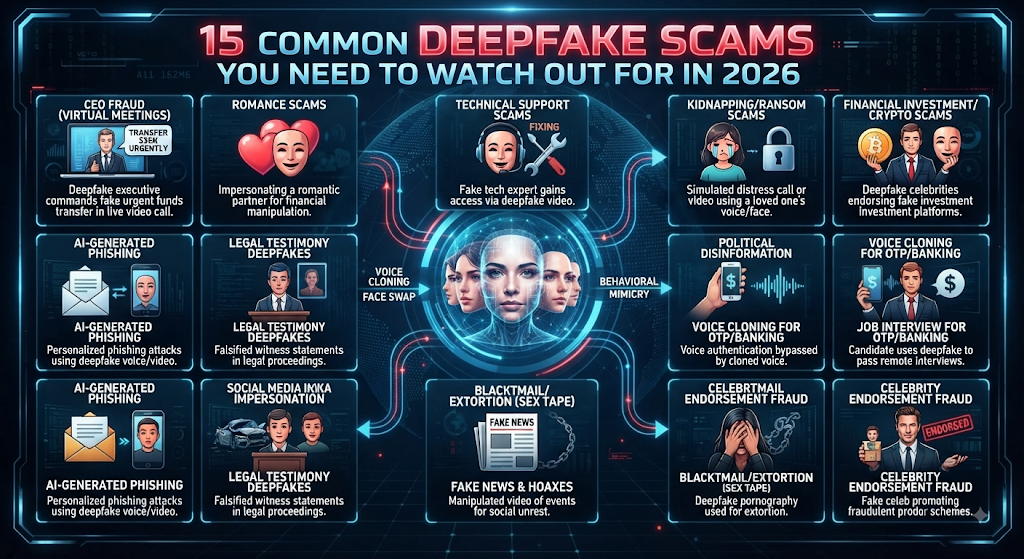
The following common deepfake scams are especially important for U.S. consumers and businesses because they combine AI fraud, impersonation, urgency, and traditional social engineering.
AI Voice Cloning Scams
An AI voice cloning scam starts with a criminal obtaining audio that resembles a real person’s voice. That voice may come from public videos, social media, interviews, podcasts, or other recordings. The scammer then uses the artificial voice during a phone call or voice message.
The FTC has warned that scammers can use a short audio sample to clone a loved one’s voice. The caller may claim they have been arrested, injured, or involved in an emergency and need money immediately. (consumer.ftc.gov)
The safest response is to stop relying on the caller’s voice. Contact the person through a trusted phone number that you already have. If they are genuinely in trouble, independent verification will still work.
Fake Family Emergency Calls
A fake family emergency is one of the most emotionally powerful forms of deepfake fraud. The caller may sound like your child, grandchild, sibling, or another relative. They might claim they need money for bail, medical treatment, transportation, or another urgent problem.
The criminal usually wants you to act before you have time to think. They may also tell you not to contact anyone else. That secrecy is a major warning sign because it prevents independent verification.
A simple family safety plan can help. Agree on a private phrase or question that isn’t publicly available online. If an unexpected emergency call arrives, contact another family member before sending money.
Deepfake CEO and Executive Scams
Businesses face a growing risk from CEO fraud, where criminals impersonate senior executives and ask employees to make payments or share sensitive information. Deepfake audio and video can make this type of business email compromise more convincing.
Imagine an employee receives an urgent message from a supposed CEO. The employee then joins a video call and sees someone who looks like the executive. The person requests an unusual payment and says the transaction must remain confidential.
The employee should not approve the payment simply because the face and voice look authentic. Companies should use independent approval procedures for unusual transfers, changed bank details, and urgent financial requests.
Fake Video Call Scams
A deepfake video scam can make a criminal appear on camera as someone the victim already knows. The scammer might pretend to be a manager, government official, business partner, celebrity, or family member.
The FBI warned in July 2026 that criminals were using AI-generated videos in alleged real-time communications to impersonate trusted individuals. The agency also warned about fake videos impersonating an FBI leader. (ic3.gov)
The key lesson is simple: seeing someone on camera isn’t enough to prove identity. If the conversation involves money, passwords, confidential information, or unusual instructions, verify the person through another trusted channel.
Celebrity Deepfake Investment Scams
A deepfake celebrity scam uses a famous person’s identity to make an investment opportunity appear legitimate. A fake video might show a celebrity supposedly discussing cryptocurrency, trading, artificial intelligence, or a special investment platform.
These scams are particularly dangerous because celebrity recognition creates instant credibility. The victim may think, “I’ve seen this person before, so this must be genuine.”
Don’t make that assumption. Search for the investment independently. Check whether the celebrity’s verified official channels actually published the promotion. Be especially cautious about guaranteed returns, pressure to deposit money, and platforms that make withdrawals difficult.
Fake Government Official Scams
Government impersonation scams already rely heavily on authority and fear. AI-generated video and voice technology can make these schemes more convincing by creating a person who appears to represent a government agency.
A scammer may claim that you owe money, have violated a law, or need to provide personal information immediately. They may threaten arrest or legal action if you don’t cooperate.
The FBI’s July 2026 warning showed how realistic this approach can become. Criminals used AI-generated videos impersonating FBI personnel and directed victims toward a spoofed website. (ic3.gov)
Never use a phone number or website supplied by the suspicious contact to verify their identity. Find the agency’s official website yourself and use its published contact information.
Deepfake Romance Scams
A deepfake romance scam can begin with an attractive profile photograph and develop into regular messages, voice calls, and video conversations. AI-generated images and synthetic voices can make a fake relationship feel more genuine.
The criminal usually spends time building emotional trust. Later, they introduce a financial problem, business opportunity, travel emergency, medical situation, or investment proposal.
Romance scams can become especially painful because victims aren’t only losing money. They may believe they have lost someone they genuinely loved.
If an online relationship repeatedly avoids real-world verification while eventually requesting money or cryptocurrency, treat that combination as a serious warning sign.
Fake Job Interview Scams
A deepfake job scam targets people searching for employment. The criminal may create a fake recruiter profile and conduct an online interview using manipulated video or synthetic audio.
The position may look attractive. The recruiter may even use the name and branding of a real company. After establishing trust, the scammer could ask for banking information, identity documents, fees, cryptocurrency payments, or software installation.
Legitimate employers generally don’t require applicants to pay money to receive a job. Before sharing sensitive information, visit the company’s official careers page and verify that the position and recruiter are genuine.
AI-Generated Customer Support Scams
Fake customer-support accounts can appear after someone posts publicly about a problem with a bank, airline, technology company, cryptocurrency service, or online marketplace. The criminal contacts the person while pretending to offer help.
The conversation may eventually request a password, one-time verification code, payment, or remote access to the victim’s computer. AI scams can make these interactions sound more polished and professional.
Don’t trust support contacts simply because they use a company logo or professional language. Open the company’s official website yourself and start the support process there.
Fake Cryptocurrency and Investment Promotions
Cryptocurrency remains an attractive target because transactions can be difficult to reverse. A scammer may use AI-generated images, fake interviews, cloned voices, or manipulated videos to promote an investment opportunity.
The pitch often focuses on extraordinary returns. It may claim that a famous investor, technology leader, celebrity, or financial expert is personally supporting the platform.
The FBI reported that investment fraud remained one of the largest categories of reported cybercrime losses in 2025. It also warned about the growing use of AI in financial schemes. (fbi.gov)
Never invest simply because a familiar person appears to recommend something. Research the company, understand how the investment works, and be suspicious of guaranteed profits.
Deepfake Blackmail and Extortion Scams
A deepfake blackmail scam uses manipulated or synthetic media to frighten someone into paying money. The criminal may claim they possess embarrassing material or threaten to distribute a fake image or video.
The victim may feel pressured to pay immediately. Unfortunately, paying doesn’t necessarily end the situation. The criminal may simply demand more money.
If this happens, preserve the evidence instead of deleting everything immediately. Save messages, usernames, URLs, payment details, and screenshots. Avoid escalating the conversation and report the incident through the appropriate platform or authorities.
Fake News and Political Deepfakes
Political deepfakes can make public figures appear to say things they never said. A fabricated video might spread through social media during an election, breaking-news event, protest, or political controversy.
This type of synthetic media can cause more than individual financial harm. It can create confusion about what actually happened and make people distrust legitimate information.
CISA, the FBI, and NSA have previously warned organizations about threats involving deepfakes and synthetic media. (cisa.gov)
Before sharing shocking political content, check reputable news organizations and official sources. Don’t let a short emotional video become your only evidence.
Deepfake Identity and Verification Scams
A synthetic identity can combine real and fabricated information to create a believable persona. Criminals may use manipulated photographs, fake documents, stolen personal information, and AI-generated media to support that identity.
The victim might be asked to provide a driver’s license, Social Security information, bank details, or verification codes. Once criminals obtain enough information, the damage can extend beyond the original scam.
This is where identity theft becomes a serious concern. Never send sensitive documents simply because someone appears convincing during a video call.
Fake Influencer and Social Media Scams
A scammer can create a fake influencer account using copied branding, stolen photographs, synthetic images, and AI-generated video. The account may promote investments, giveaways, products, or cryptocurrency.
These social media scams work because followers already trust the creator’s identity. A familiar face can make an unfamiliar offer seem safe.
Before acting on a promotion, visit the creator’s established official channels. Check whether the same promotion appears there. If the offer exists only on one suspicious account, stop and investigate.
Business Payment and Invoice Scams Using AI
Business payment fraud can become especially dangerous when criminals combine fake emails with voice cloning, manipulated video, and stolen company information.
A scammer might impersonate a supplier and announce new banking details. Another may pretend to be a finance executive and request an urgent transfer. The message can include real employee names and accurate company information.
The FBI’s 2025 report recorded more than $30 million in reported losses from BEC complaints involving AI-related content. (fbi.gov)
Companies should therefore treat unusual payment instructions as high-risk events. A second employee or independent communication channel should confirm important transactions before money moves.
Why These 15 Deepfake Scams Matter
The biggest mistake is assuming that scammers will use only one type of AI. Modern fraud can combine AI-generated audio, AI-generated images, video manipulation, fake profiles, stolen information, and traditional phishing.
That combination creates a layered attack. One piece establishes identity. Another creates credibility. A third introduces urgency. The final step asks for money or information.
For consumers, the strongest defense is independent verification. For businesses, the same principle should become part of formal payment and identity procedures.
A Simple Example
Suppose you receive a video call from your manager asking you to transfer $8,000 to a new supplier account.
The face looks right.
The voice sounds right.
The request even includes information about a real project.
Don’t approve the transfer.
Instead, contact your manager through a previously known phone number or established company channel. If the request is genuine, independent verification will confirm it.
If it’s fraudulent, you’ve just stopped a potentially expensive AI-powered scam.
What Makes Deepfake Scams So Difficult to Recognize?
The problem isn’t only technical quality. It’s human perception.
When you recognize a face or voice, your brain tends to treat that information as evidence of identity. A scammer can exploit that instinct.
That’s why scam detection needs to move beyond looking for blurry faces or strange eyes. Those clues can sometimes help, but sophisticated manipulation may not contain obvious visual errors.
Instead, consider the entire situation.
Was the contact unexpected?
Is there unusual urgency?
Is someone asking for money?
Are they demanding secrecy?
Are they asking you to bypass normal procedures?
Did they provide a new phone number or payment account?
Does the story make sense outside the emotional pressure?
These questions can reveal a scam even when the media itself looks convincing.
A New Rule for 2026: Verify the Request, Not Just the Person
One of the strongest lessons from modern deepfake fraud is that identity verification alone isn’t always enough.
Imagine you successfully confirm that you’re speaking with your CEO.
You still need to ask whether the payment request itself is legitimate.
Likewise, suppose you confirm that the caller really is your relative. You should still verify the emergency story before sending money.
This creates two separate questions:
Who is this person?
Is what they’re asking me to do legitimate?
Both questions matter.
That distinction can protect you from scams involving compromised accounts as well as synthetic identities.
Deepfake Scams in 2026: How AI Is Making Online Fraud More Dangerous
How Do Deepfake Scammers Clone Someone’s Voice?
Voice cloning has become one of the most worrying parts of modern AI fraud because people naturally trust familiar voices. A scammer can use publicly available audio and AI software to create speech that resembles another person. The FTC specifically warns that even a short audio clip can be enough to support a fake family-emergency call.
The scammer doesn’t need to reproduce every part of the person’s personality. They only need to sound convincing for long enough to make the victim react. A supposed relative might ask for emergency money, while a fake manager could request confidential information or a payment. The technology supports the deception, while social engineering creates the pressure.
Where Scammers Can Get Voice Samples
Publicly posted videos, interviews, livestreams, podcasts, social-media clips, and other recordings can provide material that criminals may misuse. The FBI has warned that criminals can use publicly available photographs and AI-generated voices to masquerade as known contacts.
This doesn’t mean you should delete every video containing your voice. Public information has many legitimate uses. The practical lesson is simply to understand that your voice should no longer be treated as a completely secret identifier.
Why a Cloned Voice Can Sound So Convincing
Human listeners usually don’t analyze every sound in a conversation. We recognize someone’s overall voice, rhythm, vocabulary, and emotional tone. When those characteristics appear familiar, our brains can quickly assume that the person is genuine.
That’s why AI voice cloning works particularly well during emotional situations. A worried parent may not stop to analyze the caller’s speech pattern when someone claiming to be their child says they are in trouble.
The FTC recommends contacting the supposed family member through a phone number you already know rather than trusting the voice alone.
How Do Deepfake Scammers Create Fake Videos?
A deepfake video can involve several forms of multimedia manipulation. AI systems may generate or alter facial expressions, synchronize speech with a face, modify existing footage, or create synthetic visual content. The exact technology varies, and criminals can combine different techniques.
The important point for ordinary users isn’t learning how to create a fake video. It’s understanding why a video call should not automatically be considered proof of identity. The FBI says synthetic content has become easier to create and increasingly difficult to identify.
Face Swapping and Synthetic Video
Face swapping can place one person’s facial appearance into existing footage. Other techniques can generate a synthetic person or modify facial movements so that the subject appears to say something they never said.
A convincing result can contain enough familiar details to pass a quick visual inspection. That’s especially concerning when the scammer already knows the target’s name, workplace, family details, or business relationships.
Why Real-Time Deepfake Video Calls Are Concerning
A recorded fake video gives a victim time to investigate. A live conversation creates a different psychological effect.
The person can respond to questions. They can react to what you say. They can maintain eye contact and continue the conversation. Even if the underlying video is manipulated, the interaction can feel spontaneous.
The FBI has warned that criminals are using AI-generated videos during communications to impersonate trusted people.
That’s why an unexpected video call involving money or sensitive information deserves the same caution as an unexpected email.
How to Identify a Deepfake Video or Image
Knowing how to identify a deepfake isn’t about finding one magical visual flaw. Modern deepfake detection is difficult because generated media continues to improve. The FBI says consumers can still look for visual distortions, unnatural movement, strange lighting, inconsistent audio, and other irregularities.
However, visual inspection should only be one part of your verification process. A video can look completely normal and still be fraudulent. If someone is asking for money, account access, security codes, or confidential information, the identity and request should be independently verified.
| Possible Warning Sign | What to Look For |
| Facial movement | Expressions that seem slightly unnatural |
| Lip synchronization | Speech that doesn’t perfectly match mouth movement |
| Lighting | Shadows or brightness that don’t make sense |
| Hands and objects | Distorted fingers or unusual object shapes |
| Blinking | Unusual blinking patterns or facial movement |
| Audio | Strange pauses, pitch, background noise, or timing |
| Background | Details that change or appear inconsistent |
| Account | New, suspicious, or recently created profile |
| Context | Claims that don’t match reliable information |
| Urgency | Pressure to act before you can verify |
The FBI has also highlighted distorted hands and feet, irregular facial features, inaccurate shadows, unusual accessories, lag, and unnatural movement as possible warning signs.
Strange Facial Movement
When watching a suspicious video, pay attention to whether facial movement naturally matches speech. The eyes, eyebrows, mouth, cheeks, and head should generally move together in a believable way.
A strange-looking face doesn’t automatically prove a video is fake. Camera quality, compression, poor lighting, and video calls can also create visual artifacts.
Unnatural Lip Synchronization
One useful clue is lip synchronization. Listen carefully while watching the person’s mouth. If the audio and mouth movement seem slightly disconnected, the content deserves more scrutiny.
Still, don’t make a final decision based on this clue alone. Better synthetic media can reduce obvious synchronization problems.
Inconsistent Lighting and Shadows
Lighting can reveal inconsistencies when different elements don’t appear to exist under the same conditions. A face may appear brighter than its surroundings, or shadows may behave strangely.
Again, these clues are indicators rather than proof. Poor webcams and difficult lighting conditions can produce similar effects.
Strange Hands, Accessories, or Objects
The FBI specifically recommends looking for unusual hands, feet, accessories, glasses, jewelry, and other visual details.
These imperfections can sometimes reveal AI-generated video or manipulated imagery. Yet improved AI models can reduce such errors, so viewers should avoid relying on one visual feature.
Unnatural Blinking or Movement
Some synthetic videos may show unusual blinking, awkward head movement, or facial expressions that don’t quite fit the conversation. The FBI includes unnatural blinking and body positioning among possible indicators.
The key word is possible.
A person may blink unusually because they’re tired. A video may lag because of a weak internet connection. Context matters.
Audio Inconsistencies
Listen for unusual pauses, unnatural pronunciation, strange inflections, choppy speech, or background sounds that don’t fit the environment. The FBI identifies these types of audio inconsistencies as possible indicators of synthetic content.
But audio quality can vary for perfectly normal reasons. A bad microphone isn’t evidence of AI-generated audio.
Suspicious Accounts and Sources
Sometimes the strongest clue isn’t inside the video.
Look at the account publishing it.
Is the profile new? Does the username contain unusual characters? Does the account have a strange history? Does the person normally publish this type of content?
The FBI recommends checking contact information, URLs, phone numbers, and other details because scammers often make small changes that imitate trusted sources.
How to Spot a Deepfake on Social Media
Social platforms create an especially difficult environment because users often encounter content without knowing its original source. A video may be reposted thousands of times before anyone asks where it came from.
If a video makes an extraordinary claim, don’t treat popularity as proof. Millions of views only tell you that people watched it. They don’t establish authenticity.
Instead, look for the original source and compare the claim with reliable reporting. If a supposedly major announcement exists only in one random account, that’s a reason to investigate further.
Don’t Confuse Virality With Verification
A viral AI-generated image can spread faster than fact-checkers can respond. People often share emotional material before checking its origin.
This is particularly dangerous during elections, emergencies, celebrity controversies, and breaking news. A deepfake can reach millions before reliable information catches up.
The safest habit is simple: verify before you amplify.
How to Verify a Suspicious Video Call
If someone unexpectedly contacts you by video and asks for money or sensitive information, don’t continue simply because you recognize their face.
End the conversation politely.
Then contact the person through another trusted method.
For example, if your manager supposedly called through a new messaging account, contact their established work number. If a family member calls from an unfamiliar number, call their normal number.
The FBI recommends independently identifying a trusted phone number instead of using the contact information supplied by the suspicious person.
Ask a Question the Scammer Cannot Easily Prepare For
A private question can sometimes help. However, don’t depend entirely on secret questions because personal information can be exposed online.
A better approach is independent communication.
If your supposed brother is calling through WhatsApp, contact him through his normal phone number. If your supposed CEO is messaging through a new account, confirm through the company’s established communication system.
This creates identity verification outside the suspicious conversation.
How to Know If an AI Voice Call Is Fake
There isn’t a single sound that proves a call uses synthetic audio. That’s important because many people expect AI voices to sound robotic or unnatural.
Modern systems can sound surprisingly realistic.
Instead of asking only, “Does this voice sound fake?” ask, “Does this request make sense?”
If the caller suddenly asks for money, gift cards, cryptocurrency, passwords, verification codes, or confidential information, stop and verify.
The FTC specifically recommends not trusting a familiar voice alone during family-emergency scams.
Watch the Behavior, Not Just the Voice
A genuine person can make an unusual request. A scammer can also behave normally.
That’s why several signals should be considered together.
A new phone number plus urgent payment plus secrecy is concerning.
A familiar voice plus a request for cryptocurrency is concerning.
A video call plus a demand to bypass company approval is concerning.
The technology matters, but the behavioral pattern often gives you the stronger warning.
Can AI Clone Someone’s Voice From Social Media?
Yes. Publicly available recordings can potentially provide material for voice cloning. The FTC has specifically described scams where criminals use a short audio clip from content posted online to imitate a loved one.
That doesn’t mean everyone should stop posting videos. Instead, consider what information your public content reveals. Your voice, workplace, family relationships, location clues, and daily routines can all contribute to a more convincing impersonation.
Why Public Information Can Strengthen a Scam
A voice alone may not convince someone.
A voice combined with your name, employer, family member’s name, recent vacation, and social-media activity can create a much stronger story.
This is why online security now involves more than passwords. Personal information can become part of the scammer’s script.
Deepfake Detection Tools Can Help, But Don’t Rely on One
Some AI detection tools attempt to identify synthetic audio, images, or videos by analyzing technical patterns. These tools can be useful for researchers, organizations, journalists, platforms, and security teams.
However, detection is not a perfect science.
The FBI says AI-generated content has advanced to the point that it can be difficult to identify. As generation methods improve, detection methods must continually adapt.
That creates a technological race.
One system tries to create realistic synthetic content.
Another system tries to identify it.
Neither side stays still.
Why Detection Tools Can Produce Uncertain Results
A detector may flag legitimate content or fail to identify sophisticated manipulation. Compression from social-media platforms can also change the technical characteristics of an image or video.
Therefore, a detection result should be treated as evidence, not an absolute verdict.
If a detector says something looks suspicious, investigate further.
If a detector says something looks real, don’t automatically trust it.
The source and context still matter.
What If You Can’t Tell Whether a Video Is Real?
This is where many people make a mistake.
They think they must decide whether the video is genuine before taking action.
You don’t.
If you can’t verify it, simply don’t act on it yet.
You don’t need to prove that a video is fake before refusing an unusual financial request. You don’t need to prove that a caller uses AI before protecting your account.
Uncertainty itself is a reason to slow down.
The Pause-and-Verify Rule
The FBI encourages people to “Take a Beat” when dealing with potential AI-enabled scams. Its 2025 report explains that criminals are using fake profiles, voice clones, identification documents, and believable videos as part of fraud schemes.
That advice is simple but powerful.
Pause.
Verify.
Then decide.
If the request is legitimate, verification shouldn’t destroy it.
If it’s fraudulent, verification may expose the scam before you lose money.
What About Deepfake Images Used for Blackmail?
Not every deepfake scam involves financial fraud. Synthetic images can also be used for harassment, intimidation, or non-consensual intimate imagery.
This area has received increased legal attention in the United States. The FTC says the federal TAKE IT DOWN Act requires covered platforms to provide a process for requesting removal of certain non-consensual intimate images, including AI-generated deepfakes, with covered platforms required to remove the material and known identical copies within 48 hours after a valid request.
If someone threatens you with manipulated intimate content, don’t assume that paying them will solve the problem. Preserve evidence and use the platform’s reporting and removal process. Depending on the circumstances, law enforcement or legal assistance may also be appropriate.
The Bigger Lesson From Deepfake Detection
The biggest mistake is trying to become a human deepfake detector.
You don’t need to inspect every pixel.
You need to become better at digital verification.
When a video or voice message creates urgency, ask where it came from. Ask why you’re being contacted. Ask whether the request makes sense. Then verify the identity through a separate channel.
Technology can imitate appearances.
It can’t automatically make an unreasonable request legitimate.
That distinction is one of the strongest defenses against modern AI scams.
How Deepfake Scams Target Businesses in 2026
Businesses are becoming attractive targets because one convincing impersonation can potentially influence a much larger financial transaction. A criminal may combine deepfake technology, stolen company information, and social engineering to impersonate an executive, supplier, employee, or business partner.
The financial risk is already significant even before deepfakes are added. The FTC says consumers reported $3.5 billion in losses to imposter scams in 2025, with business impersonation losses approaching $1 billion.
CEO Fraud and Executive Impersonation
A deepfake CEO scam usually begins with an urgent request from someone who appears to be a senior executive. The request could involve a wire transfer, confidential document, supplier payment, payroll change, or another sensitive action.
The danger increases when criminals combine email, messaging, voice, and video. An employee might first receive a message and then join a fake video call with someone who appears to be the executive. The goal is to make the request feel legitimate.
However, companies shouldn’t rely on appearance or voice as financial authorization. Important transactions should follow established approval procedures regardless of who appears to request them.
Fake Supplier and Invoice Scams
Supplier impersonation can be particularly difficult because criminals may already know the names of vendors a company works with. They can then send a convincing message claiming that banking information has changed.
The FTC continues to warn businesses about fake invoices and impersonation schemes. Its consumer guidance recommends stopping and independently contacting the business instead of using phone numbers or links supplied in suspicious messages.
A strong company policy should require independent confirmation before changing payment details. A simple phone call to an established supplier contact can prevent a surprisingly expensive mistake.
Voice-Based Payment Approval
Voice approval can become risky when employees assume that a familiar voice proves identity. A criminal may attempt voice cloning and then use an urgent conversation to pressure an employee into moving money.
The solution isn’t to stop using phones. Instead, financial decisions should require another verification method. For example, an employee could confirm the transaction through the company’s established finance system before releasing funds.
This creates separation between communication and authorization.
How Deepfake Scams Target Individuals and Families
Consumers face a different version of the same problem. Instead of pretending to be a CEO, the criminal may impersonate a child, parent, friend, romantic partner, celebrity, bank representative, or government employee.
The FTC says imposter scams remained the most reported fraud category in 2025, with more than one million reports and $3.5 billion in reported losses.
Family Emergency Deepfake Scams
A family emergency scam can begin with a familiar voice saying something frightening. The supposed relative might claim they were arrested, injured, stranded, or involved in an accident.
The emotional pressure is intentional. When someone believes a loved one is in danger, they may send money before checking the story.
The safest response is to verify independently. Call the relative using a number already saved in your phone. Contact another family member. Ask about information the caller should genuinely know. Don’t rely on the suspicious call itself as proof.
Fake Celebrity and Influencer Scams
Celebrities and influencers provide criminals with something extremely valuable: instant recognition. A fake video can make it appear that a famous person supports an investment, giveaway, cryptocurrency project, product, or financial opportunity.
The FTC has warned consumers about impersonation schemes across social media and other channels.
A celebrity’s face doesn’t make an investment legitimate. Before sending money, visit the person’s established official accounts and independently research the company behind the offer.
Romance Scams With Synthetic Media
Romance scams usually develop slowly. A criminal creates a believable identity, communicates regularly, builds emotional trust, and eventually introduces a financial request.
AI can strengthen this deception through synthetic identity, manipulated photographs, generated voices, and video communication. The victim may feel that repeated conversations prove the person is genuine.
But frequent communication isn’t the same as independent identity verification.
The FTC reported that romance-scam losses increased in 2025, showing that the underlying fraud remains a serious consumer problem.
How Much Money Can People Lose to Deepfake Scams?
There isn’t one reliable number that represents every deepfake scam. Losses can range from a relatively small payment to a life-changing amount of money.
A fake customer-support scam might target a few hundred dollars. An investment scheme can demand thousands. A successful business impersonation could involve a much larger transfer.
That’s why a universal “average deepfake loss” would be misleading.
What we can measure more reliably is the broader impersonation problem. The FTC reported $3.5 billion in consumer-reported losses from imposter scams during 2025.
| Scam Situation | Potential Target | Why Deepfake Technology Can Increase Risk |
| Family emergency | Individual or family | Familiar voice can increase emotional trust |
| CEO request | Employee | Face and voice may reinforce authority |
| Investment promotion | Investor | Celebrity identity can create credibility |
| Romance scam | Individual | Synthetic media can strengthen a fake identity |
| Supplier payment | Business | Multiple communication channels can appear authentic |
| Government impersonation | Consumer | Authority and urgency can pressure the victim |
| Fake recruiter | Job seeker | Video can make a fake employer appear legitimate |
These figures and categories shouldn’t be interpreted as proof that every impersonation scam uses deepfakes. Instead, they show the enormous financial environment in which AI-enabled impersonation operates.
Why Deepfake Scams Can Be More Dangerous Than Traditional Scams
Traditional scams often depend on one convincing message. Modern AI-powered scams can combine several forms of deception at once.
A criminal might begin with a stolen social-media profile. Then they could use a realistic voice message, followed by a video call and finally a fake payment page.
Each stage reinforces the previous one.
That’s what makes modern fraud difficult.
| Traditional Online Scam | Deepfake-Enabled Scam |
| Fake text message | AI-generated voice message |
| Fake profile photograph | Synthetic or manipulated identity |
| Generic phishing | Personalized social engineering |
| Fake written communication | Voice and video impersonation |
| Simple identity claim | Multiple synthetic identity signals |
| Often easier to question | Can feel more personally convincing |
The FTC has noted that impersonators already use fake caller ID, official-looking documents, real employee names, logos, and other credibility signals. Deepfake technology can add another layer to that existing playbook.
How Deepfake Scams Use Social Engineering
The technology gets attention, but psychology often drives the actual loss.
A scammer wants you to feel something strongly enough that you stop verifying. Fear, excitement, sympathy, urgency, authority, and greed can all become part of the story.
For example, a fake bank employee may claim your money is at risk. A fake government official may threaten legal consequences. A fake relative may describe an emergency.
The FTC specifically warns consumers about unexpected requests to move money to supposedly “safe” accounts.
That creates an important rule:
Urgency should increase verification, not reduce it.
If someone says you must act immediately, that’s exactly when you should slow down.
Deepfake Scams and Financial Fraud
Financial fraud becomes especially dangerous when the scammer controls the conversation from beginning to end. They may create the identity, provide the explanation, answer questions, and then give the victim instructions for transferring money.
Cryptocurrency, wire transfers, gift cards, and other difficult-to-reverse payment methods are particularly concerning in impersonation schemes.
The FTC advises consumers not to send money, cryptocurrency, or other valuable assets in response to unexpected impersonation requests.
A legitimate financial institution won’t become more legitimate because someone appears on a video call.
Always verify through the institution’s official app, website, phone number, or physical location.
What Should You Do If You Think You Are Talking to a Deepfake?
The best response is surprisingly simple:
Stop → Don’t Send Money → Verify Identity → Save Evidence → Report the Scam → Secure Your Accounts
Stopping gives you time to think. Not sending money prevents the immediate loss. Independent verification helps establish who you’re actually dealing with.
If you already received suspicious messages, preserve screenshots, usernames, email addresses, phone numbers, payment information, and relevant URLs. Don’t delete useful evidence before recording it.
For U.S. consumers, suspicious fraud can be reported to the FTC through ReportFraud.gov. The FTC says reports help investigators identify scammers and support enforcement efforts.
If the incident involves a potentially compromised bank account, contact the financial institution directly using a trusted number.
What If You Already Sent Money?
Don’t assume the situation is hopeless.
Contact the bank, card issuer, payment service, cryptocurrency platform, or other financial provider immediately. Explain that the transaction involved fraud and ask what recovery or reversal options are available.
The sooner you act, the better.
You should also secure affected accounts and change compromised passwords. If sensitive personal information was exposed, consider appropriate identity-protection measures.
Most importantly, don’t let embarrassment stop you from reporting the incident.
Scammers deliberately create convincing situations. Reporting helps create a record and may help investigators identify related activity.
How to Protect Your Family From Deepfake Scams
Families can establish simple verification habits before an emergency ever happens.
A private family phrase can help identify genuine emergency calls. However, it shouldn’t replace independent communication because personal information can sometimes be discovered online.
A stronger approach combines a family phrase with a second communication channel.
For example, if someone claiming to be your child calls from an unfamiliar number asking for money, end the call and contact your child normally.
If they don’t answer, contact another trusted family member.
Don’t let the caller’s urgency become your verification method.
How Businesses Can Reduce Deepfake Payment Fraud
Businesses need stronger procedures because individual employees shouldn’t have to become experts in deepfake detection.
Payment authorization should be based on established processes rather than a person’s appearance or voice. Changes to supplier banking information should receive independent confirmation. Large transfers should require appropriate approval. Unusual requests should receive additional scrutiny.
This approach protects companies even when the synthetic media looks convincing.
The FTC’s broader impersonation guidance supports the same principle: don’t trust unexpected communications simply because they appear to come from a familiar organization. Independently contact the organization using information you already know is legitimate.
The Practical Deepfake Defense: Trust Less, Verify More
The goal isn’t to become paranoid.
It’s to become deliberate.
You can still answer calls from family. You can still use video meetings. You can still follow creators online. You can still use AI tools.
The important change is understanding that digital identity can be copied.
A face can be copied.
A voice can be copied.
A photograph can be copied.
Even an entire online personality can be fabricated.
What cannot be copied as easily is independent verification across trusted channels.
That is the habit that matters most.
A Simple Deepfake Scam Scenario
Imagine receiving a call from your “bank.” The person says suspicious activity has been detected. They know your name and some basic account information. They tell you to move your money into a “secure account.”
Then they transfer you to another supposed government official who confirms the story.
Everything sounds professional.
Everything feels urgent.
But the entire conversation could be controlled by scammers.
The FTC has warned about exactly this style of impersonation, including schemes where criminals claim that victims must move money to protect it.
The correct response is not to argue with the caller.
End the call.
Open your bank’s official app or website independently.
Contact the bank through its established customer-service channel.
Then verify the claim.
The Most Important Lesson for Businesses and Consumers
Deepfake technology doesn’t need to be perfect to be dangerous.
It only needs to be convincing enough for a victim to make one bad decision.
That decision might be clicking a link, revealing a security code, downloading software, sending cryptocurrency, approving a payment, or sharing sensitive documents.
Modern fraud prevention therefore needs to focus on the entire situation rather than one technical clue.
Ask who contacted you.
Ask why they contacted you.
Ask what they want.
Ask whether the request is normal.
Then verify independently.
That five-second pause can be worth far more than any AI detection tool.
What Comes Next
The next section will focus on how to protect yourself from deepfake scams in 2026. We’ll cover independent verification, multi-factor authentication, family safety phrases, account security, payment controls, public information, reporting procedures, and practical steps for consumers and businesses.
How to Protect Yourself From Deepfake Scams in 2026
The best defense against deepfake scams isn’t becoming an expert at spotting every artificial face or voice. Instead, build a verification habit. When a message involves money, passwords, private information, or urgent action, pause first and confirm the request through a separate trusted channel.
The need for this approach is growing. The FTC reported that Americans lost $3.5 billion to imposter scams in 2025, while the FBI reported more than $893 million in reported losses connected to AI-related scams.
Independent Verification Is Your Strongest Defense
Independent verification means you don’t use the suspicious message itself to prove that the message is genuine. If someone sends you a new phone number, website, email address, or payment instruction, don’t automatically use it.
Instead, open the company’s official website yourself. Call a family member through their normal number. Contact a coworker through the company’s established system. This simple separation makes digital verification much harder for scammers to manipulate.
Use Multi-Factor Authentication
Multi-factor authentication adds another security layer when someone obtains your password. A criminal may successfully impersonate you or someone you know, but they still need to overcome your account’s additional protection.
Use MFA wherever important accounts support it. Prioritize email, banking, social-media, cloud-storage, and other accounts containing valuable personal information. Remember that MFA protects accounts; it doesn’t prove that an incoming caller or video participant is genuine.
Create a Family Verification Phrase
Families can establish a private phrase or question before an emergency happens. If someone suddenly calls claiming to be a relative and requesting money, the phrase can provide another signal for identity verification.
Don’t treat the phrase as perfect protection. A determined criminal may obtain personal information elsewhere. Use it alongside independent calling, questions, and a calm verification process.
Slow Down When Someone Creates Urgency
Urgency is one of the oldest tools in online scams, and AI makes the identity behind that urgency easier to imitate. A supposed bank employee may claim your account is at risk. A fake relative may say they’re in immediate danger.
The correct response isn’t panic. It’s a pause.
Ask yourself why the person wants immediate action. Then verify the situation independently. The FTC warns that scammers may pressure people to move money to supposedly safe accounts.
Never Let a Deepfake Bypass Normal Business Procedures
Businesses should assume that a face or voice can be impersonated. Financial approvals should therefore depend on established procedures rather than personal recognition.
For example, a company could require a second employee to confirm unusual wire transfers. Changes to supplier bank details could require a callback using previously verified contact information. These controls remain useful even when AI-powered scams become more convincing.
How to Secure Your Online Identity
Your public information can help criminals construct convincing impersonations. Social-media profiles may reveal your workplace, relatives, hobbies, travel plans, voice recordings, and professional relationships.
You don’t need to disappear from the internet. Instead, review what information is publicly visible and consider whether strangers really need access to every detail.
A stronger online security strategy combines privacy awareness with secure accounts. Use unique passwords, MFA, software updates, and recovery methods that you control.
Protect Your Email Account First
Your email account deserves special attention because it can act as a gateway to many other accounts. If criminals gain access, they may reset passwords, monitor communications, and impersonate you.
Use a strong unique password and MFA. Review recovery email addresses, phone numbers, and logged-in devices regularly. Remove anything you don’t recognize.
A secure email account can make identity theft considerably harder.
Be Careful With Public Voice and Video Content
Public videos aren’t automatically dangerous. However, your voice and appearance can become useful material for impersonation.
If you regularly publish interviews, livestreams, podcasts, or other long recordings, understand that strangers can potentially reuse publicly available material. The FBI has warned that criminals use publicly available photographs and AI-generated voices during impersonation campaigns.
The goal isn’t to stop creating content. It’s to avoid assuming that your voice or face can serve as a secret password.
How Businesses Should Prevent Deepfake Fraud
Companies need a different layer of protection because one successful impersonation can affect multiple employees or a large financial transaction.
A useful business strategy separates communication from authorization. Someone can request a payment through email or video, but the payment should still pass through established approval controls.
This matters because even a convincing executive video shouldn’t override company policy.
| Business Risk | Recommended Verification |
| New supplier bank details | Contact supplier through an existing verified number |
| Urgent executive payment | Confirm through a separate communication channel |
| Sensitive document request | Verify identity and business purpose |
| New employee banking details | Use established HR procedures |
| Unexpected video meeting | Confirm participant independently |
| Security-code request | Never share codes with unexpected callers |
These procedures don’t require expensive deepfake detection systems. They reduce the value of impersonation itself.
Train Employees to Question Unusual Requests
Employee training should focus on behavior rather than teaching everyone how AI-generated faces work.
Employees should know that a familiar voice isn’t enough. A video call isn’t automatically proof. An urgent request should never bypass normal authorization.
That mindset is more durable because criminals can change their technology faster than companies can update a list of visual deepfake clues.
How to Protect Older Family Members From AI Scams
Older adults can be targeted by impersonation scams because criminals often use authority, fear, and family relationships to create pressure. A family conversation before an emergency happens can make a major difference.
Explain that nobody should immediately transfer money because of an unexpected phone or video call. Make sure trusted relatives know how to reach one another through normal channels.
The FTC’s recent data shows how significant impersonation fraud has become across the United States.
The conversation should be practical rather than frightening.
Tell family members: “If someone calls with an emergency, we verify first.”
What to Do With Suspicious Social Media Accounts
A fake account may copy a person’s name, profile photograph, biography, and even previous posts. A convincing account doesn’t prove that the person behind it is genuine.
Check the account’s history. Look for unusual changes, recently created profiles, suspicious links, inconsistent usernames, and requests to move conversations to another platform.
If someone claims to represent a company or public figure, visit that person’s or organization’s established official channels independently.
The FBI recently documented a particularly convincing example in which scammers used AI-generated videos impersonating FBI personnel alongside a spoofed IC3 website.
How to Verify a Government or Bank Contact
Never assume that a government-looking logo, official-sounding voice, or professional video proves legitimacy.
If someone claims to represent a government agency, bank, or other institution, close the suspicious communication and find the organization’s official website yourself. Use the contact information published there.
Don’t click the link provided by the suspicious person.
This matters because criminals can create convincing websites as well as convincing media. The FBI’s 2026 IC3 warning showed how AI-generated videos and spoofed websites can work together to create a false sense of safety.
What to Do If You Receive a Suspicious Deepfake
A simple response framework can prevent many losses:
| Step | What You Should Do |
| Stop | Don’t react immediately |
| Don’t Send Money | Avoid transfers, crypto, gift cards, or unusual payments |
| Verify | Contact the person independently |
| Save Evidence | Keep messages, screenshots, usernames, and URLs |
| Report | Report the account, fraud, or suspicious content |
| Secure Accounts | Change passwords and review account activity |
The FBI specifically warns that scammers may use AI-generated material to create false credibility.
What to Do If You Already Sent Money
Act quickly. Contact your bank, card company, payment service, or cryptocurrency platform and explain that you believe the transaction involved fraud.
Don’t wait because you’re embarrassed.
Also preserve evidence. Keep the original messages, payment information, phone numbers, usernames, email addresses, website addresses, and screenshots. These details can help financial institutions and investigators understand what happened.
For U.S. consumers, fraud can be reported through the FTC’s official reporting system. The FTC also emphasizes that it won’t demand money, threaten you, or tell you to transfer funds to protect them.
Can Deepfake Scams Be Completely Prevented?
No security system can guarantee that every AI fraud attempt will be stopped. Technology changes continuously, and criminals adapt their methods.
The goal is risk reduction.
Independent verification, MFA, careful payment procedures, privacy awareness, employee training, and skepticism toward urgent requests can make successful fraud considerably harder.
Most importantly, don’t judge authenticity using only one signal.
A face can be fake.
A voice can be fake.
A website can be fake.
Even several signals can be manipulated together.
That’s why fraud prevention should focus on independent evidence.
Can AI Detection Tools Reliably Detect Deepfakes?
AI detection tools can analyze images, videos, and audio for patterns associated with synthetic content. They can be useful in journalism, cybersecurity, content moderation, identity verification, and investigations.
However, no detector should be treated as an infallible judge.
Researchers continue to study how well detection systems perform against changing generation methods, while the FBI advises users to look for multiple indicators rather than relying on one clue.
A detection result should therefore become one piece of evidence.
It shouldn’t replace human judgment and independent verification.
Why Deepfake Detection Is a Moving Target
Generative AI continues to evolve. A detection method that works well against one generation system may perform differently against another.
There is also another problem: social platforms can compress videos, resize images, alter audio, and remove technical information. That can make forensic analysis harder.
So the future of scam detection won’t depend on one magic detector.
It will likely combine technical analysis, account reputation, identity verification, behavioral signals, and human review.
Are Deepfake Scams Illegal?
Not every deepfake is automatically illegal. Laws depend on what the content does, how it is used, who is affected, and which jurisdiction applies.
Creating a harmless synthetic image for entertainment is different from using someone’s identity to steal money. Similarly, manipulated political content, fraud, impersonation, harassment, and non-consensual intimate imagery can raise different legal issues.
In the United States, the legal landscape is developing. The FTC began enforcing the TAKE IT DOWN Act in May 2026. Covered platforms must provide a process for removing certain non-consensual intimate images, including AI-generated deepfakes, after a valid request.
For a specific legal situation, readers should consult a qualified U.S. attorney rather than relying on a general internet article.
What Is Changing in Deepfake Security?
The next stage of the problem won’t simply involve better fake videos.
We may see increasingly natural voice cloning, faster synthetic video generation, multilingual impersonation, personalized scam conversations, and AI systems that can adapt their communication during an interaction.
That means traditional “look for the weird eyes” advice will become less useful.
Security will increasingly depend on trusted identity systems and transaction controls.
In other words, the future may be less about proving that media is fake and more about proving that the person and request are legitimate.
The Future of Deepfake Scams: What Could Change Next?
The future of deepfake scams will probably involve more automation. A criminal could potentially combine personal information, generated messages, synthetic voices, and automated conversations into one coordinated campaign.
The FBI already says criminals are using AI to make fraud more convincing and scalable. Its 2025 Internet Crime Report recorded more than 22,000 complaints involving AI-related scams and more than $893 million in reported losses.
That doesn’t mean every future scam will use sophisticated video.
Sometimes a simple phone call will still work.
The bigger change is that AI can lower the cost of creating convincing impersonations. That gives criminals more opportunities to personalize scams and contact more people.
Deepfake Scam Prevention Checklist for 2026
| Situation | Safer Response |
| Familiar person suddenly asks for money | Contact them through another trusted channel |
| Executive requests unusual payment | Follow independent company approval procedures |
| Celebrity promotes an investment | Verify the promotion through official channels |
| Government official demands immediate payment | Contact the agency independently |
| Suspicious video call | End the call and verify identity elsewhere |
| Unknown recruiter requests sensitive documents | Verify the job through the company’s official website |
| AI voice sounds exactly like a relative | Don’t trust the voice alone |
| Someone demands secrecy | Treat the request as a serious warning sign |
| Suspicious website requests personal data | Leave and access the official site independently |
| You already sent money | Contact the financial provider immediately |
The Bottom Line
The biggest lesson from deepfake scams in 2026 is simple: realistic media is not the same as verified identity.
A convincing voice can be synthetic. A familiar face can be manipulated. A professional website can be fake. A supposedly urgent request can be completely fraudulent.
Your strongest defense is therefore not fear of AI.
It’s a habit of verification.
Stop. Think. Verify independently. Then act.
That approach protects consumers, families, employees, and businesses even when the technology behind the scam becomes more convincing.
Deepfake Scams vs Traditional Online Scams: What Has Changed?
Traditional online fraud usually depends on fake messages, stolen accounts, phishing pages, or impersonation. Deepfake-enabled fraud adds another layer by making the person behind the communication appear more believable through AI-generated audio, video, or images.
The FBI says AI-enabled synthetic content is becoming easier to create and harder to detect. Its 2025 IC3 report recorded 22,364 complaints involving AI-related information with reported losses exceeding $893 million.
| Traditional Scam | Deepfake-Enabled Scam |
| Fake text message | AI-generated voice message |
| Stolen profile picture | Synthetic or manipulated identity |
| Generic phishing email | Personalized AI-written communication |
| Fake photograph | AI-generated or altered image |
| Fake caller | Cloned voice impersonation |
| Fake profile | Profile supported by synthetic media |
| Simple video manipulation | More realistic AI-generated video |
| Identity claim | Multiple signals supporting the same fake identity |
The important difference isn’t that deepfakes replaced traditional scams. Instead, AI scams can strengthen existing methods. A criminal can combine phishing, stolen information, fake websites, voice cloning, and video impersonation in one campaign. That makes the scam feel more complete.
Why Deepfake Scams Are Harder to Recognize
A traditional scam sometimes contains obvious clues. The email may contain strange grammar. The website may look poorly designed. The profile may have very few posts. Deepfake technology can remove some of those obvious warning signs.
The FBI says criminals are using fake profiles, voice clones, identification documents, and believable videos of public figures or loved ones. This means digital impersonation can now involve several believable pieces instead of one suspicious message.
The Trust Problem
People don’t normally verify every familiar voice or face. We use recognition as a shortcut because it saves time. Scammers understand that natural behavior.
A person who looks like your boss and sounds like your boss may feel trustworthy before you consciously analyze the situation. That’s why digital identity needs additional verification when money or sensitive information is involved.
How Deepfake Scams Target Social Media
Social media has become an important environment for impersonation because criminals can find enormous amounts of public information there. Photos, voices, workplaces, relationships, hobbies, locations, and interests can all help create a convincing profile.
FTC data shows that consumers reported $2.1 billion in losses from scams that started on social media during 2025. Nearly 30% of people who reported losing money to a scam said it began on a social platform.
This doesn’t mean all social-media scams are deepfakes. It shows why social platforms provide fertile ground for AI-powered scams. A criminal can combine publicly available information with synthetic content and targeted messaging.
Can Deepfake Detection Tools Reliably Detect AI Videos?
The short answer is not perfectly.
AI detection tools can examine media for signs associated with synthetic generation or manipulation. They can be useful for journalists, security teams, researchers, platforms, and investigators.
However, a detector shouldn’t be treated as absolute proof. The technology behind generated media changes rapidly, while compression and editing can also affect detection results.
The FTC has previously taken action against unsupported claims about AI detection accuracy. In one case, the agency alleged that a company advertised a detector as 98% accurate while independent testing found about 53% accuracy on general-purpose content.
That example provides an important lesson: don’t trust a detector simply because it gives you a percentage score.
What Detection Tools Can Actually Do
A detection system may provide useful evidence. It might identify unusual patterns that deserve further investigation. In professional settings, several technical signals can be combined with source information and human review.
For an ordinary consumer, however, independent verification is often more practical.
If a video supposedly shows your bank manager asking you to transfer money, you don’t need a detector to decide whether the transaction is safe.
Contact the bank independently.
That’s stronger protection.
How to Verify Someone’s Identity Online
Identity verification should use a communication method that isn’t controlled by the person making the suspicious request.
Suppose someone sends you a message saying they’re your business partner and need an urgent payment. Don’t reply to that message asking, “Is this really you?” If the account is compromised or controlled by a scammer, they can simply answer yes.
Instead, use an established phone number, company system, or previously trusted contact.
This is especially important for financial fraud, because confirming the person’s identity and confirming the payment request are two different tasks.
What Should Businesses Do About Deepfake CEO Scams?
Businesses should build verification into their payment procedures rather than expecting employees to recognize every deepfake.
The FBI’s 2025 IC3 report says businesses reported more than $30 million in losses from BEC scams involving AI. The report also notes that voice cloning can be used to request wire payments or provide instructions to employees.
That makes independent approval especially important.
A company should verify unusual wire transfers, new supplier banking information, unexpected payroll changes, and requests for sensitive documents through established channels.
The rule should be simple:
A familiar face can request a transaction, but only an approved process should authorize it.
How Should Employees Handle an Urgent Executive Request?
Imagine that an employee receives a message from a CEO asking for an immediate payment. The employee then joins a video call and sees the CEO on screen.
Even if everything appears authentic, the employee should follow normal financial controls.
The FBI has specifically warned that criminals are creating AI-generated videos for real-time video chats with supposed company executives and other authority figures.
The employee should independently confirm the request before money moves.
This protects the company without requiring the employee to determine whether the video itself is fake.
How Deepfake Scams Affect Investment Decisions
Investment fraud is particularly dangerous because criminals don’t always need to steal your existing money immediately. They can persuade you to voluntarily transfer it.
The FBI reported that investment fraud accounted for nearly 49% of all scam-related losses in its 2025 cybercrime data.
A deepfake investment scam can make a suspicious opportunity appear trustworthy by showing a famous investor, celebrity, financial expert, or business leader supposedly endorsing it.
But a person’s face isn’t financial evidence.
Before investing, research the company independently, understand how the investment works, and be extremely cautious about guaranteed returns or pressure to deposit money quickly.
Are Deepfake Scams Increasing?
The broader evidence strongly suggests that AI-assisted fraud is becoming a significant concern.
The FBI recorded 22,364 AI-related complaints in its 2025 IC3 report with reported losses exceeding $893 million. The agency also stated that AI-generated synthetic content is becoming easier to create and increasingly difficult to detect.
At the same time, the FTC reported that people lost $3.5 billion to imposter scams in 2025. Imposter scams remained the agency’s most reported fraud category for the ninth consecutive year.
These statistics don’t mean every imposter scam uses deepfakes. They show that the environment in which deepfake impersonation operates is already enormous.
Are Deepfake Videos Illegal?
There isn’t one simple rule saying every deepfake video is illegal.
The legal situation depends on the content, intent, victim, location, and how the material is used. A harmless fictional video can be very different from a deepfake used for fraud, impersonation, harassment, extortion, or non-consensual intimate imagery.
In the United States, the legal environment is also evolving. The FTC began enforcing the TAKE IT DOWN Act in May 2026. Covered platforms must provide a process for removing certain non-consensual intimate images and known identical copies after valid requests.
So the answer to “are deepfake videos illegal?” is: sometimes, depending on the circumstances and applicable law.
What Is the Future of Deepfake Scams?
The future of deepfake scams will likely involve more personalization rather than simply better-looking videos.
Criminals may increasingly combine public information with generated voices, synthetic images, automated conversations, and fake websites. The FBI’s 2025 report already describes AI as making convincing synthetic content easier to produce at scale.
Real-time manipulation could also become more difficult for ordinary users to recognize. Multilingual voice cloning may make international impersonation easier, while AI agents could potentially help criminals maintain long conversations with targets.
That doesn’t mean every future scam will be sophisticated.
Sometimes a simple fake text will still work.
The difference is that criminals now have more tools available when simple methods aren’t enough.
Deepfake Scam Prevention Checklist for 2026
| Situation | Safer Action |
| A relative urgently asks for money | Call them through a known number |
| A CEO requests an unusual payment | Confirm through another business channel |
| A celebrity promotes an investment | Verify through established official sources |
| A bank asks you to move money | Contact the bank independently |
| A government official demands immediate payment | Find the agency’s official website yourself |
| A recruiter requests sensitive information | Verify the job through the company’s careers page |
| A suspicious video appears online | Check reputable sources before sharing |
| Someone requests a security code | Never provide unexpected verification codes |
| A social account looks familiar | Check its history and official links |
| You already sent money | Contact the financial provider immediately |
This checklist works because it doesn’t depend on perfect scam detection. It focuses on reducing the consequences of impersonation.
What to Do If You Fall for a Deepfake Scam
Don’t wait until you have every detail.
First, stop communicating with the suspected scammer. Then contact the bank, payment provider, cryptocurrency platform, or other financial service involved.
Next, secure accounts that may have been exposed. Change passwords, review account activity, and enable multi-factor authentication where available.
Preserve evidence before deleting conversations. Save screenshots, phone numbers, email addresses, usernames, transaction records, websites, and messages.
For internet-enabled crimes in the United States, the FBI recommends reporting incidents to IC3. The agency says rapid reporting can support investigations and may assist with recovery of lost funds.
You can also report fraud to the FTC through its official reporting system.
What to Do If a Deepfake Is Used for Blackmail
Don’t assume that paying the criminal will make the problem disappear.
Blackmailers may demand another payment after receiving the first one. Preserve evidence and report the account or material through the relevant platform.
For non-consensual intimate images, including certain AI-generated deepfakes, the TAKE IT DOWN Act now provides additional protections and removal procedures through covered platforms. The FTC launched TakeItDown.ftc.gov for complaints involving platform compliance.
If you face threats involving intimate imagery or serious extortion, professional legal or law-enforcement assistance may be appropriate.
Frequently Asked Questions About Deepfake Scams
What is a deepfake scam?
A deepfake scam uses manipulated or AI-generated media to impersonate a real person. Criminals may use synthetic voices, images, or videos alongside social engineering to make a fraudulent request appear genuine.
How can I tell if a video is a deepfake?
Look for unusual facial movement, poor lip synchronization, inconsistent lighting, strange background details, unnatural audio, and suspicious sources. However, these clues aren’t definitive. Independent verification is more reliable than relying on one visual detail.
Can AI clone someone’s voice?
Yes. AI voice cloning can imitate characteristics of a person’s voice using available recordings. The FTC has warned that scammers use cloned voices in family-emergency impersonation schemes.
Can scammers use deepfakes on video calls?
Yes. The FBI has warned that scammers create AI-generated videos for real-time video chats involving supposed executives, law-enforcement personnel, and other trusted figures.
How do I know if an AI voice call is fake?
Don’t depend only on how the voice sounds. If the caller asks for money, passwords, security codes, or unusual action, end the conversation and contact the supposed person through a trusted channel.
Can deepfake scams steal money?
Yes. Deepfakes can support investment fraud, impersonation, business payment scams, romance scams, and other forms of financial fraud. The FBI reported nearly $893 million in losses connected to AI-related complaints in 2025.
Final Thoughts: Don’t Trust the Media — Verify the Person and the Request
Deepfake technology has changed what online impersonation can look like. A scammer may now imitate a person’s voice, face, writing style, social profile, or professional identity with convincing results.
But the basic defense hasn’t changed.
Slow down. Verify independently. Protect your accounts. Question unusual requests.
The FBI’s recent warnings make the point clearly: AI-generated content can now be difficult to identify, so people shouldn’t rely only on their ability to spot visual imperfections.
The strongest protection is a verification habit.
If someone asks for money, verify them.
If someone asks for sensitive information, verify them.
If a video looks shocking, verify the source.
If a voice sounds familiar but the request feels unusual, verify it anyway.
In 2026, online security isn’t simply about recognizing fake content. It’s about refusing to let convincing content make important decisions for you.
Meta Description
Deepfake scams in 2026 are making online fraud more dangerous. Learn how AI voice cloning, fake videos, impersonation scams, and AI fraud work.
Ready To Explore now
| RELATED ARTICLE | EXPLORE NOW |
| AI Scams in 2026 | Explore Now |
| AI Cybersecurity Threats in 2026 | Explore Now |
| AI-Powered Cybersecurity | Explore Now |
| Identity and Access Management (IAM) | Explore Now |
| Zero Trust Security | Explore Now |
| Generative AI in 2026 | Explore Now |
| AI Agents in 2026 | Explore Now |
| Agentic AI in 2026 | Explore Now |